The Mark Foundation for Cancer Research: $12 Million Funding for New Center at Penn to Study Radiation Therapy and Immune Signaling
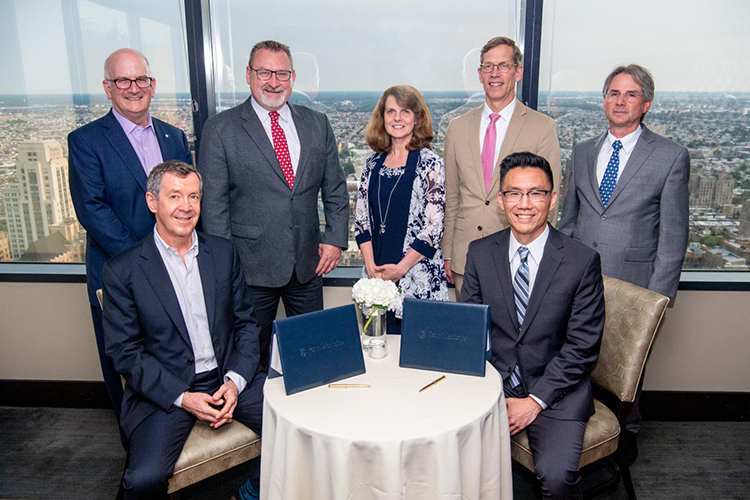
The Mark Foundation for Cancer Research announced that it has awarded a grant of $12 million to establish The Mark Foundation Center for Immunotherapy, Immune Signaling and Radiation at the University of Pennsylvania.
The Center will bring together cross-departmental teams of basic scientists and clinical researchers who will focus on better understanding the interconnected relationships between advances in radiation therapy, important signaling pathways in cancer and immune cells, and the immune system’s ability to effectively control cancer.
“The results of this exciting project could have enormous significance for cancer patients,” said The Mark Foundation CEO Michele Cleary. “This multidisciplinary effort is well positioned for success, and we expect these leading researchers will uncover novel insights into cancer biology that will substantially expand the options for treatments with better efficacy and minimal toxicities. We look forward to working with this powerhouse team over the next five years and beyond.”
The new center at the University of Pennsylvania follows in the footsteps of The Mark Foundation’s establishment last summer of The Mark Foundation Institute for Integrated Cancer Medicine at the University of Cambridge, as well as previously announced collaborations with Cancer Research UK and Evotec. These awards all derive from The Mark Foundation’s commitment to funding interdisciplinary research that shows significant promise to transform how cancer is prevented, diagnosed and treated.
The Mark Foundation Center for Immunotherapy, Immune Signaling and Radiation will be led by Andy J. Minn, associate professor of radiation oncology in Penn’s Perelman School of Medicine. The primary efforts of the center will comprise five key projects that converge on understanding the signaling pathways elicited by radiation therapy and how those pathways can be exploited therapeutically to enable the immune system to recognize and eradicate cancer.
“These projects have the chance to change the paradigm when it comes to cancer treatment,” said Dr. Minn. “Understanding important and potentially targetable mechanisms of immunotherapy resistance and how to use novel radiation therapies to enhance immunotherapies carries enormous benefits for patients.”
The Mark Foundation for Cancer Research is dedicated to accelerating cures for cancer by integrating discoveries in biology with innovative technology. Launched in 2017, The Mark Foundation pursues its mission by funding a global portfolio of groundbreaking research carried out by individual investigators, multi-investigator teams, and inter-institutional collaborations. Since its launch in 2017, the Foundation has awarded over $57 million in grant funding to 70 institutions across 18 US states and three countries.
Recognizing the obstacles that can prevent scientific advances from improving patient outcomes, The Mark Foundation maintains a nimble, high-impact approach to funding research that encompasses grants for basic and translational cancer research, as well as venture philanthropy investment in companies that bridge the gap between the bench and the bedside. To learn more about the work of The Mark Foundation for Cancer Research, visit https://themarkfoundation.org/
Major Expansion of Gene Therapy Collaboration Between Amicus Therapeutics and Penn
Amicus Therapeutics and the Perelman School of Medicine at the University of Pennsylvania announced a major expansion to their collaboration with rights to pursue collaborative research and development of novel gene therapies for lysosomal disorders (LDs) and 12 additional rare diseases. The collaboration has been expanded from three to six programs for rare genetic diseases and now includes: Pompe disease, Fabry disease, CDKL5 deficiency disorder (CDD), Niemann-Pick Type C (NPC), next generation Mucopolysaccharidosis Type IIIA (MPS IIIA), and Mucopolysaccharidosis Type IIIB (MPS IIIB), both also known as part of Sanfillipo syndrome. In addition to these three new programs, a discovery research agreement provides Amicus with exclusive disease-specific access to option rights to collaborate with Penn’s Gene Therapy Program (GTP) to develop potentially disruptive new gene therapy platform technologies and programs for the majority of lysosomal disorders and 12 additional rare diseases.
John F. Crowley, chairman and chief executive officer of Amicus stated, “The extension of our collaboration with Penn is a bold step forward in our commitment to create potential cures that may alleviate an enormous amount of suffering for countless numbers of people in the world living with rare diseases, many of them children. Together with Penn we are now able to focus on additional lysosomal disorders, as well as several more prevalent rare diseases for which we can apply our understanding of underlying disease biology in rare metabolic disease, Amicus’ protein-engineering and development expertise and the world renowned capabilities of Dr. Jim Wilson’s laboratory to develop novel gene therapy candidates. With a globally approved precision medicine product for Fabry, a late-stage biologic product with breakthrough therapy designation for Pompe, and now the industry’s largest rare disease gene therapy pipeline, Amicus is well-positioned to become a leading global biotechnology company at the forefront of human genomic medicine.”
Building off the initial success of the ongoing Amicus-Penn collaboration, including compelling initial preclinical proof-of-concept data in Pompe disease, this expanded relationship will continue to combine Amicus’ protein engineering and glycobiology expertise with Penn’s gene transfer technologies to develop novel gene therapies designed for optimal cellular uptake, targeting, dosing, safety and manufacturability.
“This agreement is a significant step forward in creating a world class industry-academia gene therapy partnership in rare diseases,” said Dr. Wilson, professor of medicine and pediatrics at the Perelman School of Medicine. “We have already seen highly encouraging preclinical results and proof-of-concept in Pompe disease through our existing collaboration and are excited by what we can further achieve together. We are looking forward to expanding the relationship further for additional preclinical programs and committing to the research required to further advance the technology platforms at Penn. We have seen the first results of our combined capabilities and platforms and I believe that we can further expand and accelerate our efforts to rapidly develop gene therapies for many more patients with unmet needs.”
“Penn Medicine has put Philadelphia on the map as the global epicenter of gene therapy research and development, and under the leadership and vision of Jim Wilson, our expanded agreement with Amicus is an exciting milestone for a field which is in the midst of transformative breakthroughs,” said J. Larry Jameson, executive vice president of the University of Pennsylvania for the Health System and Dean of the Perelman School of Medicine. “We are thrilled to be part of this collaboration, which will help to bolster our city’s growing reputation as a magnet for talent and an engine for gene therapy innovation.”
Editor’s Note: As an inventor of technology licensed or optioned to Amicus pursuant to this Gene Therapy Collaboration, Dr. Wilson and Penn may receive additional financial benefits under the license in the future.
Government Affairs Update
PA State Budget Signed
On Friday, June 28, Governor Tom Wolf signed the General Fund Appropriations Bill (House Bill 790) into law, approving a state general fund budget of nearly $34 billion for fiscal year 2019-2020. The spending plan represents a nearly 2% increase, or $596 million, over 2018-2019 while imposing no new taxes. Governor Wolf also signed House Bill 1354, approving the School of Veterinary Medicine non-preferred appropriation at nearly $32 million—a 2% increase over the prior year. Additionally, support for the state’s Animal Health and Diagnostic Commission earned a $2 million increase—the first increase in six years. This funding supports New Bolton Center’s animal health lab, which is one of three such labs in a statewide system built to test for and diagnose diseases that threaten animal and public health, the state’s food supply, and major animal agricultural industries.
Funding to the Commonwealth Universal Research Enhancement Program, or CURE, will be held level at $51.3 million for the 2019-2020 fiscal year. Penn has leveraged CURE funding to advance new treatments for tobacco addiction and smoking cessation, while also developing in collaboration with the Children’s Hospital of Philadelphia revolutionary treatments using Chimeric Antigen Receptor T cells that attack and kill cancer cells. Penn receives approximately $6 million of CURE funding each year.
New Staff at OGCA
The Office of Government and Community Affairs welcomed three new staff members over the previous academic year.
In May 2018, Jamie Spagna joined the office as OGCA coordinator. She has worked in state and local government for two decades, serving as a staffer in the state Senate; the City of Philadelphia, including the Mayor’s Office; and the School District of Philadelphia.
Cassie Tomkins was named associate director of OGCA in June 2018. Previously, she worked as an assistant director for the Fels Institute of Government, and she completed her master’s degree in public administration from Penn in May.
Michael Smith assumed the role of director of Commonwealth Relations in November 2018. He has served in senior-level positions with the Commonwealth of Pennsylvania since 2005, developing strong relationships with agencies under the Governor’s jurisdiction and General Assembly. Prior to joining Penn, Mr. Smith was executive deputy secretary of the Pennsylvania Department of Agriculture, where he worked closely with the leadership of Penn Vet.
—Jeffrey Cooper, Vice President, Government and Community Affairs
Wharton Dean Geoffrey Garrett: Becoming Dean of USC School of Business
Penn President Amy Gutmann and Provost Wendell Pritchett announced that Wharton Dean Geoffrey Garrett will be leaving Penn at the end of the 2019-2020 academic year to become Dean of the University of Southern California Marshall School of Business in Los Angeles, effective July 1, 2020.
“Geoff has done an absolutely superb job in leading Wharton for the past five years and in helping firmly establish Wharton as the world’s leading business school,” said President Gutmann. “In partnership with Wharton’s incredible community of faculty, staff, students, alumni and friends, he has expanded the Wharton standing faculty to more than 240 members and increased its breadth, depth, diversity and eminence.
“Geoff’s career has been truly international in scope, and under his leadership the Wharton footprint continues to grow in Philadelphia and around the world. Wharton’s volunteer leadership and alumni are engaged as never before, and their unprecedented support has fueled the School’s continued ascent. We are committed to sustaining Wharton’s extraordinary momentum of the past five years throughout our Power of Penn campaign and far into the future.”
During Dean Garrett’s tenure, Wharton’s reach has grown, spanning the nation and the world with record enrollments in the MBA Program for Executives in San Francisco and robust and growing offerings, including extensive Executive Education programming, the Wharton Global Forum and the launch of the Penn Wharton China Center in Beijing.
Online education has grown exponentially, including online preparation classes for incoming MBA first-year students and online specializations for business professionals in fields from leadership and management to business analytics and fintech. Hundreds of thousands of digital learners from around the world have accessed Wharton MOOCs.
Innovative programs such as the Penn Wharton Budget Model, Behavior Change for Good, the Stevens Center for Innovation in Finance, the Harris Alternative Investments Program and the Analytics Initiative are helping Wharton do pioneering work in novel ways, reach more communities, and have more global impact than ever before.
On campus, a new Wharton Academic Research Building is under construction, Tangen Hall and its associated Venture Lab, is set to transform Penn student opportunities in entrepreneurship, and renovations to Vance Hall, Lauder Hall and other Wharton facilities are providing faculty and students with the best and most cutting-edge facilities.
“Under Geoff’s leadership, the student body is now more accomplished, diverse and better supported than at any point in Wharton’s storied history,” Provost Pritchett said. “A revamped undergraduate curriculum has brought a renewed school-wide focus on experiential learning and teaching excellence. Dual-degree programs and cross-school partnerships have expanded in high-priority areas including global business and society, health-care leadership, management and delivery, integrated product design, business and law, and data science and information technology.”
Prior to becoming Dean of Wharton, Dean Garrett served on the faculty at Wharton, then became dean of the UCLA International Institute. He then returned to his native Australia, where he served as dean at both the University of Sydney and the University of New South Wales, returning to Penn as Dean in 2014.
In preparation for Dean Garrett’s departure from Penn, the University will initiate the process of forming a committee of faculty, students and alumni to advise on the selection of the next dean of the Wharton School. Penn Medicine EVP/Dean J. Larry Jameson has agreed to chair the committee.
Diana C. Robertson: Vice Dean and Director of the Wharton Undergraduate Division
 Wharton Dean Geoffrey Garrett has announced the appointment of Diana C. Robertson, the Samuel A. Blank Professor of Legal Studies and Business Ethics, as vice dean and Director of the Wharton Undergraduate Division; it was effective July 1.
Since arriving on the University of Pennsylvania in 2007, Dr. Robertson has been recognized for outstanding instruction of Wharton undergraduate students, earning seven teaching awards. Known for her interdisciplinary research on individual and organizational business ethics, Dr. Robertson incorporates perspectives from neuroscience, psychology, sociology and organizational behavior into her work. She is a co-editor of Thinking about Bribery: Neuroscience, Moral Cognition, and the Psychology of Bribery, published by Cambridge University Press.
“Diana Robertson is a highly respected researcher with a sterling reputation among the many Wharton undergraduate students and alumni fortunate enough to have joined her classroom,” said Dean Garrett. “I am grateful to vice dean Lori Rosenkopf for the innovation she brought to the undergraduate program and look forward to continued success with Diana Robertson at the helm.”
Before coming to Wharton, Dr. Robertson served on the faculties of London Business School and Goizueta Business School at Emory University. She was also a visiting professor at the London School of Economics. She received her BA from Northwestern University and her PhD from UCLA.
In addition to her teaching awards, Dr. Robertson has published an extensive set of refereed articles and book chapters, while winning numerous research awards. In 2007, she won the top research award at Emory. She is the faculty doctoral coordinator for Wharton’s legal studies and business ethics department. In 2018, she was named one of the Top 50 Undergraduate Business School Professors by Poets and Quants.
Dr. Robertson succeeds vice dean Lori Rosenkopf, who, having served two three-year terms, will return to the management department as the Simon and Midge Palley Professor.
During her tenure, vice dean Rosenkopf developed and implemented a new curriculum for Wharton undergraduate students and created the Wharton Industry Exploration Program in which students learn about the tech, entertainment and other industries on location while earning academic credit. She also led several important diversity and inclusion initiatives, including an orientation program for incoming Wharton students called the Successful Transition and Empowerment Program (STEP), and a multiyear program to increase STEM proficiency among disadvantaged Philadelphia high school students called the Summer Math and Science Honors Academy (SMASH).
Nancy Zhang: Vice Dean of Wharton Doctoral Programs
 Wharton Dean Geoffrey Garrett has announced the appointment of professor of statistics Nancy Zhang as the vice dean of Wharton Doctoral Programs (WDP); it was effective July 1. In her new role, Dr. Zhang oversees the operations and management of the nine academic areas of WDP.
Among her many accomplishments since arriving at the University of Pennsylvania in 2011, Dr. Zhang served as doctoral program co-director for the Wharton statistics department from 2012-2017. She has been an important advisor and mentor for students in statistics, as well as in other departments, including genomics and computational biology; biostatistics, epidemiology and informatics; and applied mathematics and computational sciences.
“I’m very pleased that Nancy Zhang will join us as the doctoral programs’ leader. She represents the best of Wharton’s research capabilities while, through her highly collaborative approach, serving as a role model for students,” said Dean Garrett. “I am grateful to vice dean Cathy Schrand for her dedication to the doctoral program and look forward to continued success with Nancy Zhang.”
Dr. Zhang’s research focuses primarily on statistical and computational approaches for the analysis of genetic, genomic and transcriptomic data. In addition to her contributions in statistics, her methods have made contributions to genetics, tumor genomics and single-cell biology.
In the field of genomics, she has developed methods to improve the accuracy of copy number variant and structural variant detection, methods for improved false discovery rate control, and methods for analysis of single-cell RNA sequencing data. In the field of statistics, she has developed new models and methods for change-point analysis, variable selection, and model selection. Dr. Zhang has also made contributions in the area of tumor genomics, where she has developed analysis methods to improve understanding of intra-tumor clonal heterogeneity.
Dr. Zhang earned her undergraduate degree in mathematics, her master’s in computer science and her doctorate in statistics from Stanford. In 2011, she was the recipient of a prestigious Sloan Fellowship. Prior to arriving at Wharton, Dr. Zhang was an assistant professor of statistics at Stanford and a post-doctoral fellow at the University of California, Berkeley.
Dr. Zhang succeeds Cathy Schrand, who will return to the accounting department as the Celia Z. Moh Professor. Dr. Schrand will continue her role as faculty director of the Wharton Research and Scholars programs.
During her tenure, Dr. Schrand upgraded the writing and communications offerings for doctoral students and encouraged cross-disciplinary engagement among students. She updated the statistics sequence and expanded offerings for applied courses. Dr. Schrand also oversaw outstanding placements for WDP graduates, including faculty positions at the University of Chicago, MIT, Stanford and Yale.
Under Dr. Schrand’s leadership, WDP also advanced diversity initiatives and enrollments of diverse students at WDP increased significantly. At the same time, WDP’s program for undergraduates, Introduction to Diversity in Doctoral Education and Scholarship (IDDEAS), expanded to Stanford, Berkeley, the University of Chicago and Northwestern University.
PASEF: The Penn Association of Senior and Emeritus Faculty Annual Report AY 2019
Now in its 15th year, the Penn Association of Senior and Emeritus Faculty (PASEF) strives to organize programs and activities for its Members, encourage them to continue to remain active in the intellectual and social life of the University, and promote opportunities for Members to render service to the University and the larger community. Major foci include assisting senior faculty in their transition to retirement; organizing lectures, excursions, and other social and intellectual events; and providing volunteer opportunities for Members. Encompassing both Standing Faculty in emeritus status and senior standing faculty age 55 and above, PASEF currently has 1,689 Members; 1,121 of these are senior faculty. This reflects both the growing tsunami of aging baby boomers as well as the greater longevity now enjoyed by our retirees. It also poses challenges in developing programs and services that suit the interests and needs of Members from age 55 to 100+. A sampling of our activities is described below.
Retirement Planning
Most highly subscribed of PASEF’s programs remains the series aimed at helping senior faculty plan mindfully for their own retirement. Given the importance of this life event to health and well-being, PASEF focuses not just on the financial implications, but also on the personal meanings and choices about what comes next in one’s life trajectory. PASEF’s program series—Planning for Retirement—was enhanced this year by a new panel discussion Exploring Living Options in Retirement: The Continuing Care Retirement Community (November 28). Retirees living in different CCRCs spoke candidly about their decisions and transitions, and PASEF prepared and distributed a resource to assist interested Members to further explore this option. We continued our well-honed panel discussion by Members in various stages of their own retirement process, Negotiating the Retirement Transition: What’s Next? (February 27) and the program Nuts and Bolts of Faculty Retirement (March 27) on Penn’s choices, benefits & processes. Attendance ranged from 37 to 65 across the series. We also encouraged Members to attend Human Resources’ sessions on Medicare and Social Security in May. Our highly regarded publication, The Hitchhiker’s Guide to Faculty Retirement (12th ed.), is available on our website. As further outreach, the Steering Committee met with School Deans/Department Chairs to apprise them of PASEF’s resources for their faculty. We consulted with Penn’s Department of Human Resources regarding messaging a change in health benefits management, and we advocated for individual faculty experiencing system challenges. Finally, this year’s Celebration for New Retirees (sponsored jointly by ASEF –PSOM and PASEF) feted 45 Members on May 8 in the Jordan Medical Education Center Atrium, with remarks by Vice Provost for Faculty Anita Allen and background music by past president Roger Allen.
Intellectual & Social Events
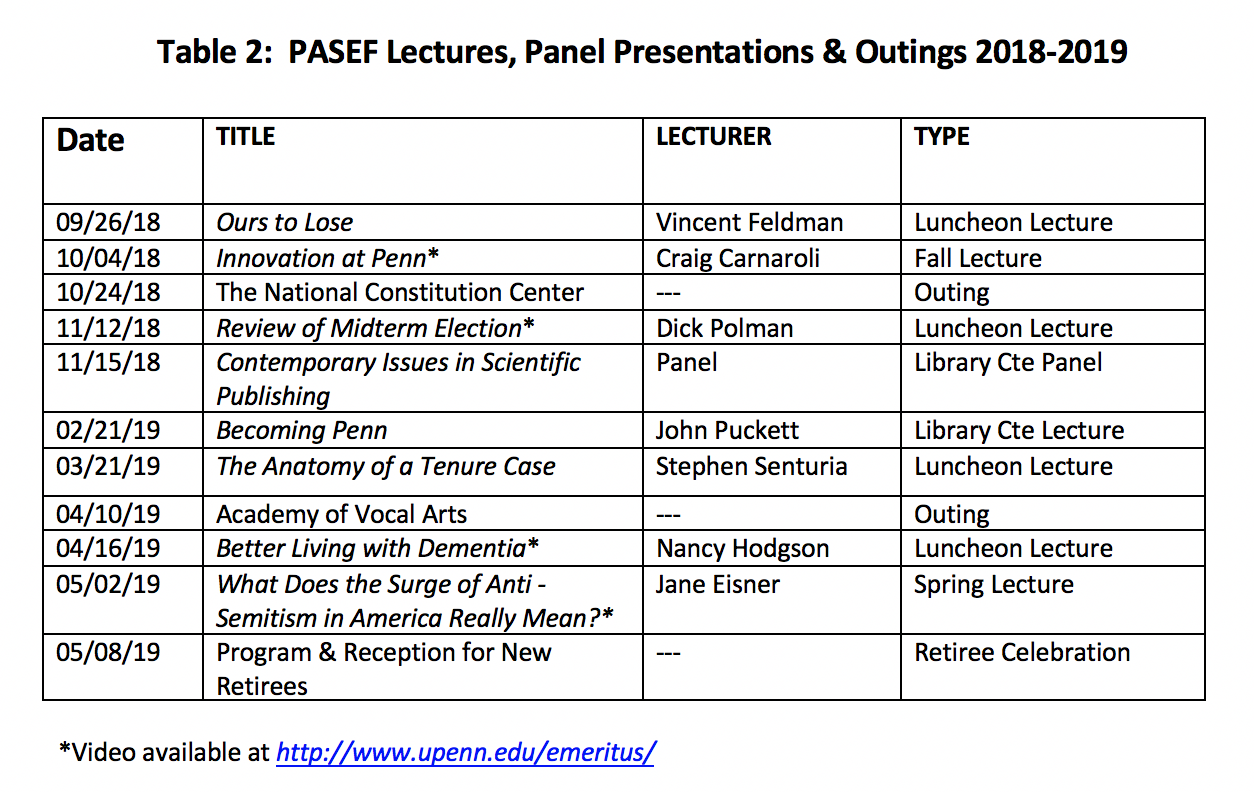
Our Program Committee, chaired by Paul Shaman, organized several events this year (see Table 2). The Fall and Spring Distinguished Lectures were given by Craig Carnaroli (Innovation at Penn on October 4, preceding the 25-Year Club Reception in Houston Hall) and Jane Eisner (What Does the Surge of Anti-Semitism in America Really Mean? on May 2 in Bodek Lounge, Houston Hall). Monthly luncheon lectures at the University Club spanned Vincent Feldman’s Ours to Lose: Places in West Philadelphia at Risk of Being Forgotten, Dick Polman’s Review of the Midterm Elections, Stephen Senturia’s Anatomy of a Tenure Case, and Nancy Hodgson’s Better Living with Dementia. (See PASEF website for videos.) The Library Committee (Ann Mayer, chair) hosted two additional lectures, one a panel discussion on Contemporary Issues in Scientific Publishing with Lewis Kaplan, Darren Taichman, Richard James and Brigitte Burris and the other Becoming Penn by co-author John Puckett. Two outings, co-sponsored by PASEF and ASEF, took members to The National Constitution Center (October 24) and to the Academy of Vocal Arts (April 10), the latter especially well-subscribed. The Membership Committee, with Anita Summers as chair, continued its outreach and organizing efforts to better meet needs and interests, especially of senior Members, and to promote social connections. Members were enabled to continue free access to rehearsals of the Philadelphia Orchestra, and a theatre option with discussion or back stage tour is planned for Fall 2019. Meanwhile, an opportunity for Members to mentor international graduate students is in exploration. In March, we formally inaugurated PASEF’s Lounge, a small furnished room in Duhring Wing available to Members for small group meetings or sessions with mentees or colleagues; Vice Provost Allen was instrumental in securing and furnishing this space for us, and we borrowed art work from University Collections.
Volunteer Service
PASEF’s newly launched Community Involvement Committee (Jorge Santiago-Aviles and Gino Segrè, Co-Chairs) explored volunteer opportunities in affiliated West Philadelphia schools & libraries through the Netter Center and, with the Penn Center for Innovation Ventures and the Office for Global Initiatives, identified and publicized opportunities on Penn’s Campus. Council Members continue to represent PASEF on the Senate Executive Committee and its standing committees as well as the University Council Committee on Personnel Benefits, bringing historical and experiential wisdom to these agendas. PASEF is also represented on an ad hoc committee exploring the feasibility of a University-affiliated continuing care retirement community near the campus. PASEF’s 28-member Speakers Bureau (led by Roger Allen), a service now in its 3rd year, provided 18 lectures to Philadelphia-area organizations, including CCRCs, Rotary Clubs, Public Libraries and senior residences. Finally, Council agreed to sunset the Library Committee and to inaugurate in Fall 2019 the PASEF Library Liaison role to keep retired Members connected and informed about library services and advise the library on Member access or service needs.
Organization
PASEF’s 17-Member Council (See Table 1), led by a three-member Steering Committee, is broadly representative of the campus, meets monthly and populates its various committees and liaisons previously described. PASEF is a member of the Association of Retirement Organizations in Higher Education (AROHE) and two Members, together with ASEF-PSOM leaders, attended its fall biennial conference. Challenges addressed this year included establishing clarity in committee roles and responsibilities, facilitating replacements for two early resignations (via Nominating Committee, Marc Dichter, chair), initiating new initiatives together with an already full agenda and without additional human resources, and significant delays in launching the new website (part of the Provost Office suite). In AY2020, we will initiate a process for archiving PASEF’s important materials, increase the frequency of brief communications with Members, and launch our new Website to provide timely access to PASEF’s resources. With support from Vice Provost Allen, we engaged a consultant to facilitate a very successful half-day strategic planning retreat in June. These efforts will help us prioritize and move to the next phase of organizational development, enabling PASEF to even better meet the needs of Members. We remain grateful for the intellectual, collegial and financial support received from Vice Provost Allen, for the able management of multiple assignments by Sarah Barr, part-time administrative coordinator, and for the consultative support of Jillian Powell in the Provost’s Office. Personally, I thank the PASEF Steering Committee and Council and our ASEF-PSOM colleagues for their support, guidance and collaboration. I look forward to what our 16th year will bring!
For information, contact: pasef@pobox.upenn.edu (215) 746-5972 http://www.upenn.edu/emeritus/
—Lois K. Evans, PASEF President 2018-2019
Table 1. PASEF Council Membership 2018-2019
Roger M.A. Allen, SAS (Near Eastern Languages and Civilizations), Past President, Chair of Speakers Bureau
David P. Balamuth, SAS (Physics & Astronomy), Representative to University Council Committee on Personnel Benefits
Joretha Bourjolly, Social Policy & Practice, At-large member of Council
Janet Deatrick, Nursing (Family & Community Health), At-large member of Council, Co-Editor of The Hitchhiker’s Guide to Faculty Retirement
Marc A. Dichter, Medicine (Neurology), At-large member of Council, Chair of Nominating Committee
Lois K. Evans, Nursing (Family & Community Health), President, Chair of Steering Committee
James Ferguson, Veterinary Medicine (Clinical Studies-New Bolton Center), President-Elect (until February)
Joel H. Greenberg, Medicine (Neurology), President, ASEF –PSOM
Howard I. Hurtig, Medicine, At-Large member of Council (elected October)
John C. Keene, Design (City and Regional Planning), At-large member of Council, Representative to Senate Committee on Faculty Development, Diversity & Equity
Walter Licht, SAS (History), At-large member of Council (until September)
Ann Mayer, Wharton (Legal Studies & Business Ethics), At-large member of Council, Chair of Library Committee
Marshall W. Meyer, Wharton (Management), Representative to Senate Committee on Faculty and the Administration
Martin Pring, Medicine (Physiology), At-large member of Council, Representative to Senate Executive Committee, Senior Editor of The Hitchhiker’s Guide to Faculty Retirement
Jorge J. Santiago-Aviles, SEAS (Electrical and Systems Engineering), At-large member of Council, Co-Chair Community Involvement Committee
Gino C. Segrè, SAS (Physics & Astronomy), At-large member of Council, Representative to Senate Committee on Faculty and the Academic Mission, Co-Chair Community Involvement Committee
Paul Shaman, Wharton (Statistics), Secretary, Chair of Program Committee, President-elect(elected April)
Anita A. Summers, Wharton (Business Economics and Public Policy), Representative to Senate Committee on Students and Educational Policy (SCSEP), Representative to Retirement Community Committee, Chair of Membership Committee
Former Presidents: Benjamin Shen, Gerald Porter, Neville Strumpf, Vivian Seltzer, Roger Allen, Ross Webber, Rob Roy MacGregor, Jack Nagel, Anita Summers, Paul Shaman
The University of Pennsylvania Update to the 2018 Annual Security & Fire Safety Report (Statistics for 2015, 2016 and 2017)
The federal Jeanne Clery Disclosure of Campus Security Policy and Campus Crime Statistics Act, as amended, requires colleges and universities to provide information related to security policies and procedures and specific statistics for criminal incidents, arrests, and disciplinary referrals to students and employees, and to make the information and statistics available to prospective students and employees upon request. Federal law also requires institutions with on-campus housing to share an annual fire report with the campus community.
In addition, the Uniform Crime Reporting Act requires Pennsylvania colleges and universities to provide information related to security policies and procedures to students, employees and applicants; to provide certain crime statistics to students and employees; and to make those statistics available to applicants and prospective employees upon request.
The University’s new Sexual Misconduct Policy, Resource Offices and Complaint Procedures that went into effect on July 1, 2019, have been added to the 2018 Annual Security Report.
To review the University’s updated 2018 annual report containing this information, please visit: https://www.publicsafety.upenn.edu/ASR/2018_ASR_PENN_2.pdf
You may request a paper copy of the report by calling the Office of the Vice President for Public Safety at (215) 898-7515 or by emailing vp@publicsafety.upenn.edu

 Denis S. Drummond, emeritus professor of orthopaedic surgery in the Perelman School of Medicine and former chief of orthopedics at the Children’s Hospital of Philadelphia, died June 18 of heart failure. He was 84.
 John B. Neff (Hon’84), emeritus trustee who grew the University of Pennsylvania’s endowment from $200 million to $3 billion, died June 4 after an illness. He was 87.
 Gail Oberton, director of the Provost’s Summer Mentorship Program at Penn, died on May 29 from breast cancer. She was 59.
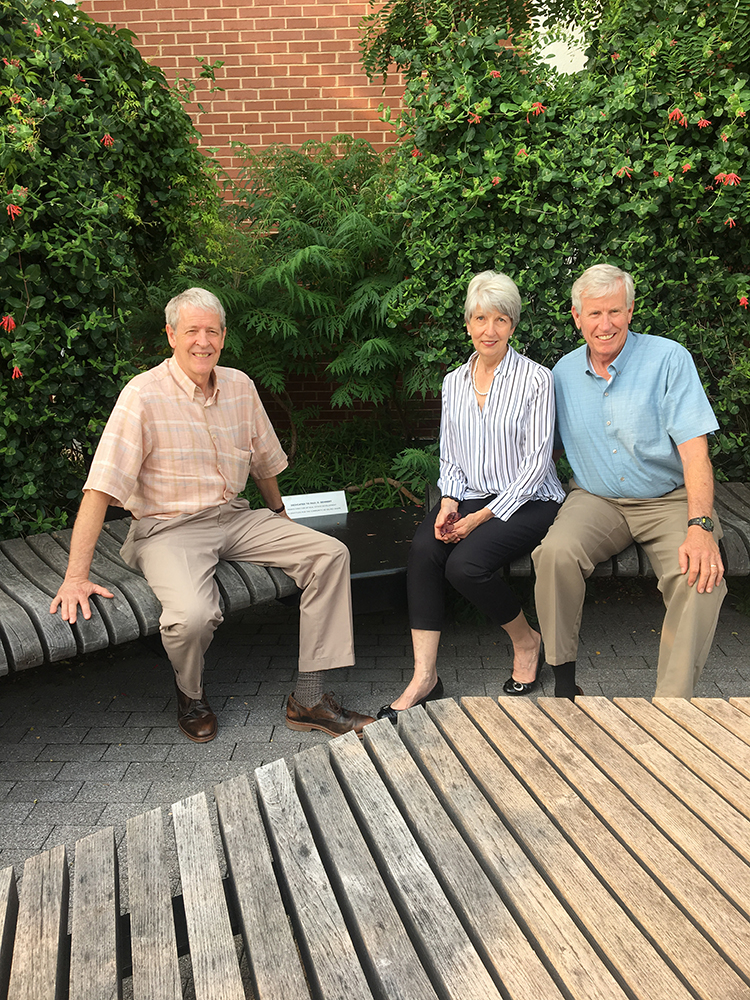 A park bench in memory of Paul Sehnert has been dedicated at the Plaza at Pennovation Works, where, according to FRES VP Anne Papageorge, Mr. Sehnert was considered the ‘mayor,’ with gratitude from the community he helped shape as Penn’s director of real estate development. Mr. Sehnert died on May 19 at the age of 63 (
 Maya Arthur (C’18) has been selected as the inaugural Kelly Writers House Post-Baccalaureate Fellow. The KWH Post-Bacc Fellows project extends a central objective of the Writers House: to direct resources toward opportunities, learning experiences and foundational support to young writers. The position comes with a full year of support (a full-time salary, mentorship and career-boosting learning opportunities). During the course of her fellowship, Ms. Arthur will pursue a self-directed creative project, working closely with professor Simone White, who has been named her faculty mentor. She will also work several hours a week at the Writers House, where she will learn editing and curating with PennSound and Jacket2, and she will assist with the presentation of public events.
 Joy Azikiwe, associate director of staff & labor relations, Human Resources/Information Management/Records and Strategic Initiatives in Penn’s Division of Human Resources, was recently named Delaware Valley HR Person of the Year. Ms. Azikiwe is responsible for supporting, developing and maintaining comprehensive staff and labor relations plans. She also works closely with the VP of HR Jack Heuer on institution-wide opportunities and objectives.
 The proposal entitled “Networked Crowdsourcing: An Online Experiment in Content Moderation” by Damon Centola, Annenberg School associate professor of communication and director of the Network Dynamics Group, and Annenberg doctoral candidate Douglas Guilbeault, was recently selected by Facebook to receive funding.
 The National Academy of Medicine (NAM) selected Penn Medicine’s Raina Merchant as a member of its newest class of Emerging Leaders of Health and Medicine Scholars. Dr. Merchant is the director of the Penn Center for Digital Health and an associate professor of Emergency Medicine in the Perelman School of Medicine at the University of Pennsylvania. She was one of only 10 selected to join this new class, which began July 1 and will serve through June 30, 2022.
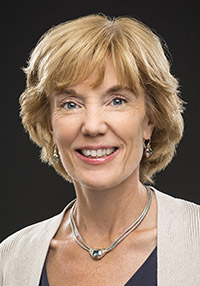 Laura Perna, James S. Riepe Professor in the division of Higher Education at Penn’s Graduate School of Education, was appointed to serve as part of a new Gates Foundation commission, the Commission on the Value of Postsecondary Education. This new national research group will “examine what we are learning about the value of postsecondary education and offer recommendations about how to define and measure that value.”
 Joseph Subotnik, Edmund J. and Louise W. Kahn Term Professor of Chemistry, is a finalist for the 2019 Blavatnik National Award for Young Scientists. Dr. Subotnik is one of 31 “rising stars in science” selected as finalists out of 343 nominations from 169 academic and research centers. Three Blavatnik National Laureate Awards will be given, in the categories of chemistry, physical sciences and engineering, and life sciences. Each of the three laureates will win $250,000—the world’s largest unrestricted prize for early-career scientists.
 At the 69th Annual Conference of the International Communication Association (ICA), Barbie Zelizer, Raymond Williams Professor of Communication and director of the Center for Media at Risk at Penn’s Annenberg School for Communication, was awarded the 2019 B. Aubrey Fisher Mentorship Award, one of ICA’s top honors.
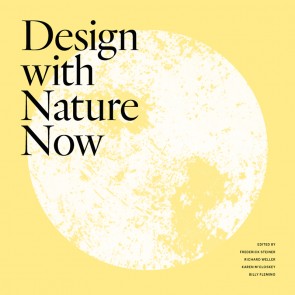 Design With Nature Now: Five Themes, 25 Projects at Meyerson Hall Lower Gallery, gallery hours: Tuesday through Friday, 10 a.m. to 5 p.m.; Saturday noon to 5 p.m. This exhibit which takes as its point of departure his book, is a global survey of ecological design in the 21st century. Design With Nature Now surveys 25 dynamic and visionary approaches to landscape architecture around the world, takes visitors to Professor McHarg’s Glasgow in a series of abstract meditations on place and time, and traces the development of his ecological approach to design. Themes: Big Wilds, Urban Futures, Rising Tides, Fresh Waters, Toxic Lands. A Curators Talk with KarenM’Closkey and Richard Weller on Designing Natures will be in Meyerson B-1 at 6:30 p.m. on August 28.
 Ian McHarg: The House We Live In at Kroiz Gallery, Architectural Archives, gallery hours: Tuesday through Friday, 10 a.m. to 5 p.m.; Saturday noon to 5 p.m. Draws from extensive archival holdings in the Weitzman School of Design’s Architectural Archives to locate the foundations of Design With Nature in the 1950s and challenge some critics’ perception that Professor McHarg was uninterested in design and aloof to the subtleties of human experience. It brings a new emphasis to his early teaching, the activism it inspired among his students and followers, and the tools he created to redefine the parameters of design to be more attuned to the natural processes that form our ever-changing landscapes.
 Now on view at the Burrison Gallery in the University Club at the Inn at Penn are paintings by 30 students from the Penn School of Dental Medicine. They participated in a Penn selective Canvas Block—taught by dental medicine professor Tom Barber—which places the emphasis on painting, what you see, not what you imagine! The students created two paintings each using acrylic on canvas. They were taught brush technique, illusion of distance, outline strategy for difficult structures, layering of painting, diaphanous effect and mixing of colors. There are three subjects: White Rhino, Americas Cup—Newport Rhode Island, and Lake Erie, Chautauqua.

 In the May 28, 2019 issue, the “Penn Law 2019 Teaching Awards” incorrectly switched the captions of two photos: Serena Mayeri and Sharon Lorenzo. We regret the error. —Eds.