Talk About Teaching & Learning

News

Quaker Commitment Expands Financial Aid for Students from Middle-Income Families

The University of Pennsylvania has announced the Quaker Commitment, a sweeping new financial aid initiative designed to support families from middle-income backgrounds by increasing financial aid packages and guaranteeing full tuition scholarships to a greater number of students.

Effective in the 2025-2026 academic year, Penn will no longer consider the value of the primary family home among assets in determining the amount of financial aid eligibility and will raise the income threshold for families eligible to receive full tuition scholarships from $140,000 to $200,000 with typical assets.

“This bold new initiative expands financial aid for more families in alignment with our commitment to have Penn’s financial aid package meet 100% of families’ demonstrated need with no loans,” said Interim President J. Larry Jameson. “We are proud to launch the Quaker Commitment, building on the University’s commitment to opportunity and long-standing leadership in undergraduate financial aid.”

These initiatives affect all aid-eligible undergraduate students, not just entering freshmen. About 46% of Penn’s 10,000 undergraduate students currently receive aid. The average aid package of $70,579 currently covers 76% of the total cost of attendance. By comparison, the average aid package covered 57% in 2008, when Penn’s no-loan financial aid policy was first introduced.

Penn is one of only a handful of universities to exclude home equity when determining a student’s expected family contribution—the amount they are asked to pay—using financial information submitted by the family. This is expected to impact about 900 currently enrolled students with an average increase in grant aid of about $4,000. The higher income threshold for middle-income families is expected to increase packages by an average of $10,000 for an additional 180 students.

The Quaker Commitment builds on last year’s expansion of Penn’s financial aid program and the Penn First Plus initiative for lower-income families. In 2023, Penn announced that, beginning with the 2023-2024 academic year, students whose families earned $75,000 or less with typical assets—up from $65,500 in 2022-2023—would receive financial aid packages that fully covered tuition, fees, housing, and dining with grants and work-study funds. This increase affected about 200 students, who saw their aid packages increase by an average of $16,000 each in grant funding each.

The new program is the latest step in Penn’s effort to widen access for students from all economic backgrounds while specifically responding to the needs of middle- and upper-middle income families. “Penn is reaffirming its commitment to the core principle that a world-class education can be affordable to students from all backgrounds, not just those from lower-income backgrounds or those who are able to pay full price,” said Mark Dingfield, vice president for finance and treasurer. “We are updating these policies because it is the right thing to do for our students and their families.”

“The Quaker Commitment is designed specifically for the middle-income families we hear from who, even after receiving a need-based financial aid package with no loans, still face difficulty in meeting their expected family contribution,” said Elaine Varas, senior director of financial aid. “These new initiatives will help close that gap for these families to make it easier for them to commit to Penn and ease their financial pressures.”

The initiative, estimated to cost approximately $6 million annually, will be funded institutionally with the expectation that donor endowed funds will be sought to provide sustained support for these increases in financial aid.

Marisa C. Kozlowski: Ponzy Lu Endowed Professor of Chemistry

caption: Marisa KozlowskiMarisa Kozlowski, a professor of chemistry in the School of Arts & Sciences, has been named the Ponzy Lu Endowed Professor of Chemistry. Dr. Kozlowski’s research focuses on the rational design of new methods and catalysts for use in organic synthesis. As well as using high throughput screening, her lab employs several novel computational tools for the discovery and optimization of new reagents and catalysts.

Dr. Kozlowski, who joined the Penn faculty in 1997, has been recognized with many awards and honors during her distinguished career. She was elected a fellow of the American Association for the Advancement of Science in 2012 and a fellow of the American Chemical Society in 2013. She has also been recognized as an Alfred P. Sloan Research Fellow as well as with Penn’s Dennis DeTurck Award for Innovation in Teaching in 2021, the American Chemical Society's Arthur C. Cope Scholar Award in 2022, Penn’s Provost Award for PhD Teaching and Mentoring in 2023, and the Leete Award in 2023. She has served in several leadership roles for the organic division of the ACS and is currently editor-in-chief of Organic Letters.

P. Roy Vagelos, C’50, HON’99, and Diana T. Vagelos, Penn parents, established the Ponzy Lu Endowed Professorship in Chemistry as part of their most recent record gift to fund science initiatives across the School of Arts & Sciences. The endowed professorship is named in honor of retired Penn chemistry professor Ponzy Lu, the founding director of the Roy and Diana Vagelos Scholars Program in the Molecular Life Sciences.

Roy Vagelos, a chemistry major who graduated from Penn in 1950 before going on to receive a medical degree from Columbia University, is the retired chairman and chief executive officer of Merck & Co. and the retired chairman of Regeneron Pharmaceuticals. Dr. Vagelos served as chair of Penn’s Board of Trustees from 1994 to 1999. He is a former member of the School of Arts & Sciences’ Board of Advisors and the founding chair of the Committee for Undergraduate Financial Aid. Diana Vagelos is a former member of the Penn Museum's Board of Advisors.

The Vageloses’ longtime support of Penn Arts & Sciences includes the Vagelos Laboratory for Energy Science and Technology, which recently opened and will serve as the home to the Vagelos Institute and the Vagelos Integrated Program in Energy Research. Their previous undergraduate science education gifts include the Roy and Diana Vagelos Scholars Program in the Molecular Life Sciences and the Roy and Diana Vagelos Program in Life Sciences and Management. They have also supported undergraduate scholarships and endowed professorships in the sciences.

Bo Zhen: Jin K. Lee Presidential Associate Professor of Physics and Astronomy

caption: Bo ZhenBo Zhen, an associate professor of physics and astronomy in the School of Arts & Sciences, has been named the Jin K. Lee Presidential Associate Professor of Physics and Astronomy. Dr. Zhen’s research focuses on the study of electromagnetic waves, such as light, in engineered environments. His group investigates exotic phenomena in condensed matter physics and quantum electrodynamics while pursuing practical applications in areas like infrared light detection, quantum control and readout, and quantum sensing.

Dr. Zhen, who joined the Penn faculty in 2018, earned his doctorate in physics from MIT and his BS in mathematics and physics from Tsinghua University. A 2021 Sloan Research Fellowship recipient, Dr. Zhen has also been recognized with young investigator awards from the Office of Naval Research, the Army Research Office, and the Air Force Office of Scientific Research. In 2021, Dr. Zhen was awarded an International Commission for Optics prize for his “pioneering research on optical bound states in the continuum, exceptional points, and other topological states in photonics.”

Jin K. Lee, C’92, and Jennifer Tod Lee established the Jin K. Lee Presidential Professorship in 2020. Jin Lee graduated from Penn in 1992 and is a member of the School of Arts & Sciences Board of Advisors and a former member of the Undergraduate Financial Aid Leadership Council and the Southern California Regional Advisory Board. His previous Penn philanthropy includes the Jin Kyu Lee Scholarship and the Lee Family Scholarship.

Penn GSE Launches Ivy League’s First Education Degree Program in Artificial Intelligence

The Graduate School of Education has announced the launch of the Ivy League’s first education degree in artificial intelligence (AI). Launching in the fall of 2025, this pioneering graduate program—titled Learning Analytics and Artificial Intelligence—underscores Penn’s commitment to leading the future of education through innovative technology and cutting-edge research.

“We’re thrilled to offer this new program, which equips graduates to spearhead transformative change in classrooms, technology companies, and educational institutions globally,” said Katharine O. Strunk, dean of the Graduate School of Education and the George and Diane Weiss Professor of Education. “The University of Pennsylvania is at the forefront of integrating AI into various disciplines, and this new degree is a testament to our dedication to innovation and excellence in service of the human good.”

The new master’s of science in education (MSEd) degree program is designed to equip data scientists, educators, administrators, and technologists with the skills and knowledge necessary to harness AI’s potential in education settings. The curriculum will cover a broad range of topics, including the power and potential of machine learning, data analytics, the social contexts of data, technologies that adapt to student needs, and the ethical implications of AI in education. The online program is designed for working professionals from around the world, who will gain hands-on experience with AI tools and technologies.

“More students around the world are now learning with AI and from AI,” said Ryan S. Baker, a professor of learning sciences and technologies at the Graduate School of Education. “Our program addresses the need to develop practitioners and scholars who can build learning systems, based on solid learning sciences principles, that leverage AI to support teachers rather than disempower them, and provides them the necessary skills to harness the exciting new possibilities of generative AI to transform learning.”

This announcement comes on the heels of Penn Engineering’s introduction of two AI-focused degree programs and is part of Penn’s broader initiative to establish itself as a global leader in AI research and education. Penn Engineering launched a Bachelor of Science in Engineering (BSE) and an online Master of Science in Engineering (MSE) in AI this fall. Penn also recently announced a new initiative, AI @ Penn, which aims to accelerate AI’s potential and Penn’s deep and cross-disciplinary expertise in the rapidly evolving landscape of AI.

The Learning Analytics and Artificial Intelligence degree is led by Penn GSE’s renowned Learning Sciences faculty. Applications for the Learning Analytics and Artificial Intelligence master’s degree are open now, with the first cohort of students beginning their studies in fall 2025. This program can be completed within 16 months by following the recommended schedule (fall, spring, summer, fall), or students can enroll part-time and complete the program within two to three years. The program consists of coursework and a capstone project where students will develop projects with real-world solutions. The program is fully online (with no in-person component) and will have a mixture of synchronous and asynchronous activities, with multiple sections/time slots for synchronous activities to accommodate students around the world.

Wharton Online and Open AI Course “AI in Education: Leveraging ChatGPT for Teaching” Available on Coursera

Wharton Online, in collaboration with Open AI, has announced the launch of a new course, AI in Education: Leveraging ChatGPT for Teaching, available on Coursera, a leading online-learning platform used by more than 162 million learners globally. Designed for educators in higher education and high school, this course covers generative AI essentials and empowers educators to leverage technology to make teaching more seamless and more effective while also enabling students to develop AI skills.

Seventy-seven percent of faculty at four-year institutions do not think their university is prepared for AI-related changes. AI in Education: Leveraging ChatGPT for Teaching will meet this critical need by offering hands-on guidance for incorporating AI-driven teaching strategies into curriculum from experts in the field—Wharton professor Ethan Mollick, who was named one of 2024’s most influential people in AI by Time magazine, and Lilach Mollick, a highly regarded specialist in pedagogy.

“GenAI has the potential to profoundly transform education and make it more impactful and tailored to individual student needs,” said Eric Hamberger, managing director at Wharton Online. “Wharton Online holds a deep commitment to delivering accessible content from the AI experts here at Wharton that can empower educators to harness this transformative technology and enrich the teaching experience for all.”

“It has been remarkable to see Wharton embrace OpenAI’s tools across the institution,” said Leah Belsky, vice president and general manager of education at OpenAI. “Ethan and Lilach Mollick in particular have been a lighthouse for the education sector, experimenting, researching, and sharing insights into how educators can use AI to accelerate learning. It’s exciting to think about the wave of educators and students who will learn from them through this Wharton Online course on Coursera.”

Through a self-paced, four-module online course focused on harnessing tools like ChatGPT to improve educational outcomes, learners will:

  • Master the key applications of GenAI and fundamentals of OpenAI’s tools like ChatGPT
  • Explore the benefits and risks of integrating AI exercises into educational contexts, including ethical and privacy concerns
  • Gain insight into AI’s potential to enhance teaching methods and support educators in their roles
  • Learn how to effectively prompt AI, build GPTs, and assess AI outputs
  • Design and test AI assignments for students

By the end of the course, educators will have the skills to seamlessly incorporate AI into their teaching methods and use it to streamline lesson planning, develop innovative assignments, and enhance classroom interaction. Learners will also receive a Wharton Online and OpenAI certificate issued by Coursera upon completion.

AI in Education: Leveraging ChatGPT for Teaching is now open for enrollment on Coursera. Learners can access the course here.

Governance

From the Faculty Senate Office: Faculty Senate Executive Committee Actions

The following is published in accordance with the Faculty Senate Rules. Among other purposes, the publication of SEC actions is intended to stimulate discussion among the constituencies and their representatives. Please communicate your comments to Patrick Walsh, executive assistant to the Senate Office, by email at senate@pobox.upenn.edu.

Faculty Senate Executive Committee Actions
Wednesday, November 20, 2024

Tri-Chairs’ Report. Faculty Senate chair Eric Feldman sought suggestions for areas of focus at upcoming meetings.

Update from the Office of the President. Interim President J. Larry Jameson offered progress reports on several matters: the implementation of In Principle and Practice, the recent groundbreaking for the Student Performing Arts Center, the dedication of Amy Gutmann Hall, and construction of the Ott Center for Track and Field. He discussed the University Values statement resulting from the recommendations of both the Presidential Commission on Countering Hate and Building Community and the University Task Force on Antisemitism. Interim President Jameson then responded to questions.

Issues Requiring a Vote. Professor Emily Steinlight, chair of the Senate Committee on Faculty and the Academic Mission (SCOF), presented three proposals to SEC following unanimous endorsement of each proposal within SCOF.

  • Proposal to add the advanced senior lecturer track and increase the cumulative cap on advanced senior lecturers, senior lecturers, and lecturers in Educational Practice to 40% of the standing faculty in the Graduate School of Education. Following discussion, a straw poll was taken, which indicated that a vote on the proposal should proceed. The final vote on the proposal, among those present, was 34 in favor and two opposed, with four abstentions.
  • Proposal to increase the cap on senior lecturers from 20% to 30% of the standing faculty in the Weitzman School of Design. Following discussion, a straw poll was taken, which indicated that a vote on the proposal should proceed. The final vote on the proposal, among those present, was 32 in favor and two opposed, with six abstentions.
  • Proposal to increase the cap on clinician educators from 50% to 60% of the standing faculty in the School of Veterinary Medicine. Following discussion, a straw poll was taken, which indicated that additional information was needed before a vote on the proposal could proceed. Discussion on the proposal will continue at a future meeting.

Penn Police Operations and Procedures. Kathleen Shields Anderson, Vice President for Public Safety, and Craig Carnaroli, Senior Executive Vice President, discussed the University of Pennsylvania Police Department’s role in law enforcement in its designated patrol zone, its relationship with the Philadelphia Police Department, and the process by which search warrants are obtained and executed within the patrol zone. They responded to questions regarding the execution of a search warrant that occurred in October 2024.

University Council Agenda

Wednesday, December 4, 2024
Hall of Flags, Houston Hall
4-6 p.m.

  1. Welcome.
  2. Approval of the minutes of October 23, 2024.
  3. Follow up comments or questions on Status Reports.
  4. Responses to the New Business topics raised at the October 23, 2024, University Council meeting.
  5. Focus Issue: Penn+ Philly.
  6. Open Forum.
  7. New Business.
  8. Adjournment.

Open Forum Topics at University Council Meeting, December 4, 2024

The following topics have been submitted for the open forum at the December 4, 2024, University Council meeting, to be held in the Hall of Flags, Houston Hall.

  1. Resources for Military-Connected Students, Hanh Theresa Dinh, GSE’25
  2. Information Regarding Warrant Executed Off Campus, Will Chan, SAS’27
  3. Campus Safety, Chi-ming Yang, SAS/English, Professor
  4. Increased Police Presence on Campus, Sara Heim, C’25
  5. Open Expression on Campus, Suvir Kaul, SAS/English, A. M. Rosenthal Professor
  6. Student Discipline and Open Expression Guidelines, Eliana Atienza, C’26
  7. Temporary Guidelines on Open Expression, Karen Redrobe, SAS/Cinema and New Media Studies, Professor
  8. Criminalizing Penn Faculty, Students, and Staff, Gerald Campano, GSE, Professor
  9. Campus Environment for Muslim Faculty, Ameena Ghaffar-Kucher, GSE, Director, International Educational Development Program
  10. Medical Ethics at Penn, Valerie Bai, Penn Presbyterian Medical Center, Registered Nurse
  11. Graduate Student Union Negotiation Progress, Kallahan Brown, ASC’29
  12. Academic Freedom for Graduate Students and the Status of the Negotiations with Graduate Student Workers, Sam Samore, GR’29
  13. International Student Concerns About Graduate Student Union Negotiation Process, Xiangyi Fang, SEAS’27
  14. Initiative Regarding Menstrual Products, Stephanie Schreiner, PSOM’28
  15. Historic Inquiries and Speeches Made During the Vietnam War in Relation to Penn’s Historic Involvement in the Research of Weapons, Alvin Luong, Weitzman’25

Policies

Rules Governing Final Examinations

The Rules Governing Final Examinations at the University of Pennsylvania are published each semester as a reminder to the academic community. Information about fall 2024 final examinations can be found at https://srfs.upenn.edu/registration-catalog-calendar/final-exams.

— John L. Jackson, Jr., Provost

1. No instructor may hold a final examination nor require the submission of a take-home final exam except during the period in which final examinations are scheduled; when necessary, exceptions to this policy may be granted for postponed examinations (see 3 and 4 below). No final examinations may be scheduled during the last week of classes or on reading days.

2. No student may be required to take more than two final examinations on any calendar day during the period in which final examinations are scheduled. If more than two are scheduled, the student may postpone the middle exam. If a take-home final exam is due on a day when two final examinations are scheduled, the take-home exam shall be postponed by one day.

3. Examinations that are postponed because of conflicts with other examinations, or because more than two examinations are scheduled on the same day, may be taken at another time during the final examinations period if the faculty member and student can agree on that time. Otherwise, they must be taken during the official period for postponed examinations.

4. Examinations that are postponed because of illness, a death in the family, for religious observance, or some other unusual event may be taken only during the official periods: the first week of the spring and fall semesters. Students must obtain permission from their dean’s office to take a postponed exam. Instructors in all courses must be willing to offer a make-up examination to all students who are excused from the final examination.

5. No instructor may change the time or date of a final exam without permission from the appropriate dean.

6. No instructor may increase the time allowed for a final exam beyond the scheduled two hours without permission from the appropriate dean.

7. No classes or required class activities may be held during the reading period.

8. The first examination of the day begins at 9 a.m. and the last examination concludes by 8 p.m. There will be one hour between exam time blocks.

9. All students must be allowed to see their final examination. Exams should be available as soon as possible after being graded with access ensured for a period of at least one regular semester after the exam has been given. To help protect student privacy, a student should have access only to their own exam and not the exams of other students. Therefore, for example, it is not permissible to leave student exams (or grades or papers) in publicly accessible areas.

10. Students may not be asked for their social security numbers. Instructors may not publicly display a student’s Penn ID or any portion of the social security number, nor use names, initials or any personally identifiable information to post grades. Even when an identifier is masked or absent, grades may not be posted in alphabetical order, to protect student privacy.

11. Final exams for College of Liberal and Professional Studies (LPS) courses must be given on the regular class meeting night during the week of final examinations. No change in scheduling is permitted without unanimous consent of all students in the class and the director of LPS. LPS final exams may not be administered during the last week of class or on a reading day.

In all matters relating to final exams, students with questions should first consult with their dean’s office. Faculty wishing to seek exceptions to the rules also should consult with their dean’s office.

Honors

Penn Alumni: Nine Honored at 2024 Alumni Award of Merit Gala

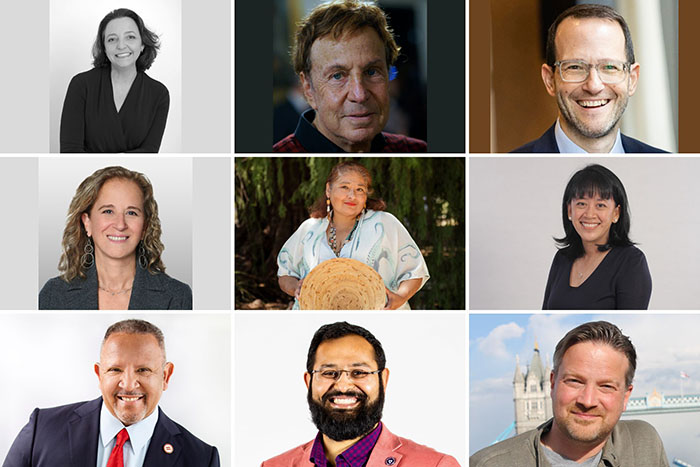
caption: The nine honored at 2024 Alumni Award of Merit Gala.Penn Alumni honored eight distinguished alumni with the Penn Alumni Award of Merit and a notable faculty member with the Faculty Award of Merit at the 2024 Alumni Award of Merit Gala on Friday, November 15.

A 1992 graduate of the College of Arts & Sciences, Belinda Bentzin Buscher was recognized for her enduring commitment to Penn through her leadership as chair of the Regional Clubs Advisory Board and for her service as co-president of the Penn Club of Seattle. In this latter role, Ms. Bentzin Buscher has worked for more than a dozen years to celebrate and strengthen the Penn community in creative ways, such as hosting an annual event for new and longstanding members.

Acclaimed and prolific movie producer Robert Cort, who earned his bachelor’s and master’s degrees in history in the School of Arts & Sciences in 1968 and 1970, respectively, then earned an MBA from the Wharton School in 1974, received the 2024 Creative Spirit Award. Mr. Cort produced films that include Three Men and a Baby, Bill and Ted’s Excellent Adventure, The Hand That Rocks the Cradle, Jumanji, Mr. Holland’s Opus, Runaway Bride, Save the Last Dance, On the Basis of Sex, and many more. His 2004 HBO film Something the Lord Made, about the pioneering Black heart surgeon Vivien Thomas, won three Emmy Awards. Mr. Cort has served as a member of the National Advisory Board of the Netter Center for Community Partnerships, helping to ensure the center has a lasting and sustainable impact on Penn, the local community, and the wider world.

Ira Hillman earned his undergraduate degree from the College of Arts & Sciences and Wharton in 1992 and was active in Penn Hillel, Mask & Wig, the Greenfield Intercultural Center, and the LGBT Center while at Penn. For his service with the Board of Advisors at the School of Social Policy & Practice (SP2), Penn Leadership Q, and PennGALA, with whom he led the 10th, 15th, and 20th anniversary celebrations for the Penn LGBT Center, Mr. Hillman was recognized for his work as a champion of social justice and advocacy for more LGBTQ+ leaders at Penn.

Sally Jutabha Michaels, who earned her MBA from the Wharton School in 1990, was recognized for her dedication to growing Penn’s alumni community in Thailand. Serving as an officer of the Penn-Wharton Club of Thailand and as a member of Wharton’s Executive Board for Asia for nine years, Ms. Jutabha Michaels was instrumental in hosting engaging events like the Wharton Global Forum in 2015 in Bangkok. As president of the Penn Club of Thailand and the school liaison, she has also strengthened Penn’s alumni community throughout the country.

Jennifer Krevitt graduated from the College of Arts & Sciences in 1986 and returned to Penn to earn her JD in 1992. She was recognized for her leadership and engagement. Ms. Krevitt served as vice chair and then as chair of the Trustees’ Council of Penn Women (TCPW). In 2023, she joined Penn Carey Law’s Board of Advisors, where she also served as a member of the Dean’s Women’s Council and the Law Alumni Society Alumni Engagement Committee.

Desiree Martinez, a 1995 graduate of the College of Arts & Sciences, received the Penn Alumni Social Impact Award in recognition of her leadership, advocacy, and support of the Native community at Penn. As an undergraduate, Ms. Martinez helped found Penn’s first organized cultural group for Native Americans, Six Directions, now known as Natives at Penn; she subsequently founded Penn’s Association of Native Alumni. She has also consulted for the Penn Native Community Council, helping to plan celebrations of Native American Heritage Month to campus.

Marc H. Morial graduated from the College of Arts & Sciences in 1980. He was recognized for his commitment to efforts that encourage the next generation of African American student leaders. Returning to campus again and again, Mr. Morial has shared his experiences, talking with students about what vibrant civic engagement can look like and participating in dialogues on important issues through Penn Spectrum events. Mr. Morial is also a longstanding member of the Black Alumni Society and the James Brister Society and is a non-resident senior fellow with the Robert A. Fox Leadership Program at Penn Arts & Sciences.

Deepak Prabhakar, who earned his bachelor’s and master’s degrees from the School of Engineering and Applied Science in 2011 and 2012 respectively, received the Young Alumni Award for his work rallying alumni around reunions, campaigns, and volunteer activities as the Class of 2011 president since 2016. He earned the Penn Alumni Student Award of Merit in 2011 in recognition of his involvement and leadership as an undergraduate in numerous groups, including the Penn Traditions Undergraduate Board, the Senior Class Executive Board to the Theta Tau Professional Engineering Fraternity, and the Sigma Alpha Mu Fraternity.

This year’s Faculty Award of Merit went to André Dombrowski in recognition of his work as a long-term faculty host with the Penn Alumni Travel program. Dr. Dombrowski, who came to Penn in 2008, is the Frances Shapiro-Weitzenhoffer Professor of 19th Century European Art in the history of art department in the School of Arts & Sciences. He has written books and articles on pivotal artists of the period like Paul Cézanne, Édouard Manet, Claude Monet, Edgar Degas, and Adolf von Menzel, and is the author of Cézanne, Murder, and Modern Life.

In addition to these individual awards, the classes of 1989 and 1974 received the Class Award of Merit, and the Class of 2004 received the David N. Tyre Award for Excellence in Class Communications. The Alumni Club of Merit went to the Penn Club of Boston, with special acknowledgement to the Penn Club of Hong Kong, Penn Club of Switzerland, and Penn Club of Philadelphia.

Om Gandhi: 2025 Rhodes Scholar

caption: Om Gandhi

University of Pennsylvania senior Om Gandhi, from Barrington, Illinois, has been awarded a Rhodes Scholarship for graduate study at the University of Oxford in England.

The Rhodes Scholarship, established in 1902, is highly competitive and one of the most prestigious scholarships in the world. The scholarship funds tuition and a living stipend for two or three years of graduate study at Oxford, and may allow funding in some instances for four years.

According to the Rhodes Trust, about 100 Rhodes Scholars will be selected worldwide this year, chosen from more than 70 countries around the world. Mr. Gandhi is among the 32 American Rhodes Scholars chosen to represent the United States. According to the Rhodes Trust, this year nearly 3,000 American students began the application process; 865 were endorsed by 243 different colleges and universities; and 238 applicants reached the final stage of the competition.

Mr. Gandhi is pursuing a master’s degree in bioengineering in the School of Engineering and Applied Science and is concurrently majoring in neuroscience and health and societies with a public health concentration in the College of Arts & Sciences. He also is pursing minors in chemistry and healthcare management. Mr. Gandhi conducts research on developing new cancer therapies and diagnostic approaches at Penn’s Center for Cellular Immunotherapies, Penn Medicine’s Neurosurgery/Radiology departments, and the Children’s Hospital of Philadelphia Center for Childhood Cancer Research. He has co-authored more than 10 peer-reviewed manuscripts, presented at multiple national conferences, and received several research grants and awards. Interested in improving cancer care delivery, he spearheaded a national non-profit and volunteers with local clinics to provide healthcare services to uninsured patients with chronic diseases.

On campus, Mr. Gandhi is the director of Locust Bioventures; president of the Wharton Undergraduate Healthcare Club, where he oversaw the nation’s largest undergraduate healthcare conference; vice president of the Penn Undergraduate Biotech Society; and editor-in-chief of the Penn Healthcare Review. He is a teaching assistant for organic chemistry and tissue engineering courses, and a statistics tutor at the Weingarten Center. Interested in spreading cultural awareness, Mr. Gandhi has organized Holi and Diwali celebrations as president of Penn’s Hindu & Jain Organization and is part of Penn’s Oracle Senior Asian Honors Society. At Oxford, Mr. Gandhi plans to pursue a DPhil in pediatrics with a focus in oncology, with a goal of attending medical school and practicing medicine as a physician-scientist.

Mr. Gandhi applied for the Rhodes Scholarship with assistance from Penn’s Center for Undergraduate Research and Fellowships.

Features

University of Pennsylvania's Climate and Sustainability Action Plan 4.0

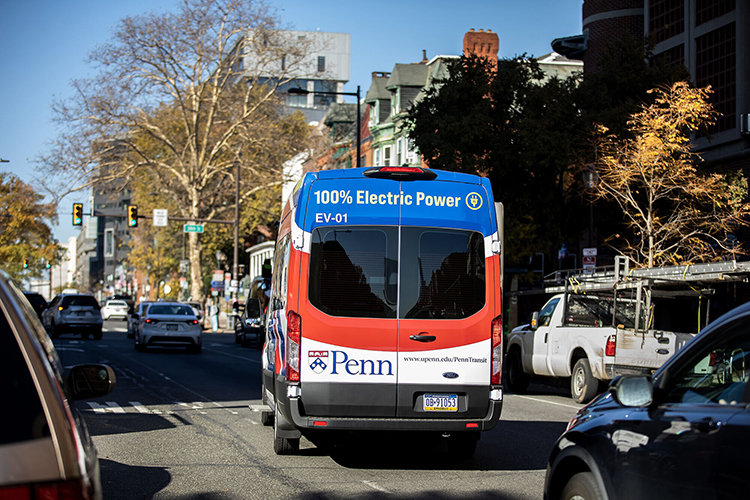
caption: Penn has begun moving toward carbon neutrality by building LEED-certified buildings (top) and buying electric transit buses (below).

Amid shifts in temperatures and weather patterns that threaten the health and well-being of humans and the planet, the University of Pennsylvania has released its fourth Climate and Sustainability Action Plan (CSAP), a roadmap that outlines ambitious sustainability goals for the next five years and lays out Penn’s path toward carbon neutrality by 2042.

CSAP 4.0 expands the University’s goals, including carbon neutrality, beyond the West Philadelphia academic campus to include the University of Pennsylvania Health System (UPHS), Morris Arboretum & Gardens, the School of Veterinary Medicine’s New Bolton Center campus in Kennett Square, and Penn-owned real estate properties.

“Our University’s strategic framework for the future, In Principle and Practice, names great challenges of our time—challenges that Penn is uniquely equipped to address,” said Interim President J. Larry Jameson. “None more so than climate and sustainability. Since Penn launched its first sustainability plan in 2009, we have made extraordinary strides across campus, in our teaching and research, and in our contributions to the world. Penn now serves as a national sustainability leader for higher education and the world.”

Progress in Emissions, Solar Energy, and Zero Waste

Penn has reduced greenhouse gas emissions by 47% from 2009 levels and launched the largest solar project in Pennsylvania, which will produce the equivalent of approximately 70% of the electricity used on Penn’s campus and UPHS facilities in Greater Philadelphia.

Other accomplishments from CSAP 3.0 include completing the first carbon footprint for all Penn-owned real estate, establishing Penn’s first air travel offset policy, adding six electric passenger vans to Penn Transit’s fleet, initiating a waste audit contract and increasing the waste diversion rate, signing onto the City of Philadelphia’s Zero Waste Partnership program, starting a Green Labs program to assess opportunities for saving energy, and enacting academic climate commitments at all 12 schools at the University.

Penn held 118 Climate Week and 132 Earth Week events during the last five years, and last academic year alone, 5,112 students enrolled in environment-related courses.

“In my Penn career, I’ve witnessed Penn’s tremendous progress in sustainability—from investments in Penn’s infrastructure to groundbreaking climate research,” said Craig R. Carnaroli, senior executive vice president. “Yet, our journey is far from over. As we continue to innovate, our charge as an institution of higher learning is to both educate and adjust our operations for the benefit of our community and society at large.”

Penn has begun moving toward carbon neutrality by building LEED-certified buildings (top) and buying electric transit buses (below).

Goals for the Next Five Years

In connection with the release of CSAP 4.0, the University of Pennsylvania Health System has released its first-ever Climate and Sustainability Action Plan, moving the institution toward the goal of becoming the most environmentally friendly healthcare organization in the country.

The goals in the health system plan include cutting greenhouse gas emissions in half by 2030 compared to 2022 levels, reducing carbon emissions from Penn Transit vehicles by 20%, ensuring all new construction and renovation projects incorporate sustainable construction best practices, increasing spending on green seal products to reduce exposures to potentially harmful chemicals, and reducing water consumption.

In addition to UPHS, CSAP 4.0 lays out goals in seven other initiative areas. Some of the goals within these areas include:

  • Academics—Expanding faculty hiring and opportunities for student research, promoting research that addresses environmental challenges while centering community perspectives and needs, and enhancing applied and experiential learning.
  • Utilities and Operations—Developing a decarbonization plan, establishing an internal shadow price for carbon, and studying the current Red Day model, to optimize grid resilience and campus responses to increasingly frequent days of extreme heat.
  • Physical Environment—Evaluating the impact of the new LEED standard on capital projects, determining the viability of a dedicated fund for sustainable capital project initiatives, and continuing to track efforts to protect the urban forest, such as supporting the City of Philadelphia’s tree canopy goals, reducing the urban heat island effect, and supporting biodiversity.
  • Procurement—Implementing a sustainability policy for third-party food vendors operating on campus, piloting zero-waste operations in at least one dining hall, and formalizing the Air Travel Working Group.
  • Strategic Waste—Raising the diversion rate for items sent to landfill and incineration, holding more zero-waste campus events, and increasing composted tonnage and collection sites.
  • Transportation—Increasing the number of commuter trips to campus made by non-single-occupancy vehicles, moving Penn’s vehicle fleet toward zero-emission vehicles, and distributing the Staff & Faculty Commuter Survey—in which more than 4,000 people previously participated—at least every two years.
  • Civic Engagement and Outreach—Developing partnerships to increase the sustainability outcomes of Philadelphia, learning from peer institutions that are implementing sustainability practices with community partners, and enhancing professional development opportunities related to sustainability careers, in collaboration with the Environmental Innovations Initiative.

“Across our campus and our community, we are forging engaged, inventive research to discover new ideas, accelerate interdisciplinary connections, and provide innovative solutions for the world’s climate crisis,” said Provost John L. Jackson, Jr.

An Environmental Sustainability Advisory Committee (ESAC) began the review and goal-setting process for CSAP 4.0 in the summer of 2023, and a Sustainability Plan Advisory Committee formed that fall to provide input on the plan’s development. This included input from the President’s Office, Provost’s Office, Office of Social Equity and Community, University of Pennsylvania Health System, Business Services, Division of Finance, and Student Advisory Group for the Environment.

ESAC and Penn Sustainability will track progress on these goals and communicate progress through publicly available annual reports.

In Principle and Practice has activated our community to accelerate our commitment to environmental sustainability solutions and work in partnership to realize our goals,” said Nina Morris, director of Penn Sustainability. “Building on nearly two decades of environmental commitment, Penn is well-positioned to meet this critical moment. With a strong focus on community engagement, and as an anchor institution in our regional ecosystem, Penn can be both a leader and a learner in our transformation ahead.”

To read the full CSAP 4.0, visit https://www.sustainability.upenn.edu/resources/climate-and-sustainability-action-plan-40-csap-40-fy25-29.

To read the report highlighting Penn’s progress toward achieving CSAP 3.0 goals for fiscal years 2020 to 2024, visit https://www.sustainability.upenn.edu/resources/climate-and-sustainability-action-plan-30-csap-30-fy20-24-summary-report.

Adapted from a Penn Today article by Erica Moser, November 18, 2024.

AT PENN

December AT PENN 2024 Calendar Now Available

The December AT PENN 2024 calendar is now online! Click here to view the calendar, and click here to view a printable PDF.

Events

Penn Bookstore’s Annual Winter Sale-A-Bration

The Penn Bookstore will hold its annual Winter Sale-a-Bration on Wednesday, December 4, and Thursday, December 5, from 8:30 a.m.-8 p.m. Take advantage of a special 20% off discount storewide*, all while enjoying seasonal festivities. Stop in one or both days starting at noon for performances by the Penn Glee Club, a free professional photo at the winter-themed photo booth (props provided), complimentary gift wrapping, and hot chocolate and cookies. Find something special for yourself or as a gift at this festive event. For the full schedule of holiday fun, click here or follow the Penn Bookstore on Instagram and Facebook.

*In store only. Cannot be combined with other offers. Not valid for the purchase of gift cards, textbooks, electronics, and specialty items. Other limits may apply.

SHOP PENN Days of Deals

’Tis the Season to eat, shop and be merry! The holidays are here, and we are excited to celebrate the season throughout the SHOP PENN district this December. The Fifth Annual SHOP PENN Days of Deals returns on December 2-13, and features 12 days of sales and giveaways from our collection of eclectic stores and restaurants around campus. The SHOP PENN Holiday Window Decorating Contest also returns on December 4-13. Take a stroll through the district, and vote for your favorite holiday window display. For more details, visit  www.shopsatpenn.com and follow SHOP PENN on Instagram, X, and Facebook (@shopsatpenn).  

Penn's Class of 1923 Ice Rink to Host Event for RockyFest 2024

Rocky Date Night, a marquee event of the upcoming weeklong RockyFest, will take place at the University of Pennsylvania’s Class of 1923 Ice Skating Rink on Friday, December 6, from 7 to 10 p.m.

Hosted in collaboration with the Philadelphia Visitors’ Center, Rocky Date Night is part of a citywide celebration of Philly’s most famous film franchise. Inspired by Rocky and Adrian’s first date, which took place at an ice rink, the evening will include an open skate, food and beverages, a character lookalike contest, photo ops, and a speed-dating hour. 

The Penn Ice Rink joins other city landmarks, including the Philadelphia Museum of Art and the Philadelphia Zoo, as a RockyFest site. Click here for details and ticket information. 

Update: November AT PENN

Films

30        Day With(out) Art 2024: Red Reminds Me…; a program of seven videos reflecting the emotional spectrum of living with HIV today; 2-4 p.m.; Institute of Contemporary Art; register: https://www.eventbrite.com/myevent/1065741043149/invite-and-promote/ (ICA).


Special Events

30        Holiday Garden Railway: Nighttime Express; visit the perennial favorite Holiday Railway as it is transformed for night-time viewing with laser lights in the trees and sparkling lights along the railway; Morris Arboretum & Gardens; tickets: free with arboretum admission; info: https://www.morrisarboretum.org/ (Morris Arboretum & Gardens). Through December 22.


Talks

26        Relating Circuit Dynamics to Computation: Robustness and Dimension-Specific Computation in Cortical Dynamics; Shaul Druckmann, Stanford University; noon; room 111, Levin Building (Computational Neuroscience Initiative).


Mathematics

In-person events. Info: https://www.math.upenn.edu/events.

26        Tautological Classes, Perverse Filtrations, and Moduli of One-Dimensional Sheaves; Weite Pi, Yale University; 3:30 p.m.; room 3C2, DRL.


This is an update to the November AT PENN calendar. To submit events for future AT PENN calendars and weekly updates, email the salient details to almanac@upenn.edu.

Crimes

Weekly Crime Reports

Division of Public Safety

University of Pennsylvania Police Department Crime Report

About the Crime Report: Below are the Crimes Against Persons and/or Crimes Against Property from the campus report for November 11-17, 2024. The Crime Reports are available at: https://almanac.upenn.edu/sections/crimes. Prior weeks’ reports are also online. –Eds.

This summary is prepared by the Division of Public Safety (DPS) and contains all criminal incidents reported and made known to the Penn Police, including those reported to the Philadelphia Police Department (PPD) that occurred within our patrol zone, for the dates of November 11-17, 2024. The Penn Police actively patrol from Market Street to Baltimore Avenue and from 30th Street to 43rd Street in conjunction with the Philadelphia Police.

In this effort to provide you with a thorough and accurate report on public safety concerns, we hope that your increased awareness will lessen the opportunity for crime. For any concerns or suggestions regarding this report, please call DPS at (215) 898-7297. You may view the daily crime log on the DPS website.


Penn Police Patrol Zone

Market Street to Baltimore Avenue and from 30th Street to 43rd Street

Crime Category

Date

Time

Location

Description

Arson

11/13/24

7:36 AM

3800 Spruce St

Offender set fire to a pile of leaves on the sidewalk; offender positively identified/Arrest

Assault

11/11/24

3:00 PM

51 N 39th St

Unknown offender pushed complainant’s head and struck complainant in the chest with a closed fist


11/13/24

11:55 AM

3400 Spruce St

Unknown offender spit on complainant after verbal altercation


11/13/24

1:00 PM

3020 Market St

Simple assault

Auto Theft

11/11/24

12:24 PM

211 S 40th St

Secured scooter taken from bike rack


11/12/24

11:57 AM

3916 Locust Walk

Secured scooter taken from bike rack


11/12/24

7:27 PM

3100 Chestnut St

Theft of an electric scooter from bike rack


11/12/24

8:07 PM

3549 Chestnut St

Theft of a motor vehicle from parking garage


11/13/24

10:10 AM

3910 Chestnut St

Motor vehicle theft


11/13/24

11:52 AM

3500 Chestnut St

Unlocked vehicle with keys inside taken from highway


11/13/24

8:36 PM

16 S 40th St

Theft of an e-bike


11/14/24

12:54 PM

4100 Market St

Attempted motor vehicle theft


11/14/24

1:58 AM

3400 Civic Center Blvd

Secured scooter taken


11/14/24

6:26 PM

118 S 36th St

Secured bike taken from bike rack


11/14/24

7:15 PM

3730 Walnut St

Secured scooter taken


11/15/24

10:47 AM

3300 Market St

Parked motor vehicle taken from highway


11/15/24

4:13 PM

210 S 34th St

Chain-secured electric scooter taken from outside of building


11/17/24

7:16 PM

1 S 41st St

Parked and secured vehicle taken from highway

Bike Theft

11/14/24

2:05 PM

209 S 33rd St

Secured bicycle taken

Fraud

11/11/24

7:07 PM

3730 Walnut St

Fraudulent wire transfer made to unknown offender

Retail Theft

11/13/24

8:08 PM

4233 Chestnut St

Retail theft


11/14/24

11:15 AM

4233 Chestnut St

Retail theft


11/15/24

8:34 PM

3744 Spruce St

Retail theft of various drinks, chips, and candy


11/16/24

6:52 PM

4233 Chestnut St

Retail theft of alcohol


11/16/24

11:32 PM

3200 Chestnut St

Retail theft

Sex Offense

11/16/24

2:47 PM

Confidential

Confidential


11/16/24

10:21 PM

Confidential

Confidential

Theft from Building

11/11/24

11:04 AM

51 N 39th St

Purse taken from work station


11/11/24

3:30 PM

4039 Chestnut St

Theft of an unsecured bicycle from apartment lobby


11/11/24

6:04 PM

3901 Walnut St

Shoulder bag taken from back of chair


11/13/24

11:11 AM

4039 Chestnut St

Package taken from lobby of apartment building


11/14/24

7:55 PM

4026 Market St

Allied security portable radio taken by unknown offender


11/15/24

6:57 PM

3901 Locust Walk

Package containing consumable goods taken from lobby area


11/16/24

1:39 PM

4045 Baltimore Ave

Package taken from apartment building

Theft Other

11/12/24

12:04 PM

200 S 40th St

Offender threatened to post photos of the complainant if money was not exchanged

Vandalism

11/15/24

2:56 PM

380 University Ave

Political statement spraypainted in blue; incident documented and FRES contacted for removal


11/17/24

1:34 AM

4014 Walnut St

Political statement spraypainted in white; incident documented and FRES contacted for removal


Philadelphia Police 18th District

Schuylkill River to 49th Street & Market Street to Woodland Avenue

Below are the Crimes Against Persons from the 18th District: 1 incident was reported for November 11-17, 2024 by the 18th District, covering the Schuylkill River to 49th Street & Market Street to Woodland Avenue.

Crime Category

Date

Time

Location

Assault

11/13/24

1:01 PM

3020 Market St


The Division of Public Safety offers resources and support to the Penn community. DPS developed a few helpful risk reduction strategies outlined below. Know that it is never the fault of the person impacted (victim/survivor) by crime.

  • See something concerning? Connect with Penn Public Safety 24/7 at (215) 573-3333.
  • Worried about a friend’s or colleague’s mental or physical health? Get 24/7 connection to appropriate resources at (215) 898-HELP (4357).
  • Seeking support after experiencing a crime? Call Special Services - Support and Advocacy resources at (215) 898-4481 or email an advocate at specialservices@publicsafety.upenn.edu
  • Use the Walking Escort and Riding services available to you free of charge.
  • Take a moment to update your cellphone information for the UPennAlert Emergency Notification System
  • Download the Penn Guardian App which can help Police better find your location when you call in an emergency.
  • Access free self-empowerment and defense courses through Penn DPS.
  • Stay alert and reduce distractions; using cellphones, ear buds, etc. may limit your awareness.
  • Orient yourself to your surroundings. (Identify your location, nearby exits, etc.)
  • Keep your valuables out of sight and only carry necessary documents.


Bulletins

One Step Ahead: Happy Holidays and Safe Travels

One Step Ahead logo

Another tip in a series provided by the Offices of Information Security, Information Systems & Computing and Audit, Compliance & Privacy

Like many, you may be packing your bags to travel during the holidays, visiting family and friends, or exploring a new destination. Before you leave work and home on your trip, please pay attention to the following advice:

  1. Back up your data to avoid data loss or corruption.
  2. Ensure your Penn Two-Step verification Duo works and follow the Two-Step Verification: Before You Travel guidance.
  3. Avoid carrying University-sensitive data unless necessary. Work with your IT support staff to locate and encrypt sensitive data. Review the Penn Data Risk Classification to understand the type of data that may be stored locally on your device.
  4. Check the U.S. Department of State Travel Advisories for any restrictions in the country you are visiting. Keep the U.S. Embassy’s number with you while traveling in case of an unforeseen emergency.
  5. Keep your financial institution’s contact information with you in case of credit or debit card loss.  
  6. Check with your department’s IT staff if they offer loaner computing devices to use during travel.

During travel, carry your computing devices, passport, and travel tickets in a locked bag, and do not leave them unattended. If you need access to a Penn system, avoid using public computers and internet services like at a café. Preferably, connect to Penn systems by running a Virtual Private Network (VPN). You can ask your IT support staff about using a VPN before traveling.

Before returning home, check that you have securely packed your computing devices. After your safe return, and if you removed data from your computer before traveling, you can transfer it back. Work with your IT support staff to scan your computer for malware.

Resources:

For additional tips, see the One Step Ahead link on the Information Security website: https://www.isc.upenn.edu/security/news-alerts#One-Step-Ahead.

Applications for 2025-2026 Provost’s Predoctoral Fellows Program Invited by January 21, 2025

The University of Pennsylvania invites applications for the 2025-2026 Provost’s Predoctoral Fellows program. These awards are designed to provide mentorship and access to Penn’s resources for doctoral students in the humanities or social sciences, enrolled in graduate or professional programs at universities other than Penn, as they complete their dissertations. The fellowships are intended to support talented scholars with diverse backgrounds, experiences, and perspectives.

These residential fellowships support graduate students in the final stages of dissertation research or writing at Penn for an academic year. They offer an opportunity for scholars who plan an academic career to take advantage of Penn programs and faculty expertise and afford access to libraries and the resources of the Philadelphia region. Each scholar will be selected and hosted by a department or school and assigned a faculty mentor. Applicants should be in the stage of advanced dissertation research or writing.

The fellowship provides a stipend of $43,500, health insurance, library privileges, and a $5,000 research and travel fund. The application deadline is January 21, 2025.

This year, up to five fellowships will be awarded.

Qualifications

Candidates for the fellowship must be a U.S. citizen or permanent resident who is enrolled in a PhD program in the humanities or social sciences at an accredited university graduate or professional school other than Penn. Candidates must have passed any PhD qualifying examinations and be in an advanced stage of research and writing on an approved dissertation topic. Candidates must be students of exceptional academic merit who pursue academic research that produces new understandings about cultural, societal, or educational topics as they affect particular under-researched populations.

Application

  • Applicants should submit:
  • A letter from a Penn faculty member with compatible research interests stating their agreement, if selected, to serve as a mentor for the duration of the fellowship.
  • Two letters of recommendation, signed and on official letterhead. One must be from the dissertation advisor, commenting on the student’s performance, potential, and expected time to degree. At least one of the letters must address the applicant’s contribution to advancing inclusive excellence and improving understanding of the perspectives and experiences of diverse populations.
  • Graduate transcript(s).
  • Current curriculum vitae.
  • Responses to predoctoral fellowship application questions in Interfolio:
    • Describe your dissertation’s aims and methodology. (No more than 500 words)
    • Explain how your dissertation advances knowledge in the field of study. (No more than 250 words)
    • Explain how your dissertation contributes to understanding the perspectives and experiences of diverse populations. (No more than 250 words)
    • Describe your future research and professional goals. (No more than 250 words)
    • Explain how the Penn fellowship will support your goals. (No more than 250 words)
    • Indicate your expected date of graduation. (Month and year)

Application will be accepted at http://apply.interfolio.com/159350.

Questions can be addressed to the Office of the Vice Provost for Faculty at provost-fac@upenn.edu.

Call for Applications from Center for Molecular Studies in Digestive and Liver Diseases Grant Program for Pilot and Feasibility Projects

Application Instructions Purpose and Research Focus

The purpose of Penn’s Center for Molecular Studies in Digestive and Liver Diseases (CMSDLD) is to unite investigators with interests in digestive and liver physiology and disease and to stimulate others in the biomedical community to enter this area of research. One of the most important parts of this effort is the funding of pilot and feasibility projects.

The proposed pilot and feasibility project should be related to the focus of the center, which encompasses molecular studies on the biology or disease of the alimentary tract, pancreas, and liver. Relevant investigations include those in developmental biology, nutrition, regulation of gene expression, growth, differentiation, the biology of stem cells, molecular genetics, bioengineering approaches to digestive diseases, gene therapy, and immunology, including growth factors and cytokines. Please note that preference is given to junior investigators and to proposals studying areas other than cancer, although applications from senior investigators and on cancer-related topics will be considered. Pilot project awards are for $40,000 for 1 year with a second year possible through a competitive renewal.

Candidates will be notified by the end of April 2025. The funding start date is June 1, 2025.

Eligibility

All faculty members of the University scientific community (at the rank of instructor and above) who meet the eligibility requirements below are invited to submit proposals. Applicants must be U.S. Citizens or hold permanent resident visas. There are three categories of applications:

  1. New investigators who have never held extramural support at the level of a NIH R01.
  2. Established investigators in other areas of biomedical research who wish to apply their expertise to a problem in digestive and liver diseases.
  3. Established digestive and liver investigators who wish to study an area that represents a significant departure from currently funded work.

Proposal Preparation

Submit documents outlined below by sending them directly to the email center address located at the bottom of this document. Complete proposals are due by Tuesday, January 21, 2025.

  1. Format (Submit as a single PDF, in this order)
  2. Cover page: must include an abstract of up to 250 words and a list of approved or pending IACUC/IRB protocols. If embryonic cell lines will be used, they must be from the NIH Embryonic Stem Cell Registry, and you must provide a list within your cover page. Finally, if your pilot grant will include human subject research, involving more than minimal risk, that will need to be included in the letter as well. NIH has to approve these studies in advance of an award.
    *If you are not currently a faculty member but will be by the project start date of June 1, 2025, please state that explicitly in the cover letter.
    • NIH Biosketch
    • NIH Other Support
    • Budget and justification: one year, $40,000; no PI salary allowed (one page).
    • Background, preliminary results, estimated core usage, research plan including statistical analyses, and future directions (up to three pages total).
    • Senior investigators should indicate how this project represents a new direction in their research
    • References (one page).
    • Appendix: tables or high-resolution images pertaining to preliminary data that is already reported in the research section only, no reprints

Please note: The top applicants will be asked to present a 5-minute summary of their proposal to the center’s external advisory board (EAB) on Friday, March 21, 2025. Applications from top candidates identified by the EAB will be reviewed further by center leadership and members of the Center Community Advisory Board.

For additional information, please contact the Center for Molecular Studies in Digestive and Liver Diseases at Kristi.Taverno@Pennmedicine.upenn.edu.

ISC Rate Adjustments for Fiscal Year 2026

In FY26, ISC plans to adjust rates in alignment with the planning parameters provided by the Office of Budget Planning & Analysis (as of fall 2024). These changes allow ISC to continue making important investments and deliver services that are effective and efficient. Rates for all billed services will increase by 2.0% and labor rates will increase by 3.0%. Additionally, there are a subset of services for which there will be no increase. ISC Relationship Managers will follow up with IT leaders to review these changes and answer any questions.

—Tom Murphy, Senior Vice President for Information Technology and University Chief Information Officer

Talk About Teaching & Learning

Experiential Learning

Russell J. Composto

I bet you can recall at least one teacher who excited and engaged you in the subject matter, left you wanting to learn more, and quite possibly impacted your career choice. To me that teacher was Professor Richard Mara, who taught the foundational physics classes at Gettysburg College ca. 1980. Professor Mara exhibited an enthusiasm and excitement for teaching science that just pulled the class along. You could tell that he really wanted us to understand the concepts, using both equations for the more matheamatically inclined and also diagrams for the more visually inclined. From this experience, I learned that you have to be knowledgeable and excited about the subject matter and also truly invested in having students understand (not regurgitate) concepts to achieve true learning. This was true in the 1980s and is even more true in 2024, given the competition for students’ time, be it social media, activities, work and/or research, and juggling classes as well as interest in the subject.

Infectious enthusiasm and transparency can engage students, but to reach what I think of as true student learning, students need to internalize and connect to the material by actually touching and experiencing the concept. To help us internalize a concept (something like rotational kinematics), Professor Mara presented the big picture by explaining where we had been (translational motion) and how that related to the new topic (rotational motion). Using equations, diagrams (with colored chalk), a few words, and many homework problems (in class and outside), we were able to internalize the “concept” of rotational inertia. However, to really connect, Professor Mara used demonstrations, which he saw as the only way to really learn. For example, I went to Professor Mara and explained that I was going to catch an early bus home for fall break and would miss class. I recall his exact words: although it was my choice, he would really like to see me participate because this was “demonstration day” where we would get hands-on experience with fundamental concepts from class. These weren’t canned laboratories but manifestations of abstract physical concepts. One demonstration had a heavy wheel with an axel sticking out of the center to hold onto. After he rotated the wheel, he said, “Mr. Composto, turn now.” I turned the wheel and went flying across the room due to the torque exerted by the turning wheel. This was the first time that I truly learned how a class concept applies to real life and that, although the math was fun, the actual “feeling” of a concept created a learning experience that I recall like it was yesterday. I was right to go home a little later!

At Penn, I teach a soft matter course to upper class undergraduates from materials science and engineering, chemical and biomolecular engineering, bioengineering, physics and chemistry, where the students learn thought direct contact with materials. This is a class where concepts from physics, chemistry and biology are used to design materials with precise structure-property relationships. The first third of the course is about the basic principles of soft materials (think Jell-O). Here I rely on Professor Mara’s enthusiasm and the promise that applying fundamental concepts from physics, chemistry and biology learned in their first years underlie students’ ability to learn to design and create new materials needed for lighter cars, smaller batteries, and tastier souffles. Concepts like viscoelasticity can be brought to life by showing that a toy like Silly Putty can flow like a viscous liquid if pulled slowly or behave like a solid if pulled quickly. The latter is nicely demonstrated (and used to awaken students) by throwing a ball of silly putty at the chalk board and ducking before it rebounds. Paying homage to Professor Mara, students pass silly putty around so they can try for themselves while I then explain the principles underlying this unique behavior. It’s also fun to show them how to imprint a comic strip from a newspaper after introducing them to physical newspapers.

The final two-thirds of the course is even more fun because we discuss the behavior of each type of soft matter, including polymers, colloids (which are very small balls suspended in liquid), surfactants/lipids (things like soaps and cells), and my favorite topic, food. For polymers, we pass around Lycra, a flexible fiber used in your workout clothing, and Kevlar, which is molecularly similar but stronger than steel on a weight basis.  

The classes on food, however, most completely cement students’ understanding and delight. In these classes, we discuss the components of chocolate and compare their structural similarity to what they learned when discussing polymers, colloids, etc. We go back to the fundamental concepts about thermodynamics of mixing (equations and diagrams), and I remind them how these concepts also captured the behavior of synthetic materials discussed previously (polymers in sneaker soles). Then I show them that chocolate has multiple incompatible phases that make up its microstructure. We then do a blind taste test with four types of chocolate ranging from very dark (95% and bitter) to white (arguably not chocolate).  Eggs too are multiphase material; students see this when they combine egg whites (water/proteins) with egg yolk (water/fats/proteins/carbohydrates). Students also whip up a foam from egg whites and compare its porous structure to a synthetic foam (e.g., polyurethane seat cushion). Again, the purpose is to connect fundamental concepts that appear to only apply to “engineered” soft matter to everyday examples of soft matter so students can internalize concepts rather than memorize them.

Around Halloween, we teach a particularly popular class called Chemistry in Candy Making. Here, I invite food scientists from the Hershey Company to discuss chemical reactions underlying caramelization and Maillard Browning, as well as classification of sugar-based confectionery according to their crystallinity from high (rock candy) to medium (fondants) to low (gummies). We discuss the “sucrose phase diagram,” harkening back to earlier concepts, and show how the cooling pathway of the sugar solution determines whether you have hard candy (amorphous glass) or rock candy (large crystals). The food scientists then demonstrate how to make a Jolly Rancher hard candy (including the trade secret coloring/flavor) and a highly aerated candy like marshmallows (another example of a porous foam). The class ends with two huge bags of candy of the Hershey power brands (Reese’s and Kit Kat) and other brands (Good & Plenty, York Peppermint Pattie). 

One goal of this class is to demonstrate to students that learning is fun and that the concepts we teach in class have many applications if they think creatively. Another goal is to get students to think broadly and creatively about the fundamental principles of engineering. Rather than memorizing that this type of material behaves in a certain way, students see that the concepts are broadly applicable if they only look deeper. Beyond science, students ask about career paths (Q: do I need to study food science? A: no, any STEM degree is fine because you learn on the job). Having students have fun, learn concepts, and better understand career opportunities may be the most useful type of classroom learning because it combines so many opportunities for students to be curious and develop as critical thinkers.

Russell J. Composto is the Howell Family Faculty Fellow and professor of materials science and engineering in the School of Engineering and Applied Science with secondary appointments in bioengineering and chemical and biomolecular engineering.

--

This essay continues the series that began in the fall of 1994 as the joint creation of the College of Arts and Sciences, the Center for Teaching and Learning, and the Lindback Society for Distinguished Teaching. 

See https://almanac.upenn.edu/talk-about-teaching-and-learning-archive for previous essays.

Back to Top