News

Penn Graduate School of Education Awarded $3.5 Million to Launch The Academy at Penn

Penn’s Graduate School of Education has been awarded $3.5 million, part of a larger $8 million grant from Education Initiatives, to partner with the School District of Philadelphia (SDP) to launch The Academy at Penn, an innovative five-year, cohort-based college- and career-readiness model for high school students. Foundations, Inc., and the Consortium for Policy Research in Education (CPRE) also received support through the grant as part of the larger partnership. These collaborators will work together to design, implement, and evaluate the project.

The award reflects Penn GSE’s renewed focus on community engagement under the leadership of Katharine O. Strunk, dean and George and Diane Weiss Professor of Education, and supports strategic actions delineated by Tony B. Watlington Sr, Superintendent of the School District of Philadelphia, in its 2023–2028 Strategic Plan, “Accelerate Philly.”

“We are proud to deepen our collaboration with the School District of Philadelphia,” said Dean Strunk. “This initiative represents not just a commitment to expand opportunities for students across the city in our local schools, but also a chance to develop a national model for college and career readiness.”

“Thanks to the Office of School and Community Engagement at the University of Pennsylvania’s Graduate School of Education, this grant marks a significant step forward in our commitment to ensuring first-generation college students in the School District of Philadelphia have access to the resources and opportunities they need to succeed in college, career, and life,” said Mr. Watlington. “The collaboration reflects the power of partnerships that will support our students as we work to become the fastest-improving, large urban school district.”

Penn GSE’s Office of School and Community Engagement, led by founding director Caroline Watts, will spearhead Penn GSE’s role in the initiative, which will provide year-round academic and social-emotional support and postsecondary exploration opportunities to 200 students from two Philadelphia high schools, at no cost to the district, schools, or students. The school sites for the initiative will be selected in the coming months in partnership with the SDP.

“The Academy at Penn will offer a comprehensive support system tailored to the needs of each student,” said Dr. Watts. “By providing year-round academic assistance, social-emotional resources, and exposure to postsecondary pathways, we are equipping 200 Philadelphia students with the skills, experiences, and confidence to pursue their goals. This program is designed to address barriers to success and foster a more inclusive educational experience, preparing students for meaningful futures.”

Foundations, Inc., a capacity-building non-profit organization that works with schools, school districts, and community and afterschool organizations, was awarded $3.5 million to lead the program design and implementation, which will be customized in collaboration with each school and targeted to the needs of students who are the first in their families to attend college and/or postsecondary schooling.

The Consortium for Policy Research in Education (CPRE) was awarded $1 million to assess and evaluate academy programming with the goal of developing a scalable and replicable model. CPRE, based at Penn GSE, is a community of researchers from renowned research institutions and organizations committed to advancing educational policy and practice through evidence-based research.

The Academy at Penn launches in spring 2025. It aims to address the barriers that historically underserved students face in pursuing their higher education and career goals, paying close attention to the unique needs of students impacted by trauma and those who are the first in their families to attend postsecondary schooling. Participating students will take part in a range of in-school, after-school, weekend, and summer activities that promote academic success, well-being, belonging, and future-readiness. At the end of their high school journey, academy students will be supported through the transition to college or the workforce.

Squire Booker Appointed Richard Perry University Professor

caption: Squire BookerInterim President J. Larry Jameson and Provost John L. Jackson, Jr. announce the appointment of Squire Booker as the Richard Perry University Professor in the department of chemistry in the School of Arts & Sciences and the department of biochemistry and biophysics in the Perelman School of Medicine, effective January 1, 2025.

Dr. Booker, a world-renowned interdisciplinary chemist, brings together methods from chemistry, biochemistry, medicine, and microbiology to study the mechanisms by which enzymes containing iron-sulfur clusters catalyze chemical reactions. This research, along with his related research into the functions of proteins in antibiotic-resistant bacteria, has wide implications for advancements in human health and innovative new treatments of disease. An investigator in the Howard Hughes Medical Institute since 2015, a member of the National Academy of Sciences since 2019, and a member of the American Academy of Arts and Sciences since 2017, Dr. Booker is currently the Evan Pugh University Professor and the Eberly Distinguished Chair of Science at Penn State University, where he has taught since 1999.

“Groundbreaking life science research is essential to human health and flourishing,” said Interim President Jameson. “Professor Booker brings the caliber of expertise, novel scientific approaches, and interdisciplinary insights necessary to advance this work. His track record of advancing foundational discoveries and mentoring young scientists makes him an ideal fit for Penn’s signature approach.”

Dr. Booker’s distinguished professional awards include, most recently, the ASBMB- Merck Award from the American Society for Biochemistry and Molecular Biology, honoring outstanding contributions to research in biochemistry and molecular biology; the Ruth Kirschstein Diversity in Science Award from the American Society for Biochemistry and Molecular Biology, honoring a sustained commitment to mentoring scientists from historically marginalized or excluded groups; and the Hans Neurath Award from the Protein Society, honoring recent contributions of exceptional merit to basic protein research.

Dr. Booker serves on the editorial boards of numerous leading professional journals and has delivered major named lectures at more than a dozen universities. He received a PhD in biochemistry from MIT, a BA in chemistry from Austin College, and postdoctoral fellowships at the University of Paris V and the Enzyme Research Institute of the University of Wisconsin at Madison.

“Squire Booker’s ambitious and creative research exemplifies the mission of our strategic framework, In Principle and Practice, to lead on the great challenges of our time,” said Provost Jackson. “He will be a galvanizing leader on campus, bringing together the insights of multiple disciplines to make a powerful impact on health outcomes around the world.”

The Penn Integrates Knowledge program is a Penn-wide initiative to recruit exceptional faculty members whose research and teaching exemplify the integration of knowledge across disciplines and who are appointed in at least two schools at Penn.

The Richard Perry University Professorship is a gift of Richard C. Perry, a 1977 graduate of the Wharton School who founded the investment management firm Perry Capital. He is a University Trustee and a former member of the Undergraduate Executive Board of the Wharton School. His 2005 gift created the first four Penn Integrates Knowledge University Professorships.

Penn Vet Reopens Newly Named and Renovated $2.8 Million Richard Lichter Advanced Dentistry and Oral Surgery Suite

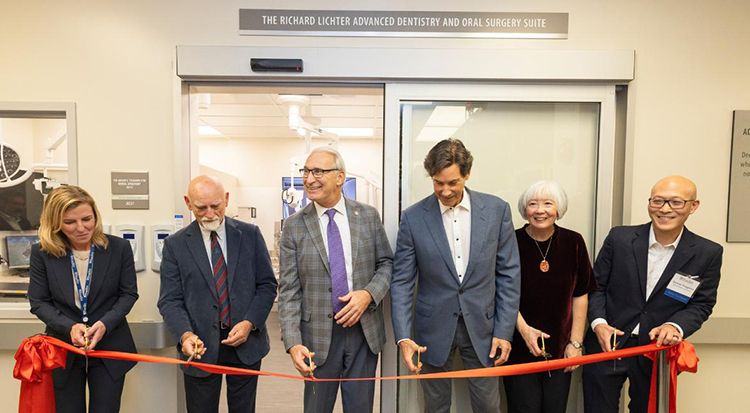
caption: Brady Beale, Colin Harvey, Andrew Hoffman, Richard Lichter, Nadine Chien, and Anson Tsugawa cut the ribbon for the new Richard Lichter Advanced Dentistry and Oral Surgery Suite.

Penn Vet commemorated the official re-opening of the newly named and renovated Richard Lichter Advanced Dentistry and Oral Surgery Suite at Ryan Hospital with a ribbon-cutting ceremony held on November 7. The ceremony celebrated the effort to fund and renovate a state-of-the-art clinic for comprehensive oral and restorative small animal patient care, clinical instruction, and research.  

Event speakers included Andrew Hoffman, the Gilbert S. Kahn Dean of Veterinary Medicine; Brady Beale, director of Ryan Hospital, chief medical officer, and associate dean of clinical enterprise; major donors Richard Lichter and Nadine Chien; and Colin Harvey, a professor emeritus of dental and oral surgery and founding member of the first veterinary dental organization, the American Veterinary Dental Society (AVDS), who delivered remarks on the history of dental services at Penn Vet.

Penn Vet is recognized as the birthplace of the dental and oral surgery (DOS) veterinary specialty. With a focus on complex oral procedures, including cleft palate repairs, the DOS service attracts clients, students, and residents from across the U.S. and globally. Over three decades of growth and demand for advanced veterinary surgical treatments necessitated a physical space expansion to meet patient and client needs.

“Our specialists have been diagnosing and treating diseases—including life-threatening diseases—for the last 35 years, and this new state-of-the-art facility is going to help us take that to the next level,” said Dr. Beale. “It really is a facility of the future. The Richard Lichter Advanced Dentistry and Oral Surgery Suite will allow us to contribute to the clinical research mission that we are so proud of. It will allow us to provide better patient care. This space will also make a remarkable difference in our teaching mission.”

Work on the Richard Lichter Advanced Dentistry and Oral Surgery Suite began in February 2024. Construction increased the size of the original dental operatory by adding a third surgical station to accommodate the dentistry and oral surgery (DOS) service’s higher caseload. State-of-the-art Olympic Hi-Lo adjustable weight surgical tables were installed to offer advanced docking systems for integration of dental equipment and surgical tools and provide greater efficiency during procedures. In addition, video capture systems—complete with boom mounted pan-tilt-zoom (PTZ) cameras, 55-inch 4k displays, and live video streaming capabilities—were added at every surgical station to facilitate Penn Vet’s innovative student and resident learning experiences.  

A space was also established for a Xoran Technologies vTRON cone beam CT unit, an advanced imaging modality that allows for 3D imaging of teeth and bones. Offering instant access to images and advanced software viewing capabilities, the vTRON will allow for real-time diagnosing and treatment planning, filling the gap left by traditional two-dimensional radiographs.

Because of its proximity to nine other Ryan Hospital surgery suites, the vTRON will facilitate more efficient care for patients undergoing neurology and orthopedic surgeries.

“My mission is to support dogs during their greatest time of need, but I am not a veterinarian,” said Richard Lichter. “I can’t fulfill my mission without great partners. Penn Vet is an amazing partner, because they don’t just create something that is great, they pay attention to every single detail. With this new suite, they have built something that is truly spectacular. This space is dedicated to the unknown dogs who passed through life without notice, love, or the comfort of human companionship.”  

The completed DOS expansion will significantly increase Ryan Hospital’s ability to deliver care to patients and shorten appointment wait times. It will also foster advanced understanding of oral diseases and conditions, including head and neck cancers.

“The new Richard Lichter Advanced Dentistry and Oral Surgery Suite is a testament to our commitment to excellence,” said Dean Hoffman. “This facility enhances our dentistry and oral surgery service while shaping the future of the field by advancing the training experiences of the next generation of veterinary dental and oral specialists. Thanks to the generous contributions of Richard Lichter and our esteemed naming donors—Nadine Chien, her late husband Frederick Batzold, and Anson Tsugawa, V’98—we are creating a legacy that builds upon Penn Vet’s reputation as a regional and national destination for the most advanced care of companion animals.”

Sade Bonilla: Inaugural Faculty Research Director of Penn GSE’s Office of School and Community Engagement

caption: Sade BonillaAssistant professor Sade Bonilla has been named the faculty research director of Penn GSE’s Office of School and Community Engagement (OSCE). In this role, she will lead the evaluation of programs administered by the OSCE while serving as the principal investigator for selected research projects with the School District of Philadelphia (SDP).

The appointment is part of an expansion of OSCE under Katharine O. Strunk, dean of the Graduate School of Education and the George and Diane Weiss Professor of Education, which aims to create new capacity and focus on research to drive Penn GSE’s community engagement efforts.

“I am excited that Sade Bonilla will serve as OSCE’s inaugural faculty research director,” said Dean Strunk. “With this new role, Penn GSE will expand our capability to conduct research that directly responds to needs identified by the School District of Philadelphia. We want to empower the district to translate rigorous research insights directly into impactful practice and policy. We look forward to the many ways Sade’s efforts will advance Penn GSE’s commitment to deepening our longstanding relationships with the school district.”

Dr. Bonilla’s first research project, at the request of SDP superintendent Tony Watlington, is an analysis of teacher quality in the school district. The project will analyze data from SDP to identify teachers who have demonstrated strong positive impacts on student outcomes and examine the equity implications of uneven teacher distributions across schools. By evaluating teachers’ contributions to student learning and engagement and simulating changes in their placements, Dr. Bonilla aims to provide actionable insights for improving educational equity across student groups. The study will also examine non-academic outcomes, such as attendance, to provide a more comprehensive view of teacher influence on student success.

In the future, Dr. Bonilla will collaborate closely with SDP to develop a research agenda that addresses pressing questions and topics aligned with the school district’s needs, is responsive to the decision-making timelines of district leadership, and informs resource allocation and policy adoption. This partnership is particularly crucial as the legislature considers additional resource allocations to SDP—and districts across Pennsylvania—following the landmark school funding court decision last year.

Deaths

Alan Heston, Economics and South Asia Studies

caption: Alan HestonAlan Heston, a professor emeritus of economics and South Asia studies in the School of Arts & Sciences, died on October 25. He was 90.

Dr. Heston was born in 1934 and raised in Portland, Oregon. He earned a BA in economics from the University of Oregon in 1955, followed by an MA from the University of Washington in 1957. In 1962, he completed his PhD in economics at Yale University, where he also served briefly as an assistant professor.

In 1962, Dr. Heston joined Penn’s faculty as a professor of economics. Along with collaborators Robert Summers and Irving Kravis, he developed the International Comparison Program (ICP) and the Penn World Table. These resources, now indispensable to economists, policymakers, and researchers worldwide, introduced a methodology for comparing prices and real incomes across countries, transforming the field of international economics. The ICP, currently administered by the World Bank, stands as a major legacy of this work.

Dr. Heston joined the ICP in its inaugural year in 1968 and worked to develop its benchmark comparisons. By 1985, he and Dr. Summers had expanded the database to cover 34 countries, introducing GDP estimates on a purchasing power basis for non-benchmark countries. Their work continued to grow, culminating in the Penn World Table in 1991, which extended these comparisons over time and geography. The Penn World Table continues to provide panel data on relative levels of income, output, input, and productivity covering 183 countries over the period from 1950 to 2019. For this work, Drs. Summers and Heston were named American Economic Association Distinguished Fellows in 1998.

Dr. Heston co-directed (with Dr. Summers) Penn’s Center for International Comparisons (CIC), a successor to the ICP. Over his career, Dr. Heston also served as a consultant to the World Bank, United Nations, and numerous international organizations, helping to establish influential standards for international price comparisons. He retired from Penn and was awarded emeritus status in 2004.

“In his memoir, Alan noted that his relationship with the ICP was approaching 50 years and attributed this longevity to him continuing to find the program intellectually interesting and his colleagues congenial,” said the World Bank in an online tribute to Dr. Heston. “Many involved in the ICP would attribute this congeniality to Alan himself—a kind and supportive mentor, always willing to help and explain to others complex concepts and provide innovative solutions.”

Dr. Heston is survived by his wife, Bettina Aten; his son, Alex; his daughter, Laura; his brother, Leonard Heston; five grandchildren; and two great-grandchildren.

The family requests that donations be made to the Equal Justice Initiative.

Becky Young, Fine Arts

caption: Becky YoungBecky Young, a former lecturer and adjunct professor of photography of fine arts in the Weitzman School of Design, died on October 24. She was 85.

Ms. Young earned her bachelor of fine arts in 1961 from the Rhode Island School of Design, focusing on painting. While there, she had an assistantship with the renowned photographer Harry Callahan, which inspired her to take up photography. She worked as a medical photographer for Massachusetts General Hospital while teaching at the Boston Center for Adult Education from 1964 to 1967. During this period, she expanded her expertise in commercial and portrait photography, contributing to various journals and magazines.

Ms. Young joined Penn’s faculty in 1975 and spent 30 years there building Penn’s photography program, making it one of Penn’s most popular fine arts offerings. She attracted students from across the university, inspiring them to “create something out of nothing” and question societal narratives. At Penn, Ms. Young led courses ranging from Photography I to her acclaimed Visual Diary course, where students explored personal themes visually. This transformative course typified her teaching style, which extended beyond the classroom as she hosted students at her home and studio, fostering a deeply connected and inspiring environment. Ms. Young retired from Penn in 2005.

Julie Saecker Schneider, former undergraduate chair of fine arts, reflected on Ms. Young’s impact: “Rarely does a teacher exhibit the magnetism that Becky Young did. Students from all over the University of Pennsylvania flocked to her, regardless of their major. Certainly, her skill as a photographer attracted these savvy students, but so did her warmth, availability, and openness. She accepted whatever visual path a student wanted to pursue, never compromising on craft and demanding conceptual rigor.”

She received the Weitzman School’s G. Holmes Perkins Award for Distinguished Teaching in Undergraduate Programs in 2005.

In addition to Ms. Young’s teaching at Penn, she also taught at the University City Arts League in Philadelphia for several years. After retiring from Penn, she continued to work in many mediums and a wide range of subjects. “Becky never stopped looking deeply into her own soul, processing the world around her and manifesting all and everything in her profound, diverse, beautiful, and prolific output,” said her friend Nancy Hellebrand. In 2006, Ms. Young was honored by the Mid-Atlantic chapter of the Society for Photographic Education with its Teacher of the Year Award.

Several students’ tributes to Ms. Young can be read here.

--

To Report A Death

Almanac appreciates being informed of the deaths of current and former faculty and staff members, students and other members of the University community. Call (215) 898-5274 or email almanac@upenn.edu.

Governance

University of Pennsylvania Board of Trustees Fall Meeting

At the stated meeting of the Trustees of the University of Pennsylvania on November 15, Vice President for Social Equity and Community and University Chaplain Charles Howard gave the invocation, asking for attendees to find room in their hearts for gratitude during Thanksgiving month. Inspired by a Penn Admissions short answer prompt for applicants, he urged attendees to think of at least one person they are grateful for and write them a thank you note.

Board of Trustees Chair Ramanan Raghavendran presented resolutions of appreciation for trustees Bonnie Miao Bandeen, Ofer Nemirovsky, Kevin S. Penn, and Stacey G. Snider for their service upon the completion of their terms. The resolutions were approved. He also presented a resolution to amend the statutes of the Trustees regarding term length of the chair of the board. The resolution was approved.

During his report, Interim President J. Larry Jameson remarked on the recent dedication of Amy Gutmann Hall; the 10th anniversary of the Kleinman Center for Energy Policy; the Silfen Forum; faculty awards and honors; and the success of Family Weekend, October 24-26. He presented two resolutions: one in appreciation of Steven J. Fluharty, dean of the School of Arts & Sciences, whose tenure will conclude on December 31, 2024, and one to extend the appointment of Frederick Steiner as dean of the Stuart Weitzman School of Design through June 30, 2027. Both resolutions were approved.

During his report, Provost John L. Jackson, Jr., noted the appointments of Michael Mann as inaugural vice provost for climate science, policy, and action (Almanac October 22, 2024), and Timothy Rommen as inaugural vice provost for the arts (Almanac November 5, 2024). He also presented a resolution on faculty appointments and promotions, which was approved.

Senior Executive Vice President Craig Carnaroli presented the financial report for the three months ending September 30, 2024. For the consolidated University, total net assets were $31.5 billion, an increase of $1.8 billion or 6% over September 30, 2023. The change in net assets from operations reflected an increase of $80 million through September 30, 2024; $62 million, or 43.6%, below the prior year, but $27 million favorable to budget.

For the academic component, the change in net assets from operations for the University reflected a $15 million decrease versus a $50 million increase in the prior year and budgeted decrease of $26 million. Total revenue of $1.2 billion was $14 million, or 1.2%, above the prior year. For the health system, the change in net assets from operations reflected an increase of $49 million. Operating revenue increased $264 million, or 10.3%, from $2.6 billion on September 30, 2023 to $2.8 billion on September 30, 2024. Expenses increased $272 million, or 10.8%, from $2.5 billion on September 30, 2023 to $2.8 billion on September 30, 2024.

During the Penn Medicine report, Jonathan A. Epstein, Interim Executive Vice President for the Health System and Interim Dean of the Perelman School of Medicine, said that PSOM celebrated five years of Penn’s Council for Discovery Science. He noted the impact of the Dean’s Innovation Fund, which has super-charged scientific investigations.

During the Academic Policy Committee’s report, a resolution was presented to establish a master of applied criminology and police leadership in the School of Arts & Sciences. During the Budget & Finance Committee’s report,  the following resolutions were presented:

  • To authorize $5.8 million of additional costs related to the renovation of floors three-eight at 3600 Civic Center Blvd for PSOM, with a total project cost of $30.6 million
  • To authorize funding for the Penn Advanced Research Computing Center in the amount of $35 million
  • To authorize the construction of the Riepe Center for Advanced Veterinary Education in the Amount of $17.035 million
  • To authorize the Clinical Research Building redundant rooftop vivarium air handling unit installation in the amount of $17 million
  • To authorize the new Physical Sciences Building and David Rittenhouse Laboratories renovation schematic design in the amount of $11.25 million

All five resolutions were appoved.

Penn Alumni President Michael L. Barrett, ENG ’89, welcomed attendees to enjoy homecoming weekend and lauded the nine distinguished alumni to be honored that evening at the Alumni Award of Merit Gala.

Mr. Raghavendran ended the meeting with a resolution to elect Michael L. Barrett as a term trustee as well as seven resolutions for appointments to Penn Medicine, Advisory, and other boards, all of which were approved.

Honors

Kathleen Hall Jamieson and Antonia M. Villarruel: National Science and Technology Task Force

Antonia M. Villarruel, dean of the University of Pennsylvania School of Nursing, and Kathleen Hall Jamieson, director of Penn’s Annenberg Public Policy Center, are among 60 leaders in education, science, public policy, philanthropy, and industry who have been named to a new task force to produce a Vision for American Science and Technology (VAST).

Amid increasing global competitiveness, the task force will identify challenges and opportunities facing science and technology in the United States and lay out avenues to future prosperity. It is an initiative of the Science and Technology Action Committee (STAC), a nonpartisan group of nonprofit, academic, foundation, and corporate leaders working to strengthen U.S. science and technology.

STAC said that VAST aims to provide a road map to U.S. policymakers to ensure that the American science and technology enterprise remains at the forefront. Leaders of the task force plan to share a draft with the incoming presidential administration and Congress during the transition period and then release a final version in February.

“There is a critical need to continue to invest in the science and technology infrastructure and pipeline,” Dean Villarruel said. “The VAST Task Force brings together a diverse set of perspectives to inform policies and partnerships to ensure discoveries can lead to a safe and healthy environment for all.”

“It is an honor to serve with a distinguished group working to identify ways for science to continue to serve the interests of the nation,” Dr. Jamieson said.

Dean Villarruel is the Margaret Bond Simon Dean of Nursing and director of Penn Nursing’s World Health Organization Collaborating Center for Nursing and Midwifery Leadership. She leads Penn Nursing to meet its core mission of advancing science, promoting equity, and demonstrating practice excellence. As a bilingual and bicultural researcher, Dean Villarruel has extensive research and practice experience with Latino populations and with health promotion and equity.

Dr. Jamieson is the Elizabeth Ware Packard Professor of Communication in the Annenberg School for Communication and director of the Annenberg Public Policy Center. She co-founded FactCheck.org and its science-focused initiative, SciCheck; has authored or co-authored 18 books; co-edited The Oxford Handbook of the Science of Science Communication (2017); and co-edited the forthcoming book Realizing the Promise and Minimizing the Perils of AI for Science and the Scientific Community (2024, Penn Press).

Robin Pemantle: National Academy of Sciences

caption: Robin PemantleRobin Pemantle, the Merriam Term Professor of Mathematics in the School of Arts & Sciences, has been elected to the National Academy of Sciences (NAS). One of the most prestigious honors a scientist can receive, NAS membership recognizes distinguished and continuing achievements in original research. Dr. Pemantle joins 143 others elected in 2024.

Dr. Pemantle works in the fields of probability theory and combinatorics. Combinatorics is an area of mathematics primarily concerned with counting, both as a means and an end to obtaining results, and certain properties of finite structures. His current research focuses on analytic combinatorics in several variables (ACSV), an emerging field of combinatorics that develops tools for the asymptotic analysis of multivariate generating functions and discrete structures with parameters. Dr. Pemantle’s work in probability theory focuses on properties of random combinatorial structures. His work has applications spanning computer science, statistics, and natural sciences. He has also been heavily involved in active learning initiatives.

Dr. Pemantle joined the Penn faculty in 2003. He has received numerous prestigious awards, including a Simons Fellowship and a Sloan Foundation Fellowship, and has been elected to the American Mathematical Society and the Institute of Mathematical Statistics. He is also a member of the Simons Foundation Mathematics and Physical Sciences Division Scientific Advisory Board.

Nicole Rust: Simons Foundation Pivot Fellow

caption: Nicole RustNicole C. Rust, a professor of psychology in the School of Arts & Sciences, has been named a 2024 Simons Foundation Pivot Fellow. She joins a program launched in 2022 that supports “researchers who have a strong track record of success and achievement in their current field, as well as a deep interest, curiosity and drive to make contributions to a new discipline.” As a fellow, she will receive salary support, along with research, travel, and professional development funding.

Dr. Rust’s research combines behavioral, neural, and computational approaches to understand the brain’s remarkable ability to remember what we’ve seen, including where and how visual memories are stored. As a complement to this foundational research, she has worked to develop new therapies to treat memory dysfunction. She is also the author of the forthcoming book Elusive Cures: Why Neuroscience Hasn’t Solved Brain Disorders—And How We Can Change That. In the book, she argues that treating a brain disorder is more like redirecting a hurricane than fixing a domino chain of cause and effect and that only once we embrace the idea of the brain as a complex system will we have any hope of improving treatments and cures for brain and mental illness.

The goal of Dr. Rust’s fellowship is to determine ways to approach the subjectivity of mood in a manner that can facilitate a rigorous, computationally grounded understanding of mood percepts and how they are shaped by the brain. In that pursuit, she plans to bring a systems neuroscience perspective to mood research that parallels the approaches that have led to breakthroughs in perception, memory, and decisionmaking. Her Simons Foundation Pivot Fellowship will be guided by the mentorship of Yael Niv at Princeton, whose group has developed a compelling, state-of-the-art theory about what mood is and why it exists.

Mary A. Robinson: Zoetis Award for Veterinary Research Excellence

caption: Mary RobinsonMary A. Robinson, an assistant professor of veterinary pharmacology at Penn Vet and director of the New Bolton Center Equine Pharmacology Research Laboratory, has received the 2024 Zoetis Award for Veterinary Research Excellence.  

Established in 1985, the annual award recognizes researchers whose outstanding scientific effort fosters veterinary advancement. Dr. Robinson was honored with the award during the 30th annual Penn Vet Research Retreat on November 1.

Dr. Robinson’s research focuses on pharmacologics and forensics in support of working horse welfare and equestrian sports integrity. Her publications over the past five years have centered around pharmacokinetics/dynamics, exercise physiology, and analytical chemistry, with an emphasis on informing the development and optimization of anti-doping control programs and equine biological passport development.

In addition to her roles with Penn Vet, Dr. Robinson also serves as acting director of the Pennsylvania Department of Agriculture State Horse Racing Commission’s Equine Toxicology and Research Laboratory (PETRL).

Connie M. Ulrich: Welch/Woerner Path-Paver Award

Connie M. Ulrich, the Lillian S. Brunner Chair in Medical and Surgical Nursing and a professor of nursing in the department of biobehavioral health sciences in Penn Nursing, has received the Welch/Woerner Path-Paver Award from the Friends of the National Institute of Nursing Research. The award is given to a mid-to-late career nurse scientist who has achieved one or more breakthroughs in theory development, research methods, instruments, or subject matter who has paved the way for other scientists and who has influenced and mentored the next generation of nurse researchers.

Research

New Study Shows How the Brain Processes Partisan Information

In the lead-up to the U.S. presidential election, discussion about the effect of partisanship was commonplace. It has long been known that partisanship creates a lens through which people experience the world. A new study recently published in Cerebral Cortex is making strides towards a nuanced understanding of the neural underpinning of this partisan lens.

A team of researchers from the Annenberg School for Communication at Penn, Columbia University, the University of California Berkeley, and Dartmouth College sought to understand how different kinds of partisan messaging are processed in the brain. Specifically, they asked whether partisan messaging that focuses on policy is neurally processed in the same way as messaging that foregrounds partisan identity and emotions. 

“There are two common notions of partisanship; one centers on political identities as Republicans and Democrats, while the second centers around policy positions on the issues—economy, immigration, healthcare—and so on,” said Nir Jacoby, a postdoctoral fellow at Dartmouth College, who led the study as a graduate student in Kevin Ochsner’s lab at Columbia University. “To this day, it was unclear how these two notions relate to each other and whether one takes some form of precedence over the other.” 

To test the question of whether different partisan lenses work differently in the brain, the researchers gathered fMRI data from 61 participants between July 2017 and August 2018 as they watched video clips that either discussed policy-specific issues or denigrated people from “the other party” and its leaders. 

The researchers then searched for parts of the brain that—for a given person—responded similarly to the brains of other participants who shared their political affiliation (i.e., their partisan “in-group”) over those who did not (i.e., their partisan “out-group”). By doing so, the study sought to identify the neural bases of “partisan lenses” that lead members of a given political group to respond similarly to political messaging.

The study found there was no single brain region associated with processing different types of partisan information. Instead, when processing policy-based messaging, a partisan lens effect was observed in regions otherwise associated with socio-political reasoning and emotional responding. At the same time, when viewing negative identity-based attacks, a partisan lens effect was observed in brain regions for emotional responding and understanding beliefs and intentions.

These data suggest that the processing of political discourse that appeals to different forms of partisanship is supported by related but distinguishable neural—and, therefore, psychological—mechanisms, which may have implications for how we characterize partisanship and ameliorate its deleterious impacts.

“American politics has become increasingly partisan with a tendency to view the world through partisan lenses,” said Emily Falk, vice dean of the Annenberg School for Communication and director of Penn’s Communication Neuroscience Lab. Dr. Falk worked closely with the late Emile Bruneau, whose Peace and Conflict Neuroscience Lab collected the data on which this study is based. 

“The results of this study are a reminder that there are no simple answers,” said Dr. Jacoby. “Any explanation about the ‘the partisan brain’ grossly simplifies the complexity of the processes that combine different sorts of reasoning and emotions.”

Adapted from an Annenberg School for Communication press release, November 4, 2024. 

Weitzman-Led Team’s Glass Bridge On Exhibit at Corning Museum Beginning on November 30

Glass Bridge, a prototype of an ultra-thin high-performance glass structure designed by a team led by Masoud Akbarzadeh, an assistant professor of architecture and the director of the Polyhedral Structures Laboratory in the Weitzman School of Design, will be exhibited at the Corning Museum of Glass beginning on November 30, 2024.

A proposition for future manufacturing that minimizes construction impact and carbon emissions, Glass Bridge features ultra-thin, high-performance, double-layered glass sheets. Inspired by design forms found in nature, the team used geometry-based structural design methods, known as polyhedral graphic statics, to create three-dimensional hollow glass units that form an arch and can be easily assembled and disassembled. In 2016, Dr. Akbarzadeh was among the first to develop polyhedral graphic statics methods based on a 150-year-old publication by J.C. Maxwell and W.J.M. Rankine in Philosophical Magazine. He has been applying this method to design architectural structures with minimal use of material ever since.

The hollow glass units of the structure carry the external loads as pure compressive forces thanks to the bridge’s precise arch form. These compression-dominant structures are among the most efficient forms found in nature and in the history of building construction and architecture—an important feature that significantly reduces unnecessary weight and mass. The system can also be easily disassembled, recycled, and repurposed—making it a sustainable alternative to existing architectural design methods due to the reduced amount of carbon required. The dynamic, asymmetrical design of the bridge results in a visually compelling form while improving the structural soundness of the bridge under an uneven load. The transparency of the bridge reduces obstructions to viewing or receiving natural light.

“The project’s primary goal is to show how a challenging construction material such as glass can be designed for use as a primary structural system, intending to inspire architects, engineers, and researchers to question conventional design and explore strategies to minimize material use and maximize efficiency,” said Dr. Akbarzadeh. “Moreover, the same construction method can be applied to other sheet-based materials such as steel, aluminum, and wood to reduce material use and carbon emissions.”

The prototype of the glass bridge was realized over four years by a team of specialists assembled by Dr. Akbarzadeh. “The Corning Museum of Glass celebrates the artistry, history, and science of glass, so it’s very meaningful to welcome the work of Penn professors and students into the galleries to demonstrate new possibilities for this medium,” said Karol Wight, the museum’s president and executive director.

Adapted from a Weitzman School of Design press release, November 8, 2024.

Events

Update: November AT PENN

Conferences

22        Law Review Symposium: The Uses (and Misuses) of History in Constitutional Interpretation; will explore how history is used in constitutional interpretation, often employed to support opposite conclusions regarding the same topics; 1-3:30 p.m.; room 100, Golkin Hall; register: https://tinyurl.com/law-review-conf-2024 (Penn Law Review). Also November 23, 9 a.m.-3:30 p.m.


Films

19        Anne+; a twenty-something lesbian university graduate in Amsterdam prepares to leave for Montreal, meanwhile navigating her social life and writing career; 6 p.m.; room 543, Williams Hall (FIGS Queer Monthly Movie Night).

20        Persona; an enigmatic and frequently studied film that presents questions of domestic relations, psychology, and the uncanny; 6 p.m.; ICA; register: https://tinyurl.com/persona-ica-nov-20 (Institute of Contemporary Art).

            Slow; Lithuanian film that portrays closeness and intimacy within a relationship that challenges stereotypes and the conventional notions of a couple; 7 p.m.; rooftop lounge, Harnwell College House (Penn Eastern European Film Series).


Fitness & Learning

19        Lunch & Learn: Name Changes @ Penn; the Office of the University Registrar provides a “lunch and learn” on name changes in Penn systems; questions from students and attendees are encouraged; noon; LGBT Center (LGBT Center).

20        Master of Public Health Virtual Info Session for Penn Employees; noon; info: https://tinyurl.com/MPH-info-session (MPH).

21        RealArts@Penn Internships Info Session; learn about an undergraduate program at Penn that offers paid summer internships in publishing, TV and film, journalism, public relations, talent management, music, theater, and museums; noon; Arts Café, Kelly Writers House; RSVP: https://writing.upenn.edu/wh/calendar/1124.php (Kelly Writers House).

23        M.Arch Portfolio Show and Tell; current M.Arch students from a variety of backgrounds will share their approaches to crafting their portfolios when they were applying to graduate school; noon; online webinar; register: https://tinyurl.com/m-arch-portfolio-nov-23 (Architecture).

25        Impactfully Leading Beyond the Numbers; Susan Ní Chríodáin, Beyond the Numbers, will explore the vital connection between emotions and organizational performance, highlighting how understanding our body and brain’s interconnections can positively influence people, performance, and impact; 3 p.m.; online webinar; register: https://bit.ly/sprk24 (SP2).


Graduate School of Education

Online webinars. Info and to register: https://www.gse.upenn.edu/news/events-calendar.

20        Learning Analytics (Online) Virtual Information Session; 7 p.m.

21        School Leadership Program Virtual Information Session; 7 p.m.

22        International Educational Development Virtual Open House; 10 a.m.

25        Penn GSE Virtual Information Session: Returning Peace Corps Volunteers; 6:30 p.m.

26        Global Higher Education Management (Online) Virtual Information Session; 7 p.m.


Morris Arboretum & Gardens

In-person events. Info and to register: https://www.morrisarboretum.org/.

23        More Hidden Gems Tour; 11 a.m.


Music

Platt Student Performing Arts House

In-person events. Info and to register: https://tinyurl.com/platt-house-events.

21        Penn Shabbatones Presents “The ShabBest in the Business”; Penn’s premier Jewish a cappella group presents an evening of songs by Sia, Pe’er Tasi, Sam Fischer, Uri Banai, Zayn Malik, Paramore, Elton John, and more; 8:30 p.m.; Widener Lecture Hall, Penn Museum.

22        Dischord Presents: The WizChord of Oz; Dischord, Penn’s premier pop and R&B a cappella group, presents a stellar set list of songs, featuring artists like Michael Jackson, Billie Eilish, Shakira, Miguel, and more; 6 p.m.; Iron Gate Theater. Also November 23, 8:30 p.m.

            Upstage A Cappella Presents “Oh, What a Night!”; a throwback, feel-good a cappella performance to cap off the end of the semester; 6 p.m.; Class of 1949 Auditorium, Houston Hall. Also November 23, 8:30 p.m.

            Keynotes A Cappella Presents “Kaleidoscope”; co-ed a cappella group at Penn invites Penn community members to take a night off from feeling anxious about midterms, excited about Thanksgiving break, and eager for finals to be over; 7:30 p.m.; lobby, Platt Student Performing Arts House. Also November 23¸ 8:30 p.m.

            The Inspiration Acapella Presents “Black To The Past”; Penn’s a cappella group celebrating the music of the African diaspora celebrates the history of its group by inviting alumni to perform songs from the group’s past; 8:30 p.m.; Class of 1949 Auditorium, Houston Hall. Also November 23, 6 p.m.

            Atma Presents “A Garden of Time”; Penn’s premier female & non-binary South Asian a capella group present an evening where melodies bloom and rhythms flow, where irresistible beats intertwine with the group’s signature vocals; 9 p.m.; Harold Prince Theatre, Annenberg Center. Also November 23, 7 p.m.

23        Kapacity Fall ‘24 Show; a band concert thrown by Penn’s premier K-rock band, featuring songs of diverse genres and languages including jazz, rock, indie, and pop songs from Korea, China, America, and more; 7 p.m.; Hall of Flags, Houston Hall.

24        Penn Enchord 2024 Fall Concert: Store of Possibilities; an electrifying evening of cross-cultural fusion, where Chinese and Western music blend seamlessly in captivating, fresh arrangements; 7 p.m.; Class of 1949 Auditorium, Houston Hall.


On Stage

Platt Student Performing Arts House

In-person events. Info and to register: https://tinyurl.com/platt-house-events.

21        The Theatre Arts Program Presents: Antigone; Penn Theatre Arts Program production explores the ancient Greek tragedy of Antigone, the story of a daughter in a powerful family tries to bury her brother’s corpse against the dictates of her uncle Creon; 7 p.m.; Montgomery Theatre, Annenberg Center. Also November 22, 23, 7 p.m.; November 24, 2 p.m.

22        Arts House Dance Company Presents “House of Cards”; a diverse and multimodal student group combines videos and live dancing to create an exciting experience for the audience; 8:30 p.m.; Iron Gate Theater. Also November 23, 6 p.m.

            Penn Singers Present “Pippin”; ensemble-drivenproduction that features a small but powerful troupe of Penn’s best who bring the songs of Stephen Schwartz alive on stage; 6 p.m.; Harold Prince Theater, Annenberg Center. Also November 23, 2 p.m. and 9 p.m.

23        Penn Chinese Theater Presents “Perfetti Sconosciuti”; three couples, each at different stages of their relationships, and a single man gather for dinner; as a result, secrets begin to emerge and the complexity of their emotional entanglements throws everyone into chaos; 7:30 p.m.; Harrison Auditorium, Penn Museum.

24        Penn Ballet Presents “The Nutcracker”; Penn’s premier ballet technique and performance group ventures through the Land of Sweets; magic, mice, and memories await; 6 p.m.; Iron Gate Theater.


Special Events

19        Climate and Sustainability Action Plan 4.0 Open House; will feature interactive tabling that highlights the eight initiative areas: Academics, Utilities & Operations, Physical Environment, Procurement, Strategic Waste, Transportation, Civic Engagement & Outreach, and the University of Pennsylvania Health System; free food and giveaways; 1-3 p.m.; Hall of Flags, Houston Hall (Facilities and Real Estate Services).

22        LA+ Journal Launch; launch of the latest issues, Botanic and Exotique, of an award-winning interdisciplinary journal founded in 2014 by Tatum L. Hands and Richard Weller and produced by the Weitzman School of Design; 6:30 p.m.; Upper Gallery, Meyerson Hall (Landscape Architecture).

23        Holiday Garden Railway: Daytime Viewing; make your holiday even more magical with a visit to the Holiday Garden Railway, as it is transformed for the season with thousands of twinkling lights; see the enchanting rail cars in a festive wonderland of lights and sounds, a marvelous experience for visitors of all ages; all day; Morris Arboretum & Gardens; free with arboretum admission (Morris Arboretum & Gardens).


Talks

19        Non-Parametric Analysis of Dynamical Systems: From Recurrent Sets to Generalized Lyapunov and Barrier Conditions; Enrique Mallada, Johns Hopkins University; 11 a.m.; room 225, Town Building (Electrical & Systems Engineering).

            Just Infrastructures; Karrie Karahalios, University of Illinois; 3:30 p.m.; Wu & Chen Auditorium, Levine Hall (Computer & Information Science).

20        Advancing a Multi-Method Community-Engaged Research Portfolio: A Case Study in Maternal and Infant Home Visiting in Pennsylvania; Meredith Matone, CHOP; 9 a.m.; room 701, Blockley Hall, and Zoom webinar; join: https://pennmedicine.zoom.us/j/96442998641 (Center for Clinical Epidemiology & Biostatistics).

            Beyond Suspicion: The Moral Clash Between Rootedness and Progressive Liberalism; Nissim Mizrachi, Tel Aviv University; noon; room 403, McNeil Building (Sociology).

            Control with Coarse Measurements: Perception Contracts and Indistinguishable Sets; Sayan Mitra, University of Illinois at Urbana Champaign; noon; room 225, Towne Building, and Zoom webinar; join: https://upenn.zoom.us/j/91934138074 (ASSET Center).

            Discovering and Exploiting Biosynthetic Vulnerabilities in Pathogens; Laura Dassama, Stanford University; noon; Carolyn Hoff Lynch Lecture Hall, 1973 Chemistry Building (Chemistry).

            Exploring Cities through the Lens of Urban Analytics; Andrew Crooks, University at Buffalo; noon; Research Data & Digital Scholarship Exchange, Van Pelt Library (Penn Institute for Urban Research).

            Beyond the First Wave: Where We Stand in Understanding Binary Neutron Star and Black Hole Formation Channels; Lieke van Son, Flatiron Institute; 3:30 p.m.; room 4E19, DRL (Physics & Astronomy).

            Women, Mass Incarceration & Reentry: Voices of the Forgotten; Kemba Smith, criminal justice advocate; 6 p.m.; auditorium, Claire Fagin Hall; register: https://tinyurl.com/smith-talk-nov-20 (Penn Nursing).

            Unlocking the Power of “The Substance”; Ian Fleishman and Meta Mazaj, cinema & media studies; 7 p.m.; Zoom webinar; register: https://tinyurl.com/fleishman-mazaj-nov-20 (Penn NYC).

21        A Changing Grid Powered by the New Generations of Power Conversion, Control, and Energy Management; Adel Nasiri, University of South Carolina; 10:30 a.m.; room 337, Towne Building (Electrical & Systems Engineering).

            Civic Effects of Education Models; Emily Noh, Korean Studies; noon; room 310, 3600 Market Street (Korean Studies).

            Exploring the Interface Between RNA and Innate Immunity; Sara Cherry, pathobiology & laboratory medicine; noon; room 109, Leidy Laboratory, and Zoom webinar; join: https://tinyurl.com/cherry-talk-nov-21 (Biology).

            Lipid Nanoparticle Optimization for Combined MRNA and Chemotherapeutic Oral Cancer Therapy; Marshall Padilla, Center for Innovation & Precision Dentistry; noon; room LL-20A, Evan Building, and Zoom webinar; register: https://tinyurl.com/padilla-talk-nov-21 (Penn Dental Medicine).

            New Building in Old Cities: Writings by Gustavo Giovannoni on Architectural and Urban Conservation; Steven W. Semes, University of Notre Dame; Jeff Cody, Getty Conservation Institute; noon; Kleinman Forum, Fisher Fine Arts Library, and Zoom webinar; register: https://tinyurl.com/historic-pres-talk-nov-21 (Historic Preservation).

            Politics of Muslim Representation: Ideas and Trajectories; Hilal Ahmed, Centre for the Study of Developing Societies; noon; room 230, PCPSE (South Asia Center).

            Programming Language: The Socio-Linguistic Politics of Global Tech Work in Brazil; Sébastien Antoine, sociology; noon; room 367, McNeil Building (Center for Latin American & Latinx Studies).

            Fels Racial Equity and Social Justice Conversation Series; Arun S. Prabhakaran, president of Urban Affairs Coalition; 6 p.m.; Zoom webinar; register: https://tinyurl.com/prabhakaran-talk-nov-21 (Fels Institute of Government).

22        Statecraft Urbanism: Building Garden City in Shenzhen; Li Hou, Harvard University; Global Policy Lab, Perry World House; register: https://tinyurl.com/hou-talk-nov-22 (Penn Institute for Urban Research).

            The Role of “Carbon Removal” in Achieving Net-Zero Greenhouse Gas Emissions; Jennifer Wilcox, chemical engineering & energy policy; 3 p.m.; room 358, Hayden Hall (Earth & Environmental Science).


Asian American Studies

In-person events at room 473, McNeil Building. Info: https://asam.sas.upenn.edu/events.

20        Asian American Across the Disciplines; Sharmin Hossain, organizing director and artist; 3:30 p.m.

26        Asian American Across the Disciplines; Mohan Seshadri, Asian Pacific Islander Political Alliance; noon.


Economics

In-person events. Info: https://economics.sas.upenn.edu/events.

20        An Agent-Based Approach to the Limits of Economic Planning; Emanuele Martinelli, University of Zurich; noon; room 625, PCPSE.


GRASP Lab

Hybrid events. Info: https://www.grasp.upenn.edu/events/.

22        Building Life-like Robots: From Musculoskeletal Designs to Biohybrid Innovations; Robert Katzschmann, ETH Zürich; 10:30 a.m.; Wu & Chen Auditorium, Levine Hall, and Zoom webinar.


Mathematics

In-person events. Info: https://www.math.upenn.edu/events.

19        Motivic Enumerative Invariants of Algebraic Stacks; Andres Ibañez Nuñez, Columbia University; 3:30 p.m.; room 3C2, DRL.

21        Cohomological Vertex Algebras; Colton Griffin, mathematics; 3:30 p.m.; room 3C2, DRL.


Medical Ethics & Health Policy

Various locations. Info: https://medicalethicshealthpolicy.med.upenn.edu/events.

26        Evolving Ethical Considerations in HIV Status Discussions In The Age Of HIV Treatment-As-Prevention And Pre-Exposure Prophylaxis; Dovie Watson, infectious diseases; noon; room 1402, Blockley Hall, and Zoom webinar.


This is an update to the November AT PENN calendar. To submit events for future AT PENN calendars and weekly updates, email the salient details to almanac@upenn.edu.

Crimes

Weekly Crime Reports

Division of Public Safety

University of Pennsylvania Police Department Crime Report

About the Crime Report: Below are the Crimes Against Persons and/or Crimes Against Property from the campus report for November 4-11, 2024. The Crime Reports are available at: https://almanac.upenn.edu/sections/crimes. Prior weeks’ reports are also online. –Eds.

This summary is prepared by the Division of Public Safety (DPS) and contains all criminal incidents reported and made known to the Penn Police, including those reported to the Philadelphia Police Department (PPD) that occurred within our patrol zone, for the dates of November 4-11, 2024. The Penn Police actively patrol from Market Street to Baltimore Avenue and from 30th Street to 43rd Street in conjunction with the Philadelphia Police.

In this effort to provide you with a thorough and accurate report on public safety concerns, we hope that your increased awareness will lessen the opportunity for crime. For any concerns or suggestions regarding this report, please call DPS at (215) 898-7297. You may view the daily crime log on the DPS website.


Penn Police Patrol Zone

Market Street to Baltimore Avenue and from 30th Street to 43rd Street

Crime Category

Date

Time

Location

Description

Assault

11/04/24

2:42 PM

3800 Locust St

Unknown offender bumped complainant in the shoulder


11/05/24

4:54 PM

3400 Spruce St

Complainant struck in the face by his partner/Arrest


11/06/24

8:04 PM

4000 Chestnut St

Complainant was assaulted by an unknown juvenile who fled the area when police arrived


11/06/24

8:28 PM

3600 Civic Center Blvd

Verbal-turned-physical altercation between a motorist and construction worker directing traffic; no injuries


11/08/24

7:34 PM

4125 Chestnut St

Complainant was assaulted by a group of three unknown juveniles who fled the area prior to police arrival


11/09/24

5:10 PM

3400 Civic Center Blvd

Domestic incident


11/10/24

3:46 AM

3935 Walnut St

Complainant was struck by an unknown offender during a verbal altercation over food


11/11/24

3:00 PM

51 N 39th St

Unknown offender pushed complainant’s head and struck complainant in the chest with a closed fist

Auto Theft

11/04/24

4:32 PM

3925 Walnut St

Attempted scooter theft, scooter damaged


11/05/24

11:18 AM

4055 Ludlow St

Theft of an unsecured electric bicycle from rear yard


11/05/24

2:59 PM

3400 Civic Center Blvd

Theft of a secured electric scooter from bike rack


11/06/24

3:20 PM

3400 Spruce St

Secured scooter taken from bike rack


11/06/24

5:36 PM

1 Convention Ave

Theft of a secured electric scooter from bike rack


11/06/24

9:02 PM

3420 Walnut St

Secured scooter taken from bike rack


11/08/24

10:07 PM

4100 Chestnut St

Theft of a parked motor vehicle from highway


11/10/24

11:17 PM

3700 Spruce St

Secured scooter taken from bike rack


11/11/24

12:24 PM

211 S 40th St

Secured scooter taken from bike rack

Bike Theft

11/05/24

11:14 PM

100 S 34th St

Theft of a secured bicycle from rack on the highway

Burglary

11/05/24

2:12 PM

4222 Spruce St

Burglary to a residence interrupted by police/Arrest


11/07/24

12:16 PM

3816 Chestnut St

Apartment burglarized and approximately $4,000 worth of property taken; no signs of forced entry

Fraud

11/07/24

6:00 PM

4039 Chestnut St

Fraudulent wire transfer made to unknown offender


11/11/24

7:07 PM

3730 Walnut St

Fraudulent wire transfer made to unknown offender

Other Offense

11/06/24

11:59 AM

3702 Spruce St

Failure to appear/Arrest

Retail Theft

11/07/24

11:34 AM

4201 Walnut St

Retail theft of consumable goods


11/07/24

9:22 PM

4233 Chestnut St

Retail theft of alcohol


11/07/24

11:21 AM

4233 Chestnut St

Retail theft of alcohol


11/09/24

11:47 AM

4233 Chestnut St

Retail theft of alcohol


11/10/24

9:08 PM

3925 Walnut St

Retail theft of consumable goods

Theft from Building

11/08/24

4:49 PM

3340 Walnut St

Theft of an antique violin from inside of building


11/10/24

7:05 PM

4055 Ludlow St

Theft of a laptop from common area


11/11/24

3:30 PM

4039 Chestnut St

Theft of an unsecured bicycle from apartment lobby


11/11/24

11:04 AM

51 N 39th St

Purse taken from workstation


11/11/24

6:04 PM

3901 Walnut St

Shoulder bag taken from back of chair

Theft Other

11/04/24

12:33 PM

3100 Walnut St

Several bins taken


11/08/24

5:58 AM

3700 Locust Walk

Complainant reported that her phone

and identification cards were taken from

her back pocket/Arrest


11/08/24

10:51 AM

3160 Chestnut St

Unsecured leaf blower taken from parking lot by unknown offender

Vandalism

11/04/24

12:53 PM

110 S 40th St

Front windowpane glass broken


11/04/24

8:40 PM

51 N 39th St

Mechanical door and frosted glass pane broken


11/05/24

7:03 AM

3800 Locust Walk

Graffiti written with white paint on the

underside of the bridge


11/05/24

12:52 PM

4028 Spruce St

Graffiti written with white spray paint on the sidewalk


11/05/24

2:33 PM

4200 Spruce St

Camera covered in red spray paint


11/08/24

7:12 PM

4200 Spruce St

Driver side window broken by rock found inside vehicle; no items were taken


11/09/24

6:17 PM

3401 Grays Ferry Ave

Damaged discovered to a pull station; scene cleared


11/09/24

7:58 PM

4100 Market St

Graffiti written with white marker found on sewer manhole


Philadelphia Police 18th District

Schuylkill River to 49th Street & Market Street to Woodland Avenue

Below are the Crimes Against Persons from the 18th District: 12 incidents were reported for November 4-11, 2024 by the 18th District, covering the Schuylkill River to 49th Street & Market Street to Woodland Avenue.

Crime Category

Date

Time

Location

Assault

11/04/24

3:01 PM

3800 Locust Walk


11/06/24

8:06 PM

100 S 40th St


11/07/24

9:30 AM

4832 Walnut St


11/07/24

4:53 PM

4700 Chestnut St


11/08/24

8:06 PM

4100 Chestnut St


11/09/24

5:10 PM

3401 Civic Center Blvd


11/09/24

9:28 PM

207 S 49th St


11/10/24

3:35 AM

3935 Walnut St

Harassment

11/05/24

11:30 AM

315 S 45th St

Rape

11/10/24

12:20 AM

3900 Chestnut St

Robbery/Arrest

11/05/24

5:15 PM

3400 Spruce St

Terroristic Threats

11/05/24

5:54 PM

24 S 45th St


The Division of Public Safety offers resources and support to the Penn community. DPS developed a few helpful risk reduction strategies outlined below. Know that it is never the fault of the person impacted (victim/survivor) by crime.

  • See something concerning? Connect with Penn Public Safety 24/7 at (215) 573-3333.
  • Worried about a friend’s or colleague’s mental or physical health? Get 24/7 connection to appropriate resources at (215) 898-HELP (4357).
  • Seeking support after experiencing a crime? Call Special Services - Support and Advocacy resources at (215) 898-4481 or email an advocate at specialservices@publicsafety.upenn.edu
  • Use the Walking Escort and Riding services available to you free of charge.
  • Take a moment to update your cellphone information for the UPennAlert Emergency Notification System
  • Download the Penn Guardian App which can help Police better find your location when you call in an emergency.
  • Access free self-empowerment and defense courses through Penn DPS.
  • Stay alert and reduce distractions; using cellphones, ear buds, etc. may limit your awareness.
  • Orient yourself to your surroundings. (Identify your location, nearby exits, etc.)
  • Keep your valuables out of sight and only carry necessary documents.

Bulletins

Call for Programs for the 2025 Dr. Martin Luther King, Jr. Symposium on Social Change

2025 MLK Symposium logo

We invite your organization/department to plan a program in conjunction with this year’s symposium. Programs can include reflection, action, and response on/to contemporary issues and should raise issues of social change and social justice while incorporating Dr. King’s challenging visions to end racism and poverty, to strengthen and embrace diversity, and to support free expression.

For date availability, visit aarc.upenn.edu/events.

If you are interested, contact the African-American Resource Center no later than December 13, 2024 with your program idea. Please email Colleen Winn at cowinn@upenn.edu or call (215) 898-0104.

—African-American Resource Center

Final Week of the 2024 Penn’s Way Campaign

Penn's Way logo

Through week 7 of Penn’s Way, $1,790,027 has been raised for the campaign. This amount will be matched 100% to double individuals’ contributions to organizations working in our communities to better the lives of neighbors, family and friends.

If you would like to make a donation that will be matched, you can log in until Friday afternoon, November 22, at www.pennsway.upenn.edu with your PennKey and password to make your pledge. If you have questions, information is available on the site. To contribute, select the red “Donate Now” link in the upper right corner. For those of you who have already stepped up, thank you for supporting our workplace giving campaign.

Thank you for your generosity. Your support will make a difference.

—Maureen Rush and Tom Hecker,
Penn’s Way Co-Chairs

Penn's Way match photo

Back to Top