$17.5 Million Gift from Jay Alix, W’77 Supports New Indoor Track & Field Facility
On April 18, the University of Pennsylvania announced a $17.5 million gift to the Penn Track & Field and Cross-Country Campaign for Excellence from Jay Alix, a 1977 graduate of the Wharton School, noted philanthropist, and founder of AlixPartners, the global consulting firm. This milestone gift will support the centerpiece of the campaign, a planned indoor track and field facility to be located at the southeast corner of campus. Mr. Alix’s gift provides vital support that will allow construction to begin on this long-planned project. Once complete, the new track & field center will be the only collegiate indoor facility of its kind in the greater Philadelphia region.
Mr. Alix’s commitment complements a lead gift from Wharton alumni Jane Ott and David Ott and will name the Jay Alix Throws Area in the new Jane and David Ott Center for Track & Field.
“We are incredibly grateful to Jay Alix for this extraordinary gift, which provides the additional support needed to turn a decades-long dream into reality,” said Interim Penn President Wendell Pritchett. “The new track & field center will have a dramatic impact on Penn’s program, enhancing our ability to recruit and develop scholar-athletes into leaders on and off the field.”
The planned 73,000-square-foot structure will be located behind the existing Hollenback Center near the South Street Bridge. Designed specifically for track and field, it will include a six-lane, 200-meter banked track; an eight-lane sprint track; dedicated areas for field events; and seating for spectators during competitions. Construction is slated to begin in August 2022.
For Mr. Alix, this gift has a personal significance. “My time at Penn was made all the more memorable by training and competing as a thrower, often in inclement weather. Track and field is an incredibly diverse sport and serves as an ideal platform for students to develop the teamwork and leadership skills that will serve them far beyond their college years. Investing in these talented student-athletes is more important than ever. I am pleased to help launch this new facility into construction. It will build on Penn’s legacy of track and field achievement to create an even brighter future for Penn athletes.”
The planned Ott Center will offer countless benefits to Penn’s track and field athletes. “This modern venue will not only allow us to attract elite scholar-athletes but will also serve as a home for Penn’s cross country and track & field teams. Enhancing the training and competition facilities for our talented student-athletes sends a strong message that Penn Track & Field is committed to helping them reach their full potential,” said Steve Dolan, James P. Tuppeny/Betty J. Costanza Director of Track & Field/Cross Country.
Perelman School of Medicine 2022 Teaching Awards
Dean’s Award for Excellence in Clinical Teaching (at an Affiliated Hospital)
The Dean’s Award for Excellence in Clinical Teaching was established in 1989 to recognize clinical teaching excellence and commitment to medical education by outstanding faculty members from affiliated hospitals. One or more Dean’s Awards are given annually, the recipients being selected on the advice of a committee composed of faculty and students.
 Judd Flesch is an assistant professor of clinical medicine in the department of medicine’s division of pulmonary, allergy, and critical care. He graduated from the Perelman School of Medicine in 2006 and subsequently completed his internal medicine residency, chief residency, and pulmonary/critical care fellowship at the Hospital of the University of Pennsylvania. During his fellowship, he also served as the Mayock Chief Fellow. He joined Penn’s faculty in January 2014 and has served as an associate program director of the Internal Medicine Residency Program and site director at Penn Presbyterian Medical Center (PPMC) for the past eight years. In addition to overseeing clinical rotations at PPMC, Dr. Flesch also oversees the mentorship program for residents. He is passionate about clinical teaching, working with residents, fellows, and medical students in both inpatient and outpatient settings. In addition to his educational roles, Dr. Flesch is active in clinical operations leadership at PPMC, serves on the department of medicine Professionalism Committee, and is the co-director of the Penn Medicine Program for LGBTQ Health.
 Temitayo Ogunleye is an associate professor of clinical dermatology and the associate director of diversity, equity, and inclusion in the department of dermatology. She received her medical degree from the Perelman School of Medicine, completed her residency training in dermatology at the University of Michigan, and trained at the University of Pennsylvania as a clinician educator fellow to further her interests in medical education and develop her current niches of skin color and hair disorders. Dr. Ogunleye received a master’s degree in healthcare innovation from Penn in 2021 and was appointed as medical director of the dermatology clinic at the Perelman Center for Advanced Medicine in January 2022. She plays an active role in medical education, interacting with both medical students and residents in her clinics and on inpatient consultations at Penn Presbyterian Medical Center. She is a member of her department’s Clinical Competency Committee and serves as a GME Ombudsperson. She is also a faculty leader of the Faculty Forums committee of the Alliance of Minority Physicians, a resident-led organization comprised of residents, fellows, and attending physicians who are underrepresented in medicine and committed to creating a diverse workforce. A former trainee commented, “(she) is simply the best. She is kind, courteous, charismatic. She is a great teacher and…I love working with her.”
 Carla R. Scanzello is an associate professor of medicine in the division of rheumatology at the Perelman School of Medicine, and section chief of rheumatology at the Corporal Michael J. Crescenz VA Medical Center (CMCVAMC) in Philadelphia. Dr. Scanzello received her medical and graduate degrees from Temple University School of Medicine in Philadelphia, completed her residency training at New York-Presbyterian/Weill Cornell Medical Center, and her rheumatology fellowship at the Hospital for Special Surgery in New York. She joined Penn and the CMCVAMC in 2013, where she established a laboratory focused on osteoarthritis therapeutic development within the Translational Musculoskeletal Research Center, which she now co-directs. In addition to her research pursuits, she is dedicated to education of clinical trainees. She regularly supervises rheumatology fellows in their weekly VA clinics and participates as a faculty member in PSOM’s Cell & Tissue Biology and Mechanisms of Disease and Therapeutic Interventions courses. She teaches medical students and trainees from multiple specialties and primary care rotating through the rheumatology clinics at the CMCVAMC. This includes bedside teaching within the CMCVAMC Multi-Disciplinary Osteoarthritis Clinic, which she co-established. In partnership with colleagues in endocrinology and radiology, she co-organizes quarterly conferences in metabolic bone disorders for trainees at the CMCVAMC. In all these settings, she encourages trainees to set educational goals for themselves to foster a lifetime of self-directed learning and to collaboratively engage colleagues from other specialties to optimize inter-disciplinary care for patients. As former trainees have commented, “Dr. Scanzello is an outstanding teacher. She regularly helps fellows develop learning goals and then revisits these to check in on progress.” “I appreciate that she takes into account my learning goals and actively incorporates these into her teaching style…She is a great role model as a rheumatologist.”
 Nicole Washington is an assistant professor of clinical pediatrics within the department of pediatrics at the Perelman School of Medicine and an attending physician with the division of general pediatrics at the Children’s Hospital of Philadelphia (CHOP). Dr. Washington received her BA in Spanish and her medical doctorate from the University of Virginia. She completed her pediatric residency training at CHOP. After completing her residency, she served as a pediatric chief resident for the hospital and the pediatric residency program. Dr. Washington remains active in the pediatric residency program, serving as one of the associate program directors and an integral member of the Intern Selection Committee; she also is currently the chair of the American Board of Pediatrics’ Education and Training Committee. Dr. Washington is one of the faculty mentors of the Alliance of Minority Physicians, a resident-led organization at CHOP comprised of residents, fellows, and attending physicians who are underrepresented in medicine and committed to creating a diverse workforce. Dr. Washington has mentored countless residents, medical students, and undergraduate students with a strong dedication to ensuring their personal and professional growth. Dr. Washington is also committed to her own professional growth and improvement, and is currently enrolled in the College of Liberal & Professional Studies’ Master in Organizational Dynamics Program. She plans to share this new knowledge and growing expertise with her trainees to further their leadership development.
Robert Dunning Dripps Memorial Award for Excellence in Graduate Medical Education
This award was established by the department of anesthesia in 1984. As a pioneer in the specialty of anesthesia and chair of the department from 1943 to 1972, Dr. Dripps was instrumental in the training of more than 300 residents and fellows, many of whom went on to chair other departments. This award is to recognize excellence as an educator of residents and fellows in clinical care, research, teaching, or administration.
 David Aizenberg is an associate professor of clinical medicine in the division of general internal medicine. He came to Penn in 2007 as an intern and stayed on to complete his residency and a chief resident year. He then joined the faculty and continued to have an active role within the internal medicine residency. Dr. Aizenberg enjoys optimizing learning environments and has led several educational innovations, including transitioning the program into a block scheduling system and designing and implementing a theme-based ambulatory curriculum. In 2018, Dr. Aizenberg left Penn to lead the Drexel/Hahnemann University Hospital internal medicine residency as its program director. During the unexpected closure of Hahnemann, Dr. Aizenberg advocated on behalf of all the residents and fellows impacted by this crisis and helped them to find receiving programs. Dr. Aizenberg returned to Penn in 2020 and joined the GME leadership team as director of assessment and professional development. In this role, he helps programs improve their assessment systems and coaches struggling housestaff. Dr. Aizenberg continues to be clinically active in outpatient primary care and the inpatient wards at PPMC.
Blockley-Osler Award
Created in 1987 by the Blockley Section of the Philadelphia College of Physicians, this award is given annually to a member of the faculty at an affiliated hospital for excellence in teaching modern clinical medicine at the bedside in the tradition of William Osler and others who taught at Philadelphia General Hospital.
 Sean Harbison is a native Philadelphian, having spent almost his entire education and professional career within blocks of Broad Street. After earning his BA in biology from LaSalle College, Dr. Harbison attended Temple University School of Medicine and completed general surgery training at the Graduate Hospital and at Memorial Sloan Kettering Cancer Center in New York. He has served as a faculty attending surgeon and professor of surgery at Graduate Hospital, Temple University Hospital and, most recently, in the department of surgery at the Perelman School of Medicine, where he focuses on educational roles at each institution. For the past 8 years he has served as an associate clerkship and sub-internship director in the department of surgery, and he recently earned a master’s degree in medical education from Penn. He has had his teaching prowess recognized by multiple teaching awards, including induction into AOA Medical Honor Society (2005), three Penn Pearl Awards (1995, 2017, 2021), and the Dean’s Award for Clinical Teaching (1997). A former student stated, “I hope to emulate your style with patients and students when I’m a physician: Thank you for making me feel like a valued team-member and [for] an inspired learning experience.”
Leonard Berwick Memorial Teaching Award
This award was established in 1981 as a memorial to Leonard Berwick by his family and the department of pathology. It recognizes “a member of the medical faculty who in his or her teaching effectively fuses basic science and clinical medicine.” It is intended that this award recognize persons who are outstanding teachers, particularly among younger faculty.
 Katharine Bar is an assistant professor of medicine in the division of infectious diseases and a physician-scientist studying novel approaches to HIV prevention and cure. Her translational research program fuses a virology laboratory studying the basic mechanisms of viral pathogenesis with clinical trials of HIV and SARS-CoV-2 interventions. Dr. Bar is an engaged teacher in both her clinical and research roles at Penn and through her leadership in national scientific organizations. She precepts medical trainees and leads multiple small group sessions for medical students, internal medicine residents, and infectious disease fellows. She is also an active teacher of cell and molecular biology graduate students, for whom she co-directs a journal club format class centered on HIV. Through her laboratory, she serves as a formal mentor for multiple students and an informal mentor to many additional trainees, in particular women pursuing basic and translational research careers. Outside of Penn, she is known as a dynamic speaker who communicates complex concepts in an engaging manner. A physician-scientist trainee mentored by Dr. Bar wrote, “Dr. Bar has consistently mentored me through graduate and clinical phases of my development as a physician-scientist, always reminding me of the duality of my training. I have witnessed Dr. Bar’s tailored mentorship of numerous friends who are graduate students, medical trainees, and budding physician-scientists. She assesses a mentee’s needs and meets them at their level. Her advice is honest, thoughtful, and based on her wealth of experience as a successful physician-scientist.”
Scott Mackler Award for Excellence in Substance Abuse Teaching
This award was established in 2000 by the Penn/VA Center for Studies of Addiction and the department of psychiatry. Scott Mackler is known for his excellence in teaching medical students, residents, post-doctoral fellows, nurses, and other Penn faculty in many different departments in the area of substance abuse.
 Subhajit Chakravorty is an assistant professor of psychiatry at the Perelman School of Medicine and a staff physician at the affiliated Corporal Michael J. Crescenz Veterans Affairs Medical Center (CMCVAMC). He completed his medical school training at the University College of Medical Sciences, Delhi, India. He trained in psychiatry at the University of Pittsburgh and completed his sleep medicine training and a master of science in translational research at the University of Pennsylvania. In addition, he completed his addiction research and clinical care fellowship at the affiliated CMCVAMC. He is certified in psychiatry, sleep medicine, and addiction medicine. He attends to patients in sleep medicine at the Hospital of the University of Pennsylvania and addiction psychiatry at CMCVAMC.
His program of research focuses on developing personalized treatment interventions for insomnia comorbid with alcohol use disorder and their underlying mechanisms for change. Additionally, he is interested in understanding how alcohol use interfaces with sleep-related disorders.
Dean’s Award for Excellence in Basic Science Teaching
The Dean’s Award for Excellence in Basic Science Teaching was established in 1988 to recognize teaching excellence and commitment to medical student teaching in the basic sciences. One or more Dean’s Awards are given annually, the recipients being selected on the advice of a committee comprised of faculty and students.
 Rahul Kohli is an associate professor of medicine in the division of infectious disease, with a secondary appointment in the department of biochemistry and biophysics. Dr. Kohli obtained his MD and PhD from Harvard Medical School, after which he completed his internal medicine residency at Penn and his post-doctoral fellowship and clinical infectious disease training at Johns Hopkins University. The chief objective of his research group has been to probe DNA modifying enzymes and using approaches rooted in enzymology and chemical biology. The enzymes targeted by his group’s studies catalyze the purposeful modification of the genome and are central to host-pathogen interactions or to epigenetics. Dr. Kohli’s work has been recognized through support from the Burroughs Wellcome Fund, the Doris Duke Foundation, the Rita Allen Foundation and an NIH Director’s New Innovator Award, among others. He has been elected to the American Society for Clinical Investigators (ASCI) and has received the American Chemical Society (ACS) Pfizer Award in Enzyme Chemistry. At Penn, Dr. Kohli is dedicated to the mission of training the next generation of physician-scientists grounded in basic science. Since 2014, he has served as an associate program director of the Penn MD/PhD program. His roles in the program include supporting combined degree students in the Biochemistry and Molecular Biophysics Graduate Group and being the course director for Topics in Molecular Medicine, a course aimed at introducing all first-year combined degree students to cutting edge basic science work with medical implications.
Dean’s Award for Excellence in Medical Student Teaching by an Allied Health Professional
This award was established in 1997 to recognize outstanding teaching by allied health professionals (e.g.; nurses, physician’s assistants, emergency medical technicians). The recipient is selected on the advice of a committee composed of faculty and students.
 Michelle Jackson has nearly 15 years of experience as a clinician working in the field of individual, couple, and family therapy. She holds a BA in women’s studies and philosophy from Temple University and an MSS in clinical social work from the Bryn Mawr College Graduate School of Social Work and Social Research. Currently, Ms. Jackson is an attending faculty member in the Psychiatry Residency Assessment Clinic for third-year residents at Penn. She adds family and systems perspectives to the overall discussion of patients presenting for care and also ensures that residents consider race, gender, sexual orientation, social class, and cultural background for all of their new and on-going patients. Ms. Jackson was on the clinical faculty of the Center for Couples and Adult Families in the department of psychiatry at Penn Medicine until 2019. In that position, she collaborated with the clinical director and other colleagues to provide therapy for a wide variety of family life cycle transitions, adjustment and mood disorders, and relationship concerns. In addition to her work at Penn, Ms. Jackson has been a valued instructor for undergraduate, graduate, and post-graduate students since 2014. She has taught in the department of psychology at Philadelphia University (now part of Thomas Jefferson University), in the Rutgers University School of Social Work, in the Couple and Family Therapy program at Thomas Jefferson University, and in the post-graduate certificate program at Council for Relationships. Known for her enthusiasm and dynamism in the classroom, Ms. Jackson is sought after as a student advisor, professional mentor, and clinical supervisor.
Dean’s Award for Excellence in Clinical Teaching by Housestaff
This award was established in 2015 to recognize clinical teaching excellence and commitment to medical education by outstanding housestaff. One award is given annually. The recipient is selected on the advice of a committee composed of faculty and students.
 Stéphane “Vie” Guerrier is a senior internal medicine resident at the University of Pennsylvania. She graduated from the Perelman School of Medicine in 2019. After she completes her residency in June of 2022, she will join Penn’s department of endocrinology as a fellow. She enjoys working alongside Penn’s hardworking and inquisitive medical students, who teach her unexpected lessons every day.
The Michael P. Nusbaum Graduate Student Mentoring Award
The Michael P. Nusbaum Graduate Student Mentoring Award was established in 2017 to honor Mikey Nusbaum as he stepped down from his role as Associate Dean for Graduate Education and director of Biomedical Graduate Studies.
 Christopher Hunter is the Mindy Halikman Heyer Distinguished Professor of Pathobiology in Penn’s School of Veterinary Medicine. Dr. Hunter has been a mentor far beyond the borders of his own laboratory, through the T32 grant he leads, the courses he directs, and the regular connection with students across several graduate groups. Dr. Hunter’s thoughtful advice has guided several generations of biomedical graduate studies (BGS) students through their PhD education and beyond. His dedication to mentoring students and guiding them in reaching their scholarly potential exemplifies the type of scientist and mentor that Mikey Nusbaum represents.
The Jane M. Glick Graduate Student Teaching Award
The Jane M. Glick Graduate Student Teaching Award was established in 2009 by the Glick family in remembrance of Jane Glick and her dedication to the Biomedical Graduate Studies (BGS) programs.
 Dan Beiting is an assistant professor of pathobiology in Penn’s School of Veterinary Medicine. Dr. Beiting’s creation of a new teaching model within Biomedical Graduate Studies through the development of the CAMB 714 DIY Transcriptomics course and his innovative approach to deliver biostatistics training with the BIOM 610 course will have a lasting impact on quantitative training for BGS students for years to come. His dedication to these efforts exemplifies the type of scientist/educator that Jane represented.
School of Arts and Sciences 2022 Teaching Awards
The School of Arts and Sciences announces the following recipients of its 2022 teaching awards:
Ira H. Abrams Memorial Award for Distinguished Teaching

 This year’s recipients of SAS’s highest teaching honor are Toni Bowers, a professor of English, and Rudra Sil, a professor of political science. Created in 1983, the Ira H. Abrams Award recognizes teaching that is intellectually challenging and exceptionally coherent. The award honors faculty who embody high standards of integrity and fairness, have a strong commitment to learning, and are open to new ideas.
Since her arrival at Penn in 1991, Dr. Bowers has taught generations of Penn students, sharing with them her deep knowledge of and passion for eighteenth-century British fiction and drama. According to her colleagues, Dr. Bowers is a masterful teacher who both models and communicates a deep excitement about other worlds and times; the kind of teacher who can alter the course of a student’s life by example and encouragement. The department chair notes that Dr. Bowers’s legacy as a teacher is evidenced by her mentorship of several other celebrated teachers in her department, including another Abrams award winner.
Dr. Sil’s valuable contributions to teaching and mentoring range from his leadership of the Huntsman Program in International Studies and Business to his stellar teaching of Russian and comparative politics, his acclaimed undergraduate and graduate seminars, and his long history of nurturing mentorship of both graduate and undergraduate research. A faculty colleague exclaimed, “there is, in short, no dimension of teaching — seminar leading, course lecturing, undergraduate and graduate thesis advising, departmental and university administration—in which Rudy Sil has not excelled, consistently and repeatedly, for more than two decades.”
Dennis M. DeTurck Award for Innovation in Teaching
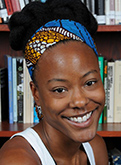

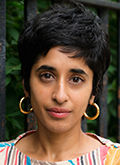 This award, which is named after Robert A. Fox Leadership Professor and former Dean of the College in SAS Dennis DeTurck, recognizes exceptional creativity and innovation in instruction. The 2022 recipient is Grace Sanders Johnson, an assistant professor of Africana studies. Dr. Sanders Johnson brings extraordinary creativity and a penchant for interdisciplinarity and collaborative spirit to her teaching. A student describes the inventive structure of her course “Ships: Modalities of Black Freedom and Escape”—which included theorizing, sewing, dyeing fabric, photography, obtaining a boating license, and sailing—as “a journey where I bonded with peers and harnessed the various devices in the course to re-imagine freedom as a form of art.”
Dean’s Award for Mentorship of Undergraduate Research
This award, which recognizes faculty members who have excelled in nurturing undergraduate students’ desires and abilities to conduct meaningful research, goes to Mechthild “Mecky” Pohlschröder, a professor of biology. For many years, Dr. Pohlschröder has worked to enhance participation of a diverse group of students in biology and STEM, and she recently founded the Penn Freshmen Exposure to Research in Biological Sciences (PennFERBS) program, which aims to achieve educational equity through the integration, establishment, and retention of traditionally underrepresented students in lab research.
Dean’s Award for Distinguished Teaching by an Assistant Professor
This award recognizes a member of the junior faculty who demonstrates unusual promise as an educator. The 2022 recipient is Sukaina Hirji, an assistant professor of philosophy. Colleagues and students describe Dr. Hirji as an educator who has deeply reflected on how to foster a meaningful and inclusive approach to teaching philosophy, one who strives to break down the barriers of access to philosophy for women and students of color through careful scaffolding that allows students of all backgrounds in philosophy to feel confident in her classroom.
Dean’s Award for Distinguished Teaching by Affiliated Faculty

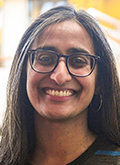 Robert Johnson, a senior lecturer in physics and astronomy, and Rupa Pillai, a senior lecturer in Asian American studies, are the recipients of this award, which recognizes the contributions to undergraduate education made by the school’s associated faculty.
Dr. Johnson’s students praise his ability to connect with them, especially during the pandemic, with “a sense of enthusiasm and caring that was invaluable to me, a student who was generally isolated from campus and my other peers and professors,” says one, while another explains that “Dr. Johnson managed to make the class very appropriate and suited to the difficult circumstances while still making it rigorous, challenging, and enjoyable.”
In addition to bringing her cutting-edge research – including new methodologies in mapping and digital access – into the classroom, Dr. Pillai creates “an intellectually rich and warm space for students to advance and test their ideas,” according to one faculty colleague who observed her class. Dr. Pillai’s students agree, including one who states, “her course gave me confidence to stand up for myself and others like me.”
College of Liberal and Professional Studies Award for Distinguished Teaching in Undergraduate and Post-Baccalaureate Programs

 The recipient of this award, which recognizes teaching excellence in LPS undergraduate programs, is Sukalpa Basu, a lecturer and advisor in the pre-health post-baccalaureate program. Highlighting Dr. Basu’s keen dedication to making her challenging courses in physics and calculus accessible to all learners, a student said, “my last physics class was in high school over ten years ago, and I never imagined physics could be this straightforward and understandable. I fully credit Dr. Basu with providing me, and all her students, with the tools we need to study the physical world.”
College of Liberal and Professional Studies Award for Distinguished Teaching in Professional Graduate Programs
The recipient of this award, which recognizes teaching excellence in LPS graduate programs, is associate professor of practice Lauren Russell, who teaches three core courses for the master of public administration program at the Fels Institute of Government. Dr. Russell is praised as a vital contributor to the Fels academic program and curriculum, and for her dedication to helping students succeed. According to the director of the Fels Institute, Dr. Russell “exemplifies the qualities of a master teacher...this is reflected in her thoughtful planning, her communication with students, her clear and compelling instruction, and her timely and effective feedback for students.”
Dean’s Award for Distinguished Teaching by Graduate Students
This award recognizes graduate students for teaching that is intellectually rigorous and has a considerable impact on undergraduate students. This year’s awardees are:
- Nana Adjeiwaa-Manu, Sociology
- Francesca Bolfo, History of Art
- Erin Busch, Music
- Joseph Coppola, English
- Devin Daniels, English
- Abigail Dym, Political Science
- Angelina Eimannsberger, Comparative Literature
- Christopher Fritschi, Chemistry
- Julian Gould, Mathematics
- Alicia Meyer, English
From the University Leadership: An Update on Campus Masking Policy
April 22, 2022
We are very pleased to let you know that, in alignment with the changes announced earlier today by the City of Philadelphia, our campus will now operate at Protective Measures Level 1. This level means that masks are no longer required in indoor public spaces on campus. They continue to be required in classrooms, healthcare settings, and Penn Transit. We thank you for your continuing patience and partnership, and we look forward to seeing you at our many joyful campus celebrations in the weeks ahead.
—Wendell Pritchett, Interim President
—Beth Winkelstein, Interim Provost
—Craig Carnaroli, Senior Executive Vice President
—J. Larry Jameson, Executive Vice President for the Health System
Class of 2022 President’s Engagement, Innovation, and Sustainability Prize Winners
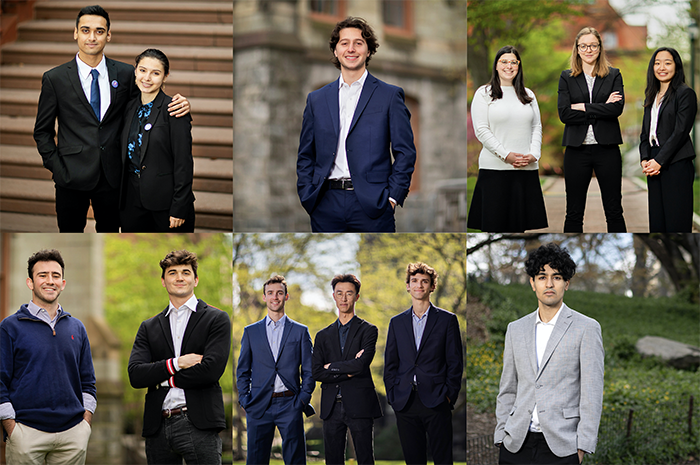
On April 20, University of Pennsylvania Interim President Wendell Pritchett announced the recipients of the 2022 President’s Engagement, Innovation, and Sustainability Prizes. Awarded annually, the prizes empower Penn students to design and undertake post-graduation projects that make a positive, lasting difference in the world. Each Prize-winning project will receive $100,000, as well as a $50,000 living stipend per team member.
Five seniors were named recipients of the 2022 President’s Engagement prize. They are Rowana Miller and Manoj Simha for Cosmic Writers and Seungkwon Son, Max Strickberger, and Sam Strickberger for College Green Ventures. Two seniors have received the President’s Innovation Prize: William Kohler Danon and Lukas Achilles Yancopoulos for Grapevine. Three seniors and two December 2021 graduates received the inaugural President’s Sustainability Prize. They are Saif Khawaja for Shinkei Systems; Sarah Beth Gleeson, Shoshana Weintraub, and Julia Yan for EcoSPIN; and Eli Moraru for The Community Grocer.
“This year’s prize recipients have selflessly dedicated themselves to improving environmental, health, and educational outcomes for others,” said Provost Pritchett. “From empowering young people through free creative writing education to building robotics that minimize fish waste to reducing microfiber pollution in the ocean, these outstanding and inspiring projects exemplify the vision and passion of our Penn students, who are deeply committed to making a positive difference in the world.”
The 2022 prize recipients—selected from an applicant pool of 71 people—will spend the next year implementing the following projects:
Rowana Miller and Manoj Simha for Cosmic Writers: Ms. Miller, a sociology major in the College of Arts and Sciences from New York City, and Mr. Simha, an economics major in the Wharton School from Seattle, will provide equitable opportunities for free creative writing education to K-12 students across the United States, available regardless of socioeconomic background. Their nonprofit, Cosmic Writers, is a transformative tool for developing literacy, communication skills, and a passion for words. They are mentored by Al Filreis, the Kelly Family Professor of English in the School of Arts and Sciences.
Seungkwon Son, Max Strickberger, and Sam Strickberger for College Green Ventures: Mr. Son, a double major in business analytics in the Wharton School and psychology in the College of Arts and Sciences from Allentown, Pennsylvania, along with Max Strickberger, an English major in the College, and Sam Strickberger, an intellectual history major in the College, both from Chevy Chase, Maryland, will build out College Green Ventures, an organization that aims to be a centralized hub for supporting student social entrepreneurs and creating more of them. They are mentored by Tyler Wry, an associate professor of management in the Wharton School.
William Kohler Danon and Lukas Achilles Yancopoulos for Grapevine: Mr. Danon, a history major in the College from Miami, and Mr. Yancopoulos, an environmental studies major in the College of Arts and Sciences and a bioengineering major in the School of Engineering and Applied Science from Yorktown Heights, New York, will work to increase resilience across the healthcare supply chain, with a particular focus on small-to-medium businesses. Grapevine builds upon Mr. Danon and Mr. Yancopoulos’s inspiring work with Pandemic Relief Supply, a venture that delivered $20 million worth of healthcare supplies to frontline workers at the height of the COVID-19 pandemic. They are mentored by David F. Meaney, the Solomon R. Pollack Professor of Bioengineering and senior associate dean of Penn Engineering.
Saif Khawaja for Shinkei Systems: Mr. Khawaja, a December 2021 graduate of the Wharton School from Dubai, will continue to grow his startup, Shinkei Systems, which builds robotics that minimize fish waste and multiply shelf-life. Shinkei’s robotics automate humane Japanese slaughter techniques—similar to kosher or halal practices for cattle—to ensure that every fish makes it to a plate at top quality. Mr. Khawaja is mentored by Jacqueline Kirtley, an assistant professor of management in the Wharton School.
Sarah Beth Gleeson, Shoshana Weintraub, and Julia Yan for EcoSPIN: Ms. Gleeson, from Lexington, Kentucky; Ms Weintraub, from Bala Cynwyd, Pennsylvania; and Ms. Yan, from Cary, North Carolina; are materials science and engineering majors in the School of Engineering and Applied Science. They are pioneering EcoSPIN, an innovative device that captures microfibers at their laundry point source, protecting oceans and waterways. They are mentored by Karen I. Winey, the Harold Pender Professor of Materials Science and Engineering in the department of chemical and biomolecular engineering in Penn Engineering.
Eli Moraru for The Community Grocer: Mr. Moraru, a December 2021 graduate of the College of Arts and Sciences from Washington, D.C., will continue to work on The Community Grocer, a Philadelphia-based nonprofit organization reimagining nutritional assistance to promote health equity and fight food insecurity. He is mentored by Akira Drake Rodriguez, an assistant professor in the Stuart Weitzman School of Design’s department of city and regional planning.
This year’s finalists also included the following seniors: Bema Boateng for Project Reignite the Light, a program designed to improve mental health literacy in Ghana; Hector Cure and Saskia Wright for Acción para la Reincorporación Profesional, a program to help demobilized women in Colombia; and Joshua Kim, John Ta, and Myahn Walker for CommuniHealth, a community health care partnership in Philadelphia.
“These inspiring projects exemplify the wide range of interests that energize our great Penn students and faculty,” said Interim Provost Beth A. Winkelstein. “They aim to make a tangible difference in people’s lives, bringing our shared commitments to social justice, intellectual creativity, and entrepreneurial drive to some of the world’s most urgent challenges. We are indebted to the faculty advisors and the Center for Undergraduate Research and Fellowships, who worked closely with our students to develop their exciting and innovative initiatives.”
The prizes are generously supported by Emerita Trustee Judith Bollinger and William G. Bollinger, in honor of Ed Resovsky; Emerita Trustee Lee Spelman Doty and George E. Doty, Jr.; Emeritus Trustee James S. Riepe and Gail Petty Riepe; Trustee David Ertel and Beth Seidenberg Ertel; Trustee Ramanan Raghavendran; Wallis Annenberg and the Annenberg Foundation; and an anonymous donor.
Of Record: Rules Governing Final Examinations
The Rules Governing Final Examinations govern final examinations at the University of Pennsylvania. These rules are published each semester as a reminder to the academic community.
The spring 2022 Final Examination schedule is available at https://srfs.upenn.edu/registration-catalog-calendar/final-exams. Students should confirm the exam format and time with their instructors for all courses.
1. No instructor may hold a final examination nor require the submission of a take-home final exam except during the period in which final examinations are scheduled; when necessary, exceptions to this policy may be granted for postponed examinations (see 3 and 4 below). No final examinations may be scheduled during the last week of classes or on reading days.
2. No student may be required to take more than two final examinations on any calendar day during the period in which final examinations are scheduled. If more than two are scheduled, the student may postpone the middle exam. If a take-home final exam is due on a day when two final examinations are scheduled, the take-home exam shall be postponed by one day.
3. Examinations that are postponed because of conflicts with other examinations, or because more than two examinations are scheduled on the same day, may be taken at another time during the final examinations period if the faculty member and student can agree on that time. Otherwise, they must be taken during the official period for postponed examinations.
4. Examinations that are postponed because of illness, a death in the family, for religious observance or some other unusual event may be taken only during the official periods: the first week of the spring and fall semesters. Students must obtain permission from their Dean’s office to take a postponed exam. Instructors in all courses must be willing to offer a make-up examination to all students who are excused from the final examination.
5. No instructor may change the time or date of a final exam without permission from the appropriate Dean.
6. No instructor may increase the time allowed for a final exam beyond the scheduled two hours without permission from the appropriate Dean.
7. No classes or required class activities may be held during the reading period.
8. The first examination of the day begins at 9 a.m. and the last examination concludes by 8 p.m. There will be one hour between exam time blocks.
9. All students must be allowed to see their final examination. Exams should be available as soon as possible after being graded with access ensured for a period of at least one regular semester after the exam has been given. To help protect student privacy, a student should have access only to their own exam and not the exams of other students. Therefore, for example, it is not permissible to leave student exams (or grades or papers) in publicly accessible areas.
10. Students may not be asked for their Social Security numbers. Instructors may not publicly display a student’s Penn ID or any portion of the Social Security number, nor use names, initials or any personally identifiable information to post grades. Even when an identifier is masked or absent, grades may not be posted in alphabetical order, to protect student privacy.
11. Final exams for College of Liberal and Professional Studies (LPS) courses must be given on the regular class meeting night during the week of final examinations. No change in scheduling is permitted without unanimous consent of all students in the class and the director of LPS. LPS final exams may not be administered during the last week of class or on a reading day.
In all matters relating to final exams, students with questions should first consult with their Dean’s office. Faculty wishing to seek exceptions to the rules also should consult with their Dean’s office.
—Beth A. Winkelstein, Interim Provost