University of Pennsylvania Provost Wendell Pritchett recently announced the appointment of Zoë Ryan as the new Daniel W. Dietrich, II Director of the Institute of Contemporary Art (ICA), effective November 5.
Ms. Ryan is a world-renowned curator and scholar who is currently John H. Bryan Chair and Curator of Architecture and Design at the Art Institute of Chicago. She has been at the Art Institute since 2006, when she was appointed the inaugural Neville Bryan Curator of Design, following six years at the Van Alen Institute in New York. An expert in architecture and design and their impact on evolving social and cultural contexts, she has focused at the Art Institute on building the museum’s collection of 20th- and 21st-century architecture and design with work that expands definitions of these fields, emphasizes cross-disciplinary ideas, and recognizes overlooked figures and narratives. This culminated in the major 2017 installation, Past Forward: Architecture and Design at the Art Institute.
“Zoë Ryan embodies our great Penn spirit of wide-ranging curiosity, of informing contemporary practices with their deep roots in history and theory, and of understanding how art profoundly impacts—and is profoundly impacted by—its social contexts,” said Provost Pritchett. “Her vibrant scholarship and inclusive leadership will make her a transformative leader of ICA in the essential years ahead. I am very grateful to John McInerney, who has served with extraordinary grace and distinction as interim director of ICA; the invaluable ICA staff, who are sustaining ICA’s historic mission even in this challenging year; and the consultative committee, chaired by Professor Anita Allen, whose insightful and judicious work helped us arrive at this exciting result.”
Ms. Ryan’s appointment follows a yearlong search led by the Museum’s search committee and Russell Reynolds Associates, which was chaired by Anita Allen, the Henry R. Silverman Professor of Law and professor of philosophy at the University of Pennsylvania Law School and until recently Penn’s vice provost for faculty.
Taking an interdisciplinary approach to her work, Ms. Ryan has led landmark exhibitions such as the acclaimed In a Cloud, in a Wall, in a Chair: Six Modernists in Mexico at Midcentury, uniting the work of designers and artists Clara Porset, Lola Álvarez Bravo, Ruth Asawa, Anni Albers, Cynthia Sargent, and Sheila Hicks; As Seen: Exhibitions that Made Architecture and Design History, the first show and publication to explore in depth the critical role of exhibitions in shaping architecture and design practice; and retrospectives on architects including David Adjaye, Studio Gang, and Bertrand Goldberg. In 2018 she established the Franke/Herro Design Series to highlight emerging talent, such as Max Lamb, Christien Meindertsma, and the Ambiguous Standards Institute. In 2014, she curated the second Istanbul Design Biennial, The Future Is Not What It Used to Be, and was named that year as a fellow of the Center for Curatorial Leadership. She has taught graduate seminars on design history and theory at the School of the Art Institute of Chicago and the University of Illinois at Chicago; is an executive committee member of the International Confederation of Architectural Museums (ICAM); was the jury chair for the National Design Awards at the Cooper Hewitt Smithsonian National Design Museum; served on the curatorial advisory committee for the U.S. Pavilion at the Venice Architecture Biennale in 2012 and 2018; and was named by Fast Company Magazine as one of the 50 People Shaping the Future of Design. She earned a master’s degree in art history from Hunter College, The City University of New York, and a bachelor’s degree in art history from University of Sussex.
“ICA’s Board of Overseers is delighted to welcome Zoë Ryan as the institution’s new director,” said David E. Simon, board chair and co-chair of the search committee. “I have been tremendously impressed by her achievements and leadership in the curatorial field, her passion for contemporary art, and her ability to connect and effectively engage with diverse constituencies. I know that she will bring great vitality and enthusiasm to ICA’s mission to inform and inspire through the power of art and artists.”
“I am incredibly honored to join the ICA, an institution that has long championed under-recognized artists, diverse narratives, and a breadth of artistic practices,” said Ms. Ryan. “I look forward to collaborating with the team at ICA, Penn’s students, faculty, and staff, and the broader community, to build on the ICA’s rich history as an inclusive, expansive, and vital center for interdisciplinary art. At this transformative moment in history and for the field, I’m eager to continue to shape the ICA as a crucial platform for engaging with the issues and ideas of our time through a critical and creative lens.”
The vision set by ICA’s founder, former dean of GSFA (1951-1971, now known as the Weitzman School), G. Holmes Perkins, in 1963 comes full circle with Ms. Ryan’s work in architecture and design only furthering ICA’s international reputation as a preeminent venue for contemporary art and culture.
Emily Wilson: Endowing a Fund to Support Students in Classical Studies

 Emily Wilson, College for Women Class of 1963 Term Professor in the Humanities, made a gift to endow a fund supporting students enrolled in the post-baccalaureate program in the Department of Classical Studies. The Elsie Phare Fellowship will provide tuition support for a student from a group underrepresented in classical studies.
Penn’s post-baccalaureate program in classical studies prepares students to enter doctoral programs in classical studies, ancient history, and related fields. It is the oldest classical studies post-baccalaureate program in the country and has historically been a bridge for people from a variety of backgrounds to gain access to advanced study and professional opportunities.
Dr. Wilson commented, “Classical studies and ancient history as fields are historically and presently extremely white and dominated by people with certain kinds of privilege. If everybody who’s in the field of study is more or less the same demographically, we can get into stale narratives. In terms of intellectual life, as well as social justice, there needs to be a lot more diversity than there is.”
Peter Struck, professor and chair of Classical studies, says, “Increasing the intellectual diversity in our field is a priority. Emily’s generous gift promises to have an outsized impact on future generations who study the ancient Mediterranean and the many and complicated ways it continues to influence our world.”
Dr. Wilson named the fund after her grandmother, Elsie Phare, who was one of the first generation of women to study at University of Cambridge, in an era when Cambridge did not grant women degrees. “My grandmother came from a working-class background,” said Dr. Wilson. “Without a scholarship, she would not have had access to an educational experience that was transformative for her. I’d like the Elsie Phare Fund to create a new path for people, like her scholarship did for her.”
Ms. Phare went on to be a writer and teacher and was awarded Cambridge’s Seatonian Prize for religious poetry in 1935 and 1938. Her translation of Molière’s The Misanthrope was performed in London in 1937 and she was a leading contributor to the study of the poet Andrew Marvell.
Dr. Wilson has been teaching at Penn since 2002 and is the graduate chair of the Comparative Literature and Literary Theory program. Her 2017 translation of Homer’s Odyssey received widespread acclaim, and she was named 2019 MacArthur Fellow by the John D. and Catherine T. MacArthur Foundation (Almanac October 1, 2019). She earned her PhD in classics and comparative literature from Yale University, and her master’s and bachelor’s degrees from Oxford University.
Strengthening Cultural Protection with a Memorandum of Understanding
On August 12, the Assistant Secretary of State for Educational and Cultural Affairs Marie Royce and Williams Director of the University of Pennsylvania Museum of Archaeology and Anthropology Julian Siggers signed a Memorandum of Understanding to establish a new public-private partnership. Under this partnership, the Department of State and the Penn Cultural Heritage Center will cooperate to combat international cultural property trafficking.
The memorandum stated:
The United States is unwavering in its commitment to protect and preserve cultural heritage around the world and to combat the trafficking in cultural property that funds criminal and terrorist networks. This new partnership will facilitate consultations between U.S. law enforcement officials from the Federal Bureau of Investigation, Homeland Security Investigations, and U.S. Customs and Border Protection and experts in archaeology and art history when expertise is needed during the course of investigations. Experts from the faculty and staff of the University of Pennsylvania and other relevant universities, museums, libraries, archives, and nonprofit organizations will also participate.
The U.S. Government’s Cultural Heritage Coordinating Committee member agencies have repatriated more than 20,000 cultural objects to more than 45 different countries and supported nearly 100 training programs in the United States and overseas.
For more information, visit the Cultural Heritage Center website at https://eca.state.gov/cultural-heritage-center/ and the Penn Cultural Heritage Center at https://www.penn.museum/sites/chc
FY 2020 Annual Disciplinary Report for the University of Pennsylvania
To the University Community:
The Office of Student Conduct and the Office of the AVP for Equity and Title IX Officer are committed to preparing a report for the University community each summer that includes information regarding the type of violations and the sanctions imposed for cases opened and resolved during FY2020. Once again, we are providing our report to the University community.
—Julie Nettleton, Director, Office of Student Conduct
—Michele Rovinsky-Mayer, AVP for Equity and Title IX Officer
|
Incident Type (by respondents)
|
Academic Year
2016-2017
|
Academic Year
2017-2018
|
Academic Year
2018-2019
|
Academic Year
2019-2020
|
|
Academic Integrity (total)
|
227
|
210
|
208
|
244
|
|
Undergraduate
|
199
|
167
|
150
|
188
|
|
Graduate/Professional
|
28 |
43 |
58 |
58 |
| Student Conduct (total) |
180 |
88 |
166 |
77 |
| Undergraduate |
161 |
71 |
152 |
69 |
| Graduate/Professional |
19 |
18 |
14 |
8 |
| Academic Integrity and Student Conduct (total) |
1 |
0 |
1 |
1 |
| Undergraduate |
1 |
0 |
1 |
1 |
| Graduate/Professional |
0 |
0 |
0 |
0 |
| Cases Resolved via Restorative Practices (Non-Case Related)* |
16 |
16 |
24 |
174 |
| Group Cases (Students Organizations/Fraternities/etc)** |
3 |
3 |
7 |
7 |
| TOTAL: |
427 |
317 |
406 |
503 |
*During FY20, the OSC hired a full-time Associate Director of Restorative Practices who collaborates with campus partners to resolve student conflicts as appropriate.
See participant numbers below under “Sanctions: Student Conduct.”
**Group Cases include several individuals but are being counted as one respondent.
^On March 14, 2020 the University shifted to remote operation due to the COVID-19 pandemic.
|
Case Investigations: Academic Integrity***
|
Academic Year
2016-2017
|
Academic Year
2017-2018
|
Academic Year
2018-2019
|
Academic Year
2019-2020
|
|
Plagiarism
|
122 |
104 |
73 |
51 |
|
Unauthorized collaboration/use of another person’s work
|
95 |
44 |
34 |
63 |
|
Misconduct during an exam
|
16 |
33 |
12 |
15 |
|
Submission of false data
|
5 |
3 |
1 |
0 |
|
Falsification of grades or transcripts
|
2 |
1 |
0 |
1 |
|
Other academic violation
|
6 |
6 |
3 |
2 |
|
Altering of exam/paper for re-grade
|
6 |
5 |
3 |
2 |
|
Misrepresentation of academic records
|
1 |
1 |
0 |
0 |
|
Provided information to another student
|
2 |
0 |
0 |
0 |
|
Cheating
|
60 |
24 |
52 |
89 |
|
Fabrication
|
1 |
1 |
0 |
0 |
|
Multiple submission
|
0 |
1 |
1 |
2 |
|
Facilitating academic dishonesty
|
23 |
28 |
34 |
13 |
|
Unfair advantage over fellow students
|
12 |
4 |
3 |
5 |
|
Case Investigations: Student Conduct***
|
Academic Year
2016-2017
|
Academic Year
2017-2018
|
Academic Year
2018-2019
|
Academic Year
2019-2020
|
|
Alcohol violation: First offense
|
41 |
32 |
4 |
0 |
|
Alcohol violation: Other
|
21 |
2 |
18 |
22 |
|
Assault
|
3 |
5 |
13 |
0 |
|
Attempted theft
|
0 |
0 |
0 |
0 |
|
Burglary
|
2 |
0 |
0 |
0 |
|
Disorderly conduct
|
44 |
27 |
11 |
7 |
|
Drug violation
|
7 |
1 |
2 |
0 |
|
Fire code violation
|
1 |
9 |
2 |
0 |
|
Forgery
|
0 |
0 |
0 |
0 |
|
Fraud
|
3 |
0 |
2 |
0 |
|
Fraudulent use of Penn ID
|
0 |
3 |
0 |
0 |
|
Harassment (not sexual harassment which is listed separately below)
|
0 |
0 |
2 |
0 |
|
Indecent exposure
|
4 |
0 |
0 |
0 |
|
Malicious mischief
|
4 |
1 |
0 |
0 |
|
Miscellaneous security violations
|
0 |
0 |
0 |
0 |
|
Disturbance/investigation of person
|
0 |
0 |
0 |
0 |
|
Relationship Violence
|
2 |
7 |
2 |
0 |
|
Retail theft/shoplifting
|
0 |
1 |
1 |
0 |
|
Sexual harassment
|
5 |
1 |
4 |
4 |
|
Sexual violence
|
10 |
9 |
6 |
6 |
|
Stalking
|
3 |
0 |
0 |
0
|
|
Theft
|
2 |
2 |
2 |
0 |
|
Trespassing
|
7 |
1 |
3 |
2 |
|
Vandalism
|
31 |
2 |
5 |
1 |
|
Other conduct violation
|
43 |
17 |
60 |
28 |
|
Propulsion of object
|
0 |
0 |
0 |
0 |
|
Receiving stolen property
|
0 |
0 |
0 |
0 |
|
Use or possession of fake ID card
|
9 |
1 |
12 |
0 |
|
Recklessly endangering another person
|
0 |
1 |
0 |
0 |
|
Hazing
|
16 |
0 |
3 |
5 |
|
Terroristic threats
|
6 |
0 |
0 |
0 |
|
Use or possession of air guns/firearms/dangerous articles
|
0 |
0 |
0 |
0 |
|
Threats
|
0 |
0 |
6 |
0 |
|
Violation of safety regulations
|
0 |
0 |
0 |
0 |
|
Dangerous articles in residences
|
0 |
0 |
0 |
0 |
|
Noise violation
|
0 |
0 |
0 |
0 |
|
Threats with dangerous article
|
0 |
0 |
0 |
0 |
|
Computer violation/unethical behavior in the digital environment
|
41 |
11 |
27 |
0 |
|
Violation of agreement
|
0 |
1 |
0 |
4 |
|
Misrepresentation of status to the University
|
1 |
0 |
0 |
0 |
***Number of case investigations does not equal the number of respondents because some cases involve more than one type of misconduct.
|
Sanctions: Academic Integrity****
|
Academic Year
2016-2017
|
Academic Year
2017-2018
|
Academic Year
2018-2019
|
Academic Year
2019-2020
|
|
Academic support
|
79 |
86 |
118 |
57 |
|
Apology
|
4 |
5 |
15 |
0 |
|
Counseling
|
4 |
12 |
10 |
11 |
|
Decision-Making Tree*****
|
n/a |
n/a |
n/a |
47 |
|
Essay
|
134 |
90 |
105 |
55 |
|
Meet with appropriate person related to charge
|
5 |
1 |
0 |
1 |
|
Expulsion
|
0 |
0 |
0 |
0 |
|
Notation on transcript
|
1 |
2 |
0 |
0 |
|
Other (specialized)
|
3 |
2 |
9 |
1 |
|
Probation
|
49 |
13 |
19 |
34 |
|
Reprimand
|
62 |
82 |
77 |
53 |
|
Suspension
|
4 |
6 |
9 |
7 |
|
Suspension not imposed
|
25 |
26 |
32 |
12 |
|
Warning
|
39 |
34 |
75 |
32 |
|
Withdraw permanently from the University
|
0 |
3 |
1 |
0 |
|
Withheld/Delayed Degree
|
6 |
5 |
4 |
4 |
|
Sanctions: Student Conduct****
|
Academic Year
2016-2017
|
Academic Year
2017-2018
|
Academic Year
2018-2019
|
Academic Year
2019-2020
|
|
Resolved Through Restorative Practices^^
|
n/a |
n/a |
n/a |
42 |
|
Alcohol and drug education/evaluation
|
12 |
45 |
11 |
2 |
|
Alcohol/drug fine
|
0 |
0 |
0 |
0 |
|
Apology
|
3 |
58 |
6 |
0 |
|
CAPS substance abuse evaluation
|
3 |
0 |
0 |
3 |
|
Community services
|
46 |
41 |
28 |
0 |
|
Counseling
|
4 |
9 |
7 |
5 |
|
Essay
|
40 |
9 |
40 |
5 |
|
Expulsion
|
2 |
0 |
0 |
0 |
|
File sharing educational module
|
40 |
11 |
27 |
0 |
|
File sharing fine
|
0 |
0 |
0 |
0 |
|
Meet with appropriate person related to charge
|
1 |
2 |
1 |
0 |
|
No contact
|
2 |
4 |
12 |
8 |
|
Notation on transcript
|
0 |
5 |
0 |
0 |
|
Other (specialized)
|
18 |
51 |
7 |
6 |
|
Probation
|
20 |
4 |
7 |
6 |
|
Reprimand
|
24 |
61 |
27 |
3 |
|
Restitution
|
4 |
0 |
0 |
0 |
|
Suspension
|
5 |
3 |
1 |
2 |
|
Suspension not imposed
|
7 |
1 |
2 |
6 |
|
Warning
|
18 |
12 |
27 |
3 |
|
Withdraw permanently from the university
|
0 |
0 |
1 |
0 |
|
Withhold/Delay Degree
|
2 |
4 |
1 |
0 |
****Number of Sanctions does not equal the number of respondents because some cases result in more than one type of sanction.
*****The Decision-Making Tree is a new educational sanction that offers a structured learning opportunity in lieu of essay writing.
^^New category as of FY20. Restorative Practices involve consequences that are determined during the process rather than the student disciplinary system.
|
Mode of Resolution of Cases
|
Academic Year
2016-2017
|
Academic Year
2017-2018
|
Academic Year
2018-2019
|
Academic Year
2019-2020
|
|
Signed Agreement
|
279 |
254 |
228 |
168 |
|
Resolved by Hearing
|
5 |
6 |
3 |
2 |
|
No formal disciplinary action/no policy violation or informal resolution
|
66 |
20 |
57 |
13 |
|
Restorative Practices (Total Case-Resolution and Non-Case Resolution)
|
8 |
8 |
77 |
216 |
|
Unresolved******
|
21 |
10 |
14 |
10 |
******Unresolved can mean that a student is no longer a member of the Penn community, that the investigation is on-going, or that a determination has been made, but no agreement has been reached.
Transformational Gift from Warren Lichtenstein, C’87 to Name Baseball Facility Tommy Lasorda Field at Meiklejohn Stadium

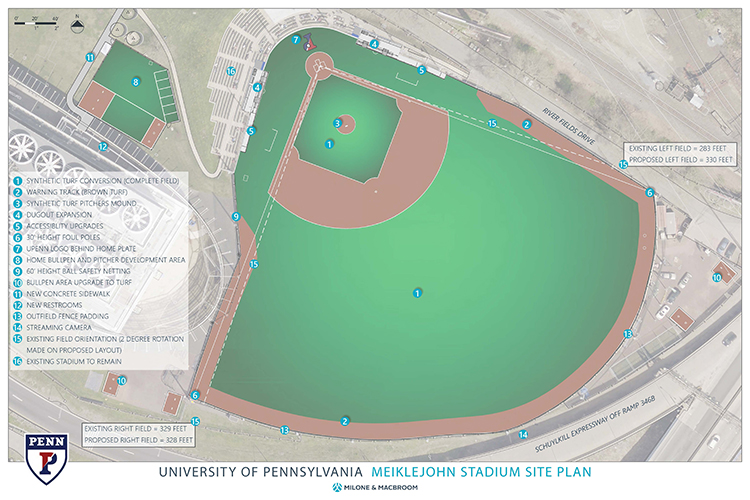
 The Division of Recreation and Intercollegiate Athletics at the University of Pennsylvania is thrilled to announce a transformational gift of more than $2 million from Warren Lichtenstein, C’87, to help fund capital upgrades at the home of Penn Baseball. As a result of his generosity, Penn Athletics is excited to share that once Phase I of the renovation is complete, the playing surface will be known as Tommy Lasorda Field at Meiklejohn Stadium, named after the Baseball Hall of Fame inductee from Norristown, PA, who won two World Series titles while managing the Los Angeles Dodgers.
Through a portion of his gift, Mr. Lichtenstein has created a matching fund in the hopes that others will be inspired to get involved. He will match dollar-for-dollar any contribution to the stadium project up to $2,050,000, creating the $4,100,000 necessary to complete Phase I of the project. All gifts can be completed over a five-year pledge schedule. As a result of Mr. Lichtenstein’s matching gift, naming opportunities associated with the project are available at half the gift level that was initially required.
“We are incredibly grateful for Warren’s generosity in honor of his dear friend Tommy Lasorda,” said M. Grace Calhoun, the T. Gibbs Kane, Jr. W’69 Director of Athletics and Recreation. “Once Warren’s gift is matched, we will be able to upgrade the baseball facility to include artificial turf and enhance the student-athlete experience in a number of ways to help us compete for Ivy League championships. We are confident that our alumni community, and the greater baseball community, will step up to the plate to improve our student-athlete experience and honor Mr. Lasorda.”
Mr. Lichtenstein is motivated to conduct this challenge and honor his dear friend as a result of the incredible character, grit and growth mindset that Mr. Lasorda has displayed throughout his life as a player, a manager and perhaps most importantly, as a mentor to so many. “Tommy Lasorda has been a great mentor and coach and he has touched the lives of so many people around the world as the greatest ambassador for the game of baseball and the Dodgers,” said Mr. Lichtenstein. “Tommy and the Lasorda family have meant so much and done so much for Norristown and the state of Pennsylvania that it is only fitting to name Penn’s baseball field for him.”
Mr. Lasorda’s accomplishments in baseball are numerous, beginning with his 1997 induction into the National Baseball Hall of Fame in Cooperstown, N.Y. He led the Dodgers to World Series titles in 1981 and 1988 and was a two-time National League Manager of the Year. Mr. Lasorda became the first manager to win a World Series championship and an Olympic gold medal when he led the United States’ baseball team to gold at the 2000 Summer Games in Sydney, Australia. Originally signed by the Philadelphia Phillies in 1945, Mr. Lasorda reached the big leagues as a pitcher with the Brooklyn Dodgers in 1954.
“I am honored to have a baseball field named after me in my home state of Pennsylvania and at the University of Pennsylvania,” said Mr. Lasorda. “I am most thankful to my great friend, Warren Lichtenstein, and everyone at the University of Pennsylvania, for this unbelievable tribute and honor.” Mr. Lasorda, who resides in Fullerton, California and is 92, just celebrated his wife, Jo’s, 90th birthday. The two have been married for 70 years and Mr. Lasorda has been with the Dodgers organization 71 years.
Upgrades in Phase I of this project include a brand new fully turfed field, renovated dugouts, a re-orientation of the field, updated protective netting at the field, and a permanent restroom facility. Updates in Phase II include a pitcher development area. The matching gift is only focused on Phase I and Penn Athletics will accept pledges for Phase II once Phase I is completely funded.
“I want to thank Warren for his generosity and invaluable contribution to the Penn baseball program,” said John Yurkow, Penn’s current W. Joseph Blood Head Coach of Baseball. “Current and future teams will be positively impacted by these enhancements, which will serve a key role in player development moving forward. Tommy has touched countless players and coaches throughout his impressive career, and I am honored that our field will be named after such a pivotal figure in the baseball community. I’m excited to see the positive momentum of the program continue and this gift will help to solidify Penn as a top team in the region.”
For more information about the project, including various naming opportunities, contact Tim McLaughlin in the Penn Champions Club at (215) 573-5350 or at tmclau@upenn.edu
PennOpen Pass: A Collective Responsibility
We share a collective responsibility to protect ourselves and each other from COVID-19. PennOpen Pass is a daily symptom tracker designed to reduce the risk of COVID-19 spreading within the Penn community. PennOpen Pass enables early detection of COVID-19 by:
- Identifying individuals whose health may be at risk or may pose health risks to others,
- Supporting those individuals to receive assistance, which may include COVID-19 testing, self-isolation, contact tracing, and medical care, and
- Monitoring trends related to COVID-19 to enable timely allocation of resources for campus health and safety.
Throughout the summer, schools and centers have introduced PennOpen Pass to their faculty, students, postdocs, and staff. After a one-time enrollment process, users complete a quick, web-based survey each day. Users who report no symptoms and no recent contact with someone who may have COVID-19 get a Green Pass. Users who receive a Red Pass are directed to assistance and follow up tailored to their individual needs.
Faculty, students, postdocs, and staff with PennKey or UPHS credentials and visitors, vendors, and contractors are currently supported to use the tool.
Faculty, students, postdocs, and staff returning to campus are required to complete daily symptom checks using PennOpen Pass. Symptom checks must be completed before the start of each day, including on weekends, to reduce the risk that any COVID-19 case could lead to an outbreak. Daily symptom tracking enables PennOpen Pass to act as an early warning system of potential COVID-19 infections on campus. If COVID-19 cases are diagnosed, clinical staff and contact tracers will respond quickly to contain spread and connect individuals at risk to care in an expedited manner.
For persons working or learning remotely 100% of the time, PennOpen Pass can provide access to expedited clinical guidance should a need arise.
Visitors, vendors, and contractors are required to complete symptom checks using PennOpen Pass on the days they visit campus. Visitors, vendors, or contractors who routinely report to campus should use PennOpen Pass on a daily basis.
We share a collective responsibility to protect ourselves and each other, and it will take participation from all to help slow the spread of this disease. When you wear a face covering, practice physical distancing, and complete your daily symptom check on PennOpen Pass, you promote the health and safety of everyone around you and advance Penn’s mission of excellence in education, research, and patient care.
For information on how it works, answers to frequently asked questions, the privacy policy, and other resources, visit the PennOpen Pass website at https://pennopen.med.upenn.edu/
—Penn Wellness
Weitzman School: Green New Deal Superstudio
In 2019, Representative Alexandria Ocasio-Cortez and Senator Ed Markey introduced H.R. 109, a non-binding resolution “Recognizing the duty of the Federal Government to create a Green New Deal”—a framework for future legislation that builds resiliency against climate change-related disasters, repairs and upgrades the infrastructure of the U.S. In response, Billy Fleming, Wilks Family Director of The Ian L. McHarg Center for Urbanism and Ecology, led an interdisciplinary studio in which he asked students from the departments of landscape architecture and city and regional planning to give form and visual clarity to the scale, scope, and pace of transformation that the Green New Deal implies.
Now, The McHarg Center at Weitzman is partnering with The Landscape Architecture Foundation (LAF), the Center for Resilient Cities and Landscapes, the American Society of Landscape Architects (ASLA), and the Council of Educators in Landscape Architecture (CELA) to launch The Green New Deal Superstudio, an open call for designs that spatially manifest the principles and policy ideas of the Green New Deal with regional and local specificity.
The goal of the Superstudio is to create and assemble work that translates the core goals of the Green New Deal—decarbonization, justice, and jobs—into design and planning projects for the respective regions of the contributors. LAF notes that entries “can cross the spectrum from small- to large-scale and along a gradient from conceptual to ‘shovel ready.’ However, all must address decarbonization, justice, and jobs per the goals of the Green New Deal.
Superstudio participants will join a collaborative network of other participating studios that will have access to a design brief and supporting resources such as lectures, roundtable discussions, and reviews. The concepts and dialogue produced through the Superstudio will be catalogued as part of a curated collection to form a national vision for the Green New Deal that can support policymakers and advocates to advance Green New Deal ideas and approaches. The Superstudio projects will also inform a national conversation on policy and design at a summit convened by the Landscape Architecture Foundation in September 2021. All eligible submittals will be archived and used to form a curated collection for potential exhibits, articles, or content for congressional readership.
Participation in the Superstudio is open to graduate and undergraduate programs of landscape architecture, architecture, planning, and related fields as well as professional practices and individuals in these fields. Participants may also build teams and/or collaborate with other professions or academic programs and disciplines, community organizations, local firms, and other stakeholders. The approach, types of projects, pedagogical method, and how the projects manifest the ethos of the Green New Deal are at the discretion of each studio.
The Superstudio began on August 1, 2020 and will run through June 30, 2021. Universities may participate in the Superstudio in the fall semester of 2020 and/or the spring semester of 2021. Other groups and individuals may participate on their own timeline as long as work is submitted by the June 30 deadline. (Green New Deal studios that took place before this call are encouraged to submit prior work.)
All studios that wish to participate must register in order to join the network of other participating studios and receive access to Superstudio resources, events, and opportunities. Final materials from the studios must be submitted by June 30, 2021.
For more information and to register, visit: www.lafoundation.org/superstudio
To learn about the proposals produced in the Weitzman studio in the fall of 2019, visit the department’s issuu page, https://issuu.com/pennplanning/docs/gnd_studio_report_v2


 Céline Apollon and Jazmin Diaz have been selected for the Moelis Scholars Program in the department of city and regional planning at the Weitzman School. Established in 2019 through the leadership of Ron Moelis (C’78 W’78), the Program prepares students with a commitment to diversity to be the next generation of leaders in the field of urban planning (