News

$2 Million Gift from Amy Gutmann and Michael Doyle: Gutmann Leadership Scholars Program at Penn Nursing

caption: Amy Gutmann and Michael DoyleUniversity of Pennsylvania President Amy Gutmann and her husband Michael Doyle have a made a $2 million gift to the University of Pennsylvania School of Nursing’s Innovating for Life and Living Campaign, as part of the University’s Power of Penn Campaign.  The gift, which brings the couple’s total giving to Penn to $4.5 million, will create the Gutmann Leadership Scholars Program at Penn Nursing.

The newly endowed program will select and fund 10 scholars annually across undergraduate and graduate degree-levels, creating new cohorts of leaders at Penn who are prepared to deliver exceptional care, locally and in communities around the world. The program will have immediate impact, launching in January 2021, with new scholars selected every year, in perpetuity. Scholarship candidates will be selected by Penn Nursing Professor and Margaret Bond Simon Dean of Nursing, Antonia Villarruel, and a specially appointed admissions committee. Selection criteria will prioritize diversity, first-generation status, high academic achievement, demonstrated leadership potential, and an expressed desire to make a lasting impact in underserved urban and rural communities.

“Philadelphia, our country, and the world desperately need more nurses and nursing leaders,” said President Gutmann. “Nurses consistently rank among the most trusted professionals, and it is a trust eminently well-earned through their compassion, strength, and selfless dedication to improving and saving lives. Serving on the front lines of healthcare, they are heroes in the effort to contain and defeat the COVID-19 virus.They are also key to making high-quality healthcare both universal and affordable. Michael and I want to do our part to support the most talented and diverse nursing students who are eager to serve in urban and rural areas that need them most. We fervently hope that our gift will inspire others to join us in supporting Penn Nursing, the top-ranked nursing school in our country and the world.”

Penn Nursing’s leadership in innovation and reputation as a trusted partner is unparalleled. In addition to its number one ranking in the world for five years in a row, it is also the top ranked nursing school in funding from the National Institutes of Health, and its faculty comprise a higher percentage of both Fellows in the American Academy of Nursing and members of the National Academy of Medicine than any other peer institution. With alumni living in more than 50 countries around the world, the program’s newly-minted scholars will join a vast network with an ever-growing legacy of global impact.

“The value of nursing has never been more evident than it is today as we grapple with the dual pandemics of Covid-19 and systemic racism,” said Dean Villarruel. “When the World Health Organization designated 2020 as the Year of the Nurse and Midwife, it affirmed the critical importance of nursing, while calling for renewed investments in nursing education and leadership. I am beyond proud and honored that Amy Gutmann and Michael Doyle are leading by example in the establishment of the Gutmann Leadership Scholars Program at Penn Nursing. It is an unprecedented demonstration of support for Penn Nursing and for nurses around the world.”

Dr. Gutmann is the 8th President of the University of Pennsylvania, serving since 2004, and is the Christopher H. Browne Distinguished Professor of Political Science in the School of Arts and Sciences. Dr. Doyle is a University Professor at Columbia University’s School of International and Public Affairs. Together, they have a longstanding commitment to financial aid, including creating the Amy Gutmann and Michael Doyle Endowed Scholarship to support undergraduates who would otherwise be unable to meet the cost of a Penn education, and the Amy Gutmann and Michael Doyle President’s Men and Women of Pennsylvania Challenge Fund to encourage additional endowment gifts to support undergraduate scholarships at the University. They also established the Amy Gutmann and Michael Doyle Research Opportunities Endowment Fund for undergraduates and have supported The Penn Fund and a variety of other areas throughout the University.

$1.5 Million Gift from Alums to Establish Arifa Hasan Ahmad and Nada Al Shoaibi Presidential Professorship

Hyder Ahmad, W’90, parent, and Faisal S. Al Shoaibi, W’90, jointly endowed a Presidential Professorship with a gift of $1.5 million, including matching funds. The gift establishes the Arifa Hasan Ahmad and Nada Al Shoaibi Presidential Professorship, to be held by a faculty member in Penn Arts & Sciences with a preference for a scholar focused on data science. The professorship is named in honor of their mothers.

Presidential Professorships are awarded to exceptional scholars at any rank. Selected on the basis of their achievements, with an emphasis on enhancing the diversity of Penn’s faculty, Presidential Professors enrich the academic community and bring new perspectives to our students and faculty.

“Diverse voices are needed in classic and cutting-edge fields of study to broaden our perspectives and lead us to new frontiers of knowledge,” says Penn President Amy Gutmann. “I am grateful that Hyder and Faisal have come together to make this impactful gift to help us continue to recruit excellent, diverse faculty members who advance knowledge and prepare our students to be critical thinkers and leaders in an ever-changing world.”

“On the occasion of our 30th reunion, Faisal and I wanted to show support for the institution that gave us our starts”, said Mr. Ahmad. Mr.  Shoaibi added, “We could think of no better investment in Penn than a professorship that will impact research and learning for students now and long in the future.”

Steven J. Fluharty, Dean and Thomas S. Gates Jr. Professor of Psychology, Pharmacology, and Neuroscience, said, “Faculty impact everything we do and our ability to recognize and reward them is critical for the School. Hyder and Faisal make this possible through their generous and thoughtful gift, and we are deeply appreciative.”

Mr. Ahmad graduated with a degree in economics and a concentration in finance. He is a member of the Penn Arts & Sciences Board of Overseers and the Asia Campaign Leadership Committee. His previous Penn support includes the Ahmad Family Endowment for Penn Global Seminars in Arts and Sciences, the Arts & Sciences Annual Fund, and volunteer service on the Power of Penn Host Committee in Hong Kong. He is the founder and Chief Investment Officer of Broad Peak Investment Advisers Pte Ltd., based in Singapore.

Mr. Shoaibi graduated with a degree in economics and a dual concentration in finance and management. He is a member of the Penn Europe Middle East and Africa Leadership Committee and previously established the Faisal Al-Shoaibi Scholarship Fund. He is a director at the Shoaibi Group, based in Saudi Arabia.

From the President, Provost, EVP and VPUL: Take Time to Vote 

October 20, 2020

A Message to the Penn Community:

Perhaps never before in our nation’s history has your vote been more important. This has been an unusually long and stressful campaign season. As it draws to an end, with Election Day just two weeks away, we write to encourage everyone in the Penn community to take the time to vote. Our democracy depends on all Americans making their voices heard.

Because Pennsylvania regulations mandate the necessary length of the semester, we are unable to declare a holiday for November 3. As we have previously announced, we are encouraging flexibility by supervisors to allow time for staff to vote, and we strongly support the recent Faculty Senate resolution calling on all faculty and instructors to accommodate students who wish to engage in election-related activities on Election Day. We encourage faculty to avoid tests on that day and to make as many accommodations as possible to ensure that there is no penalty to any student who may miss class to participate in the election process.

Whatever the outcome of the election, some members of our community will see their candidate lose, and we may not know the result until after November 3. We ask all of you to take particular care with each other in those days after the election and to model the empathy and civility at the heart of Penn culture. There are many resources available to those of you who may experience added stress or anxiety, which are listed at the bottom of this message. All of these resources are fully available online. 

Democracies survive only if they are not taken for granted. They depend on the support of citizens. Elections determine their fate. Please take the opportunity to make your voices heard.

Resources and Support

If you have any doubt about where to turn,
Penn’s HELP Line is available 365 days a year, 24 hours a day, at (215) 898-HELP.
CAPS: (215) 898-7021
Student Health Service: (215) 746-3535
Student Intervention Services: (215) 898-6081
Office of the Chaplain: (215) 898-8456
Weingarten Learning Resources Center: (215) 573-9235
Special Services (within Division of Public Safety): (215) 898-6600
Employee Assistance Program: (866) 799-2329

—Amy Gutmann, President
—Wendell Pritchett, Provost
—Craig Carnaroli, Executive Vice President
—Mamta Accapadi, Vice Provost for University Life

Call for Honorary Degree Nominations: December 11

Dear Colleagues,

We invite you to nominate candidates to receive honorary degrees from the University of Pennsylvania at the 2021 Commencement ceremony and beyond. Candidates should exemplify the highest ideals of the University, which seek to educate those who will change the world through innovative scholarship, scientific discovery, artistic creativity, and/or societal leadership.

We encourage you to involve your faculty colleagues, within and across departments and schools, in the nomination process. Nominations should detail how nominees meet the criteria for selection and outline the nominees’ achievements and contributions. Please include as much biographical and other supporting information as possible, but do not contact the nominees, who should not know that they are being considered. We particularly encourage nominations from departments and schools whose fields have not been recognized by the awarding of honorary degrees in recent years. Please note that it is University policy not to consider Penn standing faculty, trustees, or school and center overseers for Penn honorary degrees. Nominations for the University Commencement speaker are also considered through this honorary degrees selection process.

Nominations are welcome any time, but for consideration by this year’s University Council Honorary Degrees Committee, it would be helpful to have them in hand by December 11. Review is ongoing and candidates may ultimately be selected several years after their initial nominations. The University Council Committee’s recommendations are forwarded to the Trustee Committee on Honorary Degrees and Awards for final selection. A list of previous University of Pennsylvania honorary degree recipients can be found at: https://secretary.upenn.edu/ceremonies/honorary-degree-recipients.

Please send signed letters of nomination on your official stationery to: University Council Committee on Honorary Degrees, c/o Office of the University Secretary, 1 College Hall, Room 211/6303. Additional information on the honorary degrees process and an online nomination form can be found at: https://secretary.upenn.edu/ceremonies/honorary-degree-nominations. If you have any questions, please contact Antoine Jones at jonesan@upenn.edu or (215) 898-7005.

Penn emeritus faculty are eligible to receive honorary degrees through a special nomination process. University deans propose candidates for consideration by the Council of Deans. The Council’s nominations are then reviewed by the President and Provost, and final selection is made by the Trustee Committee on Honorary Degrees.

Honorary degrees are important statements of Penn’s values and aspirations, and we strongly encourage your participation in this process.

—Amy Gutmann, President
—Jonathan Moreno, Chair, University Council Committee on Honorary Degrees

Summary Annual Report for The University of Pennsylvania Basic Plan

This is a summary of the annual report of The University of Pennsylvania Basic Plan (Plan No. 028) sponsored by the University of Pennsylvania, EIN: 23-1352685, for the period January 1, 2019 through December 31, 2019. This annual report has been filed with the Employee Benefits Security Administration, as required under the Employee Retirement Income Security Act of 1974 (ERISA).

Basic Financial Statement

Benefits under the plan are provided through unallocated insurance contracts and a trust fund. Plan expenses were $32,189,778. These expenses included $1,977 in administrative expenses and $32,187,801 in benefits paid to participants and beneficiaries. A total of 26,002 persons were participants in or beneficiaries of the plan at the end of the plan year.

The value of plan assets, after subtracting liabilities of the plan, was $1,212,372,395 as of December 31, 2019, compared to $973,835,010 as of January 1, 2019. During the plan year the plan experienced an increase in its net assets of $238,537,385. This increase includes net unrealized appreciation in the value of plan assets; that is, the difference between the value of the plan’s assets at the end of the plan year and the value of assets at the beginning of the plan year or the cost of assets acquired during the plan year. The plan had total income of $270,727,163, including employer contributions of $62,065,832, employee rollover contributions of $1,338,373, gains from investments of $206,887,156 and other income of $435,802.

Your Rights to Additional Information

Under ERISA, you have the right to receive a copy of the full annual report, or any part thereof, upon request. The items listed below are included in that report for the University of Pennsylvania Basic Plan:

  1. An accountant’s opinion;
  2. Financial information;
  3. Information on payments to service providers;
  4. Assets held for investment;
  5. Insurance information; and
  6. Information regarding pooled separate accounts in which the plan participates.

To obtain a copy of the full annual report, or any part thereof, write or call the office of the Plan Administrator, c/o Joanne M. Blythe, Retirement Manager, University of Pennsylvania, 3451 Walnut Street, 600 Franklin Building, Philadelphia, PA 19104-6205, (215) 898-9947. The charge to cover copying costs will be $5.00 for the full annual report or 25 cents per page for any part thereof.

You also have the right to receive from the Plan Administrator, on request and at no charge, a statement of the assets and liabilities of the plan and accompanying notes, or a statement of income and expenses of the plan and accompanying notes, or both for the University of Pennsylvania Basic Plan. If you request a copy of the full annual report from the Plan Administrator, these two statements and accompanying notes will be included as part of that report. The charge to cover copying costs given above does not include a charge for the copying of these portions of the report because these portions are furnished without charge.

You also have the legally protected right under ERISA to examine the annual reports in the offices of the Employer at the address for the Plan Administrator, above, and at the U.S. Department of Labor in Washington, D.C., or to obtain a copy from the U.S. Department of Labor upon payment of copying costs. Requests to the Department should be addressed to: Public Disclosure Room, Room N-1513, Employee Benefits Security Administration, U.S. Department of Labor, 200 Constitution Avenue, N.W., Washington, D.C. 20210.

Summary Annual Report for The University of Pennsylvania Matching Plan

This is a summary of the annual report of The University of Pennsylvania Matching Plan (Plan No. 001) sponsored by the University of Pennsylvania, EIN: 23-1352685, for the period January 1, 2019 through December 31, 2019. This annual report has been filed with the Employee Benefits Security Administration, as required under the Employee Retirement Income Security Act of 1974 (ERISA).

Basic Financial Statement

Benefits under the plan are provided through unallocated insurance contracts and a trust fund. Plan expenses were $217,559,910. These expenses included $10,153 in administrative expenses and $217,549,757 in benefits paid to participants and beneficiaries. A total of 26,053 persons were participants in or beneficiaries of the plan at the end of the plan year.

The value of plan assets, after subtracting liabilities of the plan, was $5,207,584,598 as of December 31, 2019, compared to $4,423,936,223 as of January 1, 2019. During the plan year the plan experienced an increase in its net assets of $783,648,375. This increase includes net unrealized appreciation in the value of plan assets; that is, the difference between the value of the plan’s assets at the end of the plan year and the value of assets at the beginning of the plan year or the cost of assets acquired during the plan year. The plan had total income of $1,001,208,285, including employer contributions of $74,064,771, employee contributions of $81,366,446, employee rollover contributions of $7,126,154, gains from investments of $835,661,476 and other income of $2,989,438.

Your Rights to Additional Information

Under ERISA, you have the right to receive a copy of the full annual report, or any part thereof, upon request. The items listed below are included in that report for the University of Pennsylvania Matching Plan:

  1. An accountant’s opinion;
  2. Financial information;
  3. Information on payments to service providers;
  4. Assets held for investment;
  5. Insurance information; and
  6. Information regarding pooled separate accounts in which the plan participates.

To obtain a copy of the full annual report, or any part thereof, write or call the office of the Plan Administrator, c/o Joanne M. Blythe, Retirement Manager, University of Pennsylvania, 3451 Walnut Street, 600 Franklin Building, Philadelphia, PA 19104-6205, (215) 898-9947. The charge to cover copying costs will be $5.00 for the full annual report or 25 cents per page for any part thereof.

You also have the right to receive from the Plan Administrator, on request and at no charge, a statement of the assets and liabilities of the plan and accompanying notes, or a statement of income and expenses of the plan and accompanying notes, or both for the University of Pennsylvania Matching Plan. If you request a copy of the full annual report from the Plan Administrator, these two statements and accompanying notes will be included as part of that report. The charge to cover copying costs given above does not include a charge for the copying of these portions of the report because these portions are furnished without charge.

You also have the legally protected right under ERISA to examine the annual reports in the offices of the Employer at the address for the Plan Administrator, above, and at the U.S. Department of Labor in Washington, D.C., or to obtain a copy from the U.S. Department of Labor upon payment of copying costs. Requests to the Department should be addressed to: Public Disclosure Room, Room N-1513, Employee Benefits Security Administration, U.S. Department of Labor, 200 Constitution Avenue, N.W., Washington, D.C. 20210.

Summary Annual Report for The Supplemental Retirement Annuity Plan of The University of Pennsylvania

This is a summary of the annual report of The Supplemental Retirement Annuity Plan of the University of Pennsylvania (Plan No. 002) sponsored by the University of Pennsylvania, EIN: 23-1352685, for the period January 1, 2019 through December 31, 2019. This annual report has been filed with the Employee Benefits Security Administration, as required under the Employee Retirement Income Security Act of 1974 (ERISA).

Basic Financial Statement

Benefits under the plan are provided through unallocated insurance contracts and a trust fund. Plan expenses were $53,395,815. These expenses included $10,999 in administrative expenses and $53,384,816 in benefits paid to participants and beneficiaries. A total of 28,294 persons were participants in or beneficiaries of the plan at the end of the plan year.

The value of plan assets, after subtracting liabilities of the plan, was $1,497,520,370 as of December 31, 2019, compared to $1,220,041,524 as of January 1, 2019. During the plan year the plan experienced an increase in its net assets of $277,478,846. This increase includes net unrealized appreciation in the value of plan assets; that is, the difference between the value of the plan’s assets at the end of the plan year and the value of assets at the beginning of the plan year or the cost of assets acquired during the plan year. The plan had total income of $330,874,661 including employee contributions of $57,456,704, employee rollover contributions of $34,669,171, gains from investments of $238,456,495 and other income of $292,291.

Your Rights to Additional Information

Under ERISA, you have the right to receive a copy of the full annual report, or any part thereof, upon request. The items listed below are included in that report for the Supplemental Retirement Annuity Plan of the University of Pennsylvania:

  1. An accountant’s opinion;
  2. Financial information;
  3. Information on payments to service providers;
  4. Assets held for investment;
  5. Insurance information; and
  6. Information regarding pooled separate accounts in which the plan participates.

To obtain a copy of the full annual report, or any part thereof, write or call the office of the Plan Administrator, c/o Joanne M. Blythe, Retirement Manager, University of Pennsylvania, 3451 Walnut Street, 600 Franklin Building, Philadelphia, PA 19104-6205, (215) 898-9947. The charge to cover copying costs will be $5.00 for the full annual report or 25 cents per page for any part thereof.

You also have the right to receive from the Plan Administrator, on request and at no charge, a statement of the assets and liabilities of the plan and accompanying notes, or a statement of income and expenses of the plan and accompanying notes, or both for the Supplemental Retirement Annuity Plan of the University of Pennsylvania. If you request a copy of the full annual report from the Plan Administrator, these two statements and accompanying notes will be included as part of that report. The charge to cover copying costs given above does not include a charge for the copying of these portions of the report because these portions are furnished without charge.

You also have the legally protected right under ERISA to examine the annual reports in the offices of the Employer at the address for the Plan Administrator, above, and at the U.S. Department of Labor in Washington, D.C., or to obtain a copy from the U.S. Department of Labor upon payment of copying costs. Requests to the Department should be addressed to: Public Disclosure Room, Room N-1513, Employee Benefits Security Administration, U.S. Department of Labor, 200 Constitution Avenue, N.W., Washington, D.C. 20210.

Summary Annual Report for University of Pennsylvania Health and Welfare Plan for Retirees and Disabled Employees

This is a summary of the annual report of the University of Pennsylvania Health and Welfare Plan for Retirees and Disabled Employees (Plan No. 530), sponsored by The Trustees of the University of Pennsylvania, EIN 23-1352685 for the period that began on January 1, 2019 and ended on December 31, 2019. The annual report has been filed with the Employee Benefits Security Administration as required under the Employee Retirement Income Security Act of 1974 (ERISA). Please note that not all employees are eligible to participate in the Plan. Please consult your Plan materials for specific eligibility information.

Retiree benefits were provided through a combination of self-insured payments from the University’s general assets, payments from a trust fund established to fund retiree benefits, and insurance contracts with third party insurance companies.

Medical, Dental and Prescription Drug Benefits

Insurance Information:
The Plan has contracts with Aetna Health, Inc., Keystone Health Plan East, AmeriHealth and Metropolitan Life Insurance Company to pay medical and dental claims incurred under the terms of the contracts. The total premiums paid for the plan year ending December 31, 2019 were $1,449,606.

Basic Financial Information:
The value of Plan assets, after subtracting liabilities of the Plan, was $555,996,917 as of December 31, 2019, compared to $471,786,416 as of January 1, 2019. During the plan year the Plan experienced an increase in its net assets of $84,210,501. This increase includes net unrealized appreciation in the value of Plan assets; that is, the difference between the value of the Plan’s assets at the end of the year and the value of assets at the beginning of the year or the cost of assets acquired during the year. The Plan had total income of $112,259,441, including employee contributions of $6,216,136, employer contributions of $24,350,325 and gains from investments of $81,692,980.

Plan expenses were $28,048,940. These expenses included $2,459,309 in administrative expenses and $25,589,631 in benefits paid to participants and beneficiaries.

Life Insurance Benefits

The Plan has a contract with Aetna Life Insurance Company to pay life insurance claims incurred under the terms of the contract. The total premiums paid under this contract for the plan year ending December 31, 2019 were $706,769.

Your Rights to Additional Information

You have the right to receive a copy of the full annual report, or any part thereof, on request. The items listed below are included in that report:

  1. An accountant’s opinion;
  2. Financial information;
  3. Information on payments to service providers;
  4. Assets held for investment; and
  5. Insurance information.

To obtain a copy of the full annual report, or any part thereof, write or call the office of the Plan Administrator, c/o Joanne M. Blythe, Retirement Manager, University of Pennsylvania, 3451 Walnut Street, 600 Franklin Building, Philadelphia, PA 19104-6205, (215) 898-9947. The charge to cover copying costs will be $5.00 for the full annual report or 25 cents per page for any part thereof.

You also have the right to receive from the Plan Administrator, on request and at no charge, a statement of the assets and liabilities of the Plan and accompanying notes, or a statement of income and expenses of the plan and accompanying notes, or both. If you request a copy of the full annual report from the Plan Administrator, these two statements and accompanying notes will be included as part of that report. The charge to cover copying costs given above does not include a charge for the copying of these portions of the report because these portions are furnished without charge.

You also have the legally protected right under ERISA to examine the annual reports in the offices of the Employer at the address for the Plan Administrator, above, and at the U.S. Department of Labor in Washington, D.C., or to obtain a copy from the U.S. Department of Labor upon payment of copying costs. Requests to the Department should be addressed to: Public Disclosure Room, Room N-1513, Employee Benefits Security Administration, U.S. Department of Labor, 200 Constitution Avenue, N.W., Washington, D.C. 20210.

Deaths

Harvey Nisenbaum, PSOM

caption: Harvey NisenbaumHarvey Nisenbaum, emeritus professor of radiology at HUP and chair of medical imaging at Penn Presbyterian Medical Center, died on October 8 of complications from glioblastoma. He was 77.

Born in Boston, Dr. Nisenbaum graduated from Boston Latin School, then earned a BS at Tufts University School of Engineering in 1965 and an MD at Tufts University School of Medicine in 1970. He completed a surgical internship at Mount Sinai Hospital in New York and a residency in diagnostic radiology at Montefiore Medical Center in the Bronx.

He was commissioned a lieutenant commander in the US Navy and served as the director of ultrasound at the former Naval Regional Medical Center in Philadelphia from 1974 to 1976. In 1976, he joined the faculty of Albert Einstein Medical Center in Philadelphia, where he served until 1993 as head of the Ultrasound Section and acting chairman of Einstein’s Department of Radiology and president of the medical center’s staff. During this time, he was also a faculty member at Temple University’s School of Medicine. He held a number of administrative leadership positions there, including president of medical staff, chair of the division of diagnostic radiology, and seats on the board of trustees and the executive committee. He was also the chairman of the department of radiology at the Philadelphia Geriatric Center.

Dr. Nisenbaum joined Penn’s Perelman School of Medicine as a lecturer of radiology in 1993. In 1996, he became an associate professor and clinician-educator in radiology. Five years later, he became chairman of the department of medical imaging at Penn Presbyterian Medical Center, a position he held until 2018. In 2002, he also became an associate professor of radiology at Penn Presbyterian.

His tenure at Penn Presbyterian was influential. “Under his leadership, the department introduced tremendous scientific advances in medical imaging into clinical practice, and greatly expanded its contribution to the hospital’s mission,” Penn Presbyterian posted in an online tribute.

While at Penn, Dr. Nisenbaum served on 19 hospital committees and was a strong proponent of medical education and professional training. In his free time, Dr. Nisenbaum performed volunteer work with the World Federation for Ultrasound in Medicine and Biology, bringing ultrasound technology to developing countries. After retiring from Penn Presbyterian in 2018, he took a yearlong sabbatical to pursue this volunteer work. He retired from Penn’s department of radiology in 2019 as chairman emeritus.

During his career, Dr. Nisenbaum received many accolades. In 2015, he won the Perelman School of Medicine’s Special Dean’s Award, which recognizes “outstanding achievements in medical education by faculty members, particularly in the development of new and innovative educational programs” (Almanac April 28, 2015). Earlier this year, he was recognized with the Peter H. Arger, MD Excellence in Medical Student Education Award from the American Institute of Ultrasound in Medicine. Also this year, Penn’s Department of Radiology created the Harvey Nisenbaum Award for Medical Imaging Research at Penn Presbyterian. It will be given for the first time in 2021.

Dr. Nisenbaum was a member of 15 medical and professional societies and served on 140 committees. He was president of the World Federation for Ultrasound in Medicine and Biology, the American Institute of Ultrasound in Medicine, the Pennsylvania Radiological Society, and the Greater Delaware Valley Ultrasound Society. He had a pivotal role in integrating ultrasound technology into medical school programs.

Dr. Nisenbaum is survived by his wife of 45 years, Sylvia; his son, Eric; and eight nieces and nephews.

Due to the coronavirus pandemic, a celebration of life will be held later. Donations in his honor can be made to the Harvey L. Nisenbaum, MD Memorial Fund for Glioblastoma Research. Checks should be made payable to Trustees of the University of Pennsylvania and sent to Penn Medicine Development, Attn: Sheryl Garton, 3535 Market St., Suite 750, Philadelphia, Pa. 19104. Gifts may also be made at www.pennmedicine.org/NisenbaumMemorial

---

To Report A Death

Almanac appreciates being informed of the deaths of current and former faculty and staff members, students and other members of the University community. Call (215) 898-5274 or email almanac@upenn.edu.

Governance

From the Senate Office: SEC Agenda

The following agenda is published in accordance with the Faculty Senate Rules. Any member of the standing faculty may attend SEC meetings and observe. Questions may be directed to Patrick Walsh, executive assistant to the Senate Office, either by telephone at (215) 898-6943 or by email at senate@pobox.upenn.edu.

Faculty Senate Executive Committee Agenda
Wednesday, November 4, 2020
3-3:50 p.m. EST

  1. Finalize the Minutes of October 14, 2020
  2. Slate for Approval: 2021 Senate Nominating Committee
  3. Chair’s Report
  4. Past Chair’s Report
  5. Proposal to Add the Senior Lecturer Track in the Wharton School
  6. Update from the Office of the Provost
    • Discussion with Provost Wendell Pritchett
  7. New Business
  8. Adjourn and transition to “Bluejeans Events” Platform for Seminar with Provost Wendell Pritchett (4-5 p.m. EST)

University Council Open Forum

Section IV.3(c) of the Council bylaws provides that a University Council meeting “shall incorporate an open forum to which all members of the University community are invited and during which any member of the University community can direct questions to the Council.”

All members of the University community are invited to bring issues for discussion to the

University Council Open Forum
Wednesday, December 2, 2020 at 4:00 p.m.
Meeting Platform: BlueJeans Events

Individuals who want to be assured of speaking at Open Forum must inform the Office of the University Secretary (ucouncil@pobox.upenn.edu) by 10 a.m. on Monday, November 9, 2020. Please indicate the topic you would like to discuss.

Those who have not so informed the Office of the University Secretary will be permitted to speak only at the discretion of the moderator of University Council and in the event that time remains after the scheduled speakers.

Meeting access links will be posted to the University Council website on Monday, November 30, 2020 (https://secretary.upenn.edu/univ-council/open-forum).

Please see the meeting format provided below. Questions may be directed to the Office of the University Secretary at (215) 898-7005 or ucouncil@pobox.upenn.edu.

—Office of the University Secretary

Format for University Council’s Open Forum
December 2, 2020

The University Council will devote a substantial portion of its December 2, 2020 meeting to a public forum. The purpose of the Open Forum is to inform Council of issues important to the University’s general welfare and of the range of views held by members of the University. The forum is open to all members of the University community under the conditions set by the bylaws, following guidelines established by the Steering Committee of University Council:

  1. Any member of the University who wishes to do so may attend the Council meeting.  Individuals who want to be assured of speaking at Council, however, must inform the Office of the University Secretary (ucouncil@pobox.upenn.edu) by 10 a.m. on Monday, November 9, 2020, indicating briefly the subject of their remarks. Those who have not so informed the Office of the University Secretary will be permitted to speak only at the discretion of the moderator of University Council and in the event that time remains after the scheduled speakers.
  2. Speakers should expect to be limited to three minutes with the possibility of additional time in cases where members of Council engage the speakers with follow-up questions or remarks. The moderator may restrict repetition of views.
  3. Following the deadline for speakers to sign up with the Office of the University Secretary, the chair of the Steering Committee and the moderator of University Council will structure the subject matter themes, speakers, and times for the Open Forum session. In the event that there is not enough time available at the meeting to provide for all those who have requested to speak, the two officers may make selections which accommodate the broadest array of issues having important implications for Council’s work and represent the breadth of Council’s constituencies. The resulting order of Open Forum topics will be made available no later than the Tuesday before the meeting, to be published on the Office of the University Secretary website (https://secretary.upenn.edu/univ-council/open-forum) and, if deadline constraints allow, in Almanac.
  4. Speakers’ statements should be framed to present policy issues and be directed to University Council as a body through the moderator. The moderator will have discretion to interrupt statements that are directed against persons and otherwise to maintain the decorum of the meeting, as provided for in the bylaws. In cases where questions or positions can be appropriately addressed by members of Council, or where a colloquy would seem to be productive given the time constraints of the meeting, the moderator may recognize members of Council to respond to speakers’ statements, with opportunities for follow-up by the speakers.
  5. Should the number of submitted topics of community-wide interest exceed what can be accommodated during a single Open Forum session, discussion will be allowed to continue at the following University Council meeting.

Council: State of the University: Recovery Planning Group and COVID-19's Impact on Penn

At the University Council meeting on October 21, the annual State of the University presentations were given.

The President’s portion, which focused on the COVID-19 Recovery Plan, was introduced by President Amy Gutmann and then given by Provost Wendell Pritchett, Executive Vice President Craig Carnaroli, and Chief Wellness Officer Benoit Dubé. Those presentations appear here, based on edited transcriptions of the remarks.

The Provost’s portion of the State of the University, which focused on Engagement, will be published next week.

 Recovery Planning Group and COVID’s Impact on Penn

Amy Gutmann

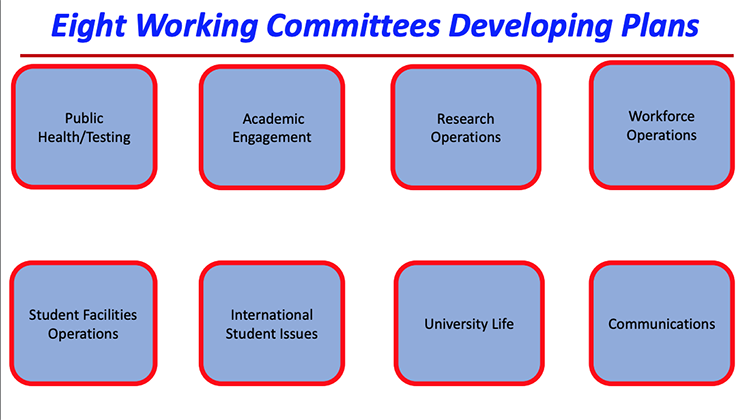
You all know that Penn has been working very hard, not only to weather the challenges of this pandemic but also to plan for our future. Our University is immensely complex, so our planning and response have to be very multifaceted. Yet, we really have to remain nimble because we don’t have control over the external COVID-19 environment. What we’ve done at the very outset of the pandemic is to establish a Recovery Planning Group. It’s the RPG that is helping to steer the process. In partnership with the RPG are eight working committees, and each is focused on a key facet of University operations and individual health and well being, which of course are core to our planning.

I’ve asked Provost Wendell Pritchett and EVP Craig Carnaroli to present to University Council on the work of the RPG and COVID’s impact on Penn. Before I turn it over to Wendell and Craig. I just have to say on behalf of University Council and the entire University, how grateful we are to them not only for taking the time today to do this, but for being the chief partners with me in moving the RPG forward.
Wendell Pritchett

Thank you, Dr. Gutmann, I will go first and then be joined by our colleague and Chief Wellness Officer Benoit Dubé, and then we’ll turn it over to Craig for the final aspects of our presentation. I hope that everyone and your families are well and you are persevering through this unprecedented challenge, and I’m grateful for all of our colleagueship as a community in weathering this together.

As President Gutmann said, we organized the Recovery Planning Group as soon as we pivoted to remote campus in the spring and it’s being guided by the following principles. First and foremost, maintaining the public safety of our community and the broader Philadelphia community. Using best practices and advice from the many wonderful experts that we have at the University for safely reopening campus, which we’ve done slowly as we will discuss today. Continuing the essential operations of teaching and research. Research started becoming more active on campus before teaching, though we do have some teaching on campus. Now we are mostly remote though that is still moving in the direction of more in-person activities. Protecting against negative outcomes, both short run or the expansion of COVID in the long run. Protecting the University and clearly communicating with all the members of our community, which is something that we spent a lot of time on over the past seven months to make sure that everyone is aware of our plans and feels supported.

So what’s the framework for the Recovery Planning Group?

We’ve had to lay out a lot of possible scenarios and this is one of the most dynamic situations I think any group of institutions has faced. The health situation has changed constantly, our understanding of COVID-19 has changed constantly, though we are getting a better handle on it. We’ve been trying to adapt to the health framework (our understanding of COVID) and also the needs of the campus. As President Gutmann said, we organized working committees to develop plans for the different aspects of our recovery. We’ve been working constantly to integrate those plans to make sure that the most important aspects of the University can continue to grow and flourish.

There are eight committees: public health/testing, academic engagement, research operations, workforce operations, student facilities operations, international student issues, University life, and communications. All of these working groups have been populated by staff and faculty, with constant input from students, and they have done their work well over the past seven months to get us to this point. I will give some highlights of things that we have done over the last seven months. These committees have been very active. We’re very grateful for their work, and they’ve been getting constant outreach from lots of members of our community and input, more importantly.

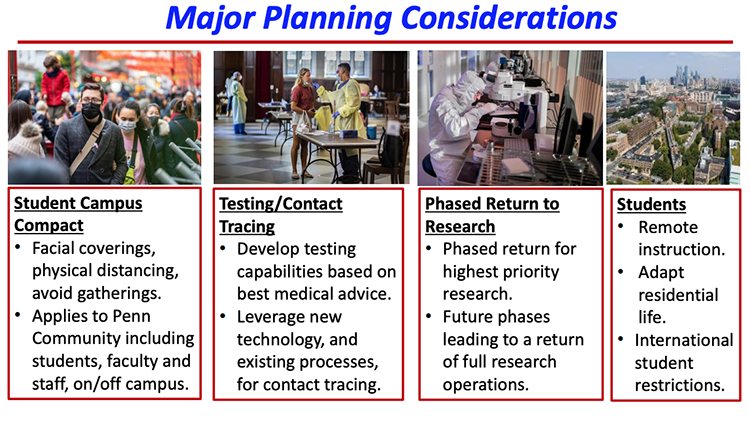
What are major planning considerations?

Our students, and having our students support each other and members of the community. We have a Campus Compact that applies to all members of the community. We’re very grateful that compliance with the Compact has been very strong. I’m very proud of our community, that people have been very considerate to each other, trying to make sure that the disease is not spread and that we use best practices. We certainly have had incidents on and around campus, which have resulted in outreach from the Campus Compact Committee and the Office of Student Conduct, but I am very proud of our community in how it has responded to this crisis. My colleague Benoit Dubé will describe in more detail our testing and contact tracing, but they are robust and growing every day. We’re leveraging our amazing IT folks and technology and expertise to make them as seamless as possible.

We have had a phased return to research, which has started; some of our research operations never stopped, particularly those involving COVID. And so we’re grateful to our faculty and their students and supporters who have continued that research. Over time, starting in June when we agreed to begin phase one of research ramp up, we’ve welcomed more and more people to campus to conduct important research, and we’ve continued to support our students at the undergraduate and graduate level, primarily through remote instruction. We’ve adapted residential life for a small number of people who are on campus, and we certainly work with our international students, who have faced very complex challenges in this year. Some key milestones: we pivoted to remote instruction and formed the RPG during the spring; we made significant investments in workforce and student grants to make sure that they were supported, as well as our community which continues to be challenged with regard to our health and economy in light of the slow recovery; we launched the PennOpen Pass. If you have not accessed it, I encourage you to go online and access the PennOpen Pass. At the end of the summer we welcomed students back to the region, and we conducted gateway testing, which Benoit will describe. And we have now transitioned to screening and surveillance testing for significant members of our student community, and all of those aspects of the work have gone well. We’re grateful to the many people who have helped us do this. Now I’m going to turn it over to Dr. Dubé to talk a little bit more about testing, contact tracing, compliance and the work that we continue to do to protect the health of our community.

Benoit Dubé 

Thank you, Provost Pritchett. I’m really grateful for the opportunity to update the Council and the University community on some of our accomplishments and to share the strategies we’ve used to guide us forward as we navigate this unprecedented public health challenge. I’d like to highlight for you some of those accomplishments. You’ve heard already of Gateway Testing and the Campus Compact. I’d like to share a few more details about both of these, and also add some other mitigation strategies that we’ve added to our toolkit.

As we navigate this challenge, and to prioritize the health and safety of the community through Gateway Testing, you should all be familiar with the testing site at Hall of Flags. The gateway period was testing individuals as they return to campus in order to quickly identify and isolate cases to minimize the spread in our community. At the end of Gateway Testing, we had delivered 16,000 tests, if we include students, faculty and staff, with the positivity rate overall of 1.2%. To put it in context, anything below 2% is reassuring, as it does not necessitate triggering any restrictions on our campus population. We do offer, and we didn’t need to, quarantine space for students living on campus. We set aside a significant number of beds in preparation for a need for isolation—which is individuals who have been diagnosed with the disease—or quarantine, which is removing individuals who may have been exposed to the disease from the general circulation so as to minimize the risk of person-to-person transmission.

Testing is one of many layers in our approach to this disease, the Campus Compact is a first line of behaviors that are expected of students, and you’ve all heard the three W’s: wear your mask, watch your distance and wash your hands. But we’ve also translated these expectations into student specific concerns, namely social gatherings and the necessity to restrict interactions to specific pods, as there are expectations, there are consequences for non-compliance. We set up a review panel, so that when transgressions are reported to the review panel there can be opportunities for education and reminders about public health guidance or more sharp consequences. In cases of more egregious transgressions, I want to echo Provost Pritchett’s comments earlier: the overwhelming majority of our students have been responsible and have been making smart decisions. And that’s why we’re proud to have a limited positivity rate. One of the tools that we have that allows us to navigate this is PennOpen Pass, a daily symptom access program that we can navigate through our phones, and it allows us to break old habits of just plowing through if we’re not feeling well. Under the new rules of engagement in the COVID world, we cannot simply go to school, to class or to work if we’re not feeling well; we must check in with ourselves, every day, in order to get a green Open Pass that will allow us access to buildings.

The last thing I want to highlight is the establishment of public health ambassadors. This is a new team of individuals who are there to reinforce and support individuals as they engage in any interactions on campus to remind them of the importance of following the three W’s as we navigate campus, whether as a place to learn or as a work environment. The analogy here is that it’s the same way we protect our home and our belongings to protect ourselves from theft. We can also protect ourselves from the transmission of COVID-19 by applying these multiple layers and those W’s: masking, physical distancing and hand washing. Testing is definitely part of our mitigation strategies, but it’s not considered to be a first line intervention. You’ll see symptom checks through PennOpen Pass’ second layer, and isolation and quarantine are simply a reaction when necessary.

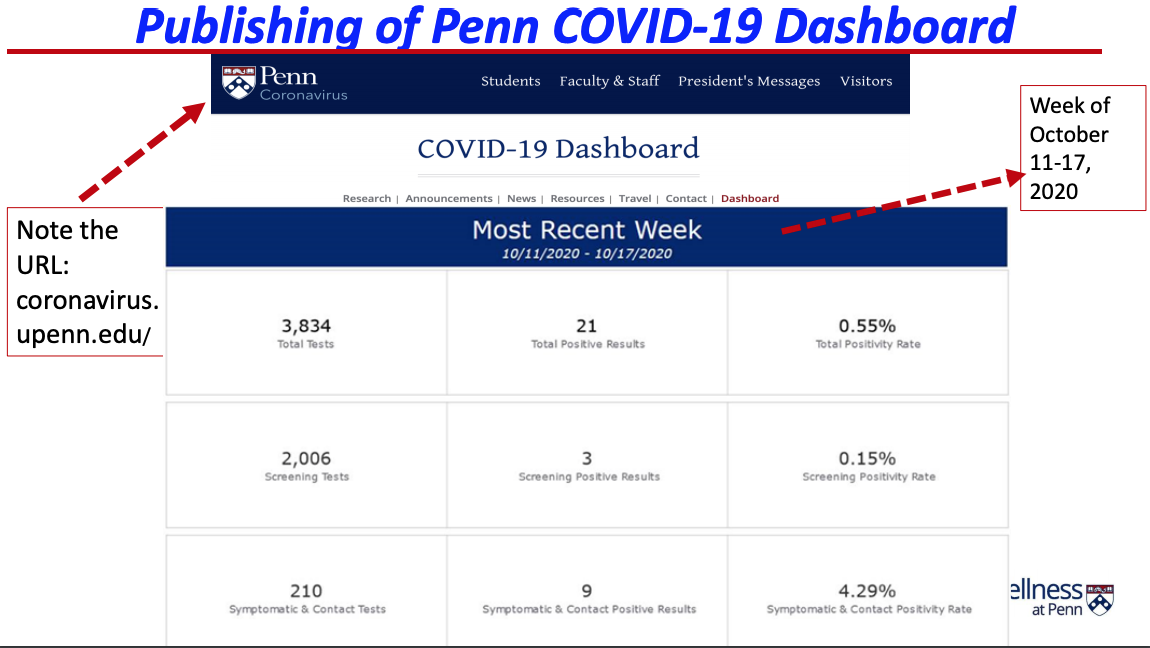
I want to tell you a little bit more about testing and our ability to share these results with the population. Every Tuesday, if you go to coronavirus.upenn.edu, you can have access to the dashboard. We publicize these results on a weekly basis and what you’re looking at now are the latest results, as of last Saturday. During the previous week we tested over 3,800 individuals. We identified 21 positive results with a positivity rate that week of 0.55%. We publish a cumulative positivity rate, so, since we ended gateway testing, we’ve now tested over 13,500 individuals, and our overall positivity rate is 0.81%. You can also see the tracking trends of our positivity rate, the number of tests every weekend and number of cases. The 210 individuals who were either symptomatic or defined as close contacts, those individuals were referred through the red PennOpen Pass system. Nine of these individuals were diagnosed with COVID-19 for a positivity rate of 4.29%. This really underscores the effectiveness of our contact tracing team that is able to very quickly, effectively and efficiently identify cases and their close contacts in order to minimize the spread of person to person disease from a student perspective.

We put together for you the constellation of signs and symptoms that students present with. If they are symptomatic, you will see that nearly a quarter of students at the time of testing are asymptomatic. However, nearly 80% of students during the course of illness will develop, at the very least, mild symptoms. I can also report that since March, only one student has needed to be hospitalized because of COVID-19, and this was a precautionary measure—a 24-hour observation, just to monitor and just to be safe. Speaking of other interventions besides hospitalization, I want to share with you how many students have been in isolation or quarantine. These are the results from last week: as of the end of the day Saturday, 38 students were in isolation and 112 people were quarantined. None of these students were in isolation or quarantine from our College House residences. And as we did contact investigations to identify these individuals, it’s interesting to learn that the average number of contacts per case is about 5.4, with a range of zero to 39 contacts, and this is lower than what the Philadelphia Department of Public Health has shown, looking at similar populations in the city. I can also show you how our isolation and quarantine numbers have trended over time. There have been peaks and valleys in these numbers, but there has not been any data that would suggest an outbreak on our campus, which is very reassuring and again confirms the good decisions that our students are making.

I want to share with you a little bit about how we understand these numbers for isolation and quarantine. They really pertain to spread within households. Anybody who’s diagnosed with the disease who shares an apartment or house with other students or friends is very likely to inadvertently bring the disease into their living space, and that’s why we see the numbers that we see: for example, 112 individuals in quarantine and 38 people in isolation. We do wonder if our presence in West Philadelphia has led to spread within the community; the jury is still out. There are trends that may suggest that, but it is too soon to conclude that our presence as Quakers in West Philadelphia has led to an increase in positivity. One more reflection on the Campus Compact in the context of behaviors and decisions that our students are making—you heard of the review panel. Well, in the month of August we received 34 reports of transgressions of the Campus Compact and last month, in September, we received 92 reports of transgressions of the Campus Compact. Most of these transgressions have to do with not respecting the guidance surrounding social life and recreation, so yes, those were parties that should not have happened. They represent about 60% of the complaints that are received by the Compact Review Panel, and you’ll see that was pretty steady from August to September. I do want to point out that from August to September, we have seen a decrease in the number of complaints in terms of campus movements, and that would mean more students respecting or fewer students violating guidance about social distancing and wearing masks or people flow when they’re navigating spaces on campus. That is a quick update from a public health perspective of how the campus is doing.

Wendell Pritchett

Thank you, Dr. Dubé. I do just want to express my gratitude to you for your leadership and my gratitude to all of your colleagues in Penn Wellness for their amazing work to protect our community. We’re all deeply grateful to you and them for all of your work. And I’d like to talk a little bit about some aspects of the return recovery that we’ve experienced. It is extremely impressive the amount of work that our faculty, students, and staff have put into our educational and research and service experiences. I’m deeply impressed and gratified for all of the work that’s been done in this community. We have stood up more than 2,500 undergraduate courses. We have offered 115 preceptorials; there will be more discussion about some of those educational engagements a little bit later in this meeting. The community has really stood strong together in continuing to provide an excellent education.

I want to thank our University Life colleagues, who also pivoted immediately and amazingly to remote support for our students. And you see some of the amazing data related to those supports, the continuing excellent work of Career Services, the Learning Resources Center, and the Office of Student Affairs, supporting 700-plus Penn clubs and a virtual activities fair and a platform created by our amazing students. There’s been, again, an amazing amount of support for our community through all of the activities that we’ve come to know in person but that we’ve been able to replicate in many ways online.

Our research operations never stopped. In June, we started to welcome more people back to campus for research. By July 13, we were at 50% occupancy, and occupancy continues to very slowly grow. We are certainly not at 100% occupancy of our research operation, though. Research happens remotely, and our faculty have been amazingly productive, both in responding to COVID-19 and in continuing their work and thinking about new avenues for their work related to COVID-19 and not related to COVID-19. Under the leadership of our Senior Vice Provost for Research Dawn Bonnell, we’ve now launched several research recovery programs to help people continue to advance into new avenues for their research, and we’re very grateful to all of them for that work. All of that work has been supported by our amazing staff, and to discuss a little bit more of that aspect of our recovery plan, I turn over to my colleague Craig Carnaroli.

Craig Carnaroli

Provost Pritchett and Benoit Dubé had mentioned PennOpen Pass. For the one or two of you on this call, who may not be familiar with it, I’m going to hold up my green pass for the day. You can see what it looks like. And basically, this is how I get access to my office every day. And so, this will be key for when you’re back on campus hopefully in January. So I’m just giving you a gentle nudge that this is something you should be enrolled in whether you’re in Philadelphia or not. But now with that commercial being done, returning to the presentation.

One of the important committees we’ve set up is around workforce operations—a shout out to Kathleen Hall Jamieson, who has been an active member of this. She’s the current chair of the Faculty Senate and has been a really important part of this effort. We put together a guide that was mailed this summer to every faculty and staff member, along with a mask, you see there on the right part of your screen. And what this did is provided a Q & A, the information needed to prepare as we’re permitted to bring people back in what to expect. One of the things we heard from the community, over the course of the summer were the challenges families were having relative to childcare and through the good leadership of Laura Perna, our Vice Provost for Faculty Affairs, along with our Vice President for Human Resources Jack Heuer, we put together a Childcare Grant Program, which was targeted to families of children that were 10  and younger. And so far, I think the current total is over 400 people have received a grant to help support them in childcare expenses in their home.

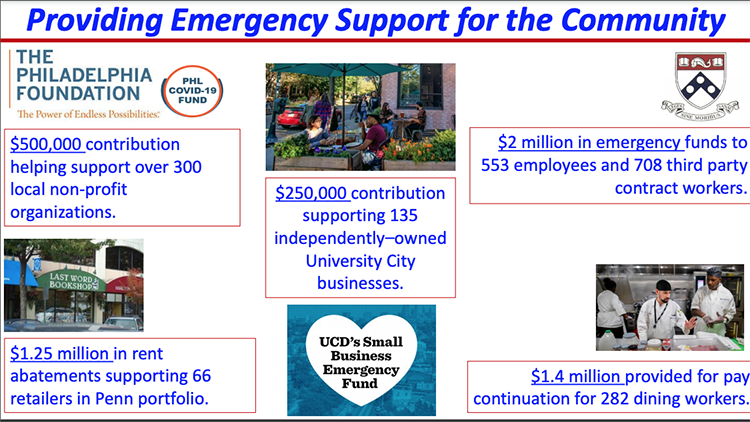
There are a lot of questions I’m asked about what has been the impact of COVID-19 on the University finances. While I think we’ve all responded well to the environment we are still forecasting a deficit for the year between $90 and $100 million, our forecast there as you can see in the red bar is $91 million, and along the right side you see some of the mitigation actions we’ve taken this year, including limitations on hiring, raising salaries, capital project deferrals, a big focus on reduced discretionary spending, essentially there really is no travel going on right now, very prudently. And I would say this is an environment where, I know, at times we bemoan Responsibility Center Management, but I would give a big shout out to all the schools and centers and their financial administrative leadership, as we’ve seen a really commensurate reduction in expenses and it should help us mitigate through this tough time period. One of the things we realized early on was not only were we as an institution grappling with COVID, but many in our surrounding neighborhoods and nearby communities, and the city as a whole, were also struggling. And Dr. Gutmann supported an effort that Wendell and I organized around on how we could support these three distinct areas. So just to summarize briefly, Penn’s was among the larger contributors to the Philadelphia COVID Relief Fund with a $500,000 contribution. This is organized by the Philadelphia Foundation in the United Way and they’re making grants to smaller local nonprofit organizations.

In addition, a lot of the local retailers were hurt as we basically had to shut down campus. And so we have offered rent abatement to the number of retailers in the Penn portfolio. We partnered with the University City District for a small business emergency grant fund. This was targeted at truly small businesses and by that I mean with revenues between $100,000 and a million dollars. We supported 135 businesses, the vast majority of which were owned by underrepresented minorities, but we also supported people within the Penn community through an emergency grant fund, which provided up to $1,500 to employees that made less than $70,000, and also third-party contract workers Allied Barton, dining hotel workers, etc. That was very well received, as well as the pay continuation we able to do for dining workers in the balance of the spring.

But we’ve all been adapting to this new reality, whether it’s our entrepreneurial students coming up with pandemic themed merchandise to Dr. Gutmann delivering a brilliant virtual convocation. Wendell mentioned the research going on in several labs, and obviously the good work of our colleagues and VPUL and creating virtual platforms to permit interaction.

Perhaps my favorite story is actually not on this slide, I’ll be very brief but those of you who follow the Penn Innovation Prize winner may recall two years ago, Michael Wong had a great idea for energy conservation. Michael, once this pandemic broke, actually pivoted his company Instahub, which is based over at Pennovation, to using his 3D equipment to make more protective gear. I had a great conversation with Michael over the summer to check in on him. And it’s just really powerful the way Penn alumni and the Penn community really pivoted to supporting each other during this challenging time. 

Just to summarize, the fall is going well. A lot of our focus since August, has been on planning for the spring and Wendell and Benoit have covered this quite well so I’m going to move on. One of the ways you can help us is that currently there is a student survey that is live, it closes on October 26, and we’re looking for some feedback from the student community; there is also a faculty survey, that Laura Perna is leading. We’re using this as an opportunity, if you can help get out the word. Our spring semester survey had a 51% response rate, which for those of you who are in various social or sciences know that’s a very incredibly high response rate, and it’s very helpful to us as we try to fine-tune plans for the spring.

The big gateway issue we have to bring students back safely to campus is that of testing and working with our colleagues in Penn Medicine. We’ve established a project called Project Quaker. And what this is—Wendell and I made very clear—we need a minimum of 40,000 tests weekly. This will be administered two times a week for undergraduate students. There’ll be more information coming about this. It’s a saliva-based test, we actually have the tests being stored now on campus. We’re working with a third party; we have the equipment on site, we have the sites and acknowledge that all the project management is underway on this. We’re really confident in the ability to be able to deliver the testing that’s needed for the safety of the community. This has been a big initiative and we’re really proud of where we stand at this point in time, nut stay tuned for more details because this is the gateway issue that is needed to bring the community back together in the spring.

Question from Audience

Are there plans to have asymptomatic testing for the entire course of the fall semester so, is that correct?

Benoit Dubé 

Yes, we do currently offer asymptomatic testing. We rolled out an invitation to our students. Initially, students living off campus had to enroll in weekly testing, and this form of screening test is what we report on the dashboard every week. It’s the second line on the dashboard. But this is also available to other members of the Penn community. When rolling out the invitation, we did offer a risk stratification along with our invitation, specifically for individuals with a significant presence on campus and whose presence on campus was predominantly in an aggregate setting with at least 10 people in a single space. Having said that, this risk assessment should not preclude any individual who has concerns from accessing our testing site.

Amy Gutmann

I would just simply and profoundly like to thank the Provost, Executive Vice President, and our Chief Wellness Officer for leading this effort and for presenting to University Council. And I also encourage all members of Council to get the word out about the dashboard that’s available and also, obviously the most important thing about continuing safe and healthy practices which is making this semester successful and will make it possible to plan, for a spring semester when we can have more students on campus in a safe and healthy way. So thank you all.
AT PENN

Events

Morris Arboretum: Celebrating Halloween By Night

New this year, the Morris Arboretum has more ways to celebrate Halloween beyond its month-long Scarecrow Walk (Almanac September 8, 2020).

Visitors are invited to nighttime events that are safe, fun, and just a little spooky.

Ghostly Gathering at Morris ArBOOretum, Friday, October 30 and Saturday, October 31 from 5-8 p.m., invites visitors to come costumed and ready for fun at the Morris Arboretum’s first ever Halloween nighttime events. The Arboretum is giving out trick-or-treat bags to fill, reading scary stories, hosting fun games, and lighting up the Fairy Tale Scarecrows for nighttime viewing. Every activity will be appropriately distanced—and you’ll already be wearing a mask!

Advance tickets required. Register at: morrisarb.org/halloween. Member Adult: $15; Member Youth: $8; Non-Member Adult: $20; Non-Member Youth: $10

For more Halloween fun, join adult friends for The Witching Hour on Sunday, November 1, from 6-9 p.m.

Come costumed (or not) and enjoy the Morris Arboretum as it’s rarely seen–after dark– at this Halloween event for adults on Sunday, November 1 from 6-9 p.m. Enjoy the garden’s eerie ambience with the scarecrows lit up for the night, tarot readings, Quizzo, and pumpkin smashing! Beer and light snacks available for purchase.

Register: morrisarb.org/halloween. Member Adult: $15; Non-Member Adult: $20.

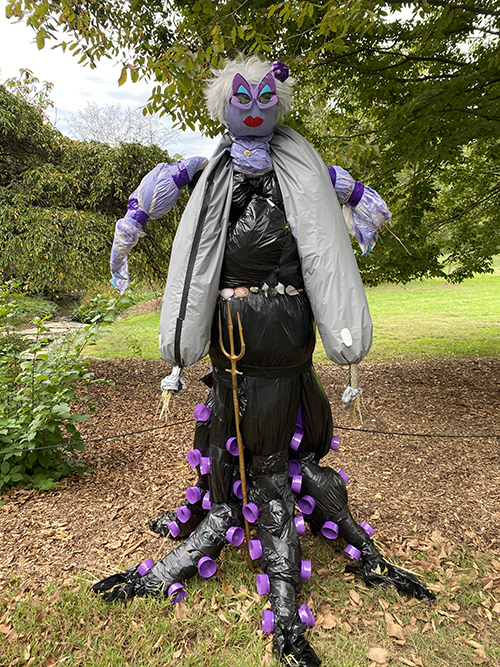
caption: A Hansel and Gretel scarecrow display. caption: Ursula scarecrow display (1st Place).

PPSA Presents: Taking Care of Your Emotional Health, an Overview of Penn Resources: November 2

Please join PPSA online for a talk by Health Advocate and Penn Human Resources on behavioral and mental health resources available to Penn staff on Monday, November 2 from noon-1 p.m. on Zoom. Between the challenges from the pandemic and these eventful times, PPSA thought this would be a good time to highlight resources available to you.

Health Advocate will focus on Penn’s Employee Assistance Plan including options for counseling and a website demo which covers health, finance, and well-being, including:

Penn Human Resources will go over other resources such as behavioral health benefits accessible through your medical plan and Virgin Pulse.

To register, visit https://tinyurl.com/PPSAemotionalhealth. A Zoom link will be sent the day before the presentation.

Human Resources: Upcoming November Programs

Professional and Personal Development Programs

Open to faculty and staff. Register at http://knowledgelink.upenn.edu/.

Getting Work Done; 11/10; 12:30-1:30 p.m. Throughout a normal workday, there are multiple distractions that can get many of us off task and behind on our to-do lists.  In this course, we’ll review tactics to help you stay on target with the many moving pieces of your role.  You’ll identify your biggest time sponges and ways to manage them, create priority lists, understand ways to delegate when not in a position of authority, and learn ways to achieve an acceptable work life balance.

Challenging Your Negative Attitudes; 11/17; 12:30-1:30 p.m. By challenging our negative attitudes, we have the power to take control of pessimistic perspectives and stressful situations. During this course, participants will learn to manage the impact of negative situations, deal with their own negative thoughts more effectively, and learn coping tools for dealing with change.

Work-life Workshops

Open to faculty and staff. Register at www.hr.upenn.edu/registration.

Sharing the Caregiving: Managing Sibling Disagreements; 11/3; 1-2 p.m. Siblings can be our best friends and partners in crime growing up. But as adults, siblings can make caring for an aging parent challenging and stressful. You think Mom needs in-home care, your brother wants assisted living and Mom doesn’t want help at all! Sound familiar? How can you and your siblings get on the same page, help Mom find the right care and not get entangled in simmering past resentments? This webinar will discuss how to create a care team, delegating responsibilities, managing sibling conflict, and coping with your own stress.

Call up Calm 30 Minute Meditation; 11/5; 12:30-1 p.m. In these uncertain times, it’s essential to release fear and step into the calm. This call is offered for participants to have the opportunity to be led in guided meditation, practice letting go of stress, fear, and anxiety, and be present to having courage and resilience. The guided meditations will focus on breath, letting go negativity and fear, and allowing one’s self to feel inner reserves of strength, clarity, and intentionality. No experience necessary.   

Managing the Holidays During COVID-19; 11/10; 12:30-1:30 p.m. As the COVID-19 pandemic continues, many people are experiencing stress and uncertainty about their current situation as well as what is to come next. Even as some regions begin loosening restrictions, we still face an unknown future that can cause fear and anxiety. This webinar discusses tools and techniques to manage stress related to both ongoing and potential future challenges and maintain mental well-being during this difficult time.

Developing a Daily Practice for Calm; 11/16; 12:30-1:30 p.m. The mind is either creative or negative. How we think and feel becomes our habitual behaviors. In this class, you will develop a short daily practice for calming and establishing the priority of peace, ease, and relaxation for wellbeing and work-life balance.   This 75-minute experiential class offers participants:

  • Journaling
  • Breathing
  • Noting mindset
  • Establishing the awareness of acceptance, harmony and releasing fear

Caring for the Caregiver During the Pandemic; 11/17; 12:30-1:30 p.m. Whether you have always been caring for an elderly or disabled loved one or are newly doing so in a greater capacity, in these times of recommended physical distancing, it can be especially challenging. With the outbreak of COVID-19 and the emphasis on the elderly needing to exercise the most caution, more and more caregivers are finding themselves torn between self-care, caring for loved ones, and trying to counter their loved ones’ isolation. This webinar outlines the impact of the pandemic on the elderly and strategies for caring for the caregiver in the midst of this recent pandemic. It will help participants understand caregiver stress, and learn tips and coping strategies for the caregiver as well as isolated family members likely battling loneliness.

Radical Resilience: Ideas for Sustainable Life Balance; 11/18; 2-3 p.m. The term “anti-fragility”, coined by NYU professor Nassim Taleb, takes the concept of resilience to the next level by asserting that there are conditions whereby we are not only able to bounce back, but we become even stronger as a result. This interactive workshop provides tools for increasing your ability to be super-resilient. Based on the work of Harvard educator Dr. Tal Ben-Shahar, author of Happier: Learn the Secrets to Daily Joy and Lasting Fulfillment.

Penn Healthy You Workshops

Open to faculty and staff. Register at www.hr.upenn.edu/registration.

Corporate Wellness Nutrition Cooking Demonstration; 11/5; noon-1 p.m. Participants will learn healthy cooking methods while observing a tasty recipe being prepared by chef and Registered Dietitian Erin.

HIIT Strength; 11/6; noon-1 p.m. Come for a 45min High-Intensity Interval Training (HIIT) workout! Each week will be a different sequence of exercises, with a focus on strength training. This short workout will be a full-body blast, guaranteed to leave you sweating!

Mat Pilates; 11/11; noon-1 p.m. All levels are welcome! You will learn the proper technique of Mat Pilates, focusing on body connections, breathing, alignment, and awareness. Learn how to identify your own weaknesses and imbalances and work with them to restore healthier movement. The exercises are designed to align, lengthen, and strengthen the body in a unique way. Most movements are non-impact and non-weight bearing. All require focus and concentration. Every 45-minute-long class is in a small, personalized setting allowing us to meet each client’s particular needs.

Tax Strategies; 11/12; noon-1 p.m. Some tax strategies are easy to accomplish while others may take some planning. It’s important to know the basics and learn about ways you can save money by reducing your tax bill.  This workshop will help you identify some simple strategies from making the most of tax-deferred programs and diversification to maintaining accurate records and knowing the rules for home sales, charitable contributions, and childcare credits.

Chair Yoga; 11/18; noon-1 p.m. Plenty of people turn to yoga for exercise, but striking a pose isn’t for everyone. If you’ve been tempted to try it but don’t know where to start, it’s time to try chair yoga. Chair yoga is a more moderate form of yoga that’s done while sitting in a chair or using a chair for support. You get the same benefits of a regular yoga workout (like increased strength, flexibility, and balance) but don’t have to master complex poses. Chair yoga can even better your breathing and teach you how to relax your mind and improve your wellbeing. Ready to give it a try? Join us for a free Chair Yoga workshop. And don’t worry about your experience or flexibility—chair yoga can be modified for all levels! This workshop will be led by Judith Glass from UPHS.

Yoga Sculpt; 11/19; noon-1 p.m. Yoga Sculpt is a class that incorporates hand weights and cardio bursts into a traditional yoga class for an added challenge!

Gentle Yoga; 11/24; noon-1 p.m. Let your body reward itself with movement! Join us for this Gentle Yoga session and explore the natural movements of the spine with slow and fluid moving bends and soft twists. During this session, you will flow into modified sun salutations that loosen those tightened muscles and joints of the lower back, neck, shoulders, and wrists. And as an added bonus, you’ll get a workout in the process.

Update: October AT PENN

Films

Cinema Studies
For info and to register, visit https://cinemastudies.sas.upenn.edu/events.
27    Twilight Revelations; 7 p.m.
28    Good White People; 6 p.m.
29    Lamb; 7 p.m.

Fitness & Learning

30    Mindfulness at the Museum: Restorative Contact with Gabrielle Revlock; 6:30 p.m.; Zoom meeting; join: https://tinyurl.com/ica-mindfulness-oct-30 (ICA).

Nursing
For info and to register, visit https://www.nursing.upenn.edu/calendar/.
29    PhD Admissions, Student Services, and Financial Aid Webinar; noon.
30    LGBT History Month Program: Transitioning in the Work Place; noon.

Meetings

29    WPPSA Meeting; noon; more info and to RSVP, email Mariel Featherstone at fmariel@upenn.edu (WPPSA).

Readings & Signings

29    Dark Mirror: Edward Snowden and the American Surveillance State; Barton Gellman; 5 p.m.; Zoom meeting; info: https://pennlaw.cvent.com/c/express/46db81ba-2f20-4214-ab22-fd0ee1be5478 (Penn Law).
       Book Launch: Our Days Are Like Full Years; Harriet Pattison; 6 p.m.; Zoom meeting; register: https://tinyurl.com/pattison-book-launch (Architectural Archives).

Special Events

30    Monsters, Myths, and Legends: Spirits and Storytelling; night of stories in collaboration with six Philly breweries; 7 p.m.; tickets: $10/adult; https://www.penn.museum/calendar/550/monsters-myths-and-legends (Penn Museum).

Talks

28    Antibiotic Discovery by Means of Computers; Cesar de la Fuente, microbiology; 3 p.m.; Zoom meeting; info: chebiom@seas.upenn.edu (CBE).
       Recent Developments in Ricci Flow; Richard Bamler, UC Berkeley; 3:30 p.m.; Zoom meeting; info: https://www.math.upenn.edu/events/recent-developments-ricci-flow (Mathematics).
       Measuring the Effects of Co-workers on Wages; Jianhong Xin, economics; 4 p.m.; Zoom meeting; info: https://economics.sas.upenn.edu/events/measuring-effects-co-workers-wages (Economics).
       Off the Beaten Track: Long-Lived Particles at the LHC; Tova Holmes, University of Tennessee; 4 p.m.; online event; info: https://www.physics.upenn.edu/events/high-energy-experiment-seminar-beaten-track-long-lived-particles-lhc (Physics & Astronomy).
       The Future of the Supreme Court; panel of speakers; 4:30 p.m.; online event; register: https://pennlaw.cvent.com/d/y7qrmf (Penn Law).
       Voter Suppression: Past and Present; panel of speakers; 6 p.m.; online event; register: https://voter-suppression-past-present.eventbrite.com (History, Andrea Mitchell Center).
29    Causal Inference With Ultra-High Dimensional Covariates in Alzheimer’s Studies; Dehan Kong, University of Toronto; 9 a.m.; BlueJeans meeting; join: https://bluejeans.com/368827150 (CCEB).
       On Optimal Taxation and Subsidization of Health Goods; Seung-Ryong Shin, economics; noon; Zoom meeting; info: https://economics.sas.upenn.edu/events/optimal-taxation-and-subsidization-health-goods (Economics).

---

AT PENN Deadlines 

The November AT PENN calendar is online. The deadline to submit events for the December AT PENN calendar is Monday, November 16. Submit events at almanac@upenn.edu.

Crimes

Weekly Crime Reports

University of Pennsylvania Police Department Crime Report

Below are the Crimes Against Persons, Crimes Against Society and Crimes Against Property from the campus report for October 12-18, 2020. View prior weeks' reports. —Ed.

This summary is prepared by the Division of Public Safety and includes all criminal incidents reported and made known to the University Police Department for the dates of October 12-18, 2020. The University Police actively patrol from Market St to Baltimore and from the Schuylkill River to 43rd St in conjunction with the Philadelphia Police. In this effort to provide you with a thorough and accurate report on public safety concerns, we hope that your increased awareness will lessen the opportunity for crime. For any concerns or suggestions regarding this report, please call the Division of Public Safety at (215) 898-4482

10/12/20

7:28 PM

3925 Walnut St

Complainant touched in an inappropriate manner

10/12/20

9:20 AM

3400 Spruce St

Cell phone taken from desk

10/13/20

1:27 PM

4042-4044 Chestnut St

Payment sent to unauthorized person

10/13/20

3:31 PM

3604 Chestnut St

Employee took money from register

10/13/20

5:42 PM

115 S 43rd St

Property removed from residence by unknown person

10/14/20

2:01 AM

4028 Market St

Unknown males took wallet

10/14/20

12:17 PM

4032 Sansom St

Packages taken/Arrest

10/14/20

4:03 PM

3400 Spruce St

Secured bike taken from bike rack

10/14/20

5:00 PM

3400 Spruce St

Complainant struck in the cheek three times

10/14/20

6:00 PM

220 S 33rd St

USB extender taken

10/14/20

6:10 PM

51 N 39th St

Secured bike stolen

10/16/20

2:17 AM

3600 Civic Center Blvd

Vehicle was stolen and recovered/Arrest

10/16/20

8:25 AM

4000 Market St

Known offender shot at complainant

10/17/20

7:25 AM

3604 Chestnut St

Merchandise taken without payment

10/17/20

8:23 AM

3549 Chestnut St

Male with weapon/Arrest

10/17/20

1:10 PM

417 S 43rd St

Offender entered through a window and stole jewelry

10/17/20

4:35 PM

220 S 34th St

Currency taken from donation box

10/18/20

3:50 AM

3925 Walnut St

Secured bike taken

10/18/20

12:08 PM

4029 Walnut St

Unsecured package taken

10/18/20

7:55 PM

4100 Locust St

Vehicle taken that had engine running

18th District

Below are the Crimes Against Persons from the 18th District: 10 crimes against persons (2 aggravated assaults, 2 assaults, 2 domestic assaults, 1 homicide, 1 indecent assault, 1 rape, 1 robbery) with 2 arrests were reported for October 12-18, 2020 by the 18th District, covering the Schuylkill River to 49th Street & Market Street to Woodland Avenue.

10/12/20

8:21 AM

4050 Chestnut St

Domestic Assault

10/12/20

8:02 PM

3925 Walnut St

Indecent Assault

10/12/20

10:18 PM

4816 Pine St

Homicide/Arrest

10/14/20

2:50 AM

4028 Market St

Robbery

10/14/20

5:03 PM

3400 blk Civic Center Blvd

Assault

10/14/20

5:25 PM

1213 S 47th St

Domestic Assault

10/15/20

6:42 PM

1 S 34th St

Assault

10/16/20

8:39 AM

4000 Market St

Aggravated Assault

10/17/20

3:36 AM

4100 blk Chester Ave

Rape

10/17/20

8:29 AM

3549 Chestnut St

Aggravated Assault/Arrest

Bulletins

Factcheck.org Roundup

Leading up to Election Day on Tuesday, November 3, Almanac will run a bi-weekly FactCheck.org roundup. This will be the final installment. Here are some of the latest stories:

FactChecking the Final 2020 Presidential Debate (October 23, 2020). The candidates repeated talking points from the stump and added some new twists on the facts.

Trump on the Stump (October 22, 2020). Factcheck.org identified 46 false and misleading claims President Trump made in six stump speeches from October 12 to October 16.

Biden on the Stump (October 22, 2020).Nine fact checked claims made by the Democratic presidential nominee in recent campaign speeches.

Trump’s Long History With Conspiracy Theories (October 20, 2020). President Trump has exhibited a years-long pattern of directly espousing or leaning into conspiracy theories, often those that smear his political opponents or critics.

FactChecking Trump’s Immunity Claims (October 16, 2020). President Trump said that once he came down with COVID-19, people shifted for partisan reasons from saying immunity was lifelong to saying it lasted only a few months. Experts haven’t changed their estimates.

FactChecking Trump’s Town Hall (October 16, 2020). In an October 15 town hall on NBC News, President Trump made false and misleading claims on the coronavirus, the economy and more.

FactChecking Biden’s Town Hall (October 16, 2020). At a televised town hall in Philadelphia, Democratic presidential nominee Joe Biden made false and misleading claims on COVID-19, health insurance and the 1994 crime bill.

Trump Ad Lifts Fauci Praise Out of Context (October 12, 2020). A Trump campaign ad uses a clip of Dr. Anthony Fauci praising federal public health officials—saying that he “can’t imagine that…anybody could be doing more”—and makes it seem like Dr. Fauci was personally complimenting the president. Dr. Fauci says the ad lifted his words “out of context.”

Kamala Harris, Honest Abe and the Supreme Court (October 9, 2020). There’s no evidence that Lincoln said he delayed the nomination to let voters choose the next president, as Senator Harris said.

Penn's Way

The Penn’s Way Campaign runs from October 5 through November 27. Please consider supporting our region by making your tax-deductible gift now. By making a gift to Penn’s Way using the Penn’s Way website at http://pennsway.upenn.edu to enter your pledge online, you will be supporting your chosen organizations in a secure, quick and convenient way.

Almanac Schedule

Almanac will publish weekly through the rest of the fall 2020 semester, with the exception of December 1, the Tuesday after Thanksgiving break. Submissions are due Mondays for the next Tuesday's issue. Email almanac@upenn.edu

Please Share Almanac

This edition of Almanac is digital-only. Please distribute to your colleagues and encourage them to subscribe to receive the E-Almanac by visiting https://almanac.upenn.edu/express-almanac The email will include links to the newly posted material. 

No issues were printed to distribute across campus because of COVID-19. Almanac is distributed electronically each Tuesday.

Talk About Teaching & Learning

Making the Virtual Real

Megan Robb

This semester, the physical cues that one has arrived at a place of learning and teaching have been replaced by a 30-second commute from bedroom to desk. A virtual classroom is absent obvious signals that one has arrived in an intellectual, collaborative space. The boundaries set up around the college classroom, intended to mark that space as neutral and egalitarian, may make it easier to have difficult conversations. The myth of the college classroom as a neutral space should be troubled, since indicators of class, national origin, race, and gender are apparent in any classroom space and mark stratification. On the other hand, at its best the classroom, with all of its artifice, can enable the interpolation of students into a shared scholarly conversation. 

The success of my introductory course Gender, Sexuality, and Religion depends on a sense of community. Without mutual trust, no meaningful conversations about such sensitive topics can occur. In “the before times” our shared humanity felt more accessible and the grandeur of the University of Pennsylvania campus helped to set aside our classroom as a privileged space of intellectual conversation. By closing the door, I could set apart a space for conversation. While some of my established teaching techniques were translatable to online teaching this semester, the challenges of this unprecedented moment required new approaches to make the virtual feel real. 

The structure of my class has not changed much this semester: I still give short 10-minute lectures punctuated by breakout sessions. While I encourage my students to keep their video on, as the semester winds on, fewer students show their faces regularly. In the physical classroom, I watched for physical cues that students were confused. In a virtual classroom, I needed new ways of soliciting student feedback in a similarly low-stakes way. Pear Deck—a plug-in for Google Slides—allows me to walk students through a few slides before inviting students to tell me whether they understand the new concept by interacting with the slide on their screen. I can ask students simply whether they want me to slow down, for instance, or I can ask a topic-specific comprehension question. Following breakout sessions on Zoom, I ask students to take 60 seconds to summarize the results of their group conversation, share the screen, and scroll through anonymous student responses, identifying patterns of thought and correcting misconceptions. While not as organic as simply noticing that a student is squinting at a slide in frustration, using Pear Deck slides allow me to build into the class moments for low-stakes reflection and sharing of ideas. 

I have tried three additional techniques to foster community in the online classroom this fall. First, I ensured the course material was streamlined, easily labeled, and articulated the same information in multiple media formats. I wanted students to feel that the task ahead of them was feasible, that there would be adequate time to ask questions, so that as a result they could at each step feel confident in their grasp of the theories we were discussing. I clearly labelled and enumerated each component of each weekly module to make course material and class meeting links easy to navigate. I also included similar information in a variety of formats to suit different learning styles. Each week begins with a tab that includes a short description of the week to come and an embedded short video introducing the material for that week. Each week ends with a short description of what we will do the next week, and short video summarizing the week and highlighting positive student contributions. Recorded class lectures include transcripts generated by Zoom, which I correct to ensure that terms are spelled correctly.

My second step was encouraging students to ground themselves in the class physically by engaging multiple senses. For instance, I created a guide that encouraged students to think of our class as having a “virtual campus.” I drew a map of this virtual campus, visualizing the Canvas site as a three-dimensional space that they could navigate through hyperlinks labelled “The Library” (for the files tab), “The Great Room” (for the list of assignments in modular form), and “The Workshop” (for Perusall assignments where students comment on readings collaboratively). My office was also included in the visualization. I encouraged them to identify a dedicated workspace and included a picture of my own desk, so that they could see where I would be when I joined them in class. While I have not yet invited students to share photos of their workspaces, for fear that some students would feel too keenly a sense of comparison between classmates’ socio-economic circumstances, I did ask students to introduce themselves by sharing an image connected to a hobby or activity that made them feel grounded. Many students shared pictures of their cooking, nature walks, and family pets on the introductory thread. I asked my students to create a class playlist and I play music to welcome students to the Zoom meeting, signing on five minutes early before each class so that they can listen to music they like and get into the classroom mindset. We often start each class with a short breathing exercises or grounding exercise. As is recommended, we take a short stretch break halfway through each class to remind ourselves that we have bodies.

Third, I have made virtual classwork a social experience. I invited each student to schedule a one-on-one meeting with me in the first two weeks of the class, where I talked to them about their motivations for enrolling in the class. While this took a large investment of time on my part, most students took me up on the offer and expressed appreciation for the chance to meet me individually. Those students with whom I spoke individually have been more likely to attend virtual office hours and reach out independently of class time as the class has continued. I also made the process of reading collaborative. For each reading I put students into small groups who then comment on the readings together on Perusall, a program that allows students to respond to my questions and encourages them to ask questions of each other in a low-stakes environment before class. Students can upvote each others’ responses, pose questions to each other, tag each other, and include hyperlinks to interesting additional materials. During class, the breakout sessions focus on the topics that students found most confusing and interesting, as determined by the content of their collaborative annotations. 

Finally, I cultivate compassion for my students as whole humans by modeling humility in the face of failure. It is difficult for me to teach in a new way in a stressful time, just as it is difficult for my students to learn in a new way in this stressful time. In my first class of the semester, I stated my intention to be kind to myself and to others while figuring out this unconventional semester, inviting them to make a similar commitment to themselves. Even while requiring high standards in scholarly performance from my students, I try to empathize with them by asking about their lives and remembering what is going on in their lives. When I need to correct my own mistakes in online course design or I am compelled to troubleshoot a new technology on the fly—my least favorite activity—I try to model for my students a growth mindset that allows them to embrace making mistakes while growing as scholars. Only time will tell which strategies are successful in cultivating a classroom community. In the meantime, I am grateful for the opportunity to emphasize caring for my students as whole humans, an unexpected silver lining to an otherwise monumentally challenging situation for us all.

Megan Robb is the Julie and Martin Franklin Assistant Professor of Religious Studies in SAS.

This essay continues the series that began in the fall of 1994 as the joint creation of the College of Arts and Sciences, the Center for Teaching and Learning and the Lindback Society for Distinguished Teaching. 

See https://almanac.upenn.edu/talk-about-teaching-and-learning-archive for previous essays.

Back to Top