
Making the Virtual Real
Megan Robb
This semester, the physical cues that one has arrived at a place of learning and teaching have been replaced by a 30-second commute from bedroom to desk. A virtual classroom is absent obvious signals that one has arrived in an intellectual, collaborative space. The boundaries set up around the college classroom, intended to mark that space as neutral and egalitarian, may make it easier to have difficult conversations. The myth of the college classroom as a neutral space should be troubled, since indicators of class, national origin, race, and gender are apparent in any classroom space and mark stratification. On the other hand, at its best the classroom, with all of its artifice, can enable the interpolation of students into a shared scholarly conversation.
The success of my introductory course Gender, Sexuality, and Religion depends on a sense of community. Without mutual trust, no meaningful conversations about such sensitive topics can occur. In “the before times” our shared humanity felt more accessible and the grandeur of the University of Pennsylvania campus helped to set aside our classroom as a privileged space of intellectual conversation. By closing the door, I could set apart a space for conversation. While some of my established teaching techniques were translatable to online teaching this semester, the challenges of this unprecedented moment required new approaches to make the virtual feel real.
The structure of my class has not changed much this semester: I still give short 10-minute lectures punctuated by breakout sessions. While I encourage my students to keep their video on, as the semester winds on, fewer students show their faces regularly. In the physical classroom, I watched for physical cues that students were confused. In a virtual classroom, I needed new ways of soliciting student feedback in a similarly low-stakes way. Pear Deck—a plug-in for Google Slides—allows me to walk students through a few slides before inviting students to tell me whether they understand the new concept by interacting with the slide on their screen. I can ask students simply whether they want me to slow down, for instance, or I can ask a topic-specific comprehension question. Following breakout sessions on Zoom, I ask students to take 60 seconds to summarize the results of their group conversation, share the screen, and scroll through anonymous student responses, identifying patterns of thought and correcting misconceptions. While not as organic as simply noticing that a student is squinting at a slide in frustration, using Pear Deck slides allow me to build into the class moments for low-stakes reflection and sharing of ideas.
I have tried three additional techniques to foster community in the online classroom this fall. First, I ensured the course material was streamlined, easily labeled, and articulated the same information in multiple media formats. I wanted students to feel that the task ahead of them was feasible, that there would be adequate time to ask questions, so that as a result they could at each step feel confident in their grasp of the theories we were discussing. I clearly labelled and enumerated each component of each weekly module to make course material and class meeting links easy to navigate. I also included similar information in a variety of formats to suit different learning styles. Each week begins with a tab that includes a short description of the week to come and an embedded short video introducing the material for that week. Each week ends with a short description of what we will do the next week, and short video summarizing the week and highlighting positive student contributions. Recorded class lectures include transcripts generated by Zoom, which I correct to ensure that terms are spelled correctly.
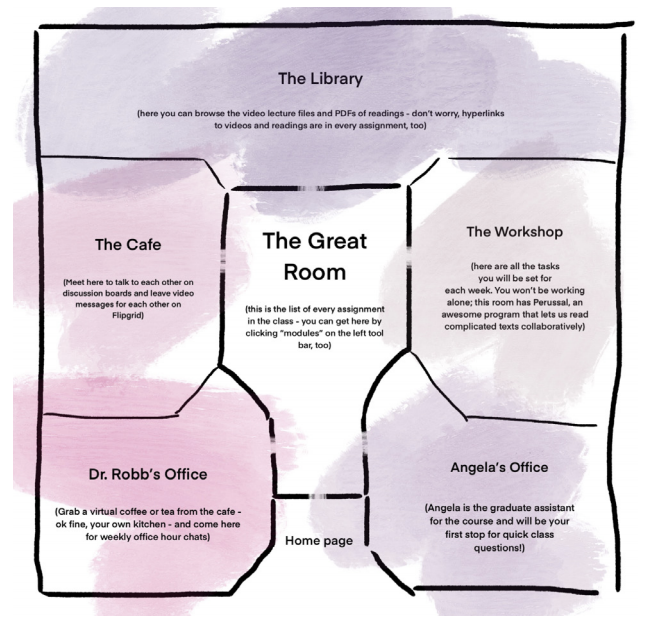
My second step was encouraging students to ground themselves in the class physically by engaging multiple senses. For instance, I created a guide that encouraged students to think of our class as having a “virtual campus.” I drew a map of this virtual campus, visualizing the Canvas site as a three-dimensional space that they could navigate through hyperlinks labelled “The Library” (for the files tab), “The Great Room” (for the list of assignments in modular form), and “The Workshop” (for Perusall assignments where students comment on readings collaboratively). My office was also included in the visualization. I encouraged them to identify a dedicated workspace and included a picture of my own desk, so that they could see where I would be when I joined them in class. While I have not yet invited students to share photos of their workspaces, for fear that some students would feel too keenly a sense of comparison between classmates’ socio-economic circumstances, I did ask students to introduce themselves by sharing an image connected to a hobby or activity that made them feel grounded. Many students shared pictures of their cooking, nature walks, and family pets on the introductory thread. I asked my students to create a class playlist and I play music to welcome students to the Zoom meeting, signing on five minutes early before each class so that they can listen to music they like and get into the classroom mindset. We often start each class with a short breathing exercises or grounding exercise. As is recommended, we take a short stretch break halfway through each class to remind ourselves that we have bodies.
Third, I have made virtual classwork a social experience. I invited each student to schedule a one-on-one meeting with me in the first two weeks of the class, where I talked to them about their motivations for enrolling in the class. While this took a large investment of time on my part, most students took me up on the offer and expressed appreciation for the chance to meet me individually. Those students with whom I spoke individually have been more likely to attend virtual office hours and reach out independently of class time as the class has continued. I also made the process of reading collaborative. For each reading I put students into small groups who then comment on the readings together on Perusall, a program that allows students to respond to my questions and encourages them to ask questions of each other in a low-stakes environment before class. Students can upvote each others’ responses, pose questions to each other, tag each other, and include hyperlinks to interesting additional materials. During class, the breakout sessions focus on the topics that students found most confusing and interesting, as determined by the content of their collaborative annotations.
Finally, I cultivate compassion for my students as whole humans by modeling humility in the face of failure. It is difficult for me to teach in a new way in a stressful time, just as it is difficult for my students to learn in a new way in this stressful time. In my first class of the semester, I stated my intention to be kind to myself and to others while figuring out this unconventional semester, inviting them to make a similar commitment to themselves. Even while requiring high standards in scholarly performance from my students, I try to empathize with them by asking about their lives and remembering what is going on in their lives. When I need to correct my own mistakes in online course design or I am compelled to troubleshoot a new technology on the fly—my least favorite activity—I try to model for my students a growth mindset that allows them to embrace making mistakes while growing as scholars. Only time will tell which strategies are successful in cultivating a classroom community. In the meantime, I am grateful for the opportunity to emphasize caring for my students as whole humans, an unexpected silver lining to an otherwise monumentally challenging situation for us all.
Megan Robb is the Julie and Martin Franklin Assistant Professor of Religious Studies in SAS.
This essay continues the series that began in the fall of 1994 as the joint creation of the College of Arts and Sciences, the Center for Teaching and Learning and the Lindback Society for Distinguished Teaching.
See https://almanac.upenn.edu/talk-about-teaching-and-learning-archive for previous essays.