Novartis-Penn Center for Advanced Cellular Therapeutics
Physicians, scientists and leaders from the University of Pennsylvania’s Perelman School of Medicine and the global pharmaceutical company Novartis gathered recently to unveil the Novartis-Penn Center for Advanced Cellular Therapeutics (CACT). Located on Penn Medicine’s campus amidst both clinical care and laboratory facilities atop the Jordan Medical Education Center and South Pavilion Extension of the Perelman Center for Advanced Medicne, the CACT is poised to become an epicenter for research and early development of personalized cellular therapies for cancer, expanding on Penn’s groundbreaking research using Chimeric Antigen Receptor (CAR) technology, which enables a patient’s own immune cells to be reprogrammed outside of the body and re-infused to hunt for and potentially destroy tumors.
“In only a few years, we have generated significant achievements that have moved the field of personalized cellular therapies forward, opening clinical trials to test these treatments not only for patients with blood cancers, but also those with solid tumors,” said Carl June, the Richard W. Vague Professor in Immunotherapy in the department of pathology & laboratory medicine and director of the Center for Cellular Immunotherapies in Penn’s Perelman School of Medicine. “The CACT will allow us to leverage this progress to develop and test new approaches more quickly and expand our ability to manufacture personalized cell therapies for a greater number of trials.”
The new facility is a marquee component of Penn’s translational science efforts to expedite the development of novel therapies for many types of disease. The collaboration with Novartis was announced in August 2012, when the two organizations entered an exclusive global research and licensing agreement to further study and commercialize novel CAR therapies. The $27 million CACT was constructed in part through a $20 million investment from Novartis, and will employ 100 highly specialized cell therapy professionals working across 6,300 square feet of “clean room” space for cell engineering and 23,610 square feet of laboratory and cell therapy manufacturing space with the capacity to manufacture cellular therapies for up to 400 patients per year (Almanac September 30, 2014).
“The opening of the Novartis-Penn Center for Advanced Cellular Therapeutics is a significant milestone in our collaboration with Penn,” said Mark C. Fishman, president of Novartis Institutes for BioMedical Research. “It is our hope that discoveries will be made at this facility that could one day lead to new medicines to help cancer patients around the world.”
Frederick Steiner: Dean of PennDesign
 Frederick “Fritz” Steiner will be the next Dean of the University of Pennsylvania School of Design, effective July 1.
The announcement was made last Thursday by Penn President Amy Gutmann and Provost Vincent Price.
Dr. Steiner, who will also be the Paley Professor at Penn, is an acclaimed scholar and teacher and a proven leader who presently serves as dean of the School of Architecture at the University of Texas at Austin. He holds two master’s degrees and a doctoral degree, in city and regional planning, from PennDesign, and he has also been a research scholar at the Penn Institute for Urban Research since 2013.
At UT Austin, where he holds the Henry M. Rockwell Chair in Architecture and has a courtesy appointment in the department of geography and the environment, Dr. Steiner leads a school with nearly 70 faculty and teaching staff and nearly 700 students across a variety of disciplines and professions, including architecture, community and regional planning, historic preservation, interior design, landscape architecture, sustainable design and urban design. During his 15-year tenure, the number of the School’s endowments has nearly doubled, a new Center for Sustainable Development and new degree programs in landscape architecture and interior design were created and the school’s buildings and physical plant were expanded and modernized.
Before moving to UT Austin as dean in 2001, Dr. Steiner served for 12 years at Arizona State University as director of the School of Planning and Landscape Architecture. While there, he led efforts to elevate the department to school status, developed a college-wide interdisciplinary doctoral program in environmental design and planning, won accreditation for degree programs in planning and landscape architecture and created an undergraduate program in landscape architecture.
He had earlier served as a faculty member and director of the Center for Built Environment Studies at the University of Colorado Denver and on the faculty of Washington State University.
A Fellow of both the American Society of Landscape Architects and the Council of Educators in Landscape Architecture, Dr. Steiner has written, edited or co-edited 17 books, including two editions of the widely used and frequently translated The Living Landscape: An Ecological Approach to Landscape Planning and influential edited volumes with and on Ian McHarg, the celebrated landscape architect and founder of Penn’s department of landscape architecture (Almanac March 20, 2001).
Dr. Steiner has been a visiting professor of landscape architecture at Tsinghua University in Beijing; a Fulbright-Hays Scholar at Wageningen University, the Netherlands; and a Rome Prize Fellow in Historic Preservation at the American Academy in Rome.
“I am excited and honored to return to Penn as dean of PennDesign,” Dr. Steiner said. “This is an exciting time for students, scholars and practitioners in architecture, city and regional planning, preservation, landscape architecture and the fine arts. As a PennDesign alumnus and a research scholar at the Penn Institute for Urban Research, I have a particular appreciation for the talented community of faculty, staff, students and alumni that is PennDesign. I look forward to working with all members of the PennDesign community, and with colleagues across campus and around the nation and the world, to bring PennDesign to even greater heights of success.”
“Fritz Steiner has a long and distinguished track record as a scholar, teacher and administrator,” President Gutmann said. “His work crosses traditional disciplinary and professional boundaries.
“Because of his deep and abiding connection to PennDesign, his appreciation of the School’s impressive history and his excitement to contribute to its bright and compelling future, we look forward to working with him as he collaborates with faculty, staff, students, overseers and alumni to build on PennDesign’s incredibly strong foundation.”
“Our selection of Fritz Steiner as the next dean of PennDesign successfully concludes a comprehensive global search to identify a successor to Marilyn Jordan Taylor, who is stepping down after serving as dean since 2008,” Provost Price said. “Under Marilyn’s leadership, PennDesign’s faculty and student body grew more interdisciplinary, eminent and diverse; new interdisciplinary teaching and research initiatives were created, including the Kleinman Center for Energy Policy; and the School’s facilities were modernized and upgraded.”
MaryFrances McCourt: Penn Vice President for Finance and Treasurer
 MaryFrances McCourt has been named Vice President for Finance and Treasurer at the University of Pennsylvania.
In her role, Ms. McCourt will lead Penn’s cash and short-term investment and capital financing strategies as well as oversee Penn’s financial functions. Ms. McCourt will also be responsible for the University’s multi-year financial planning efforts and will collaborate closely with Penn Medicine leadership on its growth and financial planning. She will directly manage the strategic and operational direction of a variety of functions, including the Comptroller’s Office, Financial Training, Global Support Services, Research Services, Risk Management and Insurance, Student Registration and Financial Services and the Treasurer’s Office.
In making the announcement, Penn Executive Vice President Craig Carnaroli said, “MaryFrances brings superior financial management and leadership skills in the financial operations of a large complex institution of higher education. Penn will benefit in many ways from MaryFrances’ deep and diverse experience.”
Ms. McCourt is currently the senior vice president and chief financial officer at Indiana University and will join Penn on March 21.
Ms. McCourt has also served in financial-management positions for Agilysys, Inc., a diversified enterprise focused on technology and enterprise system solutions. She earned her bachelor’s degree magna cum laude from Duke University and an MBA from Case Western University.
Ms. McCourt replaces Stephen D. Golding (Almanac January 15, 2008), who will retire in March after serving more than seven years in the role.
Penn’s 2016-2017 Financial-aid Budget, Undergraduate Tuition
The University of Pennsylvania announced that it has authorized a $214 million financial-aid budget for 2016-2017—the largest in the University’s history—while increasing total undergraduate charges by 3.9 percent.
This represents the eighth consecutive year that Penn has kept its tuition growth under 4 percent. Since Amy Gutmann became Penn’s president in 2004, Penn’s financial-aid budget has now grown by 171 percent, averaging 8 percent per year, close to twice the average annual growth in total charges through FY17.
“Penn’s all-grant policy is one of our highest evergreen priorities,” said President Gutmann. “Since we first implemented the program in 2008, Penn has awarded nearly $1 billion in grants, providing access to Penn’s Ivy League education to exceptional young women and men with extraordinary promise from all backgrounds. Ensuring a Penn education while reducing the burden of debt for students from a range of social and economic circumstances is fundamental to Penn’s mission.
“Access to a high quality higher education is the single greatest gateway to economic opportunity. As the first in my family to attend college, I know the indelible, transformative impact that a college education can have. By eliminating financial barriers to be able to attend the University of Pennsylvania and by reducing the burden of debt, Penn’s all-grant program is making a Penn education possible for thousands of students and their families.”
Total undergraduate charges for 2016-2017—tuition, fees and room and board—will increase by 3.9 percent. Undergraduate tuition will increase to $45,556 from $43,838; room and board will increase to $14,536 from $13,990; and fees will increase to $5,908 from $5,698. Tuition and fees cover only 70 percent of the direct cost of delivering a Penn education.
As a result of Penn’s all-grant financial aid program, the average net cost for aided students to attend Penn today is almost $2,700 less than it was in 2005 in constant 2005 dollars.
Penn has substituted grants for loans in undergraduate financial aid packages since 2009. Next year, the average grant for students is estimated at $45,000. These grants do not require repayment.
This academic year, 46 percent of Penn’s undergraduate students received need-based grants from the University. Most undergraduates from families with incomes of less than $180,000 are receiving grant assistance, and the typical student with family income of less than $40,000 receives grant aid that covers full tuition and fees, and room and board.
With 10,400 undergraduates, Penn is the largest school in the nation to offer an all-grant financial aid program for undergraduates.
Penn’s all-grant financial aid initiative supports the University’s long-standing commitment to its need-blind admissions policy, which means students are accepted based on academic achievement, regardless of their ability to pay. The program has helped to reduce the number of Penn students borrowing. Today, nearly two-thirds of Penn undergraduates graduate debt free.
Penn’s all-grant program is aligned with the inclusion goals outlined in the Penn Compact 2020 Presidential Initiatives, which include a comprehensive effort to raise additional funding for the endowment to support undergraduate financial aid. In support of this initiative, President Gutmann announced the “Penn Impact 2020” plan, which includes a goal of raising one billion dollars for student financial aid from 2005 to 2020, comprised of a $600 million goal for undergraduate financial aid and a $400 million goal for graduate and professional student aid.
Additional information on undergraduate financial aid is available at www.sfs.upenn.edu
ABCS Course Development Grants: April 1
The Barbara and Edward Netter Center for Community Partnerships announces course development grants for Fall 2016 and Spring 2017 to promote Academically Based Community Service (ABCS) courses that integrate research, teaching, learning and service. Over 150 courses from a wide range of disciplines and Penn schools have linked Penn undergraduate and graduate students to work in the community. The grants support University faculty to develop new courses or adapt existing courses that combine research with school and community projects.
To see a list of the ABCS courses, visit https://www.nettercenter.upenn.edu/abcs-courses/current-courses
Grants will be for no more than $5,000 per project. These funds can be used to provide graduate and undergraduate support, course support and/or summer salary ($5,000 is inclusive of E.B. if taken as salary).
Funded by the Netter Center, course development grants facilitate faculty in developing new and substantially restructured undergraduate and graduate level courses that engage students in real-world problem-solving projects in conjunction with schools and community organizations located in West Philadelphia.
The following criteria will be used to evaluate proposals:
1. Academic excellence
2. Integration of research, teaching and service
3. Partnership with schools, community groups, service agencies, etc.
4. Focus on Philadelphia, especially West Philadelphia
5. Evidence as to how the course activity will involve participation or interaction with the community as well as contribute to improving the community
6. Evidence as to how the course activity will engage undergraduate and/or graduate students in real-world problem-solving research opportunities
7. Potential for sustainability
Please format proposals as follows:
1. Cover page
1.1 Name, title, department, school, mailing address
1.2 Title of the proposal
1.3 Total amount of funding you would like to receive
1.4 100-word abstract of the proposal (include a description of how the course will involve interaction with the community and benefit the community)
2. A one-page biographical sketch of applicant
3. A two-to-four-page mini-proposal
4. Budget detailing how you intend to use the requested funding
Proposals for Fall 2016 and Spring 2017 courses should be submitted to the Netter Center for Community Partnerships by April 1, 2016.
Please e-mail proposals to Janeé Franklin, ABCS coordinator, at janeef@pobox.upenn.edu
Penn Futures Project: Investing in Children & Communities
Three University of Pennsylvania deans have joined forces to improve the lives of Philadelphia youth and families through the Penn Futures Project (PFP). Penn Nursing Dean Antonia Villarruel, Social Policy & Practice (SP2) Dean John L. Jackson, Jr. and Graduate School of Education (GSE) Dean Pam Grossman announced that they are investing $30,000 to launch cross-school pilot projects aimed at working in partnership with communities to improve the lives of children and families. Vincent Price, provost of the University of Pennsylvania, agreed to match the contribution, making a total of $60,000 available for PFP work. The selected projects will focus on forging a partnership with a local high school for health sciences to prepare professionals who work with youth and support cross-professional and cross-sector collaboration, harnessing the power of cross-city agency data to create new solutions for children in poverty, and preparing practitioners to work with vulnerable LGBTQ youth.
The idea for the joint effort sprang from the common interests of three new deans joining Penn for the 2014-2015 academic year. The Nursing, SP2 and GSE deans quickly identified a common passion for improving the health and well-being of children and families. In the fall of 2015, these deans asked faculty members from across their schools to come together for a meeting to share the work they were doing in the community—over 50 Penn faculty attended. They were invited to find commonalities across schools, initiate cross-school collaborations and create high-impact funding proposals for the deans. Three of these proposals were chosen for inaugural grants.
“The challenges facing our community cannot be solved by any one discipline, school, health system or community,” said SP2 Dean Jackson, the Richard Perry University Professor. “It’s for this reason that we have partnered to work across Penn and across Philadelphia’s landscape of community organizations, local businesses, government agencies and other entities to develop innovative, multi-disciplinary solutions to some of the most pressing problems. I am excited to see the social change we can bring about by combining our energy, expertise and passion.”
“We are committed to finding ways to work with community members and other professionals to create greater opportunity for all of our children,” said GSE Dean Grossman. “The challenges facing our youth go well beyond the schoolhouse, and these projects represent a unique opportunity to leverage the collective wisdom of the Penn community and beyond to invest in children and communities. Cross-professional collaborations promise to better prepare GSE, SP2 and Nursing students to work together on behalf of children and families.”
“Health is shaped not only by genetics and behavior, but also by access to healthcare and opportunities for healthy choices, which are largely a function of socioeconomic factors, including neighborhood environments, income, education and social support,” said Penn Nursing Dean Villarruel. “We must address issues comprehensively by looking across these factors and investing in solutions that will make Philadelphia a healthier, safer and more equitable city for our youth.”
The 2016 Penn Futures Projects are:
Penn Graduate School Alliance for Field Practice with Kensington Health Sciences Academy (KHSA) brings the three Penn Futures Project schools (Nursing, GSE and SP2) together to develop a Penn Graduate School Alliance for Field Practice at KHSA, a Philadelphia health science public school located in one of America’s most under-served neighborhoods. Understanding that developing practitioners to serve the needs of a community in poverty requires the expertise of multiple disciplines, this collaboration aims to serve as an innovative model for a partnership between a university and an urban school district for the purpose of developing and supporting a “whole child/community” model of professional learning.
Serving LGBTQ Youth and Families: Preparing the Next Generation of Social Workers, Teachers, School Counselors and Nurses—To better serve LGBTQ youth and their families—particularly transgender youth of color—there is a pressing need to expand training opportunities and curriculum content for the next generation of social workers, teachers, school counselors and nurses. Faculty, students and alumni from SP2, GSE and Nursing will work with partners from CHOP and The Attic Youth Center. Together, they will review classroom and field learning opportunities for Penn graduate students, with the intent of preparing the next generation of clinical and educational professionals to better serve this vulnerable population. The collaborators will propose—and, where possible, implement—changes in the content of existing courses and the creation of new courses. Field training options will be expanded, and LGBTQ youth will be directly engaged in their work.
A Penn Interdisciplinary Contribution to Data-based Decision-making in Philadelphia—The opportunities for Integrated Data Systems (IDSs), which can make government more efficient through cross-system collaboration, are just beginning to be understood. IDSs can link individual administrative records across public agencies to provide an unprecedented and nuanced snapshot of the effects of poverty on children’s lives—and how factors such as homelessness or low birth weight might impact their outcomes. Expanding on previous work, this project draws together researchers from GSE, SP2 and Nursing to support the City of Philadelphia’s integrated data system in the Deputy Mayor’s Office for Health and Opportunity. This project will look across City systems and agencies to identify young children who are high-cost service recipients—and create a model that can be used to improve service delivery and inform intervention building. This work holds great promise for Philadelphia’s children—and may be a role model for cities nationwide.
Each of the winning projects is expected to commence this spring.
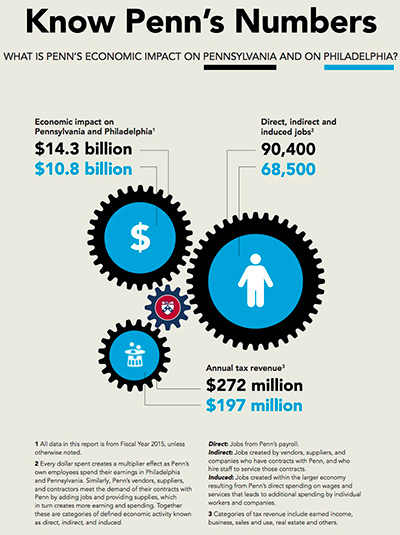
The University of Pennsylvania recently released a report demonstrating a combined economic impact of the University and Penn Medicine of more than $14 billion on the state and citywide economy in fiscal year 2015.
The independent report, conducted by Econsult Solutions, Inc. of Philadelphia, shows that in fiscal year 2015, Penn contributed $14.3 billion yearly, or $39 million per day, to the economy of the Commonwealth of Pennsylvania, and $10.8 billion, or $29.6 million per day, to the City of Philadelphia. According to the Econsult report, $1 out of every $20 in Philadelphia’s general fund and one out of every nine jobs in the Philadelphia economy are generated by Penn.
“The University of Pennsylvania and its Health System are an innovating force for good in Philadelphia, our region, society and the world: advancing creative knowledge, making impactful discoveries, sustaining health and educating great new leaders,” said Penn President Amy Gutmann. “As Philadelphia’s largest private employer, Penn provides 37,000 stable jobs with good wages and exceptional benefits. Penn powers key sectors of our regional economy while contributing in manifold ways to making Philadelphia a thriving and exciting place to live, work, study and visit.”
Using data from the University and Health System’s financial statements for fiscal year 2015, the report illustrates Penn’s role as a powerful economic engine in the region, especially as a major employer; campus developer of significant capital projects, research and innovation; and as a purchaser of goods and services.
Highlights of the report:
• Directly and indirectly, Penn generated 90,400 jobs in 2015. As the second-largest private employer in Pennsylvania, Penn directly employs 37,000 people. In addition, 53,400 individuals are indirectly employed through the construction-related industries, professional services, retail and manufacturing industries through Penn’s activities.
• Penn’s capital spending in new buildings and renovations, and that of third party private real estate development, was $932 million in the local economy for fiscal year 2015. This employed 10,300 Pennsylvanians in construction-related jobs. Of all on-campus construction jobs (for projects totaling $5 million or more), 35 percent employed minority- and women-owned businesses and 26 percent of all contracts went to minority- and women-owned businesses.
• In fiscal year 2015, Penn attracted $939 million in sponsored research funding from government grants and other sources stimulating job creation and spending in the local economy. As a preeminent research institution, Penn is consistently among the top five recipients of federally sponsored research dollars.
• The statewide impact of Penn’s purchasing of goods and services was $572 million in fiscal year 2015. Locally, $344 million of spending was with Philadelphia-based businesses, $122 million with West Philadelphia-based businesses.
• In fiscal year 2015, ancillary spending by Penn students, patients and visitors to campus was $279 million on local goods and services such as trips to restaurants, shops, collegiate athletic events and visits to cultural attractions. In addition to generating jobs, capital, operational and research dollars, Penn attracts private and public investment and development and bolsters the state and local tax base through wage tax, earned income, business, sales and use and real estate taxes generating $272 million in state taxes and $197 million in City taxes.
The report also details substantial support in West Philadelphia, where the University’s investment in neighborhood services includes supplementing municipal services such as safety, public space management, workforce development and homeownership programs, and retail development.
The University’s commitment to local engagement programs and its partnerships and programs providing services and support to public education in Philadelphia include an $800,000 contribution annually to the neighboring Sadie Tanner Mossell Alexander University of Pennsylvania Partnership School, expertise from Penn’s Graduate School of Education and a $1 million dollar annual investment by Penn’s Netter Center for Community Partnerships providing initiatives such as tutoring and health and nutrition programs to public school children across Philadelphia.
The FY2015 Economic Impact Report paints a broad picture of the University’s wide-ranging and deep impact on the state, city and region’s economic development and prosperity.
The full report is available at http://www.evp.upenn.edu/pdf/Penn_Economic_Impact_Powering_PHL_PA.pdf
What is the IMPACT of Penn being a large and stable employer?
Penn is the largest private employer in the city and second in the state, generating a workforce impact from its more than 37,000 individuals directly employed. Additionally, there are over 53,400 indirectly employed from within the region. These people work within the supply chain of private companies servicing Penn with a range of necessary goods and services such as medical instruments, office supplies, maintenance, construction and food—to name a few—or in induced jobs needed to service these commercial enterprises.
• $6.4 billion in salaries and wages in
Pennsylvania
• $163 million in earned income tax revenue in Philadelphia
• $181 million in earned income tax revenue in Pennsylvania
What is the IMPACT of Penn’s purchasing of goods, supplies and services?
To maintain its wide-ranging operations, Penn is a large-scale purchaser of goods and services. Channeling purchasing capacity to minority and women business owners in West and Southwest Philadelphia, and across the entire city, has long been a commitment to fostering local engagement.
Driving the Philadelphia economy through socially responsible purchasing and procurement is the Supplier Diversity Program, which deepens Penn’s supply chain by including vendors in Philadelphia and Pennsylvania that directly infuse millions of dollars into the local economy.
• $572 million spent with Pennsylvania- based businesses
• $344 million spent with Philadelphia-based businesses
• $122 million spent with West
Philadelphia-based businesses
What is the IMPACT of Penn’s student and visitor spending?
Students, patients and visitors to Penn spend millions on local goods and services such as renting off-campus apartments, apparel, food and beverage, entertainment, books and supplies, as well as hotels, meetings, sporting and cultural events. A primary benefactor of this ancillary spending is the successful commercial district that Penn develops and manages, and the tax revenue it generates.
• $246 million spent by students
• $26 million spent by visitors
• $7 million spent by visitors to
Penn hospitals
• 2,065 Philadelphia jobs paying
$74 million in wages
• 2,465 Pennsylvania jobs paying
$85 million in wages

 Theodore Caputi, a junior studying economics at the Wharton School and mathematics at the College of Arts & Sciences at Penn, won the Leonard Davis Institute of Health Economics (LDI) inaugural Undergraduate Health Services Research Prize. The prize, to be given annually, recognizes a student who has demonstrated a high level of interest and initiative in the area of health research services and health policy analysis. It includes mentoring by an LDI senior fellow, invitations to conferences and to to LDI’s research and policy seminars, and the potential to network throughout the year with some of the field’s leading experts.
 Dance Theatre of Harlem performs exceptional masterpieces around the world. They will be at Annenberg Center on March 3-5 including two Arts4Youth performances on March 3-4. The iconic company brings unprecedented relevance to classical ballet with cutting-edge new works and beloved masterpieces performed by some of the most beautiful and exceptionally trained dancers. For tickets:
  Most everyone knows the importance of protecting their online passwords. But while best practices to secure these ‘crown jewels’ are plentiful (e.g., have complex passwords, maintain unique passwords for all your accounts, change your passwords regularly, etc.), they can also be hard to keep up with. Many find it difficult to remember multiple, complex passwords. The result: passwords that are relatively easy to guess, and that are reused for multiple accounts—even for accounts that contain sensitive information like banking or credit card data. Fortunately, there is a technical solution that can help: LastPass.