Trailblazing African Americans at Penn and Their Lasting Legacies
Some of Penn’s early trailblazers’ names are now found among the University’s societies, fellowships, awards and even a school, all created during the twentieth century to honor them. Below are some of the many notable men and women who were among the first African Americans to graduate from the University of Pennsylvania or to be the first in other ways. For more information, visit the University Archives at http://www.archives.upenn.edu/histy/features/aframer/gallery.html
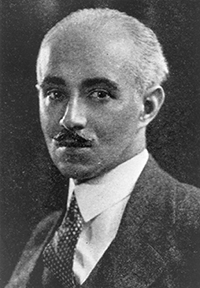 Julian Francis Abele (1881-1950)—Mr. Abele was the first black graduate of what was then Penn’s Architecture School. An outstanding student, Mr. Abele received numerous honors and was active in undergraduate life at Penn. After graduating in 1902 with a BA in architecture, he earned a diploma at l’Ecole des Beaux Arts in Paris in 1905. In 1906 he was hired by the renowned architect Horace Trumbauer, whose later works are often attributed to Mr. Abele. He became a celebrated Philadelphia architect and worked on landmark buildings such as the Philadelphia Museum of Art, the Free Library of Philadelphia and Penn’s Irvine Auditorium, for which he was the chief designer while working for Mr. Trumbauer.
 William Adger (1856-1885)—Mr. Adger was the first African American to graduate from the College of the University of Pennsylvania, earning his bachelor’s degree in 1883. Born in 1856, Mr. Adger was the son of Mary and Robert Adger, the latter, a slave raised in South Carolina. Young William graduated from the Institute for Colored Youth (forerunner of Cheyney University) in 1875. He planned a career in the ministry, but died young of hip disease.
 Raymond Pace Alexander (1897-1974)—Born in 1897 to a poor family, Mr. Alexander supported himself after the death of his mother when he was 12 years old. He graduated from Penn’s Wharton School in 1920 and from Harvard Law School in 1923. He was then admitted to the Pennsylvania Bar and entered practice; his wife Sadie Tanner Mossell Alexander joined him in practice in 1927. Mr. Alexander served until 1950 in many important segregation and civil rights cases. Later, he served on the City Council and became the first black judge on the Court of Common Pleas.
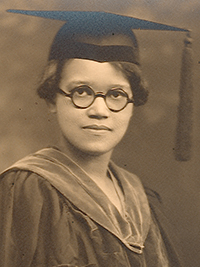 Sadie Tanner Mossell Alexander (1898-1989)—A member of two distinguished families, Sadie Tanner Mossell Alexander graduated from the Penn School of Education in 1918. In 1921, her graduation from the Graduate School at Penn made her the first African-American woman in the country to earn a PhD. In 1927, she graduated from the Penn Law School and was admitted to the Pennsylvania Bar (the first African-American woman to do so). Dr. Alexander held numerous prominent positions in the local, state and national governments until retiring in 1982.
Sadie School (Penn Alexander School) – Conceived in 1998 as a partnership between the University of Pennsylvania, the School District of Philadelphia and the Philadelphia Federation of Teachers, the Sadie Tanner Mossell Alexander University of Pennsylvania Partnership School—affectionately known as the Sadie School or Penn Alexander School—first opened its doors in 2001 to kindergartners and first-graders, soon to include all of grades PreK-8. This University-assisted West Philadelphia public school boasts a hugely diverse student body housed in an 83,000- square-foot-building and supported by an annual Penn subsidy.
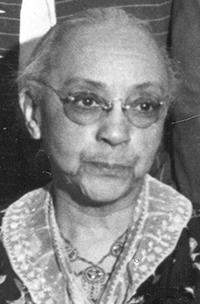 Ida Elizabeth (Bowser) Asbury (1869-1955)—The daughter of a painter, Ida Elizabeth Bowser enrolled at the University of Pennsylvania in 1887 and graduated in 1890 with a Certificate of Proficiency in Music, making her the first African-American woman to graduate from Penn. Ms. Bowser was a violinist and a teacher of music until her marriage to John Asbury, a prominent politician and lawyer.
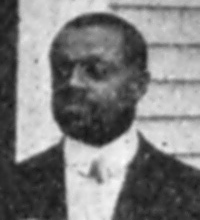 James Brister (1858-1916)—James Brister was born in 1858, the son of Olivia and Joseph Brister, the latter, a dentist and social activist. The younger Brister entered the Penn Dental School in 1879 and graduated in 1881 with a DDS, which made him the first African American to receive a degree of any kind at Penn. Around 1890, Dr. Brister moved to Chicago, practicing dentistry and becoming the only African-American city official of the small religious community of Zion, Illinois.
James Brister Society – Since 1993, the James Brister Society – originally called the Committee for Minority Permanence – has worked to promote diversity at Penn. The Society established the James Brister Society Student Leadership Award to recognize senior students at Penn who demonstrate strong, positive leadership qualities, maintain a 3.0 or higher gpa, demonstrate a commitment to advancing diversity at Penn and exemplify the commitment to achieving excellence at Penn.
 Willis Nelson Cummings (1894-1991)—After earning his bachelor’s degree from Fisk University (where he also became the first African American to register with the Texas Association of the Amateur Athletic Union), he enrolled at the Penn Dental School, from which he graduated in 1919. Dr. Cummings was a member of the varsity cross-country team from 1917 to 1919, and the first African American to captain a varsity team at Penn, encountering racism from rival teams and from the University itself. He practiced dentistry in Harlem from 1920 until his retirement in 1969.
 Helen Octavia Dickens (1909-2001)—Born in Ohio, Dr. Dickens graduated in 1934 from the University of Illinois School of Medicine. After graduating, she practiced in Chicago and Philadelphia. In 1945, Dr. Dickens became the first female African-American board-certified Ob/Gyn in Philadelphia. In 1951, she began working at Philadelphia’s Women’s Hospital, and when Penn took over the Women’s Hospital in 1956, Dr. Dickens became the first African-American woman to serve on the Penn hospital staff. In 1969, Dr. Dickens was named Penn’s associate dean of minority admissions.
The Dr. Helen Octavia Dickens Lifetime Achievement Award – is given annually by Women of Color at Penn (WOCAP). It is named in honor of the late Dr. Dickens (Almanac December 11, 2001), its first recipient. In 1991, she was nominated for an award of merit, but it became apparent that she was no mere candidate but was an exemplary role model.
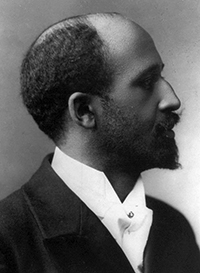 William Edward Burghardt (W.E.B.) Du Bois (1868-1963)—Appointed to the Wharton School from 1896-1897, W.E.B. Du Bois first received an AB from Fisk University in 1888 and an MA and PhD from Harvard University in 1891 and 1895, respectively. While at Penn, Dr. Du Bois was on the Wharton staff teaching sociology and writing the sociological classic, The Philadelphia Negro: A Social Study, which was published in 1899 by the University Press and involved a study of the Seventh Ward in Philadelphia, consisting of door-to-door interviews with thousands of Philadelphia households. The College House named in his honor is the first of its kind to offer its own endowed scholarship, made possible by the Black Alumni Society. In 2012, he was awarded a posthumous honorary professorship.

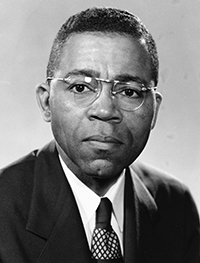 William Thomas Valeria Fontaine (1909-1968)—Born in Chester, Pennsylvania, in a heavily racist climate, Dr. Fontaine graduated cum laude from Lincoln University in 1930. He enrolled at the University of Pennsylvania to study philosophy, earning a master’s degree in 1932 and a PhD in 1936. He taught at Southern University until 1942, when he entered the Army as a vocational counselor. In 1947, Dr. Fontaine became a visiting lecturer at Penn, finally becoming a fully tenured faculty member at Penn in 1963, the first African American to do so. He was chosen ‘lecturer of the year’ by Penn’s Ivy Club in 1958. He taught philosophy here for 21 years.
Fontaine Fellowships –Established in 1970 to honor Dr. William Fontaine, the Fontaine Fellowships support the education of the most underrepresented groups in PhD education. While originally just serving historically underrepresented groups, “diversity” has become more broadly defined and as a result the fellowships now also encompass first-generation college students who are from low-income families as well as students whose backgrounds are underrepresented in a specific discipline or field. In addition to financial aid, the fellowship offers students the opportunity to come together throughout the year in support of one another’s academic progress.
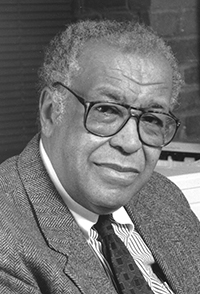 A. Leon Higginbotham, Jr. (1928-1998)—Judge Leon Higginbotham was an eminent jurist, lawyer, scholar and statesman. In 1968, he was elected as the first African- American Trustee at Penn and in 1978 he was elected a Trustee for life. He served at Penn for over 30 years as a Trustee, overseer of Penn Law and the Graduate School of Education, and teacher of sociology and law. He graduated from Yale Law School with honors in 1952. He served as an advisor to President Lyndon Johnson following the assassination of Dr. Martin Luther King, Jr. on how to respond to Dr. King’s death. In 1957 he received an honorary degree from Penn. Among his many prestigious awards is the Presidential Medal of Freedom, which he received in 1995.
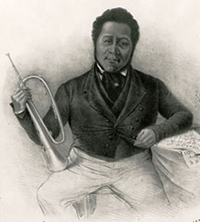 In 2006, the Penn Libraries acquired a collection of printed music by Francis Johnson (Almanac February 14, 2012).
Francis (Frank) Johnson (1792-1844)—Mr. Johnson, known as America’s first ‘big-band’ leader, was a well-known and multi-talented instrumentalist and bandleader in Philadelphia. In 1818, he became the first African American to have one of his pieces published as sheet music. Between 1832 and 1842, his band played at several Penn events, including commencements. Despite rampant racism (including a mob at one of his Pittsburgh appearances), he wrote several enduring compositions and traveled abroad with his band on several occasions.
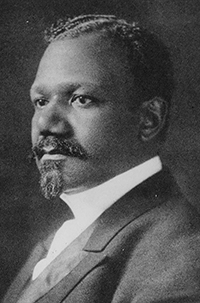 Lewis Baxter Moore (1866-1928)—Lewis Baxter Moore earned AB and AM degrees at Fisk University. In 1896, he was the first African American to earn a PhD from Penn. Dr. Moore was only the fifth African American to earn a PhD in the country. Dr. Moore later served as the Dean of Howard Teachers’ College. After becoming an ordained minister, the Rev. Dr. Moore spent the last three years of his life in Philadelphia as the pastor of the Faith Presbyterian Church in Germantown.
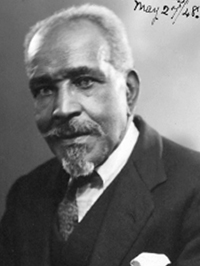 Aaron Albert Mossell (1863-1951)—Aaron Albert Mossell was born in 1863 in Hamilton, Ontario; his great-grandfather was a slave brought from West Africa. Mr. Mossell graduated from Lincoln University in 1885; in 1885, he moved to Philadelphia, where he became the first African American to graduate from Penn’s Law School in 1888. He practiced law in Philadelphia and married in 1890. After divorcing his wife, he settled abroad; Mr. Mossell died in Cardiff, Wales, in 1951.
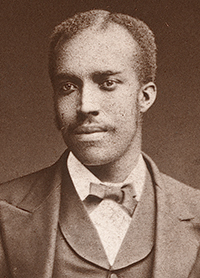 Nathan Francis Mossell (1856-1946)—Born to a bricklayer in 1856, Nathan Francis Mossell graduated from Lincoln University in 1879 with a BA degree and high honors. In 1882, he graduated from Penn’s Medical School, the first African American to do so. Dr. Mossell completed an internship in London, then returned to Philadelphia, becoming the first African American in the Philadelphia County Medical Society in 1888. In 1895, while practicing in Philadelphia, he founded the Frederick Douglass Memorial Hospital. He also founded the Philadelphia Academy of Medicine and Allied Sciences and was influential in the Philadelphia branch of the NAACP.
 Miles Tucker (1856-1904)—Miles Tucker graduated in 1876 from the Institute for Colored Youth, forerunner to Cheyney University. He entered Wharton in 1885 and graduated in 1887, the first African American to do so; his graduate thesis won a national medal. Mr. Tucker aspired to be a politician, though he found himself unable to make a living; he became a teacher and then a day laborer. He died young, widely mourned by his classmates.
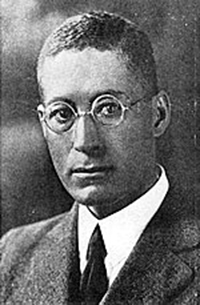 Dudley Weldon Woodard (1881-1965)—By the time Dudley Weldon Woodard enrolled at Penn in 1927, he had already had a prestigious career at Tuskegee Institute, Howard University and Wilberforce University. In 1928, Dr. Woodard became the second African American in the country (and the first at Penn) to earn a PhD in mathematics. He returned to Howard, where he founded a mathematics library, established their graduate program and led the department through a shining quarter-century.

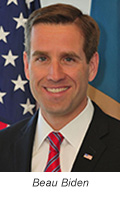 The University of Pennsylvania and the Tau Chapter of Psi Upsilon have announced the creation of the Joseph R. “Beau” Biden III Memorial Scholarship to provide financial support to an undergraduate in the College of Arts & Sciences who would otherwise be unable to meet the cost of a Penn education.
 John Albert Quinn, professor emeritus of chemical & biochemical engineering at Penn, died on February 8 after a brief illness. He was 83 years old.
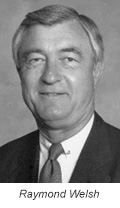 Raymond H. Welsh, W’53, emeritus Trustee at the University of Pennsylvania, died on February 15 after contracting a bacterial infection. He was 84 years old.
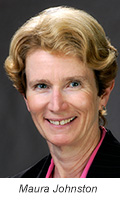 Maura Ann Johnston, former University privacy officer at Penn, died on December 2 in the Good Shepherd Hospice House in Philadelphia, Pennsylvania. She was 60 years old.
 A study published by a multi-disciplinary team led by Kathryn Bowles, the van Ameringen Chair in Nursing Excellence and professor of nursing in the department of biobehavioral health sciences at Penn, was recently awarded the ‘Best Research Article for 2015’ by Research in Nursing & Health (RINAH).
 University City District (UCD) announced that its board chair, Craig Carnaroli, was named a Philadelphia Business Journal Outstanding Director for 2016. Mr. Carnaroli’s stewardship has helped UCD become a regional pioneer in workforce development, public space development and abandoned property rehabilitation. Mr. Carnaroli, who is also executive vice president at Penn, will be honored today at the 4th Annual Outstanding Directors Awards program.
 Christopher L. Coleman, the Fagin Term Associate Professor of Nursing & Multi-Cultural Diversity and associate director of the Center for Health Equity Research at the University of Pennsylvania School of Nursing, has been named a Leadership Fellow in the Society of Behavioral Medicine (SBM) Leadership Institute.
 Earlier this month, Andy Ma, the Young Family Head Coach of the University of Pennsylvania men’s and women’s fencing teams, was named Ivy League Co-Coach of the Year. He shares the honor with Zoltan Dudas of Princeton University.
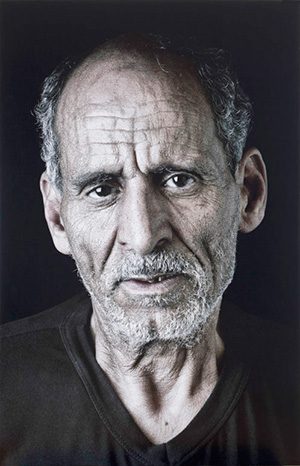 The University of Pennsylvania Art Collection recently received two limited-edition prints by internationally acclaimed visual artist Shirin Neshat. As a partnership with Penn’s Arthur Ross Gallery, the prints are on view within Abbas: Children of Abraham, an exhibition of 66 black and white photographs of the monotheistic religions of Christianity, Judaism and Islam by internationally renowned photographer Abbas. The Robert Rauschenberg Foundation donated the prints in a campaign to foster cross-cultural discussions in the wake of recent events in Europe and the Middle East. The prints—Ghada and Sayed—are part of Ms. Neshat’s Our House is on Fire series, an exploration of Egypt after the Arab Spring. The Robert Rauschenberg Foundation commissioned the series in 2012.
 The Penn Libraries are pleased to announce the opening of Across the Spectrum: Color in American Fine & Private Press Books, 1890-2015. Across the Spectrum explores the establishment of a fine and private press movement in America through its various uses of color.
 On Friday, February 26 at 5:30 p.m., the keynote address will be delivered by Mark Dimunation, chief of the Rare Book and Special Collections Division, Library of Congress, with a reception and formal exhibition opening to follow. On Saturday, February 27, from 8:30 a.m.-6 p.m., the Muriel Pfaelzer Bodek Fund for Library Events will sponsor the symposium, The Arts of the Book: Fine Printing in North America in the 21st Century, in the Kislak Center for Special Collections, Rare Books and Manuscripts.
 Guides have played an active role at Morris Arboretum for nearly 40 years. Today, as in the past, guides are people from the community interested in giving their time and energy to the Arboretum for many reasons. Often they want to learn exciting new things, to be inspired by the beauty of Morris Arboretum, and also to meet staff and other volunteers who believe trees are vitally important to everyone’s life. Active guides at Morris Arboretum are rewarded with a variety of learning opportunities such as field trips, lectures and classes; receive exciting awards for volunteering; make lifelong friends; and improve their physical and mental health.