$2.9 Million in Awards for Penn Researchers from the Burroughs Wellcome Fund to Launch Biomedical
Five early-career researchers from three schools at the University of Pennsylvania have received funding from the Burroughs Wellcome Fund (BWF) for their excellence in biomedical research, in topics including heart disease, sleep and infectious diseases, as part of a nationwide program totaling $22.5 million.
“The Fund awards excellence at an individual level, and provides an opportunity for scientists to leverage our support into long and fruitful careers,” said BWF President, John E. Burris.
 Ann M Hermundstad, a postdoctoral researcher in physics & astronomy in the School of Arts and Sciences, will receive $500,000 over five years as part of the Career Awards at the Scientific Interface, which are intended to foster the early career development of researchers in the physical/mathematical/computational sciences or engineering. Dr. Hermundstad studies how neurons coordinate with one another to support collective functionality, such as the ability to track a moving object or distinguish different smells. By studying this interplay, she hopes to gain insight into why the brain is organized as it is and how this organization enables organisms to function in a complex and dynamic world.
Two Penn investigators will each receive Career Awards for Medical Scientists, which provide $700,000 over five years to facilitate the transition of the academic physician-scientist from a mentored position to a tenure-track faculty appointment. Recipients of these awards are:
 Rajan Jain, an instructor in the department of medicine in the Perelman School of Medicine, studies the mechanisms of genome organization and how that influences cardiac cell development and maturation, to ultimately better understand heart disease. Specifically, Dr. Jain studies the protein network that surrounds the nucleus and how that is emerging as an important scaffold to organize large pieces of DNA that affects gene expression.
.jpg) Matthew Stern Kayser, an assistant professor of psychiatry and neuroscience in the Perelman School of Medicine, studies the mechanisms by which sleep, a critical and highly conserved biological process, controls brain development. He aims to examine whether abnormal sleep early in life increases susceptibility to neurodevelopmental disorders and how sleep itself might be harnessed as a novel therapeutic modality.
Matthew Stern Kayser, an assistant professor of psychiatry and neuroscience in the Perelman School of Medicine, studies the mechanisms by which sleep, a critical and highly conserved biological process, controls brain development. He aims to examine whether abnormal sleep early in life increases susceptibility to neurodevelopmental disorders and how sleep itself might be harnessed as a novel therapeutic modality.
Two Penn investigators will each receive the Investigators in the Pathogenesis of Infectious Disease award, which provides $500,000 over five years to support accomplished investigators at the assistant professor level to study pathogenesis, with a focus on the interplay between human and microbial biology. Recipients of these awards are:
 Igor E. Brodsky, an assistant professor of pathobiology in the School of Veterinary Medicine, will focus on the activity of an enzyme called caspase-8, which plays a key role in how the immune system defends against invading microbes. Dr. Brodsky’s research could help identify therapeutic targets to either boost or tone down the immune system’s response to infection or inflammation.
 Rahul Manu Kohli, an assistant professor of medicine, infectious disease division, in the Perelman School of Medicine, studies new approaches to antibiotic-resistant bacteria. There is some evidence that when bacteria experience stress they can mutate at higher rates, which would facilitate their escape from antibiotics. Dr. Kohli plans to evaluate this possibility by generating bacteria strains to directly tune stress responses and ask how evolutionary dynamics are altered when the bacteria are challenged with antibiotics.
Janus Pannonius Prize for Poetry: Charles Bernstein
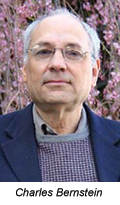 Charles Bernstein, Donald T. Regan Professor of English and Comparative Literature at the University of Pennsylvania, is a winner of the 2015 Janus Pannonius Grand Prize for Poetry along with Giuseppe Conte of Italy.
Founded in 2012 by the Hungarian PEN Club, the award is modeled after the Nobel Prize for Literature, and is named after the first known and celebrated Hungarian poet. The award honors poets considered heirs to human spirituality and culture.
Mr. Bernstein and Mr. Conte were presented with their prize late last month in Italy and Hungary. Their joint bilingual volume, Tutto il whiskey in cielo/Tutto il meraviglioso in terra (All the Whiskey in Heaven/All the Wonder of the World) was presented at that time. On August 29, an award ceremony was held in Pécs, Hungary, the birthplace of Pannonius. The event was in the courtyard of the Episcopal Palace.
The prize comes with 50,000meuros, or $56,405, which is to be split between the two winners.
This is the second major international poetry prize for Professor Bernstein in 2015. He also won the Münster International Poetry Prize.
Modification to Fall 2015 Academic Calendar
No Classes: Friday, September 25
Due to anticipated logistical and transportation issues related to the historic visit of Pope Francis to Philadelphia, Penn will suspend normal operations. Classes and University-sponsored events are cancelled.
Deadline to Drop Classes Extended: Friday, October 9
The drop deadline for fall semester classes has been extended to Friday, October 9. Due to the combined effects of the Jewish holidays and the Papal Visit, instructors may not be able to schedule and return work early enough in the semester to allow students to make an informed decision about continuing in a class in time for the existing earlier drop deadline. Please note that although the new deadline occurs during Fall Break, Penn InTouch will be available to process drop requests.
See the modified Three-Year Academic Calendar on the back page.
Nominations for One Health Award: September 30
The Deans of the health schools of the University of Pennsylvania (Perelman School of Medicine, School of Nursing, School of Dental Medicine and School of Veterinary Medicine) announce an Award for Excellence in promoting One Health initiatives and education.
The One Health concept is a worldwide strategy to expand interdisciplinary collaboration and communication in all aspects of healthcare. Interdisciplinary One Health efforts arose with the goal of sharing knowledge of healthcare and preventive measures to attain optimal health for people, animals and the environment. Government, professional and academic institutions around the world have committed to promoting these important One Health efforts to improve global health. For more information about One Health, visit www.vet.upenn.edu/one-health
The four-school One Health Committee invites nominations for candidates who are full-time staff or faculty members engaged in professional education that bridges two or more of the schools with outreach/innovation in training and service in clinics or to the community. Collaborative research focused on healthcare education, clinical outcomes or real-world impact will receive more favorable consideration than strictly laboratory collaborations. The winner(s) will be awarded the prize (including a $500 cash award) at a reception in October, with all four Deans in attendance.
Examples:
• Developing a multi-school clinical service/teaching program,
• Providing training in communications/outreach to more than one school’s professional students and or interns/residents,
• Including more than one school’s students in a clinical experience,
• Building bridges between healthcare specialties in animals and humans,
• Creating multidisciplinary programs that improve healthcare or prevent famine or disease outbreaks,
• Developing a research program or project that crosses schools to increase the impact of a promising line of discovery.
To nominate a staff or faculty member from the Penn Community, please send a letter of recommendation that describes the candidate’s contributions to One Health, Cerie O’Toole at cerieo@vet.upenn.edu by Wednesday, September 30, 2015.
From the Provost: Serving as Open Expression Monitors: September 10
I hope that all of you enjoyed a wonderful summer and are looking forward to the year ahead. As our richly diverse community of scholars reassembles on campus for the new academic year, this is a fitting time to reaffirm our shared commitment to freedom of thought, inquiry and expression.
This fall marks the first semester of our Campaign for Community, the campus-wide initiative that launched in the spring. Through a range of events, the Campaign will aim to help us discuss and confront issues that are often avoided because they may seem “controversial” or intractable.
One of the most vital ways for faculty and staff to promote this freedom to hear, express and debate various views is to serve as an Open Expression Monitor. Monitors attend meetings or demonstrations to ensure that Penn’s robust Guidelines on Open Expression are followed, supporting the principles of open expression at the heart of our identity as a community of diverse viewpoints.
As the Campaign for Community begins, I encourage all Penn faculty and staff members to consider serving as an Open Expression Monitor. Please contact Katie Hanlon Bonner by September 10 at hanlonkj@exchange.upenn.edu if you are interested.
We welcome the active participation of all students, faculty and staff in the Campaign as it moves forward. You can address your thoughts and suggestions at any time to the Campaign Steering Committee at c4c@exchange.upenn.edu
—Vincent Price, Provost
Penn Glee Club Director: Joshua Glassman
 The University of Pennsylvania Glee Club, Penn’s oldest student performing arts group and treasured University tradition lasting 153 years, welcomes its new director, Joshua Glassman.
Following the resignation of Erik Nordgren, who served as Glee Club Director for 15 years, Platt Student Performing Arts House and the Penn Glee Club announced Mr. Glassman as the newest addition to their staff. Mr. Glassman will assume his responsibilities as Glee Club Director effective fall 2015, including but not limited to campus and community engagement, artistic leadership, performance preparation and conducting.
Mr. Glassman comes to the Glee Club with a master of music from Peabody Conservatory (2015), bachelor of music with teacher certification from the University of Michigan (2012) and eight years’ teaching and conducting experience. Most recently, he held the position of director of choirs for Point Counterpoint Summer Camp in Leicester, Vermont.
“Platt House staff collaborated with Glee Club student and alumni leadership for this national search. I was very impressed with the sincerity and dedication of Glee Club members—current and graduated—as they balanced the responsibilities of such a high-profile hiring process with their school work, extracurricular responsibilities, work, family needs and so on,” shared Platt House Director Laurie McCall. “This collaboration revealed a wealth of passion and thoughtfulness that resulted in the selection of an accomplished and well-suited Glee Club Director. We have very high expectations for Josh and the Glee Club under his leadership.”
“The Penn Glee Club is excited to usher in a new era under the direction of Mr. Josh Glassman. His passion for all-male choral singing, as well as his reverence for the Club’s traditions, promise to make his tenure a special one,” said Glee Club President Daniel Carsello, C’16.
An Additional Gift from Barry R. Lipman to Enhance the Lipman Family Prize
The Wharton School of the University of Pennsylvania is delighted to announce a leadership gift from Barry R. Lipman, W’70 to enhance the Lipman Family Prize, an annual global prize that celebrates leadership and innovation among organizations creating positive social impact. Mr. Lipman’s gift will raise the award amounts for the esteemed Lipman Prize from $125,000 to $250,000 for first place recipients and from $12,500 to $25,000 to each of the second and third place recipients, providing even more generous support to the grateful recipients.
“Barry and Marie’s generosity has an incredible impact, not only on students here at Wharton but on the entire world,” said Wharton Dean Geoff Garrett. “By establishing this fund and continuing to expand upon it in amazing ways, they are providing life-changing support to recipients and to the communities that they serve through their innovative projects. We are extremely grateful for their generosity.”
This marks a second supplemental gift from Mr. Lipman since he originally established the fund with his wife, Marie, in 2011 (Almanac February 1, 2011). In 2013, Mr. Lipman made an additional gift to the prize, increasing the award for winning organizations from $100,000 to $125,000 and providing an award of $12,500 to finalists.
“Our objectives in creating and enlarging this prize are threefold. First, to assist organizations to improve their operations and impact through a competitive process, which leads to collaboration with Penn and Wharton. Second, to encourage students to join the social impact sector. Lastly, to facilitate the transfer of successful elements of the finalist organizations’ models and practices across geography and need,” said Mr. Lipman. “After witnessing the success and impact of past recipients, it is our pleasure to grow the resources and opportunities. We have enjoyed being a part of this prize and look forward to many future positive experiences.”
The Lipman Family Prize has received applications from hundreds of organizations dedicated to a range of global causes including economic development, education, environmental sustainability, human rights, disaster preparedness and poverty alleviation since it was first established. Finalists are selected through a rigorous evaluation conducted by a committee of faculty, students and staff from across the University. In spring 2015, the Wharton School announced the recipient of the fourth annual Lipman Family Prize: Riders for Health, an international social enterprise bringing public health care services to rural communities in sub-Saharan Africa. The 2015 finalists included CareMessage, a social enterprise that provides mobile technologies to improve health literacy and self-health management, and Innovation: Africa, an organization bringing Israeli innovation to African villages through infrastructure projects. The 2016 winner and finalists will be announced in early 2016.
Mr. Lipman is a co-founder of Goldfarb & Lipman—now Goldfarb Lipman—a leading California law firm. He graduated from Wharton’s undergraduate program in 1970.
The Lipman Family Prize at Penn is an annual global prize that celebrates leadership and innovation among organizations creating positive social impact. Governed by a steering committee comprised of Penn faculty, staff and Lipman family representatives, the Prize is administered by Wharton on behalf of the University.
$2 Million Mellon Foundation Grant: Supporting Digital Humanities
The Andrew W. Mellon Foundation recently awarded the University of Pennsylvania a $2 million grant to support University initiatives in the digital humanities in both Penn Arts & Sciences and Penn Libraries.
“The Mellon Foundation’s generous philanthropy will serve to strengthen Penn’s abiding commitment to the most creative scholarship and teaching in the humanities,” said Penn President Amy Gutmann. “We are grateful for the Foundation’s partnership as we launch key initiatives to advance the use of technology along with innovative analyses of the most important big data in the study of the humanities.”
“Digital humanities” is an umbrella term for the proliferation of digital and computational technologies that are being applied to scholarship across higher education and transforming the way humanists work. The digital humanities encompass tools ranging from computers that read massive amounts of digitized writing to facilitate the analysis of texts and detect previously invisible patterns, to geographic information systems (GIS) that present complex histories in the form of interactive maps, to 3-D modeling technologies that can produce immersive re-creations of archaeological sites and artifacts.
Penn’s Humanities in the Digital Age Initiative builds upon projects that have been underway in Penn Arts & Sciences, the Libraries and the University of Pennsylvania Museum of Archaeology and Anthropology. The initiative seeks to consolidate the University’s existing digital resources and significantly expand them in order to profoundly strengthen humanities teaching and research.
The Mellon Foundation grant will help fund special training for faculty and students in the latest digital tools and methods, and enable collaborative, experimental faculty-student research and classroom projects. As a result, Penn will be better positioned to fully utilize the new Price Lab for the Digital Humanities, which was made possible by a $7 million gift from Penn Arts & Sciences Overseer Michael J. Price, W’79, and his wife, Vikki (Almanac February 10, 2015).
“The Mellon Foundation grant further strengthens Penn’s leadership in the digital humanities revolution,” said Penn Arts & Sciences Dean Steven Fluharty, who also noted that the digital humanities initiative is a key component of the School’s new strategic plan (Almanac January 20, 2015). “With the digital humanities we will not only produce new knowledge but new ways of knowing, and new ways to show and share outcomes and results.”
First Place Finish in Competition for Penn's Electric Race Car
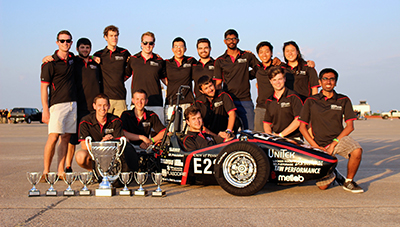
The Penn Electric Racing team in Nebraska this summer: (back row, left to right) Jeremy Wright, Eli Gottlieb, Jay Fleischer, Tommy Sutton, David (Xiaohan) Chen, Manfred Reiche, Prith Gowda, Jason Chen and Courtney Kobata; (front row, left to right) Foster Collins, Dan Shanks, Adam Farabaugh (seated in car), Andrew Remec, Forrest Milburn and Parth Patel. All the students are in mechanical engineering and applied mechanics (MEAM), except Parth Patel, who is in electrical and systems engineering (ESE). An additional 20 members of the team did not travel to Nebraska, but contributed to the design and construction of the car.
Penn Electric Racing has taken home top honors at an international competition. The automotive engineering society SAE International hosts an annual series of racing events designed to spur creativity, innovation and problem solving in the next generation of engineering students. Its Formula SAE competition pits custom-built, high-performance racecars against one another. This year, over the weekend of June 17, it brought in more than 100 teams, hailing from the United States, Canada, Mexico, Brazil, India and Japan.
Gas-powered racers made up a majority of the field, but Penn’s team set out to show that an electric car could hold its own against them. The more than 30 student members are united by their desire to push the envelope of what an electric car can do, not only in terms of its environmental bona fides but the qualities that make driving fun.
A high-speed test track is the perfect venue for such a synthesis. Even getting on the track is an accomplishment. Most of the 20 electric racing teams that came to the Lincoln, Nebraska event, including peer automotive engineering powerhouses MIT and Carnegie Mellon, were disqualified during the event’s exacting technical inspections.
Penn’s car last year, REV0, met with that fate. Drawing on the lessons learned there, the team put a year’s worth of fine-tuning into its successor, REV1. Beyond design upgrades in the shop, the team was able to do more rigorous field-testing of their vehicle this year. The opening of Pennovation Works (Almanac March 3, 2015) allowed for extra practice space.
Their hard work paid off. REV1 took first place among electrics overall, winning seven of the eight categories. These included overall design, cornering, endurance and time-trials on a full racetrack. The acceleration test was one of the team’s strongest suits; beyond taking first among electrics, REV1 would have beaten all but three of the gas-powered cars.
“We had our fingers crossed, but we really didn’t need to. The car worked flawlessly,” said Andy Jackson, the team’s faculty advisor, at a ceremony marking the team’s return to campus.
Dr. Jackson, a professor of practice in the School of Engineering and Applied Science’s department of mechanical engineering and applied mechanics (MEAM), stressed that his role on the team was merely an administrative one and that the students did all of the work on the car themselves.
Not only are they involved in all aspects of its design, fabrication and testing, but senior team members are also responsible for recruiting and training their successors.
The team is looking to raise additional funds for the 2015-2016 year. They have put together a budget with the goal of being the top-performing race car, gasoline or electric, in FSAE Lincoln in June 2016. They would like to identify a team sponsor and major donor, such as GM, and are working on this.
“This is an incredible learning experience for the students,” Dr. Jackson said. “Next year, we expect to be not only the clear winner among electric cars but to beat most of the gasoline cars, too.”
Penn Dental Medicine: $750K for Haptic Technology Center
Margrit Maggio (right), director of operative dentistry and advanced simulation, works with a student on one of the simulation units that will outfit the Measey Haptic Technology Center.Penn Dental Medicine has been awarded a $750,000 grant from the Benjamin & Mary Siddons Measey Foundation of Media, Pennsylvania, in support of a state-of-the-art advanced dental simulation laboratory. The new facility, to be named the Measey Haptic Technology Center at Penn Dental Medicine, will feature Simodont simulation units that use haptic technology to mimic the feel of tooth preparation, delivering a highly realistic virtual reality simulation of dental procedures.
“The Board is proud to be a part of creating this unique educational resource at Penn Dental Medicine,” says Measey Foundation Board Chair, Clyde F. Barker.
Penn Dental Medicine has been a leader in advanced simulation and is the first dental school in North and South America to integrate the Simodont technology into its curriculum. The School acquired 12 Simodont units in the spring of 2014, and starting this academic year, all first-year students were immersed in the technology to build proficiency in handpiece use, depth perception and fine motor movement. The Measey Haptic Technology Center will enable the School to continue to build its resources in this area.
“This advanced simulation lab is such a vital part of ensuring our students are well prepared and confident as clinicians,” said Denis Kinane, Penn Dental Medicine’s Morton Amsterdam Dean. “Through this Center, the Measey Foundation will truly have a far-reaching impact on students and patients,” added Dr. Kinane.
The new Center, projected to be completed next year, will be situated in the lower concourse of the School’s Thomas W. Evans Building and will serve as one of the focal points of the $34 million Evans Building Centennial Renaissance project, a major renovation of the building set to begin this fall.
The Benjamin & Mary Siddons Measey Foundation is named for the parents of William Maul Measey, an 1898 graduate of the University of Pennsylvania Law School.
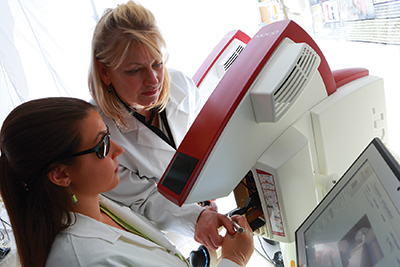
Margrit Maggio (right), director of operative dentistry and advanced simulation, works with a student on one of the simulation units that will outfit the Measey Haptic Technology Center.
AppItUP Challenge: October 12
The Penn Center for Innovation invites the Penn community to participate in the third annual mobile app challenge, AppItUP. Submissions will be accepted from September 14 to October 12.
Submit ideas and spread the word.
AppItUP collects app ideas from Penn students, staff and faculty with the goal of turning the best ideas into products. They partner with investors, software developers and business leaders to make it happen.
To learn more about AppItUP, read the How it Works and FAQ sections at www.appitupchallenge.com
Last year the Center for Innovation collected 427 ideas from 11 schools on campus and turned five winning ideas into companies.
Besides the chance to have your idea made into a working prototype by their Development Partners free of charge, this year’s challenge brings other great prizes as well. Ben Franklin Technology Partners, one of the nation’s most successful technology-based economic development programs, is going to offer an investment of $50,000 to two finalists of its choice.
Aboretum Voices: Sharing Personal Stories of the Morris Arboretum
The history of the University of Pennsylvania’s Morris Arboretum has been chronicled in written stories over the years, but now an audio history series offers an insider’s view from people with strong ties to the organization from the early days to the present.
Started in 2014, the Arboretum Voices project offers information about the 128-year-old estate’s transition into the Arboretum it is today.
“Those stories, they’re not written down anywhere,” says Bob Gutowski, the Arboretum’s director of public programs. “We decided that, if we waited, we would lose a generation of wisdom and experience whose stories may not have been told. Let’s get these before we lose the opportunity.”
On the oral-history webpage, Phoebe Driscoll, a descendant of John and Lydia Morris, shares her thoughts and remembrances of her ancestors.
“It makes me feel good to understand and see in concrete form, their great legacy, which means so much to so many people,” says Ms. Driscoll, who grew up in Baltimore and moved to Philadelphia in the 1960s.
In the interview, Ms. Driscoll recounts her mother’s memories of visits to the Morris’ summer home, originally known as Compton. Ms. Driscoll says her mother grew up across the street and spent time at Compton, where the pet peacocks “scared her to death” because they were “pretty aggressive and very noisy.”
For John Shober, an emeritus member of the Arboretum’s advisory board, the Arboretum became his haven for recovery from post-traumatic stress in 1957 after he served in the Army. At a time when the arboretum wasn’t as well maintained as it is today, Mr. Shober would spend hours taking in the scenery on the grounds.
“I was going to law school at night, and I would take books over there and study,” says Mr. Shober. “It was a wasteland, but it was oddly comforting to me. It’s hard to explain, but this place had an atmosphere about it.”
Mr. Shober would take his children to explore the arboretum, and then years later his grandchildren. Now, he brings his great-grandchildren.
Mr. Shober marvels about the Arboretum’s “handkerchief tree,” also known as Davidia involucrata or dove tree.
“The leaves look like giant handkerchiefs,” says Mr. Shober. “When they start coming down, you see these handkerchiefs coming down all over the ground.”
“These stories carry knowledge beyond the sum of the words,” says Mr. Gutowski. “There’s a lot about transmitting values and what’s important about a place, what’s important about an experience.”
To hear more Arboretum Voices, visit: http://www.business-services.upenn.edu/arboretum/about_arboretum_voices.shtml
Founded in 1887, the property on Northwestern Avenue in the Chestnut Hill section of Philadelphia was the private estate of siblings John and Lydia Morris, horticulturists and civic leaders.
The Morris Arboretum of the University of Pennsylvania is located at 100 East Northwestern Avenue in the Chestnut Hill section of Philadelphia. The 92-acre horticulture display garden features a spectacular collection of mature trees in a beautiful and colorful landscape. The Arboretum includes numerous picturesque spots such as a formal rose garden, historic water features, a swan pond and the only remaining freestanding fernery in North America. The Arboretum is listed on the National Register of Historic Places and is also the official arboretum of Pennsylvania.
To ensure that future generations would have access to the site where they had established their summer home and a garden with botanical treasures, John and Lydia willed these 166 acres to establish a public Arboretum. After their deaths, the University was entrusted in 1932 with the administration of the estate and transforming it into a public arboretum and educational center.
In 1981, art patrons Philip and Muriel Berman commissioned an American sculptor Michael B. Price to create posthumous portraits of the Arboretum’s founders. Mr. Price first researched historical photos to determine the Morris’s appearances. Next he created their likenesses in full-size clay figures (below). To create these Everdur silicon bronze statues, he used the classic lost-wax process of metal casting.
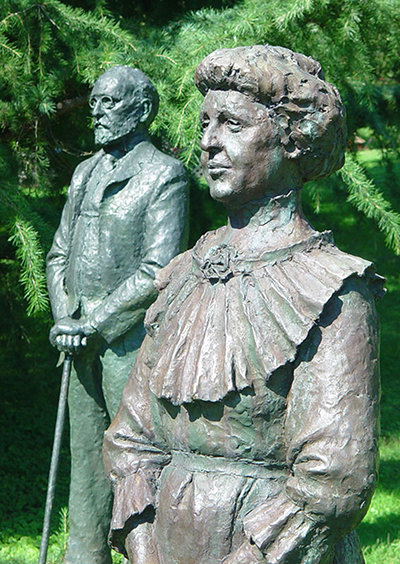
John Morris and his sister, Lydia Morris, are immortalized in the life-size sculptures that since 1981 have stood overlooking the Arboretum’s Azalea Meadow, where their private summer estate was located for many years.
Open weekdays 10 a.m.-4 p.m. and weekends 10 a.m.-5 p.m. (April-October). For more information, visit www.morrisarboretum.org

.jpg) Anthony (Tony) Joseph Atkin, adjunct associate professor in PennDesign’s graduate architecture department for more than 30 years, died on May 21 in Santa Fe, New Mexico after a two-year battle with cancer. He was 64 years old.
Anthony (Tony) Joseph Atkin, adjunct associate professor in PennDesign’s graduate architecture department for more than 30 years, died on May 21 in Santa Fe, New Mexico after a two-year battle with cancer. He was 64 years old.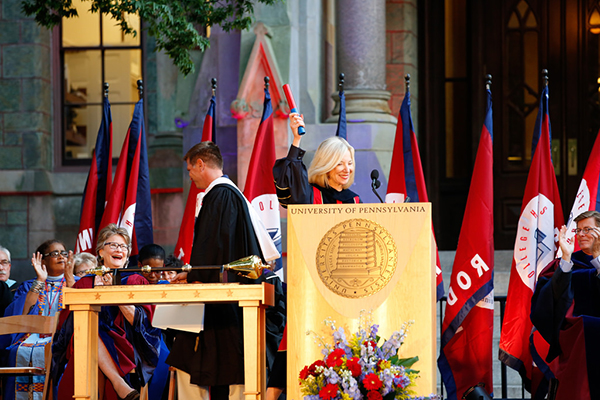
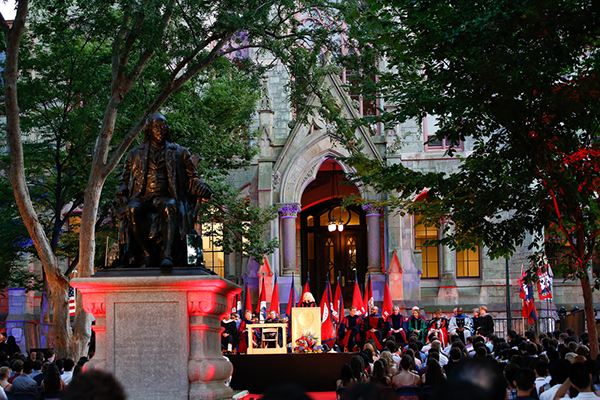
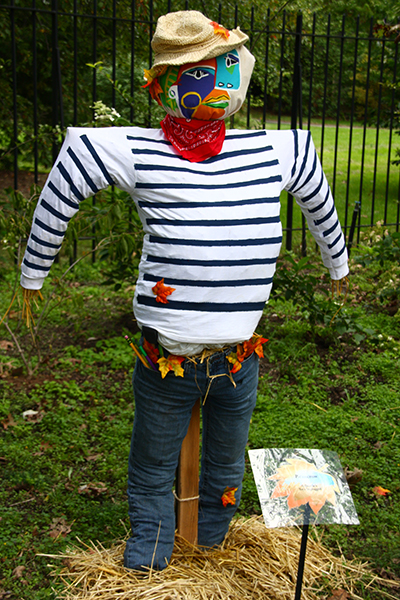 Morris Arboretum is calling all scarecrows for its annual Scarecrow Design Contest. This year participants may create a scarecrow for the theme: Famous Art & Artists. Those who sign up by Thursday, September 24 ensure their place in the contest. The entry fee is $30, with a $5 discount for those who register by Friday, September 11. Scarecrow frames, straw, burlap and twine are all provided. Details and downloadable contest entry forms are available online at www.bit.ly/MAcrows