
The Campus Development Plan 2001--approved by the Trustees' resolution on February 16--stems from the planning process initiated by the President, Provost and EVP (Almanac April 6, 1999) and provides a long-term strategy prepared by Olin Partnership in consultation with the Penn community.
Campus Development Plan 2001
|
Key Findings
The comprehensive review of existing conditions for every aspect of campus life, operations, facilities and infrastructure yielded findings so fundamental in their impact on the mission of the University that they form the basis for the primary goals and recommendations of the Campus Development Plan.
Academic Organization of the Campus
The Historic Pedestrian Core: Penn's undergraduate identity is substantially shaped by the concentration of academic uses set in fine-textured historic buildings within the pedestrian core. This historic core is vital and must be preserved and strengthened as the academic heart of the campus.
The President and Provost's offices are located in College Hall, at the geographic and historic center of the campus. Classrooms, libraries and undergraduate student activities are concentrated in numerous buildings set amid an integrated and thoughtfully designed pedestrian landscape that spans from 33rd to 38th streets and Walnut to Spruce streets. This landscape successfully knits the School of Engineering precinct to the rest of the core in spite of 34th Street. This model should be emulated elsewhere on campus.
A Compartmentalized Campus: Penn's development pattern has resulted in clearly defined graduate and professional school precincts at the perimeter of campus that are clearly defined, but often poorly linked to the historic core.
This pattern has some distinct benefits, such as the concentration of resources and the ability to create a strong school identity. But, it has also resulted in the social and intellectual compartmentalization of Penn at the expense of a more coherent institutional identity. In addition, a number of buildings create difficult perimeters that should be more effectively integrated to establish links to other parts of campus.
Campus Fabric: Buildings, Grounds, Streets and Infrastructure
Buildings: Many buildings on campus do not function well and suffer from systemic deterioration that represents a challenge to their effective use, maintenance and operation. Others have significant historic value but may not meet current academic needs.
Approximately one quarter of campus buildings were constructed during the '60s and '70s and need significant upgrades to systems reaching the end of their life cycles. Many buildings fall far short in fulfilling current program requirements. These buildings need to be carefully evaluated to determine whether they are worth repairing or whether replacement makes more sense.
Buildings allocated to shared academic or support uses experience the greatest wear, but receive the least care and investment due to a lack of "ownership". This is particularly true of residences and those academic buildings with large numbers of pooled classrooms.
Historic buildings contribute to the overall campus image. They present a difficult challenge, however, in meeting academic and functional requirements. Preservation and strategies for adaptive re-use and adjacent development should reinforce the image of Penn as a premier Ivy League university. The University has an important responsibility for the stewardship of its historic buildings.
The Need for Enrichments of Academic Life: Apart from the physical connections that define the campus, the undergraduate and graduate experience at Penn is significantly shaped by the quality of campus life enjoyed by students, faculty and staff. Retail, dining, cultural and recreational activities on and around campus must be seen as enrichments to academic life.
Retail, dining and cultural facilities tend to be concentrated along 40th Street to the west and along Walnut and Sansom Streets to the north. The southern and eastern areas of the campus are inadequately served with retail and service amenities, in spite of the increasing campus population in these areas.
Most athletic and recreational facilities are concentrated at the far eastern end of the campus. As the campus continues to develop, increased demand will be placed on already scarce recreational space. The preservation of flexible recreation space in the vicinity of Hill Field is essential. Finding and developing additional, new space for active recreation within Penn's campus is critical to the health and well-being of the on-campus population.
Intimate and small-scale open spaces for quiet reflection and conversation are concentrated to the eastern end of the campus, primarily within the historic pedestrian core. As a medium for social mixing and the sharing of ideas, the value of these kinds of spaces cannot be overestimated.
Grounds: Institutional resources are unevenly applied to the development and care of campus grounds--open space, paving, fixtures, furnishing, and plantings.
The care of the landscape evident around Blanche Levy Park has been limited throughout the rest--and greater part--of campus. This contributes to the lack of a coherent campus identity and has limited many students' perceptions of what constitutes "campus". The new Penn Bookstore, with its adjacent sidewalk café, has given students and faculty alike a reason to embrace the north side of Walnut Street as part of the campus.
Infrastructure: The complex needs of a large organization and a large population, overlaid on the urban fabric of walks and streets, create a number of conflicts and cause significant wear and tear on the campus.
Penn's pedestrian pattern has been developed without a commensurate vehicular circulation and service access plan. This has resulted in widespread conflicts between pedestrians, cyclists, passenger cars and service vehicles within pedestrian areas and along campus streets. These conflicts must be resolved to maximize safety for the campus population.
Planning the campus infrastructure of utilities and systems has typically been addressed on a project-by-project basis that limits the efficiencies possible when planned for and managed system-wide.
 Penn's
Context Within the City
Penn's
Context Within the City
With a workforce of over 25,000, Penn is an economic engine. It is the largest employer in the region and fourth largest in the state. As an institution it has a significant impact not only on the economic health of the region, but on the daily life of the many individuals who live and work at Penn, in Center City or in the neighborhoods of West Philadelphia. Penn is a resource for learning, culture, entertainment and services of many kinds.
East: Penn is currently disconnected from Center City to the east by an expanse of vacant industrial land that has become, de facto, the gateway to the campus.
This area is unattractive and contributes to a sense of disengagement of Penn from the city. There is a strong desire to establish a connection of appropriate and continuous urban fabric, physically linking Penn to Center City Philadelphia.
West: The quality of the critical transition from campus to neighborhood, extending from 40th to 42nd streets, has been compromised by the high percentage of rental properties that are in decline.
Penn's campus meets West Philadelphia at 40th Street, but the University's impact is felt far beyond this point. Increased opportunities for on-campus housing, coupled with incentives for Penn's faculty and staff to buy homes in West Philadelphia, will help to increase owner-occupied homes in this critical transition zone. With these and other initiatives already in place, Penn has defined its mission to enhance and revitalize the residential and historic fabric of West Philadelphia.
North: Although Penn is bordered by successful institutions and continuous development to the north there are still opportunities for in-fill development to create a more contiguous campus fabric.
The University is the primary stakeholder in the University City Science Center and new construction could be developed for uses more directly supporting Penn's academic mission. Stronger connections can be made to adjacent institutions such as Presbyterian Hospital.
South: Large tracts of land to the south of the campus represent a significant potential for long-term growth in areas well served by regional roadways and transit.
Forging partnerships with Children's Hospital of Philadelphia, the Veterans Administration and other institutions can support future need for growth in research and lab space in zones that support the natural affinities of certain disciplines for each other. The Woodlands represents an opportunity for open space partnerships that are already being developed, in part, by the University of the Sciences.
Recommendations
Goals, Strategies and Key Initiatives
Six goals for guiding the improvement of the academic infrastructure, extending the campus fabric, and strengthening the interaction of the University with the City of Philadelphia emerged as key to achieving Penn's vision for the future. The strategies and initiatives capable of catalyzing great progress are included as part of this discussion. Undertaking any one of these will have a profound impact on the perception and use of the campus.
- Strengthen Connections Across Campus
- Create a Coherent Identity for the Entire Campus
- Reinforce the Historic Pedestrian Core
- Invest in Capital Renewal
- Enhance the Residential Communities of University City
- Connect Penn to Center City
BACK TO RECOMMENDATIONS (6 GOALS)
Goal One
Strengthen connections of campus areas to each other and to the historic pedestrian core, while providing each area with a revitalized open-space heart.
Penn is unique in that all 12 schools are on one campus. This is of immense value for the integration of knowledge. The undergraduate experience, more than any other aspect of university life, unites the various resources of the institution. It is substantially shaped by the concentration of academic uses set in fine-textured historic buildings within the pedestrian core of the campus.
Better connections and open spaces with distinctive local character and amenity would bring those graduate and professional schools that are distant from this historic pedestrian core closer to the heart of the campus.
A Strategy for Connection
Extend and improve, with supporting infrastructure and shared common spaces, the three primary axes that connect the various campus areas to the historic core.
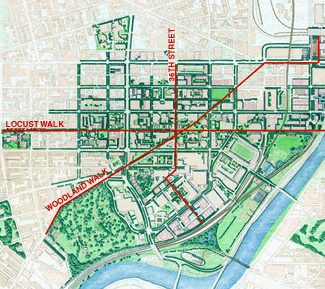
One of the fundamental recommendations of this plan is to extend and enhance the three primary axes of Locust Walk, Woodland Walk and 36th Street, which share College Hall at their center and which, to a significant extent, connect the various campus zones to the historic pedestrian core. Improvement and creation of new central open spaces within each campus area along these axes will further clarify overall campus organization while creating unique local identities.
Locust Walk: Extend Locust Walk from 43rd Street to the east bank of the Schuylkill River.
East
- Implement traffic-calming measures for 34th Street, including traffic signals and an improved crossing at Locust Walk.
- Relocate tennis courts and create "Palestra Green" as a major new open space at the eastern edge of the pedestrian core. Continue the pedestrian and visual connection to the east with a new passage between the Palestra and Hutchinson Gymnasium.
- Extend Locust Walk to renovated and expanded athletic facilities.
- Build a pedestrian bridge across the Schuylkill River to join the campus to Center City.
West
- Transform Locust Walk west of 38th Street through Hamilton Village and undertake street improvements west to 43rd Street. Enhance the western pedestrian entrance to campus at Locust and 40th streets.
- Create new distinctive open spaces associated with College House initiatives in Hamilton Village.
- Extend Penn's academic resources into the community; the University Assisted Public School is one of several ongoing initiatives in University City.
Woodland Walk: Extend Woodland Walk from 39th Street in the southwest to Chestnut and 33rd streets in the northeast.
- Reconfigure the intersection of Woodland and Baltimore avenues with University Avenue and 38th Street to reduce traffic congestion, driver confusion and conflicts with pedestrians.
- Forge a stronger link to historic Woodlands, an open-space resource that offers untapped potential.
- Define the entrance to the campus from the southwest with a new Life Sciences building and the proposed addition to the School of Veterinary Medicine.
- Activate Woodland Walk with College House dining facilities at Stouffer Commons and a more inviting and accessible recreation space for the many students in nearby residences.
- Improve the pedestrian connection and landscape spaces behind the Wistar Institute between 37th and 36th streets to reinforce this key campus vector.
- Renovate Hill Field and build a new College House at 33rd and Chestnut streets to mark the entry to campus at the northeastern corner.
36th Street: Improve 36th Street from the University City Science Center south to the Civic Center Redevelopment.
The 36th Street axis can and should link researchers at the University City Science Center with their colleagues to the south in the biomedical and research facilities planned for the site of the former Civic Center. 36th Street must go through a building to make a continuous connection--in this case through the Johnson Pavilion to the Nursing Education Building.
The 36th street connection brings vast pieces of the academic enterprise closer to the heart of campus and provides opportunities to focus the northern and southeastern parts of campus around new open spaces strategically located along this axis.
- Implement traffic-calming at Walnut and Spruce streets including improved signalization, designated bicycle lanes and improved crossings.
- Open a public passage through the Johnson Pavilion to permit a connection to the Nursing Education Building Plaza and Guardian Drive.
- Create a significant open space with views to the Schuylkill River and Center City in the redevelopment of the Civic Center site.
- Improve the connection between the Civic Center redevelopment and public transit.
BACK TO RECOMMENDATIONS (6 GOALS)
Goal Two
Create a coherent identity for the entire campus by extending the quality, character and amenities of the historic pedestrian core.
Learning of one kind occurs in classrooms and labs. Learning of another, equally important kind occurs in many of the places in and around campus. A university is about bringing diverse people together to learn form one another. An extensive, integrated fabric, rich in spaces and places for contemplation and conversation is essential to fostering a productive community life on campus.
The well-cared for fabric at Penn's pedestrian center-the grounds, open spaces, paving, fixtures, furnishings and planting-creates a strong visual identity for the University that must be implemented with all campus development.
Extend the core campus fabric to new development.
Make universal the character and quality of the pedestrian historic core--the paving, lighting, seating, planting and signs--along walkways and streets as well as throughout the open spaces. Even and consistent use of those elements that make the historic core so appealing will create a sense of comfort, belonging and safety throughout the campus.
- Select from a palette of recommended materials, furnishings and fixtures to ensure that site development is integrated across campus in new projects.
- Coordinate with the city and state for public projects that occur within the campus to ensure design that meets campus standards. The current redevelopment of Spruce Street is an example of effective collaboration.
Reorganize service and operations to avoid conflicts that undermine the quality and safety of the campus environment.
Penn is a major urban institution increasingly dependent on reliable and up-to-date utilities and technology. While there still remains the legacy of a piecemeal network of utilities designed to serve a series of individual buildings, recent efforts to plan for future development though a carefully phased implementation of systems will yield both short- and long-term efficient use of resources.
- Consolidate or relocate many of these functions to the perimeter of campus, or underground where possible to make these functions more efficient and less intrusive.
- Implement traffic-calming measures that communicate the primacy of pedestrians over vehicles, such as the narrowing of intersections at cross-walks.
- Undertake a major comprehensive utilities renewal project to enable the University to maintain leadership in technology-based teaching and research.
Reinforce campus gateways with appropriate designs.
The primary gateways into the campus should be both welcoming and architecturally significant. "Module VII", the award-winning chilled water plant at University Avenue, is a unique gateway that marks a previously undistinguished entry to campus. Currently the University is working with the city to create a stronger entry experience on the South Street Bridge.
- Use new development to create memorable entrances to the campus. For example, the proposed Life Science Building and addition to the School of Veterinary Medicine will frame an important entrance to the campus at the intersection of Woodland and University avenues. Other important gateways include Chestnut Street at 33rd, 34th Street and Walnut, Locust Walk at 40th Street and all entrances to the campus from the east where new development is proposed.
- Treat the railroad bridges that span many campus streets as opportunities to extend a positive image of the campus with fresh graphics of relevant themes.
BACK TO RECOMMENDATIONS (6 GOALS)
Goal Three
Reinforce the historic pedestrian core (33rd to 38th streets Walnut to Spruce streets) as the center of campus life and learning.
College Hall is not only an institutional icon, it is at the heart of Penn's academic enterprise. It is here that the three main campus axes meet, reinforcing the historic pedestrian core's role as the center of campus life and learning. Six of Penn's 12 schools are represented in buildings within the core. The remaining buildings house non-academic functions which must be managed to serve the academic mission of the University. The challenge of caring for academic buildings in the core is compounded by the fact that they are heavily used, but the responsibility for their care is not clearly defined.
Consolidate and improve the academic infrastructure within the historic pedestrian core.
Give priority to those activities that support the academic mission and foster campus life, and, where necessary, relocate other uses to the periphery. The recent acquisition of the Christian Association and the transformation of Charles Addams Hall for use by the Graduate School of Fine Arts are examples of this strategy.
- Relocate non-student-related administrative functions out of the core.
- Identify opportunities to acquire buildings within the core that do not currently support the academic mission.
- Adapt or renovate buildings not currently used for campus academics or student life. College Hall, for example, currently has a large amount of space that could be renovated for academic program use.
Build upon the distinguished qualities of the historic pedestrian core when determining strategies for in-fill and reuse.
The historic buildings that make up Penn's campus core are among the institution's most precious resources. This high concentration of historic buildings demands the highest commitment of university stewardship and great sensitivity in the creation of new architecture. Making the upgrades necessary to meet the academic needs of today's students can be a challenge.
- Renovate and preserve those buildings in the core suitable for sensitive re-use, such as the Music Building and Hayden Hall.
- Implement in-fill strategies that preserve the historic texture and context of the many historic buildings. Jaffe Fine Arts is a good example of this.
Activate the campus core with new residential development at the eastern and western ends of the campus.
A circle of student residences surrounding the campus core will provide round-the-clock vitality. New College Houses in Hamilton Village to the west and Hill Field to the east, along with privately developed housing on adjacent properties, such as the Left Bank apartments and other residential developments proposed to the north, will sustain a lively to-and-fro across the center of campus.
BACK TO RECOMMENDATIONS (6 GOALS)
Goal Four
Invest in capital renewal and encourage rehabilitation and appropriate adaptive reuse of buildings and landscape.
While Penn has many architecturally significant buildings worthy of preservation or adaptive re-use, there are many undistinguished buildings. There is a need to develop sensitive re-use strategies for buildings to be preserved; identify interim uses for those buildings scheduled to go out of service, and plan for the obsolescence of less distinguished structures.
The University has committed significant resources to the landscape infrastructure, particularly in the historic pedestrian core. Preservation and maintenance of the pedestrian core landscape requires ongoing attention and care.
- Preserve and rehabilitate with suitable uses buildings of significance, character and value.
- Invest in buildings constructed in the 1960s and '70s that require significant renewal to meet current standards of teaching and operations.
- Commit resources to the development and maintenance of the landscape fabric, within the core and beyond.
BACK TO RECOMMENDATIONS (6 GOALS)
Goal Five
Enhance the vibrant and historically significant residential communities of University City.
The critical transition from the campus to the neighborhood (40th to 43rd streets) must be improved to create a permeable edge where the campus meets the community. Continued initiatives to improve University City housing and an enhanced corridor of retail activity could yield positive results for both Penn and the neighborhoods to the west.
Continue to improve residential infrastructure.
As new housing is provided for students on campus, more high-quality single family housing will become available to the west. Continued initiatives that encourage home ownership by faculty and staff will help foster more positive bonds with off-campus neighbors.
Facilitate opportunities for retail and entertainment.
New cultural, entertainment and appropriate retail initiative along Walnut and 40th streets will better serve the neighborhood and campus communities alike.
- Establish partnerships with private, public and other institutional enterprises to foster a diverse mixed-use retail and cultural environment.
BACK TO RECOMMENDATIONS (6 GOALS)
Goal Six
Connect Penn to Center City with appropriate urban development.
Despite the tremendous growth and revitalization of Center City in the last decade, and the direct connection of Center City to West Philadelphia via Market, Chestnut, Walnut and South streets, the perception remains that Penn is cut off from the City. Penn's most visible gateways to the east remain underdeveloped, with expanses of industrial land creating a perceived, if not actual, barrier.
This connective growth has already begun with the private development of the Left Bank apartments and Penn's relocation of the Facilities Services Division to the former GE building on Walnut Street.
In recent years, University City has promoted its wide variety of cultural and dining and academic programs to Center City residents and visitors. This is just one example of the many ways public-private partnerships and other collaborations can help to develop stronger ties to the community.
Identify opportunities for development to the east.
The University should seek appropriate partnerships and encourage development of the land that lies between its existing boundary and the Schuylkill River that is consistent with its vision and institutional objectives.
- Connect Penn to Center City along Walnut Street with new, continuous urban fabric. Ideally, this would include a mix of street level retail, housing, and commercial office space that takes advantage of the available multiple levels of access for service and parking.
- Provide opportunities for the growth of Penn's academic facilities, including research and development, and in support of related emerging enterprises.
- Expand campus athletic facilities to include new playing fields, court sports facilities, a natatorium and fieldhouse.
In Summary
Universities grow to their fullest and highest potential when guided by sound, long-term strategic planning for excellence in both their academic mission and supporting physical environment. Those plans that succeed provide flexibility and can accommodate changes in society, the economy, and the institutions themselves. Success will be found in Penn's ability to support and express those ideals that make it unique within a dynamic and unpredictable future.
In creating a vision for the campus that supports the academic mission and the goals identified in the Agenda for Excellence, this plan enables the University to make informed decisions about future growth and development; enter into productive relationships across intellectual disciplines and diverse communities; and to seize opportunities to join with public, private and institutional partners in endeavors that allow Penn to follow its intellectual pathways into the future.
Across the campus, across the city and region, across the nation and world, Penn will secure its continued leadership as a premier academic institution through active stewardship of the Campus Development Plan.
Almanac, Vol. 47, No. 24, February 27, 2001