Albert Maguire, Jean Bennett and Katherine High Receive the 2026 Breakthrough Prize in Life Sciences


 Jean Bennett and Albert Maguire, both emeritus professors of ophthalmology in the Perelman School of Medicine, and Katherine High, an emeritus professor of pediatrics and the founding director of the Raymond G. Perelman Center for Cellular and Molecular Therapeutics at Children’s Hospital of Philadelphia (CHOP), have received the Breakthrough Prize in Life Sciences for their work in developing the first FDA-approved gene therapy for an inherited condition, which dramatically improves sight in people with a form of blindness called Leber Congenital Amaurosis (LCA).
Their work has blazed a trail for the more than 140 gene therapy trials for retinal conditions, including macular degeneration and diabetic retinopathy, diseases that collectively impact about 30 million people in the U.S. Eighty more trials are currently underway.
“Even 20 years ago, treating people with gene therapy was seen by some as an impossibility,” said Jonathan Epstein, dean of the Perelman School of Medicine and executive vice president of the University of Pennsylvania for the Health System. “But this group of incredible physician-scientists persisted and created something that is providing sight to people who would have been completely blind as early as kindergarten. Their belief in the power of life-changing science has led to breathtaking results and richly deserved global recognition.”
The Breakthrough Prizes are called the “Oscars of Science” and are a high-profile celebration of research and support from celebrities spanning numerous areas of pop culture. Created in 2012 by Sergey Brin, Priscilla Chan and Mark Zuckerberg, Yuri and Julia Milner, and Anne Wojcicki, the prizes are given out in five categories, including Life Sciences, Fundamental Physics, and Mathematics, each with an accompanying $3 million award.
This year’s accolade now means that nine Penn-affiliated researchers have received the Breakthrough Prize, tied for the most with Harvard University. The prior Penn Medicine award winners are Carl June (2024), Drew Weissman and Katalin Karikó (2022), and Virginia M.Y. Lee (2019). Additionally, Penn faculty members Charles Kane and Eugene Mele from the School of Arts & Sciences (SAS) won the prize for Physics in 2019.
Eight other faculty members from SAS have been part of research groups that were awarded Breakthrough Prizes for Fundamental Physics, as well: A Penn team won in 2016 as part of the Sudbury Neutrino Observatory Collaboration (Eugene Beier, Joshua Klein, and Christopher Mauger) and in 2025 as part of the ATLAS Collaboration at CERN (Joseph Kroll, Evelyn Thomson, Elliot Lipeles, Dylan Rankin, and Brig Williams, part of the Penn ATLAS Group).
“Science is rarely a straight path, and those who make the most profound discoveries are resilient and persistent, overcoming obstacles along the way,” said J. Larry Jameson, president of the University of Pennsylvania. “That is exactly what I see in this year’s awardees, and it has been true of all our remarkable faculty who have been recognized for scientific breakthroughs. Whether they are discovering what lies beneath Alzheimer’s Disease, curing cancer by engineering a patient’s own immune cells, or reversing blindness, they have persisted with imagination and rigor. Their steadfastness has pushed the boundaries of what medicine can achieve.”
“Developing cell and gene therapies has long been a top priority for our organization,” said Madeline Bell, CHOP’s CEO. “This breakthrough is the result of decades of investment and collaboration, and reflects our commitment to translating scientific discoveries into therapies that will transform patients’ lives. It has paved the way for many more cell and gene therapy innovations and has given hope to families around the world.”
Drs. Bennett and Maguire met and married during medical school in the 1980s. It was then that they both became intrigued by the concept of genetic therapy, the practice of replacing a mutated or faulty gene with a functional copy, and started dreaming of treating inherited forms of blindness with the technique, which at that time remained the stuff of science fiction.
Together, Drs. Bennett and Maguire joined Penn’s Scheie Eye Institute in the 1990s and began working on their ideas with lab mice. They learned that Gustavo Aguirre at the University of Pennsylvania School of Veterinary Medicine had identified a spontaneous canine model of blindness analogous to LCA that would prove to be invaluable to their research.
The pair developed a therapy that used a virus as a transport, carrying a piece of DNA into cells that would then correct the faulty, blindness-causing proteins formed by the bad gene. The idea: Once the proteins were set right, some sight might return. First, they tested the therapy by injecting it into a single eye in each of three dogs.
It wasn’t long until they knew whether it worked. Dr. Bennett recalls receiving an excited phone call from a technician at the lab, who exclaimed, “They can see!”
Sure enough, the dogs were twirling around, using their treated eyes to see. Before treatment, the dogs had bumped and tripped through an obstacle course set up to test their sight. After the full treatment, the course was an easy task for the dogs.
In parallel with Drs. Bennett and Maguire’s dreams of gene therapy, Dr. High was also working to push the field forward. Like Drs. Bennett and Maguire, she had achieved long-term reversal of a serious genetic disease in a dog model: In her case, for hemophilia, a life-threatening bleeding disorder. Dr. High had advanced these studies from success in dogs to initial clinical trials in humans, delivering the donated gene into skeletal muscle and the liver.
The work was promising, but the human immune response to the gene delivery vessel—which was derived from a virus in the same way Drs. Bennett and Maguire’s therapy was—prevented sustained benefits from the therapeutic gene. At the same time, companies and investors, discouraged by high-profile negative events, began to turn away from gene therapy. Progress stalled.
But with support from CHOP, Dr. High founded the Raymond G. Perelman Center for Cellular and Molecular Therapeutics in 2004. She recruited experts in all aspects of clinical gene therapy, including specialized knowledge in the manufacturing and release of gene therapy vectors, which are the particles that deliver a healthy copy of a defective gene to patients.
After vector production was set up at CHOP, Dr. High discussed starting a clinical trial in humans with Dr. Bennett. In 2007, Dr. Maguire, who was then a surgeon in pediatric ophthalmology at CHOP, administered an injection of the experimental therapy at CHOP into a clinical trial participant—a 26-year-old woman—for the first time. Her twin, with the same condition, received the treatment shortly after.
When the team assessed the treatment of the 37 eligible participants from the original clinical trials, 72 percent reported the maximum possible improvement in a test of low-light conditions, which simulates night vision. Amid these, many reported improved peripheral and central vision, too. One patient, who could only detect changes in light, was suddenly able to navigate walking through Philadelphia at night, unaided, and could make out the clock on City Hall. Another patient was able to see a star for the first time in her life just six days after the procedure.
In 2017, the therapy—by then manufactured by Spark Therapeutics, a spinout of CHOP, and called Luxturna—received approval by the U.S. Food and Drug Administration (FDA). It became the first FDA approval of a genetic therapy for an inherited disease. Today, hundreds of people around the world have successfully received the treatment.
“We always just did what we thought you were supposed to do if you were a doctor: Find treatments for diseases,” said Dr. Maguire. “Both my father and Jean’s worked in science, and it seemed normal to try to push the envelope.”
“I think the only surprise for us was that things worked out so well,” Dr. Bennett said. “For every success, there are usually so many failures. That’s just the nature of science. But our team hit on something that has helped so many people and helped progress the field, and we’re really grateful for our part in that.”
Dr. High described the journey from the start of her collaboration with Drs. Bennett and Maguire in 2005 to the FDA approval in 2017 as “an arduous one.”
“At times, it seemed that the number of obstacles we needed to overcome to reach regulatory approval was never-ending,” Dr. High said. “Working without the benefit of the guidelines and precedents we now have today, we sought to solve each day’s problems so that the program would have a tomorrow. It was a bold and uncertain investment of time, effort, and resources. Few were willing to take on the risks, but it ultimately paid off, and it helped build the foundation of modern gene therapy.”
Mathew Madhavacheril: New Horizons Breakthrough Prize
 Mathew Madhavacheril, an assistant professor of physics & astronomy in the School of Arts & Sciences, is among a small cohort receiving the New Horizons in Physics Prize, an early-career laureate funded by the Breakthrough Prize Foundation. The recognition, one of the highest in science, comes in honor of his work around advances in cosmic microwave background (CMB) and supernovae cosmology, and includes a $100,000 prize.
Awarded annually, the New Horizons prize recognizes exceptional achievements from junior researchers in physics. Dr. Madhavacheril’s work seeks to understand how the universe began, as well as its evolution over billions of years. His research, which has received significant funding from the National Science Foundation (NSF), probes questions around the nature of dark matter and dark energy, mysterious forces that respectively make up the bulk of the universe and seem to contribute to its expansion. As part of that work, Dr. Madhavacheril, who is part of Penn’s Center for Particle Cosmology, was involved with the Atacama Cosmology Telescope (ACT) project based in northern Chile, which focused on studying CMB, leftover radiation from when the universe was in its earliest stages. He now works with the NSF-funded Simons Observatory, a new telescope project in the same area co-directed by Mark Devlin, the Reese W. Flower Professor of Astronomy and Astrophysics.
“This is a tremendous honor and a testament to the extraordinary work Mathew has produced so early in his career,” said Marisa Kozlowski, associate dean for the natural sciences and the Ponzy Lu Endowed Professor of Chemistry. “We look forward to seeing where his cutting-edge interdisciplinary program takes him in the years ahead.”
The New Horizons prize has gone to CMB researchers before—including some of Dr. Madhavacheril’s mentors—underscoring the value that the subject holds for the broader field of physics. Dr. Madhavacheril is receiving the prize alongside five other researchers: Dillon Brout of Boston University; J. Colin Hill of Columbia University; Maria Vincenzi of the University of Oxford; Daniel Scolnic of Duke University; and W. L. Kimmy Wu of Caltech.
“Everything I have done has been collaborative,” Dr. Madhavacheril said. “My work would not have been possible without the talented graduate students and postdocs I have been so lucky to work with, the builders who create incredible instruments like ACT, and my mentors, who inspired me and taught me how to solve problems.”
Dr. Madhavacheril and his colleagues received the New Horizons award on April 18 as part of a live event in Los Angeles. The broader Breakthrough Prizes are annually awarded in the categories of Life Sciences, Mathematics, and Fundamental Physics.
From the Provost and Executive Vice President: University Financial and Budget Update
April 21, 2026
Colleagues:
We are writing to follow up on the budget planning process announced in January, which asked schools and centers to build on existing cost-containment measures and develop plans to further reduce expenditures. We are grateful for the care, thoughtfulness, and collaboration that went into this work across the University.
We are now moving forward with FY27 budgets based on those reduction plans. All schools, centers, and central administrative units will be making reductions as part of a shared effort to meet this moment. While the University continues to see growth in certain revenue streams, federal policy changes and rising institutional expenses—including legal, insurance, and employee benefits expenses—continue to place current and future pressure on our finances. These pressures are compounded by broader challenges, including inflationary growth and global instability.
In the coming months, additional federal policy changes, such as updates to federal student loan programs and an increase in the endowment excise tax, will take effect, while uncertainties around research funding and international student enrollment will continue to play out. In this environment, reductions will enable us to address structural costs deliberately and protect the University’s financial stability for the long term.
These reductions will take shape in a variety of ways within and across schools, centers, and central administrative units, reflecting their distinct circumstances and the careful choices that each unit must make. They may include adjustments to staffing levels, consolidation of activities, or changes to programs or services. We will continue working closely with these teams to support their efforts and to understand how the changes are developing across the University.
Careful stewardship during this period will help all of us to advance Penn’s core academic goals and position the University for ongoing resilience. We will navigate these challenges together with transparency and care, recognizing these changes will affect us all, and we thank you for your continued commitment to our shared mission.
—John L. Jackson, Jr., Provost
—Mark F. Dingfield, Executive Vice President
$1 Million Gift for Penn Live Arts Endows the Tricia and Jason Pantzer Family Box Office
Penn Live Arts (PLA) at the University of Pennsylvania has announced a $1 million gift from Tricia and Jason Pantzer to name the Tricia and Jason Pantzer Family Box Office at the Annenberg Center for the Performing Arts, a major cultural destination that serves an annual audience of over 80,000 people, connecting Penn and Philadelphia with a wide range of world-renowned and emerging artists.
The Pantzer family’s gift is one of the first leadership gifts to Penn Live Arts’ capital campaign and reflects the family’s strong belief in the University’s vision to renovate and expand the facilities that support performance and cultural life at Penn.
“This is an exciting moment,” said Christopher A. Gruits, executive and artistic director of Penn Live Arts. “Jason and Tricia immediately embraced our vision, and their dedicated leadership helped inspire broader support. The box office is where every audience member’s journey begins. Naming this space in their honor is a fitting tribute to their belief in access and artistic excellence.”
Under Mr. Gruits’s leadership, Penn Live Arts has embarked on a significant transformation to reimagine its facilities, strengthen academic partnerships, and expand engagement across campus and the city. The capital campaign builds on that momentum, positioning Penn Live Arts as a vibrant crossroads for students, faculty, visiting artists, and the entire Philadelphia community.
“Performance and creative expression are central to the University’s mission,” added Timothy Rommen, Penn’s vice provost for the arts. “Jason and Tricia’s generosity strengthens our ability to ensure that the arts continue to thrive as a vital part of our campus and our region.”
“We’ve been incredibly energized by the progress at Penn Live Arts,” said Jason Pantzer. “The renovation and expansion plans reflect Penn’s serious commitment to the performing arts, and we wanted to support this effort early to help fuel that momentum. The arts bring people together, and we’re proud to support that shared experience.”
Jason and Tricia Pantzer are longstanding supporters of cultural initiatives at Penn and beyond. Jason Pantzer is co-CEO of Pantzer and oversees the firm’s investment, asset management, and fundraising efforts. He received his Bachelor of Arts from the University of Pennsylvania in 1993 and currently serves as a member of the Boards of Advisors of Penn Live Arts and the Penn Parents Council, and is a former member of the Penn Fund Executive Board. Tricia Pantzer serves on the Board of Advisors of the Institute of Contemporary Art and on the Penn Parents Council. Together with their three daughters, Amanda, C’25, Lauren, C’26, and Caroline, C’29, they have fostered a deep and enduring family connection to Penn.
2026 Penn Engineering Student Choice Faculty Teaching Awards
Penn Engineering has announced the faculty recipients of the 2026 Student Choice Awards. Each year, the Penn Engineering undergraduate student body thoughtfully selects the recipients of these awards for their dedication in teaching, mentorship and student advocacy.
Vanessa Chan: Michael L. Barrett (ENG’89) and Traci Barrett (W’91) Faculty Award for Student Advocacy
 Vanessa Chan, the Jonathan and Linda Brassington Practice Professor in Materials Science and Engineering (MSE) and Penn Engineering’s Vice Dean of Innovation and Entrepreneurship, is the recipient of the Michael L. Barrett (ENG’89) and Traci Barrett (W’91) Faculty Award for Student Advocacy, which recognizes a member of the faculty for their exceptional support of undergraduate students and their outstanding commitment to building community.
Dr. Chan’s students commented that she is “a deeply committed and generous mentor who invests extraordinary time and care in her students,” in particular highlighting her dedication to “empowering students, especially those from underrepresented and first-generation backgrounds, to navigate Penn with confidence.”
Dr. Chan is the inaugural Vice Dean of Innovation and Entrepreneurship at Penn Engineering, with a career that includes co-leading McKinsey’s innovation practice and serving as the U.S. Department of Energy’s Chief Commercialization Officer, in addition to her time on Penn’s faculty.
Sid Deliwala: Hatfield Award for Excellence in Teaching for Faculty in the Lecturer and Practice Professor Track
 Sid Deliwala, the Alfred Moore Senior Fellow and a lecturer in electrical and systems engineering (ESE), has received the Hatfield Award for Excellence in Teaching in the Lecturer and Practice Professor Track, which recognizes outstanding teaching ability, dedication to innovative undergraduate instruction, and exemplary service to the school in consistently inspiring students in the engineering and scientific professions.
Students in Dr. Deliwala’s classes said that he “is among the most approachable, engaging, and devoted educators at Penn whose passion for engineering and teaching has inspired countless students,” and that “he consistently goes above and beyond for every student he works with.”
In his role as director of lab programs in ESE, Dr. Deliwala oversees and develops the department’s hands-on laboratory education, managing critical teaching spaces like the Detkin, Africk, and ESE Senior Design labs.
Samantha McBride: Ford Motor Company Award for Faculty Advising
 Samantha McBride, the William K. Gemmill Term Assistant Professor of Mechanical Engineering, has been awarded the Ford Motor Company Award for Faculty Advising in recognition of her dedication in helping students realize their educational, career and personal goals.
Students expressed appreciation for how Dr. McBride “fosters a culture of collaboration and continuous improvement,” and said that she “creates an environment where undergraduates feel genuinely supported, appreciated and capable, making her an exceptionally encouraging and invested mentor.”
Dr. McBride’s research focuses on using interfacial physics and fluid mechanics to design advanced materials and processes for water treatment, desalination, and sustainable resource recovery.
Alejandro Ribeiro: S. Reid Warren, Jr. Award
 Alejandro Ribeiro, the Solomon and Sylvia G. Charp Professor of Electrical and Systems Engineering, has received the S. Reid Warren, Jr. Award in recognition of outstanding service in stimulating and guiding the intellectual and professional development of undergraduate students in the school.
Dr. Ribeiro’s students commented that he is “an exceptionally dynamic and dedicated educator whose high-energy teaching style makes complex material genuinely engaging,” and that “his deep care for students extends beyond the classroom through thorough answers to follow-up questions, shared research papers, and personal check-ins long after the course has ended.”
Dr. Ribeiro’s research is organized around the theme of distributed collaborative intelligence, with the goal of developing the technology necessary to build groups of intelligent autonomous agents.
Anthony Sigillito: Undergraduate Research Mentoring Award
 Anthony Sigillito, an assistant professor of electrical and systems engineering, has received the Undergraduate Research Mentoring Award in recognition of outstanding research mentorship of undergraduate students through the fostering of creativity and independent thought through all facets of academic research, which embodies Penn’s missions for inquiry and discovery.
Students praised Dr. Sigillito’s efforts to “provide undergraduate researchers with truly formative experiences, offering them opportunities to speak at conferences, contribute to publications, and generate meaningful experimental data, all while personally discussing both research specifics and broader career goals.”
Dr. Sigillito is working to engineer the next generation of quantum computing hardware based on nuclear and electronic spins in semiconductors.

 Eric Stephen Weinberg, a professor emeritus of biology in the School of Arts & Sciences, died on March 24. He was 83.
 Kiran Musunuru, the Barry J. Gertz Professor for Translational Research and director of the Penn Cardiovascular Institute’s Genetic and Epigenetic Origins of Disease Program, and Rebecca Ahrens-Nicklas, an assistant professor of pediatrics in CHOP, have been named to the TIME list of the 100 Most Influential People in the World. The list recognizes the impact, innovation, and achievement of the world’s most influential individuals.
  Sudev Sheth, Gr’18, a senior lecturer of international studies at the Lauder Institute, has received the 2026 Book Prize from the British Association for South Asian Studies, or BASAS, in recognition of his recent book, Bankrolling Empire: Family Fortunes and Political Transformation in Mughal India, which chronicles the decline of the Mughal Empire by homing in on prominent Gujarati banking families.
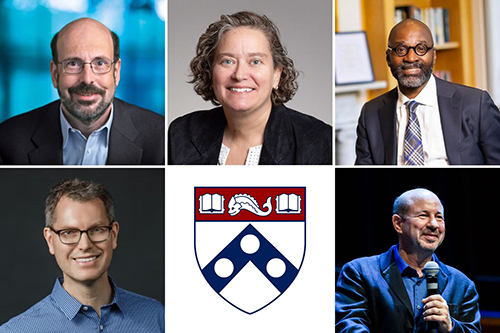 Five faculty at the University of Pennsylvania have been elected to the American Academy of Arts & Sciences, an honorary society and independent research center founded in 1780. They are Mark G. Allen of the School of Engineering and Applied Science (SEAS); Sara Cherry of the Perelman School of Medicine (PSOM); Provost John L. Jackson, Jr., a Penn Integrates Knowledge (PIK) professor with appointments in the Annenberg School for Communication (ASC) and the School of Arts & Sciences (SAS); Michael E. Mann of SAS with a secondary appointment in ASC; and PIK Professor Duncan Watts, who has appointments in SEAS, ASC, and the Wharton School. They are among the 252 new members elected in 2026 to be recognized for their excellence, innovation, leadership, and broad array of accomplishments in their fields.
 Flavia Vitale, an associate professor of bioengineering and in neurology, has been awarded $30,000 through the Grainger Foundation Frontiers of Engineering Grant program from the National Academy of Engineering (NAE). The award recognizes promising interdisciplinary research emerging from the Frontiers of Engineering Symposium and provides seed funding to advance innovative collaborations.