News

$19 Million NIH Grant to Establish Maternal Health Implementation Science Hub at Penn Medicine

Penn Medicine will serve a critical role in driving research to reduce pregnancy-related complications and deaths and promote maternal health equity through a new National Institutes of Health (NIH) grant. The $19 million, seven-year grant funds the creation of an implementation science hub as part of the NIH’s new Maternal Health Research of Centers of Excellence initiative.

Through this initiative, the NIH has funded 10 centers of excellence research centers, the implementation science hub, and a data innovation hub to support research to reduce pregnancy-related complications, deaths, and promote maternal health equity. The implementation science hub team—led by Meghan Lane-Fall, the David E. Longnecker Associate Professor of Anesthesiology and Critical Care, and Rebecca Hamm, an assistant professor of maternal fetal medicine, both in the Perelman School of Medicine at the University of Pennsylvania—will work with these centers on development, execution, and analysis of their research, to help bring findings into clinical practice and community settings. The hub is called AMETHIST@Penn, which stands for Achieving Maternal Equity and Transforming Health through Implementation Science and Training.

“While there have been great strides and increased focus in advancing our understanding of maternal health, especially in the last few years, without the ability to integrate our knowledge and findings into practice, there is no benefit to patients,” said Dr. Lane-Fall. “This is why implementation science is so important—it helps ramp up the pathway from research to clinical care.”

The new grant adds to Penn’s robust maternal health research portfolio, which includes initiatives to address racial disparities in maternal health outcomes, measure cardiovascular risks in pregnant patients, and monitor placental health to more accurately measure and predict high-risk pregnancies. Poor maternal health outcomes in the United States are statistically more common compared to other similar countries. According to the CDC, maternal mortality is increasing, with more than 1,200 women having died of maternal causes in the United States in 2021—compared to 861 in 2020 and 754 in 2019.

“There are a myriad of causes for poor maternal health outcomes from socio-economic disparities, to structural racism and environmental impacts,” said Dr. Hamm. “Challenges are as straightforward as problems making it to important medical appointments due to job or other personal responsibilities, to the management of more complicated disorders like gestational diabetes. So when we think through addressing specific outcomes, we need to make sure solutions we test can actually reach the populations who need them most. This is what our implementation science hub can help researchers studying interventions in maternal health address. ”

Researchers from the 10 research centers across the United States include Avera McKennan Hospital, Columbia University, Jackson State University, the Medical College of Wisconsin, Michigan State University, Morehouse School of Medicine, Stanford University, Tulane University, University of Oklahoma Health Sciences Center, and the University of Utah. The centers of excellence, a data innovation and coordinating hub led by Johns Hopkins University, and the implementation science hub at Penn Medicine, will work together to design and implement research projects to address the many factors that affect pregnancy-related complications and deaths, with a focus on populations that experience health disparities.

Drs. Lane-Fall, Hamm, and others involved with the implementation science hub will support nearly 20 large-scale research projects being performed at the selected centers from beginning to end, assisting in incorporating implementation science methods into their designs and analyses, and ideally helping experts in the centers for excellence deploy their innovative ideas into practice. The hub will also support training and education for the next generation of maternal health implementation scientists nationwide.

Kevin Kline: Penn Medicine’s Inaugural Medical Director for LGBTQ+ Health

caption: Kevin KlinePenn Medicine has appointed its first medical director for LGBTQ+ Health—Kevin Kline, currently an assistant professor of family medicine and community health in the Perelman School of Medicine at the University of Pennsylvania. Penn Medicine’s Program for LGBTQ+ Health works to increase access to care, along with quality of care and patient experience, for LGBTQ+ individuals across the health system. Since its establishment 10 years ago, the program has become a leader in LGBTQ+ patient care, education, research, and advocacy.

In his new role, Dr. Kline will partner with fellow Program for LGBTQ+ Health leaders to develop and standardize guidelines to improve the quality of LGBTQ+ patient care across the health system, and to expand and ensure the implementation of LGBTQ+ affirming practices and clinical services at Penn. He will also focus on increasing pathways for consultation to LGBTQ+ health clinical services and care teams, making it easier and faster for patients to obtain referrals to specialists knowledgeable in their unique healthcare needs.

Dr. Kline will continue to serve as the director of LGBTQ+ Health in the department of family medicine and community health, and as a member of Penn Medicine’s sexual orientation and gender identity working group and the Preferred Name Steering Committee. Dr. Kline also provides regular lectures and presentations on LGBTQ+ care to students and professional organizations throughout the region.

“Throughout his career, Kevin has remained steadfast in his commitment to serving the LGBTQ+ community and other marginalized groups who historically have faced barriers to accessing healthcare,” said Judd Flesch, co-director of the Penn Medicine Program for LGBTQ+ Health and an associate professor of pulmonary medicine. “His efforts to prioritize care for the LGBTQ+ community are critical to Penn Medicine’s work in advancing health equity for all patients.”

Providing the highest possible standard of care is paramount to every provider at Penn Medicine. But there are few standardized national or international guidelines for providers when seeking to address health needs of LGBTQ+ populations—from gender-affirming surgical care to sexual health and more. This can negatively impact the speed at which proper treatment is administered, as well as the overall care environment for patients.

“If you’re a provider caring for a transgender patient seeking testosterone therapy, you’ll find dozens of medication options available. But there may only be several appropriate [options] to use for gender-affirming hormone therapy,” said Dr. Kline. “Moving forward, one of our priorities is to identify areas across LGBTQ+ and gender-affirming care where the development of standardized care guidelines can increase provider knowledge and cultural humility, improve the overall quality and efficiency of care, and serve as a model for providers across the medical landscape—not just here at Penn.”

Additionally, Dr. Kline aims to enhance education, training, and professional development opportunities, working closely with Peter J. Vasquez, an associate professor of clinical obstetrics and gynecology and faculty director of gender and sexuality curriculum. Dr. Kline envisions programs covering sexual orientation and gender-affirming care for Penn’s medical students, faculty, and clinical care teams across the health system.

In addition to learning modules, clinical instruction, and lectures for Penn Medicine providers and students on specific areas within LGBTQ+ care, Dr. Kline’s goal is to incorporate care guidelines for LGBTQ+ patients across all specialties at Penn.

“LGBTQ+ patients should expect the same level of care whether they come to the emergency department with a broken bone or are seeing their primary care provider for pre-exposure prophylaxis (PrEP) follow-up,” Dr. Kline said. “However, providers across specialties don’t always share the same base-level knowledge on LGBTQ-affirming care because we all come from different backgrounds where this was often not a focus of our educations. For example, while some may have an intricate understanding of how to manage certain health considerations for transgender and gender-diverse patients, others may have a more basic understanding on how hormones can affect a person’s medical conditions.

“There’s much that can be done to ensure competency levels are maximized across specialties, and not just siloed into areas of care directly related to sexual orientation and gender identity,” continued Dr. Kline.

Established in 2013 and currently co-directed by Dr. Flesch and Rebecca Hirsh, an associate professor of hematology, Penn’s LGBTQ+ Health Program works to provide the highest level of care for the LGBTQ+ community in a culturally-humble and judgement-free environment. The program has been critical to Penn Medicine’s work in advancing health equity and has been designated as a “Leader in LGBT Healthcare Equality” by the Human Rights Campaign Foundation (Almanac September 29, 2020).

University Research Foundation–Application Deadline: October 13 

The University Research Foundation (URF) is now accepting applications for the fall 2023 program with a deadline of October 13, 2023. The URF is an intramural funding program that provides up to $75,000 support for research projects and up to $3,000 for conference support. The URF provides seed funding for up to one year for research activities that are expected to lead to external sponsorship and/or peer-reviewed research publications. The Office of the Vice Provost for Research will operate one URF cycle for FY 2024, accepting proposals in two categories: Research Grants and Conference Support Grants. Each program has its own guidelines and budget requirements. Details are below, and more information is available online at: https://research.upenn.edu/urf.

Research Grants

The URF provides up to $75,000 for research support. The objectives of this program are to: (a) Help junior faculty undertake pilot projects that will enable them to successfully apply for extramural sources of funding and aid in establishing their careers as independent investigators; (b) Help established faculty perform novel, pioneering research to determine project feasibility and develop preliminary data to support extramural grant applications; (c) Provide support in disciplines where extramural support is difficult to obtain and where significant research can be facilitated with internal funding; and (d) Provide limited institutional matching funds that are required as part of a successful external peer-reviewed application.

Conference Support Grants

This program is designed to provide funding (up to $3,000) for meetings and conferences to enhance existing research and scholarly programs, particularly in disciplines where external funding is difficult to obtain. Conferences that promote interdisciplinary and multi-school participation are given priority.

Disciplinary Areas

Faculty members are invited to submit their research applications to one of four disciplinary areas: humanities, social science & management, natural sciences & engineering, and biomedical.

Eligibility

Except for the biomedical panel, the URF is open to Penn assistant, associate, and full professors in any track. Note: the biomedical panel limits applications to research grants to assistant and early stage associate professors only. Instructors and research associates must provide a letter (attached to the proposal) from their department chair establishing that the applicant will receive an appointment as an assistant professor by the time of the award. Adjunct and emeritus faculty are not eligible to apply. Only one application per PI per cycle. Awards must be expended on University of Pennsylvania facilities, equipment and/or associated University technical staff and undergraduate students.

—Office of the Vice Provost for Research

Deaths

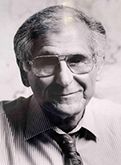
Thomas Naff, Middle East Center

caption: Thomas NaffThomas (Tom) Naff, HOM’84, a former associate professor of Asian and Middle Eastern studies (AMES) at Penn and the director of Penn’s Middle East Center from 1967 to 1983, died on August 2. He was 93.

Dr. Naff was born in Spring Valley, Illinois, to Lebanese immigrant parents. He grew up in Highland Park, Michigan, and attended high school there. He earned his PhD from the University of California, Berkeley, for a dissertation titled, “Ottoman Diplomacy and the Great European Powers, 1789-1802,” which he pursued concomitantly at the School of Oriental and African Studies (SOAS) of the University in London.  

After teaching at Harvard and the American University in Cairo, Dr. Naff joined Penn’s School of Arts & Sciences in 1967 in what was then known as the department of oriental studies. During his time as director, Dr. Naff significantly expanded both the Near East Center, as it was then known, and the Middle East studies program at Penn. As part of his restructuring of the department, Dr. Naff recruited scholars on the Middle East across multiple disciplines, some of whom are still at Penn today. Under Dr. Naff’s leadership, Penn’s program became one of the most renowned Middle Eastern studies programs in the country, ranked number one or number two several times in national listings. In the mid-1980s, and with support from scholars including Edward Said and others, Dr. Naff played an instrumental role in raising funds to establish the Janet Lee Stevens Fellowship (named in honor of one of the department’s graduate students, who died in the bombing of the U.S. embassy in Beirut in 1983). Even after stepping down as the Middle East Center’s director in 1983, he continued to teach until retiring in 2002. The department, then known as Asian and Middle Eastern Studies (AMES), endures today as Near Eastern languages and civilizations (NELC), as does the Middle East Center.

Dr. Naff had a keen interest in the history of Near Eastern and Middle Eastern studies and in how academic institutions and disciplines evolved against their social, political, and economic contexts. To that end, he wrote Paths to the Middle East: Ten Scholars Look Back (1993), for which he interviewed leading historians on how Middle Eastern studies had emerged from Oriental Studies and in response to U.S. and international political agendas surrounding Cold War politics, the demand for oil, and more. A decade before the advent of the internet, he launched a program to connect ordinary people around the world via telecommunication satellites and interpreters. He was also an early leader in researching water politics in the contemporary Middle East, and co-edited Water in the Middle East: Conflict or Cooperation? (1984). Dr. Naff gave a talk at the Brookings Institution in 2003 on the environmental impact of Saddam Hussein’s policies on the Iraqi marshlands and possible courses of action.

Dr. Naff was married to Joan Rice from 1952 until her death in 2015. They had three sons, Clayton, C’78, Derek, and Bryan; and several grandchildren.

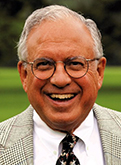
Stephen Weber, ICA Board Member

caption: Stephen WeberStephen Robert Weber, CHE’60, a former chair of the board of the Institute of Contemporary Art, died peacefully on May 28. He was 85.

Born in Kansas City, MO, he attended Southwest High School in Kansas City, and graduated as a chemical engineering major from Penn’s School of Engineering in 1960. Two years later, he earned an MBA from the Harvard Business School, then began his business career at Waddell & Reed. He later worked at G.S. Grumman & Associates, Jennison Associates, and then Cowen & Company SG-Cowen Securities Corp. (the latter two of which were later incarnations of Grumman). He retired as managing director of SG-Cowen in 2005.

Mr. Weber was a generous benefactor of the Boston Symphony Orchestra, where he was elected a life trustee in 2017. He chaired the board of Penn’s Institute of Contemporary Art, and he and his wife Dorothy endowed the Dorothy and Stephen R. Weber Senior Curator position at ICA, to which Alex Klein was appointed in 2022.

He is survived by his wife of 55 years, Dorothy Altman Weber; his daughter, Meredith Weber Blitstein (Alexander Blitstein); and his brother-in-law, Lawrence K. Altman. Services were held on June 2. Memorial contributions may be made to the Boston Symphony Orchestra, www.bso.org; Combined Jewish Philanthropies, www.ma.cjp.org; and 18 Degrees—Kids 4 Harmony, www.18degreesma.org/how-we-help/kids-4-harmony.

Peter Whinnery, Theater Arts

caption: Peter WhinneryPeter Whinnery, a longtime tech advisor to student performing arts groups and a lecturer in the theater arts and English departments of the School of Arts and Sciences, died on August 25, 2022. He was 64.

During his childhood, Mr. Whinnery worked with his hands early on, learning woodworking techniques from his father in a small woodworking factory in Spring Lake, Michigan. He majored in mathematics at Albion College but took his first job at the wood shop at National Music Camp at Interlochen, Michigan, the summer after he graduated. He also held a job early in his career at Drew Theater in Long Island.

Mr. Whinnery came to Penn in 1982 after graduating from a master’s program in technical theater and design at the University of Michigan. Initially, he had a temporary role supervising the shop in Irvine Auditorium, but nine months later, the division of University Life hired him full-time. He came to hold great influence in Student Performing Arts, helping design the Performing Arts Council (PAC)’s wood shop at 41st and Walnut Streets when the shop moved out of Irvine Auditorium in 1997 and building sets for dozens of productions, often more than ten a semester, for various student groups. Mr. Whinnery became a beloved figure on campus, teaching students how to use intimidating tools and working through time crunches to get sets ready for productions’ opening nights.

“I worked under Peter for 13 years at the PAC shop,” said Michelle Moller, currently an assistant in the shop. “He was consistently the kindest, most knowledgeable, and patient person I have ever met. He provided a safe space for students to learn new techniques—his office was always full of students asking for advice on sets, school, and life. He loved summers, when he could go stay at his cabin with Jorja, his family, and often his cats. He was such an amazingly wonderful human.”

“Peter was responsible for creating a scene shop space specifically for students who wanted to create,” said Amanda Labonte, the present technical advisor to the PAC shop. “Every piece of the shop was so thoughtfully laid out that we feel Peter’s presence daily. He always put students first. When I met him, one of the first things he said to me was, ‘this is their shop. Let them put their art on the wall. Let them be them.’” Mr. Whinnery’s mantra was, “it should be good enough for who it’s for,” reflecting his passion for designing beautiful and creative sets for the students he loved.

Between 1985 and 2018, Mr. Whinnery also taught courses in theater arts (specifically in lighting, scene, and costume design) and in English, both in the School of Arts and Sciences and in the College of General Studies (today’s College of Liberal and Professional Studies). Academically, Mr. Whinnery advised many students concentrating in design-related areas, and supervised honors theses. Aside from his Penn duties, Mr. Whinnery was the main lighting designer and contributing member at InterAct Theater Company, founded by Penn alum and Mr. Whinnery’s mentee, Seth Rozin.

Mr. Whinnery retired from Penn in 2018, an occasion that merited a celebration at the 2019 Alumni Weekend.

He is survived by his wife, Jorja.

Jay Zemel, Electrical and Systems Engineering

caption: Jay ZemelJay Zemel, the H. Nedwill Ramsey Professor Emeritus of Sensor Technologies in the department of electrical and systems engineering, died on July 20. He was 95.

Born in the Bronx, New York, Dr. Zemel was a member of the first freshman class at the Bronx High School of Science. He received bachelor’s (1949), master’s (1953), and PhD (1956) degrees in physics, all from Syracuse University. While working on his PhD, he took a part-time research position in the Naval Ordnance Laboratory in Silver Spring, Maryland, and after he finished his PhD, he rose to become a supervisory research physicist and head of the surface and film group. In 1966, Dr. Zemel joined the Penn’s faculty in what was then known as the Moore School of Electrical Engineering as the RCA Professor of Solid State Electronics.

Dr. Zemel’s career at Penn spanned nearly 60 years and was dedicated to work in sensors, sensor systems and thin films. In 1969, Dr. Zemel was selected to direct the new Solid State Electronics Lab at the Moore School (Almanac February 1969), and when this laboratory was reorganized to become the Center for Chemical Electronics and then the Center for Sensor Technologies, he remained its director (Almanac May 27, 1986). He chaired the department of electrical engineering (today called electrical and systems engineering) from 1972 to 1977. During the 1970s, he also spearheaded a team at Penn that collaborated with the Italian University of L’Aquila, a partnership that strengthened the technological expertise at both universities.

Dr. Zemel served on Penn’s Faculty Senate Executive Committee and on the University Council. In 1994, he was named the H. Nedwill Ramsey Professor of Sensor Technologies. Two years later he retired from Penn and the distinction became emeritus. Throughout his career and during his retirement, Dr. Zemel mentored a great number of undergraduate students during their work on senior design projects. He held 26 patents and authored over 120 peer-reviewed journal articles and book chapters, and served as the editor-in-chief of the journal Thin Solid Films, based in Lausanne, Switzerland, from 1969 to 1990. From 1994 to 2002, he was chief scientific officer of Scitefair International, and he was a fellow of the Institute of Electrical and Electronics Engineers (IEEE).

Dr. Zemel is predeceased by his wife, Jacqueline (nee Lax), and his companion, Vivian Green. He is survived by his children, Alan Zemel, Babette Zemel (Jon Shapiro) and Andrea Zemel (Adam Brown); his grandchildren, Mark Zemel (Laura Kaltman), Rayna Zemel (Miranda Winters), Aaron Shapiro (Natalie), Gabriel Shapiro (Ria Watko), Miriam Zemel and Jessica Shapiro; his step-grandchildren, Arielle Brown and Lily Brown; and his great-grandchildren, Nico, Wren and Casey. A funeral service was held on July 24. Contributions in Dr. Zemel’s memory can be made to Planned Parenthood (https://www.plannedparenthood.org/) or to a charity of the donor’s choice. 

Governance

From the Office of the Secretary: University Council Meeting Agenda

University Council Meeting Agenda

Wednesday, September 13, 2023
4 p.m.
Hall of Flags, Houston Hall

  1. Welcome
  2. Appointment of Moderator
  3. Appointment of Parliamentarian
  4. Approval of the minutes of April 19, 2023
  5. Follow up comments or questions on Status Reports
  6. Responses to New Business topics raised at the April 19, 2023 University Council meeting
  7. Presentation of Council Committee Charges for 2023-2024
  8. Presentation of Focus Issues for 2023-2024
  9. New Business
  10. Adjournment

2023-2026 Board of Trustees Meetings

2023

Thursday, September 28, 2023
Executive Committee
Audit & Compliance Committee Meeting
Budget & Finance Committee Meeting

Thursday-Friday, November 2-3, 2023
Fall Full Board Meeting

Thursday, December 7, 2023 (cancelled)
Executive Committee
Budget & Finance Committee Meeting (if needed)

2024

Thursday-Friday, February 29-March 1, 2024
Winter Full Board Meeting

Thursday, May 16, 2024
Executive Committee
Budget & Finance Committee Meeting

Thursday-Friday, June 13-14, 2024
Spring Full Board Meeting

Thursday, September 26, 2024
Executive Committee
Audit & Compliance Committee Meeting
Budget & Finance Committee Meeting

Thursday-Friday, November 14-15, 2024
Fall Full Board Meeting

Thursday, December 12, 2024
Executive Committee
Budget & Finance Committee Meeting (if needed)

2025

Thursday-Friday, February 27-28, 2025
Winter Full Board Meeting

Thursday, May 15, 2025
Executive Committee
Budget & Finance Committee Meeting

Thursday-Friday, June 12-13, 2025
Spring Full Board Meeting

Thursday, September 25, 2025
Executive Committee
Audit & Compliance Committee Meeting
Budget & Finance Committee Meeting

Thursday-Friday, November 6-7, 2025
Fall Full Board Meeting

Thursday, December 11, 2025
Executive Committee
Budget & Finance Committee Meeting (if needed)

2026

Thursday-Friday, March 5-6, 2026
Winter Full Board Meeting

Thursday, May 14, 2026
Executive Committee
Budget & Finance Committee Meeting

Thursday-Friday, June 11-12, 2026
Spring Full Board Meeting

Policies

Revised Faculty Income Allowance Policy

The University of Pennsylvania announces a revised Faculty Income Allowance Policy (FIAP), effective July 1, 2023. The revised policy provides an improved cash benefit, while recognizing that some Penn faculty members may be seeking to retire later and have more flexible retirement options.

The revised FIAP offers a cash benefit of 200% of a faculty member’s academic base salary (defined by the academic salary plan for faculty in the Perelman School of Medicine), with two payment options: the Immediate FIAP, which distributes the cash benefit in one lump sum shortly after termination of employment, and the Phased Work FIAP, which distributes the cash benefit first during a two-year phased work period and then in a lump sum in the calendar year after the completion of that two-year phased work period.

Individual faculty members have been contacted directly about their eligibility for benefits related to the revised FIAP. Senior faculty members are eligible to participate in the revised FIAP if they fit within one of the following age and service categories. Age is determined by the date of employment termination.

  • Ages 60-64: Senior faculty members who have 10 or more years of full-time continuous service and are between the ages of 60 and 64 as of June 30, 2024.
  • Ages 65-72: Senior faculty members who have 10 or more years of full-time continuous service and who terminate their employment on or after age 65 but before June 30 of the academic year in which they reach age 72.
  • Ages 72 or later: Senior faculty members who have 10 years of full-time continuous service on or after age 72. The faculty member must terminate employment as of June 30 in the academic year in which the eligibility requirements are satisfied.

You can find more details about the revised FIAP in the FAQs (https://faculty.upenn.edu/wp-content/uploads/FIAP-FAQ.pdf) and the detailed booklet (https://faculty.upenn.edu/wp-content/uploads/FIAP-Booklet.pdf).

—Office of the Vice Provost for Faculty

Honors

2023 Mellon Fellows

Provost John L. Jackson, Jr. and Vice Provost for Faculty Laura Perna have announced the third cohort of Mellon Fellows.

The Mellon Fellows Program seeks to support mid-career faculty from core humanities and arts disciplines whose work is strongly based on cultural/historical analysis. The program is intended to orient arts and humanities faculty to the fundamentals of leadership roles, encourage collaboration and community across departments and disciplines, and build the next generation of higher education leaders inflected with humanistic culture and values.

Andrea Goulet, a professor of French and Francophone studies and chair of Francophone, Italian, and Germanic studies in the School of Arts and Sciences, studies 19th- and 20th-century French fiction, science and literature, spatial theory, urbanism, and popular crime fiction.

Cam Grey, an associate professor and undergraduate chair of classical studies in the School of Arts and Sciences, studies the late and post-Roman world (third through seventh centuries CE), especially rural communities in late antiquity: how they worked; what strategies, institutions and structures they possessed for maintaining equilibrium and managing conflict; and what they did when things went wrong.

Ayako Kano, a professor and graduate chair of East Asian languages & civilizations in the School of Arts and Sciences, studies the intersection of gender, performance, and politics, especially in Japanese cultural history from the late 19th century to the present.

Rahul Mukherjee, the Dick Wolf Associate Professor of Television and New Media and graduate chair of cinema and media studies in the School of Arts and Sciences, studies media theory, cultural studies, and science studies, including database management systems, advertising cultures of mobile telephony, Bollywood thrillers, development discourses, chronic toxicity, and translocal documentaries.

Jennifer Ponce de León, an associate professor of English in the School of Arts and Sciences, studies Marxist, anticolonial, and postcolonial thought, including 20th and 21st century Left movements and cultural production in the Americas; critical theory; visual arts, literature, and performance; and transnational Latinx and Latin American studies.

Adelheid Voskuhl, an associate professor and graduate chair of history and sociology of science in the School of Arts and Sciences, studies the history of technology from the early modern period to the modern period, including the philosophy of technology, the history of the Enlightenment, and modern European intellectual and cultural history.

2023 Penn Fellows

Provost John L. Jackson, Jr. and Vice Provost for Faculty Laura Perna have announced the appointment of the fifteenth cohort of Penn Fellows.

The Penn Fellows Program provides leadership development to select Penn faculty in mid-career. Begun in 2009, it includes opportunities to build alliances across the University, meet distinguished academic leaders, think strategically about University governance, and consult with Penn’s senior administrators.

Amalia Z. Daché, an associate professor in the Graduate School of Education, studies postcolonial geographic contexts of higher education, Afro-Latinx studies, community and student resistance, and the college-access experiences of African diasporic students and communities.

Joe Devietti, an associate professor and undergraduate curriculum chair of computer & information science in the School of Engineering and Applied Science, studies computer architecture and programming languages, especially making multiprocessors easier to program by leveraging changes in both computer architectures and parallel programming models.

David Dillenberger, a professor and graduate chair of economics in the School of Arts and Sciences, studies microeconomic theory and decision theory, especially social preferences, models of non-expected utility, and the economics of risk and time.

Kristen R. Ghodsee, a professor and chair of Russian and East European studies in the School of Arts and Sciences, studies the lived experience of socialism and postsocialism, the gendered effects of the economic transition from communism to capitalism, and postcommunist nostalgia in Central and Eastern Europe.

Angela Gibney, a Presidential Professor of Mathematics in the School of Arts and Sciences, is an algebraic geometer who has obtained deep results about moduli spaces of complex curves and vertex operator algebras—core topics that arise in algebraic geometry, algebraic topology, and mathematical physics.

Jeffrey Green, a professor of political science in the School of Arts and Sciences and director of the Andrea Mitchell Center for the Study of Democracy, is a political theorist with a broad interest in democracy, ancient and modern political philosophy, and contemporary social theory.

Roy H. Hamilton, a professor of neurology in the Perelman School of Medicine, studies the characteristics and limits of functional neuroplasticity in the adult human brain, including how the brain reorganizes itself in response to injury and the brain’s potential for reorganization in order to speed rehabilitation using noninvasive electrical or magnetic brain stimulation.

Blanca E. Himes, an associate professor of biostatistics, epidemiology, and informatics in the Perelman School of Medicine, studies asthma pathogenesis and treatment using biomedical informatics approaches, including genome-wide association studies of asthma and related traits as a lead investigator and as part of large collaborations.

Taku Kambayashi, a professor of pathology and laboratory medicine in the Perelman School of Medicine, studies signal transduction pathways employed by cells involved in fundamental immunological processes and in immune-related disorders, especially the mechanistic underpinnings of these processes to identify novel targets for therapeutic intervention or for diagnostic/prognostic value.

Mia Levine, an associate professor of biology in the School of Arts and Sciences, studies the biological forces that drive the evolution of chromatin proteins, which package our genomic DNA yet are wildly unconserved over evolutionary time, and the functional consequences for chromosome segregation, telomere integrity, and genome defense.

Sarah E. Light, a professor of legal studies & business ethics in the Wharton School, works at the intersections of environmental law, corporate sustainability, and business innovation, including the ways in which laws that structure corporations and the marketplace should be considered forms of environmental law and how private actions by business firms can be forms of private environmental governance. 

Beth Linker, the Samuel H. Preston Associate Professor and chair of history and sociology of science in the School of Arts and Sciences, studies the history of science and medicine, disability, healthcare policy, and gender, including research on rehabilitation and on postural abnormalities in early 20th century America.

Keisha-Khan Y. Perry, the Presidential Penn Compact Associate Professor of Africana Studies in the School of Arts and Sciences, studies race, gender, and politics in the Americas, including urban geography and questions of citizenship, intellectual history and disciplinary formation, and the interrelationships among scholarship, pedagogy, and political engagement.

Amy M. Sawyer, an associate professor of biobehavioral health sciences in the School of Nursing, studies health behaviors related to sleep disorders, especially the differences between adults who consistently use treatments for their sleep-disordered breathing and those who do not, the development and testing of a non-adherence risk screening index, and the design/testing of interventions to improve treatment use.

Frank Setzer, an associate professor of endodontics in the School of Dental Medicine, works on the clinical detection, prognosis, and assessment of periradicular pathology, especially apical periodontitis, CBCT imaging and artificial intelligence, and endodontic microsurgery.

Meredith Tamminga, an associate professor and graduate chair of linguistics in the School of Arts and Sciences, studies the ways in which social, temporal, and spatial patterns of linguistic variation reflect the underlying structure of the human capacity for language, using experimental psycholinguistic methods, computational modeling, and the quantitative analysis of natural speech data to learn how speakers store and produce linguistic variables.

Donovan Schaefer: 2023 Ludwik Fleck Prize

Donovan Schaefer, an associate professor in the department of religious studies, has won the 2023 Ludwik Fleck Prize for his book Wild Experiment: Feeling Science and Secularism After Darwin. The honor, given by the Society for the Social Studies of Science, is awarded annually for “an exemplary book in science and technology studies (STS) that contributes to the global STS community, based on solid empirical or theoretical research, a creative methodology, and/or an innovative transnational perspective.”

In describing the reason for selecting Dr. Schaefer’s work, the organization wrote: “Wild Experiment is a rare book that returns to some foundational STS questions of the character of knowledge and knowledge-making, and it does so by demonstrating persuasively the inextricability of knowing and feeling. In challenging the cognition-emotion binary, Schaefer offers a fresh perspective on classic thinkers that have informed STS since its foundation.”

Accepting the award, Dr. Schaefer wrote, “In Wild Experiment, I call for a reassessment of the role of emotion in scientific knowledge-production. Combining feminist, antiracist, and queer perspectives with affect theory, psychology, and STS, the book argues that we need to abandon the thinking/feeling binary altogether. Science—and all other forms of knowledge-making—are necessarily defined by feeling at every level.” The book is “an opening move,” he adds, in a broader conversation about the link between thinking and feeling.

Dr. Schaefer has taught at Penn since 2017. His research interests include a range of topics related to the politics of feeling/affect/emotion and their links with science, religion, secularism, and material culture. Other than Wild Experiment, he has written two other books, Religious Affects: Animality, Evolution, and Power and The Evolution of Affect Theory: The Humanities, the Sciences, and the Study of Power, as well as many journal articles.

Features

Convocation 2023

On Monday, August 28, 2023, Penn’s Class of 2027 Convocation was held on Franklin Field. 
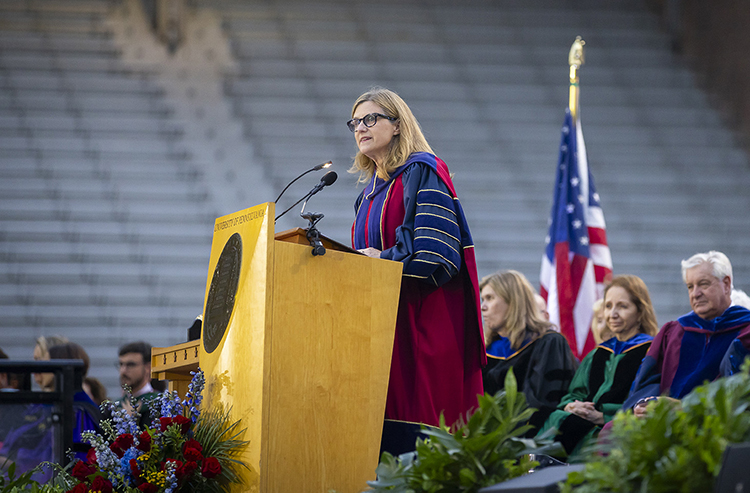
caption: President Liz Magill addresses Penn’s incoming first-year and transfer students. Photographs by Eric Sucar.

View Penn with a Fisheye Lens

President Liz Magill

Thanks, Dean Soule, and thank you and the Admissions team for bringing together Penn’s newest students. They are fabulous.

Class of 2027 and transfers: How’s everybody feeling?

As president, it’s my pleasure to welcome you all officially to Penn. This is Convocation, a tradition named from the Latin convocare. A word which, if I remember my Latin, translates roughly to ‘a lot of speeches before dessert.’

It also means “to call together.” And I want to call on all of you to participate in a little exercise. I’ll share my reasons in a few minutes. For now, though, I’d like you to listen closely.

Students in the front row: Congratulations, you get to go first. Attached to the bottom of each of your seats, there is a card. Please reach down and take it out.

Once you each have your card, hold it up high so we all can see.

Everybody can see the cards? Great.    

Next, and only when I tell you to start, I want you to turn around, say hi to the person sitting directly behind you, and pass them your card. Then the next person should do the same, and the next, until all the cards reach the very back. Think of it like a relay race. You should move fast but please be sure to say hello and your name when you hand your card to the next person.

To the students in the very back: Once you have the cards, please hold them up so I can see that you’re done. Everybody ready? Okay, let’s get started.

I’m seeing plenty of cards at the back. Back row, thank you, you can tuck those cards under your seats.

Ok, call me psychic because I can guess what you’re thinking. “What was that?”

I’m getting there. First, I’d like a show of hands. Please raise your hand if you remember the color of the card you had.

Just about everybody does. Now, I want you to think hard. No need to raise your hands and no peeking in the back. What colors were the cards to either side of you?

I’m willing to bet that’s harder to answer.

That’s because humans are hardwired to focus on what’s in front of us. Maybe it’s a goal, an obstacle, or this weird game the president had you play. In the study of this phenomenon, there’s a metaphor for how we focus. It’s called the zoom lens. We zoom in on what seems most important while everything else goes fuzzy. We see the color of our card, but likely not the color of the cards around us.

The opposite of a zoom lens is what’s called a fisheye lens. It’s a wide view that takes in more, that sees the periphery, that engages panoramically.

Today, you embark on perhaps the most important time in your life to cultivate this skill. So, here’s my message and my challenge. I encourage you to view Penn with a fisheye lens.

First, a caveat. The ability to focus is critical. By your own accomplishments to date, you know this well. We must focus intently in our classes; in our assignments and exams; when we’re on the stage, in the lab or studio, or on the field. If I stood up here and claimed otherwise, people might get a little upset with me. And by people, I mainly mean your faculty.

But there’s an important balance to strike. Penn is vast. We are tens of thousands. We study and engage across nearly every field and issue under the sun—and beyond.

And just like your class, your Penn community represents numerous countries, countless backgrounds and walks of life, different beliefs, and common causes. It is likely the single most diverse and dynamic place you’ll ever call home.

On any given day, on Locust Walk or in your college house hallway, you could encounter an entirely unexpected idea. A new friendship for life. Fresh insight that changes your point of view.

The secret, though, is that you must be open to it. You must deliberately go about every day at Penn with as broad and inquisitive a view as possible. With a fisheye lens. And Penn is the university known for exactly that. There are countless examples. Let me offer you just one.

Earlier this year, one of our faculty won a coveted honor, the Franklin Medal, for his pioneering work with light wave technology. Back in the 90s, though, Professor Nader Engheta’s work focused not on light but rather radio waves. That is, until a fellow Penn scientist invited him to investigate a fish.

Yes, a green sunfish to be precise, and the physiological adaptations in its eyes that give it an advantage underwater. Their collaboration eventually led to a new field of study, new camera technology, and new paths to other foundational discoveries.

Today, Professor Engheta’s broad-ranging research offers us a tantalizing glimpse of a future where we may compute using light. Where nanoscale materials manipulate light for any number of applications, from solar energy to augmented reality.

All because he approached his work and Penn with a fisheye lens. Quite literally in this case. “Innovation often occurs at the boundary points between fields,” Professor Engheta has said. “Knowledge does not have boundaries.”

You can see this truth at work in all our schools, including yours. The College, Engineering, Nursing, Wharton. Working in the humanities, arts, sciences, and professions, Penn people excel at zooming out and exploring across fields. They are expert innovators at the boundary points between. And our undergraduates are no exception.

Approaching Penn with a fisheye lens does not stop with your academics and extracurriculars. If you’ll think back to the card game a few minutes ago, an important part was turning around to meet the person behind you. Never underestimate the possibilities that come with stepping outside your routine to meet someone new. I encourage you to commit to learning about and with others. To venturing beyond your comfort zone and hearing differing points of view. Find common ground and, when differences inevitably occur, disagree productively.

I also encourage you to remember: While you’re taking the broad view and getting the most out of Penn, we are here to support your success and your well-being. Never hesitate to reach out for the resources you need.

Above all, know that you belong here. Remember when I said that this place is vast, dynamic, and diverse? That is Penn’s strength. And with your arrival, Penn grows that much stronger. Never doubt that you are in the right place.

And so, Class of 2027. Transfer students. Focus on the card in front of you, but don’t lose sight of the brilliant array of cards all around. Be open, be inquisitive, be panoramic. Take in everything at Penn with a fisheye lens.

Congratulations and welcome to Penn!

caption: Convocation for the Class of 2027 was held on Monday, August 28 on Franklin Field.

caption: Provost John L. Jackson, Jr. addresses Penn’s incoming first-year and transfer students.

Dare To Be Different

Provost John L. Jackson, Jr.

As Provost—Penn’s Chief Academic Officer—it’s my great pleasure to welcome you this evening. Convocation is a Penn tradition that dates, at least as a formal ceremony, way back to the 1890s, though first-years gathered informally long before even then.

And of course Franklin Field has its own storied history: built 101 years ago, it was the country’s first two-tiered stadium, and once played home to the Philadelphia Eagles and the annual Army-Navy game, both now relocated to South Philly. And we still hold the Penn Relays here, which started in 1895. So yes, as you know, Penn is very old.

But you are all new here, and that’s something we share. I’m also new: not to Penn, but to this role. I just started as Provost in June, and, to be honest, I’m still getting my feet wet. Therefore, I can’t pretend to pass along bits of provostial wisdom this evening; I don’t have a ton of that yet. And I can’t really provide you with a detailed picture of how it looks from where I sit either. It looks kind of new and exciting and even a little daunting. Maybe we share that, too.

So, I’ll speak less as Provost today than as an anthropologist, since anthropology is the field I know best. Anthropology is the study of difference. Essentially, what makes human beings quintessentially human. What is it that makes us different from any other animals and species on the planet, and from one another?

Penn is a new and different place for you, and each of you will contribute your own different story and experience. That difference—how we view it, how we understand it, and how we celebrate it—is my focus tonight.

First, think about what makes us different from, say, a bear. Or a salmon. Or a bear trying to eat that salmon. Anthropologists have four basic ways of explaining those differences: students sometimes abbreviate them as stones, tones, bones, and thrones.

First, our artifacts and the tools we’ve developed. Or, the stones. Second, our capacity for symbolic communication using language: poetry, newspapers, song lyrics, Twitter, if you must. The tones. Third, our bodies: our genes, our two legs, our lack of fur and scales. The bones. And finally, our various cultures and ideas, and our capacity to learn, adapted over many, many generations. Those are the thrones.

Yet there is a basic irony in all of this. Those stones, tones, bones, and thrones, the very things that make us alike, as humans—that no other species look like us, move quite like us, can communicate as abstractly as we can, share our rich capacity for cultural expression—are the same things we use to make distinctions between and among us. That person does not look like me. And: We don’t share a language, and can’t communicate. And: We were raised in different cultures and have different traditions and assumptions. And: we don’t share a history.

You’ve only been here for a week, but I’m sure you’ve already noticed this community is one filled with differences. It’s probably very different from what some of you are used to. That is a good thing. At Penn you will become not simply well-educated but well-rounded, exposed to new ideas and different people, prepared and excited to lead in a multicultural/multi-everything world defined by unwieldy differences.

Anthropologists often talk about trying to understand where differences come from—not to deny them, or beat them back. This is difficult. It requires trying to see the world through other people’s eyes, from their perspectives. That means listening to others. Really listening and learning from them. You might disagree with their point of view; in fact, I’m sure at some point you will. But listening and being willing to learn from others, no matter how different, is essential to everything we do here. Listen respectfully, and disagree without being disagreeable. Don’t run from differences, embrace them.

How else can you learn? I encourage you to take advantage of Penn’s numerous student and affinity groups, its various campus organizations, its community-based engagement opportunities. Try something new, and make a point of meeting others with different stories. I suspect you’ll find you have more in common than you know. But those differences will remain, too. And that’s a good thing

Take classes in subjects you know a lot about, and in subjects you know nothing about. My guess is you’ll be surprised in both cases. Finally, remember that differences define our strengths, including differences in our biographies, histories, cultures, languages, nationalities, beliefs, and commitments.

The great anthropologist and folklorist Ruth Benedict once noted that the purpose of anthropology is to make the world safe for human differences. Embrace others’ differences. And don’t be afraid of the fact that this special experience will undoubtedly make you different by the time you leave. In ways that are inspiring and foundational and inescapable, it most certainly will.

Members of the great class of 2027: If I can leave you with one clear message this evening, it’s this: Dare to be different.

Welcome to Penn.

caption: The Class of 2027 and transfer students helped ring in Penn’s 284th academic year on Franklin Field.

Research

Penn Engineers Create Low-Cost, Eco-Friendly COVID Test

The availability of rapid, accessible testing was integral to overcoming the worst surges of the COVID-19 pandemic, and will be necessary to keep up with emerging variants. However, these tests come with unfortunate costs.

Polymerase chain reaction (PCR) tests, the “gold standard” for diagnostic testing, are hampered by waste. They require significant time (results can take up to a day or more) as well as specialized equipment and labor, all of which increase costs. The sophistication of PCR tests makes them harder to tweak, and therefore slower to respond to new variants. They also carry environmental impacts. For example, most biosensor tests developed to date use printed circuit boards, or PCBs, the same materials used in computers. PCBs are difficult to recycle and slow to biodegrade, using large amounts of metal, plastic and non-eco-friendly materials.

In addition, most PCR tests end up in landfills, resulting in material waste and secondary contamination. An analysis by the World Health Organization (WHO) estimated that, as of February 2022, “over 140 million test kits, with a potential to generate 2,600 tonnes of non-infectious waste (mainly plastic) and 731,000 litres of chemical waste (equivalent to one-third of an Olympic-size swimming pool) have been shipped.”

In order to balance the need for fast, affordable and accurate testing while addressing these environmental concerns, César de la Fuente, a Presidential Assistant Professor in the departments of bioengineering and chemical & biomolecular engineering in the School of Engineering and Applied Science, with additional primary appointments in psychiatry and microbiology in the Perelman School of Medicine, has turned his attention to the urgent need for “green” testing materials.

The de la Fuente lab has been working on creative ways to create faster and cheaper testing for COVID-19 since the outbreak of the pandemic.

The team’s latest innovation incorporates the speed and cost-effectiveness of previous tests with eco-friendly materials. In a paper published in Cell Reports Physical Science, the group introduces a new test made from Bacterial Cellulose (BC), an organic compound synthesized from several strains of bacteria, as a substitute for PCBs.

Bacteria naturally serves as a “factory” for the production of cellulose, a paper-like substance which can be used as the basis for biosensors. BC is highly versatile, having been used for wound care, regenerative medicine and point-of-care or POC diagnostics. POC testing is especially important for the prevention of pandemics, in that it allows for quick and accurate diagnostics at the testing site without the need for expensive, specialized equipment or for the samples to be sent away to a lab. This new BC test is non-toxic, naturally biodegradable and both inexpensive and scalable to mass production, currently costing less than $4.00 per test to produce. Its cellulose fibers do not require the chemicals used to manufacture paper, and the test is almost entirely biodegradable. (The exception is a small amount of silver, which can be easily removed and recycled by healthcare professionals.)

In addition to these green benefits, the test proved highly accurate in clinical trials, correctly identifying multiple variants in under ten minutes. This means that the tests won’t require “recalibration” to accurately test for new variants.

As researchers and healthcare providers continue to manage the effects of COVID-19, and look ahead to the prevention of future pandemics, inexpensive and accurate testing that is also environmentally friendly is crucial to protecting the health of both our planet and its people. The results of this study suggest that these goals need not be mutually exclusive.

Adapted from a Penn Engineering news article by Kat Sas, August 25, 2023.

Engaging in Administrative Payment Tasks May Correlate With Treatment Delays and Nonadherence in Cancer Care

Among a cohort of cancer patients and survivors, engaging in administrative tasks to estimate costs or pay for care was associated with an 18% increase in cost-related treatment delays or nonadherence, according to a new study by assistant professor Meredith Doherty of Penn’s School of Social Policy & Practice (SP2) and coauthors.

Navigating the U.S. healthcare system requires a complex set of communications between patients, healthcare providers, and insurance companies, said Dr. Doherty, senior author of the study. The burden of learning about the costs of care and fixing billing errors often falls to the patients, she explained.

“It’s fairly unique to our U.S. healthcare system for the consumer to be responsible for acquiring the knowledge and skills needed to effectively use those goods or services and to ensure they’re of high quality,” Dr. Doherty said. “In the United States, healthcare is largely treated as a consumer product, so the onus is on the consumer.”

For their study, published in Cancer Epidemiology, Biomarkers & Prevention, a journal of the American Association for Cancer Research, Dr. Doherty and colleagues used data from a cross-sectional survey performed by the nonprofit CancerCare. The survey polled cancer patients and survivors about their engagement in payment-related administrative tasks and their experience with cost-associated treatment delays or nonadherence.

After adjusting for age, race/ethnicity, education, and monthly out-of-pocket costs, participants who engaged in any administrative tasks were 18% more likely to experience any treatment delays or nonadherence than participants who did not engage in administrative tasks. Engagement in each additional task was independently associated with an increase in treatment delays or nonadherence.

Adapted from a SP2 news release, August 30, 2023.

Could We Breed Cows That Emit Less Methane?

Reducing methane emissions from livestock would benefit farmers and the environment. In a first step towards breeding low-methane-emitting cows, researchers from the University of Pennsylvania School of Veterinary Medicine and Pennsylvania State University have identified key differences between cows that naturally emit less methane than average.

The study, published in the Journal of Dairy Science, shows that low emitting cows tend to be smaller and house different microbial communities, and these differences were not associated with reduced milk production or altered milk composition.

“We found that differences in methane emissions were accompanied by differences in microbial populations as well as their fermentation pathways,” said senior author Dipti Pitta, the Mark Whittier and Lila Griswold Allam Associate Professor in the School of Veterinary Medicine. “Although we focused on dairy cows, the outcomes of this project can easily be applied to any other ruminant livestock, such as beef cattle and sheep.”

Livestock—particularly cattle—produce 25% of the United States’ methane, a greenhouse gas 28 times more potent than CO2. Reducing these emissions is a priority for farmers because, on top of the environmental benefit, reducing methane emissions could increase milk production and animal growth.

“Low methane emitters are more efficient cows,” said Dr. Pitta, who works in the Center for Stewardship Agriculture and Food Security. “Methane formation is an energy-inefficient process, so reducing methane production gives that energy back to the cow to use for metabolic activities including improved growth rate and milk production.”

In cows and other ruminants, methane is produced in the rumen, or first stomach, which is essentially a microbial fermentation vent that houses millions of microbes that help cows break down their food. During this digestion process, the microbes convert fiber into various chemicals including methane, which the cows release through burps.

Currently, the most commonly used method for limiting methane emissions is to feed cattle methane inhibitors that prevent rumen microbes from producing methane, but little is known about how these inhibitors affect the microbes. Prior studies have shown that synthetic methane inhibitors can cut methane emissions by 30% and seaweed derived methane inhibitors can cut emissions by 60% but may interfere with the animals’ digestion.

An alternative approach would be to breed animals that naturally emit less methane. Cows naturally vary in how much methane they emit, and prior studies have suggested that this variation is partially heritable

Dr. Pitta’s team first identified five low-methane-emitting cows and five high-methane-emitting cows from a herd of 130 lactating Holstein cows housed at Penn State. Then, the researchers set out to characterize the differences between these low and high emitters in terms of their genetics, milk production, rumen fermentation, and rumen microbiomes.

On average, the low emitters produced approximately 22% less methane than high emitters, corresponding to 278 pounds of methane per year per cow instead of 354 pounds per year. Overall, there was no difference between low and high methane emitters in terms of food intake, amount of milk produced, or milk composition, though low methane emitters did digest less of the food they consumed.

However, there were major differences in the rumen microbes and fermentation patterns of the low- and high-methane-emitting cows because methane is produced via microbial fermentation. Low-methane-emitting cows housed fewer types of microbes in their rumens, and their microbes were less likely to be methane producers or “methanogens.”

Now, Dr. Pitta is investigating whether it’s possible to selectively breed dairy cows to have efficient microbiomes. To even further reduce methane emissions, these results could be combined with other management strategies, for example by feeding synthetic or algal methane inhibitors to low-methane-emitting cows, Dr. Pitta said.

Adapted from a Penn Vet news article by Liana F. Wait, August 2, 2023.

Events

Flu Clinic: October 4-6

Flu Clinic Poster 2023

Join Wellness at Penn at the annual Flu Clinic. This year’s Candyland-themed clinic will take place over three days: Wednesday and Thursday, October 4-5, from 10 a.m.–6 p.m., and on Friday, October 6, from 10 a.m.–4 p.m.

It will be held in the Gimbel Gymnasium, at Pottruck Health and Fitness Center (3701 Walnut Street). The flu clinic is free and open to the University community, including students, faculty, postdocs, and staff. PennCards required.

Update: September AT PENN

Conferences

8          Third Economics of Digital Services Research Symposium; features sessions covering news consumption, multi-homing, advertisers’ strategies, viral content, and other topics; 10 a.m.-5 p.m.; online webinar; register: https://tinyurl.com/digital-services-sept-8 (Center for Technology, Innovation & Competition).


Exhibits

9          Ancient Food & Flavor Tours: We Are What We Eat; a 90-minute guided tour and hands-on workshop around the new exhibition Ancient Food & Flavor; unwrap prehistoric leftovers of food and plant remains, revealing the diets and traditions of communities who lived up to 6,000 years ago; 2 p.m.; Penn Museum; tickets: $24/general, $12/members; register: https://www.penn.museum/calendar/59/ancient-food-flavor-tours (Penn Museum). Weekly through September 30.


Fitness & Learning

6          Cafecito Brunch; kick off the new semester by joining La Casa Latina for an introductory brunch; noon; Archway Café, 1st floor, the ARCH (La Casa Latina).

7          Working Safely in the Lab: Navigating Common Laboratory Hazards in MSE Research; lab safety specialist Gwenn Allen will discuss how to work safely in the lab while navigating the changing landscape of materials science and engineering research, including common laboratory hazards, routes of exposure, PPE requirements, and biological safety; 10:30 a.m.; Wu & Chen Auditorium, Levine Hall (Mechanical & Systems Engineering).

            Introduction to the Federalist Society; learn about the Federalist Society’s mission, how to get involved, and how the group can be helpful both during law school and in a legal career; noon; room 2, Gittis Hall (Carey Law School).

12        Finding a Research Mentor; undergraduates are invited to learn about how CURF can help identify, contact, and connect with potential faculty mentors; 3:30 p.m.; Ben Franklin Room, Houston Hall (Center for Undergraduate Research & Fellowship).


Talks

6          60 Second Lecture: What Is Rest? Chenshu Zhou, cinema and media studies; 11:50 a.m.; Ben Franklin Statue, College Hall (School of Arts & Sciences).

            On Testing Properties of High-Dimensional Distributions; Erik Waingarten, computer & information science; noon; room 307, Levine Hall (Computer & Information Science).

7          Evolution in the Anthropocene: Mechanisms and Consequences of Human-Mediated Selection; Shane Campbell-Staton, Princeton University; 4 p.m.; room 110, Leidy Laboratory (Biology).

            From Orvieto to Philadelphia: Attic Black-Figure Vases in the University of Pennsylvania Museum; Ann Blair Brownlee, history of art; 4:45 p.m.; room 402, Cohen Hall (Classical Studies).

8          Global Development: A Useful Notion? Zha Daojiong, Peking University; 12:30 p.m.; room 418, PCPSE (Center for the Study of Contemporary China).

12        Development of Catalytic Strategies for Advances in Polymer Sustainability; Megan Fieser, University of Southern California; noon; Carolyn Hoff Lynch Lecture Hall, Chemistry Complex (Chemistry).

            Can the COVID Playbook Help End Malaria? Mathew Laurens, University of Maryland; Drew Weissman, infectious diseases; Martina Mchenga, Centre for Social Science Research; 12:15 p.m.; World Forum, Perry World House, and online webinar; register: https://tinyurl.com/pwh-talk-sept-12 (Perry World House, Global Health).


Economics

In-person events. Info: https://economics.sas.upenn.edu/events.

5          Cuban Oranges and Rotten Cucumbers: Information Revelation and Bundling; Tomasz Sadzik, University of California, Los Angeles; 4 p.m.; room 101, PCPSE.

11        A Reality Check for the New Age of Data Snooping; Dan Anghel, Bucharest University; noon; room 202, PCPSE.

12        Migration and Human Capital Formation; Lucienne Disch, economics; 12:30 p.m.; room 100, PCPSE.


Mathematics

In-person events. Info: https://www.math.upenn.edu/events.

5          Stochastic Quantization of Yang-Mills in 2D and 3D; Hao Shen, University of Wisconsin-Madison; 3:30 p.m.; room 4C4, DRL.

8          Vector Bundles in Algebraic Geometry; Yam Felsenstein, mathematics; 10 a.m.; room 3N6, DRL; primarily intended for first-year students.


This is an update to the September AT PENN calendar, which is online now. To submit an event for a future AT PENN calendar or weekly update, email the salient details to almanac@upenn.edu. The deadline for submissions for the October AT PENN calendar is Monday, September 11, 2023.

Crimes

Weekly Crime Reports

About the Crime Report: Below are the Crimes Against Persons and/or Crimes Against Property from the campus report for August 21-27, 2023. The Crime Reports are available at: https://almanac.upenn.edu/sections/crimes. Prior weeks’ reports are also online. –Eds.

This summary is prepared by the Division of Public Safety (DPS) and contains all criminal incidents reported and made known to the Penn Police, including those reported to the Philadelphia Police Department (PPD) that occurred within our patrol zone, for the dates of August 21-27, 2023. The Penn Police actively patrol from Market Street to Baltimore Avenue and from 30th Street to 43rd Street in conjunction with the Philadelphia Police.

In this effort to provide you with a thorough and accurate report on public safety concerns, we hope that your increased awareness will lessen the opportunity for crime. For any concerns or suggestions regarding this report, please call DPS at (215) 898-7297. You may view the daily crime log on the DPS website.

Penn Police Patrol Zone

Market Street to Baltimore Avenue and from 30th Street to 43rd Street

Crime Category

Date

Time

Location

Description

Assault

08/27/23

7:40 PM

4206 Chestnut St

Simple assault by known offender

Auto Theft

08/22/23

9:02 PM

300 S 43rd St

Parked automobile stolen


08/25/23

10:32 PM

3900 Walnut St

Secured mini motorcycle stolen from in front of business


08/27/23

8:04 AM

4200 Spruce St

Automobile window broken and ignition damaged in attempt to steal vehicle

Bike Theft

08/25/23

4:25 PM

211 St. Marks Sq

Secured bike stolen from yard


08/27/23

3:24 PM

4241 Osage Ave

Bike stolen from backyard


08/27/23

3:30 PM

4258 Chestnut St

Unsecured bike stolen from common garage

Burglary

08/25/23

7:08 PM

4206 Chestnut St

Attempted burglary of an apartment by a known offender

Retail Theft

08/27/23

12:10 PM

3333 Walnut St

Cable secured scooter stolen from outside

Robbery

08/25/23

9:28 PM

3900 Delancey St

Unknown offender tackled complainant and stole her purse

Theft from Building

08/22/23

10:22 AM

3401 Civic Center Blvd

Theft of computer equipment


08/22/23

7:24 PM

4101 Spruce St

Newly delivered air conditioner unit stolen from lobby of building


08/24/23

8:46 AM

3401 Civic Center Blvd

Secured Nintendo Switch taken from waiting area


08/24/23

11:43 AM

3636 Sansom St

Theft of knives from a container insider of restaurant


08/24/23

12:24 PM

400 S 40th St

Package stolen from lobby


08/24/23

6:14 PM

210 S 34th St

Package containing laptop taken


08/26/23

7:23 PM

4206 Chestnut St

Air conditioner stolen from window frame

Theft Other

08/23/23

11:27 AM

3900 Walnut St

Two secured scooters taken


08/23/23

6:19 PM

3701 Walnut St

Secured scooter taken


08/24/23

3:54 PM

101 S 39th St

Secured scooter taken


08/25/23

12:43 PM

3900 Walnut St

Secured scooter stolen from the bike rack


08/25/23

5:18 PM

4241 Osage Ave

Package containing sneakers stolen from front porch


08/27/23

12:10 PM

3333 Walnut St

Cable secured scooter stolen from outside

Theft from Vehicle

08/24/23

10:28 AM

3800 Sansom St

Tools taken from vehicle

Vandalism

08/22/23

9:11 PM

3401 Walnut St

Graffiti on building wall


08/22/23

9:34 PM

St Marks Sq

Unknown offender broke a window


08/25/23

10:12 PM

4200 Baltimore Ave

Car cover ripped off, paint damage to parked automobile


08/26/23

10:09 AM

200 St Marks Sq

Automobile window broken out, interior ransacked but nothing stolen


Philadelphia Police 18th District

Schuylkill River to 49th Street & Market Street to Woodland Avenue

Below are the Crimes Against Persons from the 18th District: 9 incidents were reported for August 21-27, 2023 by the 18th District, covering the Schuylkill River to 49th St & Market Street to Woodland Avenue.

Crime Category

Date

Time

Location

Aggravated Assault

08/26/23

12:11 AM

4120 Chester Ave


08/26/23

7:13 PM

1239 S 49th St

Assault

08/21/23

6:23 PM

4642 Sansom St


08/27/23

12:16 AM

4924 Florence Ave


08/27/23

7:40 PM

4206 Chestnut St


08/27/23

8:06 PM

414 S 48th St

Robbery

08/24/23

5:31 AM

4400 Ionic St


08/25/23

10:33 PM

3900 Blk Delancey St


08/27/23

10:43 PM

4002 Market St


The Division of Public Safety offers resources and support to the Penn community. DPS developed a few helpful risk reduction strategies outlined below. Know that it is never the fault of the person impacted (victim/survivor) by crime.

  • See something concerning? Connect with Penn Public Safety 24/7 at 215-573-3333.
  • Worried about a friend or colleague’s mental or physical health? Get 24/7 connection to appropriate resources at 215-898-HELP (4357).
  • Seeking support after experiencing a crime? Call Special Services - Support and Advocacy resources at 215-898-4481 or email an advocate at specialservices@publicsafety.upenn.edu
  • Use the Walking Escort and Riding services available to you free of charge.
  • Take a moment to update your cellphone information for the UPennAlert Emergency Notification System
  • Download the Penn Guardian App which can help Police better find your location when you call in an emergency.
  • Access free self-empowerment and defense courses through Penn DPS.
  • Stay alert and reduce distractions; using cellphones, ear buds, etc. may limit your awareness.
  • Orient yourself to your surroundings. (Identify your location, nearby exits, etc.)
  • Keep your valuables out of sight and only carry necessary documents.


Back to Top