
Convocation 2023
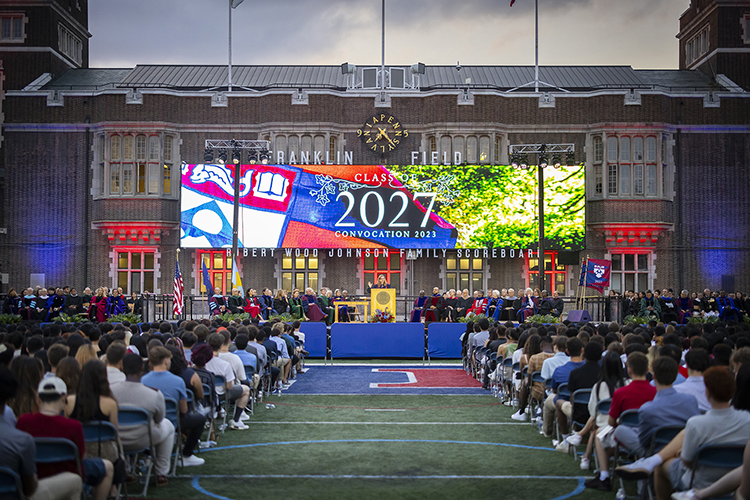
On Monday, August 28, 2023, Penn’s Class of 2027 Convocation was held on Franklin Field.
View Penn with a Fisheye Lens
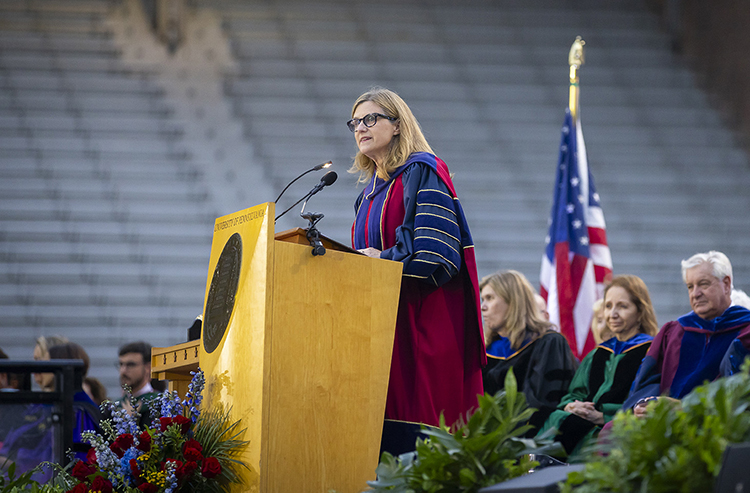
President Liz Magill
Thanks, Dean Soule, and thank you and the Admissions team for bringing together Penn’s newest students. They are fabulous.
Class of 2027 and transfers: How’s everybody feeling?
As president, it’s my pleasure to welcome you all officially to Penn. This is Convocation, a tradition named from the Latin convocare. A word which, if I remember my Latin, translates roughly to ‘a lot of speeches before dessert.’
It also means “to call together.” And I want to call on all of you to participate in a little exercise. I’ll share my reasons in a few minutes. For now, though, I’d like you to listen closely.
Students in the front row: Congratulations, you get to go first. Attached to the bottom of each of your seats, there is a card. Please reach down and take it out.
Once you each have your card, hold it up high so we all can see.
Everybody can see the cards? Great.
Next, and only when I tell you to start, I want you to turn around, say hi to the person sitting directly behind you, and pass them your card. Then the next person should do the same, and the next, until all the cards reach the very back. Think of it like a relay race. You should move fast but please be sure to say hello and your name when you hand your card to the next person.
To the students in the very back: Once you have the cards, please hold them up so I can see that you’re done. Everybody ready? Okay, let’s get started.
I’m seeing plenty of cards at the back. Back row, thank you, you can tuck those cards under your seats.
Ok, call me psychic because I can guess what you’re thinking. “What was that?”
I’m getting there. First, I’d like a show of hands. Please raise your hand if you remember the color of the card you had.
Just about everybody does. Now, I want you to think hard. No need to raise your hands and no peeking in the back. What colors were the cards to either side of you?
I’m willing to bet that’s harder to answer.
That’s because humans are hardwired to focus on what’s in front of us. Maybe it’s a goal, an obstacle, or this weird game the president had you play. In the study of this phenomenon, there’s a metaphor for how we focus. It’s called the zoom lens. We zoom in on what seems most important while everything else goes fuzzy. We see the color of our card, but likely not the color of the cards around us.
The opposite of a zoom lens is what’s called a fisheye lens. It’s a wide view that takes in more, that sees the periphery, that engages panoramically.
Today, you embark on perhaps the most important time in your life to cultivate this skill. So, here’s my message and my challenge. I encourage you to view Penn with a fisheye lens.
First, a caveat. The ability to focus is critical. By your own accomplishments to date, you know this well. We must focus intently in our classes; in our assignments and exams; when we’re on the stage, in the lab or studio, or on the field. If I stood up here and claimed otherwise, people might get a little upset with me. And by people, I mainly mean your faculty.
But there’s an important balance to strike. Penn is vast. We are tens of thousands. We study and engage across nearly every field and issue under the sun—and beyond.
And just like your class, your Penn community represents numerous countries, countless backgrounds and walks of life, different beliefs, and common causes. It is likely the single most diverse and dynamic place you’ll ever call home.
On any given day, on Locust Walk or in your college house hallway, you could encounter an entirely unexpected idea. A new friendship for life. Fresh insight that changes your point of view.
The secret, though, is that you must be open to it. You must deliberately go about every day at Penn with as broad and inquisitive a view as possible. With a fisheye lens. And Penn is the university known for exactly that. There are countless examples. Let me offer you just one.
Earlier this year, one of our faculty won a coveted honor, the Franklin Medal, for his pioneering work with light wave technology. Back in the 90s, though, Professor Nader Engheta’s work focused not on light but rather radio waves. That is, until a fellow Penn scientist invited him to investigate a fish.
Yes, a green sunfish to be precise, and the physiological adaptations in its eyes that give it an advantage underwater. Their collaboration eventually led to a new field of study, new camera technology, and new paths to other foundational discoveries.
Today, Professor Engheta’s broad-ranging research offers us a tantalizing glimpse of a future where we may compute using light. Where nanoscale materials manipulate light for any number of applications, from solar energy to augmented reality.
All because he approached his work and Penn with a fisheye lens. Quite literally in this case. “Innovation often occurs at the boundary points between fields,” Professor Engheta has said. “Knowledge does not have boundaries.”
You can see this truth at work in all our schools, including yours. The College, Engineering, Nursing, Wharton. Working in the humanities, arts, sciences, and professions, Penn people excel at zooming out and exploring across fields. They are expert innovators at the boundary points between. And our undergraduates are no exception.
Approaching Penn with a fisheye lens does not stop with your academics and extracurriculars. If you’ll think back to the card game a few minutes ago, an important part was turning around to meet the person behind you. Never underestimate the possibilities that come with stepping outside your routine to meet someone new. I encourage you to commit to learning about and with others. To venturing beyond your comfort zone and hearing differing points of view. Find common ground and, when differences inevitably occur, disagree productively.
I also encourage you to remember: While you’re taking the broad view and getting the most out of Penn, we are here to support your success and your well-being. Never hesitate to reach out for the resources you need.
Above all, know that you belong here. Remember when I said that this place is vast, dynamic, and diverse? That is Penn’s strength. And with your arrival, Penn grows that much stronger. Never doubt that you are in the right place.
And so, Class of 2027. Transfer students. Focus on the card in front of you, but don’t lose sight of the brilliant array of cards all around. Be open, be inquisitive, be panoramic. Take in everything at Penn with a fisheye lens.
Congratulations and welcome to Penn!

Dare To Be Different
Provost John L. Jackson, Jr.
As Provost—Penn’s Chief Academic Officer—it’s my great pleasure to welcome you this evening. Convocation is a Penn tradition that dates, at least as a formal ceremony, way back to the 1890s, though first-years gathered informally long before even then.
And of course Franklin Field has its own storied history: built 101 years ago, it was the country’s first two-tiered stadium, and once played home to the Philadelphia Eagles and the annual Army-Navy game, both now relocated to South Philly. And we still hold the Penn Relays here, which started in 1895. So yes, as you know, Penn is very old.
But you are all new here, and that’s something we share. I’m also new: not to Penn, but to this role. I just started as Provost in June, and, to be honest, I’m still getting my feet wet. Therefore, I can’t pretend to pass along bits of provostial wisdom this evening; I don’t have a ton of that yet. And I can’t really provide you with a detailed picture of how it looks from where I sit either. It looks kind of new and exciting and even a little daunting. Maybe we share that, too.
So, I’ll speak less as Provost today than as an anthropologist, since anthropology is the field I know best. Anthropology is the study of difference. Essentially, what makes human beings quintessentially human. What is it that makes us different from any other animals and species on the planet, and from one another?
Penn is a new and different place for you, and each of you will contribute your own different story and experience. That difference—how we view it, how we understand it, and how we celebrate it—is my focus tonight.
First, think about what makes us different from, say, a bear. Or a salmon. Or a bear trying to eat that salmon. Anthropologists have four basic ways of explaining those differences: students sometimes abbreviate them as stones, tones, bones, and thrones.
First, our artifacts and the tools we’ve developed. Or, the stones. Second, our capacity for symbolic communication using language: poetry, newspapers, song lyrics, Twitter, if you must. The tones. Third, our bodies: our genes, our two legs, our lack of fur and scales. The bones. And finally, our various cultures and ideas, and our capacity to learn, adapted over many, many generations. Those are the thrones.
Yet there is a basic irony in all of this. Those stones, tones, bones, and thrones, the very things that make us alike, as humans—that no other species look like us, move quite like us, can communicate as abstractly as we can, share our rich capacity for cultural expression—are the same things we use to make distinctions between and among us. That person does not look like me. And: We don’t share a language, and can’t communicate. And: We were raised in different cultures and have different traditions and assumptions. And: we don’t share a history.
You’ve only been here for a week, but I’m sure you’ve already noticed this community is one filled with differences. It’s probably very different from what some of you are used to. That is a good thing. At Penn you will become not simply well-educated but well-rounded, exposed to new ideas and different people, prepared and excited to lead in a multicultural/multi-everything world defined by unwieldy differences.
Anthropologists often talk about trying to understand where differences come from—not to deny them, or beat them back. This is difficult. It requires trying to see the world through other people’s eyes, from their perspectives. That means listening to others. Really listening and learning from them. You might disagree with their point of view; in fact, I’m sure at some point you will. But listening and being willing to learn from others, no matter how different, is essential to everything we do here. Listen respectfully, and disagree without being disagreeable. Don’t run from differences, embrace them.
How else can you learn? I encourage you to take advantage of Penn’s numerous student and affinity groups, its various campus organizations, its community-based engagement opportunities. Try something new, and make a point of meeting others with different stories. I suspect you’ll find you have more in common than you know. But those differences will remain, too. And that’s a good thing
Take classes in subjects you know a lot about, and in subjects you know nothing about. My guess is you’ll be surprised in both cases. Finally, remember that differences define our strengths, including differences in our biographies, histories, cultures, languages, nationalities, beliefs, and commitments.
The great anthropologist and folklorist Ruth Benedict once noted that the purpose of anthropology is to make the world safe for human differences. Embrace others’ differences. And don’t be afraid of the fact that this special experience will undoubtedly make you different by the time you leave. In ways that are inspiring and foundational and inescapable, it most certainly will.
Members of the great class of 2027: If I can leave you with one clear message this evening, it’s this: Dare to be different.
Welcome to Penn.
