Penn Libraries: $5 Million Gift from Wendy and Wayne Holman to Endow Holman Biotech Commons
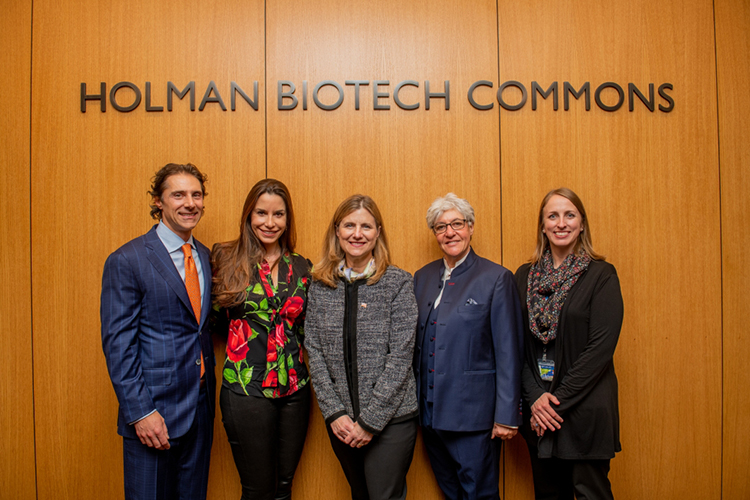
A $5 million gift from Penn Libraries Board of Advisors member Wendy Commins Holman, W’97, her husband Wayne Holman, and their family will name the recently renovated Holman Biotech Commons.
The naming gift from the Holman family will ensure this dynamic space continues to meet the evolving needs of scholars who rely on the Penn Libraries’ services, resources, and expertise as they work to impact and improve human life.
“The Holman Biotech Commons has emerged as a hub for collaboration across the University and a launching pad for innovative study in the health sciences,” said Penn President Liz Magill. “We are extraordinarily grateful to Wendy and Wayne Holman for this commitment, which provides the Penn community with access to information using the latest tools and technologies to connect and explore across disciplines.”
“This vibrant space proudly bears the name of the Holman family, and we at the Penn Libraries are deeply grateful to Wendy and Wayne for their enduring commitment to Penn, to the libraries, and to the biomedical community,” said Constantia Constantinou, H. Carton Rogers III Vice Provost and director of the Penn Libraries. “Spaces like this demonstrate the essential infrastructure that the Penn Libraries provides. The Holmans’ support ensures that we will continue to answer vital needs and provide an extraordinary user experience to every member of our community who visits the Biotech Commons.”
The Holman Biotech Commons’ innovative design is the result of an $11.5 million renovation, completed in fall 2021, which was informed by input from library users, researchers, partners in the Perelman School of Medicine and the School of Nursing, facilities experts, and the Penn Libraries’ staff and subject specialists. Situated at the heart of biomedical activity on campus, the Biotech Commons facilitates relationships among the many interdisciplinary groups that surround it, including graduate and undergraduate students, clinicians, faculty, and researchers.
Wendy Holman, the CEO and co-founder of Ridgeback Biotherapeutics, has a passion for global health and healthcare equality. In addition to serving on the Penn Libraries Board of Advisors, she is a member of the Sabin Vaccine Institute and the Presidential Advisory Council on HIV/AIDS (PACHA).
“Most of my work focus—as a philanthropist, volunteer, and CEO—has a common thread: to have a tangible positive effect on health and human suffering,” said Wendy Holman. “Penn’s researchers, scientists, and scholars have done an incredible job leading the world in biomedical research, and our planet is a safer, better, and healthier place as a result. Penn’s libraries are not only a place to house our tremendous collections; they are centers of research excellence which continue to keep Penn at the forefront of innovation.”
Wendy Holman believes in the mission of the Penn Libraries because “the libraries support all of the schools and all of our students. They continue to be the great equalizer on campus while also serving as great research and development hubs.”
Wayne Holman added, “Wendy and I have dedicated our lives to advancing and harnessing healthcare innovation to address both unmet needs and underserved areas. We are confident the Holman Biotech Commons will be a place of learning, discovery, and collaboration that further advances the great contributions the University of Pennsylvania has already made to treating and curing human disease. We are honored and proud of our long-term partnership in advancing many common goals we share with the entire Penn community.”
The Holmans previously supported the Biotech Commons renovation project by funding the centrally located Wendy and Wayne Holman Reading Room, which serves as both an independent study area and a multipurpose event space with movable furniture to accommodate a variety of activities such as lecture-style events, book talks, and conferences.
Additional highlights of the facility include the Bollinger Digital Fabrication Lab, which offers 3D printing and poster printing services to aid academic, clinical, and research projects; the Anatomage Table, which allows for the virtual dissection and review of life-size virtual cadavers outside of clinical lab coursework; and a relaxation room, a vital space for stress relief to support students in high-stress medical education programs.
“The Holman Biotech Commons is a reflection of the Holmans’ commitment to the Penn Libraries and to supporting our biomedical community,” said Hannah Rutledge, the director of the Biotech Commons. “It’s an honor to work in such a welcoming, light-filled, and inspiring space that encourages innovation and collaboration among faculty, students, and our expert staff and librarians.”
“As problems grow in complexity, the need for diversity of thought and experience becomes more and more important,” said Wendy Holman. “Collaboration requires space to work together. My hope is that the Holman Biotech Commons helps to fill that need.”
Penn Medicine: $3.5 Million National Cancer Institute Grant to Improve Cervical Cancer Care in Botswana
For more than two decades, experts at Penn Medicine have worked hand-in-hand with local partners to improve health care and outcomes in the sub-Saharan African nation of Botswana. Now, a new $3.5 million grant from the National Cancer Institute (NCI) will help further that work by addressing one of Botswana’s most serious health challenges: cervical cancer.
“We are honored to be a part of this funding initiative that extends the huge impact that years of partnership in Botswana has had on improving care for cervical cancer patients,” said Surbhi Grover, an associate professor of radiation oncology and the director of global radiation oncology at the Hospital of University of Pennsylvania. Dr. Grover co-leads the grant with Katharine Rendle, an assistant professor of family medicine and community health in the Perelman School of Medicine at the University of Pennsylvania.
Penn’s department of radiation oncology has been working with colleagues in Botswana since 2011, with Dr. Grover leading efforts in cervical cancer care since 2014 when she moved full time to Botswana. “This grant provides the opportunity for our clinical and research teams at Penn and the University of Botswana to test innovative strategies that can directly improve the lives of women diagnosed with cervical cancer in Botswana,” said Dr. Rendle, who is also deputy director for research at the Penn Center for Cancer Care Innovation (PC3I).
Cervical cancer is the leading cause of cancer death for females in Botswana and is the most common cancer among younger women between the ages of 15 to 44, according to 2021 data from HPV Information Centre. In fact, the age-standardized mortality rate for cervical cancer is 10 times higher in Botswana (20.1 per 100,000) than in the United States (2.1 per 100,000) according to 2020 Globocan estimates.
Dr. Grover said this is due in large part to the nation’s high prevalence of HIV, which substantially increases cervical cancer risk. Botswana has the third-highest rate of HIV prevalence in the world, with about 20 percent of its population of people aged 15 to 64 living with HIV, according to data from the Botswana AIDS Impact Survey published in 2022.
When there isn’t coordination between laboratories, patients, and clinics, there can be catastrophic delays in diagnosis and treatment.
“Sometimes when I see a patient, I realize their biopsy occurred months or even years ago. There is no alert system whereby the lab can notify the referring facility when cancer is diagnosed,” Dr. Grover said. “Furthermore, there is often no link between patients and the cancer clinic. This lack of communication and support is what this grant aims to address. This is the first step in our larger aim to improve outcomes of women with cervical cancer across the globe.”
As part of the NCI-funded project, researchers will identify communication and support strategies, such as text messages or phone-based patient navigation, that are best equipped to close gaps in the care continuum.
“We will test strategies that aim to shorten the gap from diagnosis to initiation of potentially life-saving treatments for all patients with cervical cancer,” Dr. Rendle said. “Our goal is to do so in the most cost-effective and efficient way, reducing burden on the health system.”
Since 2001, Penn has worked through the Botswana-UPenn Partnership (BUP) to improve health in Botswana. What began as a response to the burgeoning HIV/AIDS crisis has evolved into a wide-ranging health initiative focusing significantly on oncology over the last decade with support from Penn’s department of radiation oncology and Center for Global Health. BUP works closely with Botswana’s Ministry of Health & Wellness, the University of Botswana, and other partners to care for patients, and develop initiatives advancing cancer education, research, and capacity.
The team hopes that the study’s findings could ultimately be applied to care strategies for other cancer, in Botswana and in other countries facing similar barriers. “This project is reflective of Penn Medicine’s commitment to ensuring patients around the globe receive high-quality cancer care,” Dr. Rendle said. “By collaborating with and learning from leaders in Botswana and other countries, we aim to implement clinical solutions that are sustainable over time and directly responsive to the needs and priorities of our global partners.”
Dipti Pitta: Mark Whittier and Lila Griswold Allam Associate Professor at Penn’s School of Veterinary Medicine
 Andrew M. Hoffman, Gilbert S. Kahn Dean of the School of Veterinary Medicine at the University of Pennsylvania (Penn Vet) has named Dipti Pitta, an internationally recognized scholar working at the interface of microbiology, agriculture, and dairy nutrition, the Mark Whittier and Lila Griswold Allam Associate Professor.
Dr. Pitta possesses an exceptional record of scholarly accomplishments. Her seminal work in controlling methane production from dairy cows was awarded a prestigious USDA-NIFA IDEA grant of $995,000 in addition to other current grants and research awards from the USDA, the Pennsylvania Department of Agriculture (PDA), the Center for Poultry and Livestock Excellence, and industry totaling over $2.5 million.
Dr. Pitta’s research program is integral to the new Center for Stewardship Agriculture and Food Security (Almanac November 1, 2022), where she is a faculty leader. In addition to the center, she has also served as a member of research groups and academic committees across the University of Pennsylvania (Penn), including the Internal Advisory Board for the Center for Host-Microbial Interactions, the Committee on the Academic Status of Students, and the Penn Faculty Senate Executive Committee. Dr. Pitta served as a faculty director for the Penn Global Research and Engagement Grant Program; and has recently established a highly successful mentoring program for veterinary students, undergraduate students, and high school students in her laboratory.
“Dr. Pitta’s work in microbiomics has become a resource for faculty in diverse areas of study here at Penn Vet,” said Katrin Hinrichs, the Harry Werner Endowed Professor of Equine Medicine and chair, of the department of clinical studies at New Bolton Center. “Her collaborations have greatly increased the depth of the investigations of our clinical faculty, and she is an exemplar of what a tenure-track faculty member can contribute to a clinical department.”
Dr. Pitta earned her veterinary bachelors and masters degrees in India and received her PhD from Massey University in New Zealand. Following post-doctoral fellowships in New Zealand and at the Texas A&M AgriLife Research Center, Dr. Pitta joined Penn Vet’s faculty as an assistant professor in 2011. She was promoted to associate professor in 2021.
“The awarding of a named, endowed professorship is the highest honor bestowed upon a faculty member at Penn and reflects excellence in scholarly achievement,” said Dr. Hoffman. “Dr. Pitta embodies a commitment to scientific discovery, global engagement, mentorship, and service that is truly deserving of this honor.”
Penn Predoctoral Fellowships for Excellence Through Diversity
The University of Pennsylvania is pleased to invite applications for the 2023-2024 Predoctoral Fellowships for Excellence through Diversity. These awards are designed to provide mentorship and access to Penn’s resources for doctoral students in the humanities or social sciences, enrolled in graduate or professional programs at universities other than Penn, as they complete their dissertations. The fellowships are intended to support scholars from a wide range of backgrounds who can contribute to the diversity of Penn and the higher education community.
These residential fellowships for an academic year support graduate students in the final stages of dissertation research or writing. They offer an opportunity for scholars who plan an academic career to take advantage of Penn programs, libraries, and faculty expertise, as well as the resources of the Philadelphia region. Each scholar will be selected and hosted by a department or school and assigned a faculty mentor.
The fellowship provides a stipend of $41,000, health insurance, library privileges, and a $5,000 research and travel fund. The application deadline is January 17, 2023.
This year, up to five fellowships will be awarded.
Qualifications
Candidates for the fellowship must be a U.S. citizen or permanent resident, enrolled in a PhD program in the humanities or social sciences at an accredited university graduate or professional school other than Penn. Candidates must have passed any PhD qualifying examinations and be in an advanced stage of research and writing on an approved dissertation topic. Candidates must be students of exceptional academic merit who also belong to a group underrepresented in higher education; come from a socially, culturally, or educationally disadvantaged background or have faced other significant personal obstacles; and/or pursue academic research on cultural, societal, or educational problems as they affect disadvantaged or underrepresented sectors of society.
Application
- Applicants should submit:
- A letter from a Penn faculty member with compatible research interests whom you have contacted and who has agreed to act as a mentor for the duration of the fellowship.
- Two letters of recommendation, signed and on official letterhead. One must come from the dissertation advisor, commenting on the student’s performance, potential, and expected time to degree. At least one of the letters must address the applicant’s contribution to diversity in higher education.
- Official graduate transcript(s).
- Current curriculum vitae.
- Responses to application questions in Interfolio:
- Describe your dissertation’s aims and methodology (maximum 500 words).
- Explain how your dissertation contributes to the field (maximum 250 words).
- Explain how your dissertation contributes to understandings of diversity and inclusion (maximum 250 words).
- Describe your future research and professional goals (maximum 250 words).
- Explain how the Penn fellowship will support your goals (maximum 250 words).
- Indicate your expected date of graduation (month and year).
Applications will be accepted at: https://apply.interfolio.com/117464.
Questions can be addressed to the Office of the Vice Provost for Faculty at: provost-fac@upenn.edu.

 Audrey E. Evans, an emerita professor of pediatrics at the University of Pennsylvania, the first chief of the division of oncology at the Children’s Hospital of Philadelphia (CHOP), and the co-founder of Ronald McDonald House Charities in Philadelphia, died on September 29. She was 97.
 Irvin (Irv) Hurwitz, C’81, the former director of development at Penn, died on June 28.
 Robin Lisa Leidner, a former associate professor of sociology in the School of Arts and Sciences, died on September 23, 2022 of complications from breast cancer. She was 65.
 Alan Louis Myers, a professor emeritus of chemical and biomolecular engineering in the School of Engineering and Applied Science, died recently.
 Michael E. Mann, one of the world’s leading voices on climate change, has been awarded the 2022 Stroud Award for Freshwater Excellence by the Stroud Water Research Center. The award was presented at the 20th annual the Water’s Edge gala at the Delaware Museum of Nature & Science.