Of Record: Policy for Postdoctoral Trainees at the University of Pennsylvania
Note: The new term limit will become effective as of July 1, 2023 and will apply only to those hired on or after this effective date. Current postdocs and those hired prior to July 1, 2023 retain the current 5-year term limit at Penn, regardless of previous experience. All other terms in the postdoc policy are effective as of July 1, 2022.
--
Postdoctoral trainees are valued members of Penn’s research community. The contributions of our postdocs help to create the collaborative, dynamic and innovative research environment that is so special to Penn. The Office of the Vice Provost for Research recently reviewed and updated the Policy for Postdoctoral Trainees at the University of Pennsylvania. Key new components of the policy include a defined grievance process and an Extramural Activities section. A nondiscrimination statement was added, as well as a sexual misconduct policy. Additionally, clarifications were made throughout the policy, with an emphasis on the Ombuds, Training Program, Duration of Appointment and Termination sections.
The revised policy has been reviewed by the Provost’s Council on Research, the Office of General Counsel, Postdoctoral Trainee Stakeholders, Senior Management Group, Council of Deans, the Academic Budget and Planning Committee, the Faculty Senate Tri-Chairs, and was posted for comment in the Almanac. This policy becomes effective on July 1, 2022 and supersedes the prior version, which was published on July 13, 2010.
—Dawn Bonnell, Senior Vice Provost for Research
—Beth Winkelstein, Interim Provost
Policy for Postdoctoral Trainees at the University of Pennsylvania
Effective July 1, 2022
Preamble
Postdoctoral trainees (PDTs) come to the University for further training in their chosen discipline. An individual who has been designated as a PDT by their school receives training conducted in an apprenticeship mode under the supervision of an established faculty member who serves as a mentor. As dictated by the nature of the program, the trainee may be undertaking scholarship, research, service, and teaching activities, all of which provide training essential for career development. Because education is a pre-eminent mission of the University and because PDTs are professionals in training, it is important that PDT programs be designed to advance their careers. This policy is intended to address the distinct position of PDTs in the University community.
This policy applies to all three categories of postdoctoral trainees that are identified in the payroll system of the University, based upon funding source: postdoctoral researcher (supported from a research grant), NRSA-postdoctoral fellow (supported by an individual or institutional National Research Service Award), and postdoctoral fellow (supported by a private foundation, non-profit charitable organization, or other sources). Funding sources may have their own guidelines governing participation in their programs. In instances where these guidelines differ from the University policy, the guidelines of the funding source take precedence.
Appointment and Resignation
Letter of Appointment
When a faculty member offers an appointment to a PDT candidate, a letter should be written to the candidate prior to commencement of training. This letter should set forth the period of appointment (dates of appointment), the stipend amount, any benefits, and a statement that the candidate’s appointment is subject to all University policies. The letter must be accompanied by a copy of the University Patent Policy and the corresponding Participation Agreement. If the appointment is renewed or extended, that action should be documented by a letter, which includes the aforementioned information.
The candidate must return a countersigned copy of each letter of appointment or renewal indicating acceptance of the terms set forth, as well as a signed Patent Policy Participation Agreement. The letters (countersigned copies) and signed agreement or electronic record of the appointment/agreement should be maintained by the office of the appropriate department. If the faculty member is not affiliated with a specific department, the file may be kept in the office of the institute or center with which the faculty member is associated. The letters of appointment and renewal should indicate whether the mentor has available funding to fulfill the terms of the appointment; if not, the letter should indicate the duration of assured funding. When the appointment is to be coterminous with external funding, research grant, contract, training grant, etc., that fact should be included in the letter of appointment, including the end date of the funding even if renewal is expected.
Proof of Doctoral Degree
Eligibility for appointment as a PDT requires a candidate to hold, or to have completed the requirements for, an advanced degree, e.g., PhD, MD, or equivalent. Candidates from non-U.S. universities must hold advanced degrees equivalent to those awarded in U.S. institutions in order to qualify for appointment as postdoctoral fellows. It is the candidate’s responsibility to provide transcripts and/or a diploma certifying that the postdoc has received their degree, and although this may be delegated, it is the mentor’s responsibility to review this documentation and ensure that it is satisfactory and included in the candidate’s file. Candidates who have completed the requirements for an advanced degree, but not yet been awarded such degree, must be able to demonstrate in a manner verifiable by the University that such requirements have been completed. In no event shall a PDT be reappointed without the degree having been awarded.
Duration of Appointment
Postdoctoral appointments are for one year and may be renewed annually based on satisfactory performance and availability of funding. Under current University policy, the cumulative PDT experience should not exceed five years total. Under exceptional circumstances, such as a prolonged period of leave (e.g., extended medical leave) or other extraordinary situation (e.g., pandemic) during any of these five years, upon request of a faculty mentor, an extension may be granted by the appropriate Dean or Vice Provost for Research.
Termination
Mentors may terminate a PDT during an appointment period for any reason with three months’ written notice. The letter of termination must state the reason for termination using the PDT obligations as guidelines (see below).
Under certain circumstances, it may be appropriate to terminate a PDT immediately. Such circumstances may include (but are not limited to) gross or willful misconduct, gross insubordination, prohibited harassment, unethical behavior (including disclosure or misuse of confidential information, misuse of University resources, or other violations of University policy). In such event an appropriate administrative office (e.g., The Office of the Vice Provost for Research) must be consulted and approve the termination.
Stipend Level
Minimum stipend levels for PDTs are set annually by the Vice Provost for Research, in consultation with the Provost’s Council on Research, representing all of the schools of the University. When a funding sponsor mandates stipend levels higher than the University minimum, mentors are obligated to pay the higher amount.
PDT Notice of Resignation
PDTs are expected to provide at least 20 business days’ notice of resignation provided to both the mentor and the department or school business office. When appropriate to the discipline, it is the obligation of the PDT to ensure that all research materials and records/databases are left in a state to allow continuation of the project. Records include both hard copies and electronic materials, properly labeled and shared in secure servers as per laboratories/funding source protocols.
Benefits and Leave
Health Insurance
PDTs are required to have health insurance. PDTs are eligible to receive single person insurance, as provided under the Basic University of Pennsylvania Postdoctoral Insurance Plan. This benefit is in addition to the stipend, and no premium should be deducted from the PDT’s stipend. If the PDT elects family coverage, the difference between the single and family premium can be paid from one of three sources: (1) it can be deducted from the PDT’s stipend; (2) it can be paid by the funding source if it is an allowable expense; or (3) it can be paid by the unit that recruited the PDT. If PDTs elect to waive health insurance coverage through the University, PDTs must certify that they have alternate health insurance that provides at least comparable coverage.
Vacation and Mentor-Approved Flexibility of Observed Holidays and Winter Break
In any appointment year, a PDT may elect to take up to ten University business days as paid vacation days, on which days the PDT will continue to receive their stipend. PDTs are also entitled to the eight official holidays observed by the University and are eligible to take the University’s special winter vacation, during which time the University is typically closed. If a PDT wishes to work and/or perform research during an official holiday or special winter vacation, the postdoc can use the equivalent time as additional paid vacation days. PDTs forfeit any unused vacation days or holidays at the end of any appointment year.
Sick Leave
PDTs may continue to receive stipends for up to 15 University business days of sick leave per year. PDTs forfeit any unused sick leave at the end of the appointment year. Under exceptional circumstances, a period of leave due to illness or incapacity may be extended at the discretion of the mentor. Mentors may request for any extended absence medical documentation from a health care provider, to be provided to an appropriate administrative office consistent with confidentiality. Additional sick leave may be approved in the discretion of the mentor.
New Child Leave
PDTs are entitled to receive stipends for no more than 60 calendar days of leave per appointment year for adoption or birth of a child. Either parent is eligible. PDTs must discuss the use of new child leave in advance with the mentor. A mentor may not deny a request to use new child leave without the authorization of the appropriate administrative office. Unused sick leave or vacation days may be used, with approval, to extend the period of new child leave. Additional new child leave may be approved at the discretion of the mentor.
Unpaid Leave
PDTs requesting extended periods of time away from their training experience, including leave in excess of available sick and/or parental leave, must obtain approval for a leave of absence without stipend continuation. Approval for such leave must be requested and approved by the mentor in advance.
Record of Paid and Unpaid Leave
All paid and unpaid leave must be approved in advance by the mentor; additional leave may be approved at the mentor’s discretion. PDT and mentors are responsible of keeping accurate record of paid and unpaid leave.
Obligations and Responsibilities
Obligations of Mentors
Mentors’ responsibilities include: (i) developing in consultation with the PDT a mutually satisfactory research project or scholarly program; (ii) encouraging PDTs to present their work and to publish their results in a timely fashion; (iii) encouraging PDTs to acquire and enhance their knowledge and technical skills as dictated by their current and future needs; (iv) arrangement and oversight of teaching opportunities as appropriate to their discipline and program; (v) encouraging PDTs to apply for training and research support as appropriate; (vi) meeting regularly with their PDTs to discuss progress in their research; (vii) providing an annual review of performance that includes a discussion of the individualized development plan (IDP) or equivalent performance document; (viii) ensuring that PDTs are aware of University policies regarding postdoctoral training and are instructed about research policies of the University; and (ix) providing career counseling.
Obligations of Postdoctoral Fellows
PDTs have certain obligations to their mentor, the group in which they are working, the department with which they are associated, the sponsor whose funds support them, and the University. These obligations include but are not limited to: (i) the conscientious discharge of their research, scholarly, and teaching responsibilities, as applicable; (ii) conformity with ethical standards in research and scholarship; (iii) compliance with good scholarly practice, including the maintenance of adequate research records; (iv) observation of appropriate guidelines regarding human subjects and due observation of University standards regarding use of isotopes, chemicals, infectious agents, animals, and the like, if applicable; (v) open and timely discussion with their mentor regarding possession or distribution of tangible property such as materials, reagents, and the like; (vi) discussion of laboratory records or scholarly materials, if relevant; (vii) prior disclosure of appropriate scholarly information, findings or techniques proposed for dissemination privately, at scholarly meetings, or in publications; (viii) collegial conduct toward all members of the University community; (ix) compliance with all applicable University policies; (x) completing IDPs or equivalent performance appraisal with mentor yearly at the beginning of each appointment year starting year 2; and (xi) attending a minimum required contact hours of Responsible Conduct of Research (RCR) training per career stage.
Extramural Activities
At times a PDT may wish to engage in activities outside of the University and/or beyond the scope of their appointment. Before undertaking such activity, the PDT must secure approval, in writing, from their mentor and business administrator. The approval for such activities should include a description of the activity, include a specific end date no longer than one year later (which may be subject to renewal) and must be signed by both the mentor and the PDT. These activities may not give rise to a conflict of interest or divert or diminish the training of the PDT, and they should be reviewed regularly if approved. Approval may be withdrawn if the activity no longer is appropriate under policy or interferes with the PDT’s appointment. It is the PDT’s responsibility to update this documentation and notify their mentor should there be any changes.
Research Records
Primary research records created by PDTs during the tenure of their training at the University of Pennsylvania are the property of the University and are retained by the University when the PDT leaves. If a PDT obtains written permission from their mentor, they may retain a copy of such records as agreed upon by the mentor and the PDT.
Exceptions to this practice may be granted, subject to written prior approval of the Provost’s Office, in fields where it can be convincingly demonstrated that there is a well-established practice that individual scholars retain ownership of data generated through their research efforts. In such cases the PDTs may be permitted to retain notes and records associated with their research and publish their findings subsequent to leaving the University, provided an appropriate acknowledgement is made of the University’s contribution to the work (e.g., in the form of funding).
Training
Orientation
A compendium of information should be provided to each PDT upon arrival at the University. This compendium should be available on an appropriate University website and could include a registration form to be completed by the PDT; a copy of these guidelines; conflict of interest and financial disclosure policies; intellectual property policies; Procedures Regarding Misconduct in Research; the Sexual Misconduct Policy and Equal Opportunity and Affirmative Action Policy and nondiscrimination policies; parking policies; a clear statement about benefits; information regarding taxation; a list of sources of information within the University; and information regarding the Office of the Ombuds. Faculty mentors are encouraged to conduct orientation sessions for all new PDTs. Departments should arrange e-mail accounts for their PDTs.
Training Program Elements
PDTs are considered professionals in training. One goal of their professional experience at Penn is to provide training relevant to the performance of responsible and high-quality research. All postdocs must receive training in the responsible conduct of research (RCR). Key elements of this training should include scientific rigor and reproducibility and mitigating unconscious bias. NIH recognizes that the following topics1 have been incorporated in to most acceptable training plans, as appropriate to the individual trainee, and therefore should be included in the postdoc training plan: (i) data acquisition and analysis; laboratory tools (e.g., tools for analyzing data and creating or working with digital images): recordkeeping practices, including methods such as electronic laboratory notebooks; (ii) secure and ethical data use; data confidentiality, management, sharing and ownership; (iii) mentor/mentee responsibilities and relationships; (iv) responsible authorship and publication practices; (v) peer review, including the responsibility for maintaining confidentiality and security in peer review; (vi) collaborative research, including collaborations with industry and investigators and institutions in other countries; (vii) policies regarding human subjects, live vertebrate animal subjects in research, and safe laboratory practices; (viii) research misconduct and policies for handling misconduct; (ix) conflict of interest–personal, professional and financial–and conflict of commitment in allocating time, effort or other research services; (x) the scientist as a responsible member of society, contemporary ethical issues in biomedical research, and the environmental and societal impacts of scientific research; (xi) safe research environments (e.g., those that promote inclusion and are free of sexual, racial, ethnic, disability and other forms of discriminatory harassment). When PDTs engage in teaching, appropriate training and didactic experience should also be provided.
Application for Grants
Each school should establish a policy, consistent with section 1.5 of the Sponsored Projects Handbook (online at www.upenn.edu/researchservices/manual/sponsoredprojectshandbook.html#_Toc84300102) regarding whether PDTs may apply for grants as principal investigator. If school policy permits such applications, it is suggested that the school require approval by a knowledgeable member of the standing faculty as well as the appropriate department chair’s and Dean’s endorsement and chair’s acceptance of responsibility.
1These topics reflect the NIH guidelines as of the date of this policy. However, the current NIH guidance should always be followed (NOT-OD-10-019: Update on the Requirement for Instruction in the Responsible Conduct of Research (nih.gov))
Additional Items of Importance
University of Pennsylvania Nondiscrimination Statement
The University of Pennsylvania values diversity and seeks talented students, postdocs, faculty and staff from diverse backgrounds. The University of Pennsylvania does not discriminate on the basis of race, color, sex, sexual orientation, gender identity, religion, creed, national or ethnic origin, citizenship status, age, disability, veteran status or any other legally protected class status in the administration of its admissions, financial aid, educational or athletic programs, or other University-administered programs or in its employment practices. Additional information can be found online at Penn: Office of Affirmative Action and Equal Opportunity Programs: Policies, Handbooks and Procedures (upenn.edu).
Sexual Misconduct Policy
The University of Pennsylvania is committed to providing a working and learning environment free from sexual misconduct. It therefore is the policy of the University that sexual misconduct is unacceptable and will not be tolerated. Detailed information regarding the Sexual Misconduct Policy can be found online at Almanac Supplement- August 14, 2020 PDF (upenn.edu) and Resources | Associate Vice President for Equity and Title IX Officer (upenn.edu).
Office of the Ombuds
It is recognized that from time-to-time disagreements may arise between a PDT and a mentor. In such instances, the PDT may wish to utilize the services available through any ombuds in individual schools, and through the University’s Office of the Ombuds, Home | OMBUDS (upenn.edu).
The Ombuds Office welcomes any member of the Penn community who is experiencing difficulty, conflict, or confusion at work, within their studies, or throughout their life at the University more broadly. The office offers an accessible and safe place to resolve differences, explore matters of concern, improve communication, and generate and evaluate options. If interested, PDTs are encouraged to contact the Ombuds Office at the earliest stages of a problem so that assistance can be offered before the issue escalates.
Grievance Process
The University of Pennsylvania strives to promote an optimal training and educational experience for its PDT community through a professional and respectful environment. Open and routine communication between supervisors/mentors and PDTs throughout the PDT appointment is encouraged in order to clarify expectations, provide an ongoing and timely mechanism for constructive feedback from both parties, as well as offer the opportunity to identify, address/resolve any potential matters as they may arise. It is the expectation that this communication between supervisors and PDTs occurs openly and regularly.
This grievance process has been developed to provide a mechanism for resolution of PDT grievances which may include matters that have resulted in a perceived or actual negative impact upon the training/educational experience of a PDT. A matter is grievable only if it is not currently addressable through any other avenue such as University policy or division procedure (thus, for example, complaints of sexual misconduct must be addressed through the University’s Sexual Misconduct Policy). At any point, if the PDT feels as if the matter has been resolved, they may discontinue the grievance process.
Steps to address a grievance:
1. Efforts should be taken to address a matter informally:
- If possible and appropriate, a discussion should occur between the parties who are directly involved with the issue of the dispute.
- The PDT may consult with any individuals they feel comfortable discussing the matter, such as trusted faculty members, advisor or departmental/programmatic resources.
- Additional resources that may assist in resolving matters or providing confidential counseling include:
2. Consultation by the PDT with the Program Director, Division Chief or Department Chair to discuss the matter is encouraged.
3. If informal steps as suggested above have not resulted in a resolution to the matter, a written grievance may be submitted to the Dean of Research or Dean of the applicable school. The grievance should describe the matter and include specific facts supporting the grievance as well as any available supporting documentation; the names of any parties to the matter; any witnesses known to the grievant; as well as the desired outcome. The grievance should be submitted in a timely manner and no later than 90 days after the occurrence of any event giving rise to the grievance.
- The Dean or Dean’s designee will notify all involved parties of the grievance.
- The Dean or designee will review the grievance.
- The Dean or designee may obtain any information felt necessary to evaluate and make a determination regarding the grievance.
- The Dean or designee may elect to meet with the involved parties.
- Any or all functions to be performed by the Dean or Dean’s designee under this section 3 may be referred by such person in their discretion to a committee of one or more persons convened for the purpose, in which case the committee shall report its findings and conclusions to the Dean or designee.
- The Dean or designee will provide the involved parties with a response regarding the matter in writing. This response will occur within a timely manner, but generally within 60 days (unless circumstances require a longer period for review) and will include a determination as well as a summary of the basis for such determination.
4. If the PDT believes the decision of the Dean to be inappropriate, the PDT may submit a written appeal to the Office of the Vice Provost for Research (VPR) specifying the basis for disagreement with the decision. Appeals are limited to complaints regarding policy or procedure.
- The written appeal must be submitted no later than 30 days after receipt of the Dean’s determination.
- General dissatisfaction with the decision is not sufficient reasoning for an appeal.
- New issues may not be raised for the first time on appeal.
- The VPR or a designee will review the Dean’s determination.
- Any or all functions to be performed by the VPR or VPR’s designee under this section 4 may be referred by such person in their discretion to a committee of one or more persons convened for the purpose, in which case the committee shall report its findings and conclusions to the VPR or designee.
- The VPR or designee will notify the parties to the grievance in writing of the decision and the grounds for the decision, generally within 45 days after the receipt of the appeal (unless circumstances require a longer period for review).
- The decision of the VPR is final within the institution.
5. In the event a grievance is resolved without recourse to the VPR, the VPR should be notified of the grievance and resolution. Please see bullet under Additional Considerations below.
Additional Considerations:
1. University policy prohibits retaliation against any member of the community who participates in good faith in a University compliance, investigative, or review process. For more information, see Policy Against Retaliation (upenn.edu).
2. At any point in the grievance process, formal proceedings can be put aside in favor of voluntary mediation agreed to by all parties directly involved in the matter. The University Ombuds Office may be of assistance in pursuing mediation, Home | OMBUDS (upenn.edu).
3. The time frames set forth in this process may be extended by the relevant administrative officer in their discretion for good cause.
4. The Office of the Vice Provost for Research may periodically review past grievances to address recurring issues or consider modifications to this policy.
Questions concerning the grievance process should be directed to the Office of the Vice Provost for Research.
--
To view as a PDF, click here.

 Kathleen Shields Anderson was appointed Vice President of Public Safety, effective June 1, 2022.
 Haim Bau has been named the Richard H. & S. L. Gabel Professor of Mechanical Engineering. Dr. Bau is a professor in the department of mechanical engineering and applied mechanics. He earned a PhD in mechanical engineering from Cornell University and joined Penn that same year, in 1980.
 Tal Rabin has been named the Rachleff Family Professor. Dr. Rabin is a professor in the department of computer and information science. She joined Penn in 2020 after several years at IBM. She is an alumna of the Hebrew University of Jerusalem, where she received her PhD in 1994.
 Aaron Roth has been named the Henry Salvatori Professor of Computer & Cognitive Science. Dr. Roth is a professor in the department of computer and information science. He holds a PhD from Carnegie Mellon University and conducted postdoctoral research at Microsoft Research before joining Penn in 2011.
 Eric Stach has been named the Robert D. Bent Professor of Engineering. Dr. Stach is a professor in the department of materials science and engineering. Before joining Penn in 2017, he held leadership positions at two national laboratories, Lawrence Berkeley National Lab and Brookhaven National Laboratory, was a tenured professor at Purdue University and was the Chief Technology Officer and co-founder of Hummingbird Scientific (a position he continues to hold). He is an alumnus of the University of Virginia, where he received his PhD in 1998.
 Desmond Upton Patton has been named the University of Pennsylvania’s 31st Penn Integrates Knowledge University Professor, effective July 1. The announcement was made on June 7 by Interim President Wendell Pritchett and Interim Provost Beth Winkelstein.
 Andrew M. Hoffman, Gilbert S. Kahn Dean of the School of Veterinary Medicine at the University of Pennsylvania (Penn Vet), has named P. Jeremy Wang, an internationally recognized reproductive biologist, the Ralph L. Brinster President’s Distinguished Professor.
 Senior Vice Provost for Research Dawn Bonnell has announced the appointment of Richard C. Wender as executive director of the Center for Public Health Initiatives (CPHI), effective July 1, 2022.
 Susan Barker Baird, G’89, a former research associate at Penn’s School of Nursing, passed away on March 30. She was 79.
 Douglas Arthur Canning, the former chief of urology at Children’s Hospital of Philadelphia (CHOP) and a professor of surgery in the Perelman School of Medicine (PSOM), passed away on May 30 following injuries sustained in a bicycle accident. He was 65.
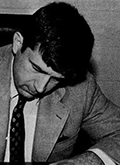 Nicholas D. Constan, L’64, a former adjunct professor in the Wharton School’s department of legal studies and an administrator in the Wharton School, passed away on May 2 from complications of Parkinson’s disease. He was 83.
  Norman Aaron Newberg, a former associate professor and senior fellow at Penn’s Graduate School of Education (GSE), passed away peacefully on May 8. He was 87.
  James Robert Riedel, the former executive director of Penn’s English Language Programs in the School of Arts and Sciences, passed away on May 25 after a long illness. He was 66.
 Joseph Francisco, President’s Distinguished Professor of chemistry in the School of Arts and Sciences, has won the 2022 Centenary Prize of the Royal Society of Chemistry.
 Faculty Advisor: Amalia Daché, Associate Professor, Higher Education Division, Graduate School of Education
 Faculty Advisor: Rand Quinn, Associate Professor, Teaching, Learning, and Leadership Division, Graduate School of Education
 Faculty Advisor: Lori Flanagan-Cato, Associate Professor, Psychology, School of Arts & Sciences
 Tyra Moore, a doctor of social work (DSW) candidate in the School of Social Policy and Practice, was awarded the Joy Award from the Boris L. Henson Foundation in recognition of her steadfast commitment to mental health care for Black Americans. The foundation, started by his daughter, actress Taraji Henson, received over 500 nominations from around the country and Ms. Moore was one of 10 award recipients. Later this month, the foundation and Black Entertainment Television (BET) will fly Ms. Moore and the other nine award winners to Los Angeles for a symposium on mental health and the for the award ceremony.
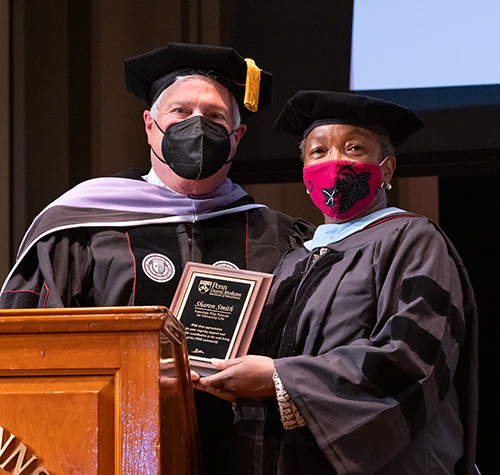 As part of Penn Dental Medicine’s commencement ceremony for the Class of 2022, the school recognized Sharon Smith, Associate Provost for University Life, with a special certificate of appreciation for her service to students. In her role at the University, Ms. Smith oversees a number of campus support programs and endeavors to holistically serve students navigating Penn.
  With eyes toward the future and a humble nod to the past, Penn Live Arts has announced its 50th anniversary 2022-2023 season, which will celebrate the richness of five decades of performance while continuing its penchant for innovation.