News

M. Elizabeth Magill Elected Penn’s Ninth President

Gritty and the Penn Quaker escort President-elect M. Elizabeth “Liz” Magill  up the steps of Fisher Fine Arts Library on March 4. Photo by Eric Sucar.

On March 4, during the Stated Meeting of the University of Pennsylvania’s Board of Trustees, M. Elizabeth “Liz” Magill was unanimously elected Penn’s ninth president. Immediately following the meeting, President-Elect Magill, along with trustees, deans, faculty, staff, students, and alumni, processed from the Inn at Penn to Fisher Fine Arts Library for a luncheon held in her honor.

President-elect Magill begins her tenure as president on July 1, 2022.

For coverage of the Trustees meeting, click here

Perelman School of Medicine: $12.3 Million NIH Grant to Study Ultra-Fast, High-Dose FLASH Radiation Therapy for Cancer

With more than $12 million in new funding from the National Institutes of Health (NIH), the Abramson Cancer Center at the University of Pennsylvania will build on its preclinical research of an emerging form of radiation that provides ultra-fast doses—in under a second, compared to several minutes with conventional radiation—and shows promise of greater protection of normal tissue, thereby reducing the toxic effects on the body.

The department of radiation oncology will use the $12.3 million, five-year NIH grant to compare the ability of proton, carbon, and electron radiotherapy to protect normal tissues from harmful effects while controlling or eradicating solid tumors of the gastrointestinal tract, lungs, soft tissues throughout the body and bones.

This research will include delving deep into the molecular mechanisms that cause toxicity and helping minimize these effects on normal tissue, so that the new technology—called FLASH, due to its incredible speed—can move toward clinical trials.

Early animal studies in Europe and the United States, including at Penn, have shown that when the same dose of radiation is delivered at a much faster rate, it tends to reduce injury to normal tissues while being equally potent against tumors. This could revolutionize radiotherapy, as critical organs near tumors can be spared, reducing toxicity to the body. Moreover, FLASH radiotherapy can be delivered in one to three treatments compared to 20, 30, or more treatments typically delivered with conventional radiotherapy.

“For decades, radiation oncologists had to administer a fraction of the total dose of conventional radiotherapy each time to minimize toxicity to healthy tissue surrounding tumors. However, FLASH radiotherapy has demonstrated a sparing effect of some normal tissues in animal models without compromising its anti-tumor action when delivered all at once,” said Constantinos Koumenis, the Richard H. Chamberlain Professor of Radiation Oncology at Penn and co-principal investigator. “Based on early promising results in animal models, we plan to study the mechanism of action of FLASH radiotherapy, and ways to deliver it safely.”

Proton radiation painlessly delivers radiation through the skin from a machine and, in many situations, has an advantage over X-ray therapy because it delivers less radiation to normal tissues that lie past the tumor. In contrast to current clinical electron beam therapy, which can treat only less invasive tumors, protons are able to treat deep-seated cancers. 

“We are intrigued by the mechanism of action of FLASH radiotherapy, and we appreciate the NIH recognizing us as leaders in this area with strong expertise in radiobiology and radiation oncology to study it further in our state-of-the-art research facilities,” said Amit Maity, the Morton Kligerman Professor of Radiation Oncology at Penn and co-principal investigator. “A great deal remains to be done to better understand under what conditions FLASH radiation is able to reduce normal tissue injury and how it does so, and the work proposed in this grant will be a major step forward in this direction.”

Penn’s research team features more than 30 scientists, including biologists, physicists, and clinicians, and for this NIH-funded program, they will collaborate with scientists from Duke University, Oxford University, and the University of Heidelberg.

“We hope to understand the best method for administering FLASH radiotherapy with shorter duration of treatment, decreased frequency of therapy, and reduced impact to healthy tissue,” said James Metz, the Henry K. Pancoast Professor of Radiation Oncology at Penn. “We envision FLASH radiotherapy not as a complete replacement for conventional radiotherapy, but as a valuable tool in the hands of radiation oncologists to treat specific solid tumors in which it would be best indicated.”

The grant consists of four projects, including observation and treatment of osteosarcoma in dog patients, as a potential precursor to human clinical trials. Researchers will also compare the relative effectiveness of FLASH radiotherapy to conventional proton therapy and electron and carbon radiation to better understand molecular mechanisms that underlie how normal tissue can be spared from treatment effects.

Penn Vet: $3.4 Million Gift from the Harold and Judy McKonly Family Foundation to Support Shelter Medicine and Community Outreach

Thanks to a generous $3.4 million gift from the Harold and Judy McKonly Family Foundation, the University of Pennsylvania’s School of Veterinary Medicine (Penn Vet) will continue its pioneering work within the field of animal shelter medicine and community outreach. This gift provides endowed support for veterinary student training through mobile unit clinical and surgical services with both shelters and the public. It also creates centralized funding for educational programming and outreach to underserved communities.

The American Society for the Prevention of Cruelty to Animals (ASPCA) reports that approximately 6.3 million companion animals enter animal shelters across the United States each year. Pennsylvania’s shelter organizations, according to the national database Shelter Animals Count, admitted nearly 69,000 homeless animals in 2020, placing Pennsylvania in the top-third countrywide for animal intake. Philadelphia and the surrounding counties of Bucks, Chester, Delaware, and Montgomery, accounted for 52% of that state-wide intake. Veterinary leadership in population health, shelter intake diversion, and community support services is critical for ethical and effective public health interventions.

“This gift will have a lasting impression on our next generation of shelter veterinarians enabling them to protect and care for some of our most at-risk animals here in Pennsylvania and across the country,” said Andrew M. Hoffman, the Gilbert S. Kahn Dean of Veterinary Medicine. “I’m so very grateful for the McKonly family’s generosity, as it will have an enduring impact on the University of Pennsylvania’s School of Veterinary Medicine and on those who attend it.”

Penn Vet’s Shelter Medicine Program has nine different community partners, and during the last five years, completed more than 17,500 surgeries and 2,200 exams—accounting for approximately 40,000 hours of community service across the greater Philadelphia area. The Penn Vet Shelter Medicine Program is the first academic shelter medicine program to integrate humane and STEM educational outreach into its core programming. The program has reached over 800 high school and middle school students. The Shelter Medicine team has published 18 peer-review publications relating to education, shelter medicine, public health, animal welfare, and community engagement. Penn Vet’s 40-foot mobile veterinary hospital, funded in part by the Bernice Barbour Foundation and PetSmart Charities, has enabled the Shelter Medicine Program to provide services and high-quality training in the community.

“On behalf of the University of Pennsylvania School of Veterinary Medicine’s Shelter Medicine Program, I would like to extend our sincere gratitude to the Harold and Judy McKonly Family Foundation for investing in the future of our program with this $3.4 million gift,” said Brittany Watson, an associate professor of clinical shelter medicine and director of shelter medicine and community engagement. “Their substantial support will help ensure our program’s ability to be a long-term, consistent resource for our community, and train future veterinarians in high quality, ethical sheltering, and community work.”

Harold and Judy McKonly founded Kleen-Rite Corporation, a wholesale distributor to the car wash industry, in 1959 in Columbia, Pennsylvania. Established by the late Judy McKonly, the Harold and Judy McKonly Family Foundation supports several animal rescue and adoption organizations in Lancaster and York Counties. The newly-opened Columbia Animal Shelter, provided with lead support from the McKonlys’ foundation, features modern adoption facilities and a low-cost clinic.

“We believe in the ripple effect that specialized shelter medicine training and community outreach can have on sheltering our most vulnerable animals, both locally and regionally,” said Mike McKonly, president of Kleen-Rite and chair of the Columbia Animal Shelter. “With its comprehensive approach to animal welfare, Penn Vet’s Shelter Medicine Program possesses unparalleled expertise here in Pennsylvania. We are proud to support the program’s mission, the team’s incredible work, and the program’s vision for the future.”

From the University Leadership: A Message to the Penn Community Concerning Booster Shots

Ed. note: While the deadline mentioned in this message to the Penn community has passed, we include the message here for informational purposes.

March 1, 2022

Thank you to everyone who has uploaded their booster information; we are pleased to report that, as of today, more than 60% of our community has reported having their third COVID shot, including 73% of faculty, staff, and postdocs. In an effort to ensure that everyone meets this requirement, the University is extending the deadline to March 14 for those who are eligible for a booster shot to upload their information.

Beginning March 14, those who have not yet uploaded their information, or are not yet booster-eligible, will be required to undergo screening testing twice each week. This requirement will be lifted once the information is uploaded. Faculty and staff who are not boosted will not be eligible for COVID pay should they become ill. CPUP physicians and Health System employees should follow Health System guidelines.

As a reminder, all students must upload their booster vaccine information into their Student Health Portal. All faculty, staff, and postdocs should upload vaccination information in Workday.

Thank you for your continued support and partnership as we work together to keep our campus safe and healthy.

—Beth Winkelstein, Interim Provost
—Craig Carnaroli, Senior Executive Vice President
—J. Larry Jameson, Executive Vice President for the Health System

From the University Leadership: Penn and Penn Medicine Commit up to $100,000 to UNICEF and the International Red Cross for Ukraine Relief

March 4, 2022

The invasion of Ukraine has marshaled Penn’s powerful sense of solidarity to help communities who are suffering, near or far. Time and again, we are inspired by the efforts of our students, faculty, and staff to find ways to help others—to comfort, heal, and bring hope in times of the greatest struggles.

Today, we are writing to commit $50,000 each from Penn and Penn Medicine to match relief donations made by members of our community, for a total of $100,000 in matching funds. Donations can be made online. Proceeds will benefit UNICEF and the International Red Cross.

We affirm our values as an organization that works each day to build and support healthy communities, to honor global cultures, and promote dialogue that unites us across our differences. As when we joined forces to help fight the COVID crisis in India last spring—and through countless fundraising campaigns to respond to humanitarian crises and disasters across the world, including the earthquake in Haiti, Hurricane Irma in Puerto Rico, and the 2020 Beirut port explosion—we are proud to do our part during this devastating time.

Together, we can help make a difference for the Ukranian citizens who’ve been forced to flee their homeland, and aid in efforts on the ground in crucial areas like providing medical assistance, shelter, and food for those whose lives have been so suddenly shattered by war.

Thank you for your generosity and compassion.

—Wendell Pritchett, Interim President
—J. Larry Jameson, Dean of the Perelman School of Medicine and Executive Vice President for the University of Pennsylvania Health System
—Kevin B. Mahoney, Chief Executive Officer of the University of Pennsylvania Health System

Human Resources: Annual 2022 Performance and Staff Development Program

Open and effective communication is essential for enhancing performance and achieving goals. The Performance and Staff Development Program (the annual performance appraisal program) provides staff and supervisors with a formal process to improve communication and promote a productive work environment.

The performance appraisal process provides benefits for both the staff member and the supervisor, such as:

  • Providing documented feedback on job expectations, performance, and accomplishments from the past year.
  • Offering positive reinforcement as well as developmental feedback.
  • Allowing staff members to participate in goal setting.
  • Setting performance expectations and goals for the upcoming year.
  • Encouraging open communication between staff and supervisors.
  • Promoting discussion of professional development opportunities and the competencies required to be successful in jobs.
  • Ensuring that job performance and accomplishment information is recorded in each staff member’s official personnel file.

Beginning March 14, 2022, staff and supervisors for participating schools and centers may use the Online Performance Appraisal System to complete self-appraisals and annual performance appraisals. Performance appraisals for all eligible regular staff should be completed and entered into the Online Performance Appraisal System by June 1. The Online Performance Appraisal System can be accessed at https://portal.hr.upenn.edu.

If you are new to Penn’s Performance and Staff Development Program or would like to refresh your knowledge, select the links below to register for a virtual workshop in March.

Participating in Performance Appraisals for Staff: March 24, noon-1 p.m. Join this workshop to understand the performance appraisal process and learn how to prepare to have a productive review session.

Conducting Performance Appraisals for Supervisors: March 25, noon-1 p.m. If you supervise or manage other employees and feel the need to learn more about preparing for and conducting performance appraisals, this is the course you’ve been looking for! Join us to find out best practices for this essential annual procedure.

Valuable information on the performance appraisal process can be found on the Human Resources website at www.hr.upenn.edu/performance-management. These resources will guide you in completing quality appraisals and providing effective performance and professional development feedback. For more information on the Performance and Staff Development Program, contact your school or center human resources professional or the Division of Human Resources at (215) 898-6093.

Deaths

Lawrence Hrebiniak, Management

caption: Larry HrebiniakLawrence (Larry) Hrebiniak, an emeritus associate professor in the Wharton School’s department of management, passed away on January 18. He was 78.

Dr. Hrebiniak was born in Jersey City, New Jersey. He received an AB in economics from Cornell University in 1964, then an MBA in strategic management in 1968 and a PhD in management three years later, both from the State University of New York at Buffalo. Dr. Hrebiniak worked for several years in various positions at Ford Motor Company, including as a district field manager, before embarking on a career in academia. He lectured at SUNY Buffalo and Penn State, then joined Wharton’s faculty in 1976 as an associate professor of management, receiving tenure in 1980. He taught courses in competitive strategy and strategy implementation in the Wharton MBA and Executive Education programs. 

Over the years, he received several awards for teaching excellence, including the Core Teaching Award for Excellence in Teaching in the Wharton MBA Program (2008) and the Wharton School’s Anvil Award for Teaching (1979, 1981, 1985, 1988-1989, 1994-1996). Dr. Hrebiniak  published five books during his career, most notably Implementing Strategy with co-author William F. Joyce (1984) and Making Strategy Work: Leading Effective Execution and Change (2005, with a second edition published in 2013). In 2013, he retired from Penn and took emeritus status. 

“Larry deeply believed in the importance of strategy for business success, and he wanted to make sure that his students understood that, too. That’s why he put so much heart and soul into his work,” Wharton Dean Erika James said in an online tribute. “He left an indelible mark on this school, and we honor his memory.” 

“He was very kind with everyone, especially new faculty and staff,” said Nicolaj Sigglekow, a professor of management. “He certainly made me feel very welcome when I started out as a new assistant professor. He gave me a number of very valuable tips for teaching in the MBA classroom and how to structure my class. He was foremost a team player, where the ‘team’ was the management department. He was always engaged and ever-present in his office and at every departmental event, be it academic or social.”

Outside of Penn, Dr. Hrebiniak served as president of the organization and management theory division of the Academy of Management. He was a reviewer and member of the editorial review boards of several academic and professional management journals, including a lengthy tenure at Administrative Science Quarterly. For two years, he was one of four Wharton faculty providing commentaries on the “Wharton Management Report,” a program that appeared daily on national television on the Financial News Network. From 1988 to 2010, he appeared in business honor society Beta Gamma Sigma’s “Who’s Who in Business” listing. 

Dr. Hrebiniak was an avid sportsman who loved the outdoors, fly fishing, and golf. He was drafted out of high school to play professional baseball for the Cincinnati Reds, but he chose college instead. He played football and baseball while at SUNY-Buffalo and Cornell.

Dr. Hrebiniak is survived by his son, Justin; his brother, Greg; and two nephews.

Anuradha Mathur, Landscape Architecture

caption: Anuradha MathurAnuradha (Anu) Mathur, a professor emeritus of landscape architecture in the Weitzman School of Design, passed away on February 28. She was 61. 

Born and raised in India, Prof. Mathur obtained a BArch in 1986 from the School of Architecture in Ahmedabad, India, then received an MLA (master’s degree in landscape architecture) in 1991 from Penn’s Weitzman School of Design. Three years after graduating, she joined the faculty of Penn’s landscape architecture department as an assistant professor. In 2003, she was promoted to associate professor, and she became a full professor in 2012. At Penn, she taught a series of studios and courses that challenged Western ideas about wildness, wetness, nature, and culture. On trips to Mumbai, Jerusalem, and the U.S.-Mexico border, among others, she challenged her students to think differently about the landscape and their role as designers. Prof. Mathur was engaged with the Penn community, serving on Faculty Senate and University Council committees during her entire tenure and receiving University Research Foundation (URF) grants to study landscape architecture adjacent to the Ganges River and to map the flood plains of the Mississippi River. She retired from Penn in the summer of 2021. 

To maintain a connection with her native India, Prof. Mathur co-founded a firm with her husband, Dilip da Cunha. “With rising seas, flooding cities, polluted rivers, piling wastes, and widening inequalities, we believe that ubiquitous wetness in place of the land-water binary holds the way forward,” they wrote. “It is an exciting pre-disciplinary ground of design by which we re-articulate the past, experience the present, and envision the future.” Prof. Mathur and Dr. da Cunha exhibited around the world and published several books, including Mississippi Floods: Designing a Shifting Landscape (2001); Deccan Traverses: The Making of Bangalore’s Terrain (2006); and Soak: Mumbai in an Estuary (2009). In 2011 and 2012, they curated In the Terrain of Water, an international symposium, at the Weitzman School. They won several awards, including a Pew Fellowship in 2017, which recognized their collaborative work imagining new possibilities for the design of the built environment and challenging the lines separating land and water, urban and rural, formal and informal environments. 

Prof. Mathur is survived by her husband, Dilip da Cunha, an adjunct professor at Columbia University’s Graduate School of Architecture, Planning and Preservation. To read several Weitzman School faculty’s remembrances of Prof. Mathur, visit https://www.design.upenn.edu/news/remembering-anu-mathur.

Arlyne Shockman, Radiology

Arlyne Taub Shockman, an emeritus associate professor of radiology in the Perelman School of Medicine, passed away on December 28, 2021. She was 93. 

Dr. Shockman was born in 1928. She received an AB from Cornell University in 1949, then received an MD from the Women’s Medical College of Pennsylvania in 1953. She was a fellow of the American College of Physicians and of the Philippine College of Physicians. She joined Penn’s faculty in 1973 as an associate professor of radiology–her area of expertise. In this capacity, she performed clinical teaching duties. Before and during her time at Penn, Dr. Shockman researched topics like the imaging of post-therapeutic mammaplasty and hemangioma of the liver, which was published in peer-reviewed journals. In 1998, she retired and took emeritus status. The same year, she also joined Penn’s 25-Year Club. Dr. Shockman was fondly remembered by her colleagues. “She had a huge beautiful smile,” said Ann Costello, director of the department of radiology. “And never shirked hard work.” Outside of Penn, Dr. Shockman also worked at the Veterans Administration Hospital in Philadelphia. 

A private service was held. Dr. Shockman is survived by her daughter, Deborah Kaplan; her sister, Suzanne Berger, four grandchildren; and four great-grandchildren. 

Roger Walmsley, Physics

Roger Walmsley, an associate professor emeritus of physics in the School of Arts and Sciences, passed away on November 14, 2021. He was 91.

Dr. Walmsley joined Penn’s faculty in 1958 as an associate in physics research in the School of Arts and Sciences. Two years later, he was promoted to assistant professor, and in 1963 he became an associate professor. Also in 1963, Dr. Walmsley earned Penn’s coveted Lindback Award for Distinguished Teaching: James Collins, an alumnus who took a class with Dr. Walmsley during this era, described his teaching as “brilliant and enjoyable.” In 1964, Dr. Walmsley accepted a position in the College of General Studies (CGS was the precursor to the College of Liberal and Professional Studies), and from 1968 to 1970, he served as vice dean of the CGS. Dr. Walmsley also served as the chair of the department of physics during the spring 1981 semester. Between the late 1960s and his retirement from Penn and assumption of emeritus status in 1994, Dr. Walmsley racked up an impressive record of service in Penn’s governance bodies, serving on several committees in Penn’s Faculty Senate, including the Senate Committee on the Economic Status of the Faculty (SCESF), the Senate Grievance Committee, and the Senate Committee on Publication Policy for Almanac. He also served in several roles on the University Council, including as its moderator in 1971 and 1972.

Dr. Walmsley researched metallic compounds, publishing research on nuclear magnetic resistance in metal-aluminum substances. Dr. Walmsley’s research was funded by awards from the National Science Foundation. In 2012, he contributed his knowledge to the Penn Museum’s archaeological projects in Abydos and Saqqara, Egypt. Outside of his academic pursuits, Dr. Walmsley was a baritone vocalist; he was a member of music ensemble Philadelphia Pro Musica and performed at a Music at Noon concert at Houston Hall in 1975. His colleagues remember his resonant voice. 

Governance

Trustees Winter Meeting Coverage

A Stated Meeting of the Trustees was held on March 4, 2022. Charles Howard, Vice President for Social Equity and Community, gave the invocation. 

Chair of the Board of Trustees Scott Bok read a resolution of appreciation for Wendell Pritchett for his exceptional service as Penn’s provost. He then read a resolution to designate Amy Gutmann as President Emerita. Both resolutions were unanimously approved. 

Interim President Pritchett presented the president’s report. He presented a resolution of appreciation for Senior Vice President for Finance and Treasurer MaryFrances McCourt, who will depart the University in mid-April. He also introduced resolutions to appoint Kathleen Shields Anderson as interim vice president of public safety and to appoint Russell DiLeo as interim vice president for finance and as treasurer. All three resolutions were unanimously approved.

Interim Provost Beth Winkelstein gave the academic report. She presented a resolution on faculty appointments and promotions, which was approved. EVP Craig Carnaroli presented Penn’s financial report, which reflected the period for the three months ended September 30, 2021. Total net assets were $27.3 billion, an increase of $7.2 billion, or 36%, from a year ago—a change largely driven by the Power of Penn campaign and the financial markets. The change in net assets from operations reflected an increase of $464 million. Total revenue of $3.5 billion was $544 million, or 18.5%, above the prior year. 

Executive Vice President of the University of Pennsylvania for the Health System and Dean of the Perelman School of Medicine J. Larry Jameson gave the Penn Medicine report. He described Penn Medicine’s efforts to support the citizens of Ukraine (click here for more information) and thanked Interim President Pritchett for his support.

Scott Bok delivered the Nominating Com- mittee report. He read a resolution of appreciation for Lee Spelman Doty and moved that she be designated Trustee Emerita, which was unanimously approved. He presented five other resolutions, which also were approved: re-elect Theodore E. Schlein as Term Trustee; elect Robert M. Stavis as Term Trustee; elect James G. Dinan as Charter Trustee; elect Bonnie Miao Bandeen to the Executive Committee; and elect Ann Reese as Vice Chair of the Board of Trustees. Eleven other resolutions of appointments to Penn Medicine and other boards were approved.

Mr. Bok then presented the final agenda item, the election of M. Elizabeth Magill as the next president of the University. The executive committee unanimously agreed to nominate M. Elizabeth Magill as Penn’s ninth president. 

The nomination was seconded by Ms. Doty and Trustee Alan Schnitzer. President-elect Magill spoke briefly, while patience may be a virtue, Penn is “an exception that proves the rule.” She stated that impatience is one of Penn’s virtues and it uses that restlessness to push knowledge forward to make itself and Philadelphia better. She said she is impatient to get started.

Mr. Bok said that the Penn community eagerly awaits July 1, when President-elect Magill’s tenure begins, and adjourned the meeting.

The Trustees’ Executive Committee and Budget & Finance Committee will meet on Thursday, May 12.

University Trustees Approve 2022-2023 Undergraduate Charges and Financial Aid Budget

At its meeting on March 4, the University of Pennsylvania Board of Trustees approved a 2.9% increase in tuition for the coming year, while also approving a $288 million undergraduate financial aid budget.

Undergraduate student charges for 2022-2023 will total $81,340, with $56,212 for tuition, $7,240 for fees, $11,754 for housing, and $6,134 for dining. The accompanying expansion in financial aid will offset the increase in cost for students whose families demonstrate financial need. 

“It was important to us that we continue to keep cost increases low while simultaneously bolstering our grant-based undergraduate financial aid program,” said Senior Executive Vice President Craig Carnaroli. “This year, our aid budget is growing at a rate triple that of charges, ensuring that we are able to fulfill our commitment to meet a student’s demonstrated need each year, even as costs increase.”

Tuition and fees provide essential operating revenue for the University, supporting the rising costs of employing a world-class faculty and staff, expanding interdisciplinary academic programs, offering the largest need-based undergraduate financial aid program of its kind, and accounting for inflationary cost increases across many operating expense categories. Penn was able to use its strong financial performance in FY21 to maintain tuition and fee increases at a lower rate than the historical average while increasing the financial aid budget by 11.1%.

The University’s undergraduate financial aid program meets 100% of demonstrated need with grant funds and work-study, supporting its philosophy that a Penn education should be attainable for talented students from all financial backgrounds. Currently, 44% of Penn’s undergraduate students receive grant-based financial aid packages, with an average of $60,506 in funding—more than the cost of tuition. The average package covers 73% of a student’s total cost of attendance, which includes billed expenses like tuition, fees, housing, and dining, and unbilled expenses like books and supplies, transportation, and personal expenses. In 2008, when Penn’s grant-based aid program was first launched, the average package covered 57% of the total cost of attendance. 

Students whose families have incomes less than $65,500 (with typical assets) receive financial aid packages that cover at least tuition, fees, room, and board. These highly aided students are also eligible for a suite of additional financial benefits, including first-year laptop grants and access to summer internship and research opportunity funding. Students whose families make up to $140,000 receive financial aid packages that cover at minimum the cost of tuition, and often much more based on their specific needs.

A combination of measured annual cost increases and generous financial aid has made it more possible than ever for students to graduate from Penn with no educational debt: 80% of financial aid recipients graduate debt-free today, compared to 58% in 2008. 

The University’s student resources extend well beyond financial aid. Financial Wellness @ Penn, a financial literacy program, aims to enhance students’ financial well-being by providing personal finance education, tools, and resources. The program has been operating virtually this year with a mission to help students feel empowered to set financial goals, make informed financial decisions, and improve their financial behaviors. 

From the Senate Office: Faculty Senate Executive Committee Agenda

The following agenda is published in accordance with the Faculty Senate Rules. Any member of the standing faculty may attend SEC meetings and observe by contacting Patrick Walsh, executive assistant to the Senate, either by telephone at (215) 898-6943 or by email at senate@pobox.upenn.edu.

Faculty Senate Executive Committee Agenda
Wednesday, March 23, 2022
3–5 p.m. EST

  1. Finalize the Minutes of February 16, 2022
  2. Tri-Chairs’ Report
  3. Resolution on Formalizing and Making Accessible School and Departmental Faculty Bylaws or Standing Rules
  4. Moderated Internal Discussion
  5. (4 p.m. ET) Seminar open to all faculty in collaboration with the SNF Paideia Program:  “Inclusion and Free Expression on Campus.” Registration Link:  https://upenn.zoom.us/meeting/register/tJUlce2rrT4rGdc7qBCSh3RZXVQWxtjjpp69
  6. New Business

Honors

Recognizing Outstanding Penn Staff Members with 2022 Models of Excellence Awards

The University of Pennsylvania’s Models of Excellence program continues to recognize the remarkable staff contributions to the University’s mission as a global leader in education, research, and public service. After another challenging year, Penn is proud to honor the professionals who exemplify the dedication, care, innovation, and resilience that allows our community to persevere during these challenging times. 

This year, Penn coworkers and colleagues nominated more than 700 members for Models of Excellence Program awards. From this pool, 12 outstanding teams and 10 individuals from schools and centers across the University were chosen to receive 2022 Models of Excellence honors. These staff embody the best in Penn community accomplishment.

This year’s honorees are listed below in four categories: Models of Excellence, Pillars of Excellence, Model Supervisor, and Supporting Penn Through COVID-19 and Return to Campus Work. Both individuals and teams are recognized in every category except Pillars of Excellence and Model Supervisor. 

In April, each Models of Excellence, Pillars of Excellence, Model Supervisor, and Supporting Penn Through COVID-19 and Return to Campus Work award-winner and winning team member will receive $500 and a symbolic award. Staff members who have earned Honorable Mentions will receive $250 and a symbolic award. 

—Division of Human Resources

2022 Models of Excellence Honorees

Models of Excellence

The Models of Excellence Award recognizes staff member accomplishments that reflect initiative, leadership, increased efficiency, and a deep commitment to service. 

Gwendolyn Beetham, School of Arts and Sciences

Vanna Hing, Perelman School of Medicine

You can find members of the Emergency and Opportunity Fund Team, Quaker Kitchen Project Team, and Wharton Intergroup Dialogue and Inclusion Team (WIDIT) on the Models of Excellence 2022 Honoree List

Models of Excellence Honorable Mentions

The Libraries’ Canvas Support Team, Redundant Steam Line Project Team, and Sexual Trauma Treatment Outreach and Prevention (STTOP) Team will receive Models of Excellence Honorable Mentions. 

See the individual members of each of these teams by checking out the Models of Excellence 2022 Honoree List.

Pillars of Excellence

The Pillars of Excellence Award recognizes the important support Penn’s weekly-paid staff members provide to promote the university’s mission. 

This year’s Pillars of Excellence awards will go to Weldon Blount, Facilities and Real Estate Services, and Rosemary Welsh, Perelman School of Medicine. 

Model Supervisors

The Model Supervisor Award honors supervisors who are effective and productive leaders in the university.

This year, Model Supervisor awards will be presented to Blair Mannix, Wharton School, and Sharon Smith, Student Services. 

Model Supervisor Honorable Mentions

Model Supervisor Honorable Mentions will go to Joseph Kay, Wharton School, and Hien Lu, Perelman School of Medicine. 

Supporting Penn Through COVID-19 and Return to Campus Work

This year’s special Supporting Penn Through COVID-19 and Return to Campus Work category showcases those individuals or teams who contributed directly to creating extraordinary outcomes for the Penn community. They may include those who serve in roles maintaining life-sustaining on-campus services and support, delivering mission-critical programs and services from their homes, finding new ways to work safely onsite, and improving the morale and well-being of students, staff, and faculty at a time of need. 

Maria Perkins, Development and Alumni Relations

Bethany Robblee Schell, Division of Finance

You can find members of the Penn Zoom Team, Perelman Quadrangle Team: Amplifying Student Life During COVID-19, and Student Campus Compact Review Team on the Models of Excellence 2022 Honoree List

Supporting Penn Through COVID-19 and Return to Campus Work Honorable Mentions

The Career Services: Supporting Students Through COVID Team, College Houses and Academic Services Team, and TEAM Student Health will receive Honorable Mentions in the Supporting Penn Through COVID-19 and Return to Campus Work award category. Team members receiving this honor can be found on the Models of Excellence 2022 Honoree List.

Visit the Models of Excellence website to learn more about this year’s honorees.

Dr. Martin Luther King, Jr. Interfaith Commemoration on March 23

On March 23, 2022, the University of Pennsylvania Dr. Martin Luther King, Jr. Interfaith Commemoration will be held in Bodek Lounge, Houston Hall at 6 p.m. This in-person event will include student performances from Penn Raas, Shabbatones, and Full Measure as well as reflections from Penn student leaders and Interim President Wendell Pritchett. The keynote speaker will be Penn alumna the Reverend Dr. Liz Theoharis. She is co-chair of the Poor People’s Campaign: A National Call for Moral Revival. She is also the director of the Kairos Center for Religions, Rights, and Social Justice at Union Theological Seminary.

The event also includes the presentation of the MLK Service Awards, honoring members of the Philadelphia community whose local engagement and service to others best exemplifies the ideas Dr. King espoused. This year’s award recipients are:

Recognition Award

Glenn Bryan, a West Philadelphia native and proud alum of Penn’s School of Social Work, serves as Penn’s Assistant Vice President of Government and Community Affairs. A great servant of Penn and the West Philadelphia community, Mr. Bryan has been involved with Penn’s MLK programming for nearly 30 years and helped establish these annual Community Involvement Awards to recognize the positive impact of the work he saw being done by our wider community.

Community Education Award in Honor of Dr. Judith Rodin

Donna Frisby-Greenwood is a lifelong educator who has served Philadelphia Schools as a teacher, as director of Children First, Inc., and After-School All-Stars. Nationally, Ms. Frisby-Greenwood directed Rock the Vote and served as a National Urban Fellow at the U.S. Department of Housing and Urban Development (HUD). She is now President and CEO of the Fund for the School District of Philadelphia.

Community Involvement Award–Community Member

Ala Stanford has helped establish the Black Doctors COVID-19 Consortium (BDCC), ensuring that underserved communities in Philadelphia area are fully vaccinated against Covid-19. In November 2021, the Dr. Ala Stanford Center for Health Equity was opened, with care provided by the Black Doctors Consortium, the center offers an array of services for children and adults in a welcoming environment.

Kent Bream, a Perelman School of Medicine (PSOM) faculty member and community health leader, has expanded care for underserved communities in Philadelphia and beyond through his work with Sayre Health Center in West Philadelphia, United Community Clinic in East Parkside, and the Guatemala Penn Partners program. During the pandemic, Dr. Bream built a community-based testing and vaccination site caring for more than 44,000 patients.

Community Involvement Award–Staff & Faculty

Matthew Goldshore has been the principal architect of the Center for Surgical Health, an academic-community partnership that has created a sustainable surgical access model for uninsured, underinsured, undocumented and undomiciled patients in Philadelphia. Under Dr. Goldshore’s leadership, the CSH has recruited 227 volunteers from across the University and has secured insurance for 96% of all referrals.

Maureen Rush has served the people of Penn and the West Philadelphia community for over 40 years. Under her leadership as Vice President for Public Safety and superintendent of Penn Police, the division of public safety developed a model community-based police force—emphasizing the value of respect for all, creating programs to build diversity, preventing biased policing practices, responding to domestic abuse, and focusing on breaking down barriers and building trust every day.

Community Involvement Award–Graduate Student

Yoonhee Patricia Ha, a PSOM student and aspiring public health physician and researcher, has been working to addressing health disparities caused by poverty and racism. In Philadelphia, Ms. Ha has worked with the Hepatitis B Foundation and a local health clinic to raise funding, create volunteer opportunities for medical students, build new partnerships with community organizations, and continue screenings during the pandemic.

Community Involvement Award–Undergraduate Student

Luke Coleman, C’22, has engaged with the West Philadelphia community as a Silverman Fellow at the Netter Center for Community Partnerships, working to strengthen literacy and communication skills among local K-12 students. At the Netter Center, Mr. Coleman provided peer-to-peer education, social justice conversations and reflection opportunities for Penn students and staff and community partners and K-12 youth.

Chaz Antoine Barracks: Diverse Richmond Black and Bold Award

caption: Chaz Antoine BarracksChaz Antoine Barracks, a postdoctoral fellow at the Center for Media at Risk and lecturer in the Annenberg School’s undergraduate program, was recognized as an honoree at the 2022 Black & Bold Awards, held in Richmond, Virginia on February 25.

Now in its sixth year, the awards program recognizes and celebrates leadership in and on behalf of the Black LGBTQ+ community. The Black & Bold Awards are conferred by Diversity Richmond, a nonprofit organization that provides support for agencies and groups that serve Central Virginia’s sexual and gender minorities and educates the public about issues facing the LGBTQ+ community.

“Access to education can be a pathway to imagining, plotting, and practicing freedom in ways that can radically transform our everyday lives,” Dr. Barracks said. “That’s what I got to experience during my time in Richmond through service, queer family networks, Black cultural production, and as a student/educator. I experienced a sense of home there that has motivated the ways I now work with care, for the community within and beyond the university. bell hooks said the homeplace is a site of resistance where we often find space to be [ourselves], and where we can ‘return for renewal and self-recovery, where we can heal our wounds and become whole.’ I found a homeplace in Richmond, and while I embark on circulating my work in a new place, Philadelphia, I remain grounded and firm by what it feels like to be cared for and seen in ways that make my humanity valued with care and recognition, and my Black joy celebrated.”

After completing his doctorate at Virginia Commonwealth University in 2020, Dr. Barracks wrote and directed the film Everyday Black Matter, which launched from his emerging media company, Black Matter Productions. An artist-scholar who sees the classroom as a space to imagine possibilities and reallocate resources, Dr. Barracks also hosts the Black Matter podcast, a social platform that serves as a curatorial space for museum exhibitions, live performances, and archive of alternative forms of making and producing knowledge.

Dr. Barracks’s research centers on Black queer aesthetics, joy as resistance, and multimodal media that centers nuanced representations of Black identity and knowledge production rooted in cultural spaces that reflect images of home. He also studies the impact of storytelling as a form of theory-making using podcast, film, and performance.

Alison Buttenheim and Kevin Volpp: NASEM Committee

caption: Alison Buttenheimcaption: Kevin VolppAlison Buttenheim, the Patricia Bleznak Silverstein and Howard A. Silverstein Term Endowed Professorship in Global Women’s Health at Penn Nursing, and Kevin Volpp, Founders President’s Distinguished Professor in the Perelman School of Medicine, have been named members of a new National Academies of Sciences, Engineering, and Medicine (NASEM) committee that will assess future prospects for the broader use of behavioral economics in public policy.

Drs. Buttenheim and Volpp will join 11 other academics in reviewing the evidence of how behavioral economics principles have successfully or unsuccessfully been applied in various fields over the last decade. The goal is to identify insights that can help direct future research related to public health, chronic illness, economic well-being, and global climate change.

Dr. Buttenheim is the director of engagement at Penn LDI, scientific director of the Penn Center for Health Incentives and Behavioral Economics (CHIBE), and the behavioral design lead for Indlela, an HIV-focused nudge unit based in South Africa.

Dr. Volpp is a professor at the Perelman School of Medicine and at the Wharton School, and is the director of the Penn Center for Health Incentives and Behavioral Economics (CHIBE). CHIBE is one of the country’s leading centers for behavioral economics research.

Penn Arts & Sciences 2022 Dean’s Scholars

Penn Arts & Sciences has named 20 students from the College of Arts and Sciences, the College of Liberal & Professional Studies, and the Graduate Division as 2022 Dean’s Scholars. This honor is presented annually to students who exhibit exceptional academic performance and intellectual promise.

College of Arts and Sciences

  • Kennedy Crowder (English)
  • Nicolas (Nico) Fonseca (Comparative Literature, Latin American and Latinx Studies)
  • Arnav Lal (Biophysics, Biology, Philosophy, Physics)
  • Michele Caroline Meline (Biochemistry, Biophysics)
  • Sarah Payne (Linguistics, Computer Science)
  • Mira Potter-Schwartz (Economics)
  • Jonathan Szeto (Earth Sciences, Political Science)
  • Nicholas Thomas-Lewis (Cognitive Science, Health and Societies)
  • Adam Zheleznyak (Mathematics)

College of Liberal and Professional Studies–Undergraduate Program

  • Nancy Khasungu Makale (Political Science)

College of Liberal and Professional Studies—Professional Master’s Programs

  • Akshay Venkatesh (Chemical Sciences)

Graduate Division–Doctoral Programs

  • Véronique Charles (Comparative Literature)
  • Max Johnson Dugan (Religious Studies)
  • Allison Nicole Dunatchik (Demography, Sociology)
  • Mehrafshan G. Jafari (Chemistry)
  • Nikola Golubović (Classical Studies)
  • Kate Nicole Hoffman (Philosophy)
  • Amber Mackey (Political Science)
  • Brigid Prial (History and Sociology of Science)
  • Xincheng Qiu (Economics)

Erin Hayes: Gates Cambridge Scholar

College of Arts and Sciences senior Erin Hayes has been awarded a Gates Cambridge Scholarship to pursue a PhD in astronomy at the University of Cambridge in England.

From Phoenixville, Pennsylvania, Ms. Hayes is a Roy and Diana Vagelos Scholar in the Molecular Life Sciences (MLS) majoring in astrophysics, with a minor in math in the College of Arts and Sciences. She is submatriculating to also receive her master’s degree in physics in May.

Ms. Hayes is one of 23 Gates Cambridge Scholars chosen this year from the United States. About 60 recipients worldwide will be chosen and announced by April. The scholarship covers the full cost of studying at Cambridge for as long as four years, as well as additional discretionary funding.

At Cambridge’s Institute of Astronomy, Ms. Hayes plans to “study supernovae in the near infrared as a probe of the accelerated expansion of the universe” and continue her efforts to “increase the involvement of women and underrepresented groups in physics through mentorship and advocacy,” she wrote in a statement.

Weijie Su: SIAM Early Career Prize

Weijie Su, an assistant professor in Wharton’s statistics and data science department and in the department of computer and information science in the School of Engineering and Applied Science, has received the inaugural Society for Industrial and Applied Mathematics (SIAM) Early Career Prize in Data Science, a  prestigious recognition for researchers in the area of data science and artificial intelligence.

SIAM’s Early Career Prize will be awarded every two years to an outstanding early career researcher in the field of data science for distinguished contributions to the field. The award recognizes an individual who has made outstanding, influential, and potentially long-lasting contributions to the mathematical, statistical, and computational foundations of data science. 

Dr. Su is a co-director of Penn Research in Machine Learning. Before joining Penn in summer 2016, he obtained his PhD from Stanford University. He received a bachelor’s degree from Peking University in 2011. Dr. Su researches statistical machine learning, deep learning theory, high-dimensional statistics, privacy-preserving data analysis, optimization, and large-scale multiple testing. 

Nine 2022 Thouron Scholars

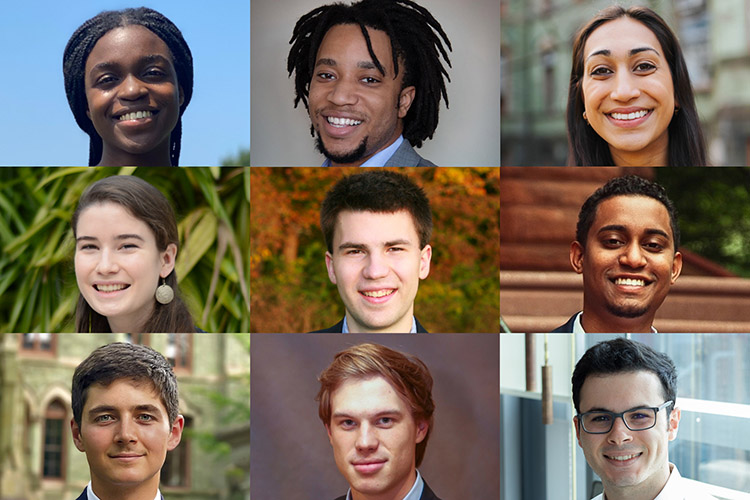
caption: Left to right from the top: senior Ayina Anyachebelu, 2020 graduate Michael John, senior Anjali Mahajan, 2020 graduate Sabine Nix, senior Robert Novak, 2021 graduate Trevor Núñez, senior Andrew Orner, senior Lawrence Phillips, and 2019 graduate Mark Rinder.

Five University of Pennsylvania seniors and four recent alumni have each received a 2022 Thouron Award to pursue graduate studies in the United Kingdom.

Each scholarship recipient receives tuition for as long as two years, as well as travel and living stipends, to earn a graduate degree there.

Established in 1960 and supported by gifts by the late John Thouron and his wife, Esther du Pont Thouron, the Thouron Award is a graduate exchange program between Penn and U.K. universities that aims to improve understanding and relations between the two countries.

Penn’s nine 2022 Thouron Scholars are:

Ayina Anyachebelu, from Lagos, Nigeria, is a senior in the Huntsman Program in International Studies and Business, in the College of Arts and Sciences and the Wharton School, majoring in business strategy and international studies. As a researcher for the City Climate-Resilient Infrastructure Financing Initiative through the Penn Institute for Urban Research (IUR), she helped develop financing strategy recommendations for the new transportation system in Freetown, Sierra Leone. She has been an advocate for clean energy equity, working with Penn Sustainability and the Netter Center for Community Partnerships to finance solar installations at Philadelphia schools with integrated energy education programs. She was also the chair of the Wharton Undergraduate Research Board, a founding member of the advocacy group Black Huntsman, and was a member of Penn Student Government for four years. She was a Perry World House Student Fellow, a Penn IUR Fellow in Urban Leadership, and a Kleinman Energy Fellow. Ms. Anyachebelu plans to pursue a master’s degree in geospatial sciences at University College London.

Michael John, from Boston, graduated in 2020 with a bachelor’s degree in Africana studies with a minor in political science from the College of Arts and Sciences. He has been working as a strategy consultant at the nonprofit Bridgespan Group, supporting non-profits, investors and philanthropists to accelerate social change. At Penn, Mr. John was a University Council undergraduate appointee to the Social Responsibility Advisory Committee and the Committee on Diversity and Equity. He was a WISE fellow at the Wharton Social Impact Initiative and conducted research in the department of political science. An undergraduate fellow at the Andrea Mitchell Center for the Study of Democracy, the Wolf Humanities Center, and the Center for the Study of Ethnicity, Race and Immigration, Mr. John used his academic research to deconstruct legacies of racial exploitation in former colonial territories, examining their relevance for contemporary democracies. Mr. John plans to pursue a master’s degree in post-colonial studies and international history.

Anjali Mahajan, of Jackson, Tennessee, is a senior majoring in political science with minors in French and chemistry in the College of Arts and Sciences. She is interested in social policy, medicine, and political reform. She focuses on health and social justice through her research on Philadelphia’s low-barrier substance-use treatment centers and sexual-wellness programs, her engagement with organizations fighting for community-centered justice through harm reduction, and her honors thesis on the political barriers to decriminalizing sex work. Ms. Mahajan was awarded a 2020 United Nations Academic Impact Millennium Fellowship for her work creating a Penn student advocacy group supporting the UNAIDS Initiative to end HIV/AIDS as a public health threat. She was a 2020-2021 Amgen Scholar at the National Institutes of Health, where she worked on projects related to disparities in tobacco-related research and vaccine hesitancy. Ms. Mahajan plans to pursue a master’s degree in comparative social policy to study the political economy of harm reduction.

Sabine Nix, from South Salem, New York, graduated in 2020 with a bachelor’s degree in earth science from the College of Arts and Sciences. She is interested in using remote sensing and geospatial technology to study environmental change as it relates to human well-being. Ms. Nix currently is working as an analyst at Spark Climate Solutions. Previously she worked as an Adirondack conservation associate at the Nature Conservancy and as an analytics fellow at the nonprofit Project Regeneration, and contributed to a book on climate solutions. She also completed three terms with the NASA DEVELOP National Program, where she used satellite remote sensing to study drought impacts in Kenya, the urban heat island effect in Huntsville, Alabama, and flood vulnerability in West Virginia. While at Penn, she was a University Scholar and a member of Epsilon Eta, and worked as a teaching assistant and tutor in biology. She completed two independent research projects studying land use and land-cover change along the Interoceanic Highway in Peru and urban tree cover change in Philadelphia parklands. Ms. Nix plans to pursue a master’s degree in geography or the environment.

Robert Novak, from Chatham, New Jersey, is a senior a majoring in biochemistry, biophysics, and physics and is submatriculating for a master’s degree in chemistry, as part of the Roy and Diana Vagelos Scholars Program in the Molecular Life Sciences in the School of Arts and Sciences. He is a member of the Eisenlohr Laboratory at the Children’s Hospital of Philadelphia Research Institute, where he studies endogenous Major Histocompatibility Complex Class II antigen processing and presentation, as well as monoclonal antibody development. Mr. Novak has been the chief trip leader of the Penn Outdoors Club for two years and is the current vice president of the Penn Bucket club. His academic distinctions at Penn include the Vagelos Challenge Award and Phi Beta Kappa. Mr. Novak plans to pursue a master’s in physics at the University of Cambridge.

Trevor Núñez, of Brooklyn, New York, graduated in 2021 with a bachelor’s degree in political science with a concentration in American politics from the College of Arts and Sciences. He has conducted research on protest and social change under Daniel Gillion, the Julie Beren Platt and Marc E. Platt Presidential Distinguished Professor of Political Science. He was an intern with the U.S. Congress through the Congressional Black Caucus Foundation and was a 2021 Advantage Testing Foundation TRIALS Scholar. Interested in understanding conflict and restorative justice, Mr. Núñez studied African political thought at the University of Cape Town in South Africa and was an Encompass Fellow through Penn Hillel, visiting Israel and the Palestinian territories. Identifying as a first-generation, low-income student, he has been a volunteer for the past four years with Prep for Prep, teaching leadership and current events. A lifelong dancer, he was a member of the Penn student Latin dance troupe Onda Latina. Mr. Núñez plans to study human migration with a focus on social integration.

Andrew Orner, from Darien, Connecticut, is a senior double majoring in economics and political science with a concentration in international relations, with a minor in Hispanic studies, in the College of Arts and Sciences. He is a Perry World House Undergraduate Fellow and a Benjamin Franklin Scholar and has worked as an intern project leader at the Think Tanks and Civil Societies Program at the Lauder Institute. In summer 2021, Mr. Orner interned at the National Defense University’s Institute for National Strategic Studies and completed the Hertog Foundation War Studies Program Fellowship. In addition, he is a four-year member of Penn’s men’s varsity lightweight rowing team. Mr. Orner plans to pursue a master’s degree in war studies at King’s College London.

Lawrence Phillips, of Harrison, New York, is a senior majoring in physics and philosophy in the College of Arts and Sciences. He is a member of Penn’s varsity lightweight rowing team. A Benjamin Franklin Scholar, he conducts computational astrophysics research under associate professor James Aguirre. Mr. Phillips is the founder and director of the Penn Physics Outreach Program, a Netter Center student organization to facilitate after-school physics experiments in West Philadelphia high schools. He was project chair for the Student Committee on Undergraduate Education in Penn Student Government and was housing manager for Penn’s Kappa Sigma fraternity chapter. Mr. Phillips plans to pursue a master’s degree in the philosophy of physics.

Mark Rinder, of Morganville, New Jersey, graduated in 2019 from the Huntsman Program in International Studies and Business in the College of Arts and Sciences and the Wharton School, with concentrations in statistics and business economics and public policy and a minor in Latin American and Latino studies. He currently works at Deloitte Consulting, where he supports the international development organizations and technology strategy practices. While at Penn, Mr. Rinder was president of 180 Degrees Consulting, leading pro bono projects for social enterprises and nonprofits. After graduating, Mr. Rinder was a Fulbright Binational Business Program grantee in Mexico, conducting research on innovation and entrepreneurship in Latin America at Endeavor, a nonprofit promoting high-impact startup networks. Mr. Rinder plans to pursue a master’s degree in development studies at the London School of Economics.

The Center for Undergraduate Research and Fellowships serves as Penn’s primary information hub and support office for students and alumni applying for major grants and fellowships, including the Thouron Award.

Features

Cascode, Art Installation That Visualizes Data, Commissioned for Amy Gutmann Hall

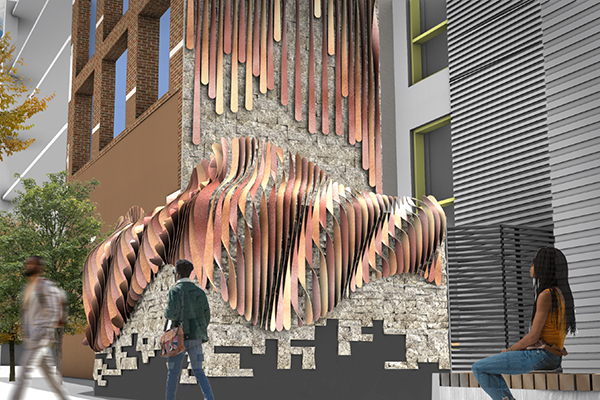
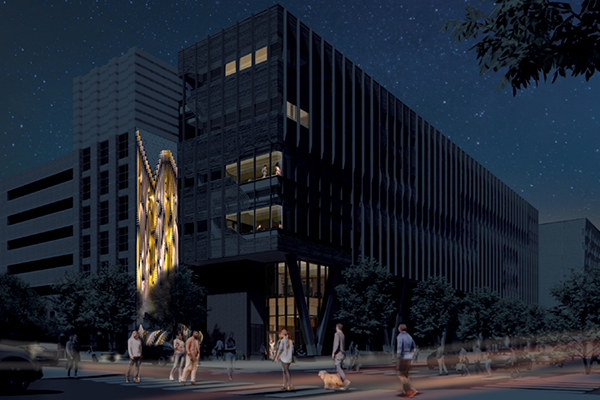
caption: Cascode public art project for Amy Gutmann Hall. Concept rendering by Michael DiCarlo for Eto Otitigbe Studio.

Located at the northeast corner of 34th and Chestnut Streets, the forthcoming Amy Gutmann Hall will serve as the hub for Penn Engineering’s IDEAS Initiative, a wide-ranging investment in data science: the field of research that analyzes and combines massive quantities of digital information to make otherwise impossible discoveries, models, and predictions.

Penn Engineering has now awarded polymedia artist Eto Otitigbe a commission to create Cascode, a landmark public art installation that embodies this initiative. Measuring approximately 60 feet high, Cascode will be installed on the facade of the parking garage adjacent to Gutmann Hall, which is slated for completion in 2024.

As part of the Philadelphia Housing Development Corporation’s (PHDC) Percent for Art program, Cascode will encompass a mix of organic forms, natural materials, and data-informed design to represent the intersection of environment, health, community and data, and its collective impact on West Philadelphia residents.

Mr. Otitigbe is a multidisciplinary artist interested in recovering buried narratives and giving form to the unseen, and his practice embodies sculpture, performance, installation, and public art. Collaborating with Mr. Otitigbe, designer Michael Di Carlo will provide Cascode’s computational design.

For Cascode, Mr. Otitigbe envisions a piece that translates hard data into interactive artwork that is representative and inclusive of the West Philadelphia community. The piece will be constructed of materials and forms that both parallel and deviate from Gutmann Hall’s proposed architecture—natural stones and metals in earth tones that play well in natural light, paired with LED lighting that lends itself to nighttime activation.

A large part of the Cascode project’s design includes an online component in which a wide range of stakeholders—community members, students and faculty occupying Gutmann Hall, and Penn at large—can respond to engaging prompts that provide data, which will, in turn, be used to inform Cascode’s final form. In all stages of Cascode’s development and launch, Atlanta-based arts nonprofit Dashboard will manage and produce public programming and engagement activities.

“I’m excited to apply the patterns found in nature and in numbers to artwork that will endure,” said Mr. Otitigbe. “Cascode speaks directly to the work being done within the walls of Gutmann Hall: harnessing data science to build equity, ensure collective wellbeing and maintain environmental stewardship. I am so honored to have been selected to create this monumental installation on Penn’s campus.”

Adapted from a Penn Engineering news release published February 23, 2022. 

caption: Cascode public art project for Amy Gutmann Hall. Concept rendering by Michael DiCarlo for Eto Otitigbe Studio.

Events

The Stephen A. Levin Family Dean’s Forum: Crazy Determined Asians

On March 17, Filmmaker Jon M. Chu joins David L. Eng to talk about artistic passion and the power of representation. Mr. Chu’s blockbuster Crazy Rich Asians, the first film by a major Hollywood studio to feature an all-Asian cast in more than 25 years, is a visual feast that helps to counter racial animus at a time when violence against AAPI communities is on the rise. 

The talk will take place from 4:30-6 p.m. at Penn Museum. For more information and to register, visit https://tinyurl.com/LevinForum.

The Wharton Future of Work Conference

Wharton Future of Work logo

On April 7, Wharton People Analytics will host the inaugural Wharton Future of Work conference. The conference is virtual.

The slate of speakers include Microsoft chairman and CEO Satya Nadella in conversation with the Saul P. Steinberg Professor of Management Adam Grant; growth mindset pioneer Carol Dweck in conversation with Rosa Lee and Egbert Chang Professor Angela Duckworth; and organizational psychologist and founder of APS Intelligence John Amaechi.

For more information, visit https://wpa.wharton.upenn.edu/conference/.

Upcoming Programs at the Penn Museum

CultureFest! Nowruz

Presented in partnership with the Drexel University Persian Students Association and the University of Pennsylvania’s Middle East Center, the Penn Museum will mark the start of spring with CultureFest! Nowruz, Saturday, March 19, 2022, from 11 a.m.-4 p.m. Part of the museum’s family-friendly CultureFest! series, Nowruz, or “new day” in Persian, is a festival that celebrates spring, rebirth, and good luck in the Iranian New Year, also known as the Persian New Year.

“Nowruz is a cherished holiday, celebrated for centuries by Iranians and Persianate communities throughout the world on the first day of spring,” John Ghazvinian, the executive director of Penn’s Middle East Center said. “The Middle East Center is proud to co-sponsor this program, introducing the public to the many customs and traditions that surround the new year’s celebration.”

Despite its roots in Zoroastrianism, one of the world’s oldest monotheistic religions, Nowruz is observed by nearly 300 million people in the Middle East, Central, and South Asia; southeastern Europe; Africa; and other locations. CultureFest! Nowruz activities at the Penn Museum include:

caption: Silk Road Dance Company shown at the D.C. Capitol Fiesta Asia. Photo by Angela N.

  • Live performance from the Silk Road Dance Company
  • Middle Eastern drumming workshops with Arabic, Armenian, and Turkish music
  • Tours of the Middle East Galleries with a Global Guide from Iraq or Syria
  • A “Daily Dig” (15-minute pop-up talk about an artifact) in the Middle East Galleries
  • “Chaharshanbe Suri” fire jumping with the Drexel Persian Students Association
  • Craft workshops, including the “Haft seen,” an arrangement of seven symbolic items traditionally displayed at Nowruz, “egg” decorating, and “goldfish” designs
  • Storytelling with Arsia Rozegar, author of Shahnameh for Kids
  • A Persian bazaar

CultureFest! is one of the many ways that the Penn Museum brings communities together to explore vibrant cultures and rich traditions around the world,” said Tena Thomason, Penn Museum’s associate director of public engagement, who works with community partners to plan the annual series. “We are thrilled to develop CultureFest! Nowruz with our friends at Penn’s Middle East Center and the Drexel University Persian Students Association. It’s a meaningful way to celebrate new beginnings.”

All CultureFest! Nowruz activities are included with Penn Museum admission. Upcoming CultureFest! events include Lamba (a dance performance practiced in West Africa) this June in collaboration with the Dunya Performing Arts Company, which is marking its 30th anniversary; Dia de Los Muertos (Day of the Dead) in October; and Lunar New Year every January.

Heritage in Our Hands: UNESCO 50 Years Later Exhibit 

Curated by three undergraduate University of Pennsylvania students from across the tri-state region, Heritage in Our Hands: UNESCO 50 Years Later is an interactive exhibition that introduces multiple perspectives on cultural preservation since the 1972 World Heritage Convention. It opens Saturday, March 26, 2022, at the Penn Museum.

Through nine objects on display in the Idea Lounge, a space on the Penn Museum’s upper level designated for student-curated shows, Heritage in Our Hands: UNESCO 50 Years Later uncovers the complex histories behind five UNESCO World Heritage Sites, and the ways in which various approaches to heritage—including ever-changing definitions—can complement or compete with one another. It also highlights how stakeholders have a notable impact on traditions, preservation, and tourism. Philadelphia’s own Independence Hall, which was added to the list of UNESCO World Heritage Sites in 1979, marks an easily recognizable entry point into the exhibition. From there, Heritage in Our Hands guides Penn Museum visitors through site case studies, such as: 

Ahwar of Southern Iraq: Designated a UNESCO World Heritage Site in 2016, it is represented through a cylinder seal from Ur in 2700 BCE, drawing attention to risks to the area’s biodiversity and natural resources that have been essential to local peoples’ ways of life for thousands of years.

Ban Chiang, Thailand: For centuries, craftspeople have produced metals and ceramics, but today, shared local interests foster tourism and community-informed preservation efforts. A UNESCO Site since 1992, it is symbolized in the exhibition by a ceramic crucible and bronze bangles.

Qhapaq Ñan, the Inka Road: This vast transportation system is characterized through a llama offering vessel and Spondylus shell from Peru. Throughout history, Inka officials, traders, messengers, and armies used these roads, but today, everyone uses them—from local herders to backpacking tourists.

Liverpool, England: The Everton Football Club was stripped of its UNESCO World Heritage Site status in 2021. A synthetic leather football represents how communities redefine their own heritage, as the local government approved the construction of a new stadium for the club despite disagreements with UNESCO.

“These incredibly diverse sites illustrate some of the many ways meaning, value, or interest may become increasingly complex or shift over time,” explained Cindy Srnka, an undergraduate from Jackson, New Jersey, majoring in Near Eastern languages & civilizations, and one of the three student curators.

For the last seven months, Ms. Srnka; Ashley Fuchs, a senior double-major in classical studies and political science from Stony Brook, New York; and Jack Clark, a senior double-major in classical studies and anthropology, from Hershey, Pennsylvania, have worked with Penn Museum staff to develop Heritage in Our Hands.

“Through our exhibition, we hope that museum visitors critically engage with UNESCO and consider how different conceptions of heritage are relevant to their own lives and communities,” Ms. Fuchs added.

In the exhibition, the student curators point out that although the current UNESCO model was helpful in the last 50 years, today it represents an inflexible design rooted in stringent criteria.

“The UNESCO model is not a unanimous success. This is evident in the conflicting sites outlined in the exhibition,” said Mr. Clark. “Local communities are not always afforded a seat at the table, which can devalue and take away a sense of shared-ownership.”

Providing an interactive element with the goal of getting people to start thinking about their own heritage, the exhibition asks visitors to share a “heritage site” or a place that is meaningful to them—whether the Grand Canyon or a favorite neighborhood park.

Heritage in Our Hands: UNESCO 50 Years Later will be on display through fall 2022. Access is included with Penn Museum admission.

Penn Museum-Barnes Foundation Joint Ticketing

caption: Jack Clark, Ashley Fuchs, and Cindy Srnka, student curators of Heritage in Our Hands, examine a Spondylus Shell from Peru. Photo by Colleen Connolly.

PennCard holders who visit the Penn Museum until May 15, 2022 can enjoy discounted tickets to the Barnes Foundation’s new exhibition Water, Wind, Breath: Southwest Native Art in Community. Co-curated by the Penn Museum and New Mexico’s Museum of Indian Arts and Culture, Water, Wind, Breath: Southwest Native Art in Community is a major exhibition at the Barnes Foundation showcasing objects that Albert Barnes collected in Santa Fe and Taos, New Mexico, as well as works by contemporary Native American artists.

In the southwest, the practices of creating pottery, textiles, and jewelry hold cultural values that sustain health and well-being—despite centuries of hardship and colonization. The Barnes Foundation’s new exhibition, Water, Wind, Breath: Southwest Native Art in Community, examines these histories while celebrating Po-wa-ha (water-wind-breath), a term used by the Tewa Pueblos to describe the flow of energy that animates all existence and the practices that nourish life.

Featuring dozens of historic pieces made by Pueblo and Diné (Navajo) people of New Mexico and Arizona, accompanied by work of contemporary Native artists, the exhibition also includes artifacts from the Penn Museum that date to the 18th century.

Through a joint-ticketing opportunity, PennCard holders who visit the Penn Museum until May 15, 2022 can present their tickets to the Barnes Foundation to receive $5 off general admission.

PennCard holders receive free admission to the Penn Museum, where they can experience its Native American Voices exhibition—a living tapestry of nations with distinct histories through interactive digital channels that share first-person perspectives.

Water, Wind, Breath: Southwest Native Art in Community is on view at the Barnes through May 15, 2022.

Online Courses for Adult Learners

The Penn Museum has announced that University of Pennsylvania professors and graduate students will continue teaching a series of virtual archaeology and anthropology courses for lifelong learners. When the Penn Museum building closed for nearly 20 weeks in 2020 due to the pandemic, the learning and public engagement team quickly moved its tours and events online, enabling the museum to continue serving the community. To date, nearly 90,000 attendees have participated in the Penn Museum’s virtual offerings.

One pilot program is a month-long virtual evening course designed for adults—with no formal education or background required—called the Deep Dig. Through highly engaging weekly class meetings, online archival reviews, and videos, the Deep Dig encourages adult-learners to “dig a little deeper” into a range of subjects related to the Penn Museum’s collections and research.

From March 2020 to date, the Penn Museum has offered 18 Deep Dig courses, which have generated nearly 600 registrations from 29 states (including Pennsylvania, California, New York, and Virginia), as well as two other countries (Canada and Turkey). Of those students, 28% have taken two or more Deep Dig classes, and 23 need-based scholarships have been awarded.

Deep Dig topics have included “Archaeology in Philadelphia,” “Understanding Greek Vases,” “Southwest Textiles,” and “Unpacking the Stories of Troy and Homer.”

Sandra Portnoy has taken every Deep Dig class, starting with prominent archaeologist Dr. Brian C. Rose’s March 2020 course “Rome, Pompeii, and Herculaneum.” In some cases, Ms. Portnoy said, she knew about the subject matter, but at other times, her curiosity compelled her to pursue new subjects, such as the archaeology of gardens.

“I enjoyed having something to look forward to on Thursday nights,” Ms. Portnoy said. “This was especially important when we were all quarantining. Now that things have opened up, I continue to sign up for the courses, knowing that if I need to miss a session, I can view the video later.”

Curt Travers, a returning Deep Dig student, said the virtual classes are “one of the only good things to arise from the pandemic.” He added, “It is the opportunity to learn from world-class historians, archaeologists, and anthropologists. The live, interactive format allows me to travel the world and through time without ever leaving my home office. The curricula never disappoint, and I appreciate the passion these experts bring to their research.” Mr. Travers, who has attended nine Deep Dig courses, considers them the highlight of his week. “I can only marvel at how rapidly the social sciences are advancing and this offers me a chance to keep up.”
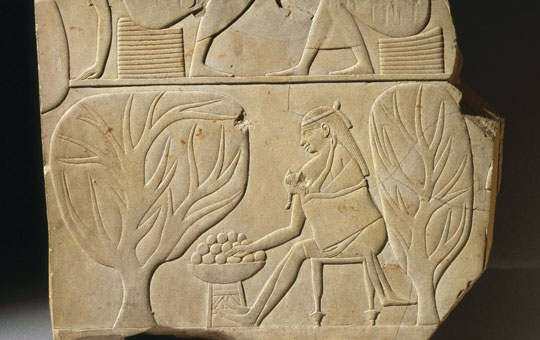
caption: Tomb relief fragment from Ancient Egypt. The Real Housewives of Ancient Egypt is a Deep Dig course at Penn Museum.

The spring semester’s new set of Deep Dig classes blends popular culture with archaeology, widening its appeal. On Thursday, March 3, the “Real Housewives of Ancient Egypt” course began.

Led by Shelby Justl, a lecturer at Penn who teaches workshops at the Penn Museum, the online course explores women’s contradictory roles: goddess, pharaoh, priestess, landowner, mother, wife, and more. It delves into the political and economic rights of ancient Egyptian women—from being able to divorce to disowning their adult children for disobedience. The class will also examine ancient Egyptian letters, romantic poetry, the archaeology of women’s tombs, and artifacts used by the women in ancient Egypt—revealing interpretations of ancient sexuality, gender stereotypes, as well as the social conditions of the time.

Another course, “Uncovering Archaeology Under the Waves,” explores underwater archaeology, including how artifacts are retrieved and studied, plus a wealth of archaeological data, from sunken cities to submerged World War II planes.

In “Cultural Heritage and Contemporary Issues,” thought leaders and advocates from the Penn Cultural Heritage Center (CHC) will guide adult-learners to examine a range of social issues that emerge from cultural heritage protection and preservation. Each week’s class will focus on a different subject—from how cultural heritage and human rights have become intertwined, to the responsibilities of academics and museums. It will also discuss the future of cultural heritage policy.

Lifelong learner Anna Hadgis said she has expanded her knowledge of archaeology, history, anthropology, and art, thanks to the Penn Museum’s online courses.

“Renowned archaeologists, curators, and academicians specializing in global research offer revealing insights into recent endeavors and expeditions,” Ms. Hadgis said. “These authorities encourage participants to pose questions in the chat and include links to current articles and titles for further research. I eagerly look forward to my monthly dose of thought-provoking Deep Digs with the Penn Museum.”

The cost for the Deep Dig is $175 for the general public or $125 for Penn Museum members, opening up direct access to internationally recognized archaeologists and Ivy League educators. A number of need-based scholarships are set aside for each course and available by contacting events@pennmuseum.org.

Penn’s 30x30 Challenge in April

Spring is around the corner, and it’s time to get back outside! Join Penn’s 30x30 Challenge and challenge yourself to spend at least 30 minutes outdoors each day during the month of April. This month-long challenge is supported by Penn Sustainability, Wellness at Penn, and Nature Rx.

Did you know that Americans spend approximately 90% of their time indoors, according to the EPA? Over the last decade, researchers have been documenting what many of us know intuitively:  that nature is good for our health and well-being. Regularly immersing yourself in a natural setting like a park, forest, or field can reduce stress while boosting immunity, energy levels, and creativity.  The 30x30 Challenge is an effort to encourage the Penn community to get outside, learn about local ecology, and appreciate the beauty of nature. 

The challenge is open to all Penn faculty, staff, and students, and runs from April 1 to April 30. To sign up, please fill out the registration form here, and if you have access to Virgin Pulse, you can sign up directly on their platform here. As a reminder, in order to earn Be In the Know Bonus Action points, you will need to:

  • Sign up for the challenge
  • Attend at least one qualifying 30x30 event
  • At the end of April, sign a pledge that you completed the challenge

Please let us know if you have any questions, and we’re looking forward to spending some quality time outdoors!

—Penn Sustainability

Update: March AT PENN

Children’s Activites

Penn Museum

Online events. Info: https://www.penn.museum/calendar.

15        At-Home Anthro Live: Celebrate the Spring Equinox; 1 p.m.

18        Virtual Passport Day: Celebrate Across Asia; 11 a.m.-2 p.m.

22        At-Home Anthro Live: Star Navigation; 1 p.m.


Conferences

17        Ninth Annual Penn Law Entertainment and Sports Law Symposium; exploring cutting-edge topics in entertainment and sports law in a rapidly changing environment for both; 9 a.m.-6 p.m.; room 100, Golkin Hall, and Zoom webinar; register: https://tinyurl.com/esls-symposium-2022 (Penn Carey Law School).


Exhibits

Penn Museum

In-person and online events. Info: https://penn.museum/calendar.

18        Virtual Global Guide Tour: Asia Galleries; 2:30 p.m.

19        Middle East Galleries Tour; 11 a.m.

            Global Guide Tour: Middle East Galleries; 2:30 p.m.

20        Rome Gallery Tour; 11 a.m.

            Global Guide Tour: Mexico & Central America Gallery; 2:30 p.m.


Films

17        Cursed Be Your Name, Freedom: Rock and Aids in 1990s Cuba; includes discussion with director Vladimir Ceballos; 5:15 p.m.; room 401, Fisher-Bennett Hall (Cinema Studies, CLALS).

18        The Donut King; includes discussion with director Alice Gu; 5 p.m.; room 111, Annenberg School; register: https://upenn.co1.qualtrics.com/jfe/form/SV_0iVWQrpfhhODW74 (Asian American Studies).


Penn Live Arts

In-person screenings at Montgomery Theater, Annenberg Center, and online screenings. Info: https://pennlivearts.org/events/.

17        La Casa de Mama Icha; 7 p.m.

18        Chèche Lavi; 7 p.m.

19        Mija; 7 p.m.


Fitness & Learning

22        Master in Law Information Webinar for General Audiences; will give an overview of the Master in Law (ML) degree, application instructions, highlight various courses of study available, and provide insight into the student experience as an ML degree candidate; noon; Zoom webinar; register: https://tinyurl.com/ml-info-mar-22 (Penn Carey Law School).


Center for Undergraduate Research and Fellowships (CURF)

Zoom webinars. Info: https://www.curf.upenn.edu/curf-events.

22        Schwarzman Scholars Program Information Session; 5 p.m.


Graduate School of Education (GSE)

Unless noted, online events. Info: https://www.gse.upenn.edu/news/events-calendar.

15        Coffee Break with ISHD/Counseling Team; for faculty and staff; 9:30 a.m.; GSE tent.

            Submatriculation Information Session; noon; Amado Recital Room, Irvine Auditorium.

17        Monthly Wellness Walk - St. Patrick's Day; for faculty and staff; noon; meet at Palestra.

18        Effective Communication; for faculty and staff; 12:30 p.m.

22        Fostering Positive Attitudes and Embracing Change; for faculty and staff; 11 a.m.


LGBT Center

Unless noted, in-person events at LGBT Center. Info: https://www.vpul.upenn.edu/secure/calendar/host/LGBT-Center/24.

18        Chinese Queer Women’s Groups; 4 p.m.

20        QPenn Kickoff: Opening Speaker and Mixer; 4-6:30 p.m.

21        Lambda Grads Open Forum; 5 p.m.; Zoom webinar.

            RP&P Event; 5:15 p.m.

            Queer Interfaith Game Night; 7-9 p.m.

22        Pocket Sewing Workshop; 2 p.m.

            “I Am” Collective Workshop; 7 p.m.


Morris Arboretum

In-person events. Info: https://www.morrisarboretum.org/events_special.shtml#simple3.

17        Pruning for the Homeowner; Vince Marrocco, Morris Arboretum; 9 a.m.-noon.

19        Propagating Ferns; Kyra Matin, Morris Arboretum; 10:30 a.m.


On Stage

Penn Live Arts

Info and tickets: https://pennlivearts.org/events/.

17        Penn Players: Small Mouth Sounds; bi-annual show from an esteemed Penn theater group asks how we address life’s biggest questions when words fail us; 8:30 p.m.; Harold Prince Theater, Annenberg Center. Also March 18, 8:30 p.m.; March 19, 2:30 p.m.


Readings & Signings

16        Seeing Human Rights: Video Activism as a Proxy Profession; Sandra Ristovska, University of Colorado Boulder; 12:30 p.m.; Zoom webinar; join: https://upenn.zoom.us/j/5172747925%25C2%25A0 (Annenberg School).

            The Afghanistan Papers; Craig Whitlock, Washington Post; 5 p.m.; room TBA, Annenberg Public Policy Center; register: https://www.eventbrite.com/e/274213288327 (Annenberg Public Policy Center). 

18        Yellow Star, Red Star: Holocaust Remembrance After Communism; Jelena Subotic, Georgia State University; noon; Forum Room, PCPSE (Russian & East European Studies).


Kelly Writers House

Hybrid events at Arts Café, Kelly Writers House, and YouTube livestream. Info: http://writing.upenn.edu/wh/calendar/0322.php.

16        Black Radical Comics; Ben Passmore, artist; 6 p.m.

17        Diasporic Poetics; Timothy Yu, University of Wisconsin-Madison; Josephine Park and Al Filreis, English; noon.

21        Live at the Writers House; six writers from the class of 2022; 6 p.m.


Special Events

19        CultureFest! Nowruz; celebrate the Persian New Year with friends and family and learn how the holiday is observed by people in the Middle East, Asia, Africa, and beyond; 11 a.m.-4 p.m.; Penn Museum; info: https://www.penn.museum/calendar/1116/culturefest-nowruz (Penn Museum).


Talks

15        Humans and Alcohol: The Archaeology of a Deeply Entangled Relationship; Michael Dietler, University of Chicago; 6:15 p.m.; Penn Museum and online webinar; register: https://www.penn.museum/calendar/1147/humans-and-alcohol (Penn Museum).

16        The Entropy of Hawking Radiation; Juan Maldacena, Institute for Advanced Study; 3:30 p.m.; room A4, DRL, and Zoom meeting; join: https://tinyurl.com/maldacena-talk-mar-16 (Physics & Astronomy).

            The Preservation of Racial Order Through Legal Transformations; Michele Goodwin, UC Irvine; 5:30 p.m.; Class of 1978 Orrery Pavilion, Van Pelt Library; register: https://tinyurl.com/goodwin-talk-mar-16 (Africana Studies).

17        Special Briefing on Work from Home: What it Means for State and Local Economies and Revenues; panel of speakers; 11 a.m.; Zoom webinar; register: https://tinyurl.com/iur-talk-mar-17 (Penn Institute for Urban Research).

            Estimating the Effects of Shrinking the Criminal Justice System on Criminal Recidivism; Charles Loeffler, criminology; noon; room 200, Education Building (Criminology).

            Androgen Receptor Splice Variants; Cynthia Sprenger, University of Washington; 3 p.m.; Zoom webinar; join: https://pennmedicine.zoom.us/j/95935762965 (Center of Excellence in Environmental Technology).

            When Homeostatic Responses Become Pathologic: Mechanisms of Type 2 Immunity in the Airway; Maya Kotas, UC San Francisco; 4 p.m.; Zoom webinar; join: https://tinyurl.com/nelson-talk-jan-13 (Penn-CHOP Lung Biology Series).

            Crazy Determined Asians; Jon Chu, director of Crazy Rich Asians; 4:30 p.m.; Harrison Auditorium, Penn Museum; register: https://tinyurl.com/chu-talk-mar-17 (Stephen A. Levin Family Dean’s Forum).

18        Researching Human Beliefs and Perceptions of AI Decision-Making; Sonia Shaikh, Annenberg School; noon; Zoom webinar; register: https://tinyurl.com/shaikh-talk-mar-18 (Annenberg School).

            Wars in the Workshop: Digitizing Manuscript Rolls; Natasha Hodgson, Nottingham Trent University; 1 p.m.; Zoom webinar; register: https://libcal.library.upenn.edu/calendar/kislak/WarsInTheWorkshop (Schoenberg Institute for Manuscript Studies).

            Computational Image Analysis For Individualized Surgical Treatment Planning of Bicuspid Aortic Valves; Alison Pouch, radiology and bioengineering; 2 p.m.; PICS Large Conference Room, 3401 Walnut St. (Penn Institute for Computational Science).

22        Agile Maneuver with Under-Actuated Millirobots; Ronald S. Fearing, UC Berkeley; 10 a.m.; Zoom webinar; info: peterlit@seas.upenn.edu (Mechanical Engineering & Applied Mechanics).

            Working with Rivers; Annea Lockwood, Vassar College; 5:15 p.m.; room 101, Lerner Building (Music).

            Distinguished Lecture in African Studies; Wole Soyinka, poet and Nobel laureate; 5:30 p.m.; Harrison Auditorium, Penn Museum; 5:30 p.m.; register: https://tinyurl.com/soyinka-talk-mar-22 (Africana Studies).


Chemistry

Unless noted, in-person events at Carol Lynch Lecture Hall, Chemistry Complex. Info: https://www.chem.upenn.edu/events.

15        Thermodynamic and Mechanistic Studies of CO2 Reduction Catalysts; Caroline Saouma, University of Utah; noon.

16        Reimagining Druggability using Chemoproteomic Platforms; Dan Nomura, UC Berkeley; noon; Zoom webinar.


Cinema Studies

Unless noted, in person events at room 401, Fisher-Bennett Hall. Info: https://cinemastudies.sas.upenn.edu/events.

16        On Escapism: Redemptive Readings of a Deeply Disparaged Pleasure; Caetlin Benson-Allott, Georgetown University; noon; room 330, Fisher-Bennett Hall.

            Flipping the Script | Making Documentaries; Bedatri D. Choudhary, documentary filmmaker; 7 p.m.

18        Flipping the Script | Community Organizing & Film Festivals; Marángeli Mejia-Rabell, Philadelphia Latino Film Festival; noon.

21        Flipping the Script | Film Education; Yuby Hernandez, Ghetto Film School, and Sharese Bailey-Bullock, Overstand Consulting; 7 p.m.


Computer & Information Science (CIS)

Hybrid events at various locations and Zoom webinars. Info: https://www.cis.upenn.edu/events/.

16        Principled Algorithm Design in the Era of Deep Learning; Surbhi Goel, Microsoft Research; 3:30 p.m.; room 307, Levine Hall.

17        Learning-Based Program Synthesis: Learning for Program Synthesis and Program Synthesis for Learning; Xinyun Chen, UC Berkeley; 3:30 p.m.; Zoom webinar.


Penn Dental

Zoom webinars. Info: https://www.dental.upenn.edu/news-events/events/.

17        Trends Between Periodontal Disease and Vascular Calcification in Undiagnosed Type II Diabetes Mellitus; Adeyinka Dayo, oral medicine; noon.


Economics

Unless noted, in-person events at room 101, PCPSE. Info: https://economics.sas.upenn.edu/events.

16        The Macroeconomics of Intensive Agriculture; Hannes Malmberg, University of Minnesota; 4 p.m.

17        Social Networks with Unobserved Links; Xun Tang, Rice University; 3:30 p.m.

21        Constrained Classification and Policy Learning; Toru Kitagawa, Brown University; 3:30 p.m.

22        Growing a Mega City; Xuequan Elsie Peng, economics; noon; room 202, PCPSE.


GRASP Lab

In-person events at Wu and Chen Auditorium, Levine Hall. Info: https://www.grasp.upenn.edu/events/month/2022-03/.

16        The Reasonable Effectiveness of Dynamic Manipulation for Deformable Objects; Shuran Song, Columbia University; 3 p.m.; room 512, Levine Hall.

18        Observing, Learning and Executing Fine-Grained Manipulation Activities; Gregory Hager, Johns Hopkins University; 10:30 a.m.


Historic Preservation

Online and in-person events. Info: https://www.design.upenn.edu/historic-preservation/events.

17        Excavating and Re-Creating Color and Texture at Stenton; Catherine Myers, Myers Conservation; noon; upper gallery, Meyerson Hall.


Mathematics

Locations vary. Info: https://www.math.upenn.edu/events.

15        Metric Growth Dynamics in Liouville Quantum Gravity; Hugo Falconet, Courant Institute; 3:30 p.m.; room 4C8, DRL.

16        p-Adic Geometry and Problems in Algebra; David Harbater, math; 3:45 p.m.; location TBA.


Medical Ethics & Health Policy

Online and in-person events. Info: https://medicalethicshealthpolicy.med.upenn.edu/events.

15        COVID-19 Vaccine Mandates in Solid Organ Transplant Candidates; Aliza Narva, HUP; noon; Zoom webinar.


Sociology

Unless noted, hybrid events at room 367, McNeil Building, and Zoom webinars. Info: https://sociology.sas.upenn.edu/events.

16        Latino Elites as Ethnoracial Capitalists; Jody Agius Vallejo, University of Southern California; noon; room 150, McNeil Building.

17        Understanding Subjective Inequality in China; Xi Song, sociology; 9:30 a.m.

18        His and Hers Earnings Trajectories: Analyzing Links Between Husbands' and Wives' Long-Term Earnings Patterns; Allison Dunatchik, sociology; noon.


More events can be found in the March AT PENN calendar, which is now online. To submit an event for a future AT PENN calendar or update, email almanac@upenn.edu.
Crimes

Weekly Crime Reports

University of Pennsylvania Police Department Crime Report

Below are the Crimes Against Persons, Crimes Against Society and Crimes Against Property from the campus report for February 28-March 6, 2022. View prior weeks’ reports. —Ed.

This summary is prepared by the Division of Public Safety and includes all criminal incidents reported and made known to the University Police Department for the dates of February 28-March 6, 2022. The University Police actively patrol from Market St to Baltimore and from the Schuylkill River to 43rd St in conjunction with the Philadelphia Police. In this effort to provide you with a thorough and accurate report on public safety concerns, we hope that your increased awareness will lessen the opportunity for crime. For any concerns or suggestions regarding this report, please call the Division of Public Safety at (215) 898-4482.

02/28/22

2:40 PM

4001 Walnut St

Merchandise taken without payment/Arrest

03/01/22

8:07 AM

3737 Market St

Unsecured wallet taken from workstation

03/01/22

10:47 AM

4037 Locust St

Unsecured package stolen

03/01/22

3:49 PM

121 S 41st St

Unsecured package stolen

03/01/22

9:09 PM

3737 Chestnut St

Complainant receiving unwanted messages

03/02/22

8:25 AM

200 S 38th St

Complainant punched in face by offender

03/02/22

9:44 AM

3400 Walnut St

Wallet taken while on SEPTA bus by unknown offender

03/02/22

12:28 PM

3900 Delancey St

Unsecured items taken from lockers

03/02/22

12:57 PM

380 University Ave

Unsecured items taken from purse

03/02/22

2:06 PM

1 Convention Ave

Complainant stabbed multiple times by unknown offender

03/02/22

3:46 PM

3601 Walnut St

Merchandise taken without payment

03/03/22

1:01 PM

3400 Civic Center Blvd

Complainant scammed out of U.S. currency

03/03/22

1:24 PM

4300 Spruce St

Complainant harassed by unknown offender

03/04/22

9:58 AM

255 S 38th St

Unsecured items taken from pocketbook

03/05/22

3:27 PM

51 N 39th St

Cable-secured bike stolen from rack

03/06/22

12:19 AM

134 S 34th St

FTA Warrant for offender/Arrest

03/06/22

11:30 AM

4247 Locust St

Complainant grabbed by offenders in lobby; money and cards taken from purse

03/06/22

3:28 PM

100 S 36th St

Complainant slapped in back of head by unknown males


18th District

Below are the Crimes Against Persons from the 18th District: 8 incidents (3 robberies, 3 assaults, and 2 aggravated assaults) with 1 arrest were reported for February 28-March 6, 2022 by the 18th District, covering the Schuylkill River to 49th St & Market St to Woodland Avenue.

02/28/22

7:36 AM

4314 Locust St

Robbery/Arrest

02/28/22

3:49 PM

405 University Ave

Assault

03/02/22

3:34 AM

S 44th & Walnut Sts

Aggravated Assault

03/02/22

2:13 PM

1 Convention Ave

Aggravated Assault

03/02/22

7:50 PM

1100 S 45th St

Robbery

03/03/22

2:18 PM

S 43rd and Locust Sts

Assault

03/06/22

11:30 AM

4247 Locust St

Robbery

03/06/22

3:28 PM

100 S 36th St

Assault

Bulletins

Excellence Through Diversity Fund: Call for Proposals Due by April 29

Interim Provost Beth Winkelstein and Vice Provost for Faculty Laura Perna have announced this year’s call for proposals for the Excellence Through Diversity Fund. The fund provides resources for innovative projects by Penn faculty that advance diversity and inclusion. This year’s awards will prioritize proposals that recognize and seek to address the needs of junior faculty who have been disproportionately negatively impacted by the COVID-19 pandemic. Penn faculty with the rank of assistant, associate, or full professor in any track are eligible to apply. Projects may include cross-school research, conferences and events, large-scale faculty development work, and projects that assess the climate for diversity and inclusion at Penn.

Priority will be given to proposals that: 

  • Recognize and address the needs of junior faculty who have been disproportionately negatively impacted by the COVID-19 pandemic;  
  • Promise to advance faculty diversity, equity and inclusion;
  • Promote collaborations across disciplines, departments, and/or schools; 
  • Foster new understandings of the structures, policies, and programs that advance faculty diversity, equity, and inclusion.

Proposals must include a one-to-one match between the school and the Office of the Provost. The maximum grant provided by the fund will be $10,000. Proposals are due by 5 p.m. on April 29, 2022. Please see the complete Call for Proposals for more information. For questions, please contact Connie Chang, Office of the Vice Provost for Faculty, at conniech@upenn.edu.

Grad Week at Penn Bookstore: March 21-27

Graduates who are currently on campus should plan on visiting the Penn Bookstore to purchase and receive their Commencement regalia during the store’s special Grad Week–March 21-27, 2022. The regalia will be yours to own as a commemorative keepsake. All regalia will be distributed on the second level of the Penn Bookstore near the textbook department. You will have the opportunity to speak with staff members regarding any questions, such as ensuring you are selecting the correct fit. Other graduation-related products and special promotions will also be available that week.

A limited number of caps and gowns will still be available at the Penn Bookstore after the above dates, but graduates are strongly encouraged to obtain their regalia at the bookstore during Grad Week, when the store’s resources are dedicated to this process.

If you are attending the May 22 Commencement or are a 2022 graduate who is not currently on campus, you may order your regalia online and have it shipped directly to you. You must place your order by April 1, 2022, to receive the regalia by Commencement. Shipping fees apply. To order regalia, visit Grad Express (www.campusexpress.upenn.edu/graduation).

For additional details about regalia and information about purchasing commemorative products and alumni benefits, all graduates are encouraged to visit Grad Express.

Back to Top