Medical Miracles at the School of Veterinary Medicine
Daisy the Goat Kid’s Harrowing ER Visit
By Sacha Adorno, Penn Vet Contributing Writer
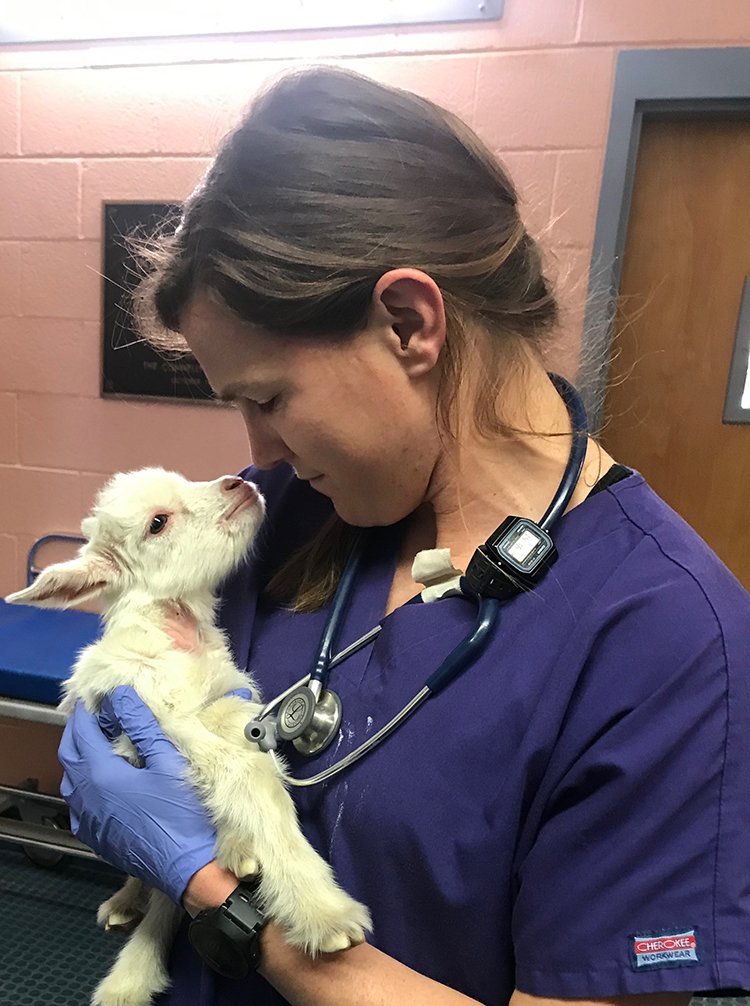
The week of March 18 started with joy and excitement for Mary Ann Bucklin and her family when, in the earliest hours of Monday morning, their goat Ivory gave birth to a doeling. But things soon took a turn, leading to five days of ups and downs (and ups) for the baby they’d named Daisy.
“On Monday morning, we heard sounds coming from the barn and found Ivory had given birth overnight,” Ms. Bucklin explained. “We noticed the kid wasn’t nursing, and she fell over whenever we helped her stand. Following our veterinarian’s advice, we tried feeding her with a syringe, which perked her up but not for long. Our vet told us to take her to the New Bolton Center emergency room.”
Penn Vet admitted both goats. “We did a complete work-up of each one. Ivory was healthy. Daisy’s heart rate and breathing were OK, but she was weak and had a low body temperature,” said Michelle Abraham, assistant professor of clinical critical care medicine. “Her mucus membranes were congested and blood sugar profoundly low. So, we administered an antibiotic to clear potential infections and helped her nurse.”
First the Good News ... Then the Bad
Within a few hours, Daisy looked brighter.
“New Bolton Center called us that night to say Daisy was improving, and we went to bed hopeful,” said Ms. Bucklin. “But the next morning we got a call that she wasn’t doing well and had a 50/50 chance with intervention.”
Overnight Daisy had become increasingly lethargic, and her glucose levels were dangerously low. Her care team—veterinarians, students and volunteers, who’d fallen in love with the little goat—circled around.
“Someone was with her every minute. We were doing everything we could to help her to get better,” said Amanda Hardcastle, an extern from the University of Tennessee, and one of four students assisting on the case along with Penn Vet students Megan Caiazzo (V’20), Gabrielle Faragasso (V’20) and Stefanie Gayer (V’19).
Daisy’s treatment included a steady flow of fluids and dextrose during the night, but by morning her condition had deteriorated. She had diarrhea and required oxygen therapy when her skin started turning blue. After multiple tests, Dr. Abraham diagnosed neonatal sepsis and septic shock, a highly fatal condition caused by serious infection. Daisy became comatose very quickly and was having trouble maintaining her blood pressure.
“Because the kid didn’t nurse in her earliest hours of life, it’s possible she didn’t ingest the colostrum, a milky substance rich in antibodies that helps newborns develop a healthy immune system to fight infection,” explained Dr. Abraham.
Dr. Abraham gave Daisy an antitoxin, an aggressive course of antimicrobial medications, and constant infusions of fluids and medications to help her heart beat and maintain her blood pressure.
Slowly, Daisy improved and wanted to nurse. Every day, Ms. Bucklin received a call from New Bolton Center about the goat’s condition—“we really appreciated these calls and hearing she was getting stronger,” she said.
By the end of the week, Daisy began to show her sparkly personality and nursed unprompted. She was discharged on Friday, going home to live with Ivory, two other goats, two dogs and eight humans.
“When we picked her up at the hospital, we were surprised by the outpouring of emotion,” remembered Ms. Bucklin. “Everyone who cared for Daisy greeted us. They clearly adored her and were so happy she pulled through. It was like a mini-celebration—and great contrast to the start of the week!”
Beloved Boxer Becomes a Penn Heart Patient
Edited version of story by Katie Baille, University Communications

Eight years ago, Karen Cortellino, a physician from New Jersey, adopted Sophie, a boxer, two weeks after the death of the family’s first boxer, and “she’s been Mommy’s baby ever since.”
A few months ago, Sophie became the first dog with a particular type of heart disease—arrhythmogenic right ventricle cardiomyopathy (ARVC)—to be treated with cardiac ablation.
Anna Gelzer, a professor of cardiology in Penn’s School of Veterinary Medicine, led Sophie through the procedure with cardiology resident Alexandra Crooks. But the equipment and expertise to perform an ablation, in which a high energy catheter tip burns tiny portions of damaged heart tissue to restore normal rhythms, wouldn’t have been possible without collaborators from down the street. At the Perelman School of Medicine’s Translational Cardiac Electrophysiology Laboratory, Director Cory Tschabrunn and members of his team worked with their veterinary colleagues to plan out and provide Sophie a procedure that mirrors the best that human medicine has to offer.
“This collaboration and this close distance between our hospitals allows us to be able to utilize the tremendous access to all this knowledge,” said Dr. Gelzer. “And from our experience with Sophie and other dogs to come, we may able to glean information that will be valuable to human medicine.”
For Dr. Gelzer and Dr. Crooks, Sophie is a pilot case for a study now backed by two grants that will support cardiac mapping and ablation procedures for six additional dogs. Currently, cardiac ablation is only available for pet dogs in two other sites in the world. Sophie’s case puts Penn Vet on the map. While the equipment necessary to perform ablations is costly, access to Penn Medicine’s Translational Electrophysiology Lab has opened the possibility that Penn Vet may one day be able to provide committed dog owners a more durable alternative to medication for treating their pets’ arrhythmias.
A Scary Spell
Sophie’s diagnosis of ARVC meant she could suffer a life-threatening arrhythmia, despite starting medications to reduce that risk. A strikingly similar condition affects roughly 1 in 1,000 humans. In both dogs and humans, the disease causes a deterioration of the tissues in the heart muscle, leading to occasional episodes when the heart beats very fast. The condition increases the risk of sudden death. While drugs like beta blockers and sodium channel blockers can mitigate this risk, arrhythmias can sometimes break through these medications.
Dr. Cortellino began researching alternative treatment options. In humans with a similar diagnosis, the treatment of choice is an implantable cardiac defibrillator (ICD). But, as Dr. Gelzer explained to Dr. Cortellino when she reached out about this possibility, that option is not yet tenable for dogs. But she did have an alternative proposal. The only catch was that it had never been done in a dog with ARVC before.
Ideal Expertise
In 2000, Dr. Gelzer had worked with David Callans, a professor of medicine at PSOM and an expert on cardiac electrophysiology. They collaborated on basic cardiac research using pig models. Roughly a year ago, when discussing one of Dr. Gelzer’s cases, Dr. Callans connected her with Dr. Tschabrunn, who had recently set up his lab in Penn Medicine’s Smilow Center for Translational Research as part of the Electrophysiology Translational Center of Excellence (EP-TCE) initiative. Dr. Tschabrunn and Dr. Gelzer struck up a collaboration that brought together the latest in technique and technology in cardiac electrophysiology with deep knowledge in veterinary cardiology.
“This was an exciting opportunity not only in terms of a research collaboration,” said Dr. Tschabrunn, “but we also had the chance to help a patient by combining our expertise and resources that are really only available at just a few institutions in the world.”
Not a Bandage
Ablations are “routine care” for many cases of arrhythmias in people. “You approach the heart through the blood vessel, get in the right spot, and—with all the expertise and knowledge of the practitioner—you can find the damaged area and burn it,” said Dr. Gelzer. “And then maybe the patient doesn’t need to be on medications that can have side effects and are in some cases not that effective.” Dr. Gelzer saw Sophie, a healthy dog aside from her heart condition, as an excellent candidate for an ablation.
Before the surgery, the veterinarians gathered data on the patterns of Sophie’s arrhythmias. That information was used during the procedure to zero in on the area of the heart to target with the ablation.
The morning of the procedure, a full complement of experts awaited Sophie: not only Dr. Gelzer, Dr. Crooks, Dr. Tschabrunn and his team and Giacomo Gianotti, head of anesthesia at Ryan, but also two anesthesia residents, Penn Vet’s two other cardiology faculty, Marc Kraus and Mark Oyama, two cardiology residents, a cardiology research intern, experts on the machines, veterinary nurses and interested observers.
The procedure was long and complex. To locate the unhealthy tissue, the clinicians used an advanced mapping system based on GPS technology called CARTO, which maps the voltage of the heart tissue. Decreased voltage corresponds with diseased tissue. They confirmed these areas by artificially introducing extra heart beats into Sophie’s normal rhythm. Sophie’s heart resisted these challenges, a sign that her disease was being kept in check by her medications, but the heart mapping and challenges did allow the clinicians to reproduce abnormal beats, giving them more evidence that they were targeting the right areas. Guided by that information, Dr. Tschabrunn used precisely directed radiofrequency to burn millimeter-sized portions of the tissue inside Sophie’s right ventricle. And all went smoothly. And Dr. Cortellino and her family are reaping the benefits: “Sophie is back to her perky self.”
Paving the Way
Drs. Gelzer and Tschabrunn recently performed another ablation on a canine patient, and they are hopeful that the outcomes from the study will lay the groundwork for ablation to become a more routine option for dogs. From Sophie’s case and others that follow, researchers hope to glean information that could benefit both human and veterinary patients in the future.
“Loveliest Colt in the World” Recovers from Eye Trauma
By Sacha Adorno, Penn Vet Contributing Writer

“I’ve been coming to New Bolton Center with my horses since I was a teenager, and I’m now in my 60s. I wouldn’t go anywhere else when there’s a problem,” said Cathy Vincent, co-owner of Adandy Farm in Greenwood, Delaware, which has been in the Arabian horse business since 1967.
During a life spent breeding, training and showing horses, Ms. Vincent has dealt with an equine injury or two. Most recently, her seven-month-old colt Total Heir suffered blunt force trauma to his eye.
“It happened around four in the afternoon. We’re not sure exactly what caused the injury, but as soon as his caretakers saw the eye, they called our regular veterinarian. She took one look and told them to go right to New Bolton Center,” said Ms. Vincent, who owns Total Heir with Millie Chapman in Junction City, Oregon. “I was in Arizona for a show, so they put him in the trailer—his first ride ever and he went without a problem.”
Two hours later Total Heir was in the hospital. By the time he arrived, the eye was filled with blood, and he was non-visual. “We knew we wanted to intervene with tissue plasminogen activator, also known as TPA,” explained Nicole Scherrer, clinical assistant professor of large animal ophthalmology. “It’s administered through an injection in the eye and acts as a clot buster. The medicine is often used in humans during the early stages of a stroke to improve their long-term prognosis.”
Artful Injection
But applying the medication isn’t as simple as immediately injecting it into the affected eye. According to Dr. Scherrer, “there’s a bit of an art as to when exactly to do the injection.” If done too soon, the procedure can cause a re-bleed because it takes away the eye’s ability to clot naturally. But waiting too long can cause permanent eye damage. To make a bit more difficult, Total Heir also had an eye ulcer needing attention.
Dr. Scherrer and her ophthalmology team first treated the horse with anti-inflammatory, antifungal, antibiotic and pressure reducing medications, monitoring him until he was stable enough for the procedure. “We had to watch to make sure the ulcer didn’t worsen, there was no active bleeding in the eye and that his intraocular pressure was appropriately managed,” she explained.
After two days of medical treatment, Dr. Scherrer believed that he was ready. “We injected the solution directly into his eye, and within 12 hours the blood had cleared,” she said.
Always Elegant ... and Super Sweet
Total Heir was able to go home, where he received daily medications. “My wonderful team at the stable gives him medication three times a day—it’s no small job; each dose takes 30-40 minutes to administer,” Ms. Vincent said.
Not that anyone is complaining. “Total Heir never gives us any trouble. He is always an elegant, happy boy,” said Ms. Vincent of the colt, who is back to his regular exercise routine. “He has a wonderful pedigree—his grandfather was Gitar AF, an amazing horse and also well known to New Bolton Center!”
Dr. Scherrer seconded this: “Total Heir is one of the loveliest babies in the entire world and super easy to work with. It’s a huge credit to the barn and how well they manage their horses. We love him very much!”
Medical Miracles on 34th Street, Perelman School of Medicine
When a Doctor Suddenly Goes into Heart Failure

“On December 21, 2018, I almost died.” That’s the first line of Alin Gragossian’s blog, “A Change of Heart.”
Dr. Gragossian was a 30-year-old emergency medicine resident who, in the weeks leading up to that day, had been feeling a little run down. As a resident working long hours, it didn’t seem too abnormal. The persistent cough she had developed was annoying but not unbearable.
Even when one of her attending physicians noticed she was short of breath from talking, Dr. Gragossian shrugged it off. “I went for a run just last week. How bad could it be?” she thought. But over the next couple of days, it became harder for her to ignore that she was having trouble breathing.
When her boyfriend who hadn’t seen her for a few months confessed that she looked sick, they headed to her ER for a chest x-ray.
“My heart looked big. My heart rate was in the 140s, and I wasn’t breathing well,” Dr. Gragossian said. “They thought it could be pneumonia.”
Still, Dr. Gragossian’s focus was on her shift the next day. If she could just get some antibiotics, she thought, she should be able to salvage some sleep and make it through another day. Instead, one of her attendings insisted she stay overnight for observation ... which proved to be a lifesaving measure.
That night, Dr. Gragossian went into heart failure. She doesn’t remember much after the rapid response team arrived at her bedside. She was intubated and put on a ventilator. And then she was put into a medically induced coma in an effort to stabilize her and buy her doctors some time to figure what was going on.
Over the next 48 hours, her doctors zeroed in on her heart, but they still weren’t sure what was causing her condition. She was taken to the catheterization lab, her heart failing from minute to minute. She was put on medications just to keep it pumping.
Dr. Gragossian was ultimately diagnosed with dilated cardiomyopathy, a condition in which the heart chambers dilate or enlarge, preventing the heart from pumping blood as well as it normally would. If it goes on long enough, it can lead to heart failure, as it did with Dr. Gragossian.
“My dad has dilated cardiomyopathy, but his isn’t as severe as mine,” Dr. Gragossian said. “And his father died in his late-thirties, early-forties from a heart condition, but we’d never put it all together before.”
The cause of dilated cardiomyopathy isn’t generally known, but it’s estimated that up to a third of cases are inherited from parents.
With the diagnosis, Dr. Gragossian was transferred to the Hospital of the University of Pennsylvania. “I knew where it was headed at that point: heart transplant,” she said.
On January 15, 2019, 11 days after Dr. Gragossian was placed on the heart transplant waiting list, she was, as she writes on her blog, “reborn with a new heart, all thanks to a selfless organ donor who was likely from around the area and happened to have a matching blood type.”
Pavan Atluri, director of Penn Medicine’s Cardiac Transplantation and Mechanical Circulatory Support Program, performed the surgery.
Making Sense of a Near-Death Experience
Dr. Gragossian started her blog seven days after her transplant, while she was still in the intensive care unit. She vowed to use it as a space to “advocate for organ donation, research and charities.” (Within the first two months, she had already raised several thousand dollars for a national charity and she’d begun working with another, Philadelphia-based one.) The blog also helped stave off boredom—Dr. Gragossian is not someone who does well with sitting still—and served as an outlet for her thoughts.
Dr. Gragossian needed to explain the thoughts racing through her mind. After all, she was suddenly forced to confront the possibility of her death at the age of 30.
“It was very, very, very scary,” she said. “But I had a lot of faith in the system. I knew that my doctors and nurses would take care of me, and that ultimately made me feel better.”
She was also just beginning to process how she was going to proceed with the rest of her life.
“You see, there are several ways to interpret these ‘inconvenient’ life events (let’s call these ILEs),” Dr. Gragossian wrote in her first blog post. “You can genuinely see them as setbacks and let them take over your thoughts. You can blame yourself or others (or even a higher being) and dwell on the reasons why such ILE happened to good, ol’ you.
“Me? I gracefully embraced my ILE. I am continuing to learn from it every day, even in my hospital room on Post-Op Day 7.”
Anticipating the Next Chapter
Dr. Gragossian was discharged from the hospital nine days after her transplant and was up and doing things for herself after a couple of weeks. By March, she had already been easing back into jogging—“slowly,” she qualifies—for a month. And she was itching to get back to work.
Before all this happened, Dr. Gragossian was preparing to move to New York to begin a fellowship in critical care. That’s been postponed for at least a year. If her follow-up care under Rhondalyn C. McLean, associate medical director of the Penn Medicine Heart Transplant Program, continues to progress as well, and if her next couple of routine biopsies remain clear, Dr. Gragossian will be allowed to finish her residency in the coming months.
Until then, she’s continuing to process the whirlwind that was last winter. “Even before all this happened, I was someone who’d try to take something and learn from it. It’s changed me in a lot of ways,” Dr. Gragossian said. “It’s got me thinking about taking full advantage of my time and making sure that I’m doing what I want to be doing. But I think it’s also going to make me a different clinician. I do think it’ll help me better empathize with my patients.”
From Conquering Cancer to Climbing Kilimanjaro

Jennifer Vrana has been in the midst of an adrenaline rush for 18 years. Following the attacks on September 11, 2001, the Philadelphia police officer headed to New York City to join the bucket brigade at the World Trade Center site. Seven weeks later, she was diagnosed with stage 4b Hodgkin’s disease. A year after that, she needed a stem cell transplant. But she didn’t slow down. Instead, she sped up.
Step One: Find Normalcy Amid Chaos
Ms. Vrana began her cancer treatment at a hospital where she quickly felt that she was being treated “as a number” rather than a person. She recalls the physicians telling her that they were “excited to be able to keep people alive for up to seven years,” and the bizarre, nonchalant comment only strengthened her resolve to beat the odds.
She switched to Pennsylvania Hospital for her care and recognized immediately that her oncologists, David Henry, vice chair of the department of medicine, and Patricia Ford, director of the Peripheral Stem Cell Transplant Program and the Center for Bloodless Medicine and Surgery, were a perfect fit. “I had my primary doctor at one location, my surgeon at another and then Dr. Henry and Dr. Ford at Pennsylvania Hospital, and they all knew each other and worked well together across health systems. In that aspect, I was beyond blessed. I’d found the right place at the right time,” she said.
During her eight cycles of chemotherapy, Ms. Vrana had two goals: keep working and keep planning. She transferred from the Roxborough/Manayunk police district to City Hall so she could walk to the hospital for treatment every other Monday at 9 a.m., and she never took time off. Seeing herself in uniform in the mirror each morning kept her motivated, “and it brought a sense of normalcy.” Sluggishness would set in by Thursday each week, but she kept herself going by planning exciting outings: rodeos, concerts, skydiving, swimming with dolphins, and “everything else that doctors told [her] not to do.”
When it came time for her stem cell transplant in October 2002, Ms. Vrana was still reveling in the success of a rodeo competition that she had won three weeks prior. Her hair was gone, but she was in high spirits, which were further bolstered by the success of the lifesaving
procedure. Two days after discharge, she contracted a staph infection and was rushed back to the hospital. Her care team noted that her chance of survival was declining by the hour, but fortunately, her fever broke overnight, and when her family arrived the next morning, they found her calmly smoking a cigarette by her window (and hiding it from her nurses).
“I had the best nurses on earth, and I still keep in touch with a couple of them,” she said. “I truly believe that if it wasn’t for my nurses that night, I wouldn’t have made it. They stuck to me like glue. I experienced the worst 24 hours of my life, but that was the turning point.”
Step Two: Ditch Normalcy Altogether
In the 17 years that followed her transplant, Ms. Vrana has recovered and was given a clean bill of health. She has given up smoking, picked up running and adopted a healthy diet. But more significantly, the shift in perspective prompted by her diagnosis surprisingly shifted her mental health in a positive direction.
“I really do consider this whole experience to be a gift. Pre-cancer, I had my job, my friends, my rodeos—but I appreciate everything so much more,” she said. “I’m a survivor, and I’m not going to slow down.”
Ms. Vrana still lives her life with a six-month-long mindset. These chunks of time are filled with as many “spectacular things” as she can fit, both to celebrate her continued ability to engage with the world around her, and to honor those who cannot embark on the same journeys.
She returned to school and earned her BA and MBA, gained two promotions and became a lieutenant on the police force, helped found the Liberty Gay Rodeo Association, reconnected with her family and married her wife and “ultimate reward,” Suzanne. She has also gone skydiving over an Arizona desert and cage diving surrounded by great white sharks; galloped on horseback through fields filled with rhinos and zebras and watched the sunrise from a hot air balloon over the Valley of the Kings; spent time supporting children orphaned by HIV/AIDS in South Africa and made regular visits to the Disney parks. She climbed Pike’s Peak in Colorado as practice for her journey to the top of Kilimanjaro.
“I’ve been able to do the craziest, most amazing things. My first post-transplant trip was to Iceland. A friend and I were snowmobiling on a glacier, and as we went through the clouds at the top, I just cried. It was so beautiful, and I was so thankful to be alive,” Ms. Vrana said.
In October, Ms. Vrana made it to the summit of Mount Kilimanjaro, on the 17th anniversary of her transplant. She and her group climbed through the night so they could watch the sunrise from the highest point in Africa.
“Cancer’s just a word. Believe me, I know how privileged I am to say that; survivor’s guilt is real, and I strive daily to be the best I can be in honor of those who were lost. But a diagnosis is just a diagnosis. It’s what you do with it that matters,” she continued. “Do it your way. Only you know what your way is. But I do know that the day you decide you’re too tired to get up—that’s the day you start dying. So I never laid down. And I’m still moving.”
Dancing with MS
Adapted from stories by Stephanie Stahl, CBS Philly, and Stu Bykofsky, Philadelphia Inquirer

A growing number of young people—especially women in their 20s and 30s—are being diagnosed with multiple sclerosis (MS). Fortunately, there are several new treatments that allow many patients to live healthy lives. MS can be debilitating, but it doesn’t have to be. Philadelphia dancer Danielle Bourgeon thought her days on pointe were over when she was diagnosed, but you’d never know.
“For me, it was really important to tell this story,” Ms. Bourgeon, a Chicago native who studied ballet at Pittsburgh’s Point Park University, said.
It’s a story about resilience, how dance helped the 34 year old get her life back. In 2005, Ms. Bourgeon suffered an injury that would keep her from becoming a ballerina. She earned a bachelor’s in fashion marketing at the Art Institute of Philadelphia and now works for a Lansdale, marketing firm. Then, in 2009, she was diagnosed with multiple sclerosis.
“I was completely paralyzed on my left side,” Ms. Bourgeon said. “It was really rough for me, and it got really dark for me really fast, particularly when I was not able to walk. I know it’s not a death sentence, but it feels like that.”
MS impacts the central nervous system. Symptoms include vision changes, pain and fatigue and they fluctuate.
“You don’t know what it’s going to take from you, you don’t know how it’s going to affect you and living with that unknown and that level of unknown and uncertainty is very scary,” Ms. Bourgeon said.
Penn Medicine Associate Director of the Multiple Sclerosis Center Dina Jacobs said more young people are being diagnosed with MS.
Dr. Jacobs said they’ve gotten better at diagnosing MS, which could account for the growing numbers.
While there’s still no cure, MS can be well managed now that there are 17 different FDA approved treatments.
“It’s such an incredibly hopeful time,” Dr. Jacobs said. “The medications we have—they have higher efficacy and they’re really making more of an impact.”
The new treatments—along with a good diet, exercise and stress control—have helped Ms. Bourgeon get back to dancing.
“It’s not a death sentence and it took me a while to figure that out,” she said.
Now with that attitude and feeling good, Ms. Bourgeon recently choreographed a dance about her journey with MS called “Made Stronger,” which incorporated her walker. This could be considered a risky move.
“I didn’t want it to come off as mocking people who need to use a walker,” she said. “I’ve spent many nights playing with the walker to see what looks interesting and gets my point across.” At the beginning of the piece, she is giving up on herself, but by the end she walks away from the walker. She performed it with a colleague in July as part of a Philadelphia Dance Day Showcase.
“I’m not MS and MS is not me,” she said. “I want to live my life as much as I can.”
Ms. Bourgeon is also reaching out to other newly diagnosed MS patients to let them know that their lives can be OK. Doctors say it can be tricky to diagnose, but finding MS early and getting treated is the best way to limit and control symptoms.
The State of University City 2020
 On December 4, hundreds of guests attended the annual State of University City at World Café Live. UCD Board Chair Craig Carnaroli and Councilperson-elect Jamie Gauthier offered opening remarks. UCD issued its annual State of University City report. Below are excerpts. For the full report, visit https://tinyurl.com/UCDStateofUnivCity2020
Spotlight on University City: University City is the region’s leader in education, science and innovation. The 2.4-square-mile neighborhood boasts world-class institutions that have catalyzed over 85,000 jobs in fields including medicine, higher education, technology, real estate, and hospitality. University City is a destination for culture seekers and food lovers, a transportation hub with some of the most bicycle- and pedestrian-friendly streets in the city, and is home to the most significant development projects in the region. With diverse demographics, a blend of housing and rental options, top-notch schools and hospitals and amenities galore, University City is Philadelphia’s neighborhood of choice where the quality of life matches the quality of opportunity.
Real Estate Development: Accelerated growth, rapid transformation and continued investment remain the story in University City’s real estate sector. Progress on major residential, institutional, public space and mixed-use projects marked another busy year of groundbreakings, topping outs and ribbon cuttings in the neighborhood. In the past year, significant progress has been made on three major long-term projects: uCity Square; Schuylkill Yards; and the 30th Street Master Plan. Other key developments, including the new Pavilion at the Hospital of the University of Pennsylvania, 3.0 University Place and Drexel’s Bentley Hall, made major strides toward completion. All told, these investments in the neighborhood are further cementing University City’s status as the region’s economic and innovation powerhouse.
Employment: New development and institutional expansions contribute to University City’s continued status as a top regional employment hub. In 2019, the total number of University City jobs increased for the fourth consecutive year and eclipsed 85,000 total workers in the neighborhood for the first time. University City accounts for approximately 12% of all jobs within Philadelphia, despite representing only 1.69% of the city’s total footprint. A large percentage of jobs are found at the local hospitals and universities, but growth associated with nascent technology firms and commercialization of research is also creating more employment opportunities at every rung of the career ladder.
Office: Look no further than the nearly 5 million square feet of office space, up 37% over five years ago, to see that University City remains a desirable place to do business within the region. The average gross rent of $39.02 per square foot far outpaces averages for Center City Philadelphia and the region at large, and the 88.4% occupancy rent remains in the top five out of all submarkets in the region. More inventory is on the way with upcoming groundbreakings planned for buildings in Schuylkill Yards, 3.0 University Place, uCity Square, plus many others.
Retail and Hospitality: Local and national retailers, restaurants and hotel operators view University City as a prime location due to an eclectic mix of employees, commuters, college students and residents. University City boasts 285 restaurants and bars, including new additions like outposts of popular chains Bonchon, Halal Guys and Panera, a hybrid beer hall/arcade called The Post and Sunset Social, a rooftop restaurant offering stunning views of Philadelphia. Adding to the vitality, a recent survey of outdoor seating revealed a whopping 5,657 outdoor seats within the district, and out-of-town visitors can choose from over 1,000 available hotel rooms, from luxury offerings at AKA University City to the chic The Study at University City to the recently renovated University City Sheraton.
Higher Education: True to its name, University City offers top options in the region and nation for undergraduate and graduate studies. More than 53,000 students are enrolled in the neighborhood’s five institutions of higher education. Students from around the country and the globe are drawn to the proximity to employment opportunities the beautiful campuses, the vitality of the surrounding community and the varied housing inventory. According to a recent report by Campus Philly, from 2000-2017, Philadelphia added 68,700 residents between the ages of 25 and 34 who hold a bachelor’s degree and retained 54% of college graduates. The total number of undergraduate and graduate students in University City and the total degrees conferred far outnumber peer employment centers.
Healthcare: The neighborhood’s medical institutions—Hospital of the University of Pennsylvania (HUP), Penn Presbyterian Medical Center, Children’s Hospital of Philadelphia (CHOP), and Michael J. Crescenz VA Medical Center—combine to account for nearly 38% of all jobs in University City, making them an essential component of the local economy. Both CHOP and the Hospitals of the University of Pennsylvania—Penn Presbyterian receive annual accolades, including CHOP’s ranking as the #2 hospital for children in America according to US News and World Report, Penn Medicine ranking #17 in the nation for top employers according to Forbes, and 481 Penn physicians ranking in Philadelphia magazine’s list of top regional doctors. Our local hospitals are also leading the way in new treatments, procedures and medical technologies and will soon be able to accomplish even more with the addition of the Pavilion, a new facility from Penn Medicine that will house 500 private patient rooms and 47 operating rooms.
Transportation: University City’s streets, sidewalks and transit stations combine to offer excellent options for traveling within the neighborhood or to points beyond, and the neighborhood once again earned “paradise” status for walking, biking and public transit from Walkscore.com A reported 68% of residents commute to work without relying on a car, a higher percentage than any peer innovation city other than Washington, DC. The addition of new bike share stations and bus routes, plus an estimated $450 million of public investment toward local transportation infrastructure over the next 10 years, will further improve University City’s accessibility.
People: Our neighborhood of nearly 55,000 people is made up of a diverse mix of college students, new families, young professionals and residents who have called University City home for decades. The abundance of college students accounts for both the high percentage of millennials living here and also the nearly 60% of residents who have obtained at least a bachelor’s degree. This young, educated population is very diverse, with an over-60% probability that any two residents meeting are of different races, a higher rate than all peer employment centers other than Mission Bay in San Francisco and downtown San Jose. The current population is up nearly 13% since 2010, which demonstrates improved quality of life and increased desirability of the neighborhood.
Life in the Neighborhood: What makes a neighborhood a great place to live? For University City, it’s fantastic amenities, an excellent dining scene, diverse housing options, world-class transit, parks and public spaces aplenty and communities with distinct personalities. Options for housing in University City are as varied as the residents, with historic homes, luxury high-rises, dormitories and walk-up apartments. Residents are never far from a piece of public art, a green space or a place to sit. Getting around is a breeze thanks to the excellent transportation options, and 68% of residents elect to walk, bicycle or ride public transit to get to work. Raising a family? Local schools earn annual accolades, and a new 90,000 square foot K-8 school at 3610 Warren Street will soon open. An eclectic dining scene caters to every appetite and retail options range from national chains to one-of-a-kind storefronts. Active neighborhood associations and community groups provide civic pride and engagement to the sub-neighborhoods within the district.
Innovation: University City is nationally recognized as a hub for advances in science, research and medicine, and is earning a reputation as the “Silicon Valley of health care,” according to Johnson & Johnson CEO Alex Gorsky and others. Local discoveries, including the first FDA-approved cell therapy and first FDA-approved gene therapy, bring billions of dollars to the regional economy, a number that grows each year as new start-ups, incubators, and laboratories launch. A record-smashing 228 patents were issued to University City businesses and institutions, who also accounted for $1.76 billion in R&D funding. Facilities, including the Cambridge Innovation Center at 3675 Market Street, the Pennovation Center, Drexel’s ic@3401, and forthcoming projects such as two new expansions of Penn’s prestigious Wharton School will fuel even more discoveries and inventions in the years to come.
|
University City by the Numbers
• 85,000+ jobs
• 54,849 residents
• $1.76 billion in research and development funding
• 2.75 million square feet of development
• 60% of residents ages 25 or older have a bachelor’s degree or higher
• 20-24 minute median commute for UC residents
• 136 retailers
• 70% of storefront businesses are locally owned
• 53,307 students across 5 colleges and universities
• 68% of residents walk, bicycle or ride public transit to work
• 2,050 average weekday boardings on new Septa route 49
• 285 bars and restaurants
• $1,720 median apartment rent
• 144 homes sold in 2018
• $382,000 median home sale price in 2018
|

 The University of Pennsylvania announced a $10 million gift from 1992 Penn graduates Mindy and Jon Gray in support of undergraduate financial aid for students from New York City, and the Penn First Plus program for students who are low income and/or the first in their families to attend college.
 The largest initiative to improve hospital work environments to date has officially begun, with an award of €4 million from the European Union’s Horizon 2020 program. The grant will support the international partnership of some of the world’s leading universities, led by KU Leuven and the University of Pennsylvania School of Nursing’s Center for Health Outcomes and Policy Research. The aim of the initiative is to redesign hospital workplaces to improve the mental health and well-being of nurses and physicians and to improve patient safety. This initiative begins in January 2020, aligning with 2020 being the International Year of the Nurse and Midwife as designated by the World Health Organization.
 Emily Wilson, professor of classical studies, has been appointed the College for Women Class of 1963 Term Professor in the Humanities. Dr. Wilson works on Greek and Roman literature and its reception and translation, with particular interests in epic, tragedy and philosophy. Her internationally-recognized research has been supported by several distinguished honors, including the American Council of Learned Societies National Endowment for the Humanities Fellowship, the Rome Prize NEH Fellowship for the Humanities in Renaissance and Early Modern Studies, and, in the fall of 2019, a MacArthur Fellowship (Almanac
  Jonathan A. Epstein, executive vice dean, chief scientific officer and the William Wikoff Smith Professor of Cardiovascular Research in the Perelman School of Medicine at the University of Pennsylvania, has been awarded the Harriet P. Dustan Award for Outstanding Work in Science as Related to Medicine by the American College of Physicians (ACP), a national organization of internists. Established by ACP’s Board of Regents in 1958, this award recognizes outstanding work in science as related to medicine, and it was renamed in 2017 after Dr. Dustan, a Master of the College and a clinician and investigator whose pioneering research advanced the detection and treatment of hypertension.
 Annenberg School for Communication doctoral candidate Natalie Herbert was recently selected to participate in the Christine Mirzayan Science and Technology Policy Graduate Fellowship Program at the National Academies of Sciences, Engineering and Medicine in Washington, DC.
 Christopher A. Hunter, Mindy Halikman Heyer Distinguished Professor of Pathobiology at the School of Veterinary Medicine of the University of Pennsylvania, has been elected president-elect of the International Cytokine and Interferon Society. Dr. Hunter officially began his term in November and will take office as president following the Cytokines 2021 Cardiff meeting in October 2021.
 Lisa Lewis, associate professor of nursing, Calvin Bland Fellow and assistant dean for diversity and inclusivity at Penn’s School of Nursing, and Sarah Light, associate professor of legal studies and business ethics at Wharton, have been awarded the Trustees’ Council of Penn Women’s 8th Annual Advising Award for Excellence in Undergraduate Advising.
  Vincent Reina, assistant professor of city and regional planning at the Weitzman School, has received the 2019 Rising Scholar Award from the Association of Collegiate Schools of Planning.
 Penn senior Christina Steele and 2018 graduate Erin Hartman have been named Marshall Scholars. Established by the British government, the Marshall Scholarship funds up to three years of study for a graduate degree in any field at an institution in the United Kingdom. They are among 46 Marshall Scholars for 2020 chosen from more than 1,000 applicants. The scholarship, meant to strengthen US-UK relations, is offered to as many as 50 Americans each year.

 Penn senior Andrew Howard, alumnus Malik Abdul Majeed (W’17), and master’s student Zinan Chen were chosen to receive the Schwarzman Scholarship, which funds a one-year master’s degree in global affairs at Tsinghua University in Beijing.
 _spiny_cones-RESIZED.jpg)