Applying Eternal Ideals of Truth, Goodness and Justice
_1940_3-resized.jpg)
In honor of what would have been President Franklin D. Roosevelt’s 137th birthday on January 30, below is a transcription of his address delivered on Friday, September 20, 1940, in Convention Hall, Philadelphia, in connection with the 200th anniversary of the founding of the University of Pennsylvania. Penn President Thomas S. Gates presented FDR with an honorary doctor of laws degree at that Bicentennial of the University. FDR was the 32nd president of the United States (1933–1945). FDR was the only president elected to the office four times. He was born January 30, 1882, in Hyde Park, New York, and died April 12, 1945, in Warm Springs, Georgia.
Applying Eternal Ideals of Truth, Goodness and Justice
President Gates, my friend the Chief Justice of Canada, and all of my friends of the University:
I am very greatly honored to have the privilege of accepting this hood.
I am very happy with the present University of Pennsylvania. I cannot say that I am wholly happy that the founders of the University chose the year 1740. If they had had that great attribute which I have so long sought of looking ahead and planning, they would have founded the University in 1739, lest the two hundredth anniversary should fall in an election year. Thereby, I, at least, would have been saved much embarrassment. And yet, what I want to say to you today, very simply, I might as readily and easily have written in the autumn of ’39.
For even then we were in the midst of a strange period of relapse in the history of the civilization of the world—for in some lands it had become the custom to burn the books of scholars and to fix by Government decree the national forms of religion and morality, and culture and education. In such a time, it is more than a mere formality, at a time like this, to join with you in celebrating the two hundredth anniversary of this free and independent institution of scholarship. And, therefore, I am doubly honored in becoming an alumnus of the University of Pennsylvania.
The very foundation of the University was concerned with the freedom of religious teaching and with free learning for the many who could not pay for higher learning. As I understand my history, this was originally proposed as a place where the good and reverent Doctor George Whitfield, who, incidentally, used to come to my little County of Dutchess on the Hudson River—a place where Doctor George Whitfield might preach his religion without certain difficulties, which—what shall I say?—the old conservatives of Philadelphia at that time threw in his path. Indeed, it was desired to make it unnecessary for the good gentleman to preach in the sun and the rain of the open fields, when the doors of some of the established churches were closed against him. And it was the dream of the founders to make it a source of education to the children of the poor who otherwise might have gone untaught.
The survival and the growth of the University through these two whole centuries are particularly symbolic of the eternal strength that is inherent in the American concept of the freedom of human thought and action. Here is living proof of the validity and the force of single-minded service to the cause of truth.
Yes, events in this world of ours today are making the vast majority of our citizens think, more and more clearly about the manner of the growth of their liberty and freedom, and how hard their people in the olden days have fought and worked to win and to hold the privilege of free Government.
With the gaining of our political freedom, we remember that there came a conflict between the point of view of Alexander Hamilton—who was such a good friend of my great-grandfather that he named one of his sons Hamilton and the other one Alexander Hamilton—that point of view of Alexander Hamilton sincerely believing in the superiority of Government by a small group of public-spirited and usually wealthy citizens, and, on the other hand, the point of view of Thomas Jefferson, an advocate of Government by representatives chosen by all the people, an advocate of the universal right of free thought and free personal living and free religion and free expression of opinion and, above all, the right of free universal suffrage.
Many of the Jeffersonian school of thought were frank to admit the high motives and disinterestedness of Hamilton and his school. Many Americans of those days were willing to concede that if Government could be guaranteed to be kept always on the high level of unselfish service suggested by the Hamiltonians, there would be nothing to fear. For every basis of the Hamiltonian philosophy was that, through a system of elections every four years, limited to the votes of the most highly educated and the most successful citizens, the best of those qualified to govern could always be selected.
It was, however, with rare perspicuity, as time has shown, that Jefferson pointed out that on the doctrine of sheer human frailty, the Hamilton theory was bound to develop, in the long run, into Government by selfishness or Government for personal gain or Government by class, that would ultimately lead to the abolishment of free elections. For he recognized that it was our system of free unhampered elections which was the surest guaranty of popular Government. Just so long as the voters of the Nation, regardless of higher education or property possessions, were free to exercise their choice in the polling place without hindrance, the country would have no cause to fear the hand of tyranny.
At all times in our history of nearly a century and a half since then, there have been many Americans who have sought to confine the ballot to limited groups of people. It was a quarter of a century ago that President Eliot of Harvard University summarized this view when he said to me something like this; he said, “Roosevelt, I am convinced that even though we have multiplied our universities in every State of the Union, even though higher learning seems to have come into its own, nevertheless, if the ballot were to be confined to the holders of college degrees, the Nation would go on the rocks in a very few years.” It may—it may seem ungracious for a very new degree-holder to say this to this audience of older degree-holders, but my authority for that view is a great educator, noted for his efforts to disseminate college education throughout the country.
And I must admit that I agree with him thoroughly, in his estimate of the superior ability of the whole of the voters to pass upon political and social issues in free and unhampered elections, as against the exclusive ability of a smaller group of individuals at the top of the social or educational structure.
On candidates and on election issues—and remember that I am trying to think of this year as of 1939—I would rather trust the aggregate judgment, for example, of all the people in a factory—the president, and all the vice presidents, and the board of directors, and the managers, and the foremen, plus all the laborers—rather than in the judgment of the few who might have financial control at the top.
And on such questions the aggregate—for another example—the aggregate total judgment of a farm owner, of the farmer and of all the farm hands will be sounder, I think, than that of the farm owner alone. I would rather rely on the aggregate opinion, on matters affecting Government of a railroad president and its superintendents, its engineers, its foremen, its brakemen, its conductors, and trainmen, and telegraphers, and porters and all the others, than on the sole opinion of a few in control of the management, or of the principal stockholders themselves.
Only too often—and we know many examples—in our own political history, the few at the top have tried to advise or dictate to the many lower down how they have got to vote.
Even today in certain quarters there are, I regret to say, demands for a return of Government to the control of a fewer number of people, people who, because of business ability or what I like to think of as economic omniscience—I took four years of economics when I was an undergraduate at Harvard and everything that I was taught is outside of all of the textbooks today. The older I grow, the less omniscient I become in regard to economics, and I think most of us do too. People however, who think they have that ability are supposed to be just a touch above the average of our citizens. And so as in the days of Hamilton, we of our own generation ought to give them all credit for a pure intention and higher ideals. Nevertheless, their type of political thinking could easily lead to Government by selfish seekers for power and riches and glory. For the greater danger is that once the Government falls into the hands of a few elite, curtailment or even abolition of free elections might be adopted as the means of keeping them in power.
I cannot forget that some well-meaning people have even recently suggested seriously that the right to the vote be denied to American men and women who through no fault of their own had lost their jobs, and in order to keep the family and the home going, were working on works relief projects. As long as periodic free elections survive, no set of people can deny the right to vote to any other set. In the maintenance of free elections rests the complete and the enduring safety of our form of Government. And remember that no dictator in history has ever dared to run the gauntlet of a really free election.
Fundamental truths like these have been stated so often that they are perhaps commonplace among Americans, but it is well constantly to keep them in mind in order to understand what has happened in other lands. A decade ago, for example, in 1930, the people of Germany, the people who lived in the Reich, despaired of the processes of their democracy, which were based on the free use of the franchise. They were willing to lend ear to a new cult called “Nazi-ism”—a minority group which professed extraordinary patriotism and offered bread and shelter and better government through the rule of a handful of persons boasting of special aptitude for government. In those days loudly professed emphasis was placed by that special group on their own purity of purpose. Nothing was ever said by them about abolishing free elections. Many people of large business affairs, influenced by several factors, and dissatisfied with the democratic system as it was working out, formed political and economic alliances with this new small group.
You and I know the subsequent history of Germany. The right of free elections and the free choice of heads of government were suddenly wiped out by a new regime, still professing the same purity of purpose. It is a travesty on fact to claim that there is any free choice of public officials in Germany today, or that there has ever been one since 1933.
What Jefferson prophesied might happen in this country—if the philosophy of the restricted vote and of government by special class were adopted—did actually happen in Germany before our very eyes.
Many years ago, speaking in San Francisco, I pointed out that new conditions imposed new requirements on government and upon those who conducted government. As Jefferson wrote a long time ago, he said, “I know also that laws and institutions must go hand in hand with the progress of the human mind, as new discoveries are made, new truths disclosed, and manners and opinions change with the change of circumstance, institutions must advance also, and keep pace with the times.”
We must follow that rule today as readily as then, always with the condition that any change in institutions or in economic methods must remain within the same old framework of a freely elected, democratic form of government.
I have pointed out many times that western migration and the free use of unoccupied lands have ended with the advent of the industrial age; that with the changes wrought by the new inventions of steam and electricity, new relationships have arisen between units of finance and industry on one side and the great mass of workers and small businessmen on the other; and that certain government controls have become necessary to prevent a few financial and industrial groups from harming or cutting the throats of other groups that are smaller in size but greater in number.
We have at the same time developed new beliefs in governmental responsibilities to humanity as a whole. It is a relatively new thing in American life to consider what the relationship of government is to its starving people, to its unemployed citizens, and to take steps to fulfill government’s duty to them.
There are many instruments of social justice that America has forged to meet the new conditions of industry and agriculture, finance and labor. I will not enumerate them, for you know them. These, these many new instruments are the means that our own generation has adopted to overcome the threats to economic democracy in our land—threats that in other lands have quickly led to political despotism.
Benjamin Franklin, to whom this University owes so much, realized too that while basic principles of natural science and of morality and the science of society were eternal and immutable, the application of these principles necessarily change with the pattern of living conditions from generation to generation. I am certain that he would insist, were he with us today, that it is the whole duty of the philosopher and the educator to apply the eternal ideals of truth and goodness and justice in terms of the present and not terms of the past.
Growth and change are the law of all life. Yesterday’s answers are inadequate for today’s problems—just as the solutions of today will not fill the needs of tomorrow. Eternal truths will be neither true nor eternal unless they have fresh meaning for every new social situation.
It is the function of education, the function of all of the great institutions of learning in the United States, to provide continuity for our national life—to transmit to youth the best of our culture that has been tested in the fire of history. And it is equally the obligation of education to train the minds and the talents of our youth; to improve, through creative citizenship, our American institutions in accord with the requirements of the future. We cannot always build the future for our youth, but we can build our youth for the future.
It is in great universities like this that the ideas which can assure our national safety and make tomorrow’s history are being forged and shaped. Civilization owes most to the men and women, known and unknown, whose free, inquiring minds and restless intellects could not be subdued by the power of tyranny.
This is no time for any man to withdraw into some ivory tower and proclaim the right to himself to hold himself aloof from the problems, yes, and the agonies of his society. The times call for bold relief in the past, yes ,and belief in the future, that the world can be changed by man’s endeavor, and that this endeavor can lead to something new and better. No man can sever the bonds that unite him to his society simply by averting his eyes. He must ever be receptive and sensitive to the new and have sufficient courage and skill to face novel facts and deal with them.
If democracy is to survive, it is the task of men of thought, as well as men of action, to put aside pride and prejudice and with courage and single-minded devotion—and above all with humility—to find the truth and teach the truth that shall keep men free.
We may find in that sense of purpose, the personal peace, not of repose, but of effort, the keen satisfaction of doing, the deep feeling of achievement for something far beyond ourselves, the knowledge that we build more gloriously than we know.
LOVE Sculpture and Love Temple

LOVE Sculpture in the Heart of Penn’s Campus
Right in the heart of Penn’s campus stands the University’s famous romantically themed artwork. The LOVE sculpture is one of many iterations of this iconic Robert Indiana image that stand around the world.
Robert Indiana, an eminent pop artist who gained fame in the 1960s, designed the LOVE logo as a Christmas card for the Museum of Modern Art in 1965. However, the image gained fame beyond this limited original use, and by the late 1960s, it had become an icon of the counterculture, with its “erotic, religious, autobiographical, and political underpinnings” (as the MOMA website describes it). In 1970, Mr. Indiana created the first sculpture based on this design, an unpainted steel version that resides at the Indianapolis Museum of Art.
The popularity of this original sculpture encouraged Indiana to recreate it worldwide in a variety of settings, including translations in a variety of languages, such as Chinese and Hebrew. In 1973, the design appeared on a United States postage stamp, and in 1976, a LOVE sculpture was installed at 15th Street and John F. Kennedy Boulevard in Center City Philadelphia. Later renditions of the sculpture were painted red with blue and green trim in reference to Mr. Indiana’s original 1965 design. It was one of these latter sculptures that is here at Penn.
In 1996, Jeffrey Loria purchased a recently-constructed incarnation of the sculpture and donated it to Penn. In the summer of 1999, it was installed in a prominent location at the corner of 36th, Locust, and Woodland Walks in the heart of Penn’s campus (Almanac September 14, 1999). The statue took the place of Tony Smith’s We Lost, which was restored the same year and is today visible at 33rd and Walnut Streets, in front of the Singh Center for Nanotechnology.
Since 1999, the LOVE sculpture has become a centerpiece of Penn’s campus, starring in numerous photos and the gathering place for numerous events, from candlelight vigils to casual meetups. And in 1998, Philadelphia had gained another example of Robert Indiana’s work when the Association for Public Art installed an Amor statue at 18th Street and the Benjamin Franklin Parkway. Indiana’s work continues to spread love every day!

Love Temple at Morris Arboretum
Penn’s campus is well known for Robert Indiana’s famous LOVE sculpture, which has been here for nearly 20 years. However, Morris Arboretum, also part of Penn (although not part of the University City campus) contains another work of love-inspired architecture that is worthy of attention.
In 1887, John Morris and his sister Lydia—children of a wealthy iron magnate—established a summer home in Chestnut Hill. They had a lavish mansion constructed and filled the large plot of land that surrounded it with a diverse and beautiful collection of plants, flowers, trees and sculptures. The Morrises named their estate Compton and dedicated it to knowledge.
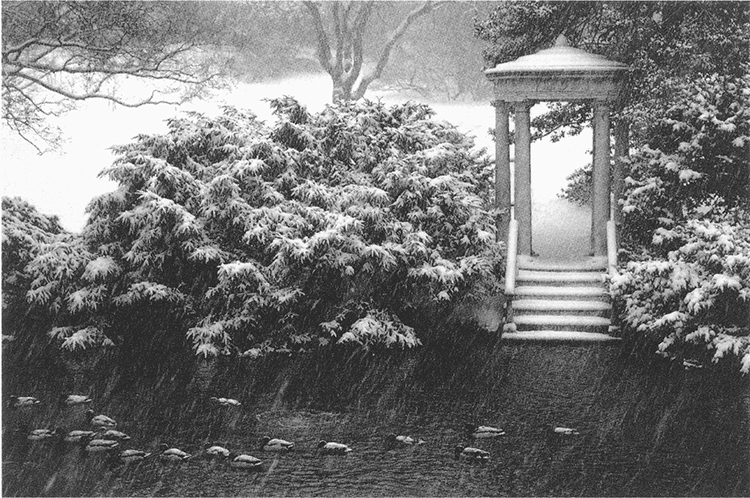
As part of the Morrises’ efforts to place sculptures in their garden, they commissioned a Love Temple to sit next to a pond on their estate in 1906. They contacted Italian sculptor Ernesto Ermete Gazzeri, who had designed neoclassical sculptures in many countries in Europe and the Americas. Mr. Gazzeri took a page out of the ancient treatise of Vitruvius and designed a small structure with a circular footprint. Though the temple featured many aspects of ancient Greek architecture, like classical columns and “egg and dart” capitals (the top segments of columns), Mr. Gazzeri also differed from strict Greek architecture by including a stepped roof.
John Morris may have sketched out a preliminary design for the temple himself. Mr. Gazzeri carved the temple out of white marble at his studio and it was installed at the estate, where it became the subject of many idyllic photos. Thirteen years later, Mr. Gazzeri would design an identical structure in Podensac, France, to shelter a statue of Venus.
Lydia Morris bequeathed her estate to the University of Pennsylvania in her will upon her death in 1932. The arboretum opened to the public in June of 1933 as the Morris Arboretum of the University of Pennsylvania. Today, the Morris Arboretum remains a vibrant and well-curated collection of plant life and art, and Mr. Gazzeri’s Love Temple remains one of its many showpieces.

 The University of Pennsylvania Law School has received a group of gifts totaling $5.7 million in support of the school’s commitments to expanding access to legal education, fostering innovative scholarship and teaching by renowned legal academics. These generous gifts have come in the midst of the Law School’s Power of Penn Law: Advocates for a New Era Campaign, which aims to build upon the Law School’s strengths by broadening access for students and alleviating burdensome debt, adding faculty who are at the forefront of law’s newest frontiers, investing in the school’s academic centers and experiential learning opportunities, and redoubling efforts to launch public-interest careers.
 Mantha Zarmakoupi has joined Penn as the Morris Russell and Josephine Chidsey Williams Assistant Professor of Roman Architecture. Dr. Zarmakoupi is a scholar of ancient architecture in the Hellenistic and Roman periods whose research addresses the broader social, economic and cultural conditions underpinning the production of architecture and urbanism. She is the author of Designing for Luxury on the Bay of Naples (c. 100 BCE-79 CE), published by Oxford in 2014.
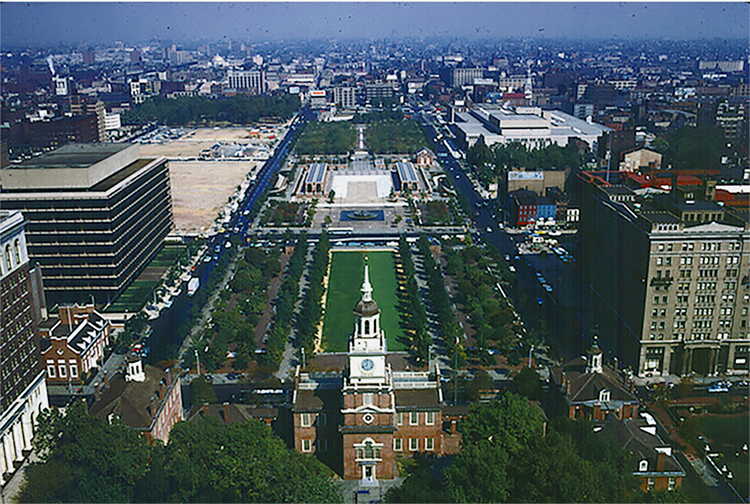 The Fisher Fine Arts Library at the University of Pennsylvania has recently been working with a collection of research and lecture slides donated by former Philadelphia city planner and educator Edmund Bacon before his death in 2005. These photos depict, in vivid color, a series of 1960s and 70s street scenes around Philadelphia as well as images from his travels to other cities around the world. Unfortunately, many of the photos are unidentified.
 David B. Glancey, director of special projects for Penn’s Office of Government and Community Affairs and a longtime city Democratic Party chair who headed the city’s Board of Revision of Taxes, died January 28 at Pennsylvania Hospital from pulmonary disease. He was 74.
 In honor of the late Rev. Dr. Martin Luther King, Jr.’s recognition that local engagement is essential to the struggle for equality, the Dr. Martin Luther King, Jr. Commemorative Symposium on Social Change Executive Planning Committee of the University of Pennsylvania announces the 2019 Community Involvement Recognition Awardees.