LOVE Sculpture and Love Temple

LOVE Sculpture in the Heart of Penn’s Campus
Right in the heart of Penn’s campus stands the University’s famous romantically themed artwork. The LOVE sculpture is one of many iterations of this iconic Robert Indiana image that stand around the world.
Robert Indiana, an eminent pop artist who gained fame in the 1960s, designed the LOVE logo as a Christmas card for the Museum of Modern Art in 1965. However, the image gained fame beyond this limited original use, and by the late 1960s, it had become an icon of the counterculture, with its “erotic, religious, autobiographical, and political underpinnings” (as the MOMA website describes it). In 1970, Mr. Indiana created the first sculpture based on this design, an unpainted steel version that resides at the Indianapolis Museum of Art.
The popularity of this original sculpture encouraged Indiana to recreate it worldwide in a variety of settings, including translations in a variety of languages, such as Chinese and Hebrew. In 1973, the design appeared on a United States postage stamp, and in 1976, a LOVE sculpture was installed at 15th Street and John F. Kennedy Boulevard in Center City Philadelphia. Later renditions of the sculpture were painted red with blue and green trim in reference to Mr. Indiana’s original 1965 design. It was one of these latter sculptures that is here at Penn.
In 1996, Jeffrey Loria purchased a recently-constructed incarnation of the sculpture and donated it to Penn. In the summer of 1999, it was installed in a prominent location at the corner of 36th, Locust, and Woodland Walks in the heart of Penn’s campus (Almanac September 14, 1999). The statue took the place of Tony Smith’s We Lost, which was restored the same year and is today visible at 33rd and Walnut Streets, in front of the Singh Center for Nanotechnology.
Since 1999, the LOVE sculpture has become a centerpiece of Penn’s campus, starring in numerous photos and the gathering place for numerous events, from candlelight vigils to casual meetups. And in 1998, Philadelphia had gained another example of Robert Indiana’s work when the Association for Public Art installed an Amor statue at 18th Street and the Benjamin Franklin Parkway. Indiana’s work continues to spread love every day!

Love Temple at Morris Arboretum
Penn’s campus is well known for Robert Indiana’s famous LOVE sculpture, which has been here for nearly 20 years. However, Morris Arboretum, also part of Penn (although not part of the University City campus) contains another work of love-inspired architecture that is worthy of attention.
In 1887, John Morris and his sister Lydia—children of a wealthy iron magnate—established a summer home in Chestnut Hill. They had a lavish mansion constructed and filled the large plot of land that surrounded it with a diverse and beautiful collection of plants, flowers, trees and sculptures. The Morrises named their estate Compton and dedicated it to knowledge.
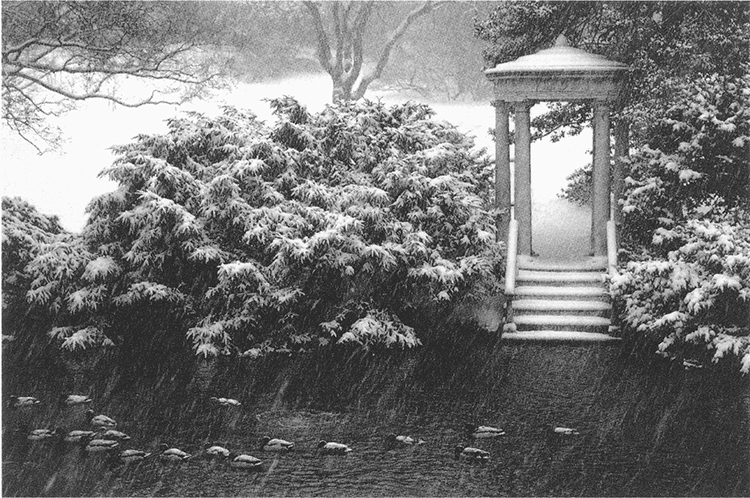
As part of the Morrises’ efforts to place sculptures in their garden, they commissioned a Love Temple to sit next to a pond on their estate in 1906. They contacted Italian sculptor Ernesto Ermete Gazzeri, who had designed neoclassical sculptures in many countries in Europe and the Americas. Mr. Gazzeri took a page out of the ancient treatise of Vitruvius and designed a small structure with a circular footprint. Though the temple featured many aspects of ancient Greek architecture, like classical columns and “egg and dart” capitals (the top segments of columns), Mr. Gazzeri also differed from strict Greek architecture by including a stepped roof.
John Morris may have sketched out a preliminary design for the temple himself. Mr. Gazzeri carved the temple out of white marble at his studio and it was installed at the estate, where it became the subject of many idyllic photos. Thirteen years later, Mr. Gazzeri would design an identical structure in Podensac, France, to shelter a statue of Venus.
Lydia Morris bequeathed her estate to the University of Pennsylvania in her will upon her death in 1932. The arboretum opened to the public in June of 1933 as the Morris Arboretum of the University of Pennsylvania. Today, the Morris Arboretum remains a vibrant and well-curated collection of plant life and art, and Mr. Gazzeri’s Love Temple remains one of its many showpieces.