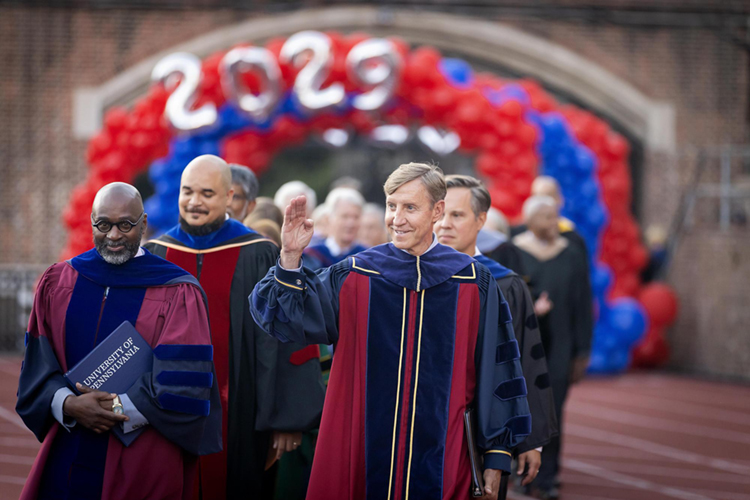
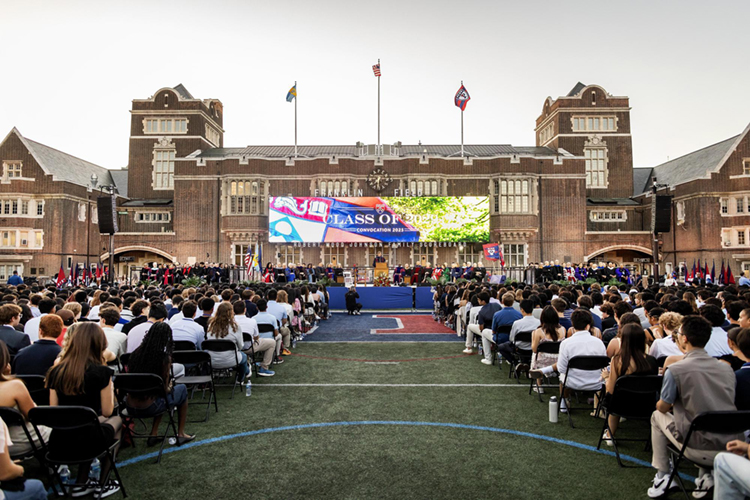
On Monday, August 25, 2025, Penn’s Class of 2029 Convocation was held on Franklin Field.
Illumination, Connection, and Purpose
President J. Larry Jameson
To the Class of 2029 and our newest transfer students: welcome to Penn!
As I prepared these remarks, I found myself thinking back to my own start to college. I had recently returned from a summer of camping in our amazing national parks—Yellowstone, Yosemite, Glacier, and one close to where I grew up, in Asheville, North Carolina—the Great Smoky Mountain National Park.
Deep in the Great Smokies, there is a fleeting, natural phenomenon. Each summer, fireflies light up the forest in a display so mesmerizing that people travel from all around the globe to witness it. The species in the Great Smokies—Photinus carolinus—is especially famous, and I will soon explain why.
Fireflies—or lightning bugs as some call them—are found worldwide. They exhibit bioluminescence—their abdomens blink on and off.
As a scientist and avid observer of nature, I like to draw lessons from our natural environment. For tonight, and the beginning of your Penn experience, there are three qualities of fireflies that I will share with you—the Class of 2029.
First, Illumination:
The Pennsylvania firefly, Photuris pensylvanica, is native to this region. In-season, you may see them nearby at the BioPond or further afield at Penn’s Morris Arboretum. Each flash is a signal—an expression of identity and intent.
Each of you also brings your own identity and brilliance to this community. A passion, a curiosity, a life experience and a perspective that no one else can replicate. Whether through the rigorous pursuit of research, showcasing your talents on the stage, or testing your athletic prowess, at Penn, you will have countless resources and opportunities to shine. In doing so, you will also meet plenty of new people. Which brings me to my second observation.
Connection:
Fireflies do not glow alone. Their light is a form of communication—a way to find one another in the dark. You have been connecting, even before coming to Penn, and especially this week at NSO.
This is just the beginning. Over the next several years, you will form bonds that will shape your life. I know this from speaking with countless alumni who always highlight their Penn network and friends. You will learn from faculty at the forefront of their fields. You may make a friend who becomes family. But connection is not always easy. You will encounter differences—and disagreements. That is an essential part of the Penn experience: learning how to engage across perspectives, to disagree respectfully, and grow through conversations. Finding connection in a global community is at the heart of this place.
I recently asked some Penn students what advice they would give to new students. Maddy said: “The people around you all have crazy amazing stories. You never know who you will meet and how they will change your outlook, so make the connection.” She made it a point to introduce herself to someone sitting nearby.
Well, we are going to act on Maddy’s excellent advice right now. I want us to try something: a quick activity to bring this idea to life before I continue my remarks. Please listen carefully.
You may be sitting with people you already know. When I ask you: please stand up and greet someone nearby you have not met yet. Say hi, exchange names, maybe share where you are from. I will come down and join you too. Alright, here we go.
[Dr. Jameson models the interaction, leaving the stage to greet a few students down the middle aisle while all students engage.]
Please take your seats.
Do you feel that? That is the power of new connections, and it can lead to something even bigger. Which brings me to my third point:
Purpose:
A firefly’s adult life is brief—sometimes just a few weeks—but purposeful. Every moment counts.
Out of 72,000 applicants, you are here because we saw something extraordinary in you. Your purpose at Penn is not nearly as prescribed as a lightning bug’s—which is a good thing. Instead, let me put on my white doctor’s coat for a moment as Dr. Jameson, and give you a formal prescription: embrace the unexpected. That is a key purpose of all Penn people.
Try out for a play. Take a class that scares you a little. Go to a party and keep your phone in your pocket. Another student I spoke with last spring, Rafi, suggested, “When you make unexpected connections and step into the unknown, wonderful—even groundbreaking things—can happen.”
Here is some brilliant—and groundbreaking—proof, and yes, it involves fireflies.
At Penn, researchers have harnessed the enzyme that makes fireflies glow. It is called luciferase. Luciferase is used to track engineered T cells in CAR T therapy, a pioneering, lifesaving cancer treatment invented here at Penn. By adding luciferase to these engineered immune cells, scientists can watch them in real time during lab experiments. This bioluminescent tracking helps make treatments more precise, more effective, and safer for patients.
I want to wrap up by returning to the Great Smoky Mountains, to that dazzling display of thousands of Photinus carolinus lights. What I did not share earlier is that this species is famous because they do something rare: they blink in perfect unison. Most fireflies blink individually. But Photinus carolinus blink together.
That is the potential I see in all of you. You have your own rhythm and brilliance, but together you are capable of something extraordinary. At Penn, that coming together is our greatest strength. We solve problems not by working alone, but by syncing up—across disciplines, backgrounds, and ideas. Collaboration is not just encouraged—it is our superpower.
You will likely experience setbacks and know moments of doubt. But you will also have enormous support here and experience no end to discovery, joy, and growth.
As you begin your journey, remember: Illumination. Connection. Purpose.
Here is to your brilliant beginning. Welcome to Penn!

Celebrate Its Past, Create Penn’s Future
Provost John L. Jackson, Jr.
As Provost—Penn’s chief academic officer—it’s my great pleasure to welcome you this evening.
You are entering the University at a pivotal time: next year marks the nation’s 250th birthday—and it will be Penn’s 287th. As you may know, the creation of Benjamin Franklin’s university was deeply intertwined with the founding of the United States. Several signers of the Declaration of Independence were alumni or trustees of this very university. There is, however, another reason why this particular moment feels charged: American colleges and universities—and indeed higher education more generally—are facing significant headwinds.
Many people are questioning the very purpose and mission of academic institutions: not simply what we teach, our courses and subjects. But also how we learn, together, in this community: the ways we consider different ideas, backgrounds, and experiences, and how those differences shape us, create knowledge, and inform our worldview.
You didn’t choose Penn because you imagined that you could avoid engaging with perspectives and opinions different from your own. Or because you assumed that what you take for granted about the world would never be tested or challenged. Or because you longed for homogeneity in your social network and intellectual pursuits. If anything, Penn should have stood out because it attracts so many different kinds of learners and teachers and researchers from all over the country and the world.
Aside from being Provost, I’m an anthropologist. I would argue, anthropologically speaking, that at a certain fundamental level, human beings need and crave difference, even if it sometimes scares us, because that is how we learn and grow. We encounter (or create) something novel, study it, absorb it, and then we seek out the next emergent thing, even as we go back, again and again, to revise and perfect some of what we thought we already knew.
My hope for you over these next four years is straightforward: that you will come to view your Penn education not as a destination, but as an exceptionally robust launching pad—as a series of investigations of what’s new and ever-evolving—and maybe even what’s impossible to fully grasp quite yet. And that you allow those investigations, those curiosities, those questions, existential and otherwise, to lead you in unexpected directions.
Current concerns about education may seem far removed from those of the 18th century. In fact, debates about the methods and purpose of advanced study are as old as Penn—not to mention disagreements about then-novel concepts like religious freedom and free speech. Penn was the first colonial college without theological training, and with most classes taught in English, not Latin. Franklin wanted his school in the city, and he specified a non-denominational college. Yet it wasn’t long before disagreements and infighting led most non-Anglicans to be pushed aside. Franklin was not pleased. And one year, a student—a young man named Francis Murray—was censured for his speech. Murray’s offense? Speaking positively about John André, a British Loyalist. That was in 1781.
So yes, then—as now—contentious debates, especially about religion and acceptable speech, roiled higher education. And it is easy to understand why. Exploring and understanding our world mandates debate. There are guardrails, as there must be. But investigation requires us to examine differing viewpoints. And it absolutely demands that we each sincerely question our own. When education is withheld—or even controlled through political or other means—human progress suffers.
Someone once argued that anyone who teaches others should not feel that mission as “mean, inferior, or circumscribed. [Neither] politics nor religion present to us a calling higher than this primary business of unfolding and strengthening the powers of the human soul. It is a permanent vocation.” That’s not Franklin or another early Penn leader. Those are the words of abolitionist Frederick Douglass, in 1894; a time when difference meant education was still denied, by law, to many.
Fortunately, that era has passed. Yet his sentiment remains true. Your Penn education is a time of opening—Douglass’s unfolding—of your mind and spirit; a time to be excited, and joyful, and likely even a little nervous about some of the differences you’ll encounter.
Take this time to examine the new and distinct opportunities Penn has to offer: the thousands of courses, hundreds of student and affinity groups, athletics (Franklin Field and the Palestra next door are iconic, so don’t graduate without creating exciting moments you will never forget cheering on all of our Penn Quaker teams), our cultural centers, and of course this amazing city, birthplace of our nation—and of the cheesesteak.
And finally: get involved! Be a part of our community. It’s no coincidence that before there was a United States, the College of Philadelphia graduated not just good students but good citizens: young people who were active and engaged in debates about speech, liberty, and democracy. Those debates are as crucial today as they ever were way back then. Speak your mind, respectfully, and allow others to speak theirs. When you listen—carefully, actively, sincerely—you will always learn something valuable.
250 years ago, this country was just getting started on a remarkable trajectory. Tomorrow, it’s your turn.
Members of the Class of 2029 and transfers, welcome to Penn.

 Emily Steiner has been named the A.M. Rosenthal Professor of English in the School of Arts & Sciences. Dr. Steiner joined Penn’s department of English in 1999 and served as the Rose Family Endowed Term Professor of English from 2021 until her appointment to the Rosenthal Professorship.
 Penn Arts & Sciences welcomes Tianquan “Tim” Lian as the John H. and Margaret B. Fassitt Professor of Chemistry in the School of Arts & Sciences. Coming to Penn from Emory University, where he served as the William Henry Emerson Professor of Chemistry, Dr. Lian will join Penn’s Vagelos Laboratory for Energy Science and Technology. He is the editor-in-chief of the Journal of Chemical Physics and a member of both the American Chemical Society and the American Physical Society.
 Ivan Drpić has been named the inaugural Cecil L. Striker Associate Professor of History of Art in the School of Arts & Sciences. Dr. Drpić joined the Penn faculty in 2017 and is currently serving as the undergraduate chair of the department of history of art.
 The Graduate School of Education has named John Silvanus Wilson, Jr.—a nationally recognized leader in higher education—as the next executive director of the McGraw Center for Educational Leadership. Dean Katharine O. Strunk, the George and Diane Weiss Professor of Education, announced the appointment on August 27, with Dr. Wilson set to begin his role on September 2.
  Douglas C. Ewbank, an emeritus research professor of sociology and the former associate director of Penn’s Population Studies Center and the Population Aging Research Center, died on July 22. He was 77.
 John Calvin Hover II, C’65, WG’67, a former Penn trustee and chairman of the advisors of the Penn Museum, died on July 18. He was 82.
  Claire Lee, a rising junior in Penn Nursing, died unexpectedly on August 20.
 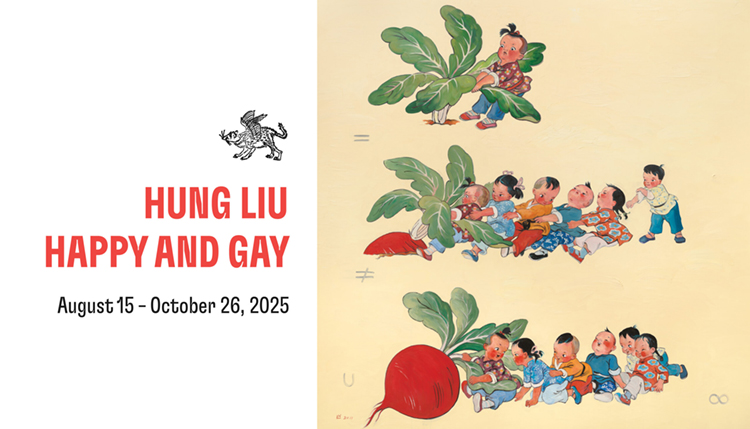 Born in Changchun, China in 1948, Hung Liu experienced war, famine, and political turmoil before emigrating to the United States in 1984. Coming of age during the era of Mao Zedong, Ms. Liu was sent to the countryside, where she lived and worked on a communal farm for four years for “proletarian re-education” during the Cultural Revolution (1966-76). Trained as an artist in the official Socialist Realist style, Ms. Liu was accepted to graduate school in the visual arts department of the University of California, San Diego, but was denied a passport by the Chinese government for four years. At UCSD, she studied with influential feminist art historian Moira Roth as well as with conceptual artist Allan Kaprow, who invented “Happenings,” live performances that combined elements of painting, music, dance, poetry, and theater. At the time of her death in 2021 she was a professor emerita at Mills College at Northeastern University, where she taught for twenty-four years.