From the Interim Chair of the Board of Trustees: J. Larry Jameson: Interim President of the University of Pennsylvania
December 12, 2023
Dear Members of the Penn Community,
 I write to share that J. Larry Jameson has graciously agreed to serve as interim president of the University of Pennsylvania, effective immediately. Dr. Jameson has served as executive vice president of the University of Pennsylvania for the health system and dean of the Raymond and Ruth Perelman School of Medicine, which together comprise Penn Medicine, since 2011. Jonathan A. Epstein, executive vice dean and chief scientific officer of the Perelman School of Medicine and senior vice president and chief scientific officer of the University of Pennsylvania Health System, will step in as interim executive vice president for the health system and dean of the Perelman School of Medicine.
Penn is fortunate to have the benefit of Dr. Jameson’s experience and leadership during this time of transition. A consummate University citizen and the longest serving current dean, Dr. Jameson is a collaborative, innovative, and visionary leader with extensive engagement with each of Penn’s 12 schools. Among other activities, he chaired the review of the School of Arts and Sciences, as well as the consultative committees for the selection of the provost and the dean of the Wharton School, and served on the Presidential Selection Committee. Dr. Jameson has a deep appreciation for Penn’s values and world-class research, teaching, patient care, and service.
As EVP/dean, Dr. Jameson collaborated with health system leadership to spearhead the development and opening of the Penn Medicine Pavilion, a game-changing patient care facility that was the largest capital project in Penn’s history. In the past year, Dr. Jameson led the development of Serving a Changing World, which outlines the strategic vision and goals for Penn Medicine for the next five years. At Penn Medicine, Dr. Jameson has also championed initiatives that promote excellence on all levels, including faculty recruitment, student success, scholarship and discovery, philanthropic giving, and a culture of inclusion and collaboration. He has led during a time of unprecedented scientific breakthroughs, FDA approved medications, and transformative platform technologies such as CAR-T cell treatment and mRNA-based Covid-19 vaccines.
Before joining Penn Medicine, Dr. Jameson served for four years as dean of the Feinberg School of Medicine and vice president of Medical Affairs at Northwestern University. He first joined Northwestern University Medical School in 1993, as chief of the division of endocrinology, metabolism, and molecular medicine. In 2000, he was named Irving S. Cutter Professor of Medicine and chair of the department of medicine there.
Dr. Jameson received his medical degree with honors and a doctoral degree in biochemistry from the University of North Carolina in 1981. He completed clinical training in internal medicine and endocrinology at the Massachusetts General Hospital in Boston. Before leaving for Northwestern University, he rose through the ranks at Harvard Medical School to become an associate professor of medicine and chief of the thyroid unit at Massachusetts General Hospital.
An accomplished physician-scientist, Dr. Jameson has pioneered studies of the genetic basis of hormonal disorders, and he is the author of more than 350 scientific articles and chapters. He is an editor of Harrison’s Principles of Internal Medicine, the most widely used textbook of internal medicine. His work has been published in leading peer-reviewed journals, including the New England Journal of Medicine, Nature Genetics, Science, and the Journal of Clinical Investigation. He has served as president of the Endocrine Society and the Association of American Physicians, and recently chaired the board of directors of the American Association of Medical Colleges. Dr. Jameson has received many distinguished awards, including the Van Meter Award from the American Thyroid Association, the Koch Award from The Endocrine Society, and the Sheen Award from the American College of Surgeons. Dr. Jameson is a member of the American Academy of Arts and Sciences and the National Academy of Medicine.
Please join me in thanking Dr. Jameson for stepping into this role and for guiding Penn during this challenging time.
—Julie Beren Platt
Interim Chair, University of Pennsylvania Board of Trustees
Ramanan Raghavendran: Chair of Penn Board of Trustees
 On January 4, 2023, Ramanan Raghavendran was elected chair of Penn's Board of Trustees, effective immediately. Mr. Raghavendran succeeds Scott L. Bok, who served as chair from July 2021 until he stepped down in December 2023. Julie Beren Platt, who had served as interim chair, returns to her role as vice chair.
Mr. Raghavendran, a Penn alumnus, is the managing partner and co-founder of Amasia, a global venture capital firm focused on climate and sustainability.
“Ramanan Raghavendran is an inspired and inspiring choice for Trustee board chair,” said Penn Interim President J. Larry Jameson. “With three Penn degrees, devoted University engagement in multiple leadership roles, and professional experience in a rapidly changing business environment, he is poised to partner with other distinguished trustees to support our University’s important and impactful missions. Ramanan has a history of bridging distance to make a lasting difference, whether between places and people or fields of knowledge.”
“I also thank Vice Chair Julie Beren Platt on behalf of Penn for her extraordinary service as interim board chair,” Interim President Jameson added.
“Having worked closely with Ramanan as a member of the Executive Committee, I have seen first-hand his passion for and commitment to Penn,” said Ms. Platt. “He is someone who listens with intention and invests deeply in relationships. I am delighted that he will serve as the next chair of Penn’s Board of Trustees, and I look forward to working alongside him as vice chair.”
“I believe great American universities, like the University of Pennsylvania, are the most important repositories of all that defines, and is good and laudable about, our modern civilization,” said Mr. Raghavendran. “I am honored to take on the role of chair of Penn’s Board of Trustees. I am humbled by the trust reposed in me by my fellow trustees. We are united in supporting the mission of this incredible institution.”
Mr. Raghavendran’s career in venture capital and growth equity spans more than 30 years. He has held investing roles at General Atlantic, Insight Partners, TH Lee Putnam Ventures, and Kubera Partners. He began his professional career at McKinsey & Company.
Mr. Raghavendran currently serves on the board of SF Goodwill. He also serves on the advisory council of the Natural Capital Project at Stanford University. He has been a seed funder and board member of several NGOs over the last three decades, and maintains a close affiliation with Magic Bus, which works with 500,000 at-risk children in South Asia.
Mr. Raghavendran became a Penn Trustee in 2014. He was appointed chair of the Local, National and Global Engagement Committee in 2020 and joined the Executive Committee in 2022. He has served on the School of Arts and Sciences’ Board of Advisors since 2012, becoming chair in 2022. Mr. Raghavendran is also a member of the advisory board of the Center for the Advanced Study of India and the Global Coordinator of the Penn Alumni Ambassador Program.
Mr. Raghavendran resides in the San Francisco Bay Area with his family. He holds three Penn degrees, including a BSE in computer science and engineering from Penn Engineering, a BS in economics from the Wharton School, and a master of liberal arts from Penn Arts and Sciences. He is currently enrolled in Stanford University’s master of liberal arts program.
A Message from the Interim President: Like You, I Love Penn
December 12, 2023
To the Penn Community,
I am honored that the Board of Trustees has asked me to serve as Penn’s Interim President. I accept this responsibility clear-eyed about the challenges facing our University.
Like you, I love Penn.
I have dedicated many years of my life to this amazing institution. I have been honored to serve as executive vice president of our health system and dean of the Raymond and Ruth Perelman School of Medicine for more than 12 years.
I know many of you but certainly not all. In the coming weeks and months, I look forward, with curiosity and an open mind, to learning from you and to sharing my own views with you. I am trained as a physician—healing is in my nature and skill set. I also trained as a scientist—hard-wired to ask challenging questions, pursue rigorous inquiry and debate, and ready to be proven wrong. I am a Penn parent, and I have had the pleasure of watching incredible students grow, explore their passions, and chart a path to make an impact on the world. My leadership role at Penn has exposed me to its unparalleled breadth of expertise and diversity of thought. It is humbling but invigorating to consider how I, and other leaders at Penn, can support each of you.
The last few weeks have been a profoundly painful chapter for our institution, for higher education, and for the world. I know these recent leadership transitions have been distressing and destabilizing. I feel it myself. There is pain, fear, and uncertainty in our community. I want to reiterate that every person at Penn should feel safe and be secure in the knowledge that hate has no home here. This is fundamental, but it is not enough. Together, we create and share values that make the University of Pennsylvania an institution where creativity flourishes, innovation creates new tools and medicines, civil debate poses and addresses challenging societal questions, and learning prepares us all to make the world a better place.
All of us—faculty, students, staff, alumni, caregivers, and the many friends of this University—can contribute to a new chapter in Penn’s nearly 300-year history. I have experienced the strength and solidarity that defines this remarkable place. With respect for one another, support for one another, and adaption to our changing world, Penn can truly lead in this moment, and emerge better and stronger than before. I hope you will join me in this important work and come together to support one another and the University we love.
—J. Larry Jameson, Interim President, University of Pennsylvania
Coltons: $1 Million Gift to “Let the Healing Begin”
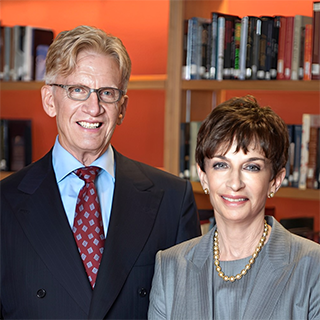 On December 20, 2023, the University of Pennsylvania announced an unrestricted $1 million gift from Stewart Colton, W’62, and Judy Colton, in support of the early work of Interim President J. Larry Jameson during a time of transition. The commitment signifies the Coltons’ strong belief in Interim President Jameson’s leadership and the University’s enduring strengths, and their hope that others will join them in coming together for Penn.
“When Larry was named Interim President, I was immediately focused on how we could support him, and in doing so, support Penn at a time when the University needs us,” said Stewart Colton. “As a physician, Larry is naturally oriented toward healing, and I see this as an important moment for us to come together. Throughout all the challenges the University has faced in recent months, we felt it was critical to stand by Penn and support the University. We feel this even more strongly today.”
It is rare for Penn to receive completely unrestricted gifts at this level, and Mr. Colton acknowledged that he trusts Interim President Jameson to determine the best use of these funds. “I believe in creating goodwill with our philanthropy, and I offered this gift hoping that it will serve as a catalyst for others to contribute in the months ahead.”
“I am grateful for Judy and Stewart’s generosity, and I am humbled by their support,” said Interim President Jameson. “This has been an enormously challenging time for Penn and, as we undertake the important work of this moment and look to a stronger future, a gift like this is impactful and encouraging to all who care about our University.”
This gift adds to the Coltons’ generous support of Penn. Their first gift established the Colton Center for Autoimmunity in 2021 (Almanac December 7, 2021), and a year later, an additional gift accelerated the center’s advancements for driving collaborative, innovative autoimmune disease research (Almanac October 4, 2022). With the Colton Center, Penn joined the Colton Consortium alongside New York University, Yale University, and Tel Aviv University, whose shared mission is to use the complementary strengths of each institution to elevate the field of autoimmunity. The Coltons are among the University of Pennsylvania’s most dedicated supporters; their lifetime giving to Penn exceeds $60 million.
Adapted from a Penn Today story by Ron Ozio, December 20, 2023.
Penn Engineering: $2 Million NASA Grant for TRUSSES Research
 The University of Pennsylvania has been awarded a $2 million grant from NASA to conduct groundbreaking research on lunar robotics. The TRUSSES Project (Temporarily, Robots Unite to Surmount Sandy Entrapments, then Separate), led by Cynthia Sung, the Gabel Family Term Assistant Professor in Mechanical Engineering and Applied Mechanics (MEAM) at Penn Engineering, aims to develop innovative methods for teams of robots to overcome environmental hazards on the Moon.
Under the TRUSSES Project, the robots will attach to one another, forming larger and more stable structures to navigate treacherous terrains. Using their interactions with the ground, the robots will create a comprehensive map of the topography, enabling them to plan safe paths and avoid potential navigation failures.
“Future lunar exploration demands the ability to navigate challenging terrains, including steep slopes, loose regolith, and potentially ice,” said Dr. Sung. “Our research will focus on developing new algorithms that allow robots to estimate ground properties through locomotion, enabling them to autonomously assess traversal risk and recover from any navigation failures.”
The TRUSSES Project will be carried out by a team of researchers from Penn Engineering, based out of the General Robotics, Automation, Sensing and Perception (GRASP) Lab, as well as researchers at the University of Southern California (USC). This collaboration will use the expertise of various fields to tackle the complex challenges of lunar exploration.
“We are thrilled to have the opportunity to lead this groundbreaking research funded by NASA,” said Dr. Sung.
From the University Leadership: Penn & Philly Website Launched
We are pleased to announce the launch of Penn & Philly, an initiative to catalogue and communicate the array of community partnerships generating social and economic impact in West Philadelphia and across the city. This initiative is an example of Penn’s role as an anchored university, described in our new strategic framework, In Principle and Practice, and of our institutional responsibility to serve as “an excellent Philadelphia neighbor and global citizen.” Penn & Philly is deeply rooted in Penn’s enduring commitment to community engagement and the mutual benefits flowing between and among our neighbors, faculty, students, and staff for more than 40 years. It is a new platform for telling these stories and testifying to the evolution of these longstanding partnerships.
After two years of interviews with neighbors and community partners, six areas emerged as the essence of Penn’s connections to Philadelphia:
- Public Education (collaborations between Penn and the School District of Philadelphia)
- Healthy Communities (how Penn advances Philadelphians’ overall health, safety, and well-being)
- Knowledge in Action (how Penn’s research contributes to innovative, practical solutions to Philadelphia’s biggest challenges)
- Arts, Culture, & Recreation (the city’s artistic and creative experiences)
- Economic Opportunity (workforce and economic development programs, as well as employment opportunities)
- Tomorrow’s Industries (how Penn encourages and advances knowledge in Philadelphia, a city where life sciences thrive)
The Penn and Philly website will be an active repository of curated, Philadelphia-forward content. You can also follow Penn & Philly on Instagram (@pennandphilly) and engage with the campaign by liking and sharing posts. We encourage you to learn more about Penn’s decades-long dedication to community engagement, socioeconomic advancement, and the belief that institutions of higher learning can and should be catalysts for positive change in our communities.
Please feel free to send questions, comments, and/or feedback to: pennandphilly@upenn.edu.
—J. Larry Jameson, Interim President
—John L. Jackson, Jr., Provost
—Craig Carnaroli, Senior Executive Vice President
Penn Global’s Strategic Framework for Initiatives, 2023-2028
2022 marked ten years since the adoption of Penn’s first global strategic framework and the establishment of Penn Global. In the decade since 2012, the University has been transformed as a preeminent global institution. International student enrollment has increased by more than 50% to nearly 7,000 and an average of 2,500 students have studied abroad for credit each year. In addition, nearly 1,400 faculty have reported research, teaching, and other activities across all seven continents. We have also witnessed the strategic expansion of global programming opportunities, such as Penn Global Seminars and the Global Research and Internship Program, establishment of global hubs in Perry World House and the Penn Wharton China Center, and investment in the people, ideas, and partnerships of Penn through key initiatives like the Holman Africa Initiative and the China and India Research and Engagement Funds.
Our continued success as a leading global university depends on our deepening commitment to global engagement going forward. Our new strategic framework builds upon the achievements of the first ten years with an eye towards expanding existing signature initiatives and piloting new, innovative programs. The framework also commits to making global engagement more accessible and inclusive for our students, faculty, and scholars than ever before. Above all, this framework reinforces Penn Global’s mission of bringing the world to Penn and Penn to the world.
At its core are three pillars: (1) ensure every Penn student has a meaningful global experience; (2) produce research for global impact; and (3) advocate for global engagement, rebuilding and strengthening Penn’s global networks. Each pillar is discussed in more detail below.
Pillar 1: Ensure every Penn student has a meaningful global experience.
All Penn students, including graduate and professional students, will have global experiences, either in the United States or overseas, fostering a deeper understanding of diverse people, cultures, and ideas. Under this pillar, we will:
- Continue to grow our robust suite of study abroad opportunities, including semester study abroad, global research programs, and embedded global seminars.
- Augment study abroad opportunities for Penn students, particularly graduate and professional students and underrepresented, less-traveled students.
- Collaborate with our campus and international partners to strengthen existing or pilot new programs designed to meaningfully deepen students’ global engagement throughout their time at Penn. New programs will include but are not limited to: summer credit-bearing opportunities, summer policy institutes, a global studies program, and a gap-year initiative.
Pillar 2: Produce research for global impact.
Penn’s broad range of global insights are positioned to inform the most pressing challenges facing our world. Penn Global supported programs will strengthen links between research and policy to generate new knowledge and amplify impact. Under this pillar, we will:
- Expand the scope of Perry World House’s impact by cultivating a strong roster of visitors with an emphasis on diverse perspectives, experiences, and backgrounds; piloting a professorship program in partnership with Penn schools to recruit faculty with global backgrounds; and developing new programs including a global human rights program or debate series.
- Promote research and engagement (including among graduate, professional and post-doctoral researchers) in key regions and on cross-border issues around the world through new and existing global funds.
- Develop initiatives to highlight and support graduate, professional, and postdoctoral research with global dimensions.
- Strengthen linkages and partnerships with our campus and international partners to support, leverage, and increase global engagement and research for impact.
Pillar 3: Advocate for global engagement, rebuilding and strengthening global networks.
There is an urgent need to reengage and reinvest in global partnerships and relationships. Advocacy for international student mobility and global research are critical to Penn’s continued preeminence and to ensuring inclusion and diversity. Under this pillar, we will:
- Support the global strategies of Penn schools, centers, and institutes, with an eye toward prioritizing diversity, inclusion, and access.
- Support Penn participation in multilateral dialogues related to pressing global challenges, such as climate, human rights, housing and development, etc.
- Establish a University strategy on immigration advocacy to proactively engage policies and processes that support international student and scholar mobility.
- Collaborate with campus partners to develop and expand the provision of online education opportunities, such as Penn’s new Global Learners Program, which serves displaced learners abroad through online offerings.
PennAITech Collaboratory to Fund Ten New Pilot Studies on Aging
The Penn Artificial Intelligence and Technology Collaboratory for Healthy Aging (PennAITech)—made up of faculty members from Penn’s School of Nursing, the Perelman School of Medicine, and other departments across Penn—focuses on identifying developing, evaluating, commercializing, and disseminating innovative technology and artificial intelligence methods/software to support aging. This is year two for the collaboratory—made possible through a grant from the National Institute on Aging—and it is providing more than $2.3 million in funding to ten pilot projects.
This year’s awardees are:
- Advancing Diagnostic Excellence for Older Adults Through Collective Intelligence and Imitation Learning (Gary Weissman, University of Pennsylvania)
- GlucoCheck: A Non-Invasive & AI-Assisted Blood Glucose Monitoring Device for Older Adults (Maria Valero, Kennesaw State University)
- Real-Time Remote Monitoring of Confirmed Medication Adherence (Tony C. Carnes, etectRx)
- A Speech-Processing Algorithm for Automatic Screening of African American Patients with Mild Cognitive Impairment and Early Dementia in Home Health Settings (Maryam Zolnoori, Columbia University Medical Center and VNS Health)
- A Device-Free Wifi Sensing System to Assess Daily Activities and Mobility in Low-Income Older Adults With and Without Cognitive Impairment (Jane Chung, Virginia Commonwealth University)
- Non-Intrusive, Fine-Grained In-Home Daily Activity Transcription for Alzheimer’s Monitoring (Xinyu Zhang, University of California San Diego)
- Fairness and Robust Interpretability of Prediction Approaches for Aging and Alzheimer’s Disease (Aidong Zhang, University of Virginia)
- Talking Tech with Dementia Care Dyads: Improving a Self-Administered Tool to Support Informed Decision (Clara Berridge, University of Washington)
- Prevention of Patch Poisoning in Elderly Alzheimer’s Patients (Sandeep Patil, Vaaji LLC)
- Health App Review Tool: Connecting those Affected by Alzheimer’s to Needed Technology Support (Julie Faieta, University of Pittsburgh)
The Collaboratory Pilot Core invites applications for pilot studies using technology and artificial intelligence (AI) to optimize care management and health outcomes for all older Americans, including those with Alzheimer’s Disease and Related Dementias (ADRD) living independently, and those receiving clinical care or skilled home and community-based services.
The goals of this pilot program are to solicit, select and oversee pilot studies that design and test cutting-edge technology to support aging and to foster collaborations among affiliated Penn investigators and a network of scientists and clinicians in peer institutions, research centers, industry partners and home and community-based services nationally.
“We are excited to see the PennAITech pilot portfolio grow with awardees that foster cutting-edge solutions and innovation to make a difference for older adults and their families. Penn is uniquely poised to support them in this journey,” said George Demiris, a Penn Integrates Knowledge Professor with joint faculty appointments in Penn Nursing’s department of biobehavioral health sciences and the department of biostatistics, epidemiology, and informatics in Penn’s Perelman School of Medicine and one of the principal investigators of PennAITech.
Jason Karlawish, a professor of medicine, medical ethics and health policy, and neurology; co-director of the Penn Memory Center and associate director of the Alzheimer’s Disease Research Center in the Perelman School of Medicine; and co-principal investigator of PennAITech, added, “We are looking forward to working with these Year 2 investigators to develop comprehensive and innovative solutions for aging that address not only technical but also clinical, ethical and policy implications.”

.png) Luis Blasco, a pioneer in infertility treatment and a professor emeritus in the department of obstetrics and gynecology in the Perelman School of Medicine and the Hospital of the University of Pennsylvania, died peacefully on October 23, 2023 from metastatic pancreatic cancer. He was 85.
Luis Blasco, a pioneer in infertility treatment and a professor emeritus in the department of obstetrics and gynecology in the Perelman School of Medicine and the Hospital of the University of Pennsylvania, died peacefully on October 23, 2023 from metastatic pancreatic cancer. He was 85. .jpg) James Loeb Dannenberg, D’48, a former professor of endodontics and pediatric dentistry at Penn Dental Medicine, died on December 17 from a perforated colon. He was 97.
James Loeb Dannenberg, D’48, a former professor of endodontics and pediatric dentistry at Penn Dental Medicine, died on December 17 from a perforated colon. He was 97. .jpg) Robert Louis Pfaltzgraff, WG’58 Gr’64, a former assistant professor of political science in the School of Arts & Sciences, died peacefully on November 17, 2023. He was 89.
Robert Louis Pfaltzgraff, WG’58 Gr’64, a former assistant professor of political science in the School of Arts & Sciences, died peacefully on November 17, 2023. He was 89.  Pamela Z. Cacchione, the Ralston House Term Chair in Gerontological Nursing and a professor of geropsychiatric nursing in the department of family and community health in Penn Nursing, and a nurse scientist at Penn Presbyterian Medical Center, will be the 2024 recipient of Penn Nursing’s Norma M. Lang Award for Scholarly Practice and Policy. The award, given every two years to a Penn Nursing faculty member or a graduate from the school’s doctoral program who has made a distinguished contribution to nursing through scholarly practice, honors Norma M. Lang, a professor and dean emerita of Penn Nursing, for her world-renowned contributions to health policy and practice.
 Yi Te (Edward) Lin, GD’ 24, a third-year periodontal resident and lab member at Penn Engineering and Applied Science’s electrical and systems engineering department, received the first-place Scientific Poster Award for Student Excellence at the prestigious Global Symposium on Artificial Intelligence in Dentistry, hosted by Harvard University’s School of Dental Medicine.
 Penn Nursing’s Alexandra Maye, a PhD student and NIH T32 pre-doctoral research fellow in the Center for Health Outcomes and Policy Research (CHOPR), has been selected to participate in one of the Robert Wood Johnson Foundation’s leadership programs. These leadership programs connect changemakers across the country—from diverse professions and fields—to learn from and work with one another to create more just and thriving communities.

 David Allman, a professor of pathology and laboratory medicine, and Dan Vogl, an associate professor of hematology-oncology and director of the Abramson Cancer Center Clinical Research Unit, have received an ASPIRE award from the Mark Foundation for Cancer Research for their project on survival pathways in multiple myeloma.
 Gregory Chen, a resident in clinical pathology, has been named to Forbes’ annual “30 Under 30” list for scientists for his work exploring CAR-T cell therapy. He was recognized for his role in the discovery that a single dose of CAR-T cells can hold cancer in remission for a decade or more.
 Susan Mandel, chief of endocrinology, diabetes, and metabolism and the Sylvan H. Eisman Professor of Medicine II, has been elected secretary-elect of the International Society of Endocrinology. Dr. Mandel will serve as secretary-elect from 2024-2025, and then as secretary from 2025-2027. The International Society of Endocrinology, a federation of over 40 international endocrine societies, aims to promote endocrine care and education. Dr. Mandel, whose career spans over three decades, was a former president of the U.S.-based Endocrine Society.