News

From the President, Provost and Executive Vice President: A Message to the Penn Community Regarding Violence and Anti-Asian Hate Incidents

March 17, 2021

During the COVID-19 pandemic, our country has witnessed an alarming and deeply troubling surge of violence, hatred, and discrimination directed at Asians and Asian Americans. We write today to denounce this appalling prejudice and to assure our students, faculty, staff, and postdocs of Asian descent that Penn is unwavering in our commitment to providing you with a safe, welcoming, and supportive campus environment.  

We are enormously proud of the large, vibrant, and diverse Asian community at Penn. We are equally proud of the myriad contributions our Asian community makes to the striking success of our University. Penn has numerous programs aimed at supporting our international and Asian American students. Just this past year, we formed a Task Force on Support for Asian and Asian American Students and Scholars to coordinate and enhance support to members of the Penn community experiencing increased stigma, bias, discrimination, and violence during the COVID-19 pandemic. We encourage all members of the Penn community to join the Task Force’s #FlattenTheHate Campaign. You can find information about important support resources and read about the campaign and the important work of the Task Force here: https://global.upenn.edu/global-initiatives/task-force-support-asian-and-asian-american-students-scholars

Please be assured that among our highest priorities is ensuring the safety of all our students, faculty, and staff while fostering a campus community that is rich in our diversity, respect, and tolerance for all groups from every nationality, religion, race, creed, and sexual orientation. We cannot state more clearly or forcefully that we will not tolerate discrimination, hatred, intimidation, or violence that is directed at any member of our University community. 

Sadly, we know that discrimination against Asians in America is not a recent development. At this time of great stress for Asian citizens and visitors across the country, we want those of Asian descent who are part of our Penn community to know that we stand strongly and proudly with you. We are committed to working together to address this racism and hatred. We are grateful that you are part of our university community, and we offer our full support at this most difficult and trying time.  

Resources and Support

If you have any doubt about where to turn, Penn’s HELP Line is available 365 days a year, 24 hours a day, at (215) 898-HELP.  

—Amy Gutmann, President 
—Wendell Pritchett, Provost 
—Craig Carnaroli, Executive Vice President 

From the President, Provost and Executive Vice President: A Message to the Penn Community Regarding Plans for the Fall Semester

March 16, 2021

Throughout the pandemic, protecting the health and safety of Penn faculty, staff, and students, and pivoting to the least restrictive ways of supporting our core educational, research, and clinical missions have been our primary considerations. This past year we were able to move with extraordinary speed to establish a virtual learning environment that was accessible and effective in delivering world-class instruction, and then in developing protocols, such as the Student Campus Compact, that allowed the safe return to some on-campus operations. 

Now, as we look forward to the fall semester, we want to share our current thinking so that students, families, faculty, and staff can begin to make plans. With the widespread distribution of the COVID-19 vaccine now underway, with projections of more ample supply in the several months ahead, and with the many safeguards we have been able to establish on campus, at this time we expect to be able to return to an in-person teaching, research, and residential environment for the fall of 2021. This will include the return to campus of staff who have been working remotely during the pandemic.  

Specific details regarding the fall semester are still being developed and will be shared with students, faculty, staff, and parents in the coming weeks. It will be necessary to remain vigilant and flexible in our planning, as the pandemic could take unpredictable turns. But we are committed to a return to operations, to in-person research, and to an in-person living and learning experience for our students.  

We are enormously grateful for the commitment and sacrifices that have been made by faculty and staff in seeing us through the most difficult days of the pandemic. During this time, we have learned a tremendous amount about the use of technology for the delivery of instruction. That knowledge makes possible complete access to course material for all students, including those who, for whatever reason, may not be able to be present on campus in the fall. 

We are thrilled to be able to bring our academic community back together to continue our critically important missions of research, teaching, learning, and patient care. While this has been a challenging time, it has also been an inspiring time of discovery and innovation. There is no greater example of this than the groundbreaking work of Penn faculty members Drew Weissman and Katalin Karikó, which has proved instrumental in the development of COVID-19 vaccines, making possible a return to normalcy in our lives. We look forward to the fall with anticipation and hope for the next great discoveries to come out of Penn’s labs and new opportunities to learn, connect, and grow here in Philadelphia. 

—Amy Gutmann, President 
—Wendell Pritchett, Provost 
—Craig Carnaroli, Executive Vice President 

Guobin Yang: Interim Director, Center for Advanced Research in Global Communication

caption: Guobin YangGuobin Yang, Grace Lee Boggs Professor of Communication and Sociology at the Annenberg School for Communication at the University of Pennsylvania, has been named Interim Director of the Center for Advanced Research in Global Communication (CARGC). 

CARGC was directed by Marwan Kraidy from 2013 until June 2020, when Dr. Kraidy left the University to become Dean and CEO of Northwestern University in Qatar.

Dr. Yang, whose work focuses on online activism, social movements, and digital cultures in China and beyond, will serve as CARGC’s faculty lead, working collaboratively with CARGC staff and fellows in the interim period. In addition to CARGC, Dr. Yang also serves as Associate Dean for Graduate Studies and director of the Center on Digital Culture and Society at Penn, where he is also deputy director of the Center for the Study of Contemporary China.  

“We are excited to welcome Guobin Yang as Interim Director for CARGC,” said John L. Jackson, Jr., Walter H. Annenberg Dean of the Annenberg School for Communication and Richard Perry University Professor at the University of Pennsylvania. “Guobin’s work and expertise in global communication resonate with CARGC’s mission, and we know that, as interim director, he will continue the innovative work currently happening at CARGC during this interim period.”  

“I’m honored to join CARGC and its community of stellar staff and postdoctoral and predoctoral fellows,” said Dr. Yang. “I will do my best to support the exciting scholarship that is going on there.”

CARGC is an institute of advanced study that produces and promotes advanced research on global communication and public life, bringing the very best scholarship from all over the world to bear on enduring global questions and pressing contemporary issues. It also incorporated the Center for Global Communication Studies (CGCS), founded and led by recently retired adjunct professor Monroe Price. CGCS was a base from which students and faculty engaged a wide network of regulators, scholars, and practitioners from all around the world.

Penn Benefits Open Enrollment: Monday, April 19-Friday, May 7, 2021

Penn Benefits Open Enrollment is your annual opportunity to make changes to your health plans, life insurance, and flexible spending accounts. While Open Enrollment is still a few weeks away, we want to give faculty and staff plenty of time to learn about the upcoming 2021-2022 plan changes. Be sure to carefully review the Benefits Enrollment Guide that will be mailed to your home soon. 

This year, the Division of Human Resources will provide a few new features during Open Enrollment, including a virtual Open Enrollment Benefits Fair, virtual benefits presentations, and a podcast called The Choice is Yours. Penn provides many other tools and resources to help you make an informed decision. 

Faculty and staff will also experience a new look to the Benefits screens when logging into Workday@Penn to complete the enrollment process. 

For more information about your benefits, visit www.hr.upenn.edu/openenrollment. You’ll have access to benefit comparison charts, contribution charts, and more.

Plan Changes as of July 1, 2021

Met Life Insurance for Dependents–Action Needed

We are now requiring the name of each dependent to be added for the Child Life MetLife Insurance plan. Faculty and staff who have enrolled in the Dependent Life Insurance plan offered through MetLife will have to re-elect the coverage and list any eligible dependent children who are under the age of 26 this year. If you do not re-elect the coverage, you will be defaulted to waive. 

Dependent Life Insurance is available for your spouse and/or your eligible children if you are full-time faculty and staff or a member of a collective bargaining unit. Eligible dependents include: 

  • Your spouse and your unmarried biological or adopted children and stepchildren up to age 26. 
  • Your spouse’s biological and/or adopted children if they meet the age and dependent criteria. 

Flexible Spending Accounts Get Uncapped Rollovers

If you have a Health Care Flexible Spending Account (HCFSA) or Dependent Care Flexible Spending Account (DCFSA), you will be able to roll over all unused funds from the 2020-2021 plan year to the 2021-2022 plan year. DCFSA participants will not receive a grace period to incur expenses after June 30, 2021. The grace period will be replaced by the rollover allowance. You must incur all expenses between July 1, 2020 and June 30, 2021. Claims must be submitted by September 30, 2021

All rollover funds will be available in November 2021. Carefully consider your contribution for the new plan year because the uncapped rollover will not continue into the 2022-2023 plan year. 

Hearing Aid Benefit Added 

A hearing aid benefit has been added to the PennCare/Personal Choice PPO, Aetna Choice POS II, Keystone/AmeriHealth HMO, Aetna High Deductible Health Plan with a Health Savings Account, and the Aetna POS II Standard plans. The benefit is up to $4,000 per participant to be covered as medically necessary, but not more than every three years. For High Deductible Health Plan participants, the deductible must first be met, then participants pay 10%. For part-time and ACA-eligible staff, participants pay 30% after meeting the deductible. This benefit applies to adults and children. 

Additional Vision Plan 

VSP Choice Plan is an additional vision plan that will provide a greater level of benefit for glasses and contact lenses. There will be an additional cost for the enhanced plan, but all other rates will remain the same. 

Medical Rates Increased Slightly 

There will be a slight increase to medical rates for the first time since 2017. Dental rates are not increasing.   

Workday@Penn Upgrade

During Open Enrollment, you can make changes to your benefits coverage 24 hours a day, 7 days a week via Workday@Penn. As a result of a Workday upgrade, the Benefits screens will have a new look starting mid-April. 

Read the Self-Service: Manage, View and Change Your Benefits 2021 tip sheet for instructions on how to navigate the new screens. 

Virtual Open Enrollment Benefits Fair and Benefits Presentations

This year the Open Enrollment Benefits Fair will be held virtually on Tuesday, April 20 and Wednesday, April 21 from 9 a.m. to 3 p.m. Representatives from Penn’s healthcare providers and wellness partners will conduct live presentations and provide recorded presentations that you can access via the Virtual Open Enrollment Benefits Fair website which will be launched during Open Enrollment. 

Five Open Enrollment presentations will also be held virtually on the following dates:

Presentation Date Time
April 7 1:30 p.m.
April 13 12:30 p.m.
April 19 12:30 p.m.
April 28 2:30 p.m.
May 4 12:30 p.m.


To attend one or more of the sessions, click on this link: https://tinyurl.com/open-enrollment-presentations

Additional Resources 

To find out more about Benefits Open Enrollment: 

  • Listen to The Choice is Yours, a new three-episode podcast that will be released during Open Enrollment. 
  • Review the 2021-2022 Benefits Enrollment Guide coming soon to your home address.
  • Visit www.hr.upenn.edu/openenrollment for details and useful tools. 
  • Check out the Benefits Media Library for videos and other helpful documents. You can access the library during Open Enrollment and throughout the plan year.  
  • Contact Human Resources at benefits@hr.upenn.edu or the Benefits Solution Center at 1-866-799-2329, Monday-Friday, 8 a.m. to 10 p.m.

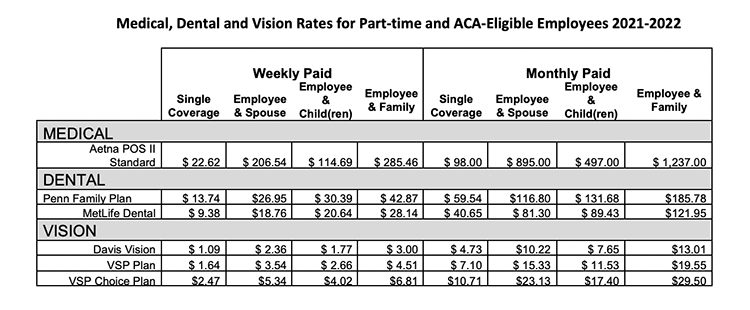
Health Care Rates Chart

Health Care Rates Chart

Pennsylvania’s Full FY 20-21 Budget Enacted

The Commonwealth finalized its full Fiscal Year 2020-2021 on November 23, 2020, following enactment of an interim five-month budget on May 29, 2020 due to the global pandemic. Lawmakers appropriated $31.955 million to the School of Veterinary Medicine in May for the full fiscal year. The Animal Health and Diagnostic Commission, which supports a laboratory at New Bolton Center, and the Penn Working Dog Center received pro-rated funding equal to 42 percent of FY 2019-2020’s appropriations in May, with the remaining 58 percent being appropriated in November.

New Commonwealth Trustee Named

Pennsylvania Senate President Pro Tempore Jake Corman has appointed Vahan Gureghian as a Commonwealth trustee. Mr. Gureghian served in this role previously from February 2009 until March 2015, having been appointed by former House Republican Leader Sam Smith. Commonwealth trustees are four nonelected officials appointed by the following representatives of the Pennsylvania General Assembly: President Pro Tempore and minority leader of the Senate, and the Speaker and minority leader of the House of Representatives, each of whom have the power to appoint one trustee in accordance with Act 25A of 1994.

University of Pennsylvania Class of 2025 Early Decision Program 

The University of Pennsylvania received 7,962 applications under the first-choice Early Decision Program for the entering class of 2025. From this group of students from around the globe, 1,194 students were offered admission, approximately 50% of the expected enrolling class in the fall of 2021.

Nationally, 43 states, Washington, D.C., Puerto Rico and Guam are represented in the class with the highest concentration of admitted students from Pennsylvania (198), New York (152), California (122), New Jersey (113) and Florida (48). Fifty-six students reside in the city of Philadelphia.

Thirteen percent of the class are international students based on their citizenship, hailing from 56 countries ranging from Australia to Zimbabwe.

Fifty-four percent of the admitted students are female, 50% of the admitted students are U.S. citizens/permanent residents self-identifying as a person of color, and 12% are first-generation college students. Twenty-two percent of the admitted students had a parent or grandparent attend Penn in prior generations. Thirteen percent are estimated to qualify for a federal Pell Grant.

Admitted students have pursued a most demanding secondary school curriculum in a range of educational settings. The University of Pennsylvania adopted a test-optional policy with regard to standardized tests for the 2020-2021 application cycle. Twenty-four percent of the Early Decision admitted students did not include testing as part of their application. For the admitted students including testing in their application, the middle 50% testing ranges are 1470-1560 on the SAT and 34-35 on the ACT.

Eric J. Furda, Penn’s former dean of admissions (Almanac June 30, 2020), said, “After a year as unusual and challenging as this one, my colleagues and I were inspired by the resilience, creativity and hopefulness exhibited by these applicants to Penn. We are humbled by their commitment to their studies and to their communities despite the extraordinary circumstances of this past year. We look forward to that spirit enriching the Penn community.”

The University of Pennsylvania enrolls a first-year class of 2,400 students across the College of Arts & Sciences, School of Engineering and Applied Science, Wharton School and School of Nursing.

McGraw Prize: Nominate an Educator for $50,000 Prize

The Harold W. McGraw, Jr. Prize in Education is now accepting nominations for 2021 in three categories: Pre-K-12, Higher Education, and Learning Science Research. The prize celebrates innovation, inspiration, and impact in education by recognizing outstanding individuals whose accomplishments are making a difference in the lives of students. Individuals can be nominated for the $50,000 prize now through 11:59 p.m. ET on April 15, 2021. Employees of the University of Pennsylvania are ineligible for McGraw Prize nomination.

Accepting 2021 nominations now through April 15. Contact info@mcgrawprize.com with any questions.

Governance

From the Senate Office: Minutes of the Meeting of the Faculty Senate

Wednesday, March 17, 2021
3 p.m., held virtually

Background: A meeting of the Faculty Senate was announced in Almanac on February 16, 2021, to consider proposed amendments to the Rules of the Faculty Senate.  A total of 192 members of the Faculty Senate registered their attendance during the meeting; the attendance list is available for inspection by any member of the Faculty Senate by contacting the Senate Office.

Faculty Senate Chair Kathleen Hall Jamieson called the meeting to order at 3 p.m. EDT.  Prof. Jamieson announced two upcoming Faculty Senate Seminars, on April 7 and May 12, respectively, and invited all members of the Faculty Senate to participate and to submit their questions in advance by contacting the Senate Office.

Upon motion and second made to accept the recommended amendments to the Rules of the Faculty Senate as proposed, and there being no further discussion, a vote was taken. A total of 167 votes were cast in favor, and none against, with five formal abstentions.  The motion passed. The amended Rules of the Faculty Senate will take effect on July 1, 2021.

There being no further business, Prof. Jamieson adjourned the meeting at 3:15 p.m. ET.

From the Senate Office: Faculty Senate Executive Committee Actions

Wednesday, March 17, 2021

The following is published in accordance with the Faculty Senate Rules. Among other purposes, the publication of SEC actions is intended to stimulate discussion among the constituencies and their representatives. Please communicate your comments to Patrick Walsh, executive assistant to the Senate Office, either by telephone at (215) 898-6943 or by email at senate@pobox.upenn.edu.

School-level Climate and Sustainability Initiatives. Leaders of the Senate Select Committee on the Institutional Response to the Climate Emergency (CIRCE) welcomed Steven Fluharty, Dean of the School of Arts and Sciences, Andrew Hoffman, Dean of Veterinary Medicine, Erika James, Dean of the Wharton School, and J. Larry Jameson, Executive Vice President of the Penn Health System and Dean of the Perelman School of Medicine, and engaged them a discussion of school-level climate and sustainability initiatives.

Policies

Principles of Responsible Conduct—Online Training Modules and Reminder to the Penn Community

The Principles of Responsible Conduct promote the highest standards of integrity and ethics at Penn. To remind the University community of the basic expectations that should guide our work at Penn, the Principles of Responsible Conduct are published annually and are found below. Everyone at Penn is expected to be familiar with and adhere to the Principles of Responsible Conduct, which can be found on the Office of Audit, Compliance and Privacy website at: https://oacp.upenn.edu/oacp-principles/.

***

The mission of the University of Pennsylvania and its Health System is to offer a world class education to our students, train future leaders, expand and advance research and knowledge, serve our community and society both at home and abroad, and provide the most expert and outstanding health care for our patients. In pursuing this mission, and to ensure the continued excellence of the University and its reputation, all members of the University community need to understand and uphold both legal requirements and the highest ethical standards.

In the following Principles of Responsible Conduct, we articulate the basic expectations that should guide each of us in our work at Penn. These Principles are embedded within many policies and practices identified throughout University and Health System handbooks, manuals, websites, and other materials. We have endeavored to distill these policies, rules, and guidelines for easy review and access. The Principles are not intended to be a comprehensive catalogue of all applicable rules and policies of the University and the Health System. Rather, these Principles set forth the underlying expectations that we have for the conduct of University and Health System activities with the highest standards of integrity and ethics. Useful references to relevant policies and resources are included.

We urge you to read these Principles closely and familiarize yourself with both the expectations and the resources provided.

—Amy Gutmann, President
—Wendell Pritchett, Provost
—Craig Carnaroli, Executive Vice President
—J. Larry Jameson, Executive Vice President for the Health System and Dean of the Perelman School of Medicine

Penn has many policies that govern the behavior of all Penn faculty, administration and staff. The ethical expectations contained in these policies are highlighted in the text of the ten principles that follow, and supporting policies, statements and guidelines are available for each at the corresponding web link.

Principles of Responsible Conduct

1. Ethical and Responsible Conduct. Penn’s faculty, administration, and staff should conduct themselves ethically, with the highest integrity, in compliance with all applicable laws, regulations, and University policies, in all aspects of their work. They should be fair and principled in University and Health System business transactions and other related professional activities, acting in good faith when dealing with both internal constituents and external entities. Their conduct should always reflect their positions of trust and loyalty with respect to the University, the Health System, and members of these communities.
https://oacp.upenn.edu/oacp-principles/ethical-and-responsible-conduct/

2. Respect for Others in the Workplace. Penn recognizes that people are the most important resource for achieving eminence in accomplishing our mission in the areas of teaching, research, community service, and patient care. Penn is an institution that values academic freedom, diversity, and respect for one another. Penn is committed to the principle of non-discrimination and does not tolerate conduct that constitutes harassment on any basis, including sexual, racial, ethnic, religious, or gender harassment.
https://oacp.upenn.edu/oacp-principles/respect-for-others-in-the-workplace/

3. Avoidance of Conflict of Interest. As more fully stated in Penn’s conflict of interest policies, Penn’s faculty, administration, and staff should avoid conflicts of interest in work at Penn. As a non-profit institution, it is imperative, for both legal and ethical reasons, that University and Health System employees do not improperly benefit from their positions of trust at Penn. Financial conflicts must be appropriately disclosed in accordance with conflict of interest and conflict of commitment policies, so that they can be reviewed, and as appropriate, managed or eliminated. Faculty, administrators, and staff are responsible for identifying potential conflicts and seeking appropriate guidance.
https://oacp.upenn.edu/oacp-principles/avoidance-of-conflict-of-interest/

4. Responsible Conduct in Research. As members of a complex research university, Penn faculty, administrators, and staff have significant responsibility to ensure that research is conducted with the highest integrity, and in compliance with federal, state, and local laws and regulations, as well as University and Health System policy.
https://oacp.upenn.edu/oacp-principles/responsible-conduct-in-research/

5. Responsible Stewardship and Use of Penn Property, Funds, and Technology. Penn faculty, administration, and staff are expected to ensure that Penn property, funds, and technology are used appropriately to benefit the institution, consistent with all legal requirements as well as University and Health System policies.
https://oacp.upenn.edu/oacp-principles/responsible-stewardship-and-use-of-penn-property-funds-and-technology/

6. Environmental Health and Safety. Penn is committed to the protection of the health and safety of the University community and the creation of a safe working environment. To accomplish this end, Penn provides training in health and safety regulation and policy and Penn faculty, administration, and staff are expected to comply with sound practices and legal requirements.
https://oacp.upenn.edu/oacp-principles/environmental-health-and-safety/

7. Respect for Privacy and Confidentiality. In their various roles and positions at Penn, faculty, administration, and staff become aware of confidential information of many different types. Such information may relate to students, employees, faculty, staff, alumni, donors, research sponsors, licensing partners, patients, and others. Penn faculty, administration, and staff are expected to inform themselves about applicable legal, contractual, and policy obligations to maintain the confidentiality of such information, so as to protect it from improper disclosure, and to protect the privacy interests of members of our community.
https://oacp.upenn.edu/oacp-principles/respect-for-privacy-and-confidentiality/

8. Appropriate Conduct with Respect to Gifts, Travel, and Entertainment. Penn faculty, administration, and staff are expected to conduct themselves so as to ensure that their positions are not misused for private gain, with respect to acceptance of gifts and the undertaking of University-related travel and entertainment.
https://oacp.upenn.edu/oacp-principles/appropriate-conduct-with-respect-to-gifts-travel-and-entertainment/

9. Appropriate Use of the University Name and Logos. Penn regulates the use of its name, its shield, and related trademarks and logos in order to protect the University’s reputation, and to ensure that their use is related to the University’s educational, research, community service, and patient care missions. Faculty, administration and staff are expected to protect the University name and logos from improper use.
https://oacp.upenn.edu/oacp-principles/appropriate-use-of-the-university-name-and-logos/

10. Responsible Reporting of Suspected Violations and Institutional Response. Penn faculty, administration, and staff are expected to report suspected material violations of University and Health System policies, as well as violations of applicable laws and regulations, including laws requiring the reporting of sexual abuse involving minors, to appropriate offices, as set forth in the various policies. Penn faculty, administration, and staff may be subject to discipline in accordance with the policies.
https://oacp.upenn.edu/oacp-principles/responsible-reporting-of-suspected-violations-and-institutional-response/

Principles of Responsible Conduct training videos for Penn employees are also available and may be accessed through the Knowledge Link catalog or by using the links below:

In addition, printed versions of the Principles of Responsible Conduct are available for Penn employees. If you are interested in obtaining the brochure or have questions about accessing the online training, please contact Linda E. Yoder, Deputy Institutional Compliance Officer, at (215) 573-3347 or at elyoder@upenn.edu.

Of Record: Revised Policy on Amending Thesis/Dissertation after Final Submission

We published a policy on Amending Thesis/Dissertation after Final Submission in June 2020 (Almanac June 23, 2020) to establish a process for the infrequent occasions when an alumni/ae requests to amend their submitted thesis or dissertation. Such requests are considered only when there is a significant chance of harm (to readers and/or to research participants). Since publishing the policy, it became apparent that the language needed to be refined and the policy expanded to accommodate name changes. The updated version was revised with input from the Graduate Council of the Faculties and the Council of Graduate Deans. This policy has now been adopted and supersedes the previous version. The revised policy is published in the Pennbook at https://catalog.upenn.edu/pennbook/.

—Wendell E. Pritchett, Provost
—Beth A. Winkelstein, Deputy Provost

Once approved by the thesis/dissertation committee and published in the University’s ScholarlyCommons, all thesis/dissertation content becomes part of the formal record. Only in rare situations in which there is a significant chance of harm (to readers following the dissertation’s recommendations and/or to research informants/participants) will requests to amend the scholarly content of the submitted thesis/dissertation be considered. Students and committees should follow all IRB guidance and review thesis/dissertation content carefully before submission to avoid this scenario whenever possible.

Any request to amend the dissertation must be approved by the thesis/dissertation advisor (if still on the Penn faculty) and Graduate Group Chair. Once approved, the request should be submitted by the Graduate Group Chair, along with a rationale for consideration, to the Deputy Provost for final approval.

Two types of amendments to the scholarly content of the thesis/dissertation will be considered: (1) the removal or modification of classified, proprietary, or confidential information, or (2) the addition of an errata sheet to note and correct significant errors in content. If the purpose is to remove or modify classified, proprietary, or confidential information, the author should fill out the page substitution request form. If the purpose is to note and correct significant errors in content, the author should create an errata sheet using the errata sheet form and instructions.

Research master’s and PhD alumni may petition to change their name on their thesis/dissertation. Such requests will only be considered in the case of a legal name change, and are intended to support alumni whose gender identity and/or cultural or religious affiliation has changed. Alumni wishing to make changes to the name on their thesis/dissertation must first update their data with the Office of the University Registrar before filling out the thesis/dissertation name change request.

Honors

David Brainard: Edgar D. Tillyer Award

David H. Brainard, Associate Dean for the Natural Sciences and RRL Professor of Psychology in the School of Arts and Sciences, has been selected as the 2021 recipient of the Edgar D. Tillyer Award of the Optical Society (OSA). Dr. Brainard is honored for his groundbreaking experimental and theoretical contributions to our understanding of how the visual system resolves the ambiguities inherent in sensory signals to produce a stable percept of object color.

Dr. Brainard is an eminent cognitive neuroscientist whose research focuses on human vision, visual neuroscience, and computational modeling of visual processing. Recently, he has applied the underlying principles of color constancy to the question of how the visual system resolves ambiguity in the visual pathway, and has developed a computational model.

He is a fellow of the Optical Society, the Association for Psychological Science, and the Association for Research in Vision and Ophthalmology. He is director of the Penn Vision Research Center.

Established in 1953, the Tillyer Award is presented to an individual who has performed distinguished work in the field of vision, including but not limited to the optics, physiology, anatomy, or psychology of the visual system. It honors Edgar D. Tillyer’s important contributions to the advancement of vision and the optical sciences and is endowed by the American Optical Company and the Chope Family Bypass Trust.

Gerald Campano: Spencer Mentor Award

caption: Gerald CampanoGerald Campano, professor and chair of the literacy, culture, and international education division of Penn’s Graduate School of Education (GSE), has been awarded the 2021 Spencer Mentor Award of the Spencer Foundation. This award provides $10,000 grants to mentors who have demonstrated extraordinary contributions to supporting the research training and career trajectories of graduate students and junior scholars who engage in education research, broadly construed.

Dr. Campano’s nomination letter from Tamara Spencer of Saint Mary’s College of California describes his work: “Dr. Campano has created a structure that fosters long-term mentoring relationships between university researchers and public school students and their families, forming bonds and connections that have persisted for a decade. Through his mentorship, families and youth of color have made their voices and research public, co-writing and co-presenting their work to national audiences. These collaborations have been transformative for all involved.”

For nearly 10 years, Dr. Campano worked as a public school teacher, during which time he earned district teacher of the year awards and was a Carnegie Scholar. Throughout his academic career, he has been interested in universalizing research through community-based inquiry based on an ethics of care and interdependence.

The grant is intended to support the winner’s ongoing mentoring. Dr. Campano is one of three recipients chosen for the 2021 award.

Hyeri Choi: Sloan Foundation Grant

caption: Hyeri ChoiHyeri Choi, a PhD candidate at Penn’s School of Social Policy & Practice (SP2), has received a significant research grant from the Alfred P. Sloan Foundation. The grant, totaling $125,516 over three years, will enable Ms. Choi and her advisor, SP2 assistant professor Ioana Marinescu, to quantify the ways that employer market power contributes to the persistence of unemployment and underemployment after a recession, understand how unemployment and underemployment evolve during a recession and its aftermath, and examine policy innovations that could deliver a stronger recovery in the labor market.

“This grant is meaningful to me not only because it’s the first research grant that I actively worked with, but also because it has been a great opportunity for me to learn a collaborative research process from the very beginning,” Ms. Choi said. “I am grateful to see an output for this project. Dr. Marinescu has been a great mentor throughout this process.”

Prior to entering SP2’s PhD in Social Welfare program, Ms. Choi earned dual bachelor’s degrees in social work from Stony Brook University and the University of Seoul in South Korea. She went on to obtain a master of social work (MSW) degree from Columbia University, with a policy concentration. Pursuing her strong interest in the policy world, Ms. Choi worked at former U.S. congressman Steve Israel’s local office and the National Assembly of the Republic of Korea as a social work intern. She also gained research experience in the Center for Research on Fathers, Children, and Family Well-Being at Columbia University and the Korea Institute for Health and Social Affairs (KIHASA).

Rangita de Silva de Alwis: Georgetown Hillary Rodham Clinton Fellow

caption: Rangita de Silva de AlwisRangita de Silva de Alwis, senior adjunct professor of global leadership at the University of Pennsylvania Carey Law School and nonresident leader in practice at Harvard’s Women and Public Policy Program (WAPPP), has been chosen as a Hillary Rodham Clinton Fellow on Gender Equity at the Georgetown Institute for Women, Peace and Security (GIWPS) for 2021-2022.

Dr. de Silva de Alwis served as the Associate Dean of International Affairs at the Penn Carey Law School and teaches women’s rights and a policy lab on AI and bias, among other courses. In 2017, she spearheaded the Global Women’s Leadership Project and the Women, Law & Leadership Lab under the auspices of UN Women’s Executive Director Phumzile Mlambo-Ngcuka to map the laws that regulate the status of women in the family.

“I’m very pleased and proud that Rangita de Silva de Alwis has been appointed to this prestigious fellowship that bears Hillary Rodham Clinton’s name and builds on her vision,” said Law School Dean Ted Ruger. “Professor de Silva de Alwis is an impactful global leader on human rights and equity, and through her dynamic teaching inspires our students here to work on those issues, and this new post recognizes her stature and impact in the field.”

Dr. de Silva de Alwis’ honorary appointments have included Distinguished Advisor to the Executive Director of UN Women on global women’s rights and women’s leadership; Leader-in-Residence at the Harvard Kennedy School’s Women and Public Policy Program (2019-2021); Senior Fellow at Harvard Law School’s Center on the Legal Profession; and Expert to the Access to Justice and Technology Task Force of the World Bank. She previously served as the inaugural director of the Women in Public Service Project at the Woodrow Wilson International Center for Scholars and the inaugural director of the Women in Public Service Institute, founded by Secretary Clinton at Wellesley College.

“I’ve been familiar with Rangita’s impressive work for many years,” said Secretary Hillary Rodham Clinton, GIWPS honorary founding chair. “Moreover, her commitment to advancing women’s rights has been recognized globally. I’m delighted that she will bring her considerable talents to Georgetown’s Institute for Women, Peace and Security as an HRC Fellow.”

Dr. de Silva de Alwis has published extensively on international women’s rights, including providing guidance on law reform and gender policies to governments and international organizations.

George Pappas: Berkeley EECS 2021 Distinguished Alumnus

caption: George PappasGeorge Pappas, UPS Foundation Professor of Transportation and chair of the department of electrical and systems engineering in SEAS, has been named one of four 2021 distinguished alumni by the department of electrical engineering and computer science at the University of California, Berkeley.

Dr. Pappas received this honor at the Berkeley EECS Annual Research Symposium (BEARS), where he was recognized for “influential contributions to the field of control theory and in particular, hybrid systems, embedded systems, hierarchical and distributed control systems, and for leadership in setting strategic directions for ECE departments in the U.S.A. and abroad.” Dr. Pappas earned a doctorate from the department of electrical engineering and computer science at UC Berkley in 1998.

Dr. Pappas also has appointments in Penn Engineering’s departments of computer and information science and mechanical engineering and applied mechanics.

Penn: One of America’s Best Large Employers

Forbes magazine honored America’s Best Employers 2021—500 large employers and 500 midsize employers—across 25 industry sectors. Penn Medicine came in at 90 and the University was ranked 92.

Forbes teamed up with market research company Statista to pinpoint the companies that employees liked best. The employees were consulted anonymously through several online panels. The evaluation was based on direct and indirect recommendations from employees who were asked to rate their willingness to recommend their own employers to friends and family.

The survey allowed the participants to openly share their opinions. The respondents were asked to rate, on a scale of zero to 10, how likely they’d be to recommend their employer to others. Statista then asked respondents to nominate organizations other than their own, as well as identify organizations they would not recommend to others. The final list ranks the 500 large and 500 midsize employers that received the most recommendations.

The awards list was announced on February 9, 2021.

Adapted from a Penn Today article by Dee Patel, February 23, 2021.

Penn Medicine Hospitals: Newsweek Rankings

The Hospital of the University of Pennsylvania (HUP) and Penn Presbyterian Medical Center (PPMC) rank #16 in the United States and #61 globally on Newsweek’s “World’s Best Hospitals 2021,” which ranks 2,000 hospitals in over 25 countries based on their consistent excellence, distinguished physicians, top-notch nursing care, and state-of-the-art technology. The combined enterprise of the Hospital of the University of Pennsylvania and Penn Presbyterian Medical Center is also the highest-ranking Pennsylvania hospital.

“Now more than ever, patients are looking for the best care available, and Penn Medicine is committed to exceeding their expectations and setting new standards every step of the way,” said Kevin B. Mahoney, CEO of the University of Pennsylvania Health System.

Two additional Penn Medicine hospitals were also honored in the new rankings: Chester County Hospital at #85 and Lancaster General Health at #149 in the nation.

The rankings were developed in partnership with data research firm Statista Inc. This year there are 350 (334 general and 16 specialized) hospitals awarded in the United States. For complete results and methodology, visit www.newsweek.com/best-hospitals-2021.  

Pawel Popiel: 2021-2023 Gerbner Fellow

Pawel Popiel, a postdoctoral fellow with the Media, Inequality and Change Center at the Annenberg School for Communication, has been named the 2021-2023 George Gerbner Postdoctoral Fellow at the Annenberg School.

Dr. Popiel, who studies the politics of platform regulation and communications policy, defended his dissertation last fall and graduated from Annenberg in December 2020. Titled “Emergent Governance: The Politics of Competition in Digital Markets,” his project explored the politics and the blurring lines of competition policy in media and digital platform sectors.

As a Gerbner Fellow, Dr. Popiel will build on his dissertation, examining how stakeholders—ranging from policymakers to civil society organizations to industry actors—attempt to shape policy oversight of digital platforms. He will explore how these stakeholders, with different policy goals, strategically construct the policy problem to be addressed, and the solutions to it, in a policy arena that spans a growing number of regulatory jurisdictions, yet plays an increasingly central role in digital communications and political life.

Weitzman Faculty and Alums: 2021 AIA Fellows

The American Institute of Architecture awarded 102 members admission into the College of Fellows for 2021, the highest level of membership and honor within AIA. Three are faculty members of the Stuart Weitzman School of Design and eight are Weitzman alums.

With nearly five decades of distinguished experience in practice and teaching among them, they exemplify the School’s ongoing commitment to advancing not just the design professions but also the public good.

This year’s new Fellows include three faculty members of the School: David Hollenberg, MArch’75, adjunct professor of historic preservation and former University Architect at Penn; Billie Faircloth, adjunct professor of architecture; and Brian Phillips, MArch’96, lecturer in architecture.

Six other alums were also inducted into the College: Brad Jacobson, MArch’98; Robert Kelly, MArch’78; Brian Lane, MArch’90; Chere LeClair, MArch’95; Richard Mohler, C’80, MArch ’84; and Stephen John Phillips, MArch’94.

Weitzman Students: Edmund N. Bacon Urban Design Award

A team of Master of City Planning and Master of Landscape Architecture students at the Stuart Weitzman School of Design won an Edmund N. Bacon Urban Design Award from Philadelphia’s Center for Architecture and Design. The award was presented in a virtual event held on February 11, and the students’ design will be featured at the upcoming Design Philadelphia festival and on the Center’s website.

The competition asked students to reimagine the 1300-acre Philadelphia Energy Solutions (PES) refinery site located along the Schuylkill River in southwest Philadelphia. The winning design by Shaoan Chiu, Junwon Kim, Heejung Shin, and Nuosha Wang is called Farming Nature, Framing Future and envisions the site as the hub for urban farming and a food share system, new transit connections, and outdoor recreation spaces.

“We wanted our project to be not only clear and feasible but also novel at the same time,” said Mr. Chiu.

Founded in 2006 in memory of Philadelphia’s 20th century city planner icon, Edmund N. Bacon (1910-2005), the annual Edmund N. Bacon Urban Design Awards honor both professionals and students whose work epitomize excellence in urban design. The student competition is open to undergraduate, graduate, and doctoral students in any field of study.

Liang Wu: Outstanding Young Researcher

caption: Liang WuLiang Wu, assistant professor of physics and astronomy, has received the 2020 Outstanding Young Researcher Award from the International Organization of Chinese Physicists and Astronomers. Also known as the Macronix Prize, the award recognizes physicists or astronomers of Chinese ethnicity working in regions outside of Asia. An experimental condensed matter physicist, Dr. Wu was chosen for his work exploring topological materials with terahertz and nonlinear spectroscopy. He joined the Penn faculty in 2018.

Arjun Yodh: 2021 Michael S. Feld Biophotonics Award

caption: Arjun YodhArjun Yodh, James M. Skinner Professor of Science in the School of Arts and Sciences’ department of physics and astronomy, was announced as the 2021 recipient of the Michael S. Feld Biophotonics Award of the Optical Society. He was selected for his “pioneering research on optical sensing in scattering media, especially diffuse optical and correlation spectroscopy and tomography, and for advancing the field of biophotonics through mentorship.”

Dr. Yodh is the former Director of the Laboratory for Research on the Structure of Matter and its National Science Foundation-supported Materials Research Science and Engineering Center. His research interests span fundamental and applied questions in condensed matter physics, medical physics, biophysics, and the optical sciences. Areas of ongoing research include soft materials, liquid crystals and other complex fluids, carbon nanotubes, optical microscopy, optical micromanipulation, and linear/nonlinear optics. Dr. Yodh holds 10 patents and has published over 350 journal articles.

The Optical Society promotes and delivers scientific and technical information on optics and photonics worldwide that is authoritative, accessible and archived. Established in 2012, the Feld Biophotonics Award recognizes innovative and influential contributions to the field of biophotonics, regardless of career stage. The award encompasses all areas of biophotonics including fundamental optics discoveries in biology, development of new theoretical frameworks, and novel instrumentation and clinical translational research for biomedicine.

Events

Update: March AT PENN

Children’s Activities

Penn Museum
Online events. Info and to register: https://www.penn.museum/calendar/

24    Virtual Archaeological Adventures: See More of South Asia; 10 a.m.

Conferences

24     The Sky is the Limit…Unless There is a Ceiling in the Way: Journal of Law & Public Affairs’ Annual Symposium; explores current topics in employment discrimination law; all day; Zoom meeting; register; https://tinyurl.com/law-symposium-mar-24 (Penn Law). 

         Third Annual DBEI & CCEB Research Day; trainee flash talks, high-impact faculty research, and keynote by Sue Curry, University of Iowa; 9 a.m.-2:30 p.m.; online event; register: https://tinyurl.com/cceb-research-day (CCEB). 

25     America Invents Act: Mission Accomplished or Promise Unfulfilled?; will feature discussions between experts on patents and innovation, including keynote from Andrei Iancu, former USPTO Director; 3-5:40 p.m.; Zoom meeting; register: https://tinyurl.com/law-symposium-mar-25 (Penn Law). 

26     Undergraduate Humanities Forum Research Conference: Choice Making; twelve undergraduate research fellows present their research on the topic of Choice; 10 a.m.-2:30 p.m.; online events; register: https://wolfhumanities.upenn.edu/events/choice-making (Wolf Humanities Center). Also March 27, 10 a.m.-2:30 p.m.

Exhibits

26      Welcome to the Shiva House – A Virtual Performance; interactive performance of a work written by Logan Gabrielle Schulman and Benjamin Behrend, wherein a community explores grieving through tears, laughter, and good memories; noon; Zoom meeting; register: https://tinyurl.com/shiva-house-mar-26 (Arthur Ross Gallery). 

          Virtual Global Guide Tour: Middle East Galleries; a thought-provoking tour of the Middle East Galleries led by a guide who grew up in the region; 2:30 p.m.; online event; register: https://tinyurl.com/global-guide-mar-26 (Penn Museum). 

Fitness and Learning

25      PAACH Restorative Practice Circle for Penn Graduate & Professional Students; 10 a.m. and 8 p.m.; Zoom meeting; join: https://upenn.zoom.us/j/96561474476 (ODEI, PAACH).

          Stammtisch 2021; speak German with friends around a virtual table; 4 p.m.; Zoom meeting; info: cefrei@sas.upenn.edu (Germanic Languages & Literatures). 

29      Diversity and Teaching When Disciplines Burn; 3:30 p.m.; online event; info: https://hss.sas.upenn.edu/events/ (HSS). 

30      PAACH Restorative Practice Circle for Penn Undergraduate Students; 7:30 p.m.; Zoom meeting; join: https://upenn.zoom.us/j/96719299272 (ODEI, SEAS). 

Graduate School of Education
Online events. Info and to register: https://www.gse.upenn.edu/news/events-calendar

24      IES Predoctoral Program Application Office Hours; 4 p.m.

25      Literary Lunch with Juliana; for staff and faculty; noon.

Readings & Signings

25      A Good Provider is One Who Leaves: Global Migration and Nursing; Jason DeParle; noon; BlueJeans meeting; register: https://primetime.bluejeans.com/a2m/register/bebyaqrw (Nursing). 

31      Extraterritorial; Matt Hart; includes publishing Q&A; 5 p.m.; Zoom meeting; info: https://www.english.upenn.edu/events/ (English).

Talks

23        Five Degrees of Separation: A Dialogue on Middle East Cinema; panel of filmmakers; noon; Zoom meeting; register: https://tinyurl.com/middle-east-cinema-mar-23 (Middle East Center).

            Spinning Helices, Heaving Panels, and Waving Tails: The Role of Flexibility in Propulsion; Lisa Fauci, Tulane University; 4 p.m.; Zoom meeting; join: https://tinyurl.com/hinow-talk-feb-9 (Mathematics).

24        It's Been A Year: Are Our Pets Really at Risk of Getting COVID-19?; Shelley Rankin, microbiology; Elizabeth Lennon, internal medicine; Deborah Mandell, clinical emergency and critical care; 4 p.m.; online event; register: https://tinyurl.com/rankin-lennon-mandell-mar-24 (Penn Vet).

            Augmenting Memory: Justice and Monuments in New Media; panel of speakers; 5 p.m.; Zoom meeting; register: https://tinyurl.com/weitzman-talk-mar-24 (Weitzman School).

            Queering Latinx: Imagining Inclusive Urban Spaces; Karla Cornejo Villavicencio, Yale; Kristal Sotomayor, ¡Presente! Media; 6 p.m.; Zoom meeting; register: https://tinyurl.com/villavicencio-sotomayor-mar-24 (Weitzman School).

            What Remains: Colonial Racial Capitalism, Videogames, and an Empire in Play; Jodi Byrd, University of Illinois; 6 p.m.; Zoom meeting; info: plaue@sas.upenn.edu or aqjames@sas.upenn.edu (English).

25        The HIV Care Continuum: A Case-Study of Biases in a Single Sample Problem and Learning; Catherine Lesko, Johns Hopkins; 9 a.m.; BlueJeans meeting; join: https://bluejeans.com/368827150 (CCEB).

            Future Directions in Self-Assembly for Nanopatterning; Ricardo Ruiz, Lawrence Berkeley National Laboratory; 10:45 a.m.; Zoom meeting; info: info-mse@seas.upenn.edu (MSE).

            ASEF-PSOM Luncheon Lecture - Happy Birthday HIPAA: Should Patients Celebrate?; Anita Allen, Penn Law; noon; online event; register: https://events.med.upenn.edu/view/event/event_id/723589 (PSOM).

            The Stephen A. Levin Family Dean’s Forum: Range vs. Grit; David Epstein and Angela Duckworth, authors; 2 p.m.; BlueJeans meeting; register: https://tinyurl.com/levin-forum-mar-25 (Levin Family Dean’s Forum).

            Two Dimensional Parsing and the Iambic-Trochaic Law; Michael Wagner, McGill University; 3 p.m.; Zoom meeting; info: https://www.ling.upenn.edu/events/ (Linguistics).  

            IPF and HPS:  Different Origins, Similar Paths; Ross Summer, Thomas Jefferson University; 4 p.m.; BlueJeans meeting; join: https://bluejeans.com/497920610 (Penn-CHOP Lung Biology Institute).

            Single-Cell Biology in a Software 2.0 World; David Van Valen, Caltech; 4 p.m.; Zoom meeting; join: https://tinyurl.com/van-valen-talk-mar-25 (Biology).

            Power and Precarity: Murdering Royal Women in the Hellenistic Age; Sheila Ager, University of Waterloo; 4:30 p.m.; Zoom meeting; info: https://www.classics.upenn.edu/events/ (Classical Studies).

            Living Room Lecture: Sattriya Dance: An Agent of Social Change from Assam, India; Madhusmita Bora, Sattriya Dance Company; 5:30 p.m.; Facebook livestream; info: https://www.penn.museum/calendar/699/living-room-lecture (Penn Museum).

            Fels Racial Equity and Social Justice Conversation Series; Regina Hairston, African American Chamber of Commerce of PA, NJ and DE; 6 p.m.; online event; register: https://www.fels.upenn.edu/events/regina-hairston (Fels Institute).

26        Towards Safe and Efficient Learning and Control for Physical Human Robot Interaction; Nadia Figueroa, MIT; 11 a.m.; Zoom meeting; info: peterlit@seas.upenn.edu (MEAM).

29        Portraits of Our Land: African American Farms and Gardens; Syd Carpenter, Swarthmore; noon; online event; register: https://tinyurl.com/carpenter-talk-mar-29 (Weitzman School).

30        Robust Functional Principal Components Analysis with Application to Accelerometry Data; Chongzhi Di, Fred Hutchinson Cancer Research Center; 3:30 p.m.; BlueJeans meeting; join: https://bluejeans.com/553472553 (CCEB).

            Florxal Review & Tropical Sacrifice; Adjua Gargi Nzinga Greaves and Lucas de Lima, authors; 4 p.m.; online event; register: https://tinyurl.com/grives-lima-mar-30 (GSWS).

31        Feeling Media: Potentiality and the Afterlife of Art; Miryam Sas, UC Berkeley; noon; Zoom meeting; noon; register: https://tinyurl.com/sas-talk-mar-31 (Cinema Studies).

            Do Well by Doing Good; Bill Novelli, Georgetown; 4 p.m.; online event; register: https://tinyurl.com/novelli-talk-mar-31 (Nursing).

Computer and Information Science (CIS)
Info and to register: https://www.cis.upenn.edu/events/

25        Graph Representation Learning for Drug Discovery; Wengong Jin, MIT; 3 p.m.

30        Wireless Systems that See the Invisible with Machine Learning: Through-Wall Vision, Emotion Recognition, and Health Monitoring; Mingmin Zhao, MIT; 3 p.m.

31        Communication Complexity, Quantum Computing and Optimization: New Connections and Insights; Makrand Sinha, National Research Institute for Mathematics and Computer Science Amsterdam; 3 p.m.

Electrical and Systems Engineering (ESE)
Info and to register: https://events.seas.upenn.edu/calendar/tag/ese/list/

25        Engineering Quantum Processors in Silicon; Anthony Sigillito, Princeton; 11 a.m.

30        Integrated Nonlinear and Quantum Photonic Devices; Mengjie Yu, Harvard; 11 a.m.

Penn Dental
Info and to register: https://www.dental.upenn.edu/news-events/events/

23        The Use of Preparation Guides in Porcelain Veneers; Fadi Yassmin, King’s College; 6 p.m.

25        Ocular and Orbital Trauma; Jacqueline Carrasco, Jefferson University Hospitals; 5:30 p.m.

            Dynamic Navigation in Implant Dentistry; Isaac Tawil, Advanced Implant Educators; 6 p.m.

Economics
Info and to register: https://economics.sas.upenn.edu/events

23        A Model of Justification; Sarah Ridout, Harvard; 4 p.m.

24        The Constraint on Public Debt When r>g but g; Ricardo Reis, London School of Economics; 4 p.m.

29        Causal Gradient Boosting: Boosted Instrumental Variable Regression; Edvard Bakhitov, economics; 1:30 p.m.

30        Sequential Sampling and Equilibrium; Duarte Goncalves, Columbia; 4 p.m.

31        Algorithmic Pricing and Competition: Empirical Evidence from the German Retail Gasoline Market; Robert Clark, Queen’s University; 3:30 p.m.

Sociology
Online events. Info and to register: https://sociology.sas.upenn.edu/events

24        The Two Trillion Dollar Medical Software Industry: The Road from Panacea to False Assurances to Peril; Ross Koppel, sociology; noon.

26        Inherently Traumatic, Invariably Victimizing: The Legal Construction of Subject Positions for Survivors of Sexual Violence; Tuğçe Ellialtı-Köse, Trent University; noon.

30        Racial Differences in Wealth Trajectories During Early Adulthood; Alexander Adames and Ellen Bryer, sociology; 9 a.m.

Crimes

Weekly Crime Reports

University of Pennsylvania Police Department Crime Report

Below are the Crimes Against Persons, Crimes Against Society and Crimes Against Property from the campus report for March 8-14, 2021. View prior weeks' reports. —Ed.

This summary is prepared by the Division of Public Safety and includes all criminal incidents reported and made known to the University Police Department for the dates of March 8-14, 2021. The University Police actively patrol from Market St to Baltimore and from the Schuylkill River to 43rd St in conjunction with the Philadelphia Police. In this effort to provide you with a thorough and accurate report on public safety concerns, we hope that your increased awareness will lessen the opportunity for crime. For any concerns or suggestions regarding this report, please call the Division of Public Safety at (215) 898-4482.

03/09/21

12:11 AM

3812 Walnut St

Disorderly conduct

03/09/21

5:46 PM

4039 Chestnut St

Unsecured package stolen from lobby

03/09/21

5:55 PM

3800 Walnut St

Automobile taken from highway

03/10/21

6:44 AM

3945 Chestnut St

Offender entered an apartment and stole a laptop

03/10/21

11:29 AM

3945 Chestnut St

Computers taken from unsecured apartment

03/10/21

3:51 PM

3500 Market St

Unsecured vehicle taken while engine running

03/11/21

8:00 AM

51 N 39th St

Patient assaulted by unknown person

03/11/21

1:40 PM

300 S 34th St

Parked vehicle stolen

03/11/21

2:59 PM

3680 Walnut St

Unsecured wallet taken from courtyard

03/12/21

12:34 PM

3925 Walnut St

Disorderly conduct by offender inside CVS/Arrest

03/12/21

12:34 PM

3800 Woodland Walk

Failure to appear warrant by offender/Arrest

03/13/21

9:59 AM

3700 Sansom St

Offender shoved complainant info wall, causing injury/Arrest

03/14/21

2:25 PM

4200 Chestnut St

Confidential sex offense

18th District

Below are the Crimes Against Persons from the 18th District: 4 crimes against persons (2 aggravated assaults, 1 assault, and 1 rape) were reported for March 8-14, 2021 by the 18th District, covering the Schuylkill River to 49th St & Market St to Woodland Avenue.

03/10/21

4:57 PM

47th & Woodland Ave

Assault

03/11/21

9:47 PM

44th & Pine Sts

Aggravated Assault

03/13/21

9:59 PM

37th & Sansom Sts

Aggravated Assault

03/14/21

2:25 PM

4200 Blk Chestnut

Rape

Back to Top