University of Pennsylvania Three-Year Academic Calendar, 2020-2021 through 2022-2023
The updated Three-Year Academic Calendar for 2020-2021 through 2022-2023 is now available.
The last day of in-person instruction for the 2020 Fall Term is November 20 and online instruction begins November 23. See the Fall 2020 Planning website at https://fall-2020-planning.upenn.edu/
Graduate and professional programs may follow their own calendars; check the website for each School or program.
Rosh Hashanah, Yom Kippur, the first two days of Passover, and Good Friday are religious holidays that affect large numbers of Penn community members and that fall during the academic year. To view Penn’s policy regarding these and other holidays, visit https://catalog.upenn.edu/pennbook/secular-religious-holidays/
The University’s Three-Year Academic Calendar is subject to change. In the event that changes are made, the latest, most up-to-date version will be posted to Almanac’s website, almanac.upenn.edu/penn-academic-calendar
Penn Medicine: Launching the Region’s First Center for Translational Neuromodulation
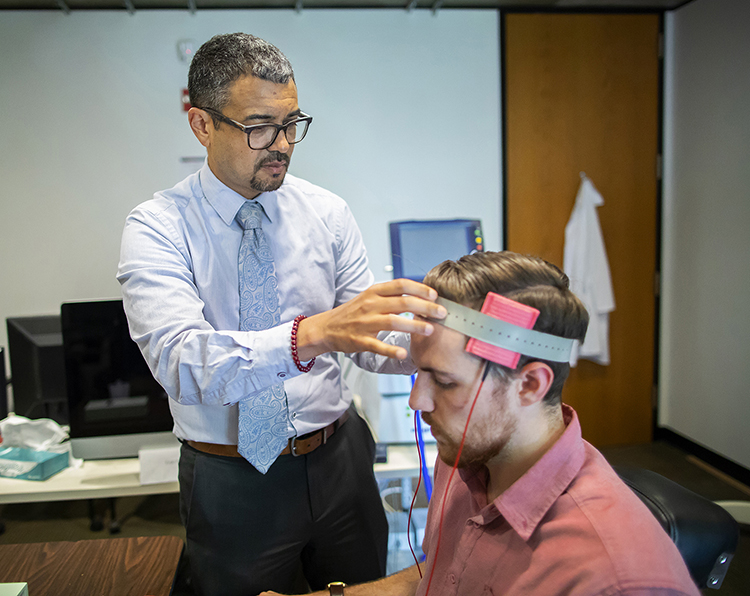
The brain is one of the most complex systems in the body, controlling movement, memory, communication, emotion, thought, and more. Unfortunately, serious diseases and injuries such as stroke, dementia, and psychiatric disorders can impede and disable core functions in the brain. Now, thanks to recent advances in neuroscience, neuroengineering, and other converging fields, experts are exploring the use of neuromodulation—noninvasive brain stimulation—to restore these functions in the brain, and Penn Medicine has launched a new center to study this science.
The Penn Brain Science, Translation, Innovation, and Modulation (brainSTIM) Center brings together a team of leading neuroscientists, neurologists, psychiatrists, psychologists, and engineers at Penn using neuromodulation techniques to research, repair, and enhance human brain function—the first translational center of its kind in the region.
The brainSTIM Center is being led by Roy Hamilton, an associate professor of neurology and physical medicine and rehabilitation at the Perelman School of Medicine at the University of Pennsylvania. The center will be a hub for developing new treatments that use neuromodulation—direct stimulation of the brain with electrical signals or magnets—to reorder, reorganize, and restore brain function in patients suffering from various types of neurological disorders such as dementia and stroke and psychiatric disorders like anxiety.
“Neuromodulation is a fascinating technology—it’s already successfully used to treat depression and we’ve led exciting research on brain stimulation and aphasia, a language disorder which impairs a person’s ability to communicate. But this is just the tip of the iceberg,” said Dr. Hamilton. “Our driving goal is to investigate how cognition works in the neural networks of the brain, uncover how to enhance those functions, and ideally develop new simulation-based therapies for our patients.”
The center uses a range of neuromodulation tools, including transcranial magnetic stimulation (TMS), and transcranial electrical stimulation (tES) techniques. By combining these technologies with advanced imaging tools, such as structural and functional magnetic resonance imaging, experts can explore key structure-function relationships in the brain that underlie human cognition and neural function.
Dr. Hamilton and fellow brainSTIM faculty members Branch Coslett, William N. Kelley Professor of Neurology, and John Medaglia, adjunct assistant professor of neurology at Penn and an assistant professor of psychology at Drexel University, are pursuing work funded by the National Institute on Deafness and Other Communication Disorders and the Department of Defense to determine whether transcranial direct current electrical stimulation (tDCS) of the brain can be used to slow the progression of language loss for those with primary progressive aphasia (PPA), a neurodegenerative condition that impairs communication ability.
Recent work from a team led by brainSTIM faculty Ted Satterthwaite, assistant professor of psychiatry, has shown that the functional networks of the brain responsible for self-control are highly variable in youth brain anatomy. They found that these networks are sculpted as adolescents develop into adulthood and are associated with individual differences in cognition. These personalized networks could be used to target neuromodulatory therapies in the developing brain.
Additionally, brainSTIM faculty Desmond Oathes, assistant professor of psychiatry, Danielle Bassett, J. Peter Skirkanich Professor of Bioengineering, and Dr. Satterthwaite are currently pursuing work funded by the National Institute of Mental Health to understand how TMS might improve working memory in healthy adults and those with ADHD by combining network control theory (a set of concepts and principles employed in engineering), magnetic stimulation of the brain, and functional brain imaging.
“Over the past 20 years I’ve witnessed remarkable advances in the ability of neuromodulation to influence brain circuits that drive functions, cognition, and behavior,” added Dr. Hamilton. “While these initiatives, and many others, are already underway at Penn, our hope is that the creation of the center will allow for even more collaboration and advancements, enabling us to provide more effective treatment options to our patients in the region and beyond.”
For more information about the brainSTIM Center, visit https://www.med.upenn.edu/brainstimcenter/
Zachary Lesser: Edward W. Kane Professor of English
 Professor of English Zachary Lesser has been appointed the Edward W. Kane Professor of English. A leading scholar in English Renaissance drama and the history of the book, Dr. Lesser is a general editor of The Arden Shakespeare. He is known for his early contributions to the digital humanities, including co-creating DEEP: Database of Early English Playbooks, launched in 2007 as an online resource for studying the printing, publishing and marketing of Renaissance drama. Both of his books, Hamlet after Q1: An Uncanny History of the Shakespearean Text and Renaissance Drama and the Politics of Publication: Readings in the English Book Trade, won the Elizabeth Dietz Memorial Award given by Rice University, making Dr. Lesser the only two-time winner of the prize. The award alternates yearly between recognizing the best book about English Renaissance literary studies and the best book about Tudor drama. His new book, Ghosts, Holes, Rips and Scrapes: Shakespeare in 1619, Bibliography in the Longue Durée, will appear soon from Penn Press.
This professorship was established by Edward W. Kane (C’71) and Martha J. Wallace to support a preeminent scholar and teacher in the department of English. Mr. Kane has served as a University trustee and on the School of Veterinary Medicine Board of Overseers.
Special Faculty Separation Incentive Plan: August 1, 2020–October 30, 2020
The University of Pennsylvania is announcing a special one-time faculty retirement incentive plan (Special Incentive Plan). While the Special Incentive Plan is similar in some respects to Penn’s longstanding Faculty Income Allowance Program (FIAP), it is a separate program and is only being offered for a short and specific period of time. Like FIAP, the Special Incentive Plan is available to standing faculty and standing faculty clinician-educators. Faculty members who elect to participate in the Special Incentive Plan will receive 200% of their academic base salary or 200% of the average academic base salary for full professors in the faculty member’s School, whichever is higher, but not exceeding 200% of the faculty member’s total salary. This amount will be paid in equal monthly installments over the two-year period following the faculty member’s retirement date. In addition, eligibility for the Special Incentive Plan is open to all faculty members over the age of 60 (or who will turn 60 on or before June 30, 2021), provided they have 10 or more years of full-time continuous service as a standing faculty member (including standing faculty clinician-educators) and meet the “Rule of 75” (the combination of a faculty member’s age and full-time continuous service as a standing faculty member equals or exceeds 75) as of June 30, 2021. It is important to note that the Special Incentive Plan is being offered not only to faculty members who are eligible for FIAP but also to standing faculty and standing faculty clinician-educators over the age of 69 who are no longer eligible to participate in FIAP.
Participation in the Special Incentive Plan must be elected between August 1, 2020 and October 30, 2020, and a faculty member’s retirement date must be no later than June 30, 2021. Any eligible faculty member who has retired or is scheduled to retire between March 1, 2020 and August 1, 2020 will also receive the enhanced benefit if it is more than they would have received under FIAP. Please note that, as Special Incentive Plan benefits are funded from the benefits pool, they do not impact funding for other academic priorities on campus.
If you have questions, you can learn more about the Special Incentive Plan benefits in the detailed brochure from Human Resources, https://www.hr.upenn.edu/docs/default-source/benefits/special-faculty-incentive-plan-guide.pdf and you can contact Jennifer Salwach at HRbenefits@hr.upenn.edu, who will direct you to the appropriate team member for an appointment with a counselor.
—Division of Human Resources
Ivy League Outlines Intercollegiate Athletics Plans: No Competition In Fall Semester
July 8, 2020
Amidst continuing health and safety concerns due to the global COVID-19 pandemic, the Ivy League Council of Presidents has set in place plans for intercollegiate athletics activity in the upcoming fall semester.
With the safety and well-being of students as their highest priority, Ivy League institutions are implementing campus-wide policies, including restrictions on student and staff travel, requirements for social distancing, limits on group gatherings, and regulations for visitors to campus. As athletics is expected to operate consistent with campus policies, it will not be possible for Ivy League teams to participate in intercollegiate athletics competition prior to the end of the fall semester.
Practice and other athletic training opportunities for enrolled student-athletes will be permitted provided they are structured in accordance with each institution’s procedures and applicable state regulations. The Ivy League will also issue guidelines on a phased approach to conditioning and practice activities to allow for interaction among student-athletes and coaches that will begin with limited individual and small group workouts and build to small group practice sessions, if public health conditions permit.
Fall sport student-athletes will not use a season of Ivy League or NCAA eligibility in the fall, whether or not they enroll. Students who wish to pursue competition during a fifth year will need to work with their institutions in accordance with campus policy to determine their options beyond their current anticipated graduation date.
Local campus policies for the student body regarding return to campus and in-person learning will apply to student-athletes.
A decision on the remaining winter and spring sports competition calendar, and on whether fall sport competition would be feasible in the spring, will be determined at a later date.
The Ivy League Council of Presidents offered the following joint statement:
“As a leadership group, we have a responsibility to make decisions that are in the best interest of the students who attend our institutions, as well as the faculty and staff who work at our schools. These decisions are extremely difficult, particularly when they impact meaningful student-athlete experiences that so many value and cherish.
“With the information available to us today regarding the continued spread of the virus, we simply do not believe we can create and maintain an environment for intercollegiate athletic competition that meets our requirements for safety and acceptable levels of risk, consistent with the policies that each of our schools is adopting as part of its reopening plans this fall.
“We are entrusted to create and maintain an educational environment that is guided by health and safety considerations. There can be no greater responsibility—and that is the basis for this difficult decision.”
—Ivy League Council of Presidents
Christina Paxson, Brown University
Lee Bollinger, Columbia University
Martha Pollack, Cornell University
Philip Hanlon, Dartmouth College
Lawrence Bacow, Harvard University
Amy Gutmann, University of Pennsylvania
Christopher Eisgruber, Princeton University
Peter Salovey, Yale University
Rendell Center: Launching Podcast Series, “Judges on Judging”
The Rendell Center for Civics and Civic Engagement has launched a series of podcasts titled Judges on Judging, in which jurists discuss current cases and legal issues.
Judge Marjorie O. Rendell, chairman of the Rendell Center and a senior judge on the U.S. Court of Appeals for the Third Circuit, moderates the podcasts, which are produced through a partnership with the Annenberg Public Policy Center.
The Rendell Center offers educational materials and lesson plans on civics for elementary school classes. These podcasts were envisioned as an extension of a symposium on a fair and impartial judiciary the center cosponsored in the fall of 2019.
The first podcast features Judge Rendell and US District Court Judge Mitchell S. Goldberg discussing the case of former Trump national security advisor Michael Flynn. Mr. Flynn twice pleaded guilty to a charge of lying to the FBI in interviews about his contacts with a Russian diplomat in late 2016 during the presidential transition. Nevertheless, in May 2020 the Justice Department moved to dismiss the case against Mr. Flynn and a federal appeals court panel subsequently ruled 2-1 that it should be dismissed. The trial judge, Emmet Sullivan, has asked the full appeals court to review that ruling.
“I was reading so much misinformation about the Michael Flynn case,” Judge Rendell said. “There are rules and principles that govern what we do. But there was so much rush to judgment from both a left and a right perspective that I thought to myself, we need to educate the public about what this is all about. I just thought it was a moment for education.”
Judge Rendell said she and her fellow judges are seeking to demystify the law and explain how judges think. “Rule 42, Rule 48, mandamus ... what are these magic words?” she said. “I am thinking of our audience as teachers. That helps me and my colleagues try to keep it educational.”
In the second podcast, on how the COVID-19 pandemic is affecting the courts, Judge Rendell said, “I’m hoping to educate the next generation of citizens by talking about what judges do, how they decide cases, the laws that are impacting what happens in our courts today [and] the situations impacting our courts.”
The third podcast looks at the balance between First Amendment rights and laws prohibiting discrimination—first in Masterpiece Cakeshop v. Colorado Civil Rights Commission, which the US Supreme Court decided in 2018, and then in Fulton v. City of Philadelphia, which will be argued before the Supreme Court in its next term. Judge Rendell and her colleague on the podcast, Judge Thomas Ambro, were on the Third Circuit Appeals Court panel that ruled in Fulton, which involves a Philadelphia Catholic adoption agency that would not place foster children with same-sex couples on the grounds of religious principle.
Two additional podcasts are planned this summer.
To listen, click here, or go to the Rendell Center’s page on its podcast series:
- Judges on Judging Podcast #1, The Michael Flynn Case
- Judges on Judging Podcast #2, The Impact of COVID on the Courts
- Judges on Judging Podcast #3, First Amendment Rights vs Laws Prohibiting Discrimination
Judaica Digital Humanities: Launching the Digital Second Edition of Judaica Americana

Judaica Digital Humanities at the Penn Libraries is excited to announce the launch of the Digital Second Edition of Judaica Americana. This bibliographic database draws from Robert Singerman’s Judaica Americana, the award-winning, magisterial two-volume bibliography of American Jewish publications before 1900. Visitors can search the database’s 9,600+ bibliographic entries by author, language, holding institution, and various tags, as well as find open-access links to digitized Jewish monographs, serials, and periodicals, when available.
Last October, Dr. Singerman donated to the Penn Libraries the draft of the full text and copyright to his revised second edition of Judaica Americana. Dr. Singerman’s first edition, issued in 1990 in two volumes, was sponsored by the Center for the Study of the American Jewish Experience, Hebrew Union College-Jewish Institute of Religion, and published by Greenwood Press as part of the Bibliographies and Indexes in American History. In the first edition, Dr. Singerman cataloged just over 6,500+ monographic and serial publications and presented each with meticulous bibliographical descriptions, classification explanations, and holdings information (i.e., the names of collections where copies are known to be held).
Judaica Americana authoritatively chronicles American Jewish book production from the 17th century to the beginning of the 20th century. The second edition contains an additional 3,000 entries. Taken as a whole, Dr. Singerman’s bibliography provides extensive documentation of American Jewish communal activity and growth before 1901.
Librarian Emeritus Dr. Singerman spent nearly three decades at the Price Library of Judaica at the University of Florida, where he grew an assortment of 24,000 unprocessed volumes to a fully-cataloged collection of over 85,000 volumes. For the second edition of Judaica Americana, the Association of Jewish Libraries awarded him the 2020 Judaica Reference and Bibliography Lifetime Achievement Award.
Dr. Singerman’s draft of the second edition—including a Supplements section, and two datasets based upon it—are now discoverable in ScholarlyCommons, the University of Pennsylvania’s open access institutional repository. All the files now are available to researchers, book trade specialists, genealogists, and bibliographers with all information needed to make full use of this invaluable resource.
Judaica Digital Humanities is profoundly grateful to Dr. Singerman for entrusting his extraordinary work to the Penn Libraries.
The project is an initiative of Judaica Digital Humanities at the Penn Libraries, which is a robust program of projects and tools for experimental digital scholarship with Judaica collections.
Additional information about this project and program can be found on the Judaica Digital Humanities website, https://repository.upenn.edu/judaicadh/
-resized.jpg) Bertram (Bert) Lubin, former assistant professor of pediatrics at Children’s Hospital of Philadelphia, died June 27 at his home in Berkeley from a brain tumor. He was 81.
Bertram (Bert) Lubin, former assistant professor of pediatrics at Children’s Hospital of Philadelphia, died June 27 at his home in Berkeley from a brain tumor. He was 81.-resized.jpg) Margaret Grace Stineman, emeritus professor of physical medicine and rehabilitation at the University of Pennsylvania Perelman School of Medicine, died at Simpson House retirement community on July 9. She was 67.
Margaret Grace Stineman, emeritus professor of physical medicine and rehabilitation at the University of Pennsylvania Perelman School of Medicine, died at Simpson House retirement community on July 9. She was 67.-resized.jpg) Francine F. (Fran) Walker, director of student life at the University of Pennsylvania for more than 35 years, died July 7. She was 76.
Francine F. (Fran) Walker, director of student life at the University of Pennsylvania for more than 35 years, died July 7. She was 76.-resized.jpg) Donald S. (Don) Young, professor emeritus of pathology and laboratory medicine at the University of Pennsylvania’s Perelman School of Medicine, died July 4. He was 86.
Donald S. (Don) Young, professor emeritus of pathology and laboratory medicine at the University of Pennsylvania’s Perelman School of Medicine, died July 4. He was 86.
 The Federation of Pediatric Organizations (FOPO) recently announced that Joseph W. St. Geme, III has been selected as the 2020 recipient of the Joseph W. St. Geme, Jr. Leadership Award, named in honor of his father. Dr. St. Geme will receive the award during the 2021 Opening General Session of the Pediatric Academic Societies Meeting in Vancouver, BC.
 The Doris Duke Charitable Foundation (DDCF) announced six subspecialty fellows receiving a total of $1.32 million in grants through the second Doris Duke Physician Scientist Fellowship, two of whom are from the University of Pennsylvania: Senthil Selvaraj in PSOM’s division of cardiovascular medicine for “Therapeutic Exogenous Ketosis in Heart Failure with Reduced and Preserved Ejection Fraction: A Randomized, Controlled, Crossover Trial,” and Scott A. Peslak in PSOM’s division of hematology and oncology for “Cellular Signaling Pathways in the Regulation of Fetal Hemoglobin for Treatment of Sickle Cell Disease.”
 Cynthia Sung, Gabel Family Term Assistant Professor of Mechanical Engineering and Applied Mechanics, has been named one of six winners of the 2020 Johnson & Johnson Women in STEM2D (WiSTEM2D) Scholars Award.