
Silence, Risk, and Fun
Toni Bowers
“I was able to immerse myself into silent film and understand how gesture [can] convey a range of meanings whereas speech in effect limits our understanding…. Through gesture, our mind is encouraged to do more critical thinking and searching.”
“By learning the various ways pantomime made my peers feel, I was able to garner… perspectives that often were vastly different than mine.”
“I really enjoyed this course.”
 These are the words of Penn undergraduates who, in a course on the silent films of Charlie Chaplin, ENGL/CIMS 596, take steps toward mastering a communication form they have usually not studied before: pantomime. As these comments indicate, the course is great fun; but that is not to say it’s easy. Chaplin’s movies are hilarious, but their undertow is dangerous: it silently pulls students into methods of imagining and communicating entirely unknown to those who are used to relying on language.
When a journalist asked Chaplin what his latest film meant, he answered in terms her question could not encompass: “What do you want a meaning for?” the filmmaker demanded; “Life is a desire, not a meaning.” “Where words leave off,” Chaplin declared at another point, “gesture begins.” This course tests that proposition and tests students’ abilities to think in profoundly different ways.
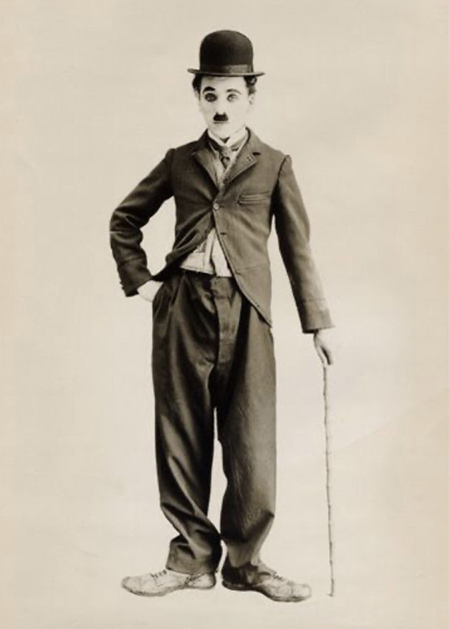 To succeed in this class, students must move out of hard-won comfort zones (facility with language) and question some of their own most reassuring assumptions (that words are reliable and adequate) and practices (the search for “meaning”). “There was definitely a learning curve…,” one student noted in a course evaluation. “But we [were] all eager to rise to the challenge.” The remark makes clear how much this course demands, how much students risk by trusting bodies and things, reactions and feelings, instead of words.
The student’s remark also raises a question that is especially pertinent to teaching and learning at Penn. Where does that eagerness come from? How might faculty motivate students to take on challenges not only to what they know, but to how they know? Given Penn’s demanding undergraduate curriculum and our students’ well-developed grade-consciousness, how might we encourage them to take genuine intellectual risks in our courses?
One answer lies in the work we do to design our courses in the first place. No single course can undo the pressures that drive students to default to safety rather than experiment, but we can structure our courses so as to make clear to students that risk-taking is, in itself, a valued aspect of success in a course.
Students at Penn are often reluctant to take risks in course selection because of the pervasive grade anxiety that hovers over undergraduate learning like an unhealthy miasma. In response, I aim to dethrone structures that make for competition among students. For three decades I have begun classes by telling students that everyone present is starting out with an A in the course. Their job over the semester is to preserve that grade—and I am as transparent as possible about how to do that: fulfill the course requirements (detailed in the syllabus and read aloud on the first day), and recognize that their abilities will improve as they take risks.
My job is to define the course goals, explain them clearly, and guarantee that if students take risks in good faith, that risk-taking will be rewarded per se. In 596, I let them know that the point isn’t to perform a professional-quality pantomime on the final day of class, but to work steadily in collaboration, imagine ambitiously, and push themselves to do more than they thought they could do. Students know that while the measurable qualities of their work matter, other qualities matter more—their willingness to try, their growth, their generosity, their commitment to mastering course concepts and putting them into practice, their perseverance. When students aim for these behaviors rather than for grades, they are surprised at how much they learn—and how much fun it is. They relax and they excel.
To help Penn students relax, I find that I have to be specific about precisely how risk-taking matters, and about what they will gain from the course that’s valuable enough to make it worth the risks. The best way to do this, I think, is to tell students that they will not be penalized for trying. What counts against a student, I make clear, is not taking risks. Even if their results are objectively good, they will not have excelled in the course if they don’t face and deal with its risks, because no assignment in the class is primarily about its result.
I explain why the learning in the class is valuable enough to justify risk-taking. This is especially important because no course I teach is designed primarily to fulfill a requirement; even though most of my courses do fulfill requirements, that is not what they’re for, or their major pay-off. Instead, the pay-off happens as students learn to see in new ways. (In 596, just seeing silent films can be difficult at the beginning). I ask students to follow their curiosity, try new things, and in the process expand their ability to learn. Students benefit most when they investigate bravely. Taking risks lets them expand and grow as learners.
I also let students know that I am committed to perceiving and rewarding their growth over time, not just their abilities to perform at pre-ordained moments of reckoning. This means that I commit myself to continuously responding to student writing and to meeting students individually and in groups. I offer an individual midterm meeting. Students develop a sense of professionalism and accountability as they set up this meeting and bring an agenda, including goals to be achieved together. The midterm grade includes the meeting and the student’s short written report on the process of preparing for it and what we accomplished during it.
I indicate that I highly value student investment in how the group is learning. I want students to re-imagine the class not as a collection of competing individuals, but as a collaborative, living organism. I teach students to think of familiar kinds of assignments—reading, posting on-line, participating in class, submitting projects by their due dates—as ways of participating in something college offers that is rare: a dedicated learning community. When they learn this, they see why it’s not possible to “make up” Canvas postings, since these are not about the post itself but about the process of trying out ideas in real time with other students; it’s not possible to make up missed classes, since a student’s presence in the group is the point, and signifies even when they are silent. I expect students to participate in other students’ learning by seriously entering into another’s point-of-view in class discussions, by suggesting specific strategies in workshops. That kind of participation in another’s intellectual life is just as important as performing well on a set task. I’ve found it possible to take the kinds of course requirements students are already used to and shift the aperture toward collaboration—not entirely, but far enough to change student expectations and behaviors in a given class.
Most students are happy to start looking differently at their own learning—though that, too, involves risk. They see that when they post on time and stay engaged, other students have adequate time to reply to them with care and deliberation—and do so. They see that when they meet submission deadlines, I have time to give their work my best attention and to do so in the context of the group’s submissions; that when they do the reading carefully, taking notes, they can participate fully in class discussion. They begin to develop what for some is a new habit: understanding their own learning alongside the learning of others. And they see that thinking this way matters not because it will help them get ahead of other students, but because it is an enjoyable, efficient, and productive way to learn.
Re-placing the emphasis from competitive individual achievement to learning in community need not change the assignments faculty require in a given course (though it might). What it does demand is that we be ready to widen the “why” for our students. I’ve found that doing so reliably produces improved student work. To build more “why” into a course means being explicit about the course’s purposes, methods, and expectations in the early places whose pedagogical value faculty can easily overlook – the initial course plan, the several published descriptions, and the syllabus, which is most useful when it details how things will work and why, and what grades mean in this class. I find it invaluable to ask students to read the syllabus aloud and discuss it during the first class meeting. This kind of extended preparatory process can help students to believe it’s worth taking risks in the service of genuine intellectual exploration. In ENGL/CIMS 596, Penn undergraduates dare to try things out and even (oh, brave new world) fail occasionally, confident that they have the power to preserve an A that depends on perseverance and creativity in new and sometimes difficult collaborative adventures.
Toni Bowers is a professor in the department of English. She received the Ira Abrams Award for Distinguished Teaching in 2022.
--
This essay continues the series that began in the fall of 1994 as the joint creation of the College of Arts and Sciences, the Center for Teaching and Learning and the Lindback Society for Distinguished Teaching.
See https://almanac.upenn.edu/talk-about-teaching-and-learning-archive for previous essays.