
Robots to the Rescue
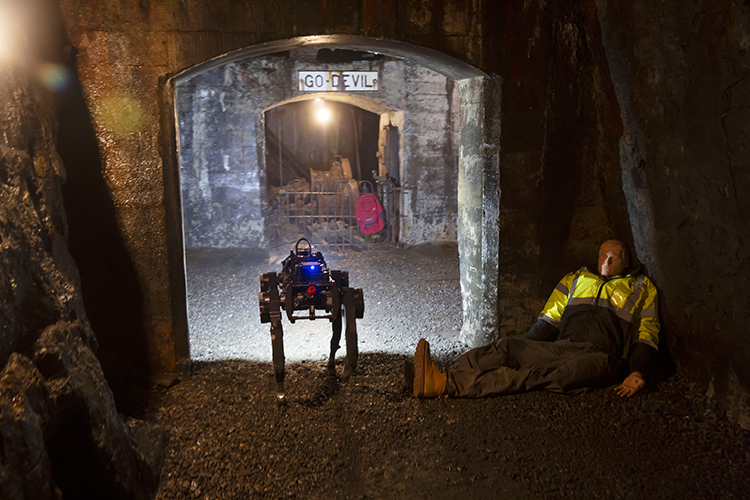 A group of Penn students, postdocs and faculty recently traveled to an experimental mine near Pittsburgh to participate in the first round of the Subterranean (SubT) Challenge, hosted by the Defense Advanced Research Projects Agency (DARPA). They were led by Camillo J. Taylor, a professor in Penn Engineering’s department of computer and information science and deputy director of the General Robotics, Automation, Sensing and Perception (GRASP) Lab. They teamed up with others outside the university to build robots to navigate and explore unknown underground environments.
The goal of SubT was to develop robots that could be sent into places too dangerous for humans, like a subway tunnel after a fire or a mine where workers are trapped. These robots could then send back reports on what it saw to a person who could remain in a safe location.
Members of the Pennsylvania Laboratory for Underground Tunnel Operations team (PLUTO) had experience working with drones in challenging settings, but going underground meant that another type of platform was needed to carry heavy equipment while navigating narrow spaces. So they turned to the four-legged “dog” platforms developed by Ghost Robotics, a company co-founded by Penn alumni Avik De and Gavin Kenneally.
Each dog carried a light detection and ranging device that uses laser light to create a 3D map, stereo RGB cameras to see artifacts, thermal cameras to detect heat signatures, and an onboard computer to process the data. PLUTO’s robots also need the ability to decide where to travel next, recognize artifacts and relay information to other dogs and to the humans outside the mine.
Programs developed by Anthony Cowley, a SEAS PhD student, were used to generate a map of the robot’s location based on images collected by the sensors, while artifacts like backpacks and phones were detected using a program developed by PhD student Shreyas Shivakumar.
Communication is particularly challenging underground since radio waves can’t travel through thick cave walls. PLUTO’s strategy, led by Fernando Cladera, a master’s student in robotics, was to create a “bucket brigade” system that allowed robots to share data with one another. That way, if a robot couldn’t get back to the entrance, the data it collected could still be relayed by other dogs to the base station.
Bringing all of these abilities together requires high-level autonomy to allow the robots to plan their exploration strategies without direct human input. PhD student Ian Miller led this effort and helped make sure that all the sensors, hardware and algorithms worked together.
PLUTO spent time at the Number 9 Coal Mine and Museum in Lansford, Pennsylvania over the summer and at the Colorado School of Mines experimental mine earlier this year to see how their automated systems performed underground. While their robots did not spot as many artifacts as hoped, the PLUTO team is pleased with how the system performed in such challenging and unknown environments.
The next round of SubT will be happening in February in an urban setting. Regardless of what lies ahead, creating and sending robots into challenging real-world environments is fundamental for progress both at Penn and in the field of robotics as a whole. For the complete story, visit https://penntoday.upenn.edu/news/robots-rescue-underground-DARPA