
Murray Murphey, History
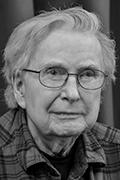 Murray Griffin Murphey, emeritus professor of history in the School of Arts and Sciences at the University of Pennsylvania, died December 6. He was 90.
Dr. Murphey was born in Colorado Springs, Colorado. He earned his BA from Harvard University in 1949, studying with C. I. Lewis, Perry Miller and Arthur Schlesinger, Jr. He went on to ean his PhD from Yale in American studies. During a fellowship year from 1953 to 1954, he worked with R.B. Braithwaite, the famed positivist philosopher of science at Cambridge University in England. He returned to New Haven in 1954 to complete his dissertation under the direction of the renowned linguist Rulon Wells.
Dr. Murphey had received a two-year appointment at Penn as a Rockefeller Fellow, and he was appointed an assistant professor of American Civilization in 1956. In 1959, Penn established 20 new Faculty Awards for Excellence in Undergraduate Teaching at the Opening Exercises on September 25 and he was one of the inaugural recipients of the awards, valued at $1,000 each, rendered for outstanding service in undergraduate teaching. He moved up the ranks to a full professorship in 1966. He served as chair of the department for long periods, and for a time edited the journal of the American Studies Association, American Quarterly. Much later he received a lifetime achievement award from the Association. Throughout his time at Penn, he served on several committees and subcommittees for the University Council and Faculty Senate.
Penn had one of the first departments of American Civilization with tenure-track lines. Although initially a combination of literature and history, the department was re-structured by Dr. Murphey to treat American Civilization as a “discipline.” Dr. Murphey’s basic idea was to systematically apply the concepts of the social sciences to the data of the history of the United States. That data included conventional sorts of historical evidence from politics but also literature, material culture and what is now commonly referred to as social history. Graduate students over the years were trained in the structural-functionalism of sociology, the statistical and quantitative methods being primarily developed in political science and the cultural approaches of anthropology. Dr. Murphey did not neglect the undergraduates in his thriving major. In 1994, the College of General Studies honored him with the Distinguished Teaching Award.
He initiated a successful year-long lecture course on the American South, which was later taught by such luminaries as Drew Faust, Sheldon Hackney, Stephanie McCurry and Steven Hahn.
Dr. Murphey wrote several essays and two books in the philosophy of history, Our Knowledge of the Historical Past (1973) and Philosophical Foundations of Historical Knowledge (1994). His vision of history derived from his comprehensive understanding of the trajectory of philosophy in the United States. His dissertation became his first book, The Development of Peirce’s Philosophy (1961). The book was honored 50 years after its publication in a special session of an international meeting of the Charles S. Peirce Society, by which time the Society for the Advancement of American Philosophy had also recognized Dr. Murphey’s career-long accomplishments that the extraordinary book on Peirce had initiated. In 1977, he co-authored, with Elizabeth Flower, who was the first tenured woman in Penn’s philosophy department (Almanac July 18, 1995), the two-volume A History of Philosophy in America, which became a standard in the field.
But in his retirement his commitment to philosophical biography became most clear. He wrote C. I. Lewis: The Last Great Pragmatist (2000) and The Development of Quine’s Philosophy (2011). In early 2018, after two months in the hospital and shortly after his 90th birthday, he published Thorstein Veblen: Economist and Social Theorist.
Dr. Murphey’s students have headed American Studies programs all over the United States, and he also trained a number of important academic administrators, including Robert Corrigan of San Francisco State University, Drew Faust of Harvard and Richard Freeland of Northeastern. According to Bruce Kuklick, the Nichols Professor of American History Emeritus at Penn, Dr. Murphey never really took credit for the decades-long impact he had on many scholars. One of his students, Michael Zuckerman, Penn professor emeritus of history, commented at one point that Dr. Murphey’s chief characteristic was his “impenetrable modesty.”
Dr. Murphey is survived by his three children, Kathleen, Christopher and Jessica; and six grandchildren.