
Medical Miracles at Penn Veterinary Medicine
Below are abbreviated stories from Penn Vet Extra. View full stories at www.vet.upenn.edu/about/press-room/publications/penn-vet-extra
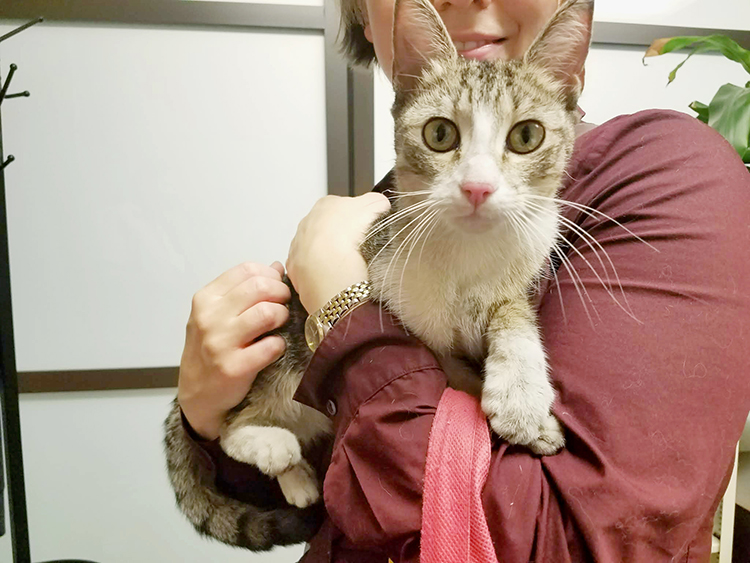
Cat-tastrophe
At only two months old, Bridget the kitten has had a lot of close calls. She was thrown from a stranger’s car off the South Street bridge in Philadelphia—where she landed, miraculously unharmed—and was rescued and fostered by Ariel Smith, who named her after the ordeal. After a few weeks in the safety of Ms. Smith’s apartment, though, Bridget ran headfirst into yet another death-defying situation.
“She and my two cats had become buddies by then, and liked to chase each other at breakneck speeds back and forth across the room,” said Ms. Smith. “They came bolting by and I heard a crash, then looked over and saw a gaping window. My heart just stopped. It was a horrifying moment.”
Bridget had somehow managed to dislodge the open window’s screen, tumbling four stories to the pavement below. Ms. Smith and her partner frantically searched for her and eventually found her panting underneath a parked car, bleeding from her mouth. “We knew we had to get her checked out, and that every second counted,” Ms. Smith said.
She rushed her kitten to Ryan Hospital’s emergency service, where veterinarians stabilized her and searched for broken bones before admitting her to the Intensive Care Unit overnight.
“Bridget suffered from classic ‘high rise disorder’,” said Lori Waddell, clinical professor of emergency and critical care, who monitored Bridget in the ICU. “We see this a lot in the warmer months. Cats fall off of balconies or windowsills, and have a range of injuries to their upper bodies. They come in with cranial and oral fractures, internal bleeding, abrasions, broken ribs, that sort of thing.”
X-rays taken at Ryan Hospital showed that several of Bridget’s ribs were indeed broken. Tiny tears in her lungs had also caused air to leak into her chest cavity, making it difficult for her to breathe. The hospital immediately removed the trapped air with a needle, freeing up space for her lungs to expand, put her on fluids and pain medication and placed her in an oxygen cage to help slow her rapid breathing. After three days of monitoring, she was eventually released back to Ms. Smith’s care.
“That’s pretty amazing given the amount of trauma she could have had,” said Dr. Waddell. “Other cats aren’t as lucky. It’s really important for owners to secure windows and keep cats away from terraces or balconies where we could see them fall. They’re amazingly curious animals, so if they see a bug or bird going by, they’ll jump for it. In a city environment, that can be really dangerous.”
Bridget made a full recovery, and was back to chasing her foster brothers around Ms. Smith’s apartment. “At less than a year old, she’s already been through a lot, but she has an unbreakable spirit. She’s a sweet girl with energy and love to spare,” said Ms. Smith.
Despite her rough beginnings, Bridget’s story has a happy ending. In early September, Ms. Smith and her partner found a “forever” home for Bridget—with a loving family that plans to keep their windows securely closed.
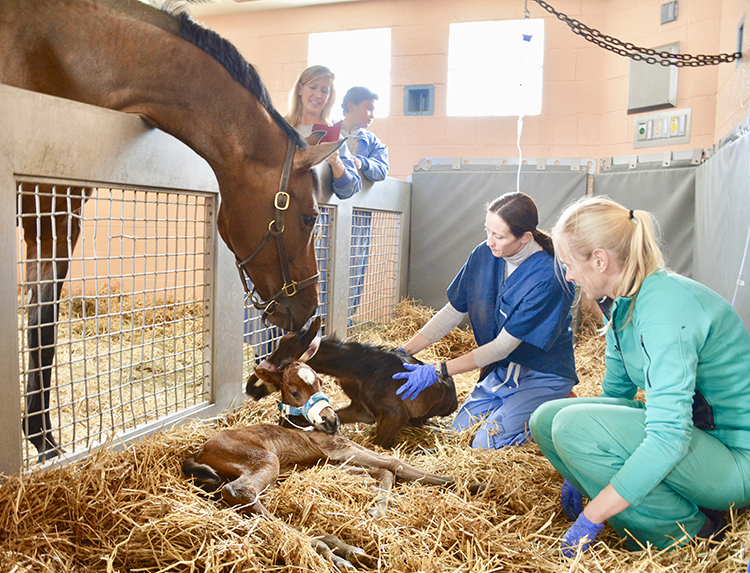
Surprise! It’s Twins!
Excitement over a first pregnancy turned to concern for owner Adel Dukes Melson when her pregnant Holsteiner, Treasure, began showing signs of premature foaling. Weeks before the mare’s March 13 due date, her mammary gland started to develop and secrete milk, a typical indication that her body was preparing to soon give birth.
On February 19, Ms. Melson and Treasure traveled two hours from their home in Bethany Beach, Delaware, to Kennett Square, Pennsylvania arriving at New Bolton Center’s Emergency & Critical Care department at 8:30 p.m.
There, they met Michelle Linton, staff veterinarian, neonatal intensive care specialist and part of Penn Vet’s High Risk and Healthy Mare Foaling programs. That night, Dr. Linton and her team performed a physical exam, transrectal ultrasound and fetal heart rate test. The next morning Treasure received an abdominal ultrasound to assess the fetus, uterus and placenta.
Dr. Linton was expecting to find placentitis, the most common reason for premature mammary gland development and a potentially life-threatening condition for mare and foals.
“Treasure came in as a likely placentitis case, and we treated her as one,” Dr. Linton said. “But her uteroplacental measurements were normal, suggesting we were maybe dealing with something more.”
Although the ultrasounds showed one fetus and one heartbeat, Dr. Linton suspected Treasure might be carrying twins, which could also explain early udder development—and which, surprisingly, can be easy to miss in prenatal exams. She admitted the mare—317 days pregnant at this point—to the Neonatal Intensive Care Unit for monitoring and rest. Over the next few weeks, Treasure grew bigger and bigger but didn’t go into labor.
Finally, on March 13, Dr. Linton’s suspicions were confirmed. At 338 days of gestation, Treasure began foaling. At 9 a.m, the mare gave birth. Not once, but twice.
“As soon as I saw the legs, it was obvious the foal—a filly—was very small,” Dr. Linton recalled. “And pretty much straight away this first set of legs was followed by a second set of legs belonging to a colt.”
Treasure successfully delivered twins—Ms. Melson named the filly Cherish and the colt Cache.
“Twins can be hard to diagnose during late gestation,” explained Dr. Linton. “The bodies were aligned in utero so we could only visualize one thorax and heartbeat.”
While Dr. Linton triaged care of two foals, Ms. Melson, who had left home as soon as she got the labor call, was just arriving.
“There was a special buzz in the hospital. Dr. Linton came out to meet me with a big grin on her face but waited to tell me anything,” Ms. Melson laughed. “When I got to Treasure, I saw the two amazing little foals. Treasure was absolutely beaming and thrilled with herself. I was shocked.”
Treasure and her duo is a rare case. In horses, twin fetuses are uncommon. Carrying them to term is even more unusual, and birthing healthy twin foals is especially unlikely.
“Twin pregnancies are extremely undesirable in horses, as they almost always have a bad outcome,” said Dr. Regina Turner, associate professor of reproduction and chief of the Reproduction & Behavior Service. “If allowed to progress through gestation, twin pregnancies almost always end in late-term abortion of both foals, or the birth of small, growth-retarded foals that either are born dead or severely compromised.”
Fortunately, this isn’t the situation for Cherish and Cache. Though small at birth—about 49 pounds for Cherish and 47 for Cache—both were born healthy to a mare that Dr. Linton said, “is a great mother and cut out for the job.”
“With twins, our immediate concern is the strength of their lungs and kidneys—are the organs mature enough and functioning properly?” explained Dr. Linton. “We also worry about whether their carpal (knee) and tarsal (hock) bones have ossified completely. The cuboidal bones, which are small bones located in those joints, are the last to make the conversion from cartilage to bone. Incomplete ossification of cuboidal bones can lead to collapse of the joints and degenerative joint disease.”
Cherish’s and Cache’s organs checked out fine. The main problem, explained Dr. Linton, was the foals’ size. “Even though Treasure carried them to term, they had in utero growth restriction. Initial X-rays confirmed incomplete ossification of the carpal and tarsal bones in both foals.”
The foals had to be kept quiet and off their feet to encourage proper bone growth. Strictly confined, they remained with Treasure at New Bolton Center for two months. The three horses were under the careful, round-the-clock watch of the NICU team and foal sitters, volunteers who assist clinicians and staff in caring for mares and foals during the foaling season.
Slowly but surely the twins’ bones ossified, and they increased their activity, such as having supervised nursing sessions with Treasure. They gained weight and got stronger every day. Playful from almost day one, it wasn’t easy to keep the feisty twins calm while they grew.
“They have become so rambunctious, up and down all the time,” said Ms. Melson at the time. “Initially, we had to discourage them from standing, but since they worked out how to stand, the care team has had its hands full!”
In the meantime, Ms. Melson’s shock at having twins has now given way to pure joy and gratitude that Treasure delivered two thriving foals. (Ms. Melson started a Facebook page to share their growth and antics.)
“Treasure and the twins are receiving excellent care from a wonderful team. At every stage, the veterinarians, students and staff have been very hands-on. Everyone cares so much about mom and her foals,” Ms. Melson commented. “New Bolton is very special place.”
Now Cherish, Cashe and Treasure are back home and doing very well.
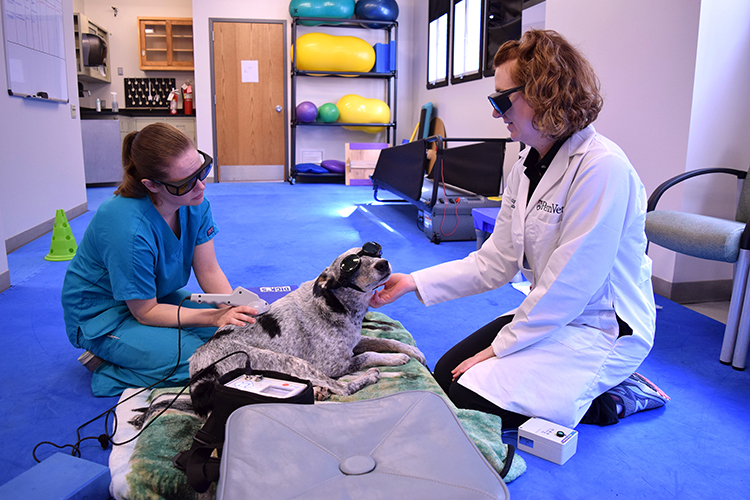
Physical Rehab Helps “Rock Star” Ranger Walk Again
On a Sunday in August, Cory Laslocky’s son Nathan left for overnight camp. The family’s four-year-old Australian cattle dog Ranger happily bid his human buddy goodbye. The following morning, Ranger was limping. By the end of the day, he was unable to stand and didn’t respond to any touch of his hind limbs.
“I rushed Ranger over [to my vet] as soon as I got home from work,” recalled Mr. Laslocky. “The doctor suspected a neurological issue and recommended we go right to Penn Vet for evaluation. Ranger was admitted immediately that night.”
An MRI found a ruptured spinal disc. Scott Petesch, a resident in neurology and neurosurgery, performed surgery. Even though surgery went smoothly, the dog faced just a 50% chance of regaining use of his back legs, and he would need intense physical therapy. His Penn Vet care team grew to include Molly Flaherty, staff veterinarian in physical rehabilitation medicine, and physical rehabilitation medicine nurse Allison Kyler.
The day after surgery, Dr. Flaherty and Ms. Kyler started Ranger’s inpatient rehab program. “We began with acupuncture to stimulate his nerves and laser therapy to increase cellular energy for healing—both also help with pain relief,” said Dr. Flaherty. “We also did some standing exercises. Because Ranger couldn’t stand or move his legs on his own, we used an inflated peanut ball to support his body weight and mimic the natural sensations of standing.”
After a week, Ranger was discharged with a home-care plan, pain medications and a lineup of Penn Vet visits. Weekly, Mr. Laslocky brings him to Penn Vet for physical therapy: movement activities, acupuncture and laser treatment to facilitate healing, pain relief and mobility. He and his son also take Ranger through prescribed exercises and monitor his activity. Ranger also underwent regular hydrotherapy at an outside facility.
“On his first post-op visit, Ranger could move his back legs a bit, but he wasn’t yet standing or walking,” said Dr. Flaherty. “A week later, he was able to stand on his own and take a few steps before falling. By mid-September, he could take several steps without stumbling. We then increased his activity, adding more involved movements. At the end of September, a month after his surgery, I met Cory and Ranger in the Ryan Hospital lobby, and Ranger proudly walked in on his own.”
Dr. Flaherty acknowledges that owner dedication plays a large role in such cases. “Ranger would not have had this kind of progress if his owners were not so dedicated to him and committed to his rehabilitation work,” said Dr. Flaherty, who joined Penn Vet in May 2018 to help expand Ryan Hospital’s Physical Rehabilitation Medicine Program. Although the program’s services are currently available only to Penn Vet patients with an internal referral, Dr. Flaherty has plans to open it to outside referring veterinarians. She also wants to add new staff and services.
Mr. Laslocky and his son view Ranger’s rehab as a part of their daily routine—and it also helps, said Mr. Laslocky, that they have a deep bench of friends and family to support the pup’s care. Mr. Laslocky has been especially thankful for Penn Vet’s comprehensive approach to Ranger’s treatment and recovery. “Whenever there’s a potential problem or something to check out, neurology experts are in the same building, and Dr. Petesch or Dr. [Greg] Kaiman can check in on Ranger while he’s doing PT.
“Ranger has become a rock star at Penn Vet. When he walks into the hospital, people I don’t know greet him and spread the word that ‘Ranger’s in the house.’”