
Helen Davies, Microbiology
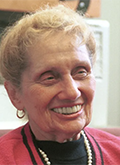 Helen Conrad (Rogoff) Davies, Gr’60, a trailblazing professor of microbiology and Associate Dean for Students and Housestaff Affairs in the Perelman School of Medicine, passed away on March 23 from respiratory failure. She was 96.
Dr. Davies grew up in Manhattan, where she graduated from the Hunter College High School for Intellectually Gifted Young Ladies at age 15. Afterwards, she graduated from Brooklyn College in 1944, then received an MS in biochemistry from the University of Rochester in 1950 and a PhD from Penn in 1960. She joined Penn’s faculty in 1960 as an assistant professor of physical biochemistry, a department in which she was the first female faculty member. In 1971, she was promoted to associate professor. Two years later, she chaired Penn’s Morgan State project, which saw Penn collaborate with the predominantly Black Morgan State University in Baltimore. She became a full professor of microbiology in 1982, once again the first woman to do so. From 1991 to 1995, she was the School of Medicine’s Associate Dean for Student Affairs, and in the 2000s she served as the Ombuds of the School of Medicine.
In her academic pursuits, Dr. Davies studied the biochemistry of prokaryotic organisms, particularly focusing on bacterial energetics, electron transfer, and the cytochrome system. She studied infectious agents that did not use DNA or RNA to reproduce. Dr. Davies was named a fellow of the American Association for the Advancement of Science in 2002, acknowledging her contributions to the field of biology. At Penn, she taught the popular course Infectious Diseases, in which she drew on her experiences when she was younger singing in New York nightclubs and taught students about diseases using popular songs, like “Leprosy,” sung to the tune of the Beatles’ “Yesterday":
Leprosy,
Bits and pieces falling off of me
But it isn't the toxicity
It's just neglect of injury
Suddenly,
I'm not half the man I used to be
Can't feel anything peripherally
From swollen nerves, hypersensitivity
This course was popular with students, and Dr. Davies won Penn’s Lindback Award in 1977 and the Medical School’s Distinguished Educator Award in 1989. Beginning in the late 1980s, she won the Medical Student Government Award for Basic Science Teaching over thirty times. In addition, Dr. Davies’ “little ditties” were popular examples of excellent medical pedagogy, and they were featured in several national news stories. In 2001, she was recognized with the American Medical Student Association’s National Golden Apple for Teaching Excellence, the first woman to be so honored.
Dr. Davies and her husband, the late Robert E. Davies, the Benjamin Franklin Professor and University Professor Emeritus of Biochemistry at Penn Vet (Almanac March 16, 1993), were active in Penn’s governing bodies and other organizations on campus, using this platform in every case to advocate for increased roles for women at Penn. She was a member of the University Council from the 1970s until the 2000s (and was a member of several of its committees) and of the Women’s Faculty Club. In 1976, she became secretary of Penn’s Faculty Senate. The next year, she served on the Task Force on Black Presence at Penn and on the Provost’s Committee for Safety and Security for Women, which later became a council committee that Dr. Davies chaired. During the 1980s, she also chaired the University Council’s Committee on Research, and a decade later, she chaired the Committee on Pluralism, which tracked Penn’s institutional response to changes recommended by the University Council. Dr. Davies and her husband, Robert, were instrumental in reducing bias in faculty appointments at Penn.
In addition to her advocacy work for women, Dr. Davies stood up for several other groups on campus: In 1981, she founded a University Council subcommittee for women’s athletics to speak up for women athletes’ interests; four years later, she spoke out against animal experimentation on campus; and in 1999, she co-wrote a “Speaking Out” piece in Almanac protesting the dismantling of Penn’s Victim Services department (Almanac September 14, 1999). In the late 1990s, she served on the Executive Board of Penn’s chapter of the American Association of University Professors. On the tenth anniversary of the founding of Penn’s Trustees Council of Penn Women, Dr. Davies was honored as a faculty member who had paved the way for women to achieve excellence at Penn (Almanac November 4, 1997). Well into the 2000s, Dr. Davies continued her involvement at Penn, serving as faculty director of Spruce (later Ware) House in the Quadrangle, sitting on the Senate Committee for the Publication of Almanac, and continuing to win teaching awards.
Outside of Penn, Dr. Davies became a member of the Penn State University Board of Trustees in 1973; the next year, she was named by Pennsylvania Secretary of Education John C. Pittenger to the statewide Faculty Evaluation Committee. In 1978, the Association for Women in Science named an award after Dr. Davies and her husband in honor of their contributions to advancing women in science; twenty years later, the American Association for the Advancement of Science awarded Dr. Davies its Lifetime Mentor Award (Almanac November 3, 1998). In 2006, she received the Alpha Omega Alpha Robert J. Glaser Distinguished Teacher Award from the Association of American Medical Colleges and the Helen O. Dickens Lifetime Achievement Award from Women of Color at Penn. Dr. Davies retired in 2021.
“Dr. Davies is among our most distinguished teachers, and scores of Penn medical students—past and present—count Dr. Davies as an inspirational and life-altering educator, mentor, and friend,” said Robert Doms, a colleague of Dr. Davies, in 2005. In 1996, the then Penn Medical Center and Health System CEO William Kelley said, “as a teacher, you did not merely meet a standard, you set it,” while unveiling a portrait of Dr. Davies.
She is survived by her sons, Daniel and Richard. Donations in her name may be made to the Helen Conrad Davies Memorial Fund, University of Pennsylvania, Office of the Treasurer, P.O. Box 71332, Philadelphia, PA 19176.