
Hal Haskins, VPUL
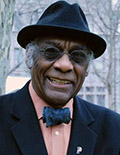 Harold (Hal or Hask) Haskins, former director of Penn’s Tutoring Center and Student Development Support Planning who set out to increase admission of Black students at Penn and to create programs supporting them socially and academically, died August 5 from pneumonia. He was 85.
Mr. Haskins, who was with Penn for 34 years, was born and raised in West Philadelphia. He attended grade school in the heart of the Penn campus and graduated from West Philadelphia High School. He earned a bachelor’s degree in public administration from Temple University and a master’s degree in city and regional planning from Penn in 1975.
In the 1960s, Mr. Haskins became known for his work with street gangs, mostly in North Philly. In 1966, he received a small grant to produce a film. During his tenure as associate vice president for community development at Temple University Health Science Center in 1967, Mr. Haskins produced the film The Jungle, featuring teenage gang life, specifically members of the 12th and Oxford Gang in North Philadelphia. In 1968, this film won a film award at the Festival dei Popoli in Italy. The film was a catalyst for a number of gang members to return to high school to earn diplomas. Several of these gang members went on to earn degrees at regional universities. It was accepted into the Library of Congress in 2009 as part of a sociological study of teenagers in gangs. In 1969, ABC featured Mr. Haskins as an urban trailblazer in a documentary, Three Young Americans in Search of Survival.
Mr. Haskins joined Penn’s staff in 1974 as the assistant dean of students. A year later he became director of Support Services, a program that was often misunderstood as serving minority students only (Almanac October 14, 1975). The program was established to serve students with special academic needs: “stretch” courses, courses with “reteaching sessions” and traditional tutoring of newcomers by advanced students Mr. Haskins described the philosophy of the office as being based on the assumption that for all students new to University life, the academic and social pressures are often overwhelming. The first-year student, no matter what their racial background, is likely to have particular difficulties in making the most of what Penn has to offer. Mr. Haskins saw their major function to be an integrative one: informing the students of all the academic and social facilities the University provides.
He then served as director of the Tutoring Center for several years, and during that time spent a year as acting director of the Affirmative Action office, until Joann Mitchell was hired for the position. In 1989, he became director of the Student Academic Support Services Program, overseeing the pre-freshman program, Reading Improvement, Upward Bound, Veterans Upward Bound, Tutoring and PennCAP.
He became director of Student Development Support Planning in 1993 (Almanac July 13, 1993). He was responsible to the VPUL for program planning, pre-college development, and other functions related to improving the climate of support for students. A significant part of his responsibility was to identify patterns of unmet student needs that affect their success within the institution and to recommend systemic changes to anticipate and respond more effectively to those needs. He also worked toward developing ways to bring students, faculty, staff, and others together to resolve issues through dialogue and collaborative effort. While he was director of Student Development Support Planning, he was also executive consultant to the Wharton LEAD (leadership education and development) Program.
Mr. Haskins was a member of one of the 20 working University groups in the late 1980s for the University-wide Planning for the 21st Century (Almanac November 8, 1988). He was recognized with the MLK Community Education Award “for outstanding contributions to the advancement of education and educational opportunities in West Philadelphia” (Almanac January 30, 2007), and he received diversity research funding for “A Study to Examine the Impact of Existing Pre-college Programs to Increase the Pipeline” (Almanac January 29, 2008).
At the time of his 2007 MLK Service Award, he was recognized for tailoring programs to support underrepresented student populations, which include services to physically challenged, minority, educationally, and economically disadvantaged students; for obtaining significant financial resources to support development activities; and numerous other accomplishments. Those included LEAD Wharton Summer Business Institute fundraising development support; establishment of the Robert Aresty Scholarship Fund, Wharton Leadership in Education and Development (LEAD) Program; establishment of the W.E.B. DuBois House Scholarship Fund, the Whitney M. Young, Jr. Memorial Chair in Wharton, and the Constance E. Clayton Chair in Urban Education in GSE; and consulting with AAMBAA for the establishment of the Whitney M. Young Endowed Fellowship.
Mr. Haskins retired from Penn in 2007. “A great deal of Mr. Haskins’ work, from encouraging students’ academic growth to nurturing their leadership dexterities, is immeasurable,” the UPenn Black History Project wrote in 2013.
He is survived by his wife, Yvonne; daughter, Kristin Haskins Simms; and a grandson. Plans for a memorial event next spring during Penn’s alumni weekend will be announced at a later date.