
Engineering and Nursing Collaboration
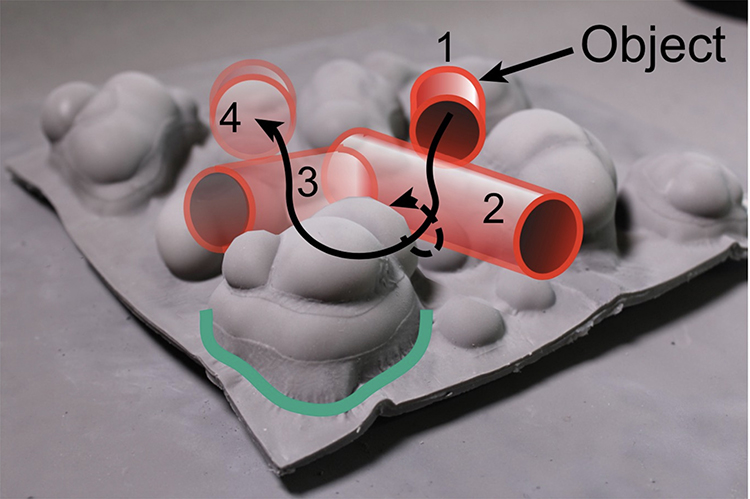 There have been huge advances in the world of “hard” robotics—robots that are made from hard plastics and metals—which are excellent for industrial jobs because they are precise, strong and well equipped for strenuous labor. James Pikul, assistant professor in mechanical engineering and applied mechanics at Penn’s School of Engineering, studies soft robotics, an emerging field that seeks to build robots that can safely handle more delicate and fragile objects. These robots must incorporate materials that deform under pressure, reducing the chances of crushing, pinching or otherwise hurting the equally soft things they interact with, such as human bodies.
In September 2019, Dr. Pikul and his team received a $2 million grant from the National Science Foundation to explore a new type of soft robotics. These soft robots start as flat sheets, then transform into precise shapes to perform tasks. Their goal: to create an inflatable robotic mat to be placed on top of hospital beds and used to move patients. This application has the potential to increase patient comfort and decrease injuries to nurses and health-care workers that can be caused by patient handling.
For inspiration, Dr. Pikul has studied octopuses—an organism with an entirely soft body—and how they transform the texture of their skin to camouflage into their surroundings. He and colleagues from Cornell developed a soft robotic system inspired by this ability; now, he is expanding on this technology.
“The challenge here is that controlling soft materials is very difficult,” Dr. Pikul said. “If I build with something soft, how do I control it to make it do something useful?”
Dr. Pikul’s team included Michael Posa, assistant professor in mechanical engineering and applied mechanics, Mark Yim, director of the GRASP Laboratory and professor in mechanical engineering and applied mechanics, as well as professors from University of Colorado at Boulder and Syracuse.
Dr. Pikul then met Pam Cacchione, nurse scientist at Penn Presbyterian, Ralston House Term Chair in Gerontological Nursing and associate professor of geropsychiatric nursing at Penn, who had a possible application for Dr. Pikul’s soft robotic technology: portable seat lifts for older adults who struggled with getting in and out of chairs.
Together, Dr. Pikul and Dr. Cacchione added the portable seat lift design as an initial prototype for the inflatable robotic mat for hospital beds that would assist nurses in moving and turning patients. This intervention would prevent patients from developing pressure injuries and alleviate strain on nurses who are often tasked with moving patients by hand and injuring themselves in the process.
Dr. Pikul’s technology has the potential to increase patient comfort as well. “When you think about it,” Dr. Pikul added, “a hospital bed is already a robot. It bends to different shapes and has sensors to monitor vital signs. They’re already sophisticated systems, they’re just bad at moving people. And we want to fix that.”
Dr. Cacchione noted that “there is great synergy between the Schools of Nursing and Engineering because the Nursing school has access to patients and clinical ideas. We are working together to conceptualize engineering ideas and apply them to something that will be meaningful for a patient.”