
An Inauspicious Arrival for the Ambitious Benjamin Franklin
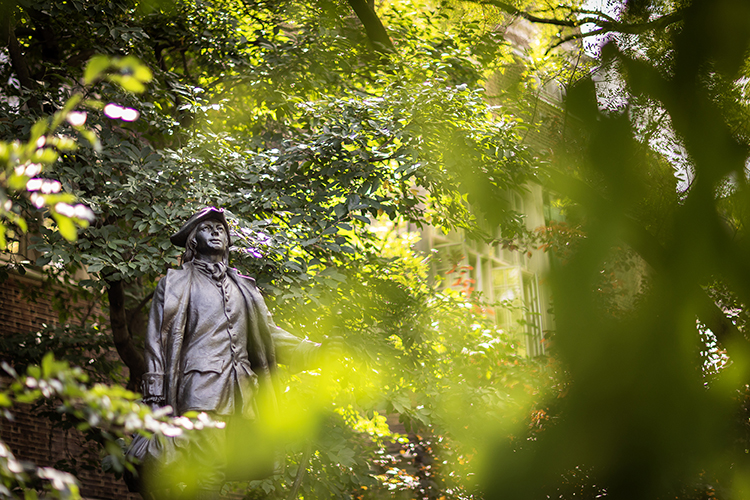
The future founder of the University of Pennsylvania arrived in Philadelphia 300 years ago—on Oct. 6, 1723—as a hungry, exhausted 17-year-old, on his own and seeking a job as a printer.
Benjamin Franklin had survived a harrowing journey from New York City that included walking through northern New Jersey and rowing a boat down the Delaware River before stepping into Philadelphia on a Sunday morning.
With just a few coins left in his pocket, Franklin knew not a soul in the small city, and yet he found his way.
“This moment of arrival, when all the possibility is before him, is the launch point for Franklin to becoming the famous individual who made himself into something out of nothing,” said Emma Hart, a professor of history in the School of Arts & Sciences. “In that respect it is a critical chapter in his story of success.”
It was in his autobiography, written in stages much later in his long life, that Franklin described his first encounter with Philadelphia in great detail. “It was obviously an important moment for Franklin, important to him that he nail down exactly when he arrived,” said Dr. Hart, also the director of the McNeil Center for Early American Studies.
Penn marked that moment on October 6 with “The Benjamin Franklin 300th Anniversary Celebration,” at the Perry World House, with a lunch and speakers, including Dr. Hart and Ezekiel Emanuel, Penn’s vice provost for global initiatives. Vice Provost Emanuel, who organized the celebration, created a Penn course on Franklin, and adapted that to create Benjamin Franklin and His World, a free online Coursera course.
“It’s important to note that he arrived at age 17, like our undergraduates. They come here at basically at the same age that Ben Franklin came here, obviously in very different circumstances,” said Vice Provost Emanuel, who is also a Penn Integrates Knowledge Professor at the Perelman School of Medicine and the Wharton School, adding that Franklin “is the most brilliant person born in North America,” in his estimation.
Unlike Penn undergrads, Vice Provost Emanuel points out, Franklin “could not call Mom and Dad” for help. “He was on his own in a city. He knew literally no one. And that didn’t daunt him,” said Vice Provost Emanuel. “And I think that’s part of his message to undergraduates: Be curious, take risks, and you’ll learn and grow a lot.”
Franklin’s Journey
Franklin took an enormous risk when he surreptitiously left Boston, breaking his indenture as an apprentice to his older brother. He first went to New York City, with very little money in his pocket, and offered his service to a printer. William Bradford did not hire Franklin but suggested that his son in Philadelphia might be looking for a new hire, as his principal pressman had recently died.
As Franklin described in his autobiography, he took passage on a boat from New York, but a squall tore the sails, threatening to drown him and his shipmates. After they endured a wet, miserable night anchored off the coast of Long Island, with no food or fresh water, they made it to Perth Amboy, New Jersey, the next afternoon.
Franklin spent a feverish night and got up the next day to set out on foot, in the rain, walking 50 miles to Burlington, New Jersey. There he caught a boat on the Delaware River, helping to row the entire way, landing at midnight at Cooper’s Creek, a bit north of Philadelphia.
It was a Sunday morning, around 8 or 9 o’clock, when Franklin stepped onto Philadelphia’s Market Street Wharf. “I have been the more particular in this Description of my Journey & shall be so of my first Entry into that City, that you may in your Mind compare such unlikely Beginning with the Figure I have since made there,” Franklin wrote.
John Pollack, curator of research services at the Kislak Center for Special Collections, Rare Books and Manuscripts in the Penn Libraries, includes Franklin’s arrival to Philadelphia in the English course he is co-teaching this semester, American Books/Books in America, with Jim Green of the Library Company of Philadelphia, another institution Franklin founded.
Dressed in his working clothes, dirty from the journey, pockets “stuff’d out with Shirts & Stockings,” Franklin wrote that was very tired and very hungry, with only a “Dutch Dollar” remaining, as he had given his last copper shilling for the passage down the river.
He saw a boy with bread, asked where he got it, and headed to the baker. He encountered confusion about the names of the baked goods, first asking for a biscuit and then a threepenny loaf, neither recognized by the baker. So he asked for three pennyworth of anything: “He gave me accordingly three great Puffy Rolls,” Franklin wrote in the autobiography.
“The three puffy rolls are famous,” Dr. Pollack said. Franklin wrote that he then walked up Market Street to 4th Street “with a roll under each Arm & eating the other.”
Quite aware of his “awkward and ridiculous appearance,” he locked eyes with a young woman, Deborah Read, in the doorway of her father’s house; she would later become his wife. Following a flow of well-dressed people, Franklin went to the Quaker Meeting House, sat down for the service, and promptly dozed off, making it, as he quipped, “the first house I was in or slept in, in Philadelphia.”
Finding food and lodging at the Crooked Billet on Water Street, the next day he set out for the printer Andrew Bradford, who gave him breakfast, but not a job. Bradford took Franklin to meet another printer, Samuel Keimer, who at that moment was composing the elegy to his pressman, named Aquila Rose. A few days later, he hired Franklin to print it.
Significant Franklin Collection
The Kislak Center has the only known copy of “An Elegy on the Death of Aquila Rose,” the first work printed by Franklin in Philadelphia during that October of 1723. “The elegy relates directly to Franklin’s arrival,” Dr. Pollack said. “There’s only one copy known to survive, and that’s the one that we have.” Presumed lost for generations, the broadside was found in a scrapbook by an antiquarian bookseller who offered it to Penn, which acquired it in 2015.
The libraries have a plethora of Franklin-related items, including letters written in his hand. The mahogany partners desk he purchased from a London cabinetmaker is located outside of the historic Lea Library on the sixth floor of the Van Pelt-Dietrich Library Center. On top are his china teapot and plate, silver spoon, cane, and set of cufflinks.

The libraries also hold nearly a third of the estimated 900 surviving works printed by Franklin, including forms, pamphlets, and currency, as well as newspapers and books, all rare and some, like the “Elegy,” unique.
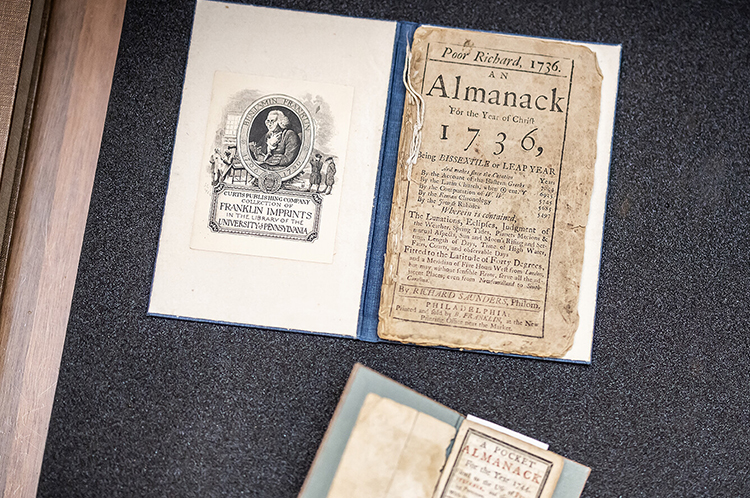
In the collection are copies he printed of his Pennsylvania Gazette newspaper, as well as his Poor Richard’s Almanack, including small pocket-size versions. A book on the history of the Quakers dated 1728 is significant, Dr. Pollack said, because Franklin took over the printing from Keimer about halfway through, and scholars have detailed the difference in the quality of the work, showing Franklin’s skill.
“When he arrived, it was at a time when the city was growing very fast, and there were lots of opportunities,” Dr. Hart said, noting a population then of only a few thousand people. “This is a particular moment in the history of the colonies when Philadelphia needs a good printer and businessman.”
Franklin, of course, went on to become not only a well-known printer, but also an author, inventor, scientist, diplomat, and statesman, as well as founder of many important institutions in Philadelphia, including what became the University of Pennsylvania.
And part of that legacy is that he kept an open mind and changed his viewpoints based on his own thinking and observations. “He knows he’s not perfect,” Vice Provost Emanuel said. “He often writes about his prejudices, and mistakes he’s made. But what makes him so powerful and valuable I think is that he’s constantly trying to improve.”
Regarding his position on slavery, Franklin once owned enslaved people, but came to view Black people as the equals of white people and wrote articles urging against slavery, Vice Provost Emanuel said. Indeed, Franklin became president of the Pennsylvania Abolition Society, and wrote the first letter petitioning Congress to end slavery and the slave trade. “He found that his conscience did not agree with owning enslaved people, and so he was a thoughtful individual who changed his behavior accordingly,” Dr. Hart said.
The University Archives holds several important documents with Franklin’s signature, including the founding documents of the University, said J.M. Duffin, assistant university archivist. These include the original bylaws, the original deed of trust, the account books, and several documents related to the Board of Trustees.
“I think that the importance of Franklin to Penn really is that he was a joiner and a community builder, and a founder of things, and having his presence in Philadelphia meant that all sorts of learned institutions exist,” Dr. Hart said. “I think Penn is really lucky to be counted amongst that select group.”
The American Philosophical Society, also founded by Franklin, was among the hosts of the “300 Years of Franklin in Philadelphia” celebration on October 6, with a young Benjamin Franklin re-enactor arriving on the Delaware River waterfront. A procession from the Independence Seaport Museum through Old City went to the Second Bank of the United States for a commemoration ceremony, with proclamations from the offices of the mayor and governor, and a chance to taste puffy rolls.
Adapted from a Penn Today story by Louisa Shepard, October 5, 2023.