
A Modified Peptide Shows Promise for Fighting Tumors
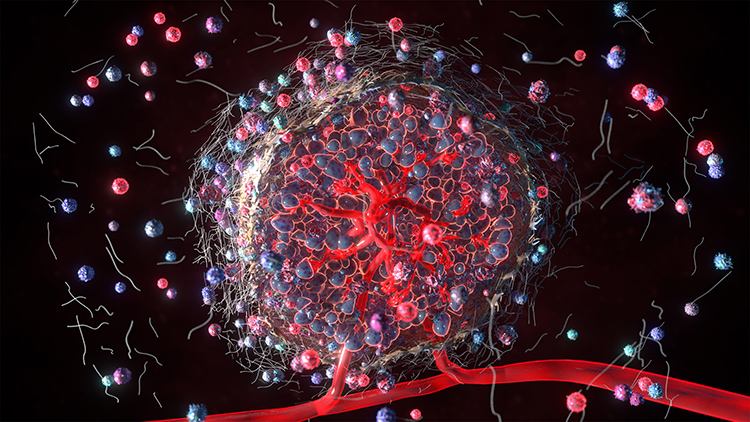
The growth of healthy tissues in the body depends on the development of new blood vessels, a process called angiogenesis, that enable proper blood flow, meaning that nutrients and oxygen are delivered while toxic metabolic products are removed. But solid tumors grow faster than healthy tissues, resulting in deficiencies in oxygen and blood flow, which leads to accelerated formation of dysfunctional blood vessels. Malignant cells rapidly grow while antitumor immune cells quickly lose their viability and function.
Cell biologist Serge Fuchs, the Elizabeth and William Whitney Clark Professor of Oncology, a professor of cell biology in the department of biomedical sciences, and director of the Mari Lowe Center for Comparative Oncology at Penn Vet, said these events promote generation of the immunosuppressive tumor microenvironment, which stimulates the spread and growth of tumors and confers resistance to antitumor therapies.
Past research has shown how native C-type natriuretic peptide (CNP), a 22-amino acid peptide produced by endothelial cells and fibroblasts, stimulates growth of normal blood vessels and restores proper blood flow and oxygenation within tissues of rodent limbs that weren’t getting enough blood flow. Given the importance of CNP in angiogenesis, researchers reasoned that CNP would also play a critical role in regulating tumor vasculature. But therapeutic potential of CNP is severely hampered by its short half-life of less than three minutes, said Zhen Lu, professor of oncology and pharmacology at the Institute of Drug Discovery and Development at China Pharmaceutical University and a former senior research investigator in Dr. Fuchs’ lab at Penn Vet.
Drs. Fuchs and Lu are part of an interdisciplinary, collaborative team which found that modifying CNP stimulated the formation of blood vessels, increased blood flow through tissue, reinvigorated antitumor immune responses, and slowed growth of tumors in an animal model. The results, published in the journal Science Translational Medicine, suggest that the treatment could alleviate hypoxia, or insufficient oxygen levels, in tumors. The team includes researchers from Kyushu University, the Higashiosaka City Medical Center, the Case Western Reserve University School of Medicine, and PharmaIN Corp.
This approach not only elicited responses on its own against solid tumors and metastatic disease but also enhanced the efficacy of multiple therapies. That includes different chemotherapy treatments, radiotherapy, immune checkpoint blockade, and adoptive cell transfer therapies, such as CAR T therapy.
Dr. Lu, first author on the paper, explained that PharmaIN researchers chemically modified part of CNP by adding an extended amino acid tail, forming a derivative of CNP (dCNP). He noted that, compared to native CNP, the derivative showed improved pharmacokinetics and pharmacodynamics in mice, meaning it was better absorbed in the body and had better effects.
The researchers successfully tested dCNP in several mouse solid tumor models, including pancreatic, colon, lung, and mammary adenocarcinomas, along with hepatocellular carcinoma and osteosarcoma.
Dr. Fuchs explains that this research builds on the work of Judah Folkman and Rakesh Jain, which looked at vascular endothelial growth factor (VEGF), a signaling protein that accelerates the formation of dilapidated and leaky blood vessels. They proposed anti-VEGF therapy. But resistance to anti-VEGF agents and difficulties with precise dosing meant obstacles remained to solving the problem of the immunosuppressive tumor microenvironment.
Dr. Lu says the new study demonstrates that, instead of inhibiting dysfunctional tumor angiogenesis by anti-VEGF agents, inducing healthy vasculature by dCNP could reinvigorate anti-tumor immunity and improve solid tumor therapies. Researchers completed preclinical studies and PharmaIN completed toxicity profiles, so the next step is selecting a solid tumor model for clinical trials.
Adapted from an August 21, 2024 Penn Today article by Erica Moser.