News

Wharton School Launches Bruce I. Jacobs Master of Science in Quantitative Finance with $60 Million Gift

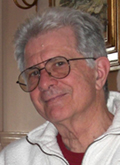
caption: Bruce JacobsThe Wharton School of the University of Pennsylvania has announced the launch of the Bruce I. Jacobs Master of Science in Quantitative Finance (MSQF) program, the school’s first new degree offering in 50 years. The program is funded by philanthropist Bruce I. Jacobs, G’79, GRW’86, whose transformational gift builds upon his longstanding support of quantitative finance initiatives at Wharton, now totaling more than $80 million. Dr. Jacobs’ latest gift of $60 million creates a new pathway for students to develop critical skills and explore career opportunities in the rapidly growing quantitative asset management industry.

“Wharton is the world’s top business school because it consistently leads at the forefront of fields like quantitative finance,” said Penn President J. Larry Jameson. “Dr. Jacobs has long been a champion for Wharton’s preeminence in this essential area, and we are deeply grateful for his historic gift. This new, innovative, hands-on graduate program will further advance our University’s strategic focus on data and AI while preparing our quantitative finance students and scholars to lead in a rapidly changing world.”

The Bruce I. Jacobs Master of Science in Quantitative Finance is initially intended for Penn students with a quantitative background and career aspirations in quantitative asset management and allied fields. With just one additional year of coursework following a bachelor’s degree, students will build expertise in quantitative methods, machine learning, artificial intelligence and financial markets, preparing them to succeed in the highly competitive and demanding quantitative asset management sector. The inaugural cohort will begin their studies in fall 2026.

“Bruce’s longtime philanthropic support has been instrumental in cementing Wharton’s position as the global leader in quantitative finance research and education,” said Wharton School dean Erika James. “We are immensely grateful for his recent gift, which will arm the next generation of finance professionals with the specialized skills needed to meet the demands of a tremendously complex and increasingly data-driven industry.  The Bruce I. Jacobs Master of Science in Quantitative Finance program marks an exciting new chapter of excellence in finance at Wharton. Building on our legacy as a powerhouse in the financial arena and a pioneer of the data-informed approach to learning, Wharton offers an unparalleled environment for students to explore this dynamic industry and emerge prepared to shape the future of finance.”

The Bruce I. Jacobs Master of Science in Quantitative Finance program combines a rigorous, data-intensive curriculum with practical experience and exposure to industry leaders through a dedicated advisory board and Wharton’s extensive global alumni network. Students will complete six required courses, including data science for finance and foundations of asset pricing, and can choose from more than 30 electives spanning accounting, business economics, computer science, engineering, operations, statistics and more. In their final semester, students will engage in a hands-on research project addressing a real-world challenge currently faced by quantitative asset management firms. Students will also gain exposure to practitioners, regulators, and other market participants throughout the program via tailored seminars and presentations.

By partnering with the Wharton School, Dr. Jacobs has made deep commitments to the study of quantitative finance over the past 15 years. His transformational giving—which totals more than $80 million—provides sustained support for faculty and students interested in moving the quantitative asset management industry forward. Dr. Jacobs co-founded the Jacobs Levy Equity Management Center for Quantitative Financial Research in 2011, as well as the Jacobs Levy Equity Management Dissertation Fellowships in Quantitative Finance and the Wharton-Jacobs Levy Prize for Quantitative Financial Innovation. His philanthropy also established the Bruce I. Jacobs Professorship in Quantitative Finance and the Bruce I. Jacobs Scholars in Quantitative Finance, and played a critical role in creating an MBA major in quantitative finance, which was introduced in 2020.

“When I was at the Wharton School, quantitative finance was in its infancy,” said Dr. Jacobs. “Now, it is an essential discipline in this data-driven world. The new Master of Science in Quantitative Finance program will offer new focused courses, internships and real-world experience alongside established opportunities in quantitative finance at the school for dissertation fellowships, a scholars program and the Jacobs Levy Center for Quantitative Financial Research. By bridging theory and practice, the MSQF program will have a lasting impact on the industry and many future generations of students, as well as ensure that the Wharton School will be at the forefront of this dynamic field.”

“Financial markets are evolving at breakneck speed, fueled by artificial intelligence, algorithmic trading and data complexity,” said David Musto, the Ronald O. Perelman Professor in Finance and faculty director of the Bruce I. Jacobs Master of Science in Quantitative Finance program. “Students in the program will benefit from the combination of Wharton’s quantitative finance expertise and the access to the multiple disciplines and vibrant communities present at Penn. Bruce’s ongoing support for the advancement of quantitative finance is nothing short of game-changing for the Wharton community.”

Dr. Jacobs is a principal and co-founder of Jacobs Levy Equity Management, where he serves as co-chief investment officer, portfolio manager, and co-director of research. He is the author of Too Smart for Our Own Good: Ingenious Investment Strategies, Illusions of Safety, and Market Crashes and Capital Ideas and Market Realities: Option Replication, Investor Behavior, and Stock Market Crashes, and co-author with Ken Levy of Equity Management: The Art and Science of Modern Quantitative Investing, 2nd ed., as well as numerous articles in peer-reviewed journals that have advanced the field of equity management.

Dr. Jacobs holds an MA in applied economics and a PhD in finance from the Wharton School. He is chair of the advisory board of the Jacobs Levy Equity Management Center for Quantitative Financial Research and previously served on the finance faculty at Wharton.

To learn more about the Bruce I. Jacobs Master of Science in Quantitative Finance program, including application requirements and deadlines, visit https://jacobs-msqf.wharton.upenn.edu.

Sara S. Bachman Reappointed Dean of School of the Social Policy & Practice

caption: Sara BachmanSara S. (Sally) Bachman’s service as dean of the School of Social Policy & Practice (SP2) has been extended to June 30, 2031, subject to approval by the Penn Board of Trustees.

The announcement was made by President J. Larry Jameson and Provost John L. Jackson Jr. 

“Dean Bachman has led SP2 through a period of remarkable growth, innovation, and resilience,” said President Jameson. “Over the past six years, she has demonstrated calm, principled, and effective leadership. Her steady presence has not only sustained the SP2 community, but has also enriched it intellectually and programmatically, all while remaining deeply committed to academic excellence and the social good.”

Following the process outlined in the Faculty Handbook, a Consultative Review Committee conducted a comprehensive evaluation of major accomplishments of Dean Bachman’s first term, along with an assessment of the new challenges and strategic opportunities that may face the school during the next five years, especially in support of the objectives articulated in the University’s strategic framework, In Principle and Practice.

“Provost Jackson and I are delighted that Dean Bachman will continue her steady leadership of Penn SP2,” President Jameson said. “The consultative committee unanimously supported her reappointment, highlighting her many accomplishments advancing the work of SP2.”

The committee charged with assessing Dean Bachman’s tenure so far was united in its praise of her work, acknowledging that under Dean Bachman’s leadership, SP2 has seen significant progress in academic innovation and faculty and staff development, and has:

  • Doubled its sponsored research revenue 
  • Reduced tuition dependency
  • Advanced academic excellence and expanded its faculty, including its first Penn Integrates Knowledge (PIK) faculty appointment
  • Launched innovative programs such as the Practice Doctorate in Nonprofit Administration, certificate in Applied Data Ethics, Law, and the Social Good, and advanced curricular initiatives in philanthropy and climate resilience

“Dean Bachman’s many accomplishments underscore the positive effects of her approachable and inclusive leadership style,” said Provost Jackson. “She works to foster a culture of collaboration, innovation and care among staff, students, and faculty. SP2’s newly launched and first-of-its-kind Practice Doctorate in Nonprofit Administration, a school-wide effort, is one of many tangible examples of how her leadership helps to facilitate ambitious and mission-critical initiatives.”

The committee included six faculty members, two students, and one alumnus. Together, they interviewed the dean, held numerous meetings with SP2 faculty, staff, and students, solicited confidential feedback, and reviewed internal data and reports detailing work from across the school. At its next meeting, the Penn Board of Trustees will receive a resolution to reappoint Dean Bachman.

$21 Million Gift from Estate of Louise A. Strauss for Penn Arts & Sciences Katz Center for Advanced Judaic Studies, the Penn Libraries, and Morris Arboretum & Gardens

The estate of Louise A. Strauss, a College of Arts & Sciences alumna who graduated in 1982, has contributed $21 million to multiple areas at Penn, including Penn Arts & Sciences’ Herbert D. Katz Center for Advanced Judaic Studies, the Rare Judaica Acquisitions Endowment Fund in the Penn Libraries, and Morris Arboretum & Gardens.

“Louise Strauss’s generous legacy gift will have a lasting impact across multiple pillars of Penn’s academic mission,” said Penn President J. Larry Jameson. “We are grateful for her commitment to provide support that will strengthen our entire community—from advancing Jewish studies scholarship and preserving rare historical materials, to supporting plant science research.”

The gift will extend the Katz Center’s fellowship program to more global scholars and provide significant general and programmatic operational support in the years ahead. The funds will also greatly bolster Penn Libraries’ ability to acquire rare materials for its Judaica collections—globally recognized for their exceptional historical depth, scholarly value, and institutional legacy—in perpetuity. The Morris Arboretum & Gardens will use its portion of the gift to support critical work in the field of plant science research. The gift was made in memory of Louise Strauss’ father, class of 1956 School of Arts & Sciences graduate student Hilary Strauss, who was an avid Penn supporter.

“Each of the initiatives Louise chose to support are home to exceptional scholarship and outreach,” said Mark Trodden, Dean of the School of Arts & Sciences and the Thomas S. Gates, Jr. Professor of Physics & Astronomy. “Her steadfast support of our Jewish studies initiatives further enhances Penn Arts & Sciences’ excellence in the field.”

Ms. Strauss was a member of the Katz Center’s board of advisors, following in the footsteps of her mother, Ione Apfelbaum Strauss, a 1954 graduate of the College of Liberal Arts for Women and former chair of the board at the center.

“This final act from Louise follows a life of profound generosity, devotion to scholarship, and sustained public service,” said Steven Weitzman, the Abraham M. Ellis Professor of Hebrew and Semitic Languages and Literature and the Ella Darivoff Director of the Katz Center. “She was a very self-effacing person, but all that she has done to support others is something that deserves to be honored for generations to come.”

Ms. Strauss’s public service commitments extended beyond Penn to multiple advisory boards, among them her service as trustee of Harcum College. 

She also served as a volunteer archivist at the Philadelphia Jewish Archives Center before volunteering as a processing archivist in the library at the Katz Center. Over the course of a decade, she worked to single-handedly organize the Lenkin Collection of Photography, consisting of more than 5,000 early photographs of the Land of Israel. She then uploaded them into an online repository, where the public may now discover and freely download them.

“Louise’s extraordinary gift enables Penn Libraries to grow its rare Judaica Collections in unprecedented ways,” said Brigitte Weinsteiger, the H. Carton Rogers III Vice Provost and director of the Penn Libraries. “Her years of volunteering alongside Schottenstein-Jesselson Curator of Judaica Arthur Kiron reflect the same devotion that now lives on in her legacy, advancing our mission to preserve and share Jewish life across time and around the globe.”

“Through thoughtful estate planning, Louise Strauss and her family significantly invested in the future of Morris Arboretum & Gardens,” said William (Bill) Cullina, the F. Otto Haas Executive Director of Morris Arboretum & Gardens. “The family’s generous gift provides truly transformational support for our research staff and new plant science lab. It will allow us to attract the best and brightest in the field and bolster our ability to maintain and cultivate our exceptional gardens and plant collections, which are enjoyed by more than 175,000 visitors annually.”

Heather Boushey: Professor of Practice in Weitzman School’s Kleinman Center for Energy Policy

caption: Heather Boushey The Kleinman Center for Energy Policy in the Weitzman School of Design welcomes former White House economist Heather Boushey as a professor of practice. In her new position, Dr. Boushey will take a leadership role in defining new opportunities for economic policy to influence the energy transition.

Dr. Boushey recently served as a member of President Biden’s Council of Economic Advisers and chief economist for the White House’s Investing in America cabinet, where she was central in shaping and implementing the administration’s industrial policy agenda.

“We are delighted to have Heather join a community of scholars here who also care deeply about the energy transition,” said Weitzman dean and Paley Professor Fritz Steiner.

“Heather brings a wealth of experience from the D.C. policymaking arena,” said Sanya Carley, the Mark Alan Hughes Faculty Director of the Kleinman Center. “And throughout her career, she has demonstrated a commitment to a fair economy for all.”

Dr. Boushey co-founded the Washington Center for Equitable Growth, where she advanced research on how inequality affects economic performance. Early in her career, she was an economist with the Center for American Progress, the Joint Economic Committee of the U.S. Congress, the Center for Economic and Policy Research, and the Economic Policy Institute.

In one of her books, Unbound: How Economic Inequality Constricts Our Economy and What We Can Do About It, Dr. Boushey argues that we do not have to choose between equality and prosperity. Through the data, she demonstrates that rising inequality has in fact deterred growth and is an impediment to a competitive U.S. marketplace. Dr. Boushey also co-edited After Piketty: The Agenda for Economics and Inequality, a collection of 22 essays about integrating inequality into economic thinking.

Dr. Boushey is widely respected as a leader in her industry. The New York Times called her one of the “most vibrant voices in the field,” and “at the forefront of a generation of economists rethinking their discipline,” and Politico has twice named her one of the top 50 “thinkers, doers, and visionaries transforming American politics.”

“I’m looking forward to continuing my career here at the Kleinman Center—moving research and policy forward on topics essential to a sustainable energy transition, which itself is a critical component of a healthy economy,” said Dr. Boushey, who received her BA from Hampshire College and her PhD in economics from the New School for Social Research. She arrives at Penn following a senior fellowship at the Reimagining the Economy project at the Harvard Kennedy School.

With this appointment, the Kleinman Center reaches a total of four professors dedicated to energy policy research and teaching.

Jennifer Wilcox, an expert in carbon management, was the first professor to join the Kleinman Center and holds a second appointment in the School of Engineering & Applied Science. Shelley Welton focuses on energy institutions and governance and holds a second appointment at Penn Carey Law School. Sanya Carley specializes in energy policy design and holds a second appointment in the department of city and regional planning at the Stuart Weitzman School of Design. Dr. Carley is also the faculty director of the Kleinman Center.

Weitzman School Launches New Master of Science in Design Post-Professional Program

Weitzman is launching the Master of Science in Design with a concentration in Property Development and Design (MSD-PDD)—a new post-professional program tailored for architects, landscape architects, and planners looking to lead in the fast-evolving real estate development sector.

“Increasingly, designers are stepping beyond traditional design roles,” said Rossana Hu, Miller Professor and chair of architecture, co-founder at Neri&Hu Design and Research Office, and the program’s director. “The MSD-PDD empowers design professionals to drive value in development processes without sacrificing architectural quality or sustainability goals.”

“The MSD-PDD develops conceptual and design abilities while allowing students to engage the economic, municipal, and environmental factors critical to a project’s success. It meets a growing need for architects to lead conversations about housing, land use, and urban equity,” said Richard Garber, an architect and co-founder at New York’s GRO Architects who is the program’s associate director.

The MSD-PDD expands on the school’s popular Real Estate Design and Development Certificate to offer a more immersive academic experience and robust credential. Over two semesters and a required summer session, students will gain the skills and vocabulary needed to become leaders as well as contributors in real estate ventures—from affordable housing and mixed-use developments to adaptive reuse and city-scale planning efforts.

Program highlights include a cross-disciplinary approach, studio-based learning, industry engagement, and career versatility.

What Sets the Penn MSD-PDD Apart

Global Outlook: Students are prepared to work internationally, in emerging markets, and navigate challenges such as design norms, differing regulations, cultural contexts, and market trends.

Social Equity and Impact: A curriculum that incorporates ethical development practices, focusing on affordable housing, mixed-income communities, and public-private partnerships.

Financial Innovation in Real Estate: Workshops on financial models and tools reshaping the real estate industry such as tokenization, REITs, impact investing, and alternative financing methods.

Emerging Design Technologies: Course content includes property technology (“PropTech”) integration, 3D printing, advanced BIM, modular construction, blockchain in property transactions, and AI for market analysis.

Sustainability: An emphasis on tools like green building certifications (LEED, WELL, SITES), modular housing technologies, renewable energy systems, and climate-responsive development.

Real-World Experience: Course content is grounded in active collaboration with developers, attorneys, planners, and city agencies in cities like Philadelphia, Boston, and New York. Students would work on live developments, from conceptual design to financial modeling and community engagement.

Applications for the inaugural cohort are now open with a deadline of January 7, 2026. Practicing professionals, entrepreneurs, and graduating students with a background in architecture, landscape architecture, or urban planning are encouraged to apply.

Wharton Executive Education and PRI Academy Announce Executive Certificate: Impact, Value, and the Materiality of Sustainability

The  Principles for Responsible Investment (PRI) Academy and Wharton Executive Education announce the launch of a new executive education program, the Wharton/PRI Executive Certificate: Impact, Value and the Materiality of Sustainability, designed to equip investment professionals with the tools and insights needed to navigate today’s complex financial landscape. The course will begin in February 2026.

This partnership reflects a shared commitment to advancing responsible investment as a core business and financial imperative. The program is grounded in fiduciary duty and evidence-based practice, helping leaders identify and manage financially material risks and opportunities in a changing world.

“As global markets face increasing complexity, from regulatory shifts and technological disruption to climate-related risks and geopolitical tensions, investors need robust frameworks and educational tools to make informed investment decisions,” said Anthony Roberts, director of the PRI Academy. “This course underpins how fiduciary responsibility and responsible investing go hand in hand. As a central platform for executive learning, the PRI Academy is proud to partner with Wharton Executive Education to bring this offering to a global audience.”

The PRI partnered with Wharton Executive Education and with Wharton’s Impact, Value, and Sustainable Business Initiative, which champions rigorous, practical education that connects measurable impact to financial value. Wharton Executive Education empowers leaders to turn insight into action through best-in-class learning that blends academic rigor with real-world relevance.

“Responsible investment is a professional discipline that empowers investors with the insights and frameworks needed to lead in a complex financial landscape,” said Witold Henisz, vice dean of the Wharton School and faculty director of the initiative. “Our goal is to prepare leaders to integrate sustainability and governance into strategy, valuation, and decision making. This partnership with PRI reflects our shared belief that long-term value creation depends on understanding and managing systemic risks.”

The course is open to participants globally and will feature expert faculty, interactive modules, and practical insights from leading practitioners.

The Principles for Responsible Investment (PRI) is the world’s leading proponent of responsible investment. Supported by the United Nations, it works to understand the investment implications of sustainability and governance factors and to support its international network of investor signatories in incorporating these factors into their investment and ownership decisions. The PRI acts in the long-term interests of its signatories, of the financial markets and economies in which they operate and ultimately of the environment and society as a whole. Launched in New York in 2006, the PRI has grown to more than 5,300 signatories, managing over $128 trillion U.S. 

Nominations for University-Wide Teaching Awards Due December 5

Nominations for Penn’s University-wide teaching awards are now being accepted by the Office of the Provost. Any member of the Penn community—past or present—may nominate a teacher for these awards. There are three awards:

  • The Lindback Award for Distinguished Teaching honors eight members of the standing faculty: four in the non-health schools (Annenberg, Weitzman, SEAS, GSE, Carey Law, SAS, SP2, Wharton) and four in the health schools (Dental Medicine, PSOM, Nursing, Veterinary Medicine).
  • The Provost’s Award for Distinguished PhD Teaching and Mentoring honors two faculty members for their teaching and mentoring of PhD students. Standing and associated faculty in any school offering the PhD are eligible for the award.
  • The Provost’s Award for Teaching Excellence by Non-Standing Faculty honors two members of the associated faculty or academic support staff who teach at Penn, one in the non-health schools and one in the health schools. 

The nomination forms are available on the teaching awards website. The deadline for nominations is Friday, December 5, 2025. Full nominations with complete dossiers prepared by the nominees’ department chairs are due Friday, February 6, 2026. For more information, please email provost-ed@upenn.edu.  

Criteria and Guidelines

The Lindback and Provost’s Awards are given in recognition of distinguished teaching. “Distinguished teaching” is teaching that is intellectually demanding, unusually coherent and permanent in its effect. The distinguished teacher has the capability of changing the way in which students view the subject they are studying. The distinguished teacher provides the basis for students to look with critical and informed perception at the fundamentals of a discipline and relate that discipline to other disciplines and to the world view of the student. The distinguished teacher is accessible to students and open to new ideas, but also expresses their own views with an articulate and informed understanding of an academic field. The distinguished teacher is fair, free from prejudice and single-minded in the pursuit of truth.

Skillful direction of dissertation students, effective supervision of student researchers, ability to organize a large course of many sections, skill in leading seminars, special talent with large classes, ability to handle discussions or structure lectures—these are all attributes of distinguished teaching, although it is unlikely that anyone will excel in all of them. At the same time, distinguished teaching means different things in different fields. While the distinguished teacher should be versatile, as much at home in large groups as in small, in beginning classes as in advanced, they may have skills of special importance in their area of specialization. The primary criteria for the Provost’s Award for Distinguished PhD Teaching and Mentoring are a record of successful doctoral student mentoring and placement, success in collaborating on doctoral committees and graduate groups, and distinguished research.

Since distinguished teaching is recognized and recorded in different ways, evaluation must also take several forms. It is not enough to look solely at letters of recommendation from students or to consider “objective” evaluations of classes in tabulated form. A faculty member’s influence extends beyond the classroom and individual classes. Nor is it enough to look only at a candidate’s most recent semester or opinions expressed immediately after a course is over; the influence of the best teachers lasts, while that of others may be great at first but lessen over time. It is not enough merely to gauge student adulation, for its basis is superficial; but neither should such feelings be discounted as unworthy of investigation. Rather, all these factors and more should enter into the identification and assessment of distinguished teaching.

The Lindback and Provost’s Awards have a symbolic importance that transcends the recognition of individual merit. They should be used to advance effective teaching by serving as reminders to the Penn community of the expectations for the quality of its mission.

Distinguished teaching occurs in all parts of the University. Therefore, faculty members from all schools are eligible for consideration. An excellent teacher who does not receive an award in a given year may be re-nominated in a future year and receive the award then.

The Lindback and Provost’s Awards may recognize faculty members with many years of distinguished service or many years of service remaining. The teaching activities for which the awards are granted must be components of the degree programs of the University of Pennsylvania.

Deaths

Lawrence R. Soma, Penn Vet

caption: Lawrence SomaLawrence Roger Soma, V’57, an emeritus professor of anesthesiology in Penn Vet, died recently from heart failure. He was 92.

Born in Queens, New York, Dr. Soma grew up in Bolton, Connecticut, and studied at the University of Connecticut from 1950 to 1953 before earning his Veterinariae Medicinae Doctoris (VMD) degree from the University of Pennsylvania in 1957. After graduating, Dr. Soma served in the United States Army Veterinary Corps. He was commissioned as a Captain, serving on active duty from 1958 to 1960 and in the Army Reserve from 1960 to 1966, during the Vietnam War.

Starting in 1960, Dr. Soma devoted more than five decades of service to the University of Pennsylvania School of Veterinary Medicine/New Bolton Center. He was assistant and associate professor prior to becoming professor of veterinary medicine clinical studies in 1972. He served as chair of the department starting in 1975. In 1993, he became the Marilyn M. Simpson Professor of Veterinary Medicine. 

A founding member of the American College of Veterinary Anesthesiology, Dr. Soma was internationally recognized for his contributions to veterinary anesthesia and clinical pharmacology. He served on numerous school and University committees, including multiple terms on the Committee on Appointments and Promotions, the Committee on Academic Status of Students, and the Institutional Animal Care and Use Committee, where he also served as chair. He also served as principal investigator of the Pennsylvania Horse & Harness Racing Commissions Research Program. 

In 2006, along with two colleagues, Dr. Soma was honored by the U.S. Harness Writers Association (USHWA) for developing the world’s first test for confirming the presence of the blood-doping drug commonly known as EPO, used in race horses. During the 2013-2014 academic year, he retired and became Professor Emeritus of Anesthesia and Clinical Pharmacology, Clinical Studies at New Bolton Center/Veterinary Medicine.

Dr. Soma is survived by his wife, Joan, and by his children, Scott J. (Nancy); Mark A. (Tracy); and Craig L. (Kim); grandchildren, Bon Soma, Jaeke Lyn Macdonald, Tyler Soma, Paul Soma, Alexander Soma, and Avery Soma; and great-grandchildren, Rory Macdonald and Camila Macdonald. 

In lieu of flowers, memorial contributions may be made to Penn Vet at Giving to Penn.

--

To Report A Death

Almanac appreciates being informed of the deaths of current and former faculty and staff members, students and other members of the University community. Call (215) 898-5274 or email almanac@upenn.edu.

However, notices of alumni deaths should be directed to the Alumni Records Office at Suite 300, 2929 Walnut St., (215) 898-8136 or email record@ben.dev.upenn.edu.

Honors

SCIMap Team Awarded $336,000 Grant by Open Philanthropy

A team that includes Alyssa Sinclair, the Joan Bossert Postdoctoral Fellow at the University of Pennsylvania’s Annenberg Public Policy Center and a researcher in the Communication Neuroscience Lab at the Annenberg School for Communication, is leading efforts to communicate the science and community impacts of ongoing cuts to federal funding for science and medical research.

The interdisciplinary team that developed an interactive, data-driven map to communicate the economic impact of sweeping cuts to federal funding for scientific and medical research recently received a $336,000 award from Open Philanthropy to sustain and expand their project. Open Philanthropy is a grantmaking organization that aims to use its resources to help others.

The team, comprised of researchers from the University of Pennsylvania, the University of Maryland, Georgia Institute of Technology, University of Utah and University of Oregon, launched the Science & Community Impacts Mapping Project (SCIMaP) in March 2025. The interactive website communicates how National Institutes of Health (NIH) funding cuts—including reductions to research infrastructure funding (known as indirect costs), grant freezes and terminations, and proposed reductions in the NIH fiscal year 2026 (FY26) budget—result in economic losses and job losses at national, state, county and congressional district levels.

With the new funding from Open Philanthropy, the team plans to expand its analysis to other federal agencies that are impacted, as well as assess and communicate the effects of federal cuts on research projects, public health, the scientific workforce and the economy.

The SCIMaP team estimates that, if implemented, NIH’s proposed drastic reduction in research infrastructure support would lead to an estimated $16 billion in economic loss and 68,000 jobs lost nationwide each year. Research grants that have been frozen and cancelled are associated with additional losses of $11 billion and 48,000 jobs nationwide. Likewise, if the NIH FY26 budget were reduced 40% as the White House proposed, the SCIMaP team projects an economic loss of $47 billion and more than 200,000 jobs lost. Visitors to the scienceimpacts.org website can see estimated economic losses from budget cuts along with a breakdown of impacts to three major NIH institutes that focus on aging, cancer and infectious disease.

“Federal investment in scientific research leads to widespread benefits for people and communities nationwide,” said project co-leader Ms. Sinclair. “SCIMaP aims to reveal the impact that science policy changes will have on local communities, and empower individuals to take actions that align with their values.” 

The SCIMaP team sourced its data from a public database of NIH grants, cancelled and frozen grants from the Grant Witness (previously Grant Watch) database, and local geographic mobility data from census data records. 

In recent years, more than $45 billion in NIH-funded medical research has been made possible annually through grant support to universities, hospitals and research institutes in communities across the U.S. Although less than 1% of the federal budget goes to the NIH, the investment has a significant positive impact on health innovation and the economy.

The United for Medical Research coalition estimates that every $1 invested in scientific research through the NIH produces $2.56 in new economic activity, a gain of more than 250% on investment. 

Frank M. Dattilio: 2025 PSOM Clinical Faculty Award in Psychiatry

caption: Frank DattilioFrank M. Dattilio is the recipient of the 2025 Clinical Faculty Award in Psychiatry from the University of Pennsylvania Perelman School of Medicine, where he is a full clinical professor of psychiatry (in psychology). He is also a teaching associate at Harvard Medical School in Boston, Massachusetts. The award is given each year to a faculty member for outstanding teaching and mentoring of residents and fellows in psychiatry. Dr. Dattilio is internationally known in the field of cognitive-behavior therapy and forensic psychology. He has published 325 peer-reviewed journal articles and 15 books, which have been translated in 30 languages and are used in 80 countries throughout the world.

Dr. Dattilio has also received numerous other state and national awards in the field of psychology and psychotherapy, including the 2002 Distinguished Psychologist Award from the American Psychological Association, which is given in recognition of his outstanding contribution to the field.

Barbara Riegel: American Heart Association Clinical Research Prize

caption: Barbara RiegelBarbara Riegel, the Emerita Edith Clemmer Steinbright Professor of Gerontology at Penn Nursing, will receive the American Heart Association’s 2025 Clinical Research Prize at the association’s 2025 Scientific Sessions. The meeting, to be held November 7-10, 2025, in New Orleans, Louisiana, is a premier global exchange of the latest scientific advancements, research and evidence-based clinical practice updates in cardiovascular science. Dr. Riegel will be awarded during the Presidential Session on Sunday, November 9, 2025.

“I’m deeply honored to receive this award from the American Heart Association,” said Dr. Riegel. “I have spent my career focused on research aiming to make a true impact on those living with heart disease and other chronic illnesses. Focusing on self-care for patients and their caregivers has been my priority for many years, and I am humbled by this prestigious recognition and look forward to continuing to support the association.”

Dr. Riegel is a senior research scientist at the Center for Home Care Policy & Research at VNS Health and co-director of the International Center for Self-Care Research, affiliated with Linköping University in Sweden. Her research interests focus on self-care for individuals with chronic illnesses such as cardiovascular disease. She began studying self-care, which she defines broadly to include treatment adherence, condition monitoring, and self-management of symptoms, early in her career as a clinical researcher in a hospital setting. Since those early years, she has developed standard ways to track and measure the burden of self-care for chronic health conditions, helping to bridge the gap between patient experiences and clinical care.

Dr. Riegel developed the internationally-recognized Self-Care of Heart Failure Index, the premier evaluation tool to comprehensively measure self-care in patients with heart failure. Through rigorous psychometric testing and continuous refinement, the index has become the global standard for measuring self-care in heart failure, widely used in research, education and interdisciplinary clinical practice, and has been cited in hundreds of peer-reviewed publications. Her most recent research focuses on innovative strategies to support caregivers, including the development of virtual health coaching interventions aimed at promoting caregiver self-care.

Penn Nursing’s Practice Environment Scale: PQM National Endorsement

Penn Nursing’s Center for Health Outcomes and Policy Research (CHOPR) announced that the Practice Environment Scale–Five-Item Composite (PES-5), developed by Penn Nursing, has been officially endorsed as a national healthcare quality measure. This endorsement by the Partnership for Quality Measurement (PQM) reflects the PES-5’s scientific rigor, usability, and potential to advance equitable, high-quality healthcare.

The PES-5 is a concise nurse survey tool that evaluates the quality of nurse work environments across five key domains: staffing and resource adequacy, leadership, nurses’ participation in hospital affairs, interprofessional collaboration, and a nursing philosophy of patient care. It provides hospital-level data that is actionable, reliable, and meaningful to healthcare leaders and frontline staff. The work environment supports or undermines professional nursing practice, which influences quality, safety, and both patient health and nurse job outcomes.

National endorsement is a formal recognition that a measure meets the highest standards of validity, reliability, and utility for healthcare performance improvement. It enables broader use in federal programs, hospital quality initiatives, and policy efforts aimed at improving nurse staffing, reducing burnout, and advancing patient safety.

“We are thrilled that the PES-5 has been recognized as a national quality measure,” said lead developer Eileen T. Lake, the Edith Clemmer Steinbright Professor in Gerontology, and associate director of CHOPR. “A strong nurse work environment is critical to patient outcomes, staff well-being, and health equity.”

Features

Celebrate ArBOOretum at Morris Arboretum & Gardens

October is ArBOOretum month at Morris Arboretum & Gardens. There are many events taking place throughout the month to help visitors get into the Halloween spirit. To learn more about all of the scheduled events, visit https://www.morrisarboretum.org/see-do/arbooretum

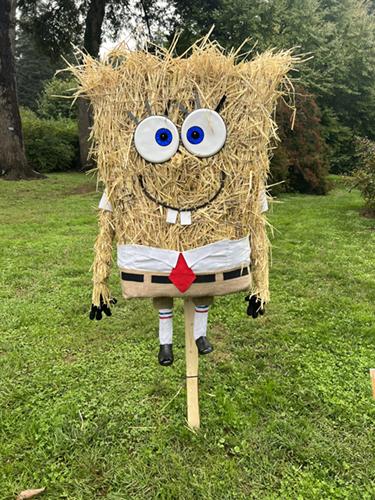
caption: SpongeBob SquareCrow created by Jason, Desmond & Ramona Sipman.

18th Annual Scarecrow Walk: From Saturday morning classics to modern animated icons, this Halloween the arboretum is celebrating the colorful, quirky, and beloved world of cartoons. Scarecrows will be on display from October 1 to November 2. Visitors can vote for their favorite scarecrow on-site from October 1 to 20 to determine the winners. The top three scarecrows win a cash prize: $300, $200, and $100. 

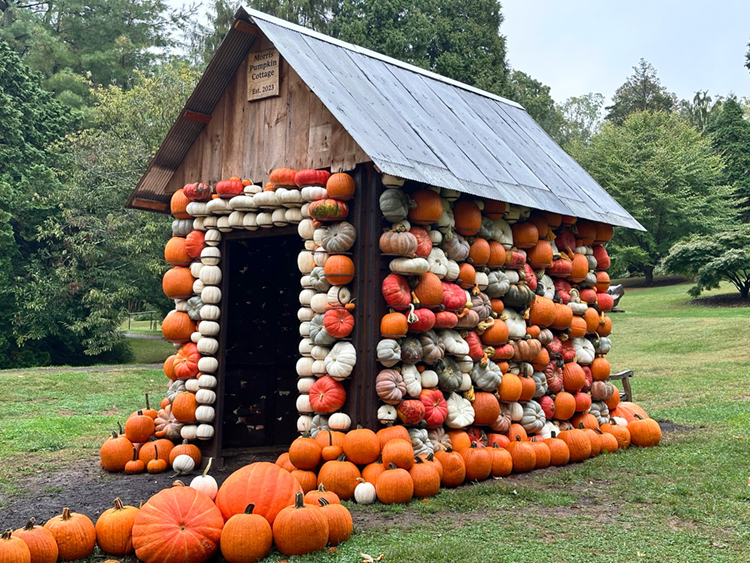
caption: The Morris Pumpkin Cottage is a 100-square-foot exhibition covered in hundreds of pumpkins. Photo by Bill Cullina.

Morris Pumpkin Cottage: Kids of all ages are invited to enjoy the Morris Pumpkin Cottage, a 100-square-foot exhibition covered in hundreds of pumpkins of various shapes and sizes. The cottage, a throwback to when the area around the arboretum used to be known as “Pumpkintown,” is tucked at the end of the Pumpkin Promenade, a small trail lined with pumpkins, gourds, scarecrows, and more.

October Storytime: A reading of the book Babushka Baba Yaga by Patricia Polacco on October 15 at 10:30 a.m. at the Outdoor Classroom. Baba Yaga is a witch famous throughout Russia for eating children, but this Babushka Baba Yaga is a lonely old woman who just wants a grandchild—to love. The reading will be followed by a short movement practice and crafting.

Fall First Friday for Kids and Families: Botanical Potions: Meet at the Pumpkin Cottage on October 3 at 11 a.m. to make botanical potions. Learn about plants and their mythological histories then make your own botanical potion for the spooky season.

Fall First Fridays for Adults: Seasonal Pause: A moment to process and reflect together in the garden as we move through a change of seasons. On October 3 at noon, participants will engage in a shared reading, discuss themes of change and transition, and then process with a slow craft.

Spooky Season Crafting: Get ready for trick or treating by making your own bat, insect, or even monster to take with you on October 30 at 11 a.m. Meet at the Pumpkin Cottage to listen to spooky tunes, dance, and craft to get into the spooky spirit. 

Events

WXPN Board Meeting: October 1

An open session of the WXPN Policy Board will take place on Wednesday, October 1, 2025 at noon at WXPN. For more information, email abby@xpn.org or call (215) 898-0628 during business hours. 

Update: September AT PENN

Exhibits

26        The Listening Cabinet; select a question about the future of democracy and the U.S. from a drawer and contemplate on your own or strike up a conversation with your neighbor; cabinet features questions submitted by Philadelphians on the eve of the U.S. Semiquincentennial; Feintuch Family Lobby, Annenberg Center. Through May 30, 2026.


Fitness & Learning

24        Goldwater Scholarship Information Session; learn about the Goldwater Foundation, which awards undergraduate scholarships to sophomores and juniors who have outstanding potential; 4 p.m.; room G08/09, College Hall (Center for Undergraduate Research & Fellowships).

            Graduate Student Bienvenida; celebrate the start of the semester with an event designed for Latinx graduate and professional students to connect across schools, explore resources, and build community; 4-6 p.m.; Castor Courtyard (La Casa Latina, Graduate Student Center).

25        Federal Cuts and IPV Programming; a fireside chat to discuss the impact of federal cuts and mandates on IPV-focused organizations, victims, and survivors; noon; Zoom webinar; register: https://tinyurl.com/gsws-workshop-sep-25 (Gender, Sexuality & Women’s Studies).

26        Knowledge for Life; associate vice provosts for operations Claire DeMarco and Alexa Pearce will share how the Penn Libraries have evolved to support scholarship, teaching, and lifelong learning—offering insight into the expanding array of services and resources available to retired faculty; noon; room 403, McNeil Building; register: https://pp.events/bAXYgDnY (Penn Association of Senior & Emeritus Faculty).

            Fall Grant-Writing Workshop; learn how you can better position yourself to be a competitive applicant for the College Alumni Society Research Grant or Vagelos Undergraduate Research Grant; 3 p.m.; room G08/09, College Hall (Center for Undergraduate Research & Fellowships).

            Pan-Asian American Community House (PAACH) Open House (Graduate); learn about Penn’s cultural hub for everyone interested in the diverse cultures and experiences of Asian Pacific Islander (API) communities; 3-5 p.m.; ARCH (Pan-Asian American Community House).

29        Transgender Periods Workshop; gain skills, receive transgender-affirming period supplies, and get resources; 6:30 p.m.; LGBT Center; registration required; info: https://ulife.vpul.upenn.edu/calendar/host/LGBT-Center/24 (LGBT Center).

30        Building Your Class Vocabulary: How to Talk about Money, Resources, and Class Background; participate in a transformative, shame-free conversation about how we all experience wealth, varying levels of social class, and shifting access to money and power at Penn; 6 p.m.; room G13, College Hall; register: https://tinyurl.com/paideia-dialogue-sep-30 (SNF Paideia Program).


Graduate School of Education

Online webinars. Info: https://www.gse.upenn.edu/news-and-events/events-calendar.

24        Alumni Panel: Where Can Your GSE Degree Take You; 4 p.m.

25        Learning Analytics & Artificial Intelligence (Online) MSEd Virtual Information Session; 7 p.m.


Morris Arboretum & Gardens

Info: https://www.morrisarboretum.org/.

30        Goodbye Pollinators, Hello Autumn!; an opportunity to say goodbye to our migrating butterflies and hummingbirds with songs, poems, and crafts; 11 a.m.


Penn Libraries

Info: https://www.library.upenn.edu/events.

24        Grad Cafe: Podcasts & Digital Scholarship at Penn Libraries; will introduce some of the approaches graduate students and early career scholars are taking to create or contribute to podcasts in order to share research more broadly; 11 a.m.; room 241, Van Pelt Library.

            Paint with Dr. Spieler; a screen-free crafternoon to learn how to paint; noon; room LL02A, Leon Levy Dental Library, Evans Building.

            Intro to Vacuum Forming for Packaging Design Part 2 of 2; learn to use a vacuum former to create your own commercial looking product using digital design and fabrication; 2-4 p.m.; Makerspace, Education Commons.

25        AI in Action: Smart Prompts & Creative Applications for Students; learn effective AI prompt writing and visual content creation for college projects in this hands-on workshop covering ChatGPT techniques, AI art generation, and ethical AI use in academic settings; 2 p.m.; room 114, Van Pelt Library.

            Bookbinding Workshop: Pamphlet and Accordion Combinations and Variations; learn the basics of making pamphlets and accordions, and create a handful of small books and book objects to take home; 5 p.m.; seminar room level B, Fisher Fine Arts Library.

30        Community Study Sessions—September; a relaxed, supportive space to stay focused, meet others, and enjoy free snacks; 6-8 p.m.; room 124, Van Pelt Library.


Readings & Signings

24        Tell Me What You Like: An Honest Discussion of Sex and Intimacy After Sexual Assault; Kate Simon, journalist; 5:30 p.m.; 2nd floor conference room, Penn Bookstore (Penn Bookstore).

25        The Sun Won’t Come Out Tomorrow: The Dark History of American Orphanhood; Kristen Martin, journalist; 5:30 p.m.; 2nd floor conference room, Penn Bookstore (Penn Bookstore).


Talks

23        Architectures, Topologies and Control for High-Frequency Power Electronics; Khurram Khan Afridi, Cornell University; 11 a.m.; room 225, Towne Building (Electrical & Systems Engineering).

24        Advancing Oral Macrocyclic Peptides as a New Modality: The Discovery and Development of Enlicitide; Robert M. Garbaccio, MERCK; noon; Carolyn Hoff Lynch Lecture Hall, 1973 Chemistry Building (Chemistry).

            Aldehyde Resistance of Mycobacterium Tuberculosis; K. Heran Darwin, New York University; noon; Austrian Auditorium, CRB (Microbiology).

            How Do LLMs Generalize on Out-of-Distribution Tasks? Insights from Model’s Internal Representations; Yiqiao Zhong, University of Wisconsin-Madison; noon; room 414, Amy Gutmann Hall, and Zoom webinar; join: https://upenn.zoom.us/j/91447341103 (ASSET Center).

            Decoding the Moment: Obamacare Subsidies at a Crossroads; Katherine Baicker, University of Chicago; Jonathan Gruber, Massachusetts Institute of Technology; 1 p.m.; online webinar; register: https://tinyurl.com/gruber-talk-sep-24 (Leonard Davis Institute).

            Indexing War; Sonal Khullar, history of art; 3 p.m.; room 113, Jaffe Building (History of Art).

            Interpreting and Leveraging Generative Representations; Deepti Ghadiyaram, Boston University; 3 p.m.; room 307, Levine Hall, and Zoom webinar; join: https://upenn.zoom.us/j/96632884234 (GRASP Lab).

            Imaging Genetics: Enhancer-mediated Dynamic Gene Control in Space and Time; Bomyi Lim, chemical & biomolecular engineering; 3:30 p.m.; Wu & Chen Auditorium, Levine Hall (Chemical & Biomolecular Engineering).

            Ramanujan Property and Edge Universality of Random Regular Graphs; Jiaoyang Huang, statistics and data science; 3:30 p.m.; room A4, DRL (Mathematics).

            Single Cell Experiments at the Epithelial Barrier: Inflammatory Bowel Disease and Host-Microbiome Interactions; Oni Basu, University of Chicago; 3:30 p.m.; room A8, DRL (Physics & Astronomy).

            Uncovering the Ancient Milky Way; Anirudh Chiti, University of Chicago; 3:30 p.m.; room 4E19, DRL (Physics & Astronomy).

            The Big House and the Large City; Kersten Geers, architect; 6:30 p.m.; Plaza Gallery, Meyerson Hall (Architecture).

25        Designing Biomaterials With Spatially Tunable Properties; Lesley Chow, Lehigh University; 10:30 a.m.; Wu & Chen Auditorium, Levine Hall (Materials Science & Engineering).

            Propagation-of-Chaos in Shallow Neural Networks Beyond Logarithmic Time; Joan Bruna, New York University; noon; room 414, Amy Gutmann Hall, and Zoom webinar; join: https://upenn.zoom.us/j/98220304722 (IDEAS Center, Statistics & Data Science, PennAI).

            Representing the President; Chad A. Readler, Sixth Circuit Court of Appeals; Mike McGinley, Dechert; noon; room 240A, Silverman Hall; register: https://tinyurl.com/readler-mcginley-talk-sep-25 (Federalist Society).

            Translated Subjects: Race, Sexuality, and Empire; Hamit Arvas, English; Jonathan Gil Harris and Madhavi Menon, Ashoka University; 3 p.m.; room 135, Fisher-Bennett Hall (Gender, Sexuality & Women’s Studies, English).

            Physical Biology Strategies for Translational Bioelectrical Interfaces; Bozhi Tian, University of Chicago; 3:30 p.m.; room 216, Moore Building (Bioengineering).

            "Domesticating" Climate Change: The Intertwining of Climate and Development in India; Navroz K. Dubash, Princeton University; 4:30 p.m.; World Forum, Perry World House; register: https://casi.sas.upenn.edu/events/navroz-dubash (Perry World House, Center for the Advanced Study of India).

            Domestic and Spectacular Energy at the Parisian Expositions: Le Pavillon du Gaz (1889) and Le Palais de l'électricité (1900); Anne O’Neil-Henry, Georgetown University; 5:15 p.m.; room 543, Williams Hall (French, Italian, & Germanic Studies).

            Taiwan at the Center: Twentieth-Century Economy, Total War, Cold War; James Gergen-Chen, University of Florida; Junko Ono, Kinjo Gakuin University; Richard Ng, Osaka University; Eiichiro Azuma, Center for East Asian Studies; 5:15 p.m.; room 111, Annenberg School; register: https://tinyurl.com/ceas-talk-sep-25 (Center for East Asian Studies).

            Output: A Celebration of Computer-Generated Text; Lillian-Yvonne Bertram, University of Maryland; Nick Monfort, Massachusetts Institute of Technology; Steve McLaughlin, writer; Jim Carpenter, Wharton School; Syd Zolf, English; 6 p.m.; Kelly Writers House, and YouTube livestream; register: https://pricelab.sas.upenn.edu/events/output-celebration-computer-generated-text (Price Lab for Digital Humanities).

26        The Picture of Her: Transnational Representations of Vietnamese Women Soldiers; Nicole Hoang, ASAM fellow; noon; room 473, McNeil Building; RSVP: https://tinyurl.com/hoang-talk-sep-26 (Asian American Studies).

            Workforce-Aligned Grant Aid; Rajeev Darolia, University of Kentucky; noon; room 201, Stiteler Hall (Graduate School of Education).

            Foreign Influencer Operations: How TikTok Shapes American Perceptions of China; Daniel Mattingly, Yale University; 12:15 p.m.; room 500, Annenberg School (Elihu Katz Colloquium).

            New Considerations in Legacy Pollutants: Urban Stormwater Management for Nitrogen: Inorganic, Organic, and Synthetic Forms; Erica R. McKenzie, Temple University; 3 p.m.; room 358, Hayden Hall (Earth & Environmental Studies).

27        Politics of Placement in the 18th Dynasty Theban Necropolis; JJ Shirley, University of Michigan; 3:30 p.m.; Penn Museum; tickets: $10/general, $7/members and Penn faculty and staff, $5/students with ID, free/ARCE members; info: https://www.penn.museum/calendar/866/arce-pa-lecture (Penn Museum, American Research Center in Egypt, Pennsylvania Chapter).

29        Beyond the National Frame: Scenes from the Indo-Pak Border; Natasha Raheja, Cornell University; noon; room 345, Penn Museum (Anthropology, Center for the Advanced Study of India).

            Creator Logic-in-Practice: Political Content Creators and the Negotiation of Influence in the Post-Networked Era; Yena Lee, Center on Digital Culture and Society; 12:15 p.m.; room 300, Annenberg School; register: https://tinyurl.com/lee-talk-sep-29 (Center on Digital Culture and Society).

            Pattern Dynamics Appearing On Compact Metric Graph; Toshi Ogawa, Meiji University; 4 p.m.; room 3W2, DRL (Mathematics).

            “These Thoughts Were All in French, Almost Untranslatable”: The Bilingual Manuscript Notebooks of Kerouac’s Maggie Cassidy; Jean-Christophe Cloutier, English; 5:15 p.m.; Class of 1978 Orrery Pavilion, Van Pelt Library (Workshop in the History of Material Texts).    

            Remembering 1991 in Central Asia: Shock Therapy? Marianne Kamp, Indiana University; 5:30 p.m.; location TBA (History, Russian & East European Studies).

30        Taking Advantage of Coherent Vortex Wakes: Formation Flight and High Density Tidal Energy Harvesting; Kenneth Breuer, Brown University; 10:15 a.m.; Wu & Chen Auditorium, Levine Hall (Mechanical Engineering & Applied Mechanics).

            Chemical Processes in Nano/Microphase Structured Fluids; Lauren Zarzar, Penn State University; noon; Carolyn Hoff Lynch Lecture Hall, 1973 Chemistry Building (Chemistry).

            Debt and Capital in the Medieval Egyptian Countryside; Lorenzo Bondioli, Harvard University; noon; room 209, College Hall (History).

            Cooperation and Chasm: The Health and Future of Global Public Health; Satoshi “Toshi” Ezoe, Senior Assistant Minister for Global Health in Japan; Louise Moncla, Penn Vet; Jennifer Pinto-Martin, Penn Nursing; 4 p.m.; World Forum, Perry World House; register: https://tinyurl.com/pwh-talk-sep-30 (Perry World House).

            Racial Capitalism, Enslavement and Fugitivity in Charleston, SC; Lisa Brock, Adler University; 5 p.m.; room 329A, Max Kade Center; register: https://tinyurl.com/brock-talk-sep-30 (Africana Studies).

            Barbershop Music, Racial Segregation, and Civil Rights, 1938-1963; Clifton Boyd, New York University; 5:15 p.m.; room 101, Lerner Building (Music).

            The Marionettist: Fradl Shtok and the Lexicon of Yiddish Joy; Sunny S. Yudkoff, University of Wisconsin–Madison; 5:15 p.m.; room 543, Williams Hall (French, Italian & Germanic Studies).

            Did Words on the Wall Matter More? Public Scripture and Jewish–Christian Encounters in the First Centuries CE; Michal Bar-Asher Siegal, Ben-Gurion University of the Negev; 5:30 p.m.; Levy Conference Room, Penn Carey Law; register: https://penncareylaw.cventevents.com/qxa2Qw (Penn Carey Law).

            Underwater Revelations: Exploring Climate and Architecture Below the Surface; Michael Weisberg, philosophy; Mantha Zarmakoupi, history of art; 5:30 p.m.; room 121, Vagelos Laboratory for Energy Science and Technology; register: https://tinyurl.com/weisberg-zarmakoupi-sep-30 (Penn Science Café).


Economics

In-person events in various locations. Info: https://economics.sas.upenn.edu/events.

23        Universal Social Pension and Labor Market Outcomes: Evidence from Nepal; Shreemayi Samujjwala, economics; noon; room 101, PCPSE.

24        The Fragility of Government Funding Advantage; Jonathan Payne, Princeton University; 4 p.m.; room 200, PCPSE.

25        Grade Inflation, Signaling, and Status Externality in the PhD Admission Market; Siqi Li, economics; 3:30 p.m.; room 101, PCPSE.

29        Revisiting the National JTPA Study: Estimation of the Distribution of Job Training Effects; Young Ahn, economics; noon; room 203, PCPSE.

30        The Impact of Publicly Funded Home Based Care on Nursing Home Quality; Brady Smith, economics; noon; room 101, PCPSE.


This is an update to the September AT PENN calendar, which is available online now. Submit events for AT PENN calendars or weekly updates at almanac@upenn.edu.

Crimes

Weekly Crime Reports

Division of Public Safety
University of Pennsylvania Police Department Crime Report

About the Crime Report: Below are the Crimes Against Persons and/or Crimes Against Property from the campus report for September 8-14, 2025. The Crime Reports are available at: https://almanac.upenn.edu/sections/crimes. Prior weeks’ reports are also online. –Eds.

This summary is prepared by the Division of Public Safety (DPS) and contains all criminal incidents reported and made known to the Penn Police, including those reported to the Philadelphia Police Department (PPD) that occurred within our patrol zone, for the dates of September 8-14, 2025. The Penn Police actively patrol from Market Street to Baltimore Avenue and from 30th Street to 43rd Street in conjunction with the Philadelphia Police.

In this effort to provide you with a thorough and accurate report on public safety concerns, we hope that your increased awareness will lessen the opportunity for crime. For any concerns or suggestions regarding this report, please call DPS at (215) 898-7297. You may view the daily crime log on the DPS website.


Penn Police Patrol Zone
Market Street to Baltimore Avenue and from 30th Street to 43rd Street

Crime Category

Date

Time

Location

Description

Assault

09/12/25

8:23 PM

4012 Walnut St

Juvenile assaulted by two unknown offenders inside of theater


09/12/25

3:13 PM

3500 Chestnut St

Complainant reported unwanted contact from her ex-partner


09/12/25

3:15 PM

1 Convention Ave

Offender threatened hospital employee and was escorted out of the building

Auto Theft

09/09/25

12:40 PM

4200 Walnut St

Theft of a motor vehicle from highway; vehicle recovered a short time later


09/09/25

6:24 PM

200 S 39th St

Theft of a secured electric scooter from bike racks


09/11/25

4:55 AM

210 S 34th St

Theft of a UPPD bait scooter from highway/Arrest


09/13/25

6:15 PM

3901 Locust Walk

Theft of a secured scooter from bike racks


09/14/25

1:09 PM

3901 Locust Walk

Secured scooter taken from bike racks/Arrest


09/14/25

10:32 PM

3817 Spruce St

Scooter taken from bike rack

Fraud

09/12/25

12:27 PM

3600 Spruce St

Complainant reported fraudulent activity on his credit card accounts

Other Offense

09/10/25

8:11 AM

3925 Walnut St

Active warrant on offender discovered during retail theft attempt/Arrest

Retail Theft

09/08/25

10:32 AM

3401 Chestnut St

Retail theft of consumable goods/Arrest


09/08/25

9:35 PM

4233 Chestnut St

Retail theft of alcohol


09/10/25

10:27 PM

3744 Spruce St

Retail theft of consumable goods


09/11/25

6:52 AM

3330 Market St

Retail theft of consumable goods


09/11/25

9:29 PM

4233 Chestnut St

Retail theft of alcohol


09/14/25

8:01 AM

3604 Chestnut St

Retail theft of consumable goods


09/14/25

2:27 PM

3744 Spruce St

Retail theft of consumable goods

Theft from Building

09/08/25

12:55 PM

3820 Locust Walk

Theft of a package containing shoes from mailroom


09/08/25

6:18 PM

4210 Chestnut St

Theft of two unsecured bicycles from apartment building garage


09/08/25

6:56 PM

4045 Baltimore Ave

Theft of unsecured bicycle stolen from apartment building laundry room


09/09/25

9:58 AM

314 S 40th St

Theft of a laptop stolen from the complainant’s front porch of residence


09/11/25

8:07 PM

4210 Chestnut St

Theft of a package containing clothing from lobby of apartment building


09/12/25

2:48 PM

240 S 40th St

Theft of dental equipment from cubicle in second floor patient area


09/12/25

2:53 PM

3409 Walnut St

Theft of a wallet from Franklin’s Table

Theft Other

09/09/25

4:48 PM

3939 Pine St

Package theft from residence


09/13/25

7:25 PM

3000 Walnut St

Theft of a wallet and headphones from bench

Vandalism

09/08/25

9:27 AM

4200 Pine St

Complainant reported that an unknown offender damaged the lock on her vehicle’s driver side door


09/13/25

3:43 PM

420 S 42nd St

Window damaged by bullet found inside of room; no injuries reported


Philadelphia Police 18th District
Schuylkill River to 49th Street & Market Street to Woodland Avenue

Below are the Crimes Against Persons from the 18th District: 5 incidents were reported for September 8-14, 2025 by the 18th District, covering the Schuylkill River to 49th Street & Market Street to Woodland Avenue.

Crime Category

Date

Time

Location

Assault

09/11/25

12:28 PM

201 S 45th St


09/12/25

4:17 PM

3500 Blk Chestnut St


09/12/25

4:18 PM

1 Convention Ave


09/12/25

8:47 PM

4012 Walnut St

Rape

09/14/25

11:58 PM

200 Blk S 40th St

The Division of Public Safety offers resources and support to the Penn community. DPS developed a few helpful risk reduction strategies outlined below. Know that it is never the fault of the person impacted (victim/survivor) by crime.

  • See something concerning? Connect with Penn Public Safety 24/7 at (215) -573-3333.
  • Worried about a friend’s or colleague’s mental or physical health? Get 24/7 connection to appropriate resources at (215) 898-HELP (4357).
  • Seeking support after experiencing a crime? Call Special Services - Support and Advocacy resources at (215) 898-4481 or email an advocate at specialservices@publicsafety.upenn.edu
  • Use the Walking Escort and Riding services available to you free of charge.
  • Take a moment to update your cellphone information for the UPennAlert Emergency Notification System
  • Download the Penn Guardian App which can help Police better find your location when you call in an emergency.
  • Access free self-empowerment and defense courses through Penn DPS.
  • Stay alert and reduce distractions; using cellphones, ear buds, etc. may limit your awareness.
  • Orient yourself to your surroundings. (Identify your location, nearby exits, etc.)
  • Keep your valuables out of sight and only carry necessary documents.

Bulletins

One Step Ahead: AI and the Real World

One Step Ahead: Security & Privacy Made Simple logo

Another tip in a series provided by the Offices of Information Security, Information Systems & Computing and Audit, Compliance & Privacy

AI is becoming more integrated into the applications we use in our day-to-day lives. AI can, and does, make things easier for us. However, we need to use AI with a sense of discernment and a bit of skepticism.

AI sometimes has something called “hallucinations,” where the response from the AI outputs things that are not factually correct.

For example, AI has fabricated legal cases that professionals have mistakenly included in legal documents. It has also falsely given several companies incorrect business or financial information. People basing their actions on these incorrect, AI-provided “facts” could cause embarrassment and legal and economic harm.

The AI companies can help mitigate the possibility of hallucinations by refining their training data and using other internal processes to try to prevent hallucinations.

You can mitigate the possibility of AI hallucinations by refining your prompts and manually confirming information after engaging with AI to validate for accuracy.

To do this, when creating your prompts, be clear and specific about the questions you ask so that the AI returns as precise responses as possible. You should also provide context and relevant details while writing your prompts.

As a part of your prompt, you can also ask the AI to provide sources. When prompted, most AI tools cite their sources and provide links, which you can use to check for response accuracy. You should also consider independently verifying AI responses.

University of Pennsylvania AI Guidance: https://isc.upenn.edu/security/AI-guidance.

--

For additional tips, see the One Step Ahead link on the Information Security website: https://isc.upenn.edu/security/news-alerts%23One-Step-Ahead.

Back to Top