
From the Provost and Vice Provost for Faculty: Recognizing the Impact of External Events on the Tenure, Promotion, and Evaluation of Penn Faculty
As the University monitors the timing and impact of federal policy changes, we are writing to share information about the mechanisms in place for recognizing the effects of external events on faculty work, especially for faculty in their probationary period. Additional steps will be taken, if necessary and appropriate, as the situation continues to evolve.
Extension of the Probationary Period
In response to the COVID-19 pandemic, the University extended the probationary period by one year for all faculty who were assistant professors and associate professors without tenure in the tenure, clinician-educator, and research tracks whose reviews had not already begun, who were not in their mandatory or terminal years, and who had not already received a COVID-related extension. This automatic extension was intended to recognize that, in response to the pandemic, Penn faculty made rapid changes to their teaching; experienced illnesses and deaths in their families; spent more time advising, mentoring, and supporting students; and experienced barriers to conducting and disseminating research, with limits on field research, lab and facility closures, loss of research subjects, conference cancellations, journal publication slowdown, and more.
As implications of current and potential federal policy changes are still playing out, a universal automatic extension of the probationary period is not warranted at this time. However, current University policy now allows for an extension of the probationary period for non-tenured members of the standing faculty, standing faculty-clinician educators, and research faculty for a new child in the home, caregiver responsibilities, serious health conditions, military service, or a catastrophic personal or professional event. A catastrophic professional event is defined in the Faculty Handbook (Section II.E.3.A.4.ii.) as follows:
The destruction, loss, or unavailability of, or interference with access to, materials, data or research opportunities necessary for completion of a research project, such that the research project is unable to proceed or is disrupted for at least sixty days; or unforeseen interruptions in the availability of building facilities or suspension of laboratory operations that deprive the faculty member or appropriate members of the research team of access to a laboratory or the availability of other essential supports for at least sixty days. It is understood that a “catastrophic event” has a serious impact on the faculty member’s ability to pursue their area of scholarly focus or activity in a customary and timely fashion and occurs through no fault of the faculty member.
Section II.E.3.I of the Faculty Handbook outlines the procedures for requesting an extension of the probationary period because of a catastrophic personal or professional event. Faculty are encouraged to contact their Dean, department chair, or faculty affairs coordinator to discuss whether their situation qualifies for an extension.
Impact Statements
In spring 2021, the University added a “pandemic impact statement” to its faculty review process to recognize the impact of the COVID pandemic on the lives and work of Penn faculty. Both assistant and associate professors have since included pandemic impact statements in their promotion and tenure dossiers, and these statements have helped external consultants and internal reviewers recognize the short- and long-term implications of the pandemic on working conditions, productivity, and career trajectory when making their evaluations.
We are now modifying the current “pandemic impact statement” to allow faculty the option of disclosing and discussing how any unforeseen and disruptive event (including the COVID pandemic, federal policy changes, etc.) has impacted their teaching, advising, mentoring, service, research, or scholarship or created other challenges, including reducing access to resources to support research and scholarship. The impact statements should reflect a faculty member’s individual circumstances and experiences and may include the following:
- Teaching: Changes in course load and course delivery; learning, use, and incorporation of new instructional technologies.
- Advising and mentoring: Changes in advising load; support provided to students experiencing challenges.
- Service: Engagement in efforts to make changes to curriculum, advising, lab access, etc.; engagement in initiatives related to external events for the department, University, professional association, and other organizations.
- Research and scholarship: Restrictions on access to research funding, sites, labs, facilities, studios, and other venues; restrictions on professional travel and field research; loss of access to research subjects; need to pause, restart, or pivot research; cancellation of seminars, presentations, and opportunities to collaborate; slowing of publication and grant funding processes; redirection of funding.
- Other challenges: Resource constraints (e.g., internet, work space); caregiving and homeschooling responsibilities; health issues* (for self or family); visa restrictions. (*Personal health information is confidential and disclosure is not required.)
Evaluation Criteria
Impact statements are intended to encourage reviewers to evaluate a faculty member’s contributions in the context of available resources and opportunities. To further encourage this contextualized approach, the University has modified the prompts external consultants are asked to consider in their evaluations for tenure and promotion of standing faculty, appointment and promotion of standing faculty-clinician educators to the ranks of associate professor-CE and professor-CE, and appointment and promotion of research faculty to the ranks of research associate professor and research professor.
The prompts in the letter to external consultants that must be used by July 1, 2025 now emphasize the “impact and trajectory” of the candidate’s contributions and the candidate’s most distinctive contributions to their disciplines. Previous prompts that encouraged reviewers to rank the candidate relative to other scholars have been removed.
We have also modified the guidelines for the selection of external consultants to allow for inclusion of a consultant from a non-academic institution or non-academic role who may speak to the impact of the candidate’s scholarship on policy and practice, including community-engaged scholarship. External consultant solicitation letter templates, and guidelines for selection of external consultants, are posted here.
As you continue forward, please take advantage of the resources Penn offers to support mental health and emotional well-being. The University is also providing ongoing updates on federal policy changes. Thank you for all that you are doing to advance our shared mission and support other members of our community.
—John L. Jackson, Jr., Provost
—Laura W. Perna, Vice Provost for Faculty
 Paul Shaman, an emeritus professor of statistics in the department of statistics and data science in the Wharton School, died on March 19. He was 85.
 This fall, Annenberg School for Communication associate professor Sarah J. Jackson will begin a one-year fellowship at the Institute for Advanced Study (IAS), one of the world’s foremost centers for intellectual inquiry.
 Three leading mid-career statisticians, including two Wharton School faculty members, have won the David Cox Medal for Statistics, which is being awarded for the first time in 2025 to commemorate the work of the late world-leading statistician and former Royal Statistical Society president, Sir David Cox.
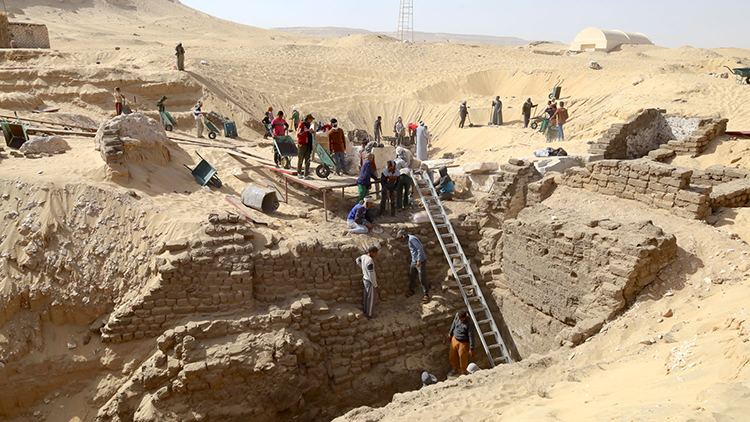 Egyptian archaeologists working at Abydos in cooperation with the Egyptian Ministry of Tourism and Antiquities, including archaeologists affiliated with the Penn Museum, have discovered the massive tomb of an unnamed pharaoh at the ancient necropolis of Anubis Mountain, shedding new light on a long-lost dynasty and a lesser-known period in Egyptian history.