News

Penn Board of Trustees Appoint J. Larry Jameson President and Extend His Term Through June 2027

caption: J. Larry JamesonThe Board of Trustees of the University of Pennsylvania voted unanimously on March 13, 2025 to appoint J. Larry Jameson, who has served as Interim President since December 2023, President of the University of Pennsylvania for a term that will run through June 30, 2027.

In announcing the appointment, chair of the Board of Trustees Ramanan Raghavendran stated, “the challenges facing higher education today are among the most significant ever encountered by American universities. Given Penn’s complexity, size, location, and visibility, these issues have profound implications for our community. In such a moment, there is nothing more important than leadership.

“Penn has been very fortunate to have Larry Jameson at the helm during this time,” continued Mr. Raghavendran. “I am pleased that our board can recognize his exceptional performance, and acknowledge his inspirational leadership and vision, by formally extending his appointment to June 30, 2027.”

Before his appointment as Interim President in December 2023, President Jameson served as Executive Vice President of the University of Pennsylvania for the Health System and as dean of the Raymond and Ruth Perelman School of Medicine since July 1, 2011.

In accepting the board’s appointment, President Jameson stated, “I am deeply honored by this vote of confidence from our Board of Trustees. I look forward to continuing the vital work of our faculty, staff, students, alumni, and community members to uphold Penn’s mission of utilizing knowledge for the greater good. I am confident that our University’s future is bright as we prioritize our core values of excellence, freedom of inquiry and expression, and respect. It is a privilege to serve this extraordinary institution as president.”

Before joining Penn Medicine, President Jameson served for four years as dean of the Feinberg School of Medicine and vice president of medical affairs at Northwestern University. He first joined Northwestern University Medical School in 1993, as chief of the division of endocrinology, metabolism, and molecular medicine. In 2000, he was named Irving S. Cutter Professor of Medicine and chair of the department of medicine.

President Jameson received his medical degree with honors and a doctoral degree in biochemistry from the University of North Carolina in 1981. He completed clinical training in internal medicine and endocrinology at the Massachusetts General Hospital in Boston. Before leaving for Northwestern University, he rose through the ranks at Harvard Medical School to become an associate professor of medicine and chief of the thyroid unit at Massachusetts General Hospital.

An accomplished physician-scientist, President Jameson has pioneered studies of the genetic basis of hormonal disorders, and he is the author of more than 350 scientific articles and chapters. He is an editor of Harrison’s Principles of Internal Medicine, the most widely used textbook of internal medicine. His research has been published in leading peer-reviewed journals, including the New England Journal of Medicine, Nature Genetics, Science, and the Journal of Clinical Investigation. He has served as president of the Endocrine Society and the Association of American Physicians, and recently chaired the Board of Directors of the American Association of Medical Colleges. President Jameson has received many distinguished awards, including the Van Meter Award from the American Thyroid Association, the Koch Award from the Endocrine Society, and the Sheen Award from the American College of Surgeons. President Jameson is a member of the American Academy of Arts and Sciences and the National Academy of Medicine.

As Interim President, President Jameson has championed Penn’s values, helped define the University’s position on academic independence and institutional neutrality, and led the implementation of its strategic frameworkIn Principle and Practice. Early milestones include the dedication of Penn’s new home for interdisciplinary data scienceDraw Down the Lightning Grants to fund projects that accelerate progress on Penn’s priorities; Penn Washington, the University’s hub for civic engagement and policy in the nation’s capital; inaugural leadership roles to advance the University’s work and expertise in climate science and the artsadvances in Penn’s commitment to sustainability; and pioneering academic programs and initiatives, including the Ivy League’s first undergraduate degree program in AI. President Jameson also leads Penn’s efforts to combat bias, build community, and balance the University’s strong commitment to open expression and mutual respect, which includes the launch of Penn’s Office of Religious and Ethnic Interests (Title VI), the first of its kind nationally.

From the Provost and Senior Executive Vice President: Proactive Financial Measures in Response to Federal Funding Environment

March 10, 2025

To the Penn community:

We are writing to update you on our near-term operational and financial planning in light of potential federal funding cuts and legislation. We recognize the strain that these policies put on our community–and the uncertainties surrounding their timing and impact. In moments like these, we are guided by our core principles: protecting our missions, sustaining our culture, supporting our people, and judiciously managing our resources.

As we communicated previously, changes to federal research funding could significantly reduce our operating budget. These include stop-work orders already issued to Penn, and the proposed NIH cap on indirect costs. Congress is also considering additional proposals that will affect our finances, including reductions in student loan programs and eligibility, and an increase in the excise tax on university endowments. Penn’s endowment provides approximately 20% of our total operating budget, supporting undergraduate and graduate financial aid, faculty salaries, research, and other critical services. 

Although the extent and final impact of these policies will not be known for several months, the direction is clear, and we are already experiencing reduced funding. We continue our advocacy effort, both communicating the impact to our elected representatives and working closely with industry associations to underscore the critical role federal funding plays in fulfilling our mission and benefitting society.

In consultation with our schools and centers, we are acting to protect our institution’s core principles and support existing people and programs. Effective immediately and until further notice, we will implement the following measures:

  • Review of capital spending for new buildings, renovations, and other capital projects that are not fully funded or deemed essential.
  • Freeze on staff hiring, except for critical positions, student workers, and those funded by active grants or restricted sources. Requests for exceptions must be reviewed by school and center leadership and approved by the provost and senior executive vice president. 
  • Freeze on staff salary mid-year adjustments, including non-merit salary adjustments and position reclassifications that are not already in process. This applies to the mid-year salary adjustment pool for the remainder of the current fiscal year.
  • Review of faculty hiring, only allowing searches that schools deem essential to their missions and their highest critical priorities.
  • Five percent reduction in non-compensation expenses, and schools and centers should carefully review budgets and limit non-essential spending. This applies to the remainder of the current fiscal year and for fiscal year 2026.
  • Review of available restricted funds, ensuring these funds are used for permitted purposes and maximize support of current operations. 

The above actions apply both to schools and centers and central administrative units. Additional details on the processes supporting these steps will be provided separately to school/center administrative leadership. We will continue to provide updates and refine these measures as we learn more. 

The scope and pace of the possible disruptions we face may make them more severe than those of previous challenges, such as the 2008 financial crisis or the COVID pandemic. With careful financial management, however, Penn is well-positioned to navigate them. Our schools and centers are already engaged in thoughtful forecasting and budgeting for the coming academic year, including making difficult decisions regarding graduate admissions. While painful, such planning is a prudent safeguard for the future of our exceptional academic community.  

We deeply appreciate all you are doing to uphold our shared commitment to Penn. Together, we will continue to support and sustain our people and our missions.

John L. Jackson, Jr., Provost

Craig R. Carnaroli,Senior Executive Vice President

PennAITech Awards $2.37 Million to Support Research on AI Solutions to Improve Care for Older Adults

The Penn Artificial Intelligence and Technology Collaboratory for Healthy Aging (PennAITech) has awarded $2.37 million in pilot grants to fund the development and evaluation of artificial intelligence solutions to improve care for older adults, including those with Alzheimer’s disease and related dementias, and their caregivers.

“As we experience significant growth of AI systems and tools, we are excited to see the expansion of our research portfolio with new innovative projects that aim to create new paradigms for healthy aging and supporting persons with dementia and their families,” said George Demiris, a Penn Integrates Knowledge Professor with joint appointments in Penn Nursing and Penn Medicine and co-principal investigator of PennAITech, now in its fourth year. “We fund a broad spectrum of approaches, technologies, and systems that foster innovation. We are looking forward to working with all our awardees to create new solutions for aging.”

Jason Karlawish, co-principal investigator of PennAITech, added, “PennAITech is at the forefront of designing and evaluating innovative technologies that support aging. Our team of experts is excited to mentor these awardees as they pursue new and bold ideas.”

The nine nationwide research teams receiving 2025 PennAITech pilot awards are:

  • Rory Boyle, Perelman School of Medicine: Understanding Aging and ADRD Disparities Using a Representative Epigenetic Clock 
  • Nancy Hodgson, Penn Nursing: Using AI to Predict Depression & Burden in AD/ADRD Caregiving Conversations 
  • Bin Huang, BrainCheck: AI-Driven Chatbot to Navigate Cognitive Care Plan for Persons with AD/ADRD 
  • Katherine Kim, Health Tequity LLC: A Novel Digital Twin for Chronic Care Coordination and Healthy Aging 
  • Vijaya Kolachalama, Boston University: AI-Based Tool for Mixed Dementias 
  • Mehmet Kurt, University of Washington: An Explainable Deep Learning Framework for Brain Age Prediction in AD 
  • Min Ji Kwak, University of Texas Health Science Center at Houston: Detection of Adverse Drug Event Using NLP Among Older Adults with Heart Failure 
  • Kyra O’Brien, Perelman School of Medicine: WATCH (Warning Assessment and Alerting Tool for Cognitive Health) 
  • Nili Solomonov, Weill Cornell Medicine: Scalable Subtyping for Personalized Assessment of Late-Life Social Disconnection

PennAITech, a collaboration between Penn Nursing, Penn Medicine, and other University departments, is funded by the National Institute on Aging, part of the National Institutes of Health. The pilot program supports researchers in academia, industry, and health systems developing AI tools to identify health risks, enhance care access, improve decision-making for chronic illness management, and promote safe aging in place. Awardees receive mentorship from PennAITech experts.

Melissa J. Wilde: Davidson Kennedy Professor in the College of Arts & Sciences

caption: Melissa WildeMelissa J. Wilde has been named the Davidson Kennedy Professor in the College of Arts & Sciences. After joining the Penn faculty in 2006, Dr. Wilde served as the undergraduate chair of the department of sociology from 2013 to 2017 and currently serves as department chair.

Dr. Wilde’s research focuses on how religious groups respond to societal change. Dr. Wilde’s most recent book, Birth Control Battles (University of California Press, 2020), examines how support for contraception among America’s most prominent religious groups has been tied to white supremacist views of race, immigration, and manifest destiny.

An award-winning sociologist and mentor, Dr. Wilde has received numerous honors from the American Sociological Association and the Society for the Scientific Study of Religion, including the Charles Tilly Best Article Award in Comparative-Historical Sociology. She recently received the Dean’s Award for Mentorship of Undergraduate Research from the School of Arts & Sciences. She served as president of the Association for the Sociology of Religion in 2014.

Dr. Wilde’s current research includes a survey project on religion and politics, an archive of early 20th-century articles, and the digitization of historical census data on American religious groups. She has received grant support from numerous sources, including the National Science Foundation, the Louisville Institute, and Penn’s University Research Foundation.

Across the Penn community, Dr. Wilde has served in many roles. She is the associate faculty director of Penn’s Program for Research on Religion and Urban Civil Society and has served on the School of Arts & Sciences’ Personnel Committee, the Graduate Council of the Faculties, the Faculty Council on Access and Academic Support, and the Faculty Senate Executive Committee. She currently serves on the Provost’s Advisory Committee on Community Engaged Scholarship and as moderator of University Council.

The Davidson Kennedy Professorship was established in 1994 by the late Josephine Rankin Kennedy in memory of her husband. The professorship supports a distinguished faculty member who displays excellence in teaching, innovation in curriculum development, service to students, and first-rate scholarship.

Penn’s $37.7 Billion Economic Impact on the City, Region, and Commonwealth for Fiscal Year 2024

The University of Pennsylvania has released a new report showcasing its substantial economic impact for fiscal year 2024 (FY24), with approximately $37 billion circulating annually through the economies of the City of Philadelphia, the Commonwealth of Pennsylvania, and 14 surrounding counties in Pennsylvania, New Jersey, Delaware, and Maryland.

The report highlights how Penn, as Philadelphia’s largest private employer, plays a vital role in stimulating economic growth. According to the analysis, one in every seven jobs in the Philadelphia area is supported by Penn, with the University’s wide-ranging activities in local construction, research, innovation, and procurement delivering a significant positive economic impact. The total regional economic impact of the University and Health System amounts to $37.7 billion annually, with $30.4 billion benefiting the state of Pennsylvania and $25.2 billion supporting the City of Philadelphia.

The independent analysis, conducted by Econsult Solutions, Inc. of Philadelphia, draws on data presented in the University and Health System’s FY24 audited financial statements. The report identifies four key areas where Penn’s influence is most felt: as the city’s largest private employer, through its extensive campus and neighborhood development projects, as a leader in research and innovation, and through its substantial purchasing power with local vendors and suppliers.

“U.S. higher education is a key driver of American competitiveness in the world. This is especially true of excellent research universities such as Penn,” said President J. Larry Jameson. “Educating, innovating, and providing outstanding clinical care: Penn’s transformative discoveries grow the economy, improve lives, and increase opportunity for people far beyond our campus. One in seven jobs in Philadelphia and 155,000 jobs in Pennsylvania stem from Penn, and we foster deep relationships throughout our region and the commonwealth to help communities thrive and achieve their goals. As America’s first university, Penn takes enormous pride in contributing to our city, state, and country in such significant ways.”

“Penn’s work with local companies, combined with the broad reach of our educational, medical, and research efforts, directly and indirectly supports thousands of jobs and generates billions in economic activity,” said Senior Executive Vice President Craig Carnaroli. “The FY24 Economic Impact Report demonstrates how the University and Health System anchor the economies of the City of Philadelphia, the Commonwealth of Pennsylvania, and the greater Penn region while driving economic activity and generating public sector revenue that contributes to local growth.”

Takeaways from the report include:

Penn Generates Revenue for Philadelphia and Pennsylvania

The economic activity spurred by Penn’s operations also benefits the public sector. In fiscal year 2024, the City of Philadelphia collected $547 million in tax revenue and the Commonwealth of Pennsylvania received $450 million, largely driven by Penn’s operational activities.

Job Creation Includes Both Direct and Indirect Jobs

Directly and indirectly, Penn generated approximately 106,600 jobs in 2024 in Philadelphia alone. As the second-largest private employer in Pennsylvania, Penn directly employs 53,000 people. In addition, 53,000 individuals are indirectly employed through the construction-related industries, professional services, as well as retail and manufacturing industries through Penn’s activities.

Penn is Building a Campus and Community

In FY24, Penn invested approximately $1 billion in capital projects focused on local construction and infrastructure, enhancing both the West Philadelphia campus and the surrounding community. This spending alone has resulted in approximately 6,900 private-sector construction jobs.

Penn is a Powerhouse of Research and Innovation

One of the world’s leading research Universities, Penn’s annual expenditure of $1.37 billion spans multiple disciplines, including medicine, technology, business, and natural science. This research helps to answer society’s greatest challenges while fueling economic growth in the region. In FY24 Penn’s research investments generated:

  • $2.5 billion in total annual output within Philadelphia, supporting 9,400 jobs and $875 million in employee compensation.
  • $2.9 billion in total annual output within the Penn region, supporting 11,200 jobs and $996 million in employee compensation.
  • $2.8 billion in total annual output within the Commonwealth of Pennsylvania, supporting 10,800 jobs and $964 million in employee compensation.

Penn Buys Local

Penn’s commitment to local purchasing extends far beyond its own operations, with significant spending on goods and services from vendors across the Philadelphia area. These purchases support a wide range of industries, contributing to a vibrant, diverse local economy. $572 million spent in Philadelphia with 5,000-plus local businesses; $186 million located in West Philadelphia, and $170 million with local women- and minority-owned businesses.

Students and Visitors Spend Too

In FY24, ancillary spending by Penn’s 25,000 students, along with visitors to the University and Health System, generated $402 million in economic activity within Philadelphia. This includes spending on local businesses, restaurants, retail, cultural attractions, and more.

A Vision for the Future

Through the lens of the Penn & Philly framework, Mr. Carnaroli said the report highlights how, over the decades, Penn has become one of the city’s strongest anchored universities.

“Penn’s impact is strongest when we work together—with our neighbors, partners, and peers—to drive meaningful impact,” Mr. Carnaroli added. “As a cornerstone of economic activity, innovation, and community development, Penn’s alumni, annual operations, capital investments, and student and visitor spending fuel billions in economic output across Philadelphia, Pennsylvania, and the local community. When we partner, we progress.”

The executive summary of the report is available here: https://pennandphilly.upenn.edu/stories/2025-update-economic-impact-in-philadelphia/.

Governance

March University Council Meeting Coverage

The University Council met on March 5, 2025 in the Hall of Flags in Houston Hall.

President J. Larry Jameson introduced Vice President for Budget Planning and Analysis Trevor Lewis, who reviewed Penn’s FY2025 operating budget. Mr. Lewis noted that budget planning had been guided by Penn’s goals to accelerate interdisciplinary pursuits, lead on the great challenges of our time, grow opportunity and strengthen community, deepen connections with neighbors and the world, and foster leadership and service.

In FY2025, Penn had revenue of $4.819 billion (largely from tuition and fees, which rep- resented $1.891 billion, and grants, which represented $1.45 billion) and expenses of $4.714 billion (with compensation accounting for $2.2 billion). Undergraduate charges in FY2025 were $87,860, with 46% of students receiving support from a financial aid budget of $308 million. In addition, Penn has 3,734 PhD students, almost all of whom are fully funded and it was reported that a five-year PhD funding package was $470,280. Mr. Lewis described a generally positive outlook, with Penn having a strong cash position, stable student enrollment, momentum from In Principle and Practice, mRNA applications, and AI innovations. Nonetheless, geopolitical instability, federal budget challenges, labor market pressures, and cyber- security risks present challenges.

Deputy Provost Beth A. Winkelstein introduced the third focus issue presentation of the year, an update on efforts made in response to recommendations from the University Task Force on Antisemitism and the Presidential Commission on Countering Hate and Building Community. The task force and commission each had reported their recommendations in May 2024, and both had urged enhanced promotion of cross-cultural understanding (including through programmatic activities and structures), clarification of Penn’s Guidelines on Open Expression, and enhanced incident reporting and security. Several initiatives were launched in response to these recommendations, chief among them the Office of Religious and Ethnic Interests. Dr. Winkelstein introduced the leaders of the new office to discuss its work, which is guided by four pillars: educate, investigate, mediate, and evaluate. The office partners with other campus programs, offices, and groups to educate about religious and ethnic hate and bias, to offer programming, and to help mediate issues and support the parties involved.

Associate Vice President and Associate University Secretary Lizann Boyle Rode briefly addressed issues raised during the new business portion of the January 29 meeting, which included:

  • Support for student research during federal funding freezes
  • Transparency regarding Penn’s investments
  • Support and resources for first-generation, low-income graduate students
  • Prevention of sexual misconduct and support for survivors
  • Information regarding how Penn would respond to potential immigration enforcement efforts
  • Support for military-affiliated students
  • Additional resources and support for post-doctoral trainees.

During the open forum portion of the meeting, speakers discussed topics that included:

  • Creation of a teaching award and prize for undergraduate teaching assistants
  • Protections for community members who are not U.S. citizens
  • A call to hold antisemites accountable
  • Enhanced benefits for postdoctoral trainees
  • Visa issues for international postdoctoral trainees
  • Institutional neutrality’s impact on student safety
  • Safeguarding the University’s core principles
  • Support for PhD students
  • Reaffirmation of Penn’s commitment to support gender and sexual minorities, linguistic diversity, international students, and people from diverse backgrounds and perspectives

Several issues were raised during the new business portion of the meeting that will be addressed in due course. 

The approved meeting minutes will be posted on the University Council website https://secretary.upenn.edu/univ-council/meeting-materials.

The next meeting of the University Council is scheduled for April 2, 2025.

Honors

Deep Jariwala: 2025 SPIE Early Career Achievement Award

caption: Deep JariwalaDeep Jariwala, the Peter and Susanne Armstrong Distinguished Scholar and an associate professor of electrical and systems engineering in Penn Engineering, is a 2025 recipient of an SPIE Early Career Achievement Award for his “pioneering contributions towards understanding strong light-matter interactions in quantum-confined excitonic and magnetic semiconductors, and for the development of excitonic metamaterials.” This honor rounds out Dr. Jariwala’s trifecta of early career awards in optics and photonics, including his IEEE Photonics Society Young Investigator award in 2022 and his Optica Adolph Lomb medal in 2024.  

“This award is a welcome addition to the recognition of my research group’s efforts in optoelectronic and photonic materials and their devices,” said Dr. Jariwala. “I am very pleased to share this honor with the other 2025 recipients and join the list of prior recipients, which includes very prominent researchers who I look up to.”

During his five years at Penn, Dr. Jariwala has conducted innovative research on the study of nanometer- and atomic-scale devices, materials and interfaces for applications in computing, sensing, information technology, and renewable energy. This work has uncovered new ways in which light interacts with different kinds of materials and develops novel materials such as exciton-based metamaterials that have unique properties not found in nature. By examining the ways in which photons interact with quantum-level structured materials, Dr. Jariwala combines new techniques to assemble, grow, and integrate nanostructured materials to create novel electronic and photonic devices.

“Penn strongly supports collaborative research in optics of novel materials and novel optical concepts,” said Dr. Jariwala. “I have drawn inspiration through many collaborations, most notably the works and guidance of Nader Engheta, which have been very influential in my work. Nader has been an omnipresent supportive figure and invaluable colleague for me in this area of research. I’m also grateful for various other colleagues in the department and school, including Cherie Kagan, Rob Carpick, Eric Stach and Troy Olsson, who have been influential in other areas of my group’s research.”

SPIE, the international society for optics and photonics, brings engineers, scientists, students, and business professionals together to advance light-based science and technology—the kinds of tech used in fiber optics, laser surgery, solar cells and quantum computing. The society’s Early Career Achievement Award recognizes  significant and innovative technical contributions in these fields within the first five years of a faculty appointment.

Annabelle Jin: 2025-2026 Luce Scholar

caption: Annabelle JinAnnabelle Jin, a senior in the College of Arts and Sciences, is one of 16 recipients selected by the Henry Luce Foundation to be a 2025-2026 Luce Scholar. During the 13-month fellowship in Asia, scholars will receive stipends, language training, and an individualized professional placement that aligns with their interests.

Established in 1974, the Luce Scholars Program is a competitive leadership-development fellowship that provides immersive professional experiences in Asia. Its goal is to strengthen relationships across borders by offering opportunities for the scholars to “deepen their understanding of Asia’s countries, cultures, and people” and “expand their perspectives, strengthen their leadership, and build bridges across cultures.”

Ms. Jin, from Moorestown, New Jersey, is majoring in biology with a concentration in neurobiology and minoring in English and chemistry. As co-founder and education committee leader of the Penn Reproductive Justice student group, she is interested in educating students about menstrual health. Ms. Jin spearheaded the group’s menstrual health education program in West Philadelphia middle and high schools.

Ms. Jin also co-founded Students Organizing for Access to Reproductive Health, a nonprofit funded by Davis Projects for Peace that trains high school students to become reproductive health leaders in their own communities. She has also organized educational events about reproductive health at Penn and was the lead organizer of Penn’s inaugural Reproductive Justice Conference, which explored themes ranging from intersectionality and activism to entrepreneurship and healthcare.

Beyond reproductive health, Ms. Jin listens to patient stories while providing free blood pressure screenings at food kitchens and creates interactive play activities for pediatric cancer patients at the Children’s Hospital of Philadelphia (CHOP). She conducts pulmonary development research at the David Frank Research Laboratory at CHOP, where she leads an independent project investigating the role of the epigenetic reader BRD4 in lung morphology, with implications for treatment of pulmonary fibrosis.

Ms. Jin is a Benjamin Franklin Scholar, a 2022 Penn Office of Social Equity & Community fellow, a 2022 United Nations Millennium fellow, and a 2023 Penn Institute for Urban Research fellow. She plans to become an adolescent medicine physician, a career path that will combine her interests in reproductive justice and medicine.

Ms. Jin is the 19th Penn affiliate to be named a Luce Scholar. The Center for Undergraduate Research and Fellowships serves as Penn’s primary information hub and support office for students and alumni applying for major grants and fellowships.

Penn: Top Producer of 2024-2025 Fulbright Scholars

The Department of State has recognized the University of Pennsylvania as a Fulbright U.S. Student Program “Top Producing Institution,” one of the colleges and universities with the highest number of awardees, for the 2024-2025 academic year. Last year, 15 Penn students and alumni were offered Fulbright grants to 13 countries.

The Fulbright Program, founded in 1946, is the U.S. government’s flagship international educational exchange program, awarding grants to fund as long as 12 months of international experience. The U.S. Student Fulbright offers graduating seniors, graduate students, and recent alumni from all backgrounds the opportunity to pursue graduate study, conduct research, or teach English.

“It is an honor to be again named a Fulbright ‘Top Producing Institution,’ a recognition Penn has earned for over two decades,” said Jane Morris, executive director of Penn’s Center for Undergraduate Research and Fellowships (CURF). “The Fulbright U.S. Student Program is an exceptional opportunity for educational exchange between the U.S. and other countries, which aims to foster mutual understanding,” Ms. Morris said.

Most 2024-2025 Penn-affiliated recipients applied for the Fulbright with support from CURF. Penn students and alumni who are offered Fulbright awards for the 2025-2026 academic year will be announced in May.

Ravi Radhakrishnan: AIChE Fellow

caption: Ravi RadhakrishnanThe American Institute of Chemical Engineers (AIChE) has named Ravi Radhakrishnan, a professor of bioengineering, the Herman P. Schwan Department Chair of Bioengineering, and a professor of chemical and biomolecular engineering in Penn Engineering, an AIChE Fellow. This prestigious recognition is bestowed upon individuals who have made significant contributions to the chemical engineering profession and who exemplify the highest standards of leadership, research, and service. Dr. Radhakrishnan’s election as a fellow marks a major milestone in his career and highlights his exceptional achievements in the fields of bioengineering, computational sciences, and biomedical research.

“I am humbled by this recognition,” said Dr. Radhakrishnan. “The AIChE network has always been there for me, opening doors and providing mentorship at all stages of my career. To be recognized as an AIChE fellow, and to be an ambassador and contribute to the community in this capacity, means a lot.”

In addition to his academic roles, Dr. Radhakrishnan is a member of the genomics & computational biology and biochemistry & molecular biophysics graduate groups at Penn. He is also a founder and former director of the Penn Institute for Computational Science (PISCE), where he promoted interdisciplinary research at the intersection of multiscale modeling, machine learning and high-performance supercomputing.

Dr. Radhakrishnan’s research aims to revolutionize cancer treatment and next-generation therapeutics through the development of digital twin models in biomedical engineering. By integrating molecular- and cellular-scale computational algorithms with artificial intelligence (AI), statistical mechanics, and high-performance scientific computing, he is leading the charge in creating novel nanomedicine-based solutions. His lab’s work, which spans a wide range of computational techniques, aims to deliver more effective and personalized approaches to cancer therapy.

As an AIChE fellow, Dr. Radhakrishnan joins an esteemed group of professionals who contribute their wealth of experience and expertise to advance the mission of AIChE. Fellows play a key role in providing leadership, mentoring and guidance to the institute’s activities, and Dr. Radhakrishnan’s contributions will undoubtedly help shape the future of chemical engineering in the fields of bioengineering and computational science.

Five Seniors and Two Recent Alumni: 2025 Thouron Scholars

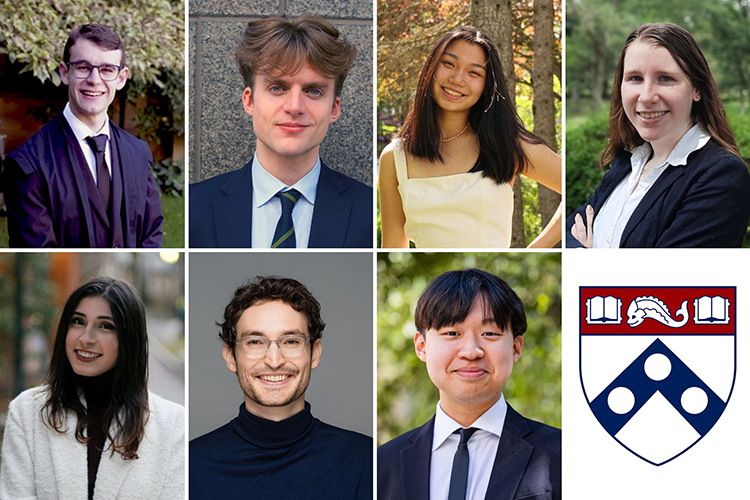
caption: Penn’s 2025 Thouron Scholars are (left to right): (top) Benjamin Cohen, Alexander Gerlach, Joy Gong, and Sarah Hinkel; (bottom) Sophie Kadan, Benjamin May, and Joey Wu.Seven University of Pennsylvania affiliates—five seniors and two recent graduates—have each received a 2025 Thouron Award to pursue graduate studies in the United Kingdom. Each Thouron Scholar receives tuition for as long as two years, as well as travel and living stipends.

Penn’s 2025 Thouron Scholars are seniors Benjamin Cohen, Joy Gong, Sarah Hinkel, Sophie Kadan, and Joey Wu and recent graduates Alexander Gerlach and Benjamin May.

Established in 1960 and supported by gifts from the late John Thouron and his wife, Esther du Pont Thouron, the Thouron Award is a graduate exchange program between Penn and U.K. universities that aims to improve understanding and relations between the two nations.

Benjamin Cohen, from Cleveland, Ohio, is double-majoring in economics and political science with a concentration in comparative politics in the College of Arts & Sciences. He is interested in analyzing fiscal policy to identify beneficial reforms that improve social welfare. His honors thesis investigates the effects of negative oil price shocks on fiscal policy reform in authoritarian petrostates. At Penn, he works as a peer writing fellow at the Marks Family Writing Center and as an undergraduate fellow for FactCheck.org. Mr. Cohen has also conducted research with Penn’s Center for Ethics and the Rule of Law. During his third year at Penn, he was a visiting student at the University of Oxford. In 2022-2023, he worked as an economic consulting intern for Pacific Economics Group. Mr. Cohen plays various intramural sports, is a member of a student e-sports team, and has volunteered as a coach for a local high school debate team. As a Thouron Scholar, Mr. Cohen plans to pursue a master’s degree in political economy at the London School of Economics and Political Science.

Alexander Gerlach, from Washington, D.C., completed his bachelor’s degree in neuroscience in December 2024, with minors in philosophy and chemistry from the College of Arts & Sciences and a minor in healthcare management from the Wharton School. Interested in neurodegenerative disease, he has conducted bench research at the National Institutes of Health and clinical and pharmaceutical research in multiple sclerosis at NYU Langone Health and Merck U.K. He completed his honors thesis at Penn on mitochondrial function in a traumatic brain injury model of optic neuropathies. Mr. Gerlach has worked as a teaching assistant in molecular and cellular neurobiology, served on the Dean’s Advisory Board, and written for the Penn Healthcare Review. He currently investigates the role of copper in oligodendrocyte function at the Children’s Hospital of Philadelphia and builds neural networks as a predictive tool in neurology for Mount Sinai’s clinical neuroinformatics unit. He volunteers across Philadelphia with the Shelter Health Outreach Program and is a certified emergency medical technician. As a Thouron Scholar, Mr. Gerlach plans to pursue a master’s degree in clinical and therapeutic neuroscience at the University of Oxford.

Joy Gong, from Lexington, Massachusetts, is majoring in physics with a concentration in astrophysics and a minor in mathematics. She is also submatriculating to earn a master’s degree in physics in the School of Arts & Sciences. Since 2022, she has been an undergraduate researcher in the department of physics and astronomy. She has conducted research on galaxy simulations for the Roman Space Telescope and is currently conducting supernovae analyses from the Dark Energy Survey, investigating how intergalactic dust affects supernovae colors and distances. At Penn, Ms. Gong is chair of the Dance Arts Council and a dancer with Sparks Dance Company. She is the mentorship leader of Women in Physics, a research peer advisor, and a teaching assistant for physics courses. Previously, she served as president of the Astronomical Student Association, leading trips to Cherry Springs, a dark sky site four hours west of Philadelphia. As a Thouron Scholar, Ms. Gong plans to attend the University of Cambridge to pursue a PhD in astronomy, contributing to discovery of gravitationally lensed supernovae as probes of the accelerated expansion of the universe.

Sarah Hinkel, from Maytown, Pennsylvania, is majoring in Middle Eastern languages and cultures and ancient history with a minor in archaeological science in the College of Arts & Sciences. Fascinated by ancient history and archaeology, she has explored many periods and cultures during her time at Penn and is particularly interested in Bronze Age ceramics. As a Penn Museum student curator and fellow, she co-created an exhibit on objects from Song Dynasty China and conducted research on objects from the ancient Sumerian city-state of Ur. She has also excavated at several archaeological sites in Armenia, Israel, and Philadelphia. As a Thouron Scholar, Ms. Hinkel plans to pursue a master’s degree in archaeological science at the University of Cambridge before going on to complete a PhD in archaeology.

Sophie Kadan, from Doylestown, Pennsylvania, is a physics and math major in the School of Arts & Sciences, pursuing a bachelor’s and master’s joint degree and combining theoretical coursework with research in high-energy physics. As a student with multiple sclerosis, she is committed to making physics more accessible, writing and illustrating guides to help students engage with mathematical and physical concepts. She has worked to make academic spaces more welcoming by painting two 5-by-6-foot murals for the undergraduate physics lounge in Penn’s David Rittenhouse Laboratory building. Ms. Kadan has conducted research at the Perimeter Institute for Theoretical Physics and with Penn ATLAS, focusing on machine learning applications in particle physics. She also was a National Science Foundation intern at the University of Texas at Dallas. As a Thouron Scholar, Ms. Kadan plans to attend the University of Cambridge and pursue a master’s degree in theoretical physics, building on her previous research.

Benjamin May, from Philadelphia, Pennsylvania, graduated in 2021 from the College of Arts & Sciences with a bachelor’s degree in international relations, concentrating in environmental policy, with a minor in history. He is currently a sustainability program manager at Microsoft, working to decarbonize its service and hardware suppliers. Previously, he was as an associate at Boston Consulting Group, consulting emerging clean technologies, and sustainability manager at Costco Wholesale, spearheading the effort to decarbonize their supply chain. In 2020, Mr. May took a leave of absence from Penn to work full-time on the Biden for President campaign, leading efforts across 15 states and ultimately serving as the Philadelphia regional organizing director. As a student at Penn, Mr. May was the committee director for sustainability and community impact on the Undergraduate Assembly, a student liaison to the Board of Trustees, co-chair of the Student Sustainability Association at Penn, and campus tour guide captain for Kite & Key. A Perry World House student fellow, Mr. May co-authored four papers analyzing policy avenues to address the global climate crisis. He also founded the nonprofit ThinkOcean, a global youth-led ocean advocacy group. With a goal of leading efforts to address the global water crisis, Mr. May plans to pursue a master’s degree in water science, policy, and management at the University of Oxford.

Joey Wu, from Woodbury, Minnesota, is studying bioengineering and environmental science in the Vagelos Integrated Program in Energy Research, a dual-degree program in the School of Engineering & Applied Science and School of Arts & Sciences. He is a plastic researcher in Penn Engineering’s McBride Lab. Mr. Wu founded Waterroots, a global education nonprofit that works to combat water insecurity through developing grassroots water literacy projects in more than 25 countries. Mr. Wu is an active climate activist, serving as a Penn Climate Fellow, an EarthEcho Marine Plastic Ambassador, a member of the Student Advisory Group for the Environment, and a PBS Climate Storytelling Fellow. A 2025 Dean’s Scholar at Penn, Mr. Wu is also a Clinton Global Initiative Scholar, a Duke Interfaith Climate Fellow, an Ashoka Changemaker Fellow, an IEEE Bio-X Scholar, a 2023 Millennium Fellow, a 2023 Udall Scholar, a UN Youth Delegate, a World Bank/IMF Youth Delegate, and a member of the Tau Beta Pi Engineering Honor Society.

Features

Into the Blue: The Pursuit of Color, a Student Exhibition, Opens March 29 at the Penn Museum

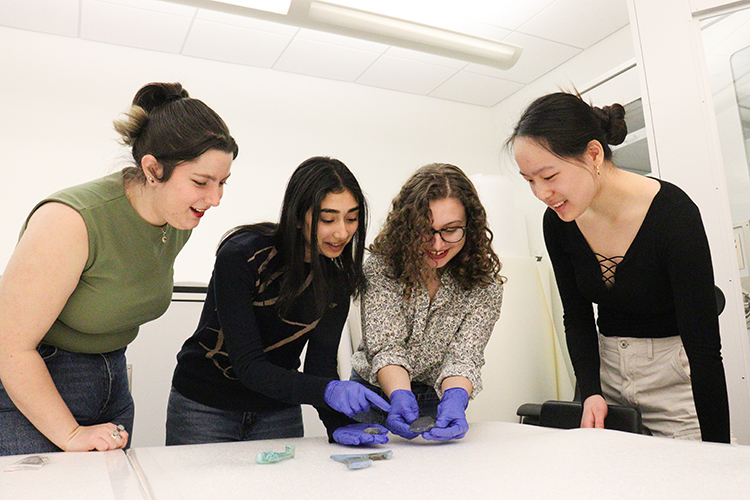
caption: Four undergraduate student curators (from left)—Nadia McGrath, Talia Desai, Iris Peron-Ames, and April Zang—study  lapis lazuli shaped into an axe-head from a site in Nippur, Iraq. Photo courtesy of Penn Museum.A new exhibition curated by Penn undergraduate students explores the deep human history associated with a popular hue that has stood the test of time. Into the Blue: The Pursuit of a Color opens on Saturday, March 29, 2025 at the Penn Museum.

Unlike today, blue was not easy to produce nor acquire in the ancient past. The relentless pursuit of blue for use in textiles and art led to the development of ingenious methods in producing this rare, highly prized color that has held significant meaning for diverse cultures around the world throughout history.

Into the Blue spans 4,000 years—displaying 20 objects from across the Penn Museum’s collections, including select artifacts from the Middle East, China, Africa, ancient Egypt, and Central America.

The exhibition examines three themes: Obtaining Blue, Making Blue, and Synthesizing Blue.

Obtaining Blue highlights the mining and transportation of lapis lazuli, a semi-precious gemstone used in decorative and ceremonial objects in the Middle East—along with the trapping of kingfishers, brightly colored birds whose feathers were used to decorate articles of adornment in China.

A senior history of art major, Talia Desai from Bethesda, Maryland, is one of the exhibition’s four student curators and is enrolled in Penn’s School of Arts & Sciences. One of the striking artifacts in Into the Blue is an enamel hairpin that parallels the blue found in kingfisher feathers, Ms. Desai said.

“The imitation of the feathered pins reveals the desire for the bright blue color that comes from something natural, like feathers,” Ms. Desai explained. “The creation of this synthetic blue is reminiscent of blues produced all over today that try to replicate more natural blues.”

Making Blue showcases the West African tradition of indigo dyeing through stories of its cultural value and production—with demonstrations of the dye process and drastic color changes.

Growing up in Philadelphia, Iris Péron-Ames loved spending time at the Penn Museum. She is now a junior majoring in ancient history and the history of art in the College of Arts & Sciences. She said that curating this exhibition was a way to recreate the wonder and fun she remembers experiencing here—for today’s visitors. One object in the exhibition that Ms. Péron-Ames has connected with is a Maya effigy cup.

“Embedded within its history is adapting indigo dye into a pigment for painting and the development of Maya blue,” Ms. Péron-Ames said. “It shows the power of human desire and innovation as well as the impact of blue as a colorant.”

Another object highlighted in Making Blue—a piece of Egyptian blue pigment—has influenced student curator April Zhang, a junior design major from San Jose, California. Egyptian blue is one of the earliest examples of an artificially produced color. The pigment begins as a mix of raw materials, only becoming blue through a complex firing process.

“It carries such energy as an artifact in the middle of the color production process,” Ms. Zhang explained. “Something unfinished is less often shown in exhibits. It tells us the story of how Egyptian blue was created, hopefully inspiring visitors to think about colors in a new way.”

Synthesizing Blue covers the ongoing quest for the “perfect blue,” outlining the connections between its modern and ancient shades. This section of the exhibition will include a wall-mounted interactive touchscreen for visitors to uncover the many ways that modern blues are created for use in art, industry, and fashion today. 

Blue continues to resonate with people across time and place, added student curator Nadia McGrath, a senior from San Francisco majoring in visual studies and communication.

“Blue has a rich history and innovative processes behind, demonstrating that people desired and loved blue in the ancient past just as much as we do today,” said Ms. McGrath, who is intrigued by a statue of Imsety, the son of Horus. For the ancient Egyptians, blue was linked to ideas of solar rebirth—with connections to the sky and primeval waters of creation.

Into the Blue will be on view through spring 2026 and is included with Penn Museum admission.

Events

WXPN Policy Board Meeting: March 26

An open session of the WXPN Policy Board will be held on Wednesday, March 26 at noon at WXPN. For more information, email abby@xpn.org or call (215) 898-0628 during business hours. 

Update: March AT PENN

Conferences

19        The First 60 Days: What's Happening? The Long View; will make sense of the recent flood of directives, executive orders, cuts, erasures, attacks, and their impact on the state of U.S. democracy; 6-9 p.m.; room B1, Meyerson Hall (Gender, Sexuality & Women’s Studies).

21        Penn PhD Architecture 60 Years Symposium: Resources, Resilience, & Resistance; a day of conversations on the future of doctoral research and scholarship in architecture; 9 a.m.-6:45 p.m.; Kleinman Energy Forum, Fisher Fine Arts Library; register: https://tinyurl.com/architecture-symposium-mar-21 (Architecture).

            Penn Carey Law International Arbitration Conference; leading experts from academia and top law firms will discuss how courts and arbitral proceedings are adapting to the critical challenges shaping the modern legal landscape, such as climate change, geopolitical tensions, and emerging industries; 9:30 a.m.-7:30 p.m.; Levy Conference Center, Carey Law School; register: https://tinyurl.com/arbitration-conf-mar-21 (Penn Carey Law International Arbitration Association).


Exhibits

22        Arthur Ross Gallery Guided Tours with Penn Students; students Amelia Ketzel, Angela Cen, and Nadia McGrath will give an immersive and informative tour of After Modernism: Selections from the Neumann Family Collection; noon; Arthur Ross Gallery, Fisher Fine Arts Library (Arthur Ross Gallery).


Films

19        High on the Hog; documentary exploring the ways African American cuisine has transformed America; noon; room 108, ARCH (Makuu: The Black Cultural Center).


Fitness & Learning

20        Jewish Bioethics in Theory and Practice; three-part course that will introduce participants to contemporary bioethics through a Jewish lens and explore how secular and Jewish religious values may relate in consideration of health and medical practices; noon; Zoom webinar; register: https://tinyurl.com/katz-bioethics-mar-20 (Katz Center for Advanced Judaic Studies). Also March 27, April 3.

22        Rethinking Authenticity in Korean Language Education; Sun-Hee Lee, Wellesley College, will examine how teachers can work Korean-language instruction into their curricula; 9 a.m.-1 p.m.; room 623, Williams Hall; register: https://tinyurl.com/korean-pedagogy-mar-22 (Korean Studies).


College of Liberal & Professional Studies

Online webinars. Info: https://www.lps.upenn.edu/about/events.

25        Pre-Health Post-Baccalaureate Programs Current Student Panel Q&A; 6 p.m.


Graduate School of Education

Various locations. Info and to register: https://www.gse.upenn.edu/news/events-calendar.

20        Penn Chief Learning Officer EdD Virtual Information Session; noon; online webinar.

24        School Leadership Program Virtual Information Session; 7 p.m.; online webinar.


Penn Libraries

Workshops open to the Penn community. Various locations. Info and to register: https://www.library.upenn.edu/events.

19        Coffee + Watercolor Paint @ PDM; a screen-free crafternoon to learn how to paint with coffee and watercolors; 11 a.m.-1:30 p.m.; room LL02A, Evans Building.

20        Disability Studies Discussion Series: Digital Fabrication; learn about digital fabrication, which has revolutionized the creation of tools and prosthetics for people with disabilities by enabling highly customized, affordable, and efficient designs; 2 p.m.; room 124, Van Pelt Library.

            Shop Talk: Adobe InDesign 101; while it can feel intimidating at first, Adobe InDesign is a powerful tool for book layout and design; 5 p.m.; level B seminar room, Fisher Fine Arts Library.

21        Digital Presence in Your Job Search with Career Services; learn how you can best use platforms like LinkedIn, Twitter, Handshake and more to reach your career goals; 1 p.m.; room 113, Van Pelt Library.

25        Copyright 101; meet Stephen Wolfson, the Penn Libraries' copyright advisor; noon; room LL02A, Evans Building.


Music

21        (Deep) Listening with Brandon Lopez; bassist and composer Brandon Lopez transcends sonic limitations and finds interest in locating new and exciting possibilities; 7 p.m.; Institute of Contemporary Art; register: https://tinyurl.com/brandon-lopez-ica-mar-21 (Institute of Contemporary Art).

            Penn Six Presents "Stop. Hammer Time!"; a musical and comedic journey through the minds and lives of television's greatest heroes, HGTV's The Property Brothers; 8 p.m.; Class of 1949 Room, Houston Hall; tickets: $8-$11 (Platt Performing Arts House). Also March 22, 6 p.m.

            PennYo Presents: The Wicked Witch of Yoz; PennYo A Capella’s own original twist on the hit musical Wicked; 9 p.m.; Iron Gate Theater; tickets: $10-$13 (Platt Performing Arts House). Also March 22, 6:30 p.m.


On Stage

20        Strictly Funk Spring 2025 Show; spring show by the premiere hip-hop and contemporary student dance group at Penn; 7:30 p.m.; Iron Gate Theater; tickets: $10-$13 (Platt Performing Arts House). Also March 21, 6:30 p.m.; March 22, 9 p.m.

            Stimulus Children's Theatre Presents "Alice in Wonderland"; Alice plunges down the rabbit hole and becomes involved in a series of adventures during her time in Wonderland; 8 p.m.; Harold Prince Theater, Annenberg Center; tickets; $5-$10 (Platt Performing Arts House). Also March 22, 2 p.m.

22        Simply Chaos Presents: An Update to the Penn Community; the amazing stand-up comedians of simply chaos are back once again; 7 p.m.; Harold Prince Theater, Annenberg Center; tickets: $5-$10 (Platt Performing Arts House).


Readings & Signings

21        The Final Orchard; CJ Rivera, author; 5:30 p.m.; 2nd floor conference room, Penn Bookstore (Penn Bookstore).

25        The Rescuers: The Remarkable People Who Saved World Heritage; Nancy Moses, Penn Museum; noon; Penn Museum; tickets: pay what you wish (Penn Museum).


Special Events

21        Nawruz (Nowruz) Celebration; celebrate an observation of the spring equinox that originates from the Uyghur regions of Western China all across Central Asia through to Iran and beyond, including parts of Russia, Afghanistan, and broader South Asia; 5-8 p.m.; room 208, ARCH (Center for East Asian Studies).


Talks

19        Preliminary Results from the Whole Health Study: A Randomized Trial of Collaborative Care for People with Opioid Use and Psychiatric Disorders; David Mandell, psychology; 9 a.m.; room 701, Blockley Hall, and Zoom webinar; join: https://pennmedicine.zoom.us/j/96442998641 (Center for Clinical Epidemiology and Biostatistics).

            Algorithmic Stability for Trustworthy Machine Learning and Statistics; Lydia Zakynthinou, University of California Berkeley; noon; room 414, Amy Gutmann Hall, and Zoom webinar; join: https://upenn.zoom.us/j/94645455801 (SEAS ASSET Center).

            Mucinomics as the Next Frontier of Mass Spectrometry; Stacy Malaker, Yale University; noon; Carolyn Hoff Lynch Lecture Hall, 1973 Chemistry Building (Chemistry).

            Whither South Korean Democracy? Democratic Backsliding, Executive Power, and Constitutional Governing; Hyunjoon Park, sociology; Soosun You, political science; Jane Esberg, political science; William Burke-White, Carey Law School; noon; Perry World House (Perry World House, Population Studies Center).

            Development of High Precision 4D-Trackers for Future Experiments; Artur Apresyan, Fermilab; 3:30 p.m.; room 3W2, DRL (Physics & Astronomy).

            Look Back in Laughter: Medieval and Renaissance Aristotelianisms Put to the Test of Humor; Aristotelianisms Put to the Test of Humor. A lecture by Andrea Robiglio, KU Leuven; 4:30 p.m.; room 625, Van Pelt Library (Italian Studies).

            The Executive Abroad: Presidential Power and the U.S. Role in the World; Sebastian Schmidt, Johns Hopkins University; Kristin Wells, USAID; Mary Bruce, Johns Hopkins University; 6 p.m.; online webinar; register: https://hopkinsathome.jhu.edu/watch-now (Paideia Program).

20        Soft Microparticle Assembles to MAP Scaffolds; Tatiana Segura, Duke University; 10:30 a.m.; Wu & Chen Auditorium, Levine Hall (Materials Science & Engineering).

            Can Robots Learn from Machine Dreams? Robot Learning via GenAI-powered World Models; Ge Yang, Massachusetts Institute of Technology; 11 a.m.; room 225, Towne Building (Electrical & Systems Engineering).

            Investigating the Role of Epithelial PERK in the Lung Injury and Repair; Anit Shah, pulmonary, allergy & critical care; noon; room 213, Stemmler Hall (Penn-CHOP Lung Biology Institute).

            Lnc(RNA)ing COX-2 and Cardioprotection: A PACERR Story; Elizabeth Hennessy, Institute for Translational Medicine and Therapeutics; noon; room LL-20A, Evans Building, and Zoom webinar; register: https://tinyurl.com/hennessy-talk-mar-20 (Penn Dental Medicine).

            Statistics-Powered ML: Building Trust and Robustness in Black-Box Predictions; Yaniv Romano, Technion; noon; room 414, Amy Gutmann Hall (SEAS IDEAS Center).

            Beyond the Headlines: Assessing Lebanon's Present and Future; Yara Damaj and Jowel Choufani, Middle East Center; 3 p.m.; room 419, Fisher-Bennett Hall (Middle East Center).

            Herodotus in Hiding: The Histories in Roman Rhetorical Education; Jacqueline Arthur-Montagne, University of Virginia; 4:45 p.m.; room 402, Cohen Hall (Classical Studies).

            Bazaar: Markets and the Making of the Muslim World; Fahad Ahmad Bishara, Fahad Ahmad Bishara, University of Virginia; 5:15 p.m.; room 209, College Hall (History).

            Intersections of Humanities and Stem: The Graphic Medicine Lab; Leah Misemer, Georgia Institute of Technology; 5:30 p.m.; room 543, Williams Hall (Cinema & Media Studies).

21        A-Movement: Subject (Sub)extraction in Igbo; Doreen Georgi, University of Potsdam; 10:15 a.m.; room 326, 3401 Walnut Street (Linguistics).

24        Geography of the U.S. Health Care Safety Net and Racial/Ethnic Disparities in Mortality; Emily Parker, Rutgers University-New Brunswick; noon; room 403, McNeil Building (Population Studies Center).

            Occupying Selves or How to be an Indian via Unciteable Pain; Audra Simpson, Columbia University; noon; room 345, Penn Museum (Anthropology).

            The Climate of Architectural History and Theory; Maria Gonzales Pendas, Cornell University; 12:30 p.m.; Lower Gallery, Meyerson Hall (Architecture).

            Prosthetics, Robotics, and the “Uncanny”; Yulia Frumer, Johns Hopkins University; 3:30 p.m.; room 402, Cohen Hall (History & Sociology of Science).

25        Engineering and Using Interactions Between Spins and Light with Molecular Qubits; Leah Weiss, University of Chicago; 11 a.m.; room 225, Towne Building (Electrical & Systems Engineering).


Economics

In-person events. Info: https://economics.sas.upenn.edu/events.

19        Forward-Looking Politicians; Javier Tasso, economics; noon; room 100, PCPSE.

            Firm Dynamics with Downward Nominal Wage Rigidity; Masao Fukui, Boston University; 4 p.m.; room 101, PCPSE.

24        Trade and the End of Antiquity; Johannes Boehm, Geneva Graduate Institute; 4 p.m.; room 101, PCPSE.

            Covariate-Assisted Estimation of Grouped Panel Data Models; Oriol González-Casasús, economics; 4:30 p.m.; room 101, PCPSE.

25        Dynamic Evidence Disclosure: Delay the Good to Accelerate the Bad; Jan Knoepfle, Queen Mary University London; 4 p.m.; room 100, PCPSE.


This is an update to the March AT PENN calendar. To contribute events to upcoming Almanac monthly AT PENN calendars and weekly updates, email almanac@upenn.edu.


Crimes

Weekly Crime Reports

Division of Public Safety
University of Pennsylvania Police Department Crime Report

About the Crime Report: Below are the Crimes Against Persons and/or Crimes Against Property from the campus report for March 3-9, 2025. The Crime Reports are available at: https://almanac.upenn.edu/sections/crimes. Prior weeks’ reports are also online. –Eds.

This summary is prepared by the Division of Public Safety (DPS) and contains all criminal incidents reported and made known to the Penn Police, including those reported to the Philadelphia Police Department (PPD) that occurred within our patrol zone, for the dates of March 3-9, 2025. The Penn Police actively patrol from Market Street to Baltimore Avenue and from 30th Street to 43rd Street in conjunction with the Philadelphia Police.

In this effort to provide you with a thorough and accurate report on public safety concerns, we hope that your increased awareness will lessen the opportunity for crime. For any concerns or suggestions regarding this report, please call DPS at (215) 898-7297. You may view the daily crime log on the DPS website.


Penn Police Patrol Zone
Market Street to Baltimore Avenue and from 30th Street to 43rd Street

Crime Category

Date

Time

Location

Description

Assault

03/07/25

6:27 PM

3200 Chestnut St

Report of threats


03/09/25

7:09 AM

200 S 43rd St

Physical altercation

Auto Theft

03/08/25

9:09 AM

4000 Locust St

Vehicle taken


03/09/25

11:08 PM

2929 Walnut St

Secured vehicle taken from garage

Fraud

03/06/25

8:56 AM

3737 Chestnut St

Complainant defrauded of money by unknown offender

Other Offense

03/09/25

5:56 PM

4200 Spruce St

Investigate vehicle stop/Arrest

Retail Theft

03/03/25

8:19 AM

3330 Market St

Retail theft of consumable goods/Arrest


03/05/25

8:14 AM

3330 Market St

Retail theft of baked goods


03/06/25

5:51 AM

3330 Market St

Retail theft of consumable goods


03/06/25

8:15 AM

3604 Chestnut St

Retail theft of consumable goods


03/06/25

10:47 AM

3330 Market St

Retail theft of consumable goods


03/08/25

11:35 AM

3330 Market St

Retail theft/Arrest


03/09/25

11:30 AM

4233 Chestnut St

Retail theft

Theft from Building

03/03/25

1:08 PM

3737 Walnut St

Jacket taken from study desk


03/03/25

4:20 PM

2930 Chestnut St

Package taken


03/04/25

9:42 AM

3131 Walnut St

Black laptop case taken from office


03/04/25

12:33 PM

3100 Market St

Theft of money in common area


03/06/25

2:30 PM

209 S 33rd St

Credit cards and currency taken from wallet


03/09/25

12:26 AM

3901 Locust Walk

Laundry taken

Theft from Vehicle

03/03/25

1:32 PM

3550 Market St

Theft of personal items from unsecured vehicle in parking garage

Theft Other

03/07/25

3:40 PM

3400 Civic Center Blvd

Report of pocket picking


03/09/25

3:15 PM

3200 Chestnut St

Report of theft

Vandalism

03/07/25

12:39 PM

3400 Spruce St

Offender wrote on walls and medical equipment


Philadelphia Police 18th District
Schuylkill River to 49th Street & Market Street to Woodland Avenue

Below are the Crimes Against Persons from the 18th District: 4 incidents were reported for March 3-9, 2025 by the 18th District, covering the Schuylkill River to 49th Street & Market Street to Woodland Avenue.

Crime Category

Date

Time

Location

Aggravated Assault

03/03/25

11:55 PM

1229 Markoe St

Assault/Arrest

03/06/25

2:41 AM

4640 Walnut St

Rape

03/06/25

9:12 AM

3400 Blk Civic Center Blvd

Robbery

03/06/25

5:33 AM

36 Farragut St

The Division of Public Safety offers resources and support to the Penn community. DPS developed a few helpful risk reduction strategies outlined below. Know that it is never the fault of the person impacted (victim/survivor) by crime.

  • See something concerning? Connect with Penn Public Safety 24/7 at (215) -573-3333.
  • Worried about a friend’s or colleague’s mental or physical health? Get 24/7 connection to appropriate resources at (215) 898-HELP (4357).
  • Seeking support after experiencing a crime? Call Special Services - Support and Advocacy resources at (215) 898-4481 or email an advocate at specialservices@publicsafety.upenn.edu
  • Use the Walking Escort and Riding services available to you free of charge.
  • Take a moment to update your cellphone information for the UPennAlert Emergency Notification System
  • Download the Penn Guardian App which can help Police better find your location when you call in an emergency.
  • Access free self-empowerment and defense courses through Penn DPS.
  • Stay alert and reduce distractions; using cellphones, ear buds, etc. may limit your awareness.
  • Orient yourself to your surroundings. (Identify your location, nearby exits, etc.)
  • Keep your valuables out of sight and only carry necessary documents.

Bulletins

Volunteer Opportunities Through the Netter Center for Community Partnerships

Dear Penn Community,

Thank you for your continued generosity. It is especially notable during the holiday season, but evident at all times. Many continue to benefit from your willingness to give. Here are examples of various holiday efforts:

Thanks to the President’s Office for sponsoring the toy donation drive held during the holiday party. These toys, along with many others, were donated to local agencies and families in the surrounding community. 

Thank you to the following departments; they brought joy to families during the holidays by “adopting” them:

  • African American Resource Center coordinated by Valerie Allen 
  • Career Services coordinated by Jamie Grant
  • Center for Excellence in Teaching, Learning and Innovation coordinated by Jessica E. Morris
  • College of Arts & Sciences coordinated by Laura Brasch
  • Consortium for Policy Research in Education coordinated by Katarina Suwak
  • Facilities and Real Estate Services coordinated by Cheryl Smith, Chloe Cerwinka, and Alice Cheng
  • Financial Systems and Training coordinated by Yuri Rayford
  • Institutional Research & Analysis coordinated by Ryan Chesla
  • Netter Center for Community Partnerships coordinated by Whitney Winters
  • Office of the Comptroller coordinated by Celestine Silverman
  • Office of General Counsel coordinated by Krystyna Dereszowska and Denene Wambach
  • Office of Gift Planning coordinated by Lorleen Finor-Maxwell and Christina Reichert
  • Penn Center for Innovation coordinated by Kathryn Harris 
  • Penn Champions Club & Penn Athletics Development coordinated by Abby Bergman
  • Perelman School of Medicine coordinated by Rachel McGarrigle
  • Platt Student Performing Arts House coordinated by Laurie McCall
  • Research Services coordinated by Tina Nemetz and Evelyn Ford
  • Residential Services coordinated by Linda M. Kromer
  • SAS Advancement Office coordinated by Lusi Klimenko
  • Talent Management, Division of Human Resources coordinated by Amma Napier
  • Training and Development, Division of Human Resources, coordinated by Holly Marrone
  • University Communications coordinated by Lauren Summers
  • Wharton Business Economics and Public Policy coordinated by Beth Moskat
  • Wharton Communication Program coordinated by Sunida Witayakarn and Sara Mangat
  • Wharton Executive Education coordinated by Grace Eun Tak
  • Wharton Fund coordinated by Beth Truta Morris
  • Wharton Global Youth Program coordinated by Kara Dunn
  • Wharton MBA Career Management coordinated by Rebecca Alig

Special thanks to:

  • Carisma Therapeutics coordinated by Kara Collins
  • Interius BioTherapeutics, Inc. coordinated by Kari Smitherman and the Operations Team
  • Amazon AMZL Station coordinated by Gerald Price

Several departments adopted multiple families.  

A special thank you to the following drop site committee volunteers, without whose dedication holiday donations would not be possible.

Department/Building

Volunteer

Email Address

President’s Office/College Hall

Brenda Gonzalez

gonzalez@upenn.edu   

Franklin Building Lobby

Chris Hyson, Eric Stewart

chyson@upenn.edu; estew@upenn.edu

Van Pelt Library

Rachelle Nelson, Illene Rubin

nelsonrr@pobox.upenn.edu; rubinir@upenn.edu

Netter Center

Isabel Sampson-Mapp 

sammapp@upenn.edu  

University Communications

Lauren Summers

lsummers@upenn.edu

Research Services

Evelyn Ford, Tina Nemetz

fordej@upenn.edu; tnemetz@upenn.edu

DAR/FMC Tower

Maryanne Nuzzo

nuzzo@upenn.edu

Comptroller’s Office

Celestine Silverman

celes@upenn.edu

Penn Nursing

Landy Georges

lgeorges@nursing.upenn.edu

Business Services 

Kerri Strike-Stahller

kerriss@upenn.edu

Residential Services

Linda Kromer

lkromer@upenn.edu

Wharton Undergraduate Division

Phoebe Decker

pdecker@wharton.upenn.edu

Information Systems & Computing

Marcia Marshall

mamarcia@upenn.edu

Physics & Astronomy

Michelle Last

michlast@sas.upenn.edu

Penn Engineering

Chambrel Jones

chambrel@seas.upenn.edu

Liberal & Professional Studies

Laura Taylor

lauratay@sas.upenn.edu

Biology Department/Leidy Laboratories

Leah Dennis

leahd@sas.upenn.edu

Public Safety

Stacy Ritchey

sritchey@publicsafety.upenn.edu

This group collected all the toys/gifts and made it possible to respond to requests for donations from People’s Emergency Center, Walnut Hill CDC, Baring House, Lift As We Climb, Inc., Potter’s House Mission, Christ Community Church, the Penn Workplace Mentoring Program, Netter Center-affiliated local schools, and local families.

Thank you to Franklin Building Group, Human Resources, Penn Engineering, and more for the generous sneaker donations and gift cards to benefit the unhoused. Special thanks to Mary Kinney for making beautiful hand-made sweaters, hats, and gloves for deserving community members. Thank you to the entire Penn community for donating over 550 gifts and toys.

Additionally, the following benefitted from the Annual Food Drive:

  • Parkside Association
  • Potter’s House Mission
  • People’s Emergency Center
  • Institute for the Development of African American Youth
  • Second Antioch Baptist Church Food Pantry
  • Calvary Center for Culture and Community
  • West Philadelphia High School and other local public schools affiliated with Netter Center programming
  • Families needing emergency food supplies

Thank you to all the people, named and unnamed, for their remarkable generosity. Please forgive any oversights, and send corrections to Isabel Sampson-Mapp at sammapp@upenn.edu.

Upcoming March Event: Marie K. Bogle Scholarship March 17-31

This change drive benefits a graduating high school student accepted at an accredited college or university. This is a non-tuition scholarship donation that has been in existence for over 20 years and has made a difference in many students’ lives; the program name was changed to the Marie K. Bogle Scholarship in 2017. Students have been able to use the funds to buy books and many other items needed to make a home away from home.

Drop Site Locations and Committee Members

Please feel free to contact the most convenient drop site location listed above to make your donation. Contact Isabel Sampson-Mapp at sammapp@pobox.upenn.edu for additional info.

Volunteer With Chosen 300

Chosen 300 serves meals and groceries to homeless individuals and families in need. Its West Philadelphia site is located at 3959 Lancaster Avenue, Philadelphia, PA 19104. There, it distributes groceries to the community every Monday, Tuesday and Friday from 11 a.m. to 2 p.m.  Chosen 300 is looking for volunteers for those days and hours.   

Chosen 300 also serves dinner to homeless individuals and families in need at its Center City location (1116 Spring Garden Street, Philadelphia, PA 19123) on Mondays, Wednesdays, and Fridays from 5:30 p.m. to 7:30 p.m. and Saturdays from 4:30 p.m. to 6:30 p.m.

Guidance and supervision are provided for volunteers while they are providing services and no separate training session is necessary.

If you are interested in volunteering, please call (215) 243-0300 or email info@chosen300.org. You can also contact Isabel Sampson-Mapp at sammapp@pobox.upenn.edu for additional information and/or to volunteer for this program.

Donate Used Office Furniture 

Reorganizing? Do you have furniture no longer needed by your department? Do you have any electronics or leftover bags, t-shirts, or tchotchkes from a conference? Need to empty out your storage space? Local nonprofits need your items. Please donate them to Penn VIPS. We will put them to great use by donating them to community members and many of the students we work with, and we will also use them to say thank you to our many volunteers. Contact Isabel Sampson-Mapp at sammapp@pobox.upenn.edu to donate your items.

Join Penn Workplace Mentoring Program

The goal of the program is to expose mentees to a college campus and to help the mentees set goals for their future. Mentors form positive relationships with their mentees and talk to them about the importance of an education and how to set goals.

This is an on-campus-only mentoring program. Mentees visit campus the third Thursday of the months from October to May from 9 a.m. to 1:30 p.m. The program includes group activities as well as meetings with mentors and mentees.

Mentors must complete three mandatory background clearances (the Pennsylvania Child Abuse Check, the Pennsylvania Criminal Record Check, and FBI fingerprinting), which are facilitated by the Netter Center and Penn HR. Contact Isabel Sampson-Mapp at sammapp@pobox.upenn.edu for additional info.

Create Your Own Volunteer Activity

Would you and your colleagues or friends like to participate in a volunteer activity? Penn VIPS is happy to connect you to an activity or help you develop one of your own. Contact Isabel Sampson-Mapp at sammapp@pobox.upenn.edu for additional information and/or to make a donation.

—Isabel Sampson-Mapp
Associate Director, Netter Center for Community Partnerships

One Step Ahead: Secure Your Phone and Protect Yourself

One Step Ahead logo

Another tip in a series provided by the Offices of Information Security, Information Systems & Computing and Audit, Compliance & Privacy

The smartphone has become a vital part of people’s lives. More than just a device that makes phone calls, it can access financial, medical, and personal information. It is often used as a “second factor” in multi-factor verification, for example, with Duo Security.

Because your phone is so important, be sure to secure your device and the information it contains.

Start with your phone provider and make sure that your SIM card, either physical or an eSIM, is secured from SIM swapping. Set up a PIN to prevent unauthorized number porting so your phone number can’t be moved to another phone provider without your permission.

Enable locking your phone using a PIN, swipe pattern, or biometrics such as fingerprints or Face ID.

Enable security for any applications  on your phone. This is especially important for financial apps such as Venmo, PayPal, CashApp, or your bank or credit card apps.

Many smartphones have options for you to back up their contents, so if your phone is damaged, lost, or stolen, you don’t lose photos and important information like contacts.

If your phone has an option for tracking and locking a lost phone, such as “Find my...” use that option. That way if your phone is lost or stolen, you can lock the device remotely so it can’t be used.

Finally, be mindful about who has access to your phone. Don’t let strangers access your phone.

----

For additional tips, see the One Step Ahead link on the Information Security website: https://www.isc.upenn.edu/security/news-alerts#One-Step-Ahead.

Wharton Academy: Applications Open

Wharton Academy, a Wharton School program designed for visiting liberal arts and STEM undergraduates as well as recent college graduates, bridges the gap between academic knowledge and practical business expertise.

Through a full selection of non-credit programs taught by top-ranked Wharton faculty and hosted on Wharton’s Philadelphia campus, students build a strong foundation in business principles. Wharton Academy programs combine an immersive classroom experience with the real-world training of an internship, equipping students with the business and finance tools they need to shape successful and fulfilling careers, whatever paths they pursue. 

Academy programs provide:

  • Critical Transferable Skills: Strengthen problem-solving, analytical, and communication expertise valued across industries;
  • Networking Opportunities: Connect with alumni, industry leaders, and peers to open doors to exciting career prospects and long-term success;
  • Global Perspective: Understand international markets and cultural dynamics to excel in multicultural environments;
  • Entrepreneurial Mindset: Learn to think strategically, solve problems, and turn ideas into impactful solutions;
  • Career Diversity: Explore paths in management, finance, marketing, and beyond, tailored to individual goals. 

Wharton Academy is currently accepting applications for summer 2025 until early April. Apply today to learn from the Wharton School, a world leader in business education.

New CCTV Camera

In accordance with the University policy “Closed Circuit Television Monitoring and Recording of Public Areas for Safety and Security Purposes” (Almanac October 23, 2012), the CCTV Monitoring Committee has approved the installation of a new camera on the Memorial Garden walkway by Van Pelt Library. 

Back to Top