News

From the Interim President: Jonathan A. Epstein: Executive Vice President of the University of Pennsylvania for the Health System and Dean of the Perelman School of Medicine

February 12, 2025

caption: Jonathan EpsteinDear Penn Medicine Community,

I am delighted to announce that I have selected Jonathan A. Epstein as executive vice president of the University of Pennsylvania for the Health System and dean of the Perelman School of Medicine. The appointment is effective March 1, 2025, and pending approval of the Board of Trustees. Dr. Epstein is an eminent physician-scientist, a visionary leader, and a dedicated institutional citizen who has played an integral role in shaping Penn Medicine’s excellence across research, education, and patient care.

This appointment follows a comprehensive selection process in which Dr. Epstein emerged as the clear choice at a pivotal moment to lead Penn Medicine into the future. His institutional knowledge, combined with his ability to foster collaboration and drive innovation, will ensure that Penn Medicine continues to lead in academic medicine.

In selecting a new EVP/dean, I sought an exceptional leader with unwavering academic integrity, a passion for advancing medicine and science, and a commitment to the highest standards of patient care and medical education. Above all, I sought someone with an ambitious vision for Penn Medicine’s future and immense respect for its culture—someone who will build on our tradition of excellence while forging new opportunities for interdisciplinary research, clinical innovation, and global impact.

Dr. Epstein has been a key leader at Penn Medicine for more than two decades and served for many years as executive vice dean and chief scientific officer, where he advanced research initiatives, fostered collaboration across departments, and strengthened Penn Medicine’s leadership in scientific discovery. He has also been a dedicated mentor to the next generation of physician-scientists, cultivating talent and driving progress in biomedical research and clinical innovation.

 Since assuming the role of interim EVP and interim dean in December 2023, Dr. Epstein has led with conviction, strategic insight, and unwavering commitment to our faculty, students, staff, and patients. Penn Medicine’s clinical, research, and educational missions have continued to flourish, ensuring that we remain at the forefront of medical innovation while expanding access to world-class care. 

His own research, including pioneering work in mRNA-based therapeutics and cardiovascular regenerative medicine, has earned international recognition and shaped the future of patient care. A graduate of Harvard College and Harvard Medical School, Dr. Epstein completed his residency and fellowship at Brigham and Women’s Hospital before joining Penn in 1996. He is a globally recognized figure in cardiovascular biology and regenerative medicine, with more than 37,000 citations to his name. He is an elected member of the National Academy of Medicine, the American Academy of Arts and Sciences, and the American Society for Clinical Investigation, where he previously served as president.

As EVP/dean, Dr. Epstein will oversee the entirety of the Penn Medicine enterprise: six hospitals, an expansive outpatient network, the nation’s oldest medical school, and a $12 billion academic health system with more than 50,000 faculty, clinicians, and staff. 

“Leading Penn Medicine at such a critical time in the evolution of medicine and healthcare is a profound privilege,” said Dr. Epstein. “Penn is a place where scientific discovery, patient care, and education are seamlessly integrated, creating an environment of unparalleled excellence. It is the honor of my life to take on this role and to work alongside our extraordinary faculty, students, trainees, and staff to advance Penn Medicine’s mission and to shape the future of health and medicine.”

I am deeply grateful to the members of the Consultative Committee, chaired by Provost John L. Jackson, Jr., for their diligence and thoughtful work in conducting this search. Their insights and expertise have been invaluable in identifying a leader who will further elevate Penn Medicine’s missions and impact.

Please join me in congratulating Dr. Epstein on this well-deserved appointment.

—J. Larry Jameson, Interim President

From the Interim President: A Message to the Penn Community on Recently Announced Federal Funding Cuts

February 11, 2025

As you are likely aware, on Friday evening we received news of an unprecedented action from the National Institutes of Health (NIH) that they will immediately be capping the Facilities & Administration (F&A) rates on research grants to universities at 15%. This announcement understandably has raised many questions and concerns. Please know that we are working to identify solutions to minimize the impact on faculty and staff, and the important research and clinical trials currently underway at Penn.

This is not simply an accounting change; it is far more serious, with significant implications for Penn’s research programs. On NIH grants, the actions announced this past week would reduce annual federal funding to Penn by approximately $240 million. If other federal agencies were to adopt the same formula, the loss to Penn would reach $315 million. The effect of this sudden and major change in research support will be to severely harm our highly impactful research mission.

NIH-funded research at Penn has enriched the world in innumerable and life-saving ways, whether combatting cancer with CAR T therapy; developing vaccines with mRNA technology; creating gene editing tools and advancing gene therapy cures; developing drugs that treat a range of maladies, including those that combat macular degeneration and rare forms of congenital blindness—the list is long and powerful in its impact. The reduction in funds announced by the federal government would blunt this critical, life-saving work.

Conducting academic research incurs significant infrastructure costs—such as construction of specialized labs, utilities costs, technical equipment, and regulatory compliance. These F&A rates, sometimes referred to as indirect costs, have been carefully negotiated for decades using a rigorous review process. Even at the current rate of 62.5%, government funding covers only about half of these infrastructure costs. The historic model has been one of partnership between academic institutions and the federal government, and it is arguably a major reason the U.S. is the leader in biomedical research and the envy of the world.

These cuts by NIH will affect universities across the country, and we continue to explore legal options to address these reductions. Among our actions, we are working with the Association of American Universities (AAU), which represents the 71 largest research universities, both public and private, to reach out to lawmakers to explain the impact this decision will have for research, patients, and the economy. Importantly, AAU filed a motion in federal court for a restraining order to block the implementation of the cuts. Penn, along with a number of other universities, joined the AAU in filing this action.

In addition to our work with AAU and other higher education associations, we have formed a planning group internally to address the many changes coming out of Washington.

We understand that the consequences of the actions being taken by NIH are significant, and if allowed to stand, will require us to work together to implement necessary cost saving measures. We are actively working with the leadership in each of our schools to model the potential impact of these funding cuts and will keep our community apprised of major developments and actions that need to be taken. While we don’t yet know how these administrative and judicial actions will evolve, I want to emphasize that Penn has long been a leader in research, resilience, and adaptation. Our community is strong, and we will continue our groundbreaking research, advocate forcefully, and take the steps needed to sustain our mission.

—J. Larry Jameson, Interim President

Catherine and Anthony Clifton: Transformational Gift to Penn Medicine

caption: Left to Right: Penn Medicine Board Chair Dhan Pai; Interim Penn President J. Larry Jameson; donors Catherine and Anthony Clifton; Hospital of the University of Pennsylvania CEO Regina Cunningham; University of Pennsylvania Health System CEO Kevin B. Mahoney; and Interim EVP of the University for the Health System and Perelman School of Medicine Dean Jonathan A. Epstein.Penn Medicine has announced a transformative gift from Catherine and Anthony Clifton that will usher in a new era of innovation in clinical care, research, and education.

The Cliftons, civic leaders and philanthropists with deep Philadelphia roots, are longtime supporters of Penn Medicine and champions of accessible, compassionate, and cutting-edge healthcare for all. In recognition of the gift, the Pavilion at the Hospital of the University of Pennsylvania will be renamed the Clifton Center for Medical Breakthroughs.

Located at the heart of Penn Medicine’s campus in University City, the $1.6 billion facility—the largest capital project in Penn’s history, designed by Foster + Partners—contains 47 operating rooms and 504 private patient rooms, each fitted with space where families and friends can comfortably spend time close to their loved ones, and designed for patient comfort and family support.

“It is an honor to see the Clifton name attached to this world-class facility,” said Lord Norman Foster, founder and executive chairman of world-renowned architecture firm Foster + Partners. “With Catherine’s education, experience in healthcare, and years of service on the Penn Medicine board, she brings a profound understanding of how enhancing patient-centered care leads to better outcomes. The Cliftons’ gift will further humanize the building and patient experience.”

“Being part of Penn Medicine’s vision to transform healthcare is an incredible honor,” said Catherine and Anthony Clifton. “We have long admired its commitment to advancing medicine, pioneering new treatments, and ensuring that patients receive the highest quality care. It is our deepest hope that the Clifton Center for Medical Breakthroughs will serve as a catalyst for discoveries that will shape the future of medicine for generations to come.”

“Catherine and Anthony Clifton are revolutionizing the future of healthcare in profound ways,” said Interim President J. Larry Jameson. “Their extraordinary generosity will leave an indelible mark on Penn Medicine, accelerating innovation in patient care, research, and medical education.”

“Catherine and Anthony’s record-setting gift is a defining moment in Penn Medicine’s evolution,” said University of Pennsylvania Health System CEO Kevin B. Mahoney. “The Clifton Center strengthens our ability to push the boundaries of medicine, improving patient care, advancing research, and training the next generation of physicians.”

Since opening as the Pavilion in October 2021, the Clifton Center and its teams have cared for hundreds of thousands of patients, including nearly 213,000 visits to its emergency department, more than 1,720 lifesaving organ transplants, and 110 daily surgical procedures. The facility also plays a key role in Penn Medicine’s clinical research ecosystem, serving over 350,000 patients in studies like CAR T cell therapy for glioblastoma and MRI techniques for prediction of coma recovery. The center’s rooftop helipad enables rapid transfers of more than 4,000 critically ill patients annually for specialized “rescue” programs.

Since 2010, Catherine Clifton has been an influential member of the Penn Medicine board. A distinguished leader in public health, philanthropy, and urban planning, Catherine’s career spans academia, nonprofit governance, and corporate leadership. A proud University of Pennsylvania alumna, she holds bachelor’s and master’s degrees in city and regional planning, together with a master’s degree from the Harvard T.H. Chan School of Public Health. She has served on the faculty of Tufts University School of Medicine’s community medicine department, training future healthcare professionals, and previously worked as vice president of Review Publishing, overseeing critical media and public engagement initiatives.

Beyond her professional career, Ms. Clifton has been a driving force in cultural leadership. She is vice chair of the Kimmel Center Board of Directors, leading its education & audience and nominating governance committees, and vice chair of the Philadelphia Orchestra Association Board of Directors. Her civic contributions extend to Philadelphia Hospitality, Inc. and the Fleisher Art Memorial, further shaping the city’s cultural and philanthropic landscape.

Anthony Clifton is the principal owner and founder of AAC Holdings LLC, a consulting and mentoring firm that supports small business owners and senior managers. He previously served as chairman and CEO of Review Publishing, which operated newspapers in Pennsylvania and New Jersey, including the South Philly Review, the Philadelphia Weekly, and the Atlantic City Weekly. Mr. Clifton has held leadership roles at Comcast Corporation, State Street Bank, First National Bank of Chicago, and the United Kingdom Treasury Department. He has also served on the boards of the Local Media Association, the Pennsylvania Newspaper Association, Big Brothers Big Sisters of Philadelphia, and the World Affairs Council of Philadelphia.

Ms. Clifton’s family has significantly contributed to advancing Penn Medicine’s mission. She is the daughter of Ralph Roberts, the founder of Comcast Corporation, and served together with her father on the Penn Medicine board.

Laura W. Perna Reappointed Vice Provost for Faculty

caption: Laura PernaProvost John L. Jackson, Jr. has announced the reappointment of Laura Perna, the GSE Centennial Presidential Professor of Education, as vice provost for faculty. 

“Laura Perna has been an invaluable leader in sustaining one of our most important commitments: supporting our great Penn faculty at every stage of their careers,” said Provost Jackson. “She has been an advocate for faculty wellness and work-life balance and a leader in using surveys, metrics, and other data to better assess and strengthen our resources for faculty. She has also been a key driver of faculty leadership and development programs, including Penn Fellows, Mellon Fellows, and the Provost’s Leadership Academy, along with the national Faculty Advancement Network of thirteen peer universities, for which she and Joann Mitchell are our representatives. 

“Above all,” continued Provost Jackson, “she has been an invaluable partner in furthering the work of all twelve schools and the Faculty Senate, steering faculty hiring, promotion, and retention with great judgment and skill, including collaborating with schools to improve our procedures for external consultants; significantly updating and enhancing the Faculty Income Allowance Plan; and innovating new forms of communication with and among faculty, including a dynamic new faculty website, an interactive data dashboard, and a highly successful e-newsletter.”

Vice Provost Perna is a global expert in college access, affordability, and success, especially for low-income, first-generation, and non-traditional students. Her frequently-cited research examines the ways in which social structures, educational practices, and public policies promote and limit college access and success, particularly for groups that continue to be underrepresented in higher education. The co-founder of GSE’s Alliance for Higher Education and Democracy (AHEAD), she has testified before Congress, advised university leaders and policymakers, and been featured in The New York TimesWall Street JournalWashington Post, and National Public Radio, among other media. 

Her leadership positions in major national associations have included president of the Association for the Study of Higher Education (ASHE) and vice president of the American Educational Research Association’s Postsecondary Education division. She is currently chair of the Board of Directors of the Postsecondary National Policy Institute and a board member of the Lenfest Scholars Foundation. She was elected in 2019 to the National Academy of Education and has received the Early Career Achievement Award and Research Achievement Award from ASHE, the Excellence in Public Policy in Higher Education Award from ASHE’s Council on Public Policy and Higher Education, the Dr. Constance Clayton Education Award from the Philadelphia College Prep Roundtable, and the Robert P. Huff Golden Quill Award from the National Association of Student Financial Aid Administrators, among numerous other honors. At Penn, she has served as chair of the Faculty Senate and chair of Penn GSE’s Higher Education division, and in 2010 she received the Lindback Award for Distinguished Teaching, Penn’s highest teaching honor. She is a Penn alumna, holding a BA in psychology from the College of Arts & Sciences and a BS in economics from the Wharton School, and she also received an MPP in public policy and a PhD in education from the University of Michigan. 

“It is a great honor and privilege to serve as vice provost for faculty at Penn,” said Vice Provost Perna. “I am deeply committed to continuing our vital work of advancing the recruitment, retention, development, promotion, happiness, and well-being of Penn faculty, in partnership with the Provost, deans, Faculty Senate, and our other inspiring leaders and colleagues across campus.” 

2023-2024 Report of the Office of the Ombuds

Introduction

The Office of the Ombuds is a confidential, informal, impartial, and independent resource available to assist faculty, students, and staff who are endeavoring to address issues involving conflicts, disputes, and obstacles to one’s successful engagement as a member of the Penn community.

The Year in Review

This year mirrored the last in many ways, though the number of visitors to the Office of the Ombuds rose by 6%. Staff comprised 42% of all visits to the office, faculty represented 19%, graduate/professional students comprised 17%, postdoctoral trainees represented 10%, and undergraduates represented 11%. (See Table 1).

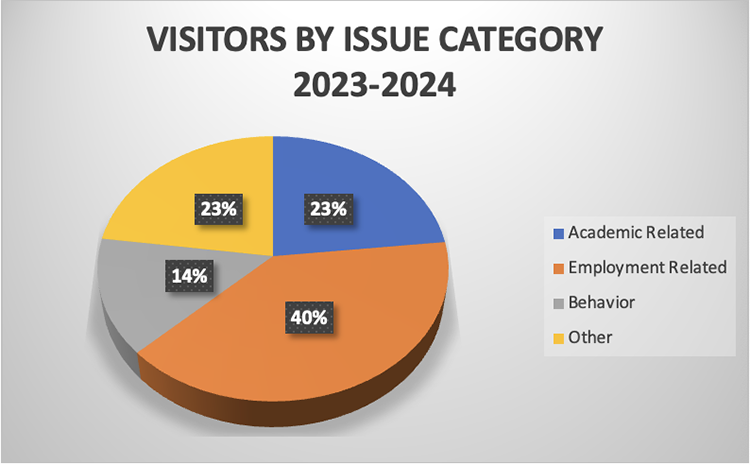
Employment-related matters continued to represent a large proportion (40%) of issues brought to the office, with academic-related issues following (23%). (See Table 2a, graphic summary). The most frequent employment issue was job performance or interpersonal issues relating to the employee’s role. Visitors described a lack of transparency about procedures and processes and, most important, an inconsistency in the application of such policies. This led to complaints of favoritism or inequality in the workplace. Formal (explicit or implicit) policies and practices that regulate the employment relationship were also raised frequently. The return to office work for those who have been working fully or partly remote emerged as a common issue. Decisions about off-site versus on-site scheduling are left to the discretion of individual managers, and policies around notification of changes to one’s on-site work schedule are lacking. In addition, we heard of significant behavioral issues, including verbally abusive demeaning interactions and microaggressions. (See Table 2b, detail).

Among faculty, some of the key issues we heard about included job security and tenure/promotion issues and faculty recruitment and retention. The issue of remote versus on-site work was also raised by faculty, although they appear to have more agency than staff in designing their own schedules. Reports of lack of collegiality and bad behavior (abusive, demeaning, bullying, demoralizing behaviors and microaggressions) were also common.

With respect to graduate and professional students, we continued to hear of challenges in relationships with faculty and principal investigators. Again, issues related to authorship and intellectual property were raised.

In summary, below are some of the main concerns raised across all categories of visitors:

  • Work-related stress and work-life balance
  • Changing expectations around on-site versus off-site work schedules, which resulted in stress for employees managing childcare and transportation issues
  • Lack of clear communication of expectations and goal setting by managers in collaboration with employees and lack of feedback

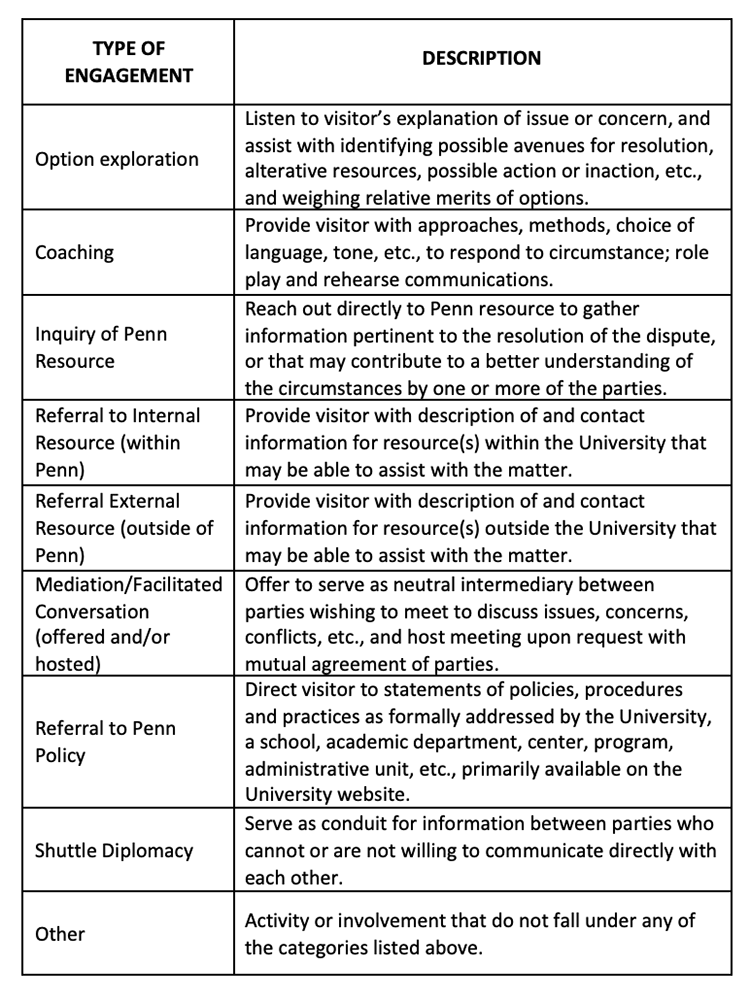
Table 3 details the ways in which we help visitors to the Ombuds Office. We strive to resolve any issue without escalation and are frequently successful. Only if we are unable to help a visitor achieve a meaningful resolution through mediation efforts do we refer them to an office that conducts investigations. The visitor has the choice to pursue this option but recognize that confidentiality will not be possible to maintain.

Ombuds Office Outreach

The office has continued to deliver a series of informational talks to enhance awareness of its services. In addition, we met with graduate student groups in programs and departments across campus in an attempt to prevent and mitigate the impact of some of the challenges described above. In the past year the Office of the Ombuds, in addition to receiving visitors and handling individual concerns, has hosted a wide range of workshops and talks on various topics including effective communication, empathetic leadership, conflict management, active listening and other issues related to conflict resolution. The office continues to provide confidential ongoing coaching sessions to various leaders and units across campus.

As experts in conflict management, we offer confidential, consistent and continuous coaching sessions for managers and leaders, across disciplines, upon request. These coaching sessions aim to assist managers in how to effectively manage and lead their teams in order to minimize conflicts and disagreements. We have successfully coached student leaders, department chairs, and managers and will continue to provide this service to all members of the Penn community as needed.

The Office of the Ombuds continues to focus on addressing systemic issues that are brought to our attention. Our constructive feedback and suggestions for improvement often lead to one-on-one coaching sessions at the request of managers.

The Way Forward

As stated in prior reports, members of the Penn community who can influence the culture and climate of their organizational unit should be mindful of the importance of collegiality and respectful treatment of others, model those behaviors, and take action when bad behavior occurs. Penn is a collection of over 50,000 human beings and conflicts and disputes will inevitably occur. The problematic behaviors we learn about in the Office of the Ombuds do not have to follow. We encourage members of the Penn community who find themselves in conflict or a dispute with others to reach out to the Office of the Ombuds before the matter escalates, when an amicable resolution can still be achieved.

On Restorative Practice at the Office of the Ombuds

The Office of the Ombuds has successfully incorporated restorative practice as an additional tool in managing conflicts. In cases of bullying and harassment, with the voluntary participation of all parties involved, restorative practice offers a positive outcome in restoring relationships and trust. Where appropriate, restorative practices lead to rapid and timely resolution of allegation of misconduct, where the focus is on the harm that was experienced and how it can be repaired. When implemented with care, restorative practice restores relationships by allowing constructive interpersonal dialogue and team building. 

The Office of the Ombuds uses restorative approaches to address conflicts by focusing on understanding the impact of actions and promoting collaborative solutions through dialogue to repair harm. Restorative approaches have allowed individuals in conflict to reach mutually beneficial outcomes through open communication and shared responsibility. The office is proud to share that restorative approaches in dealing with conflicts have been very successful in cases involving students, faculty and staff. Restorative approaches not only aim to address the conflict at hand, but they also serve as a guiding principle to rebuilding relationships and trust so that a positive working relationship extends well into the future.

Closing

In closing, we want to recognize the value of an Office of the Ombuds, especially in light of current challenges. It is critical that members of our community respect the opinions and beliefs of others as the world presents us with such global horrors and dissonance. The office represents a safe and confidential place to engage in discussions among campus community members who may differ in their beliefs. We welcome the opportunity to help.

TABLE 1: Visitors by Role

ROLE

Number

Percentage of Visitors

Faculty

41

19%

Graduate/Professional Students

38

17%

Undergraduate Students

24

11%

Staff

91

42%

Postdoctoral Trainees

22

10%

Other

2

1%

TOTAL

218

100%


TABLE 2a: Visitors By Issue Category

TABLE 2a: Visitors By Issue Category


TABLE 2b: Detailed Listing of Issues Presented by Visitors

TABLE 2b: Detailed Listing of Issues Presented by Visitors


TABLE 3: Types of Engagements with Visitors

Deaths

David Micahnik, Penn Athletics

caption: David MicahnikDavid Micahnik, C’59, a standout fencer as a Penn student and later Penn’s head fencing coach, died on January 4. He was 86.

Mr. Micahnik graduated from Penn’s College of Arts & Sciences in 1959. While an undergraduate at Penn, under the tutelage of legendary fencing master Maestro Lajos Csiszar, he earned All-Ivy accolades in fencing his senior year and competed in the Eastern final in 1958 and 1959. One year after graduating, Mr. Micahnik competed in the first of his three Olympic Games, held in Rome in 1960. He also competed in the 1964 Tokyo Games and the 1968 Mexico City Games. Accomplished in all three fencing weapons—épée, foil and saber—Mr. Micahnik’s forte was the épée, and he won the U.S. national title in 1960 and finished in second place in 1964, 1966 and 1968. Mr. Micahnik’s épée team won U.S. championships from 1965-1968, and Mr. Micahnik won individual titles in the World Maccabiah games in 1965 and 1969.

In 1973, Mr. Micahnik returned to his Penn to become the head fencing coach. In a tenure that stretched until 2010, Mr. Micahnik earned 722 wins and guided the Quakers to 20 Ivy League championships—ten each for the men’s and women’s teams—as well as NCAA team titles in 1981 (men) and 1986 (women). He also coached six individual NCAA champions for the men’s team. Mr. Micahnik was a member of the Penn Athletics Hall of Fame’s second induction class in 1998, and was also inducted into the Philadelphia Jewish Sports Hall of Fame in 1997 and the United States Fencing Association Hall of Fame in 2008.

Outside of Penn, Mr. Micahnik coached the U.S. teams at four Under-20 World Championships, five World University Games, two World Championships, the 1985 and 1993 World Maccabiah Games, and the 1986 and 1988 Junior Pan-American Games. He was a certified Maitre D’Armes (fencing master) in all three weapons by the U.S. Fencing Coaches Association and the International Academy of Arms.

Mr. Micahnik is survived by three sons, Bob, Hank (Sarah), and Tzvi (Channie); and four granddaughters, Robin Lynn, Chasya Temima, Atara Emunah, and Geulah Nechama.

Amos Smith III, Chemistry

caption: Amos SmithAmos Brittain Smith III, an emeritus professor of chemistry in the School of Arts & Sciences, died on February 3. He was 80.

Born in Lewisburg, Pennsylvania, Dr. Smith received the first combined BS/MS degree in chemistry ever given by Bucknell University in 1966. After a year of medical school at Penn, he transferred to Rockefeller University, earning a PhD in chemistry in 1972 under William C. Agostain. He then returned to Penn in 1973, joining the Faculty of Arts & Sciences (now the School of Arts & Sciences) as an assistant professor of chemistry. At the same time, he accepted a joint appointment at the Monell Chemical Senses Center, a non-profit scientific research institute founded in 1968 at the University City Science Center campus. He became an associate professor at Penn in 1978 and a full professor three years later. From 1988 to 1996, Dr. Smith chaired the department of chemistry, and in 1990, he became the Rhodes-Thompson Endowed Professor of Chemistry, a role he held until his retirement in 2024.

Dr. Smith’s research centered on the synthesis of architecturally complex organic molecules, many with biological significance. This included ongoing projects aimed at inhibiting HIV’s entry into susceptible cells and its propagation in infected cells. Dr. Smith authored over 800 research papers and mentored more than 130 PhD students and 200 postdoctoral fellows. He was the founding editor-in-chief of the American Chemical Society research journal, Organic Letters, and served in that capacity for 20 years.

Dr. Smith’s research was renowned and earned many honors. He received the Order of the Rising Sun from the government of Japan, the Yamada-Koga Prize from the Japan Research Foundation, and an honorary doctorate from Queen’s University in Belfast, Northern Ireland. He was a fellow of the American Academy of Arts and Sciences, the John Simon Guggenheim Foundation, and the American Association for the Advancement of Science, as well as of prestigious learned societies in Japan and France. He earned the William H. Nichols Medal from the New York Section of the American Chemical Society, the Kitasato Medal from the Kitasato Institute, and the Allan R. Day Award from the Philadelphia Organic Chemists’ Club. The Royal Society of Chemistry in the U.K. awarded him its Simonsen Medal, Centenary Medal, and Perkin Prize for Organic Chemistry.

Dr. Smith is survived by his wife, Janet; son, A. Matthew Smith, IV; daughter, Kathryn S. Cobb; and son-in-law, L. Travis Cobb.

In lieu of flowers, memorial contributions can be made to Penn’s chemistry department (https://www.chem.upenn.edu/giving-penn-chemistry) or to Bucknell University (https://www.bucknell.edu/azdirectory/university-advancement/ways-give) with a designation for the chemistry department.

---
To Report A Death

Almanac appreciates being informed of the deaths of current and former faculty and staff members, students and other members of the University community. Call (215) 898-5274 or email almanac@upenn.edu.

Notices of alumni deaths should be directed to the Alumni Records Office at Suite 300, 2929 Walnut St., (215) 898-8136 or email record@ben.dev.upenn.edu.

Governance

Board of Trustees Meetings: February 27-28, 2025

On Thursday and Friday, February 27 and 28, 2025, there will be meetings of the Board of Trustees.

The meeting schedule is as follows:

Thursday, February 27, 2025

  • 8:30–10 a.m.: Local, National, & Global Engagement Committee
  • 10:15–11:45 a.m.: Facilities & Campus Planning Committee
  • 1:45–3:15 p.m.: Student Life Committee
  • 3:40–5 p.m.: Academic Policy Committee
  • 4–5:15 p.m.: Budget & Finance Committee

Friday, February 28, 2025

  • 11:30 a.m.–12:30 p.m.: Stated Meeting of the Trustees

For more information, visit https://secretary.upenn.edu/trustees-governance/open-trustee-meeting.

Honors

Salman Khalil: 2025 College Squash Association National Champion

caption: Salman Khalil

Sophomore Salman Khalil won the individual title over teammate Omar Hafez, a junior, in the men’s final at the 2025 CSA Individual Championship on January 28, 2025.

Mr. Khalil is the first Quaker to win the Pool Trophy since Ned Edwards in 1979, ending a 46-year title drought for the program, and he also became only the fifth in the program’s history to raise the trophy, joining Mr. Edwards, Palmer Page (1971), Howard Coonley (1966), and Leroy Lewis (1938). The match was the first time in five years that Penn was represented in the final, and the matchup between Khalil and Hafez marked just the third time that Penn teammates faced each other in the CSA Individual Championships final.

The final was a meeting between the two most recent Ivy League Rookies of the Year, with Mr. Hafez earning the honor from the ancient eight coaches in 2022-2023 and Mr. Khalil gaining the award last season.

During the final battle, Mr. Hafez jumped out to an early lead in game one, but Mr. Khalil quickly closed the gap and steamed ahead in game three, taking control early. Falling into a rhythm, he came out victorious to clinch the victory, 11-2. The two teammates embraced after the match point was called.

Events

Penn Museum Celebrates the Arrival of Spring with CultureFest! Holi In Partnership with Three Aksha and the Penn South Asia Center

caption: The Hindu tradition of Holi celebrates the arrival of spring through the joyous throwing of brightly colored powders. Photo courtesy Penn Museum.

In partnership with Three Aksha and Penn’s South Asia Center, the Penn Museum will mark the beginning of spring with CultureFest! Holi on Saturday, March 15, from 10 a.m.-4 p.m.

Known as the Festival of Colors, Holi is a Hindu tradition that signals the arrival of spring—representing renewal, rebirth, love, unity, and the triumph of good over evil.

It is a time to embrace the positive and release negative energy. Observed in India, Nepal, and in communities around the world, this meaningful tradition celebrates the divine love of the Hindu god Krishna and his devotee, Radha. 

CultureFest! Holi is a family friendly festival featuring storytelling, colorful art-making, live music, riveting dance performances, and a marketplace.

The highlight of the day will be the joyful throwing of brightly colored powders to embrace the spirit of Holi and its message of harmonious new beginnings. 

CultureFest! Holi includes:

  • 11 a.m.-11:45 a.m.: Three Aksha musicians in Harrison Auditorium
  • Noon-12:20 p.m.: Folk Forms of India: Led by Nruthu Aaloka and Meena Venkat, a dance performance to honor Radha and Krishna—and an interactive talk in Widener Lecture Hall
  • 1-1:30 p.m.: Storytelling 
  • 2 p.m.-2:20 p.m.: Folk Forms of India, dances of Radha and Krishna
  • 2:30 p.m.-3:30 p.m.: Three Aksha dance ensemble presents UTSAV, classical Indian dance Bharatanatyam in Harrison Auditorium
  • 3:50 p.m.-4 p.m.: Holi celebration in the courtyard with colorful powder throwing

Viji Rao, artistic director of Three Aksha, a dance company and educational institute, helped to organize CultureFest! Holi. For her, this traditional festival conveys a timeless love story.

“Lord Krishna is dark blue-skinned and falls in love with Radha, but he is embarrassed by his dark blue skin,” Ms. Rao explained. “He playfully colors Radha’s face during a game—and she falls in love with him. This is the origin of throwing colored powder and water during Holi.” 

All CultureFest! Holi activities are included with Penn Museum admission. Admission is free for museum members, PennCard holders, & Penn Medicine patients and staff.

To buy tickets, click here.

caption: Three Aksha is a Philadelphia-based dance company that preserves and promotes Indian culture through classical Indian Bharatanatyam. Photo courtesy Three Aksha.

Update: February AT PENN

Conferences

21        Penn Grad Talks; a day of TED Talk-style presentations by Penn Arts & Sciences graduate students representing the humanities, social sciences, natural sciences, and professional master’s programs, who will compete for first place and audience choice prizes within their category; noon-4 p.m.; Widener Lecture Hall, Penn Museum, and YouTube livestream; watch: https://www.youtube.com/live/dya_05fZLJE?feature=shared (School of Arts & Sciences).


Exhibits

21        Tea & Tour of After Modernism; Gwendolyn DuBois Shaw gives an exclusive behind-the-scenes tour that reveals the collection and the curatorial process of this epic exhibition; 4:30 p.m.; Arthur Ross Gallery, Fisher Fine Arts Library; register: https://tinyurl.com/arg-tour-feb-21 (Arthur Ross Gallery).


Films

19        Great Migrations; explores how a series of Black migrations have shaped America; features discussion with director Henry Louis Gates, Jr.; noon; room 108, ARCH (Makuu: The Black Cultural Center).


Fitness & Learning

18        Grant Writing, Residencies, and Fellowships; Chloe Reison, associate director of the Sachs Program for Arts Innovation, will provide an in-depth overview of essential grant-writing strategies for artists, offering valuable insights on building confidence in fundraising and crafting compelling proposals; 1 p.m.; room 201C, Addams Hall (Fine Arts).

19        Fellowships 101; join CURF’s director for nationally competitive fellowships and students who have been through the process to learn about some incredible fellowship opportunities and the benefits of applying for them, regardless of the outcome; 6 p.m.; first floor, 3539 Locust Walk (Center for Undergraduate Research & Fellowships).

20        Penn Spring 2025 Virtual All Industry Career Fair; virtual all-industry fair that will provide an excellent opportunity for Penn students, alumni, and postdocs to engage in one-on-one conversations with employer representatives and/or attend group sessions hosted by individual employers; 11 a.m.-4 p.m.; online webinar; register: https://tinyurl.com/career-fair-feb-20 (Career Services).

            Grant-Writing Workshop; learn how you can better position yourself to be a competitive applicant for the College Alumni Society Research Grant, Holtz Fund, Barthmaier Award, or one of the many other grants available; 4 p.m.; room 202, 3539 Locust Walk (Center for Undergraduate Research & Fellowships).

            MFA Alumni Career Panel; an engaging discussion on careers in the arts, featuring distinguished alumni who will share insights into their unique professional journeys; 5 p.m.; room B3, Meyerson Hall (Fine Arts).


Penn Libraries

Various locations. Info: https://www.library.upenn.edu/events.

19        Research Poster Design; learn to communicate your research in clear, engaging posters with visuals that captivate your audience and convey your research with impact; noon; online webinar.

            Introduction to Media Literacy; workshop explains corporate media, including streaming platforms, television broadcasting, radio, mass media and the press, and social media; 5 p.m.; room 241, Van Pelt Library.

20        Intro to Metals: Jewelers Saw; learn the safety procedures and fundamental techniques in using a jeweler's saw, including inner and outer cuts, filing, and sanding of sheet metal to create a charm link; 3 p.m.; TinkerLab, Education Commons.

            Intro to Block Printing; after a demonstration and tutorial all about carving and printing, participants will carve their own rubber stamp; 5 p.m.; Common Press, Fisher Fine Arts Library.

25        Creative Inquiry; will explore creativity as a practice and discuss library resources that can be leveraged in your creative research, no matter your topic or discipline; 11 a.m.; room 223, Van Pelt Library.

            How do Creative Commons Licenses Work?; learn about Creative Commons licenses, which offer a vetted, user-friendly way to share your creative works with the public while ensuring you have some control over how others use your works; 3 p.m.; room 241, Van Pelt Library.

            Studio Use Training: Letterpress Printing; learn and practice the basics of letterpress printing and typesetting at Common Press; 4-7 p.m.; Common Press, Fisher Fine Arts Library.


Music

21        (Deep) Listening with Spindrift; Spindrift members DJ Papaya, Pontiac Streator, and Opheliaxz consider what is born out of the blurring of natural and artificial worlds through abstract sonic landscapes awash in texture; 7 p.m.; ICA; register: https://tinyurl.com/ica-spindrift-feb-2111 (Institute of Contemporary Art).

22        Penn Flutes: Flute Fleadh; Penn Flutes and Traditional Irish Band the Rookery visit the Penn Museum for their annual "Flute Fleadh”; 1 p.m.; 3rd floor rotunda, Penn Museum (Music).

            Penn Symphony Orchestra: An Evening of Concertos with Guest Soloists; Penn Symphony Orchestra collaborates with the Moxart Organization to present works of Mozart, Haydn and Beethoven, conducted by Ramsey Reyes, Rick Barrantes and Caleb Thompson; 8 p.m.; St. Agatha-St. James Church, 3728 Chestnut Street (Music).


On Stage

22        Penn Ballet Presents "Anthologies: An Evening Exhibition"; an exploration of the galleries of classical and contemporary ballet across time; 6 p.m.; Iron Gate Theater; tickets: $10-$12 (Platt Performing Arts House).


Readings & Signings

Penn Bookstore

In-person events at 2nd floor conference room, Penn Bookstore. Info: https://www.business-services.upenn.edu/bookstore-events-by-month/202502.

20        Who Needs College Anymore: Imagining a Future Where Degrees Won't Matter; Kathleen deLaski, Education Design Lab; 6 p.m.


Special Events

21        Tsagaan Sar Mongolian Lunar New Year Celebration; celebrate Tsagaan Sar, the "white month," the Mongolian Lunar New Year, with Mongolian-style milk tea, dumplings, and other snacks, as well as presentations about Tsagaan Sar cultural practices; 2-5 p.m.; rooftop lounge, Rodin College House; register: https://tinyurl.com/mongolian-lny-feb-21 (East Asian Languages & Cultures).

23        Carnaval; experience the vibrant spirit of Carnaval, a celebration of indigenous Andean and Quechua traditions, featuring live music by Inka Rayku, traditional folkloric dance performances by Ballet Folklórico Acuarelas Del Perú New York, and Peruvian cuisine; 4-7 p.m.; Hall of Flags, Houston Hall (Quechua at Penn).


Talks

18        Efficient Probabilistically Checkable Proofs from High-Dimensional Expanders; Mitali Bafna, Massachusetts Institute of Technology; 3:30 p.m.; Wu & Chen Auditorium, Levine Hall (Computer & Information Science).

19        Real-Time Safe and Energy-Efficient UAV Motion Planning in Windy Urban Environments; Spencer Folk, mechanical engineering & applied mechanics; 10:15 a.m.; room 319, Towne Building (Mechanical Engineering & Applied Mechanics).

            Demystifying the Inner Workings of Language Models; Sarah Wiegreffe, Allen Institute for AI; noon; room 414, Amy Gutmann Hall (ASSET Center).

            The Judicial System of China; Xin He, University of Hong Kong; 12:15 p.m.; room 418, PCPSE (Center for the Study of Contemporary China).

            Navigating Precarity: Artists on Gender, Race and Caste; Chelsey Luster, Bhumika Saraswati, and Shrujana N Shridhar, artists; 4:30 p.m.; room 500, Annenberg School; register: https://tinyurl.com/cargc-cmar-talk-feb-199 (Center for Advanced Research in Global Communication, Center for Media at Risk).

            Unraveling Cultures and Identities; Asha Salim, Temple University; 6:15 p.m.; room 543, Williams Hall (Italian Studies).

20        Quantum Simulation of Electronic Materials with a Superconducting Qubit Array; Ilan Rosen, Massachusetts Institute of Technology; 11 a.m.; room 225, Towne Building (Electrical & Systems Engineering).

            Theoretical Foundations for Multi-Agent Learning; Noah Golowich, Massachusetts Institute of Technology; noon; room 414, Amy Gutmann Hall (IDEAS Center).

            Listening to Sargassum Beyond the Sargasso Sea; Juanita Sundberg, University of British Columbia; 3 p.m.; room 250, PCPSE; register: https://tinyurl.com/sundberg-talk-feb-20 (Environmental Innovations Initiative).

            Multispecies Storytelling and Seaweed Blooms in the Mexican Caribbean; Juanita Sundberg, University of British Columbia; 3 p.m.; room 250, PCPSE (Center for Latin American & Latinx Studies).

            Molecular Mechanisms of BRCA1/2 Mediated Genome Maintenance & Tumor Suppression; Weixing Zhao, University of Texas Health; 4 p.m.; Austrian Auditorium, CRB, and Zoom webinar; join: https://tinyurl.com/cancer-biology-talks (Cancer Biology).

            From Bernie Goetz to Breaching the Capitol: Rethinking the Ugly 80s; Heather Thompson, University of Michigan; 5 p.m.; room 209, College Hall (History).

            Victorians in the River Plate; Jessie Reeder, SUNY Binghamton; 5 p.m.; room 473, McNeil Building (English, Center for Latin American & Latinx Studies).

21        Scholar For A Day; Kalala Ngalamulume, Bryn Mawr College; noon; room 329A, Max Kade Center; register: https://tinyurl.com/ngalamulume-talk-feb-21 (Africana Studies).

            Transgender Rights and American Culture Wars; TJ Billard, Northwestern University; 12:15 p.m.; room 500, Annenberg School; RSVP: https://tinyurl.com/billard-talk-feb-21 (Annenberg School).

            Unraveling Internal Friction in a Coarse-Grained Protein Model; Pep Español, Universidad Nacional de Educación a Distancia (Madrid); 2 p.m.; room 534, 3401 Walnut Street (Penn Institute for Computational Science).

            The Blue Period: Black Writing in the Early Cold War; Jesse McCarthy, Harvard University; 5 p.m.; room 135, Fisher-Bennett Hall (English).

24        Fantastic Forces and Where to Find Them; Julien Berro, Yale University; 3 p.m.; Austrian Auditorium, CRB (Pennsylvania Muscle Institute).

            Cultural Fit and Sleep Duration; Steven Heine, University of British Columbia; 3:30 p.m.; auditorium, Levin Building (Psychology).

            Targeting Extrachromosomal DNA in Cancer; Natasha Weiser, Stanford University; 4 p.m.; Class of 1962 Reunion Auditorium, John Morgan Building, and Zoom webinar; join: https://tinyurl.com/cancer-biology-talks (Cancer Biology).

25        Towards Quantum Interconnects: Entangling Microwave and Optical Photonic Qubits; David Lake, California Institute of Technology; 11 a.m.; room 225, Towne Building (Electrical & Systems Engineering).


Biology

Hybrid events. Info: https://www.bio.upenn.edu/events.

20        Light as an Architect: How Light Quality Shapes Plant Structure; Ullas Pedmale, Cold Spring Harbor Laboratory; non; room 109, Leidy Laboratory, and Zoom webinar.


Chemistry

In-person events at Carolyn Hoff Lynch Lecture Hall, 1973 Chemistry Building. Info: https://www.chem.upenn.edu/events.

19        Decoding Mechanical Signals at the Subcellular Level; Zheng Shi, Rutgers University; noon.

25        “Super-Oxidized” Iron Nitrido & “Super-Reduced” Iron Nitrosyl Complexes in tris-Carbene Coordination Spheres – and How Iron Really Feels About It; Karsten Meyer, Friedrich-Alexander University of Erlangen-Nürnberg; noon.


Economics

In-person events. Info: https://economics.sas.upenn.edu/events.

18        Urban Highway Removal: Evidence from Rochester's Inner Loop; Sherrie Cheng, economics; noon; room B13, Meyerson Hall.

19        On the Trends of Technology, Family Formation, and Women's Time Allocation; Kanato Nakakuni, University of Tokyo; noon; room 100, PCPSE.

            Are Inflationary Shocks Regressive? A Feasible Set Approach; John Grigsby, Princeton University; 4 p.m.; room 101, PCPSE.

24        Over-and Underreaction to Information; Aislinn Bohren, economics; noon; room 225, PCPSE.

25        Forward-Looking Politicians; Javier Tasso, economics; noon; room B13, Meyerson Hall.

            Efficient Learning from Ambiguous Information; Ryota Iijama, Princeton University; 4 p.m.; room 100, PCPSE.


GRASP Lab

Info: https://www.grasp.upenn.edu/events/month/2025-02/.

19        When Is Partially Observable Reinforcement Learning Not Scary? Qinghua Liu, Microsoft Research; 3 p.m.; room 307, Levine Hall, and Zoom webinar.

24        Encouraging Autonomous Agents to Behave Nicely; Sarah Keren, Technion, Israel Institute of Technology; 3 p.m.; room 307, Levine Hall.

25        Robot Learning with Minimal Human Feedback; Erdem Bıyık, University of Southern California; 2 p.m.; room 307, Levine Hall, and Zoom webinar.


Katz Center for Advanced Judaic Studies

Various locations. Info: https://katz.sas.upenn.edu/events.

25        Resilience During War in Israel; Bruria Adini, Tel Aviv University; noon; Zoom webinar.


Mathematics

Info: https://www.math.upenn.edu/events.

18        Orthosymplectic Modules for Cohomological Hall Algebras; Samuel DeHority, Yale University; 3:30 p.m.; room 4C4, DRL.

25        Sharp Threshold for Rigidity of Random Graphs; Orit Raz, Institute for Advanced Study; 3:30 p.m.; room 4C8, DRL.


Physics & Astronomy

Info: https://www.physics.upenn.edu/events/.

19        How Well Can Cosmologists Do Astrophysics Using Line Intensity Mapping Observations? Anirban Roy, New York University; 3 p.m.; room 4E19, DRL.

            First Measurement of Missing Energy Due to Nuclear Effects in Monoenergetic Neutrino Charged Current Interactions; Eric Marzec, University of Michigan; 3:30 p.m.; room 3W2, DRL.

            Robust Prediction of Moiré Material Topology; Valentin Crepel, Flatiron Institute; 3:30 p.m.; room A8, DRL.


This is an update to the February AT PENN calendar. To submit events for an upcoming AT PENN calendar or weekly update, email almanac@upenn.edu.

Crimes

Weekly Crime Reports

Division of Public Safety

University of Pennsylvania Police Department Crime Report

About the Crime Report: Below are the Crimes Against Persons and/or Crimes Against Property from the campus report for February 3-9, 2025. The Crime Reports are available at: https://almanac.upenn.edu/sections/crimes. Prior weeks’ reports are also online. –Eds.

This summary is prepared by the Division of Public Safety (DPS) and contains all criminal incidents reported and made known to the Penn Police, including those reported to the Philadelphia Police Department (PPD) that occurred within our patrol zone, for the dates of February 3-9, 2025. The Penn Police actively patrol from Market Street to Baltimore Avenue and from 30th Street to 43rd Street in conjunction with the Philadelphia Police.

In this effort to provide you with a thorough and accurate report on public safety concerns, we hope that your increased awareness will lessen the opportunity for crime. For any concerns or suggestions regarding this report, please call DPS at (215) 898-7297. You may view the daily crime log on the DPS website.

Penn Police Patrol Zone
Market Street to Baltimore Avenue and from 30th Street to 43rd Street

Crime Category

Date

Time

Location

Description

Assault

02/03/25

7:45 PM

51 N 39th St

Complainant verbally threatened by a patient’s partner


02/09/25

10:54 PM

3800 Market St

Offender assaulted police during a vehicle crash investigation

Auto Theft

02/03/25

10:09 AM

3535 Market St

Secured electric bike taken from bike rack


02/04/25

3:54 PM

3335 Woodland Walk

Secured scooter taken from bike rack


02/06/25

8:04 PM

4200 Ludlow St

Parked and locked motor vehicle taken from highway


02/06/25

1:46 PM

3730 Walnut St

Secured scooter taken from bike rack


02/06/25

6:27 PM

3400 Civic Center Blvd

Secured scooter taken from bike rack


02/07/25

8:01 PM

3410 Civic Center Blvd

Theft of a parked motor vehicle from garage

Bike Theft

02/05/25

5:00 PM

3601 Walnut St

Secured bike taken from bike rack

Burglary

02/04/25

12:28 PM

224 St Marks Sq

Attempted burglary to residence


02/05/25

9:46 AM

4247 Locust St

Report of an overnight burglary to a residence with subsequent theft of vehicle

Fraud

02/03/25

5:48 PM

3565 Sansom St

Fraudulent wire transfer made to unknown offender


02/04/25

12:19 PM

4035 Baltimore Ave

Credit card used without authorization


02/07/25

10:37 PM

3717 Chestnut St

Fraud/theft of services

Other Offense

02/05/25

12:53 PM

801 Spruce St (PAH)

Fugitive called in by Camden County Prosecutor’s Office/Warrant Arrest

Retail Theft

02/05/25

8:52 PM

4233 Chestnut St

Report of a retail theft


02/05/25

11:49 AM

4233 Chestnut St

Report of a retail theft


02/05/25

2:02 AM

3744 Spruce St

Retail theft of consumable goods


02/07/25

9:34 PM

4233 Chestnut St

Retail theft of alcohol


02/08/25

10:46 AM

3330 Market St

Retail theft of prepackaged cake/Arrest


02/09/25

11:11 AM

4233 Chestnut St

Retail theft of alcohol

Theft from Building

02/05/25

11:46 AM

3300 Market St

Report of theft from a building


02/08/25

12:09 PM

4101 Spruce St

Package taken from lobby of apartment building


02/08/25

1:23 PM

3400 Spruce St

Watch taken from backpack in unsecured office


02/08/25

4:43 PM

3935 Walnut St

Theft of computer equipment and personal items from backpack

Vandalism

02/05/25

7:54 PM

4001 Walnut St

Driver side window broken


Philadelphia Police 18th District
Schuylkill River to 49th Street & Market Street to Woodland Avenue

Below are the Crimes Against Persons from the 18th District: 7 incidents were reported for February 3-9, 2025 by the 18th District, covering the Schuylkill River to 49th Street & Market Street to Woodland Avenue.

Crime Category

Date

Time

Location

Aggravated Assault

02/08/25

11:13 AM

4800 Paschall Ave

Assault

02/04/25

11:56 AM

4640 Walnut St


02/05/25

9:31 PM

4322 Market St


02/06/25

1:06 PM

Civic Center Blvd & University Ave

Rape

02/05/25

6:54 PM

3700 Blk Chestnut St

Robbery

02/05/25

10:08 AM

4247 Locust St


02/09/25

10:53 PM

4823 Springfield Ave

The Division of Public Safety offers resources and support to the Penn community. DPS developed a few helpful risk reduction strategies outlined below. Know that it is never the fault of the person impacted (victim/survivor) by crime.

  • See something concerning? Connect with Penn Public Safety 24/7 at (215) -573-3333.
  • Worried about a friend’s or colleague’s mental or physical health? Get 24/7 connection to appropriate resources at (215) 898-HELP (4357).
  • Seeking support after experiencing a crime? Call Special Services - Support and Advocacy resources at (215) 898-4481 or email an advocate at specialservices@publicsafety.upenn.edu
  • Use the Walking Escort and Riding services available to you free of charge.
  • Take a moment to update your cellphone information for the UPennAlert Emergency Notification System
  • Download the Penn Guardian App which can help Police better find your location when you call in an emergency.
  • Access free self-empowerment and defense courses through Penn DPS.
  • Stay alert and reduce distractions; using cellphones, ear buds, etc. may limit your awareness.
  • Orient yourself to your surroundings. (Identify your location, nearby exits, etc.)
  • Keep your valuables out of sight and only carry necessary documents.

Bulletins

Call for Applications for McCabe Fund Fellows and Pilot Awards

The McCabe Fund Advisory Committee calls for applications from junior faculty in the Perelman School of Medicine (PSOM) and the School of Veterinary Medicine (SVM) for the annual Thomas B. and Jeannette E. Laws McCabe Fund Fellow and Pilot Awards. The McCabe Awards were established in 1969 by a gift from Thomas B. and Jeannette E. Laws McCabe to the Perelman School of Medicine. The purpose of this gift is to support junior faculty (assistant professors) who initiate fresh and innovative biomedical, clinical, and surgical research projects. This opportunity is open to clinical (CE and AC) track faculty. Tenure and research track faculty are not eligible to apply.

Eligible faculty are those who have received either limited or no external research funding while in their first through third years on the faculty at PSOM or the SVM. Junior faculty in these schools should contact their department chair for information and application forms. The guidelines and instructions to determine eligibility are also available on the PSOM website: https://www.med.upenn.edu/evdresearch/mccabe-fund.html.

The deadline for submission is Friday, May 9, 2025. The McCabe Fund Advisory Committee will select the winners at its annual meeting in June.

Last year there were five winners of Fellow Awards of $50,000 each: Emily Baumrin (Dermatology), Joshua Catapano (Neurosurgery), Harper Hubbeling (Radiation Oncology), Roger Kim (Medicine), and Nathan Klingensmith (Surgery).

There were sixteen Pilot Award winners, who received $36,347 each: Humera Ahmed (Pediatrics), Maria Altieri (Surgery), Marissa Anto (Neurology), Saïd Azoury (Surgery), Ali Dhanaliwala (Radiology), Megan Kassick (Radiation Oncology), Cassandra Ligh (Surgery), Daniela Luethy (Large Animal Medicine, SVM), Lin Mei (Medicine), Ralph Nader (Medicine), Julianna Rodin (Otorhinolaryngology), Mersedeh Rohanizadegan (Medicine), Nicholas Seewald (Biostatistics, Epidemiology & Informatics), Caroline Sobotyk (Parasitology, SVM), Alexandra Strauss (Medicine), and Junqian Zhang (Dermatology).

Back to Top