The Weitzman School: A Celebration of Design
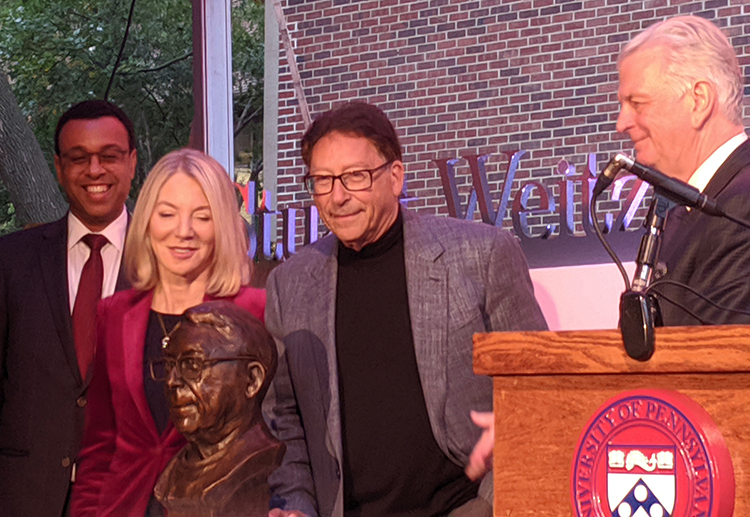
The celebration of the naming of the University of Pennsylvania Stuart Weitzman School of Design and the Stuart Weitzman Plaza took place last Thursday. There were panel discussions, a keynote address and a naming ceremony, at which President Amy Gutmann said, “Design is the alchemy that refashions our world into something better. It is nothing less than the science, the art and the magic of transformation.”
President Gutmann announced that the central plaza, located adjacent to College Green between Meyerson Hall and Fisher Fine Arts Library, is now named the Stuart Weitzman Plaza. The area will undergo significant redesign and renovation by renowned landscape architect Laurie Olin, practice professor emeritus of landscape architecture at the Weitzman School, and colleagues at his firm OLIN.
“This shared space will be a true homage to the transformative power of design. It will embody Stuart’s connection with the Weitzman School while enriching our campus for the entire Penn community,” President Gutmann said.
Mr. Weitzman, the designer and footwear industry icon, graduated from the Wharton School in 1963 (Almanac March 12, 2019). He has had a “lifetime of engagement with Penn,” and “believes in the power of design to immeasurably improve the human experience,” said President Gutmann.
$18.1 Million from NIH to Penn’s Center for Neurodegenerative Disease

 The Center for Neurodegenerative Disease Research (CNDR) at the University of Pennsylvania has received a grant expected to total $18.1 million to study the underlying genetic mechanisms that cause Alzheimer’s disease, dementia and Parkinson’s disease to progress as well as how those mechanisms are related to each other and to the cell-to-cell spread of these disease proteins. The grant, awarded by the National Institutes of Health’s National Institute on Aging (NIA), will fund four specific projects over the next five years.
The Alzheimer’s Association estimates there are 5.8 million Americans currently living with Alzheimer’s. It is the sixth leading cause of death in the United States. About 80 percent of Alzheimer’s patients also develop dementia. Both of these diseases affect language and memory, whereas Parkinson’s mainly affects motor skills. The three conditions are often associated with each other, and previous research from the CNDR and others has shown they share several underlying connections, including a connection to a protein called alpha-synuclein as well as Alzheimer’s disease plaques and tangles. When normal alpha-synuclein proteins become misfolded and are not cleared away, they become deposits in the brain in the form of lesions known as Lewy bodies. They affect chemicals in the brain, which, in turn, can lead to problems with thinking, movement, behavior and mood.
“Our theory is that specific misfolded shapes of these alpha-synuclein proteins can lead to specific, different diseases. For example, one pattern may be associated with Alzheimer’s, another with Alzheimer’s and dementia, another with Parkinson’s and dementia, and so on,” said John Q. Trojanowski, the William Maul Measey-Truman G. Schnabel, Jr., M.D. Professor of Geriatric Medicine and Gerontology in Pathology and Laboratory Medicine at Penn Medicine. Dr. Trojanowski is also the co-director and co-founder of the CNDR with Virginia Man-Yee Lee, the John H. Ware 3rd Endowed Professor in Alzheimer’s Research.
The grant will seek to further the team’s theory through four specific projects. The first project, led by Dr. Lee, will evaluate alpha-synuclein in test tubes and cell cultures in an effort to better understand how misfolding happens and how specific shapes are created. The second, led by Dr. Trojanowski, will mimic the first project in animal models to study the impact of these shapes on the progression of disease.
The other two projects will move the work into the clinic. Project three will use imaging and antibodies to study how a patient who begins with Parkinson’s progresses to dementia and vice-versa. This work, led by Murray Grossman, professor of neurology, will focus on the potential identification of biomarkers. The fourth project will focus on tissue samples in an effort to identify genetic risk factors for these diseases. Alice S. Chen-Plotkin, the Parker Family Associate Professor of Neurology, will lead this work.
Core leaders for the Penn projects include Dr. Trojanowski, Daniel Weintraub, assistant professor of psychiatry and fellow in Penn’s Institute of Aging, and Sharon Xiangwen Xie, a professor of biostatistics and epidemiology.
2018-2019 Report of the Office of the Ombuds
The Office of the Ombuds offers all members of the Penn community a safe space where they can discuss questions, concerns and complaints. Students, faculty and staff who are experiencing conflict or other problems related to their life at Penn are urged to consult the Ombuds Office for help resolving these issues. To increase the visibility of the office we regularly visit schools and administrative divisions to explain our work, participate in resource fairs for students and staff, and widely distribute literature regarding the Ombuds Office across campus.
Our website (www.upenn.edu/ombuds/) describes our services and the principles on which we operate. We offer visitors:
- Confidentiality. We do not talk about visitors’ concerns or issues with others, unless given permission.
- Neutrality. We do not take sides in a dispute.
- Informality. We do not carry out official investigations, and we do not keep records of conversations with visitors.
- Independence. The Ombuds Office operates outside Penn’s 12 schools and administrative divisions, and it is not bound by their reporting procedures. The Ombuds Office has the freedom to raise issues throughout the University and does so regularly.
Although the Ombuds Office has no authority to set Penn policies or to change specific decisions, it does defend fairness and consistency across the University. When problematic patterns are raised with the office, they are brought to the attention of the relevant administrators in ways that protect the identities of complainants.
During the academic year, 2018-2019, 172 individuals consulted the Ombuds Office. This number represents a 5.5% increase from 2017-2018. University staff accounted for the largest proportion of our visitors (43%), followed by faculty (24%), graduate and professional students (19%), undergraduate students (7%), post-doctorates (2%) and others (4%). See Table 1. These proportions have remained roughly stable for the last several years with only slight annual variations in their distribution. They reflect the relative sizes of these groups in the total population of the University, as well as the existence of alternative support services available on campus.
Table 1: Visitors by Affiliation 2018-2019
| Faculty |
24% |
42 |
| Graduate/Professional |
19% |
33 |
| Undergraduate |
7% |
12 |
| Staff |
43% |
74 |
| Post-Doctorates |
2% |
4 |
| Other |
4% |
7 |
| TOTAL |
100%* |
172 |
| *Due to rounding, the individual percentages do not add up to 100% |
|
|
Visitors come to the Ombuds Office with concerns that range from simple inquiries about a University policy to very complicated issues, such as tenure procedures and decisions. Tables 2 and 3 report the types of questions brought to the office and the numbers of people who raised them. (The Ombuds Office does not report the substance of individual cases to protect the anonymity of our visitors.) Most problems brought to the office during this reporting period fall into three broad categories: employment related (39%), behaviors [1] (28%) and academic related (24%). The classification system used remains standard to permit comparability over time. Because many individuals raised multiple subjects, the total number of issues tabulated (215) is greater than the number of visitors (172).
Table 2: Visitors by Issues Raised 2018-2019
| Academic Related |
24% |
52 |
| Employment Related |
39% |
84 |
| Behaviors |
28% |
61 |
| Other |
8% |
18 |
| TOTAL |
100% |
215 |
| *Due to rounding, the individual percentages do not add up to 100% |
|
|
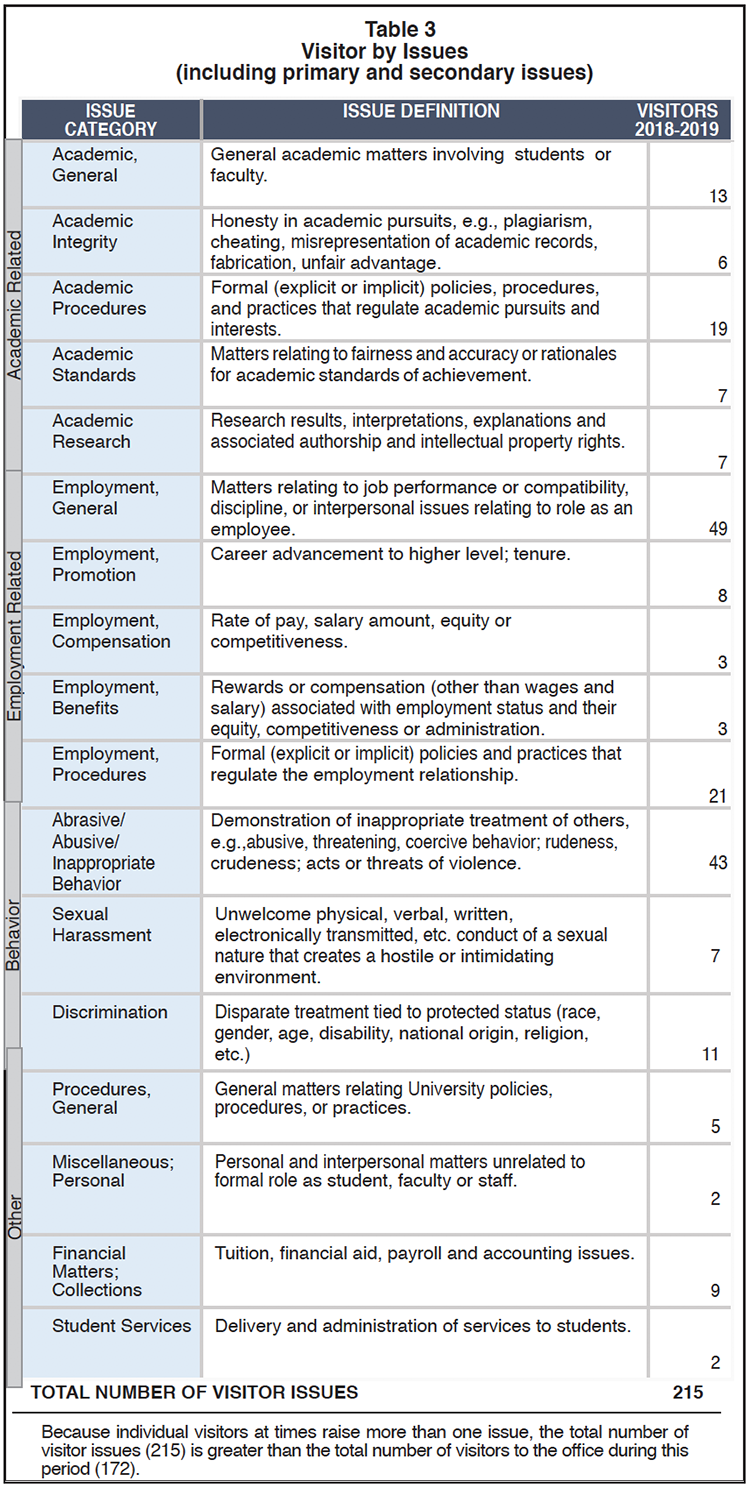
Table 3 gives more detail about, as well as definitions of, the issues brought to the Ombuds Office during the past year. Questions about employee evaluations and disciplinary procedures recurred regularly, as did concerns about students’ and advisors’ academic responsibilities. The wish to challenge a decision made by a supervisor, professor or colleague, when there is no formal appeal procedure, brought many individuals to the office. Disputes about job descriptions, employee benefits and compensation underlie many complaints. Interpersonal conflicts took many forms and made it difficult for individuals to carry out their responsibilities.
A few patterns deserve special attention. Many visitors complained about a toxic or hostile work environment, which they did not know how to handle. Employees reported what they felt to be unjust or unequal assignments and a lack of respectful treatment when they raised concerns. Channels of communication within an office or a department sometimes break down and make resolution difficult. Greater attention should be paid to maintaining consistency and clarity of messages and transparency of procedures in both academic and work settings. Inappropriate or unsympathetic methods of delivering a negative message can make challenging situations worse. Times of transition, such as when employees are leaving Penn for various reasons (resignation, retirement, etc.), can be particularly hard to navigate.
Faculty and graduate students have raised questions about academic standards and academic responsibilities. The need to change an advisor or a course assignment can lead to conflict over appropriate procedures. Decisions about dismissal and tenure are particularly contentious, as are questions related to intellectual property. These disputes can be even more difficult to resolve when a school or department lacks applicable written policies. To help address this problem, the booklet Advising and Mentoring PhD Students, issued by the Office of the Vice Provost for Education, offers guidelines for faculty, students and staff involved in graduate education. Anyone involved in graduate and professional education should be familiar with these guidelines and should circulate them within their units. Our office strongly recommends the development of associated policies at the school and department levels and for wide distribution to their respective constituencies.
Staff also need to have greater clarity about responsibilities and expectations. The Ombuds Office regularly refers staff to Penn’s Human Resources Policy Manual as well as University Policies that may be pertinent to issues and concerns they raise. Managers and supervisors should be fully informed about these policies and associated procedures, and should encourage staff to be familiar with them as well.
Many visitors complain about abusive and other inappropriate behavior by colleagues, supervisors, faculty and administrators. Many individuals report feeling intimidated, demeaned or bullied. When confrontations are public, their damage is hard to repair. Some resent the unwillingness of others to discuss a problematic issue. Some of these incidents are perceived to involve biases related to race, gender or sexuality. Sexual harassment is only a small part of a larger problem. During this past year, several of these complaints relate to use of social media in ways felt to be threatening. Abuse via the internet can be as wounding as a direct encounter. These grievances point to the need for more effective training for supervisors and chairs in anger and conflict management and in awareness of unconscious biases. Civil, respectful behavior is owed to all members of the Penn community regardless of status.
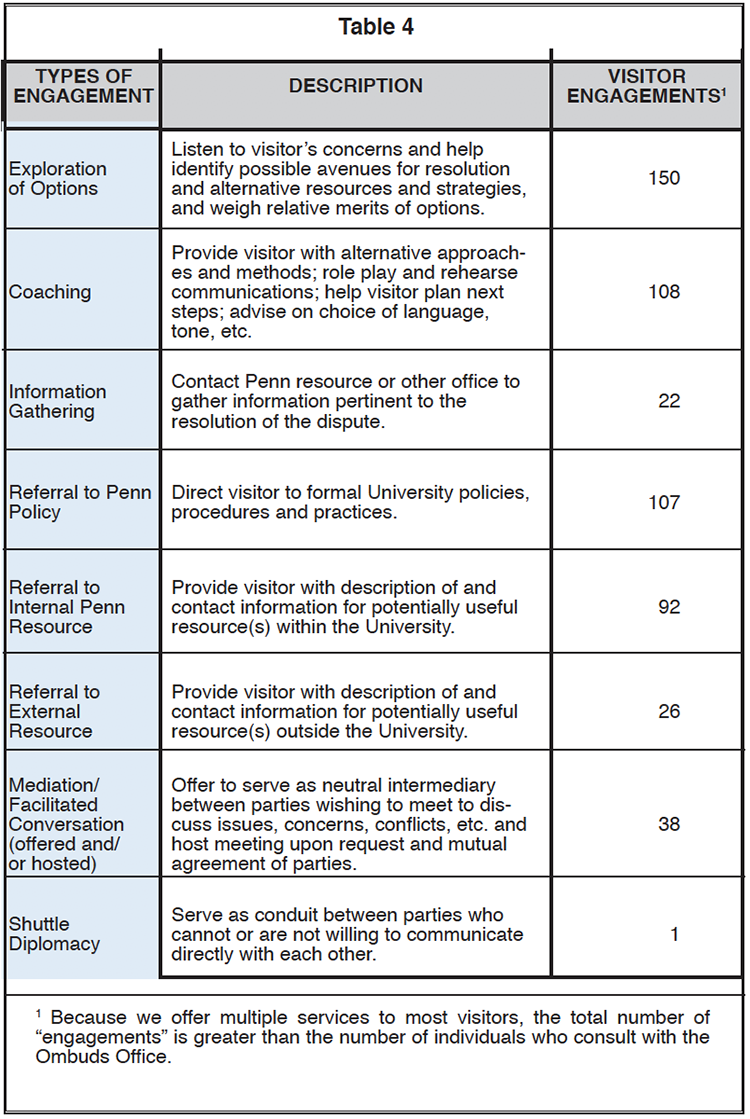
When individuals come to the Ombuds Office for help, we offer a range of services. See Table 4. The Ombuds’ first duty is to listen to visitors’ concerns and their frustrations. The Ombuds Office will work with visitors to explore options for dealing with whatever problems they have raised. Often they need more information, and we can refer them to appropriate University policies. Sometimes we gather data on visitors’ behalf. When they have clarified priorities and are willing to move forward, we often direct them to other resources on or off campus that might be of
help. The Ombuds Office does not advocate; we do often coach our visitors about how to handle appeals or approaches. We review written communications and role play possible dialogues. We can serve as neutral intermediaries between parties and can facilitate awkward discussions either through shuttle diplomacy or by hosting an expanded conversation and designing its ground rules. Associate Ombuds Marcia Martinez-Helfman is a trained mediator, and our office offers mediation services.
Our office is located in 113 Duhring Wing adjoining the Fisher Fine Art Library in the center of the Penn campus. We can be reached by phone at (215) 898-8261 or online. Please consult our website www.upenn.edu/ombuds/ for more information on our office and its activities. We respond to inquiries quickly, and we encourage anyone experiencing difficulties related to their work, academics or any other aspect of life as a member of the Penn community to set up an appointment with us. Visitors may speak with us without providing names or identifying information if they so choose.
[1] Allegations of discrimination, sexual harassment and abusive/abrasive/inappropriate behaviors.
Consultative Committee for the Appointment of a Vice Provost for Faculty
Provost Wendell Pritchett announced the formation of a consultative committee to advise him on the appointment of a new vice provost for faculty. Anita Allen, who has served as vice provost for faculty since July 1, 2013, will conclude her current term on June 30, 2020.
“Anita Allen has been a transformative leader across multiple dimensions of our campus,” said Provost Pritchett. “She has been an invaluable partner in advancing both the eminence and the inclusion of our outstanding faculty. Under her leadership, faculty diversity has grown across all measures. She has helped to develop and implement such essential programs as individual School diversity plans, diversity search advisors and a robust series of new training programs for faculty and staff. Through these efforts, we have made dramatic strides in naming women and minorities to high administrative positions, appointing and retaining eminent senior faculty members, and building the pipeline of assistant professors in the standing faculty.
“She has paid equal attention to essential programs for faculty development. Working collaboratively with faculty members across the University, she has significantly expanded our Penn Fellows program for mid-career faculty while helping to launch the Provost’s Leadership Academy and such ambitious parallel programs as the Faculty Pathways Program for STEMM faculty and the Networks in the Humanities Program in the School of Arts and Sciences. We have also significantly increased support for faculty through such resources as Presidential Professorships, the Faculty Opportunity Fund and the Excellence Through Diversity Fund.
“At the same time, she has been a historic leader in advancing the arts at Penn, chairing the Provost’s Arts Advisory Council, launching our exciting new Sachs Program for Arts Innovation, and working closely with arts leaders across campus to lead them to new heights of success, cross-campus collaboration and creative integration with our educational programs.”
As the campus leader with broad oversight of faculty affairs across the University, the vice provost for faculty reports directly to the Provost and is a member of his senior leadership team for academic and strategic planning. The vice provost oversees faculty life and the academic personnel process at Penn, including faculty recruitment, retention, development and retirement; appointments, tenure and promotions; enhancement of faculty diversity and equity; and resolution of individual faculty issues, including grievances. The vice provost coordinates the Provost’s Staff Conference and works closely with the deans and chairs of Penn’s 12 Schools, as well as the Faculty Senate, Vice President for Human Resources, Ombuds Office, Affirmative Action Office, diversity search advisors and PASEF.
The committee invites nominations of and applications from currently tenured faculty members at Penn. The ideal candidate will have extensive knowledge of the University and its policies and practices, as well as experience addressing sensitive issues in an effective and principled manner. Candidates must be tactful and discreet in handling confidential information and work well with faculty, staff, deans and department chairs in negotiating difficult situations. Excellent written and oral communication skills, sound judgment and demonstrated administrative competence are all necessary.
Nominations and applications, including CVs, may be sent by November 15, 2019 to: Lynne Hunter, associate provost for administration, at: lynneh@upenn.edu
Members of the consultative committee are:
Risa Lavizzo-Mourey, Robert Wood Johnson Foundation Population Health and Health Equity Professor, Perelman School of Medicine, School of Nursing, Wharton School (Chair)
Eugenie Birch, Laurence C. Nussdorf Professor of Urban Research and Education, Weitzman School of Design
Zachary Ives, Adani President’s Distinguished Professor and Chair, Department of Computer and Information Science, School of Engineering and Applied Science
Kelly Jordan-Sciutto, Professor and Vice Chair, Department of Basic and Translational Sciences, School of Dental Medicine
Timothy Rommen, Davidson Kennedy Professor and Chair, Department of Music, School of Arts and Sciences
Women of Color Day 2020 Awards—Call for Nominations: November 1

To Members of the University and Surrounding Community:
The National Institute for Women of Color (NIWC) has proclaimed March 1 National Women of Color Day. Penn, UPHS, Penn Presbyterian Medical Center and Pennsylvania Hospital seek to increase awareness of the talents and achievements of women of color by recognizing them with the Women of Color Day Award.
The Women of Color Awards are given in recognition of individuals who have conscientiously endeavored to increase respect for women of color at Penn, University of Pennsylvania Health Systems, Penn Presbyterian Medical Center, Pennsylvania Hospitals and the Delaware Valley community. Annually, awards are given in up to five categories:
- Helen O. Dickens Award: must have demonstrated over 25 years of previously recognized service
- Joann Mitchell Outstanding Legacy Award
- Faculty/Staff, Graduate or Professional Student Award
- Undergraduate Student Award
- Community Member Award
Nominees must be affiliated with Penn, UPHS, Penn Presbyterian Medical Center or Pennsylvania Hospital and/or the local Philadelphia area and have demonstrated:
- Outstanding leadership
- Distinguished service
- Positive impact on the community
- Commitment to enhancing quality of life for and/or serving as a role model for women of color
Joann Mitchell Outstanding Legacy Award nominees must have worked with the Women of Color Executive Planning Committee or have proven support through donations, event involvement and action advocacy of the WOCAP mission.
Nominations must be submitted on or before November 1, 2019, to Isabel Sampson-Mapp at sammapp@pobox.upenn.edu
Applications are available online at http://www.upenn.edu/aarc/wocap/awards.html
Learn more about the 2020 WOCAP Day Awards Luncheon at http://www.upenn.edu/aarc/wocap/annual.html
—Women of Color Executive Planning Committee

-resized.jpg)

 The Robert Wood Johnson Foundation (RWJF) awarded a grant of $162,000 to Tom Baker and Allison Hoffman, both professors at Penn Law, in support of their work to organize the 2020 Health Insurance Exchange Conference, “Ten Years After the ACA: Imagining Health Insurance Futures.” With the Health Insurance Exchange Research Group of Penn’s Leonard Davis Institute, they will plan the Spring 2020 invitation-only conference, the seventh in an annual series of conferences that brings together researchers, state and federal public officials and private sector business leaders to discuss the possible futures of health insurance and the role of health insurance exchanges. Mr. Baker is an expert on insurance whose research explores insurance, risk and responsibility. Ms. Hoffman is an expert on health care law and policy whose work examines the purposes and effects of health insurance regulation.
 Angela Duckworth, the Christopher H. Browne Distinguished Professor of Psychology, and Marci Hamilton, the Robert A. Fox Leadership Program Professor of Practice, were recently selected as 2019 Daughters of Pennsylvania. They and the other 2019 honorees were recognized at a ceremony hosted by Pennsylvania Governor Tom Wolf and First Lady Frances Wolf.
  George Pappas, UPS Foundation Professor of Transportation and chair of the department of electrical and systems engineering at Penn Engineering, has been elected a Fellow of the International Federation of Automatic Control (IFAC). The IFAC is a scholarly society devoted to the theory and application of automatic control and systems engineering in diverse fields, including engineering, biological, social and economic systems.