News

Kathleen Hall Jamieson: National Academy of Sciences Public Welfare Medal

caption: Kathleen Hall JamiesonKathleen Hall Jamieson, Elizabeth Ware Packard Professor of Communication at Penn’s Annenberg School for Communication, the Walter and Leonore Director (and founder) of the University’s Annenberg Public Policy Center and program director of the Annenberg Retreat at Sunnylands, will be awarded the 2020 Public Welfare Medal from the National Academy of Sciences at its annual meeting in April. 

The National Academy of Sciences announced that it is honoring Dr. Jamieson, a scholar of political and science communication, as well as an American Academy of Political and Social Science (AAPSS) Fellow and former AAPSS president, for her “nonpartisan crusade to ensure the integrity of facts in public discourse and development of the science of scientific communication to promote public understanding of complex issues.” 

“In an age when misinformation, spin and confusion about whom to trust threatens our very democracy, Kathleen Hall Jamieson’s nonpartisan, evidence-based approach to science communication and political analysis is an invaluable national treasure,” Academy President Marcia McNutt said. “Her scholarship has been essential to elevating our public discourse and boosting the integrity of science communication. We are thrilled to present her with our highest honor.” 

“For decades, Kathleen Hall Jamieson’s groundbreaking work has shaped political and science communication,” said Penn President Amy Gutmann. “She has changed how we access and think about facts, what it means to have meaningful discourse and how this affects all manner of politics, from local elections to presidential campaigns. In today’s political climate, this work couldn’t be more crucial, and we’re proud it’s happening at Penn.” 

Dr. Jamieson is also the co-founder of FactCheck.org and its subsidiary site, SciCheck. “Throughout her long and exemplary career, Kathleen Hall Jamieson has worked tirelessly to bring science, evidence and facts to the forefront of our public and political spheres,” said Susan Wessler, home secretary of the National Academy of Sciences and chair of the selection committee for the award. “Her work is strengthening the foundation of an important cornerstone of our democracy—an informed citizenry that is better able to discern fact from fiction.” 

The Public Welfare Medal, established in 1914, is the Academy’s most prestigious award and is presented annually “to honor extraordinary use of science for the public good.” Past recipients include Paul Farmer, Neil deGrasse Tyson, Alan Alda, Bill and Melinda Gates, Jane Lubchenco, Ismail Serageldin, C. Everett Koop, Carl Sagan, Maxine F. Singer, Eugenie C. Scott and Norman Borlaug. 

David Meaney: Senior Associate Dean SEAS

caption: David F. MeaneyDavid F. Meaney, Solomon R. Pollack Professor of Bioengineering, has been named the senior associate dean of Penn Engineering, effective January 1, 2020. This newly created leadership position has oversight responsibilities in budget, space and infrastructure planning; facilities and research services; and creates and cultivates new interschool partnerships to expand Penn Engineering’s footprint on campus. 

Dr. Meaney is well known not only for his scholarship and innovation in neuroengineering and concussion science, but also for his leadership during his tenure as chair of the department of bioengineering. 

“Dave’s strong connections to the health schools will help strengthen Penn Engineering’s initiatives throughout campus,” said Vijay Kumar, Nemirovsky Family Dean of Penn Engineering. “He will have oversight of Penn Health-Tech, the Center for Engineering MechanoBiology and other efforts between engineering and the health schools, and Dave brings his unique creativity, energy and leadership experience to these collaborative efforts.” 

Dr. Meaney has earned numerous honors and awards, including a National Science Foundation CAREER Award, the American Society of Mechanical Engineering’s YC Fung Young Investigator Award and the Trustees’ Council of Penn Women Provost’s Award. He also is a member of several editorial boards, and he served as program co-chair for the Biomedical Engineering Society’s annual meeting in 2004 and as its neuroengineering track co-chair in 2012. In addition, he serves as a departmental advisory board member for several biomedical engineering departments across the country and is an elected fellow of the American Institute for Medical and Biological Engineering and the Biomedical Engineering Society. 

Dr. Meaney’s research interests are focused on understanding the mechanisms and treatment of concussions. Over the course of his career, his group has contributed experimental data toward the revision of federal motor vehicle safety standards for head protection. His group was the first to identify mechanical “force sensors” in neurons that lead to the rewiring of brain circuits after concussive brain injury. In addition, his group completed some of the earliest studies to detect brain injury after concussion using clinical imaging tools. 

Dr. Meaney’s group is developing new blood-based biomarkers for diagnosing concussions and monitoring brain recovery after a concussion to develop treatments to enhance repair after traumatic brain injury. 

Benjamin Nathans: Alan Kors Term Associate Professor of History

caption: Benjamin Nathans Benjamin Nathans, associate professor of history, has been named Alan Charles Kors Term Associate Professor of History. Dr. Nathans specializes in imperial Russia and the Soviet Union, modern European Jewish history and the history of human rights. His book, Beyond the Pale: The Jewish Encounter With Late Imperial Russia, won the Koret Jewish Book Award; the Vucinich Prize in Russian, Eurasian and East European Studies; the Lincoln Prize in Russian History; and was a finalist for the National Jewish Book Award in History. The recipient of fellowships from the National Endowment for the Humanities, the John Simon Guggenheim Foundation and the Andrew W. Mellon Foundation, Dr. Nathans is currently on leave, having served as a fellow of the Shelby Cullom Davis Center at Princeton University in the fall and currently serving as senior fellow of the Freiburg Institute for Advanced Studies in Germany. He is working on a book, To the Success of Our Hopeless Cause: A History of the Soviet Dissident Movement, as well as a translation from Russian of Simon Dubnov’s memoir The Book of Life

The Alan Charles Kors Endowed Term Professorship was established by George H. Walker (C’91, W’91, WG’92) to recognize Dr. Kors, the Henry Charles Lea Professor Emeritus of History. Mr. Walker, who was a student of Dr. Kors, is the chairman and CEO of Neuberger Berman. He is also a former member of the Penn Arts & Sciences’ Board of Overseers. 

University Notification: Update on Penn’s Responses to Climate Change

We write to update the University community on Penn’s wide-ranging efforts to respond to climate change. While our recently released Climate & Sustainability Action Plan 3.0 describes the full scope and magnitude of Penn’s efforts, we are pleased to provide an update into ongoing actions and new initiatives from across the University—all designed to make Penn a leader in the university community on climate change issues. 

—Amy Gutmann, President 

—Wendell Pritchett, Provost 

—Craig R. Carnaroli, Executive Vice President 

University Notification: 

Update on Penn’s Responses to Climate Change 

Investment Status Update: In 2016, Penn’s Trustees called for the “thoughtful incorporation of climate change into investment decision making,” requesting that the Office of Investments consider the long-term investment risks associated with climate change when evaluating investments. The Trustees also encouraged the Office to evaluate investment opportunities that address causes or symptoms of climate change. The Office’s consideration of these factors is having an ongoing impact on multiple areas of Penn’s portfolio and investment process. 

  • When evaluating energy-related investments, Penn incorporates scenarios that assume the world achieves emissions levels consistent with the goals of the Paris Climate Accord. Including such scenarios highlights the advantages of cleaner energy and the elevated risks facing carbon intensive businesses. Factoring the implications of a de-carbonizing economy into investment decisions will materially limit the scope of fossil fuel-related investments in the portfolio. Notably, Penn does not hold, and would not expect to hold going forward, any direct investments in companies focused on the production of thermal coal or bituminous (tar) sands, a reflection of the significant carbon intensity—and the corresponding risks—of such businesses. 
  • Penn is extending climate-related risk analyses to the evaluation of investments beyond the fossil fuel industry. Climate change already presents dramatic new physical and economic risks for businesses, and a de-carbonizing economy will reshape cost structures, business models and competitive positioning for many companies. 
  • Penn’s venture capital portfolio has numerous companies focused on climate change solutions. Penn now has early stage investments in companies ranging from developers of high capacity batteries and carbon capture technology to firms seeking to reduce agriculture’s environmental impact. Through these investments Penn and its venture capital partners hope to catalyze the new technologies and business models that will likely be necessary to solve the world’s climate crisis. 

Renewable Power Purchase Update: Penn’s Climate & Sustainability Action Plan 3.0 calls for the University to enter into a Power Purchase Agreement (PPA) to buy green electricity for Penn’s campus. We are currently negotiating a long-term PPA that will support the development of two new solar energy facilities in the Commonwealth of Pennsylvania. By supporting the development of these solar projects, Penn will avoid emitting 166,000 tons of carbon annually. We forecast that by 2023 the PPA can reduce the University’s carbon emission by 45% from our 2010 levels, which would meet the goal of the Paris Climate Accord seven years early. 

Air Travel Offsets: University-sponsored air travel by students, faculty and staff generates approximately 64,000 tons of carbon annually, accounting for 20% of Penn’s carbon emissions and making it the second largest source of carbon emissions at Penn (after energy consumption). We are pleased to report that Penn Purchasing— in consultation with experts from the Weitzman School of Design, the School of Engineering & Applied Science and Facilities & Real Estate Services—is developing a program through which Penn will purchase carbon offsets to help neutralize emissions from Penn’s air travel. We anticipate launching the program later this year. 

Environmental Innovations Initiative: The new Environmental Innovations Initiative (Almanac December 10, 2019)—co-led by faculty members Joseph S. Francisco, President’s Distinguished Professor of Earth and Environmental Sciences, and Kathleen D. Morrison, Sally and Alvin V. Shoemaker Professor and chair of anthropology—maximizes Penn’s distinctive interdisciplinary strengths to foster collaboration among scholars and students for developing new innovative solutions for global environment management. 

Solving the challenges of global warming will require the combined forces of scientific innovation, political will and behavioral change. While the unwillingness of many governments to combat climate change creates fear and frustration, it can also motivate us all to greater effort and action. We value and appreciate the Penn community’s continued support for our collective sustainability ambitions, and we look forward to updating you in the future on our progress. 

An Update on Penn’s Response to the Novel Coronavirus Outbreak

To the Penn Community: 

We are writing with an update on Penn’s response to the novel coronavirus outbreak that originated in Wuhan, China. We are working closely with partners across campus, Penn Medicine and the City of Philadelphia to monitor this evolving situation. There are currently no cases of the virus at Penn or in Philadelphia, and health officials continue to stress that the risk of infection remains low. 

Campus Health has prepared a comprehensive FAQ (https://tinyurl.com/coronavirusfaq) to address questions from the campus community about novel coronavirus. We encourage you to read these FAQs and follow up with your healthcare provider if you have any questions. 

Consistent with any influenza/flu outbreak, we must be prepared for the possibility that cases may be reported in Philadelphia. Therefore, it is important to continue to take steps to reduce disease transmission, including: frequent handwashing, covering of coughs and sneezes using a tissue or sleeve (not your hands) and staying home if you feel unwell. 

Penn Medicine is in regular contact with the US Centers for Disease Control and Prevention (CDC), the Pennsylvania Department of Health and local health officials. It is following all CDC infection control recommendations to ensure the safety of all patients and staff, as well as to implement appropriate precautions for any patients who may arrive at Penn Medicine facilities meeting the CDC screening criteria for the virus. 

With regard to travel to and from China, the University is recommending the following: 

Penn Travelers to China 

  • Penn currently recommends rescheduling, delaying or canceling all planned University travel to China between now and the end of the term (May 12, 2020). This includes academic programs, extracurricular programs, executive education programs and all other Penn-affiliated travel. 
  • Consistent with the recommendations of both the CDC and the US Department of State, Penn is advising students, staff and faculty to delay all personal travel to China for the time being unless it is absolutely necessary. 
  • Penn will be monitoring developments in China and will make decisions about summer travel at a later date. 

Travel from China to Penn 

  • All travelers arriving from China are being thoroughly screened for symptoms of novel coronavirus at the port of entry. If they are not showing signs of illness, they are deemed eligible to enter the United States and can carry out all normal daily activities. 
  • Schools, centers and departments should be aware of inbound visiting scholars or visitors from China to provide them with information about what to do if they become unwell while at Penn. 
  • If CDC guidance regarding travelers from China should change, Penn will implement this guidance accordingly. 
  • Please note, any traveler from China who has been in the United States for more than 14 days without symptoms is considered to have passed the incubation period for this novel coronavirus. 

Current Penn Travelers/Staff in China 

  • Penn staff, faculty and students currently in China should immediately register their travel in MyTrips and be in contact with their home School or department. Penn is not mandating withdrawal at this time but is available to answer questions and provide assistance if possible. Please contact Global Support Services if you have questions related to current Penn travelers in China. 
  • The Penn Wharton China Center in Beijing will operate in accordance with Chinese government recommendations for business opening and closing. 

We recognize that this situation may cause concern or anxiety, in particular for those whose families and loved ones in China or elsewhere are directly impacted. We remain committed to providing support and guidance to the Penn community as this situation develops. Student Health and Campus Health are updating their websites regularly, as is Penn Global, and we encourage you to go to any of those sources for updated information as this situation develops. 

—Wendell E. Pritchett, Provost 

—Craig R. Carnaroli, Executive Vice President 

—Ezekiel J. Emanuel, Vice Provost for Global Initiatives 

—Benoit Dubé, Associate Provost and Chief Wellness Officer 

Walter Licht: Stepping Down as Faculty Director of Civic House and the Civic Scholars Program

Provost Wendell Pritchett recently announced that Walter Licht, Walter H. Annenberg Professor of History, will step down as faculty director of Civic House and the Civic Scholars Program at the end of this academic year. 

“Walter Licht is one of Penn’s most extraordinary citizens,” said Provost Pritchett. “He has been a leader in our community for more than 40 years—a renowned labor historian, a legendary administrator, a mentor to generations of students and the guiding light of our commitment to civic engagement. I am delighted that he will continue to be an invaluable colleague even as he steps back from his pioneering work at Civic House.” 

Dr. Licht began teaching at Penn in 1977, was appointed the second faculty director of Civic House in 2002 and launched the Civic Scholars program in 2006. His influential books in labor and economic history include Working for The Railroad: The Organization of Work in the Nineteenth Century (Princeton University Press, 1983); Getting Work: Philadelphia, 1840-1950 (Harvard University Press, 1992); Industrializing America: The Nineteenth Century (Johns Hopkins University Press, 1995); and the co-authored The Face of Decline: The Pennsylvania Anthracite Region in the Twentieth Century (Cornell University Press, 2005). At Penn, he was associate dean of the School of Arts & Sciences for ten years, served as chair of the department of history, led the University’s two-year review of graduate education programs for reaccreditation and received the Ira Abrams Memorial Award for Distinguished Teaching, the highest teaching honor awarded by the SAS. Dr. Licht is a long-time resident of West Philadelphia, active in community affairs and public history projects. 

Search for Faculty Director 

Civic House is Penn’s hub for civic engagement, promoting mutually beneficial collaborations between Penn and Philadelphia community nonprofit organizations. Through social justice education, trainings and workshops, Civic House prepares students for responsible community engagement and empowers them to become advocates for social change. The Civic Scholars Program at Civic House provides undergraduate students with a sustained four-year experience in civic engagement and scholarship, including dedicated proseminars, summer internships and a capstone senior research project. 

Provost Pritchett invites nominations and expressions of interest from standing faculty members to be the next faculty director of Civic House and the Civic Scholars Program. Inquiries and nominations can be sent to Associate Provost Lynne Hunter at lynneh@upenn.edu by March 5, 2020. 

TCPW Grants: February 14

The Trustees’ Council of Penn Women (TCPW) is accepting applications for its Annual Grants Program and encourages members of the University community to apply. 

Grants ranging between $1,000 and $4,000 will be available to individuals or organizations promoting: 

  • women’s issues 
  • the quality of undergraduate and graduate life for women 
  • the advancement of women 
  • the physical, emotional and psychological well-being of women 

Favorable consideration will be given to projects that: 

  • affect a broad segment of the University population 
  • foster a greater awareness of women’s issues 
  • provide seed money for pilot programs that have the potential to become ongoing self-supporting programs 

To apply, visit the TCPW website at www.alumni.upenn.edu/tcpw and download the application from the Grants page. Applications must be submitted no later than February 14, 2020. Awards will be announced in the Spring of 2020 and funds will be distributed in July/August 2020 for projects in the 2020-2021 academic year. For more information, contact Terri Welsh at welsh@upenn.edu 

Deaths

Arthur DuBois, Medicine

caption: Arthur DuBoisArthur Brooks DuBois, former professor of physiology and medicine at Penn, died in New Haven, Connecticut, on December 24. He was 96. 

Born in New York City, Dr. DuBois attended Milton Academy, Harvard College and then Cornell University Medical School, receiving his MD in 1946. He interned at New York Hospital, where his father had retired in 1941 as chief of medicine. He served in the United States Navy from 1947 to 1949 at St. Albans Naval Hospital in Brooklyn and the US Naval Academy at Annapolis, Maryland. After earning a fellowship in physiology at University of Rochester, Dr. DuBois served as senior assistant resident in Medicine at Peter Bent Brigham Hospital in Boston. 

Dr. DuBois moved to Philadelphia and began his two decades-plus career at University of Pennsylvania in the early 1950s, becoming assistant professor of physiology, then associate professor and then associate professor of medicine before becoming a full professor of physiology and professor of medicine. 

While at Penn, Dr. DuBois developed the body plethysmograph, “a highly sophisticated device [that] measures exactly the resistance to breathing in the body’s airways and the volume of air in the chest cavity. It is so sensitive [that] it can readily detect the effects on the airways of smoking a single cigarette.” In 1969, it was used by the University Hospital’s then-new pulmonary research laboratories to study the effects of air pollution on asthma sufferers; to test the effects of drugs in the treatment of asthma and bronchitis; and to establish effects of surgery on emphysema (Almanac January 1969). 

Dr. DuBois left Penn and moved to New Haven, Connecticut, in 1974 to direct the John B. Pierce Foundation, a position he held until 1988. He also maintained lifelong associations with the Marine Biological Laboratory and the Woods Hole Oceanographic Institution. Dr. DuBois co-authored several editions of The Lung, between 1955 and 1986, and Body Plethysmography

Dr. Dubois was briefly survived by his wife, Roberdeau C. (Robin), though she died just three days later; children, Anne, Brooks (Mary Salerno), and James; grandchildren, Laura, Brooks Michael and Marian; and many nieces and nephews and their children. 

---

To Report A Death

Almanac appreciates being informed of the deaths of current and former faculty and staff members, students and other members of the University community. Call (215) 898-5274 or email almanac@upenn.edu

However, notices of alumni deaths should be directed to the Alumni Records Office at Suite 300, 2929 Walnut St., (215) 898-8136 or email record@ben.dev.upenn.edu

Governance

From the Senate Office: SEC Agenda

The following agenda is published in accordance with the Faculty Senate Rules. Any member of the standing faculty may attend SEC meetings and observe. Questions may be directed to Patrick Walsh, executive assistant to the Senate Office, either by telephone at (215) 898-6943 or by email at senate@pobox.upenn.edu

Faculty Senate Executive Committee Agenda 

Wednesday, February 12, 2020 

3-5 p.m. 

Meyerson Conference Room (2nd floor), Van Pelt Library 

  1. Approval of the Minutes of January 22, 2020 
  2. Chair’s Report 
  3. Past-Chair’s Report 
  4. Update from the Office of the Provost (Discussion with Provost Wendell Pritchett)
  5. Moderated Discussion 
  6. New Business 

Policies

Of Record: Patent and Tangible Research Property Policies and Procedures

The University periodically revises and updates its policies and procedures regarding patent and tangible research property to ensure that such policies and procedures keep pace with best practices and national trends. The most recent revisions decrease the initial deduction from revenue distribution— increasing the revenue distributed to inventors, schools and the University—and decrease the lower limit of future initial deductions. No other revisions were made to the most recent Patent and Tangible Research Property Policies and Procedures published in Almanac on July 12, 2016. These revisions were recommended by the Executive Committee of the Penn Center for Innovation and reviewed by the Office of General Counsel, the Faculty Senate Executive Committee and the Faculty Senate Committee on Faculty and the Administration. The reduced initial deduction takes effect for FY2020. 

See the latest version of the revised Patent and Tangible Research Property Policies and Procedures at https://almanac.upenn.edu/uploads/media/Patent_Policy_Supplement.pdf

—Wendell Pritchett, Provost 

—Dawn Bonnell, Vice Provost for Research

Of Record: Change to Protecting Minors on Campus Policy

Penn successfully launched the Protecting Minors on Campus Policy in February 2019. Due to recent amendments in Commonwealth legislation regarding contact with children, Penn has updated this policy. 

Effective January 1, 2020, all University faculty, staff, postdoctoral trainees, students and volunteers having direct contact with children in connection with University activities are required to complete a three-part background check prior to employment. Employees must complete all of the following before having contact with children: 

  • Pennsylvania State Police Search (PATCH, Pennsylvania Access to Criminal History) 
  • Pennsylvania Child Abuse History Clearance 
  • FBI Criminal History Record 

In previous years, Pennsylvania allowed individuals to be employed on a provisional basis provided they had completed the two state-required clearances (PATCH and PA Child Abuse), and offered receipt of their FBI Criminal History Background Check. As a result of ACT 47 of 2019, this provisional period is no longer permitted. 

This policy update eliminates the ability for the University to hire employees on a provisional basis. This also ensures that those who have contact with children meet state and federal requirements, and enhances the safety of environments where children are served. 

You can review the updated Protecting Minors on Campus Policy at https://www.hr.upenn.edu/policies-and-procedures/policy-manual/recruitment-and-staffing/protecting-minors-on-campus-policy

If you have any questions about the policy, please call the Penn Employee Solution Center at (215) 898-7372, or email hcmsolutioncenter@upenn.edu

—Division of Human Resources 

Honors

AISP: Gates Foundation Grant

Actionable Intelligence for Social Policy (AISP) of Penn’s School of Social Policy and Practice has been awarded a grant for $448,251 over a 14-month project period from the Bill & Melinda Gates Foundation to advance the field of integrated data systems in 2020. 

Specifically, AISP’s efforts will focus on creating frameworks and tools to help stakeholders better categorize, assess and communicate data sharing approaches, motivations and impacts. These tools will be used to inform future foundation investments, advance AISP’s field-building strategy and increase the use of data in support of economic mobility. 

Dennis P. Culhane, SP2 professor and the Dana and Andrew Stone Chair in Social Policy, and John W. Fantuzzo, the Albert M. Greenfield Professor of Human Relations at the Graduate School of Education, are co-principal investigators for AISP. 

Danielle Bassett: Science Favorite Photos

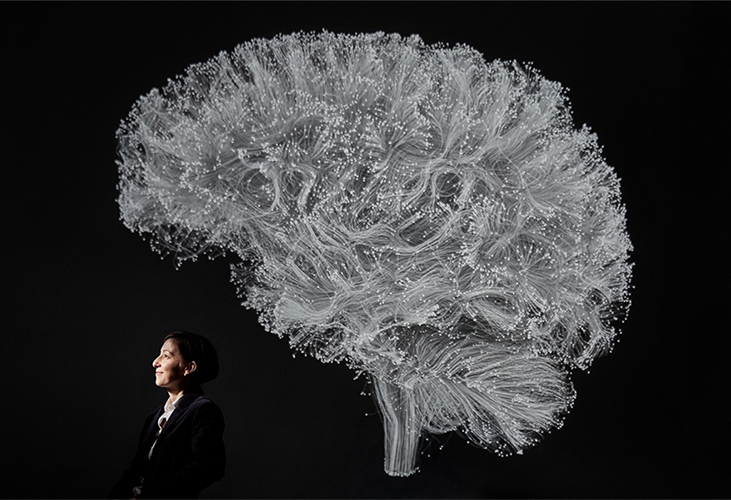
One of Science’s favorite photos of 2019 was taken in Penn Engineering’s Raisler Lounge. 

There, Danielle Bassett, Peter Skirkanich Professor of Bioengineering, poses underneath a giant visualization of the brain’s structural connections, projected on the wall behind her. Dr. Bassett’s research combines elements of physics, mathematics, engineering and neuroscience to provide a new look at how brain function arises from these networks of neurons. The image was made from MRI data. 

caption: Danielle Bassett with visualization of the brain's structural connections.

Jason Burdick: NAI Fellow

caption: Jason BurdickJason Burdick, Robert D. Bent Professor in the department of bioengineering, has been named a fellow of the National Academy of Inventors (NAI), an award of high professional distinction accorded to academic inventors. Elected fellows have demonstrated a prolific spirit of innovation in creating or facilitating outstanding inventions that have made a tangible impact on quality of life, economic development and the welfare of society. 

Dr. Burdick’s research interests include developing degradable polymeric biomaterials that can be used for tissue engineering, drug delivery, and fundamental polymer studies. His lab focuses on developing polymeric materials for biomedical applications with specific emphasis on tissue regeneration and drug delivery. Dr. Burdick believes that advances in synthetic chemistry and materials processing could be the answer to organ and tissue shortages in medicine. The specific targets of his research include: scaffolding for cartilage regeneration, controlling stem cell differentiation through material signals, electrospinning and 3D printing for scaffold fabrication and injectable hydrogels for therapies after a heart attack. 

Dr. Burdick is a member of the Laboratory for Research on the Structure of Matter (LRSM) and the Center for Engineering Cells and Regeneration, and he is the recipient of the 2017- 2018 George H. Heilmeier Faculty Award for Excellence in Research. 

The academic inventors and innovators elected to the rank of NAI Fellow are named inventors on US patents and were nominated by their peers. Along with 168 other newly elected Fellows, Dr. Burdick will be inducted on April 10, 2020, at the National Annual Meeting in Phoenix, Arizona. 

Ram Cnaan: Best Reviewer Recognition

caption: Ram CnaanRam Cnaan, director of SP2’s Program for Religion and Social Policy Research, was recently chosen as Best Reviewer for his work with the Journal of Social Work Education (JSWE). Criteria for choosing the Best Reviewer included exceptional service in responsiveness to requests for review, timeliness in submitting completed reviews and quality of written reviews. Dr. Cnaan received the award at the Council on Social Work Education 2019 Annual Program Meeting in Denver, Colorado. 

Dr. Cnaan has published numerous articles in scientific journals related to faith-based organizations, volunteerism, criminal justice, social policy and more. He serves on editorial boards for a number of academic journals and he is the author or editor of several academic books. 

Amy Gutmann: Zemsky Medal

caption: Amy GutmannAt the 2020 Zemsky Medal Gala and Awards Dinner at the Annenberg Center for the Performing Arts on January 16, this year’s Medal recipient was Penn President Amy Gutmann. The Zemsky Medal is earned by the “who’s who of outstanding and innovative leaders in higher education,” according to Penn GSE Dean Pam Grossman. “Under [President Gutmann’s] leadership, Penn has moved from excellence to eminence,” Dr. Grossman said. The gala concluded this year’s Higher Education Leadership Conference at Penn, which featured panels run by executive doctorate in higher education management alumni, keynote speakers and faculty presentations. 

Penn Dental Medicine: Apple Distinguished School

This past fall, Penn Dental Medicine became one of only a handful of higher education institutions worldwide to be selected as an Apple Distinguished School for 2019-2022. Apple Distinguished Schools are centers of innovation, leadership and educational excellence that use Apple products to inspire creativity, collaboration and critical thinking. They showcase innovative uses of technology in learning, teaching and the school environment and have documented results of academic accomplishment. 

“The Apple Distinguished School designation honors our long-term commitment to using innovation and technology to enhance teaching and learning,” said Penn Dental Medicine’s Dean Mark Wolff. 

In 2015, Penn Dental Medicine rolled out its one-to-one iPad initiative, which provides each first-year student with an iPad, along with the digital learning content and comprehensive support to use it as an educational tool. The first week of school, incoming students receive “learner-ready” iPads with the relevant applications and settings pre-installed. Additionally, to date, 76 AppleBooks, or digital textbooks, have been developed with the support of the School’s Learning Technology Team (LTT), becoming primary classroom resources. 

This digital technology is transforming the learning process at Penn Dental Medicine as the passive lecture hall model is being replaced by “blended learning” and “flipped-classroom” models, which supplement traditional content with online resources and small group discussion. In addition, many exams and quizzes are now done on the iPads, using ExamSoft software. 

Weitzman Faculty, Lauder College House, Richards Labs: AIA Annual Awards

At the AIA Philadelphia Annual Awards on December 5, which marked the culmination of AIA Philadelphia’s 150th anniversary year, several faculty members of the Weitzman School of Design were honored. 

Among the Philadelphia-area firms honored for excellence in design for 2019 were: Erdy McHenry Architecture, where architecture lecturer Scott Erdy is a principal; ISA, where architecture lecturer Brian Phillips (MArch’96) is a principal; Bohlin Cywinski Jackson, where David Murray (MArch’89) is a principal and Patreese Martin (MArch’84) is an associate principal, for two projects, including Penn’s Lauder College House; and PORT Urbanism, led by associate professor of landscape architecture Chris Marcinkoski

The Richards Medical Research Laboratories on Penn’s campus, designed by legendary faculty member Louis I. Kahn (Almanac October 17, 2017), received a Merit Award in the Historic Preservation/Adaptive Reuse Built Category. 

Features

2019 Form W-2

Your 2019 Form W-2 is available in Workday. To access your W-2 in Workday, click on the “Pay” icon under Applications on your home page, then in the Pay box on the right-hand side of the screen click on “Tax Documents”. For more information, refer to the Self Service: Access Tax Withholding Forms tip sheet under the Training heading on the Workday@Penn site.

If you upload your tax information into tax preparation software, you will need the Control Number in Box d that appears on the ADP version of the W-2 that was mailed to you (if you did not opt to go paperless) or that you can access via the “My Tax Info” link on the U@Penn portal.

Please note that if you did not opt out of receiving a paper copy of the form, your W-2 Forms were mailed to you based on your designated address in Workday. For additional information on which address is used to mail your W-2 and how to update your address information in Workday, refer to the Self Service: Modify Your Personal Information tip sheet under the Training heading on the Workday@Penn site. For information on how to opt out of receiving a paper W-2 refer to the Self Service: Access Tax Withholding Forms tip sheet under the Training heading on the Workday@Penn site.

Forms W-2 for tax years 2019, 2018 and 2017 are accessible under “My Tax Info” on the U@Penn website. For Forms W-2 for tax years 2006 through 2016, contact the Penn Employee Solution Center at hcmsolutioncenter@upenn.edu

Also see FAQs article.

An explanation of the contents of the various boxes on the W-2 Form is as follows:

Box a: Employee’s social security number. This is your Social Security Number. It should match the number on your social security card. If the number is incorrect, please provide your Social Security card to the Payroll Department. The Payroll Department will update and issue a corrected W-2 Form.

Box b: Employer identification number (EIN). This is your employer’s identification number assigned by the IRS.

Box c: Employer’s name, address, and ZIP code. This identifies the name, address, city, state and zip code of your employer. 

Box d: Control number. This is a code that identifies this unique W-2 Form document in your employer’s records. It is an optional field and may be left blank. Note that this number is used to upload your tax information into tax preparation software. This number does not appear on the Workday version of the W-2 but is shown on the ADP version of the W-2. To access the ADP version of the W-2 (same the printed copy), use the “My Tax Info” link on the U@Penn website.

Box e: Employee’s name. This identifies your full name (first name, middle initial and last name). Your name must match the name on your social security card. If the name is incorrect, please provide a copy of the Social Security card to the Payroll Department. The Payroll Department will update and issue a corrected W-2 Form.

Box f: Employee’s address. This identifies your address, city, state, and zip code. 

Numbered Boxes on W-2 Form:

Box 1: Wages, tips, other compensation. Box 1 reports your total taxable wages or salary for federal income tax purposes. This figure includes your wages, salary, tips reported, bonuses and other taxable compensation. Any taxable fringe benefits (such as group term life insurance) are also included in your Box 1 wages. Box 1 does not include any pre-tax benefits such as savings contributions to a 401(k) plan, 403(b) plan, health insurance or other types of pre-tax benefits.

Box 2: Federal income tax withheld. Box 2 reports the total amount withheld from your paychecks for federal income taxes. This represents the amount of federal taxes you have paid-in throughout the year.

Box 3: Social security wages. Box 3 reports the total amount of wages subject to the Social Security tax for 2019. The Social Security tax is assessed on wages up to $132,900 (for 2019). This limit is called the Social Security wage base.

Box 4: Social security tax withheld. Box 4 reports the total amount of Social Security taxes withheld from your paychecks. The Social Security tax is a flat tax rate of 6.2% on your wage income, up to a maximum wage base of $132,900 (for 2019). Wages above the Social Security wage base are not subject to the Social Security tax. Accordingly, the maximum figure shown in Box 4 should be $8,239.80 ($132,900 maximum wage base times 6.2%). 

If you have two or more jobs during the year and your total Social Security wages (Box 3) exceeds $132,900, you may have paid-in more Social Security tax than is required. You claim the excess Social Security tax withholding as a refundable credit on your Form 1040.

Box 5: Medicare wages and tips. Box 5 reports the amount of wages subject to the Medicare tax. There is no maximum wage base for Medicare taxes.

Box 6: Medicare tax withheld. Box 6 reports the amount of taxes withheld from your paychecks for the Medicare tax. The Medicare tax is a flat tax rate of 1.45% on your total Medicare wage under $200,000. Employees whose Medicare wages are over $200,000 will be subject to an additional withholding for the additional Medicare Tax at a rate of 0.9% on Medicare wages over the $200,000. This is a rate of 2.35% on all Medicare wages over $200,000.

Box 10: Dependent Care benefits. Shows the total dependent care benefits under a dependent care assistance program paid or incurred by the employer for the employee and amounts paid or incurred for dependent care assistance in a section 125 (cafeteria) plan. It may include the amounts paid directly to a daycare facility by the employer or reimbursed to the employee to subsidize the benefits, or benefits from the pre-tax contributions made by the employee under a section 125 dependent care flexible spending account. Any amounts over $5,000 are also included in boxes 1, 3 and 5. 

Box 12: Deferred Compensation and Other Compensations. There are several types of compensation and benefits that can be reported in Box 12. Box 12 will report a single letter or double letter code followed by a dollar amount. A complete list of the codes can be found on the box instructions on the W-2 Form. These are the most common codes found on Penn’s W-2 Form.

Code C: Taxable cost of group term-life insurance over $50,000. This amount is included as part of your taxable wages in Boxes 1, 3 and 5.

Code E: Non-taxable elective salary deferrals to a 403(b) retirement plan.

Code G: Non-taxable elective salary deferrals and employer contributions (including non-elective deferrals) to a Section 457(b) retirement plan.

Code M: Uncollected Social Security tax on taxable group term life insurance over $50,000.

Code N: Uncollected Medicare tax on taxable group-term life insurance over $50,000.

Code P: Excludable moving expense reimbursements paid directly to a member of the armed forces (not included in Box 1, 3 or 5).

Code T: Employer paid adoption benefits. This amount is not included in Box 1 wages. Use form 8839 to compute any taxable and nontaxable amounts.

Code W: Employer and employee contributions to a Health Savings Account. 

Code Y: Salary deferrals under a Section 409A non-qualified deferred compensation plan. 

Code Z: Income received under 409A non-qualified deferred compensation plan. This amount is included in taxable wages in Box 1. This amount is subject to an additional tax reported on the employee’s Form 1040.

Code BB: After-tax contributions to a Roth 403(b) retirement plan. 

Code DD: Reports the cost of your health coverage. Code DD amounts are for informational purposes only—they don’t affect the numbers in your tax return.

Box 13: Checkboxes. There are three check boxes in Box 13. The only box that may be checked off that applies to you as an employee of the University is the Retirement Plan.

Retirement plan means that you participated in your employer’s retirement plan. 

If the “Retirement plan” box is checked, special limits may apply to the amount of traditional IRA contributions you may deduct. See Pub. 590, Individual Retirement Arrangements (IRAs).

Box 14: Other Tax Information. Your employer may report additional tax information in Box 14. If any amounts are reported, they will have a brief description of what the amounts are for. For example, SUT represents the amount of State Unemployment Tax which was withheld from your earnings during the year.

Box 15: State and State Employer’s Identification. Box 15 reports the state and your employer’s state tax identification number.

Box 16: State wages. Box 16 reports the total amount of taxable wages earned in that state. You may have multiple state W-2 forms if you worked in other states during the year.

Box 17: State income tax withheld. Box 17 reports the total amount of state income taxes withheld from your paychecks for the wages reported in Box 16.

Box 18: Local wages. Box 18 reports the total amount of wages subject to local income taxes. You may also have multiple local W-2 forms if you worked in more than one locality during the year.

Box 19: Local income tax withheld. Box 19 reports the total amount of taxes withheld from your paychecks for local income taxes.

Box 20: Locality name. Box 20 provides the name of the locality where the tax is being paid.

—Victor Adams, Director, Payroll Office

2020 Payroll Tax Updates

Federal Taxes: The federal withholding tax tables for 2020 can be found in the IRS Publication 15 at: http://www.irs.gov/pub/irs-pdf/p15.pdf

Social Security Wage Rate: The 2020 Social Security wage base is $137,700.

Social Security Tax Rate: The 2020 tax rate remains at 6.2% and the maximum tax that an employee would pay will be $8,537.40.

Medicare Tax Rate: The Medicare tax rate remains at 1.45% in 2020 for wages under $200,000. Wages in excess of $200,000 are taxed at 2.35%.

PA State Unemployment Insurance Employee Rate: The tax rate remains at 0.06% for 2020.

PA State: The tax rate for 2020 remains at 3.07%.

Philadelphia City: As of July 1, 2019, the Resident Rate is 3.8712% and Non-Resident Rate is 3.4481% and remains the same for the beginning of 2020.

2019 W-2 Frequently Asked Questions

Why did I receive a mailed copy of my W-2? 

Workday defaults to automatically send employees both a paper and digital copy of their W-2. If you did not opt to go paperless in Workday, a paper version was mailed to you by our tax vendor, ADP. 

We recommend that you opt to go paperless in the future, which you can do by clicking on the Pay icon in Workday, selecting Tax Documents, and then Printing Election (found in the upper right section of the page). For more detailed instructions, please refer to the Self Service: Access Tax Withholding Forms tip sheet. All Workday tip sheets can be found under the Training heading on the Workday@Penn site. 

Why did I receive multiple mailed copies of my W-2? 

If you live outside of Philadelphia and you did not opt to go paperless, ADP mailed each page of your W-2 separately. Each page is labeled with a page number (1 of X, 2 of X, etc.). You will need all pages to complete your tax return. 

Is the version of my W-2 in Workday different from the version of the W-2 I received in the mail? 

The only differences are in presentation—both versions accurately report your tax information and can be used for filing your taxes. Depending on your residence, the information in the paper version may be disaggregated and more confusing to use. We recommend using the online Workday version as your source document. 

If you are a Philadelphia resident, there should be no differences between the forms. 

If you live outside of Philadelphia, Boxes 1 through 17 will be the same on all copies (Federal and State). On the ADP version, your Local tax information (Boxes 18 and 19) will be disaggregated across two copies representing the first half and second half of the year. You will need to add these numbers together to equal the Workday version of the same boxes. On the Workday version, your Local tax information is aggregated, and no additional calculation is required. 

Note also on the ADP version that there is a “Reference Copy” and a “Filing Copy” of each Federal, State and Local version. 

Is the ADP version of my W-2 correct? 

Yes. 

Does it matter which version of my W-2 (ADP vs. Workday) I use to prepare my taxes? 

We recommend that you use the Workday version of the W-2, as the information is aggregated. However, if you use tax preparation software, you will need the Control Number which only appears in “Box d” of the ADP version of the W-2. 

If you use the ADP version to manually enter your Local tax information, Philadelphia non-residents will have to aggregate the totals for Boxes 18 and 19 by municipality. 

Have additional questions about your individual 2019 W-2? 

Please contact the Penn Employee Solution Center at hcmsolutioncenter@upenn.edu or (215) 898-7372.

—Payroll Office 

Events

Overturning of Space and Time: The End of the Inca Empire—February 5

Explore the collapse of the Inca Empire—once the most powerful in the Americas—caused by civil unrest, European expansion and disease at the Overturning of Space and Time: The End of the Inca Empire lecture at the Penn Museum tomorrow, Wednesday, February 5.

The talk will be given by Clark Erickson, professor of anthropology and curator of the American section, at 6 p.m. in Harrison Auditorium as part of the Great Lecture Series. Visitors can get to the Museum early to join a PhD candidate or collections expert for a pre-lecture Daily Dig object talk at 4:30 p.m. that will highlight the month’s lecture topic, with no registration required. Before each of the Great Lectures, the Museum Café will serve daily-prepared hot entrees, soup and sandwiches. Guests are encouraged to arrive in the late afternoon to enjoy all the Museum has to offer!

The cost is $10 or $7 for Museum members (must log in for discount). Advance online registration is strongly suggested. To purchase tickets, visit https://tinyurl.com/IncaLecture

Galentine’s Day Event at Penn Museum: February 13

Join the Penn Museum for our first-ever Galentine’s Day celebration—just in time for the 100th Anniversary of the 19th Amendment! They will be honoring incredible and intriguing women throughout history the Leslie Knope way with an evening highlighting the five pillars of this Parks and Rec holiday. Besties are invited to enjoy special femme-focused tours of the collections, various hands-on activities and pop-up performances. Activities include feminist button making, a photo booth with frame decorating, historical figures scrapbooking and a waffle bar for an additional fee. There will be a stand-up comedy performance and Badass Ladies Trivia.

The cost is $25 or $20 for Penn Museum members. The ticket price includes admission and one drink. Tickets can be purchased online at www.penn.museum/calendar/234/galentines-day or at the door.

Making the Renaissance Manuscript: Discoveries from Philadelphia Libraries at Van Pelt Library

caption: Master B.F., Decorated letter P from the Santi Angelo e Niccolò at Villanova Sillaro choirbooks; Lombardy, ca. 1500. The Free Library of Philadelphia, Lewis E M 76:52.

The Penn Libraries will host an exhibition, Making the Renaissance Manuscript: Discoveries from Philadelphia Libraries beginning February 10 and running through May 19. The opening reception will be held on Tuesday, February 11, starting with an exhibition tour at 5:15 p.m. and a lecture at 6 p.m. by curator Nicholas Herman to follow. 

Register: https://tinyurl.com/ren-ms-exhibit

Occurring in conjunction with the 2020 annual meeting of the Renaissance Society of America in Philadelphia April 2-4, the Making the Renaissance Manuscript: Discoveries from Philadelphia Libraries exhibition will examine the making of the hand-written and hand-illuminated book during a time of great political, religious and technological transformation in Europe. Through approximately 40 loans from 10 regional institutions, as well another 40 items from Penn’s own collections, the exhibition will examine the full intellectual and artistic depth of the 15th and 16th centuries through a varied selection of extraordinary manuscripts, cuttings and incunables, many of which have never before been exhibited. A first section, “Crafting the Codex,” will introduce visitors to the patrons and collectors that were so often the genesis of these books while conveying the role of humanist scribes and decorators in establishing aesthetic conventions that continue to this day. A middle section, “Showcasing Salvation,” will vividly demonstrate the astonishing variety of artistic and codicological solutions devised to illustrate the increasingly complex rituals of private and public devotion. The final and largest section, entitled “Transmitting Knowledge,” will showcase the intellectual world of the Renaissance by examining the re-birth of classical scholarship, the rise of a liberal arts curriculum, the growth of the mercantile class and the exploration of new geographic frontiers. 

Crimes

Weekly Crime Reports

The University of Pennsylvania Police Department Community Crime Report

Below are the Crimes Against Persons, Crimes Against Society and Crimes Against Property from the campus report for January 20-26, 2020. View prior weeks' reports—Ed.

This summary is prepared by the Division of Public Safety and includes all criminal incidents reported and made known to the University Police Department for the dates of January 20-26, 2020. The University Police actively patrol from Market St to Baltimore and from the Schuylkill River to 43rd St in conjunction with the Philadelphia Police. In this effort to provide you with a thorough and accurate report on public safety concerns, we hope that your increased awareness will lessen the opportunity for crime. For any concerns or suggestions regarding this report, please call the Division of Public Safety at (215) 898-4482.

01/21/20

2:27 PM

210 S 42nd St

Male taking packages/Arrest

01/22/20

12:16 PM

3420 Walnut St

2 laptops taken

01/22/20

5:32 PM

3744 Spruce St

Merchandise taken without payment

01/23/20

11:28 AM

3411 Chestnut St

Currency taken

01/23/20

8:55 PM

3420 Walnut St

Jacket and keys taken

01/24/20

1:25 PM

215 S 39th St

Criminal trespass/Arrest

01/24/20

3:42 PM

3604 Chestnut St

Merchandise taken without payment

01/25/20

5:13 PM

3925 Walnut St

Retail theft/Arrest

01/25/20

8:53 PM

3925 Walnut St

Retail theft/Arrest

01/25/20

11:33 PM

3935 Walnut St

Retail theft

01/26/20

1:32 AM

3900 Pine St

Male wanted on warrant/Arrest

01/26/20

2:49 AM

3910 Irving St

Complainant assaulted by boyfriend

01/26/20

1:35 PM

402 S 43rd St

Unauthorized charges made on credit card

18th District

Below are the Crimes Against Persons from the 18th District: 7 incidents (3 assaults, 2 robberies, 1 aggravated assault and 1 domestic assault) with 1 arrest were reported for January 20-26, 2020 by the 18th District covering the Schuylkill River to 49th Street & Market Street to Woodland Avenue.

01/20/20

10:43 PM

504 S 42nd St

Assault

01/22/20

9:15 AM

S 47th and Locust Sts

Assault

01/23/20

1:42 PM

309 S 48th St

Assault

01/24/20

2:15 PM

4301 Walnut St

Aggravated Assault/Arrest

01/24/20

9:26 PM

47th and Walnut Sts

Robbery

01/25/20

7:03 PM

415 S 45th St

Robbery

01/26/20

4:10 AM

3910 Irving St

Domestic Assault

Bulletins

Financial Wellness @ Penn for Students

Student Registration and Financial Services is pleased to announce the launch of Financial Wellness @ Penn, a new initiative for Penn students. 

Financial Wellness @ Penn aims to enhance students’ financial well-being by providing personal finance education, tools and resources. Our goal is to help students feel empowered to set financial goals, make informed financial decisions and improve their financial behaviors. We believe every student—undergraduate or graduate—should leave Penn with a plan for their financial future. 

As part of the broader Wellness at Penn initiative and as one of the eight domains of wellness, Financial Wellness @ Penn seeks to demonstrate the importance of students’ financial health, now and in the future.  

To learn more about Financial Wellness @ Penn, visit us at https://srfs.upenn.edu/financial-wellness, where we feature personal finance educational content and a variety of opportunities to engage with the program. To get involved, consider the following opportunities: 

  • Learn about personal finance: Our website features educational content about budgeting, banking, debt and investing. We also provide free access to two external programs that offer personal finance education: Cash Course and Financial Avenue.  
  • Attend a financial wellness event: Throughout the academic year, we will host regular events, including monthly Financial Fridays. Our next Financial Friday event will be held in partnership with Career Services on February 28 and will explore how to plan for your finances after graduation.
  • Request a financial wellness presentation: Student groups and campus offices can request financial wellness presentations for the students they support. Currently we offer presentations on budgeting, banking, credit, loans and investing. If you would like to work with us to develop a specialized presentation or to explore a new topic, please contact us to coordinate. We will work with you to create a program that best supports your needs. 
  • Apply for a financial wellness grant: If you are planning an event related to financial wellness, we would like to support you as part of our mission to enhance financial wellness at Penn. Contact us for more information.
  • Apply to become a student ambassador: Penn students are encouraged to apply to become student ambassadors for Financial Wellness @ Penn. Two work-study positions are available currently. Later this semester we will begin recruiting students for our peer education program, which will launch in the Fall 2020 semester.

The Financial Wellness @ Penn program is managed by Lyndsi Burcham, a recent Penn alum. Ms. Burcham joined SRFS in October 2019 to develop and deliver a financial wellness program for Penn students. Her proven experience developing programming at Penn, based on the needs of Penn students, puts her in a terrific position to have immediate impact as we build and grow this new initiative.

We hope you are as excited about this new initiative as we are. Any questions can be directed to financialwellness@upenn.edu

—Student Registration and Financial Services

AT PENN Deadlines

The February AT PENN calendar is now online. The deadline for the March AT PENN is February 10. The deadline for the weekly Update is the Monday prior to the week of the issue’s publication.

Campus Recreation Summer Camp

In addition to the many 2020 summer programs and camps listed in the January 28 Almanac supplement, here is one more.

Campus Recreation Summer Camp

July 13-17, July 20-24, July 27-31, August 3-7 and August 10-14. Campus Recreation Summer Camp is a week-long camp that includes activities such as swimming, rock climbing, indoor and outdoor sport games and more. Camp takes place at the Pottruck Health & Fitness Center and other Penn Athletics facilities. The Campus Recreation Summer Camp is geared toward children ages 6 to 12. Cost: $395/week. Register: https://tinyurl.com/campusrecsummer or at the membership services office at the Pottruck Health & Fitness Center.

Back to Top