$5.1 Million Mellon Grant for Pathways to the Professoriate
 The University of Pennsylvania Graduate School of Education’s (GSE) Center for Minority Serving Institutions (MSIs) is launching an unprecedented program to increase the number of Latino professors working in the humanities at US colleges and universities.
Pathways to the Professoriate, supported by a $5.1 million grant from the Andrew W. Mellon Foundation, will prepare 90 students from Hispanic Serving Institutions (HSIs) for PhD programs over a five-year period.
This program comes as colleges and universities across the United States are trying, and often struggling, to develop a faculty that reflects the nation’s growing ethnic and cultural diversity. The scarcity of Latino professors is especially stark, as Latinos make up only 4.1 percent of the professoriate in the United States but 20 percent of the population aged 18-44.
“This is not a problem that can be fixed overnight,” said Marybeth Gasman, director of the Center for MSIs and professor of education at GSE. “We see this program as a way to begin a fundamental change. We hope this creates a strong pathway to graduate school for Latino students that will grow over time, with these students supporting one another, and one day becoming mentors themselves.”
“As the demographic profile of the US changes, the country has a compelling interest in obtaining the full participation of previously underrepresented communities,” said Mariët Westermann, vice president at the Andrew W. Mellon Foundation. “The past decade has seen considerable gains in doctoral degree attainment for Latinos, yet these gains have not kept up with the growth of the US Hispanic population. We have every confidence that this program will build on the successful pipeline programs piloted by the Penn Center for Minority Serving Institutions at Historically Black Colleges and Universities (HBCUs).”
During the five-year program, the Center for MSIs will partner with three HSIs—Florida International University; the University of Texas at El Paso and California State University, Northridge—and five majority research institutions—New York University; University of California, Berkeley; University of Pennsylvania (Penn); Northwestern University and University of California, Davis.
Selected HSI undergraduate students will take part in intensive summer research programs and cross-institutional conferences, while also receiving mentoring and support for applying to and enrolling in graduate school.
It will take years for these scholars to move into the professoriate, and many will be hired at schools other than the five participating research institutions. Still, UC Davis Provost Ralph Hexter believes his campus will benefit from the partnership immediately.
“We’ve been making slow progress on our own stated need—to have a diversified faculty that reflects our student body, to have research conducted by as diverse a group as possible— but we need to accelerate that progress,” Provost Hexter said. “Having our faculty work with scholars from a broad array of institutions can change how hiring decisions are made.
“There is tremendous talent in so many places,” Provost Hexter said. “We need to enhance our ability to recognize and appreciate it.”
Florida International University (FIU) is 64 percent Latino, and every country in Latin America and the Caribbean is represented in the school’s student body. “We feel like we represent the future of what academia could look like,” said Elizabeth Bejar, FIU’s vice president for Academic Affairs. Currently, FIU does not have a PhD program in many humanities subjects.
“We know we have students here who have the quality and caliber to be PhD students at nationally renowned research institutions,” Dr. Bejar said. “Pathways to the Professoriate will give these students needed support to make sure that can happen.”
Throughout the grant, the Penn Center for MSIs will be conducting assessments of how selected students are progressing. In doing so, Dr. Gasman hopes to “find the leaks in the pipeline”—the challenges that are most likely to halt a Latino scholar’s path to a PhD.
The Penn Center for Minority Serving Institutions brings together researchers and practitioners from HBCUs, Tribal Colleges and Universities, Hispanic Serving Institutions, and Asian American, Native American and Pacific Islander Serving Institutions. Based at the University of Pennsylvania’s Graduate School of Education, the Center’s goals include elevating the educational contributions of MSIs; ensuring that they are a part of national conversations; bringing awareness to the vital role MSIs play in the nation’s economic development; increasing the rigorous scholarship of MSIs; connecting MSIs’ academic and administrative leadership to promote reform initiatives; and strengthening efforts to close educational achievement gaps among disadvantaged communities. For more information about the Center, visit www2.gse.upenn.edu/cmsi
Founded in 1969, the Andrew W. Mellon Foundation endeavors to strengthen, promote and, where necessary, defend the contributions of the humanities and the arts to human flourishing and to the well-being of diverse and democratic societies by supporting exemplary institutions of higher education and culture as they renew and provide access to an invaluable heritage of ambitious, path-breaking work. For more information, visit https://mellon.org
Lauren Sallan: Early Career Award
 Lauren Sallan, assistant professor of earth & environmental science, in Penn’s School of Arts & Sciences was an inaugural recipient of the Stensiö Award, which will be given to researchers in early vertebrate palaeontology. Named after Swedish paleozoologist Erik Stensiö, who died in 1984, the Stensiö Award was proposed and approved at the previous symposium in Dallas, Texas in 2011. It recognizes the research and impact of a scholar within 10 years of receiving a PhD. Dr. Sallan and Sophie Sanchez of the University of Uppsala, Sweden, received the award last summer at the 13th International Symposium on Early and Lower Vertebrates in Melbourne, Australia.
Dr. Sallan’s research looks at how global events, environmental change and ecological interactions affect long-term evolution (macroevolution) in early vertebrates, the ray-finned fishes that make up half of vertebrate diversity, and marine ecosystems through time. She tests her hypotheses using methods ranging from “big data” quantitative approaches and mathematical modeling to studying the fossil record of fishes and reconstructing the pattern of relationships among organisms.
In November, Dr. Sallan and her lab published a paper in Science that described how a mass extinction 359 million years ago known as the Hangenberg event triggered a drastic and lasting transformation of Earth’s vertebrate community. Before the event, large creatures were the norm, but for at least 40 million years afterward, the oceans were dominated by markedly smaller fish. The story was covered by the New York Times, Washington Post, Discovery News, ScienceNow, Daily Mail, Der Spiegel and others. In October her paper showing that the ancient shark Bandringa seems to have lived both in fresh and marine water won the Taylor and Francis Award for Best Paper (second place) in the Journal of Vertebrate Paleontology.
Dr. Sallan earned her PhD from the University of Chicago in 2012, and came to Penn in the fall of 2014 from the University of Michigan, where she had taught ecology and evolutionary biology.
2015 Global Go to Think Tank Index Report
The Brookings Institution tops the list of the 2015 Global Go To Think Tank Index Report, an annual ranking of the world’s top think tanks released by the University of Pennsylvania Think Tanks and Civil Societies Program (TTCSP) at the Lauder Institute. This is the eighth consecutive year that Brookings has been ranked first.
As the premier database and measure of world think tanks, the Index aims to increase the profile, performance and impact of think tanks and to create a transnational and interdisciplinary network of centers of public policy excellence. The report will be translated into more than 20 languages.
Simultaneous 2015 Go To Think Tank Index launch events were held by 107 research organizations across 70 cities in 60 countries. A session in Washington, DC, hosted by the World Bank, featured a discussion on “Why Think Tanks Matter: Helping Make People Centered Public Policy & Development a Priority.” A session at the United Nations Headquarters in New York City focused on arms control, trade, development, sustainable development goals, the environment and COP21.
“Flows of information for rich policy analysis and research today are often disparate and fractured, which leads to a vital need for resources that highlight the best policy research out there,” said James McGann, TTCSP director. “The independent Index is designed to help users of information and policy analysis identify the leading centers of excellence in public policy research around the world.”
Top Think Tanks Worldwide
Brookings Institution (US)
Chatham House (UK)
Carnegie Endowment for International Peace (US)
Center for Strategic and International Studies (US)
Bruegel (Belgium)
Top Defense and National Security Think Tanks
Center for Strategic and International Studies (US)
International Institute for Strategic Studies (UK)
RAND Corporation (US)
Brookings Institution (US)
Chatham House (UK)
Top Foreign Policy and International Affairs Think Tanks
Chatham House (UK)
Brookings Institution (US)
Carnegie Endowment for International Peace (US)
Council on Foreign Relations (US)
Center for Strategic and International Studies (US)
The Go To Index is also being distributed through a network of global partners, giving institutions an opportunity to highlight the crucial role they play in building and maintaining civil society in their countries and regions.
The annual report, compiled with assistance from more than 1,500 peer institutions and experts from the print and electronic media, academia, public and private donor institutions and governments around the world, ranks the top 150 global think tanks across four general categories: the World, Region, Area of Research and Special Achievement.
This year’s report also includes new regional studies categories as well as a category called Think Tank With the Best Practices, Policies and Procedures to Assure the Quality, Independence and Integrity of its Policy Research. There is also a Think Tank Innovation feature, a detailed analysis of innovative practices that think tanks are undertaking to generate new frontiers in policy research and influence.
TTCSP conducts research on the relationship between think tanks, politics and public policy; produces the annual Global Go To Think Tank Index; develops capacity-building resources and programs; supports a global network of almost 7,000 think tanks in 179 countries; and trains future think tank scholars and executives.
Go To Index reports since 2008 are available at http://repository.upenn.edu/think_tanks/
Animal Planet Greenlights Production of Docu-Series Penn Vet
Animal Planet announced it is in production of an all-new series, Penn Vet, which will feature the first ever behind-the-scenes look at the University of Pennsylvania’s highly competitive veterinary school. With unprecedented access, Animal Planet will shadow fourth-year students as they complete this demanding and difficult program while learning from pioneers of veterinary medicine. Penn Vet is set to premiere this year.
“Vet students driven by a mission to heal and protect animals take everything they’ve learned and put it to the test in this series,” said Rich Ross, group president of Discovery Channel, Animal Planet and Science Channel. “Penn Vet will give our viewers a front row seat to this journey.”
Penn Vet will feature students with diverse backgrounds and goals as they handle a wide range of cases, at both Ryan Hospital for companion animals in Philadelphia and at the New Bolton Center hospital for large animals in Kennett Square, Pennsylvania. With the animals’ lives on the line, Penn Vet showcases the rigorous training of veterinary students as they face the day-to-day challenges inherent in this high pressure world.
With more than 30,000 patient visits a year and species ranging from dogs, cats, guinea pigs and iguanas to horses, cows, zebras and goats, the University of Pennsylvania School of Veterinary Medicine is home to two internationally renowned teaching hospitals with some of the largest caseloads in the world. Penn Vet established the first-ever facility for the care of critically injured large animals, the first state-of-the-art minimally invasive surgery suite, the first recovery pool for equine orthopedic surgeries and the world’s first animal bloodmobile.
Penn Vet is produced for Animal Planet by High Noon Entertainment, where Jim Berger, Scott Feeley, Sarah Presta and Michael Call serve as executive producers. For Animal Planet, Dawn Sinsel is executive producer, Krishna San Nicolas is producer and Meredith Russell is associate producer.
The Annenberg Public Policy Center (APPC) announced that SciCheck will be around to fact-check the science-based claims of politicians throughout the 2016 campaign.
A year ago, with the support of the Stanton Foundation, APPC launched SciCheck to focus exclusively on false and misleading scientific claims made by major political figures. Since then, SciCheck has fact-checked President Obama, heads of federal agencies, congressional leaders and several presidential candidates, among others. It has tackled subjects such as climate change, vaccinations, fetal pain, the California measles outbreak, the Human Genome Project, recreational and medicinal marijuana, fracking and sexual orientation.
In all, the project has produced 36 articles and four videos, and has reached millions of readers—not only on FactCheck.org, but also on the websites of major media outlets, including MSN.com, USA Today and Discover Magazine. Its articles have even been translated and redistributed by Chequeado, a Spanish-language fact-checking website in Argentina.
Now, SciCheck will be entering its second year—thanks to the continued support of the Stanton Foundation.
The foundation was founded by the late Frank Stanton, who was president of CBS for 25 years, from 1946 to 1971. Mr. Stanton was widely recognized as one of television’s top executives in its formative years. The New York Times called Mr. Stanton “a central figure in the development of television broadcasting” and credited him with helping to persuade Congress to suspend the “equal time” provision so that the 1960 presidential debates could be aired on television.
The Stanton Foundation will provide FactCheck.org with $150,000 not only to continue funding SciCheck but also to underwrite the FactCheck.org Fellowship program for undergraduates at the University of Pennsylvania.
The year-round, paid fellowship program has benefited 27 students since it was launched in the summer of 2010. Some of those students are still in school, including those who have gone on to pursue advanced degrees. But half of those who have joined the workforce are using the research and writing skills they learned at FactCheck.org at jobs in the media, government, politics and at nonprofit think tanks.
The Annenberg Public Policy Center also announced that Vanessa Schipani has joined their staff and will lead SciCheck in its second year.
For the past six years, Ms. Schipani has split her time covering a spectrum of scientific subjects as a journalist and analyzing trends in science as a philosopher and historian.
In 2008, Ms. Schipani received a bachelor of science in zoology and a bachelor of arts in philosophy at the University of Florida. She has also nearly completed a master of science in the history and philosophy of science from Utrecht University in the Netherlands.
Over the years, she has freelanced for publications such as BioScience, The American Scholar, EARTH and EuroScientist. Previously, she also interned with the Okinawa Institute of Science and Technology in Japan and The Scientist in New York.
Summary Annual Report for The University Of Pennsylvania Health & Welfare Program
This is a summary of the annual report of The University of Pennsylvania Health & Welfare Program, Plan No. 503, sponsored by The Trustees of the University of Pennsylvania, EIN 23-1352685, for the period that began on July 1, 2014 and ended on June 30, 2015. This annual report has been filed with the Employee Benefits Security Administration, as required under the Employee Retirement Income Security Act of 1974 (“ERISA”). Please note that not all employees are eligible to participate in all of the benefits available under the Plan. Please consult your Plan materials for specific eligibility information.
Medical, Prescription Drug, Dental and Long-Term Disability Benefits
The University of Pennsylvania has committed itself to pay certain medical and prescription drug claims, dental benefits and long-term disability benefits incurred under the terms of the Plan on a self-insured basis. In addition, the Plan has a contract with CIGNA Health and Life Insurance Company to pay certain medical claims incurred under the terms of the contract. The total premiums paid for the plan year ending June 30, 2015 to CIGNA were $90,236. The Plan also has a contract with Standard Insurance Company to pay certain long-term disability benefits incurred under the terms of the contract. The total premiums paid to Standard Insurance Company for the plan year ending June 30, 2015 were $953,653.
Vision Benefits
The Plan has contracts with Davis Vision Plan and Vision Service Plan to pay vision claims incurred under the terms of the contract. The total premiums paid under these contracts for the plan year ending June 30, 2015 to Davis Vision Plan were $695,630 and to Vision Service Plan were $305,914.
Life Insurance Benefits
The Plan has a contract with Aetna Life Insurance Company to pay life insurance, dependent life insurance and accidental death and dismemberment insurance claims incurred under the terms of the contract. The total premiums paid under this contract for the plan year ending June 30, 2015 were $6,928,623.
Long-Term Care Benefits
The Plan has contracts with John Hancock Life Insurance Company and Genworth Life Insurance Company to pay long-term care claims incurred under the terms of the contracts. The total premiums paid under these contracts for the plan year ending June 30, 2015 to John Hancock Life Insurance Co. were $1,271,623 and to Genworth Life Insurance Co. were $861,613.
Your Rights to Additional Information
You have the right to receive a copy of the full annual report, or any part thereof, on request. Insurance information is included in this annual report.
The items listed below are included in that report:
1. financial information and information on payments to service providers; and
2. insurance information including sales commissions paid by insurance carriers.
To obtain a copy of the full annual report, or any part thereof, write or call the office of the Plan Administrator, c/o Joanne M. Blythe, retirement manager, University of Pennsylvania, 3401 Walnut Street, Suite 527A, Philadelphia, PA 19104-6228, (215) 898-9947. The charge to cover copying costs will be $5 for the full annual report or 25 cents per page for any part thereof.
You also have the legally protected right under ERISA to examine the annual report in the offices of the Employer at the address for the Plan Administrator, above, and at the US Department of Labor in Washington, DC, or to obtain a copy from the US Department of Labor upon payment of copying costs. Requests to the Department should be addressed to: Public Disclosure Room, Room N-1513, Employee Benefits Security Administration, US Department of Labor, 200 Constitution Avenue, NW, Washington, DC 20210.
—Division of Human Resources
 The Associated Services for the Blind and Visually Impaired recognized Gustavo D. Aguirre, professor of medical genetics and ophthalmology at Penn’s School of Veterinary Medicine, with the 2016 Louis Braille Award for innovative research and treatment of inherited blinding diseases.
 Cynthia A. Connolly, associate professor of nursing in the department of family & community health at the University of Pennsylvania School of Nursing, received a fellowship from the National Endowment for the Humanities (NEH). The fellowship, one of the most prestigious in the humanities, will be used to complete her forthcoming book, Children, Drug Therapy, and Pharmaceuticals in the United States, 1906-1979.
 Eli J. Lesser, senior director, Penn Summer and Non-Degree Programs in the College of Liberal and Professional Studies, has been selected for the 2016 Fulbright-Nehru International Education Administrator Seminar.
 The annual Y Prize—co-sponsored by Penn Engineering, Wharton’s Mack Institute, Wharton Entrepreneurship and the Penn Center for Innovation—awarded top honors to the Wharton and Penn Engineering student founders of Fermento, a system to speed up the fermentation process in beer production by up to nine times while maintaining alcohol quality and composition at an industrial scale, leading to substantial cost reductions. The Fermento team, consisting of Siddharth Shah, Shashwata Narain and Alexander David, selected microfluidic fabrication technology developed by David Issadore’s lab as the basis for a technological solution to this problem.
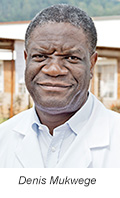 Denis Mukwege, a humanitarian and advocate for women’s rights, will receive the 2016 Penn Nursing Renfield Foundation Award for Global Women’s Health for his work in treating and highlighting the plight of women in the war-torn eastern part of the Democratic Republic of the Congo.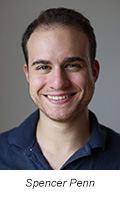
 Spencer Penn, a mechanical engineering & applied mechanics major, and Morgan Snyder, a digital media design major, were selected as co-honorees in recognition of their company, Sweet Bites. The aim of Sweet Bites is to solve the global issue of oral disease and its complications in challenged urban areas via xylitol-enhanced chewing gum. By employing local women to distribute the gum packaged with medical information, they hope to enable female entrepreneurship, close the information gap around healthcare access and improve the lives of millions suffering from preventable dental health problems.
 Yash Mulgaonkar, a PhD student in the department of mechanical engineering & applied mechanics, was selected for his achievements in developing the world’s smallest autonomous drone. He is focusing on how to make drones and other robots accessible to the general public by developing rapid fabrication methods. Additionally, he is researching training methods for robots so that they can better work together to complete tasks.
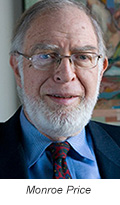 Monroe E. Price, director of the Center for Global Communication Studies at Penn’s Annenberg School for Communication, is the 2016 recipient of the C. Edwin Baker Award for the Advancement of Scholarship on Media, Markets and Democracy. The award, given annually by the Philosophy of Communication and Communication Law and Policy Divisions of the International Communication Association, will be presented in June at the International Communication Association Annual Conference in Fukuoka, Japan.
 Megan Ryerson, assistant professor of city & regional planning in PennDesign, who also holds an appointment in electrical & systems engineering (transportation) at Penn Engineering, is the 2015 recipient of the Women’s Transportation Seminar (WTS)—Philadelphia Chapter Woman of the Year Award. The WTS is an organization committed to the advancement of women within the transportation industry.
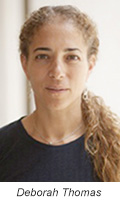 Deborah Thomas, a professor of anthropology and Africana studies in the University of Pennsylvania School of Arts & Sciences, has been named editor-in-chief of the American Anthropological Association’s (AAA) flagship journal, American Anthropologist, effective July 1. The position will run through June 30, 2020.

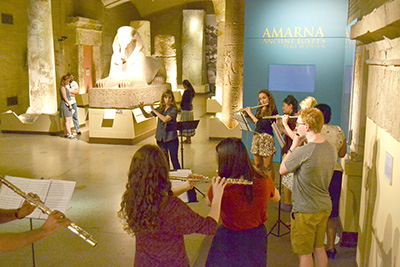
 What was behind the legendary story of King Midas and his golden touch?