Launching Penn's President's Innovation Prize
University of Pennsylvania President Amy Gutmann announced last Wednesday the launch of the President’s Innovation Prize, a competitively awarded annual prize aimed at building on the University’s culture of innovation and entrepreneurship while underscoring the high priority that Penn places on educating students to put their knowledge to work for the betterment of humankind.
The Prize will be awarded to a graduating Penn senior, or group of Penn seniors, in the spring of 2016. At $100,000, plus a $50,000 living stipend per team member, the Prize is among the largest opportunities in higher education for undergraduate students to pursue innovation and entrepreneurship outside the classroom.
“Everything we do to reward innovation and impact fuels Penn’s core missions of teaching, research and service,” Dr. Gutmann said. “Penn students are educated to think creatively and are equipped to master new areas of knowledge and collaborate across cultural and disciplinary boundaries. This Prize gives our graduating seniors a unique and life-changing opportunity to be inventive and think broadly about cutting-edge commercial projects that also have social impact.”
The President’s Innovation Prize is the commercial analogue to the nonprofit President’s Engagement Prizes, which were first awarded in March (Almanac March 31, 2015). Project ideas must be envisioned as commercial enterprises with a social component, designed to generate a profit that is sustainable over time. As part of the Prize, student winners will also receive dedicated office space at the University’s new Pennovation Works for one year, as well as mentorship from Penn Center for Innovation staff.
“Penn students and alumni have a long and impressive track record of being on the vanguard of innovation and of proving that social entrepreneurship and enterprise can remediate social ills around the globe,” Dr. Gutmann said. “From chewing gum that helps fight dental disease in the developing world to eye glasses whose sales support the donation of eyewear to people in need, they are building businesses on the idea that the generation of a profit can, and often should, be mutually supportive of social good.”
The President’s Innovation Prize further advances the Penn Compact 2020’s core commitment to innovation and impact. The Prize is the newest addition to the Presidential Initiatives, which include the President’s Engagement Prizes launched last fall (Almanac September 2, 2014). Other key Penn Compact 2020 initiatives include a comprehensive effort to raise an additional $240 million for Penn’s endowment to support undergraduate financial aid (Almanac March 4, 2014), bringing the University total to nearly $900 million raised since the start of the Making History campaign, as well as the new President’s Distinguished Professorship Fund to create as many as 50 new endowed professorships during the next four years (Almanac March 18, 2014).
Any full-time graduating senior in the College of Arts & Sciences, School of Engineering & Applied Science, School of Nursing or Wharton School who will complete an undergraduate degree in December 2015, May 2016 or August 2016 will be eligible to apply.
The application process for the President’s Innovation Prize will be jointly administered by the Center for Undergraduate Research and Fellowships (CURF) and the Penn Center for Innovation. Details of the application process are available on the CURF website at http://www.upenn.edu/curf/fellowships/presidents-innovation-prize
This year’s application deadline is February 12, 2016. The inaugural President’s Innovation Prize will be awarded in April 2016.
Penn Researchers Leading International Collaboration to Re-engineer Disaster Tents
Researchers at the University of Pennsylvania have received a five-year, $3.6 million grant from the National Science Foundation (NSF) to develop materials for multifunctional coatings on emergency tents, enabling them to manage water, prevent the spread of bacteria and capture and store solar energy.
These disparate capabilities all stem from fundamental research on how materials behave on the nanoscale, where minute structural details can produce large-scale effects.
The grant is part of the NSF’s Partnerships in International Research and Education (PIRE) program, which seeks to foster global collaborations on topics of societal importance.
The Penn team features dozens of faculty members and students in the School of Engineering & Applied Science (SEAS), School of Arts & Sciences (SAS) and Perelman School of Medicine. It is being directed by Russell Composto, SEAS’s associate dean of undergraduate education and a professor in the department of materials science & engineering. Zahra Fakhraai, an assistant professor in SAS’s department of chemistry; Daeyeon Lee, an associate professor of chemical & biomolecular engineering; and Kristin Field, director of programs at the Nano/Bio Interface Center, are also on the leadership team.
Their project, “Research and Education in Active Coatings Technologies for the human habitat” (REACT), is principally a collaboration with Grenoble Innovation for Advanced New Technologies (GIANT), a public-private research partnership based in Grenoble, France, which has received a complementary grant from the French science funding agencies Centre National de la Recherche Scientifique (CNRS) and Angence Nationale de la Recherche (ANR). Patrice Rannou, associate director of international research, is the director of the GIANT contingent.
“We have a longstanding relationship for international research experience and student exchange with GIANT,” Dr. Composto said. “This grant is going to expand this relationship and organize it around three coating technologies: water management, infection control and energy collection and storage.”
The project is also being conducted in conjunction with the Complex Assemblies of Soft Matter Lab (COMPASS), which is itself a collaboration between Penn, CNRS and Solvay, a multinational company with facilities near Penn and Grenoble. Ryan Murphy, the research and innovation external affairs coordinator for Solvay North America, leads the Solvay contingent.
Penn will also collaborate with researchers at Alabama State University, Villanova University and Bryn Mawr College.
The ultimate goal for the PIRE project is a prototype of an emergency tent that exhibits all three active coating technologies, or ACTs. However, the fundamental nature of the properties they will exhibit means they could be applied, individually or together, in many architectural contexts.
“These types of coatings can have much broader impacts,” Dr. Lee said. “Since they can be sprayed or painted on a variety of materials, they could be used to completely renovate already existing buildings to make them more eco-friendly and energy efficient.”
Members of all of the project’s partner institutions will collaborate on the basic science and industrial design necessary to realize the three ACTs.
ACT 1, Hierarchical Structures for Water Management, will be led by Robert Riggleman, assistant professor in the department of chemical & biomolecular engineering, and Shu Yang, professor in the department of materials science & engineering. Whether environmental conditions involve too much or too little water, controlling where it goes is of critical importance. ACT 1 research will involve developing superhydrophobic coatings that are inspired by natural examples, like beetles and cacti. These coatings will provide a flexible way of channeling water through nanoscale membranes that will filter out harmful impurities.
ACT 2, Prevention of Infection Transmission, will be led by Dr. Lee and Mamie Coats, an assistant professor of microbiology at Alabama State University. In crisis zones, the need for medical attention may rise as the ability to maintain sterile conditions drops. This research track will investigate how surface features influence adhesion, with the specific aim of preventing the formation of infection-spreading biofilms. Research into bacteria’s chemical and mechanical tools for clinging to surfaces will inform soft material-based countermeasures, such as coatings that react by releasing antimicrobial agents or that attempt to directly destroy these cells’ membranes.
ACT 3, Self-assembled Nanomaterials for Energy Generation and Storage, will be led by Dr. Fakhraai; Christopher Murray, a Penn Integrates Knowledge professor with appointments in chemistry and in materials science & engineering; and Karen Winey, the TowerBrook Foundation Faculty Fellow and professor in materials science & engineering. Lighting, heating, cooling and communications are also critical in disaster zones, so emergency shelters that can provide their own electricity would be more self-sufficient. ACT 3 aims to develop nanoscale “waveguides” that can channel sunlight to photovoltaic panels, as well as polymer-based batteries to store it while in the field.
“The idea is to have energy-harvesting layers, water-collecting layers and antibiotic layers,” Dr. Fakhraai said. “We can make them transparent and porous so they can stack them in different orders depending on what the needs are. The most challenging part will be to make it so that their properties don’t interfere.”
Beyond exchanging researchers and sharing nanoscale tools, the partnership will develop students’ teaching and presentation skills through Penn’s Center for Teaching and Learning. In addition, students will receive mentoring and internship opportunities with GIANT and Solvay.
“We’re training them for science in an international environment,” Dr. Field said.
Solvay is also sponsoring the group’s kick-off symposium in December where REACT members from all partner institutions will have a chance to meet and begin planning their research agenda for the next five years. Harvey Rubin of Penn’s Perelman School of Medicine, an expert on natural disasters and emergency response, will provide a keynote address. Vijay Kumar, the Nemirovsky Family Dean of Penn Engineering; Dawn Bonnell, Penn’s vice provost for Research, and Xavier Morise, head of CNRS’ North American office, will also speak.
Nominations for University-wide Teaching Awards: December 4
Nominations for Penn’s University-wide teaching awards are now being accepted by the Office of the Provost. Any member of the University community, past or present, may nominate a teacher for these awards. There are three awards:
The Lindback Award for Distinguished Teaching honors eight members of the standing faculty—four in the non-health schools (Annenberg, Design, Engineering & Applied Science, GSE, Law, SAS, Social Policy & Practice and Wharton) and four in the health schools (Dental Medicine, Medicine, Nursing and Veterinary Medicine).
The Provost’s Award for Distinguished PhD Teaching and Mentoring honors two faculty members for their teaching and mentoring of PhD students. Standing and associated faculty in any school offering the PhD are eligible for the award.
The Provost’s Award for Teaching Excellence by Non-Standing Faculty honors two members of the associated faculty or academic support staff who teach at Penn, one in the non-health schools and one in the health schools.
The nomination forms are available at http://provost.upenn.edu/education/teaching-at-penn/teaching-awards The deadline for nominations is Friday, December 4, 2015. Full nominations, with complete dossiers prepared by the nominees’ department chairs, are due Friday, February 5, 2016.
Note: For the Lindback and Non-Standing Faculty awards, the health schools—Dental Medicine, Nursing, Medicine and Veterinary Medicine—have a separate nomination and selection process. Contact the relevant Dean’s Office in order to nominate a faculty member from one of those schools.
There will be a reception honoring all the award winners in the spring. For more information, please e-mail provost-ed@upenn.edu or call (215) 898-7225.
Criteria and Guidelines
1. The Lindback and Provost’s Awards are given in recognition of distinguished teaching. “Distinguished teaching” is teaching that is intellectually demanding, unusually coherent and permanent in its effect. The distinguished teacher has the capability of changing the way in which students view the subject they are studying. The distinguished teacher provides the basis for students to look with critical and informed perception at the fundamentals of a discipline, and s/he relates that discipline to other disciplines and to the worldview of the student. The distinguished teacher is accessible to students and open to new ideas, but also expresses his/her own views with articulate and informed understanding of an academic field. The distinguished teacher is fair, free from prejudice and single-minded in the pursuit of truth.
2. Skillful direction of dissertation students, effective supervision of student researchers, ability to organize a large course of many sections, skill in leading seminars, special talent with large classes, ability to handle discussions or structure lectures—these are all attributes of distinguished teaching, although it is unlikely that anyone will excel in all of them. At the same time, distinguished teaching means different things in different fields. While the distinguished teacher should be versatile, as much at home in large groups as in small, in beginning classes as in advanced, s/he may have skills of special importance in his/her area of specialization. The primary criteria for the Provost’s Award for Distinguished PhD Teaching and Mentoring are a record of successful doctoral student mentoring and placement, success in collaborating on doctoral committees and graduate groups and distinguished research.
3. Since distinguished teaching is recognized and recorded in different ways, evaluation must also take several forms. It is not enough to look solely at letters of recommendation from students or to consider “objective” evaluations of particular classes in tabulated form. A faculty member’s influence extends beyond the classroom and individual classes. Nor is it enough to look only at a candidate’s most recent semester or opinions expressed immediately after a course is over; the influence of the best teachers lasts, while that of others may be great at first but lessen over time. It is not enough merely to gauge student adulation, for its basis is superficial; but neither should such feelings be discounted as unworthy of investigation. Rather, all of these factors and more should enter into the identification and assessment of distinguished teaching.
4. The Lindback and Provost’s Awards have a symbolic importance that transcends the recognition of individual merit. They should be used to advance effective teaching by serving as reminders to the University community of the expectations for the quality of its mission.
5. Distinguished teaching occurs in all parts of the University. Therefore, faculty members from all schools are eligible for consideration. An excellent teacher who does not receive an award in a given year may be re-nominated in some future year and receive the award then.
6. The Lindback and Provost’s Awards may recognize faculty members with many years of distinguished service or many years of service remaining. The teaching activities for which the awards are granted must be components of the degree programs of the University of Pennsylvania.
7. A faculty member may not be considered for a teaching award in a terminal year or the year in which s/he is being considered for tenure.

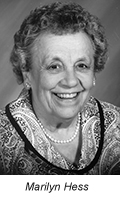 Marilyn Hess, professor emerita of pharmacology at Penn, died of natural causes on October 20 at the Quadrangle in Haverford, Pennsylvania. She was 90 years old.
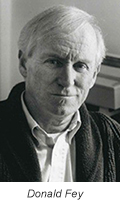 Donald H. Fey, a retired development writer and news officer at Penn, died on October 18 of heart failure at Bryn Mawr Hospital in Bryn Mawr,
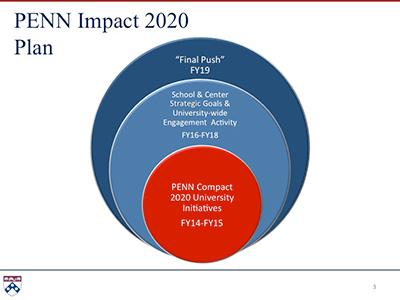 I was reflecting on the last time that I appeared before this group. It was 10 weeks before the conclusion of the Making History campaign and when asked where we stood I was unable to articulate what the number was because we were keeping it a secret (Almanac November 6, 2012). A few months later we announced that we had surpassed the $3.5 billion-dollar goal with commitments of $4.3 billion and cash of $3.6 billion. This is a remarkable testament to the entire Penn community: alumni, friends, donors, leadership, trustees, the list goes on. But there was another goal associated with the Making History campaign that wasn’t measured in terms of numerical contributions. That was the effort to not only successfully meet the three core priorities of the Campaign: the $3.5 billion goal, the highest priorities of the Schools and Centers and what we called our non-financial objectives, but also to elevate and sustain our post-campaign engagement in support of the Penn family so that all of the work that was done to increase our engagement and our success in our fundraising would continue.
 The Penn Impact 2020 focuses on key University priorities that also marked the center post of the Making History campaign: support for undergraduate, graduate and professional student aid, endowed faculty positions at all levels and the continuation of our engagement activities University-wide.
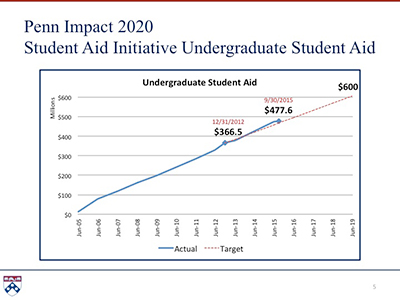 Let me break it down for you, as undergraduate financial aid is really one of the fundamental core elements. We finished the Campaign at $366.5 million and we stand at $477.6 million through September 30 with the aspirational goal of achieving $600 million towards additional endowment support towards undergraduate financial aid.
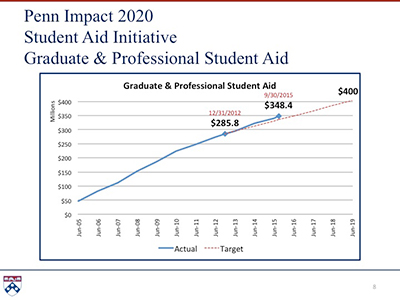 Graduate-level aid was one of the objectives of the Campaign. It did give me some pause; I was nervous about how we would do in raising funds because the nature of graduate aid is so different across the 12 Schools. However, we received $285 million in graduate aid through the Campaign with the goal of adding another $115 million, bringing the total to $400 million for new endowment. We are at roughly $350 million to date. I don’t like to make predictions but I think that we are going to blow through the $400 million goal relatively soon.
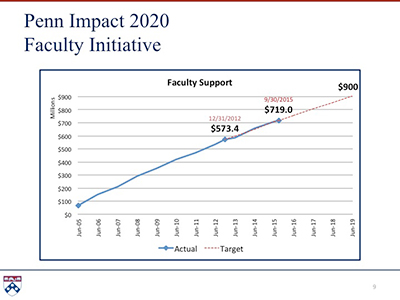 An equally important priority for Penn Impact 2020 is the continued emphasis on faculty support. Faculty is the fundamental key to the success of any University. Dr. Gutmann had charged us with looking at how we could build on the success of $573 million in new faculty support. This is predominantly endowments at all levels—the assistant, the associate, the full and the PIK program that Dr. Gutmann initiated when she started her presidency. The goal is to bring the total to $900 million, of which we are at $719 million. This has been accelerated by the President creating the matching program for donors for at least 50 new endowments in faculty appointments across the Schools. That incentive match has already generated 18 new Presidential Distinguished and PIK Professorships in 14 months, so the resonance and the messaging around this has been very strong.
 The fundraising priorities are distributed across the University, ranging from student aid, faculty, capital, programs and research, and unrestricted. This of course varies by School and Center, and in the aggregate, it is very similar to the distribution for the Making History campaign, when we were doing the planning in 2005-2006. The categories really do have an impact in all 12 Schools and in the six Centers.
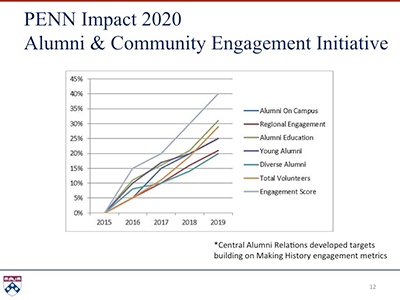
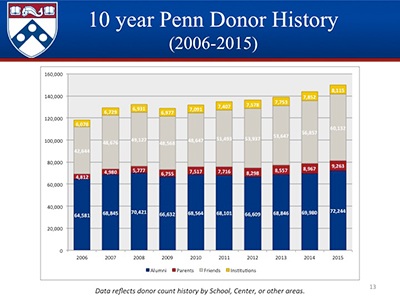 This slide gives you a graphic 10-year history of our donor growth by constituency. It shows where we started in the beginning of the Campaign and the continued growth in engagement and how support of Penn’s priorities has grown. As you can see, we have very broad support that continues to grow each year. This is a testament to the vision the Penn Compact 2020 represents, and how it resonates with the entire Penn family.
 Linda H. Aiken, the Claire M. Fagin Leadership Professor in Nursing, professor of sociology and director of the Center for Health Outcomes and Policy Research at Penn, received the Anthony J. Jannetti Award for Extraordinary Contributions to Health Care.
 Erika L.F. Holzbaur, a professor of physiology in the Perelman School of Medicine at the University of Pennsylvania, received the 2015 F.E. Bennett Award from the American Neurological Association (ANA). This award is presented annually to an “outstanding researcher and educator in neurology.”
-Carl.jpg) The Philadelphia Business Journal presented the 2015 Health Care Innovator Award in October in Philadelphia, naming Carl June an Individual Innovator of the Year.
The Philadelphia Business Journal presented the 2015 Health Care Innovator Award in October in Philadelphia, naming Carl June an Individual Innovator of the Year. Xiaowei Zhuang, the Howard Hughes Medical Institute Investigator and David B. Arnold Jr. Professor of Science in the departments of physics and chemistry & chemical biology at Harvard University, received the 2015 Award for Research Excellence in Nanotechnology from the Nano/Bio Interface Center (NBIC) at Penn.
 Provost Vincent Price, Vice Provost for Education Beth Winkelstein, the Council of Undergraduate Deans and the Office of New Student Orientation and Academic Initiatives (NSOAI) are pleased to announce the Year of Media as the Provost’s Academic Theme Year for 2016-2017, and Orson Welles’ film, Citizen Kane, as the Penn Reading Project for 2016.
 Citizen Kane, released in 1941, is considered to be producer/director/star Orson Welles’ magnum opus, and it regularly tops lists of the greatest American films ever made. A fictionalized biography—of “Charles Foster Kane,” a character closely modeled on real-life newspaper magnate William Randolph Hearst—Citizen Kane explores themes of power and media, including the importance of the news, how the news can be manipulated and how power shapes our leaders in both positive and negative ways. At the heart of Citizen Kane is a perhaps unanswerable question: Can we ever really interpret and understand a person’s life? In pursuit of an answer, Welles’ film famously switches the narrative among different observers, a technique that has had far-reaching resonance in later films.
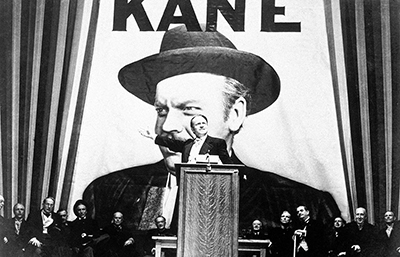 Citizen Kane and the Penn Reading Project will open the Year of Media, devoted to exploring the theme of media across many areas of inquiry. A significant factor in the committee’s choice is Citizen Kane’s focus on news and newspapers, as well as politics, since 2016 is a Presidential election year. The fact that it is the first film chosen for the Penn Reading Project also reinforces the ever-growing prominence of media in academic discourse. We expect programming throughout the year to continue exploring these topics and others, including the evolving world of social media.
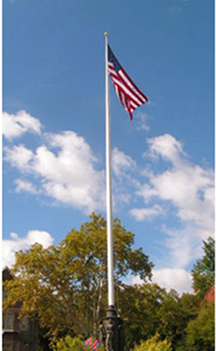 The Veterans @ Penn Committee invite the Penn community to attend the Veterans Day Flag Raising Ceremony on College Green on Veterans Day, Wednesday, November 11. It will start at 8:30 a.m. with Ralph J. De Lucia, associate director of the Office of Affirmative Action & Equal Opportunity Programs, giving the opening remarks. The Penn Navy ROTC Battalion will lead the Pledge of Allegiance. The National Anthem and Presentation of Colors will be performed by the Penn Glee Club and the Penn Navy ROTC Color Guard. The Rev. Charles Howard, University chaplain, will give the Invocation, and Anne Cocos, a military veteran and graduate student from Penn’s School of Engineering & Applied Science (SEAS) will be the keynote speaker. The Penn Glee Club will also perform “America the Beautiful.” The Office of Affirmative Action & Equal Opportunity Programs, VPUL TRIO: Veterans Upward Bound and SEAS are sponsoring this annual event. The rain location is the Franklin Room in Houston Hall.
 The reception for the Homecoming Alumni Show at The Burrison Gallery is Friday, November 6 from 3-6 p.m. The exhibit will be open from November 5-8. Above are some works from the annual show (clockwise from top left): Gorilla: Clemson Smith Muniz, C’79; Malachite Tiles: Lillian Sun Tadlock, W’93; Narni from Monte Sorotte: Paul Reuther, CGS’97; Once Upon a Time in Siwa: Mariam Georges, ENG’10 & GEN’11; Wildflowers: Donna Porter, GFA’86; Gull Reflections: Jim Schaefer, C’69 & GFA’74.
 Morris Arboretum’s Wellness Walks provide an opportunity to get outside and get some exercise beginning November 7 at 10:30 a.m. Visitors will relish the splendor of the garden and pump up their heart rate during these guide-led Wellness Walks, offered Saturday mornings, November 7 through March 26. Kick off your day with beauty and energy! Walkers meet at the Visitors Center wearing comfortable clothing and shoes to walk two-mile loops on the paved paths. For more information, visit
  As several Schools and Centers across campus prepare to migrate their email and calendaring accounts to a single common service over the course of the next year, it’s more important than ever to be on guard against “phishing” attacks: fraudulent email messages that masquerade as legitimate messages from trustworthy organizations.