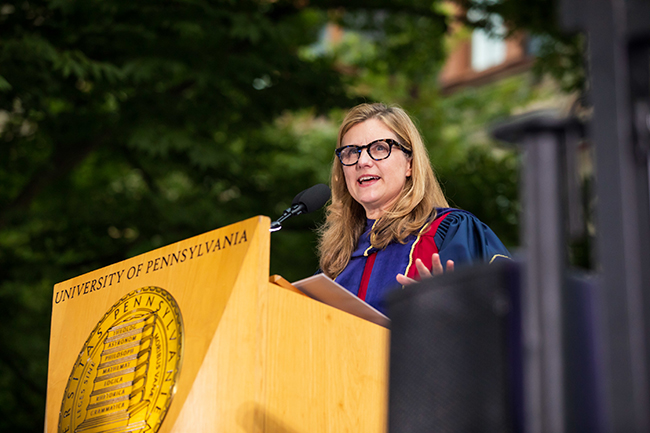
On Monday, August 29, 2022, Penn’s Class of 2026 Convocation was held in person in Blanche Levy Park, in front of College Hall. President Magill’s speech is shown below as prepared for delivery.
Free to Disagree–Productively
President Liz Magill
Let’s hear it again for the Class of 2026 and transfers! Welcome to your new University!
As you may know, it’s my new University, too. I started on July 1, so this is day 60 for me. And since we’re all just getting to know each other, I think some friendly introductions would be a great idea. I’ll go first.
Hi, I’m Liz Magill. I’m originally from North Dakota, from a town called Fargo. And I believe there’s one of my fellow North Dakotans in your class. Amy from North Dakota, if you’re here now, could you do me a favor and give a wave? Hi, Amy! Welcome! It’s always good to see folks from back home.
That was just two of us saying where we come from. But now I’m curious. I want to know what it would sound like if everybody said where they’re from—at the same time. So, let’s do an experiment together. I’m going to count to three. Then I want each of you to shout out the name of your home state or country. All together. And make it loud.
Everybody ready? Ok, here we go. One. Two. Three!
That was…really something!
Thank you! I think we satisfied my curiosity. I don’t know about you, but for me, that exercise made one thing very clear.
It’s clear that, in nearly 300 years of Penn history, this is the most diverse class ever assembled at Convocation. Just look at where you come from: 84 countries, 49 U.S. states, Washington D.C., Puerto Rico, the U.S. Virgin Islands, and American Samoa. You run the gamut of race and ethnicity, gender identity, sexual orientation, economic background, faith, ability, life experience, and points of view. So, when I say ‘diverse,’ I mean it in the broadest sense—as we just heard.
Thanks to this diversity, your time at Penn may be one of the most unique opportunities you have ever had or will ever have.
Living and learning here at Penn, you have the opportunity to learn everything you can about one another and to seek out those who are very different from you. You will also—and this is important—have plenty of opportunity to disagree.
Why is that so important, exactly? Let me offer you a quick story.
I served as law clerk for the late Supreme Court Justice Ruth Bader Ginsburg, AKA the Notorious RBG. It was one of the greatest honors of my life. It wasn’t long before I learned something very important about Justice Ginsburg.
Her number one rule—always—was this: Engage with and understand the very best version of your opponent’s argument. She followed that rule as a women’s rights advocate long before she was a judge or Justice. As general counsel for the American Civil Liberties Union, she argued more than 300 cases about discrimination against women. Six of those were before the U.S. Supreme Court. She compiled a string of victories that transformed American law’s treatment of women, work that she continued all her life.
She clearly practiced what she preached. Only by carefully and thoroughly hearing out the opposing side could she notch those victories. That’s how she could best advocate for the change she wanted to see.
Some years ago, Justice Ginsburg spoke at the memorial service of her staunch opponent—and good friend—Justice Antonin Scalia. They had argued many times over differences that seemed irreconcilable. They also traveled together—there’s a famous picture of them in India, sharing a seat on the back of an elephant.
At Justice Scalia’s memorial, Justice Ginsburg remembered how he had once shared an early draft of his dissenting opinion. She called it “a zinger.” Then she said this: “My final draft was much improved, thanks to Justice Scalia’s searing criticism.”
So, why does all this matter to us? Our willingness and our ability to engage with and understand views different from our own, to hear out ideas we disagree with, and to be humble enough to rethink our own views and question orthodoxies—this is essential.
How else can a community of people who bring so many different experiences and views live together and learn from one another? This capacity is essential to the fabric of a deeply diverse community. Foundational to the mission of a world-class university. And it is indispensable to the success of a democracy.
If you take away only one message this evening, this should be it. To make the most of your time at Penn: Seek out people who are different from you in all sorts of ways, engage with them, learn from them and, yes, feel free to disagree with them—productively.
I want to make it very clear what that means—and looks like—at a place like Penn. The entire academic enterprise—everything we do here—depends on productive disagreement. We constantly test and refine theories. We debate. We shine fresh light on ideas old, current, and brand new.
Some of Penn’s recent breakthroughs were once dismissed as wild pipe dreams or, worse, scientific dead ends.
CAR T therapy for leukemia or mRNA technology that now delivers COVID vaccines: Only through years of productive disagreement—not to mention tireless hard work—did these lifesaving, groundbreaking discoveries happen. The same could be said of any department or academic discipline on campus.
The history of breakthroughs like this also teach that a healthy dose of humility is important. In medicine, we no longer believe that bloodletting is a good idea or that mental illness is a sign of demonic possession. Nor do we think that the solar system revolves around the Earth. In the future, it’s likely that some of our most cherished ideas today may sound as outdated as the ones I just mentioned.
And we know—in part because of rigorous research done right here at Penn—that the more diverse we are and the more engaged we are across our differences, the better we’ll be in our learning, teaching, research, and service. That’s where you come in.
As Penn’s newest members, you now share our academic pursuits.
As important, this is your unique opportunity to dive headlong into one of the most diverse communities you may ever encounter in your life.
Remember how many countries, states, walks of life, and points of view I mentioned? And that’s just you. Add to the mix the tens of thousands of other people at Penn who cover just about every discipline and profession there is.
You will likely never again live, study, and have fun side by side, elbow to elbow, with such a comprehensive cross-section of the world.
So I urge you: Use this unique time. Be open to others who are very different from you in all sorts of ways. Hone your skills and your appetite for listening, learning, and, yes, productive disagreement. Seek chances to engage in good faith across divides and differences. It’s not just your personal growth and Penn’s academic mission that depend on it. The fate of our world may as well.
Observing these important guidelines has helped make my own life—my scholarship, leadership, and service—that much better.
But you don’t need me to tell you that, these days, Justice Ginsburg’s number one rule doesn’t seem to be very popular. Instead, the zeitgeist is to drown out opposing ideas, shout down debate, and demonize opponents. Sure, it might make for a highly entertaining drama on Netflix. But it makes for a poor educational experience, more dysfunctional politics, and a challenge to society.
This evening, looking at all of you, I feel a lot of hope and real excitement. If there’s something wrong with how our society handles difference and disagreement, then right here sits the cure. If there’s a place that’s going to help make our future better, then this is it.
I could go on, but I’m told that after the ceremony, we get to enjoy something that will make our near future even better—and that’s dessert.
So, I’ll wrap it up by saying, tonight, you join a very long, very proud line of Penn people who are devoted to the rewarding effort of listening, learning, and disagreeing productively. Who see differences as strength. Who, in fact, include Justice Ginsburg herself. On the day she received her honorary degree from Penn, she sat on College Green where you sit now. I am confident that she, as a member of the Penn community, would share my pride and my hope in all of you.
We’re happy you’re here with us. We’re excited to see where you’ll go. And we can’t wait to get started.
Welcome to your University. Welcome to Penn!
Make Penn Your Lab
Interim Provost Beth Winkelstein
As Interim Provost—Penn’s chief academic officer—it’s my great pleasure to welcome you this evening.
Some years ago I was a first year at Penn, too. Probably like you, I was very excited, a bit jittery, and not sure what to make of this object called a cheesesteak. Spoiler alert: they’re delicious, including the vegan ones.
For the last two-and-half years, we’ve lived through one of the most challenging times in modern human history. High school was, I’m sure, far from what you imagined. Yet tonight is a celebration: You’re here! You made it to Penn! Through all the discarded masks, the vaccines and the boosters, the remote learning and the dreaded “hybrid” schedule, you pivoted and adjusted. You made it work.
Are you still the same person who entered 9th grade? Yes. And also, no. During this pandemic experiment, you’ve undergone some major alterations. You adapted, because your environment changed. You found new paths to success. If I’m starting to sound like a scientist, that’s ok: I’m a bioengineer. Which leads me to propose a project for you: Make Penn your lab.
Consider everything you’ve already accomplished—which is a lot. You’re at Penn, after all. That’s your base, and it’s solid. Then, treat each new opportunity as a way to learn something new, about the world, and about yourself. Our university offers countless options to grow, as a scholar and as a person. I urge you to take classes outside your comfort zone: a growth mindset will serve you very well here, and will help you become not just well-educated but well-rounded. Be intellectually curious. Calculate, but don’t be overly cautious. Learn what brings you joy. In short: Experiment.
Join one of the hundreds of clubs and student groups on campus. Try a sport or activity that’s totally new. And if you don’t find one you like, start your own. We Quakers are a spirited bunch, and we love to cheer for our teams, especially when they’re winning, which is—with all humility—pretty often. Please join us on the sidelines or in the stands, consider a club sport, or just get outside with a frisbee.
It goes without saying that experiments can be challenging, and Penn is no different.
And I’m not speaking only of your courses or professors. You will be challenged to think and to learn in new ways. Penn’s greatest strength is our diversity, in every meaning of that word. You will meet new people with different ideas, backgrounds, and experiences. One of the critical skills you will hone is how to synthesize differing opinions. Free and open debate and dialogue are at the center of everything we do here.
You won’t always agree—but please don’t be disagreeable. Respect difference, and learn from it.
In the lab, things don’t always go as planned. Sometimes, that’s a good thing. But it can also be frustrating. Should you ever need support, of any kind, please reach out: to an advisor, instructor, staff member, RA, or friend. Your well-being is our top priority, and we are dedicated to your health, happiness, and success.
In closing, let me note that experimentation here is nothing new. After all, one of history’s greatest inventors, Ben Franklin, is our founder. Penn was the nation’s first university, its first secular institution of higher learning, and the first school to instruct in English as well as Latin. Our university has been made and remade countless times across nearly three centuries by all of you, our students. As times and norms have changed, we’ve changed. We haven’t always been perfect, but we always strive to be better. And the improvements will continue. For the first time in two decades, our university has a new leader. We are just thrilled to welcome President Magill as our bench partner in this grand experiment.
Members of the Class of 2026: I cannot imagine a more exciting time to be entering our great university, and to take advantage of all the discoveries to come. Welcome to Penn.

 Michele Volpe has been named the University of Pennsylvania Health System (UPHS)’s new Chief Operating Officer, following 23 years as CEO of Penn Presbyterian Medical Center (PPMC).
 Shelley Welton has joined Penn Carey Law as the Presidential Distinguished Professor of Law and Energy Policy. She will also hold an affiliation at the Kleinman Center for Energy Policy in the Weitzman School as part of former President Amy Gutmann’s 2019 commitment to build a multidisciplinary energy policy faculty affiliated with the Kleinman Center.
 Cara McClellan, GSE’12, will join the University of Pennsylvania Carey Law School as the director and associate practice professor of the newest of the Gittis Legal Clinics, the Advocacy for Racial and Civil (ARC) Justice Clinic–a clinic inspired in part by Martin Luther King Jr.’s words, “the arc of the moral universe is long, but it bends toward justice.”
 Neal Nathanson, the former chair of the department of microbiology in the Perelman School of Medicine as well as its former associate dean for global health programs and Penn’s former vice provost for research, passed away due to complications of leukemia and pneumonia on August 11. He was 94.
 Ioana Marinescu, an associate professor in the School of Social Policy & Practice, recently began a one-year leave from SP2 to join the antitrust division of the Department of Justice (DOJ) as its principal economist. In this role, Dr. Marinescu will work with Susan Athey from Stanford University’s Graduate School of Business, who recently accepted the role of chief economist.