
Transforming the Visitor Experience : Launching Penn Museum’s Major Building Renovation
The Penn Museum (University of Pennsylvania Museum of Archaeology and Anthropology) in Philadelphia kicks off a major renovation that will dramatically transform its Main Entrance Hall, make its historic building fully accessible to all, add significant visitor amenities and renovate and add air conditioning to the historic Harrison Auditorium and surrounding galleries. The construction project is a major element of the Museum’s Building Transformation campaign, to be announced next spring, that will also encompass the reinstallation of most of the 130-year-old Museum’s signature galleries and educational and public programming—to welcome visitors of all ages, from around the region and across the globe.
The announcement was made at a construction groundbreaking event with a twist—in lieu of wielding shovels, officials symbolically removed several seats from the historic Harrison Auditorium, in preparation for renovations to that public programming space.
Penn President Amy Gutmann spoke at the morning kickoff. “At the Penn Museum, we are letting in the light, in every way imaginable. A dramatic reconfiguration of the Museum—the first in nearly a century—will illuminate the story of humankind found in our galleries, while interactive technology will animate the objects which trace that narrative through our peerless archaeological and ethnographic collections. Adults and children alike will experience the thrill of discovery and gain a deeper understanding of history, and their place in it.”
“The Penn Museum’s mission is to transform understanding of the human experience,” noted Dr. Julian Siggers, Penn Museum Williams Director. “With our spectacular international collections, nearly one million objects from all over the world, and our ongoing leadership role in research and discovery, the Penn Museum is poised to take its next step and become a world heritage destination in America’s first World Heritage City. We are building transformation—through significant building renovation, new signature galleries, and new programs—to make that dream a reality.”
A new website (penn.museum/transformation) will provide updates throughout the process. Museum visitors will be able to watch the transformation in real time as new Signature Galleries, architectural enhancements, amenities and programming are added.
Building Transformation: Construction Project and New Signature Galleries
In the construction project which had its official kickoff earlier this month, with scheduled completion in summer 2019, the Main Entrance Hall will be completely transformed, opening staircases closed for more than a century, bringing light in and creating a new gallery space that visitors will see as soon as they enter. The adjoining gateway to the Egyptian Galleries will be brightened with huge windows and broadened to create new access to the galleries. Visitor accessibility and amenities are high on the list of changes: two new elevators—one providing vertical circulation to all levels of the Egyptian wing and the other to the Harrison Auditorium and Third Floor Galleries—along with new public restrooms and a new Shop location by the Pepper Mill Café, will improve ease of navigation and visitor comfort.
The Museum will also completely renovate the 1915 art deco-style Harrison Auditorium. New lighting, flooring and sound and audio-visual enhancements will transform the auditorium’s programmatic capacity, while air conditioning and reupholstering the historic 1940s seats will add significantly to visitor comfort. (Seats can also be named for a donor or their designated honoree for $2,500.) The auditorium will reopen in late summer 2019 with 618-person capacity.
Central to Building Transformation is a series of stunning new Signature Galleries, designed to tell the story of humankind as unearthed, literally and figuratively, by Museum archaeologists, anthropologists, ethnologists, laboratory scientists and scholars over more than a century of fieldwork and research discoveries that continue today.
First to be completed will be a suite of new Middle East Galleries, opening April 21, 2018, with a “Golden Gala” preview fundraiser April 14. Here the Museum draws upon its own groundbreaking excavations and research that began in the 1880s—with America’s first archaeological expedition to the Middle East—and continues today. Ten Museum curators and scholars, led by Stephen Tinney, associate curator-in-charge of the Babylonian Section, working with Haley Sharpe Design of Leicester, U.K., share their expertise in this first new Signature Gallery, which tells the compelling story of humanity’s nearly 10,000-year journey from small villages and towns to increasingly complex cities. The story will be told through 1,400 artifacts presented in 6,000 square feet of refurbished gallery space. Video, touchable artifacts and interactive stations will provide multiple avenues for engagement.
Additional Signature Galleries will follow. In November 2018, the Museum opens a new Mexico and Central America Gallery, curated by Simon Martin, a Maya expert and one of the leading Maya epigraphers in the world. In the fall of 2019, new Africa Galleries will open, reimagined and re-contextualized by Tukufu Zuberi, curator of the Museum’s 2013 Black Bodies in Propaganda exhibition, and renowned for his work on the long-running PBS series History Detectives.
Building Transformation: Expanded Programmatic Initiatives
As the Penn Museum transforms its physical spaces, it will also transform the ways in which students and visitors engage with the extraordinary collections it houses—in labs and classrooms as well as galleries, and through new programs and online discovery.
Building on strong public and online participation in a fall 2016 Public Classroom series on the topic of Race and Science made possible by a grant from The Pew Center for Arts & Heritage, a new and prestigious Advancement Grant from the Center will allow the Museum to explore strategically the addition of programmatic formats around the opening of the Middle East Galleries and the reopening of the Harrison Auditorium. A Catalyst Grant from The Barra Foundation will fund a unique gallery guides program, in which immigrant docents will give highly personalized tours of the galleries displaying collections from their homelands (see next page).
Meanwhile, the collections form the basis of inquiry for both undergraduate and graduate students, more than 1,300 of whom have taken classes in the Center for the Analysis of Archaeological Materials (CAAM), a new teaching and research center for archaeological science that was launched in 2014. Unpacking the Past, a partnership program with the School District of Philadelphia that launched the same year, brought the ancient Egyptian and Roman collections to life for more than 5,700 seventh grade students in 2016-2017. With the opening of the Middle East Galleries in April 2018, a new program on ancient Mesopotamia will be offered to teachers for their class participation in Unpacking the Past.
Together, these expanded initiatives will engage a wide range of visitors with the Museum’s renowned collections and resources.
Moving Beyond 2019
Additional Signature Galleries will open in later phases, but the groundwork for them—including curatorial development, gallery design, and extensive conservation of monumental objects—is well underway.
Among these additional Signature Galleries are spectacular new Egyptian Galleries. The Museum’s magnificent Egyptian collections reflect 5,000 years of cultural continuity and change, and include the largest ancient Sphinx in the Western Hemisphere, architectural elements from the only Pharaoh’s palace outside of Egypt, and mummies, both human and animal. The new Galleries will set these materials and their stories in rich new context and display the monumental palace elements at full height for the first time. Also planned are new Asian Galleries in the towering Rotunda and adjacent spaces, as well as two cross-cultural galleries exploring important themes: a new Crossroads of Cultures Gallery with a focus on international trade connections in ancient Israel and the eastern Mediterranean, and a long-awaited Writing Gallery to explore that most human of all activities, across cultures.
In all, the new Signature Galleries, showcasing the many strengths of the Museum’s international collections, will fill more than 44,000 square feet of reinstalled exhibition space.
Partners in the Transformation
Penn Museum leaders have tapped internationally renowned experts in a variety of fields from the United Kingdom, New York City, and Philadelphia. Leading the extensive building renovation project are Gluckman Tang Architects, of New York City, in partnership with HSC Construction, General Contractors, of Exton, Pennsylvania. For the Middle East Galleries, the first of the Signature Galleries, Haley Sharpe Design, of Leicester, U.K., is leading gallery design. Exit, of Philadelphia, is designing comprehensive wayfinding and signage.
The Kavelman Group, New York City, is the strategic planning partner for the Museum’s public programming, and LaPlaca Cohen, New York City, is providing positioning support through The Pew Center for Arts & Heritage Advancement Grant period.
Expanded Programming Initiatives
As new galleries, an upgraded auditorium, and public spaces open in a fully accessible historic building, the Penn Museum will have expanded capacity to offer public and school programs. Two major grants—one from The Pew Center for Arts & Heritage, one from The Barra Foundation—are aiding in planning and development of new programs for the public, while the Museum’s Unpacking the Past program for Philadelphia school children expands its offerings, and the Museum’s award-winning Virtual Programs continue to increase their impact.
“We are thrilled, and honored, to be awarded these prestigious grants at a very exciting time in the Museum’s history,” said Dr. Siggers. “With the help of these generous grants, we will realize our expansive and relevant vision: to be the place where people of all ages can experience the thrill of discovery and gain a deeper understanding of human history, and their place in it, and to make transformative change in our tour offerings, outreach and community engagement.”
Pew Center for Arts & Heritage Advancement Grant
In June 2017, the Penn Museum was awarded a $500,000 Advancement Grant—one of two such grants given this year—from The Pew Center for Arts & Heritage. This invitation-only grant is designed to create opportunities for cultural organizations to make lasting improvements to their programming, audience engagement, and financial health through bold initiatives.
With this award, the Penn Museum joins a select group of cultural organizations in the region whose public offerings have been strengthened by an Advancement Grant from the Center.
The two-year investment from the Center, provides a strong catalyst for creative planning at the Penn Museum to explore new ways to connect with and engage diverse and expanded audiences with its renowned international research and collections. The timing comes as the Museum prepares to embark on a dramatic reconfiguration of its physical spaces and new signature galleries designed to illuminate the story of humankind, with interactive technologies used to animate the objects that trace narratives in the archaeological and ethnographic collections.
At this transformative time in the Museum’s history, support from the Center will help further extend engagement with the collections, research, and learning in and beyond the galleries. The grant is supporting the Museum’s public programs and brand development, paving the way to innovative new programs geared to diverse communities and interests.
“The Penn Museum stewards one of the finest collections in the world, with strong archival records and rich, ongoing research that extends our understanding of what it means to be human,” said Kate Quinn, director of exhibitions and public programs. “We are eager to embark on the Museum’s next phase of its development—finding the best way to bring those collections and research to our diverse audiences in unique, thoughtful, engaging and fun ways.”
The Barra Foundation Catalyst Fund Grant
In August 2017, the Museum was the recipient of a 36-month, $195,000 Catalyst Fund Grant from The Barra Foundation. The grant will fund the development of the Global Guides: Immigrant Stories Tour Program, an innovative new model for recruiting and training a diverse and underrepresented group of individuals to lead tours and programs at the Penn Museum.
Through the Global Guides: Immigrant Stories Tour Program, the Museum will hire and train area immigrants and refugees to be tour guides for the Museum’s collections. In addition to sharing information about the history of the artifacts on display, they will be trained to use personal experience, combined with historical content, when interpreting the galleries that showcase collections from their own countries of origin.
“We see this as a terrific opportunity for the new guides, our staff and Museum visitors,” said Ellen Owens, Merle-Smith Director of Learning Programs. “Speaking from their ‘lived’ perspectives, guides can combine first-person narratives and facts to make ancient material more accessible and more relevant to general visitors, while also providing greater Museum accessibility for underserved communities.” These guides will receive training in storytelling ‘best practices’ and participate in the same comprehensive educational and content training as traditional gallery guides.
Tying in with the Penn Museum’s new Signature Galleries, the Global Guides pilot program will hire and train guides to present tours and enrichment programs beginning with the new Middle East Galleries (spring 2018). HIAS Pennsylvania and Nationalities Service Center are key community partners in the project. Guides and additional community partners for the Mexico and Central America Gallery (fall 2018) and the Africa Galleries (fall 2019), will follow this inaugural year. The Museum will hire three to four guides per gallery, with recruitment of guides for the new Middle East Galleries beginning this fall.
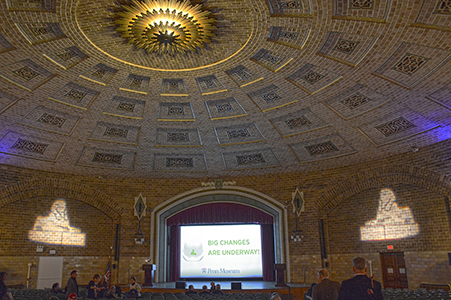
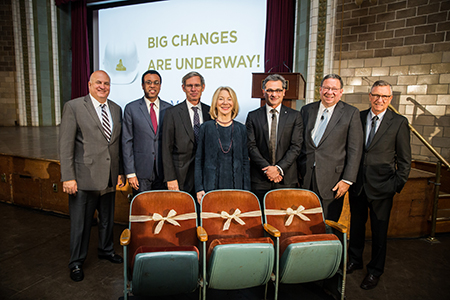
Shown at the groundbreaking ceremony for the Penn Museum’s Building Transformation project: (from left to right) Penn Executive Vice President Craig Carnaroli; Penn Provost Wendell Pritchett; Penn Museum Board Chairman Michael J. Kowalski; Penn President Amy Gutmann; Penn Museum Williams Director Julian Siggers; Penn Board of Trustees Chairman David L. Cohen; Founder and Principal, Gluckman Tang Architects, Richard Gluckman.