
So You Wanna Be an Archaeologist?
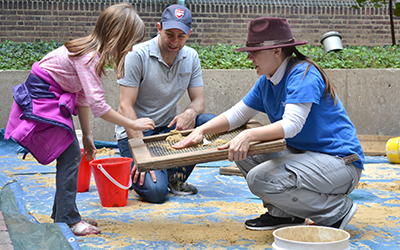 This year, Penn Museum is one of more than 100 collaborating organizations from across the United States and Canada participating in International Archaeology Day with special activities to raise public awareness of archaeology locally and nationally. Penn Museum will offer behind-the-scenes lab tours, talks on current research and mummification workshops. The special day also includes archaeological site simulations, a 3-D printing demonstration and Q&A sessions with researchers and conservators on Saturday, October 17, from 11 a.m.-4 p.m. The family-friendly program, So You Wanna Be an Archaeologist?, highlights the training and technology used by archaeologists, presented against a backdrop of mummies, ancient skeletons, clay tablets and other artifacts from the museum’s collection.
So You Wanna Be an Archaeologist? is cosponsored by the Philadelphia Society of the Archaeological Institute of America and is free with Museum admission. Activities include:
Bones, Botany, Ceramics and Metal—Inside CAAM: The Center for the Analysis of Archaeological Materials: guests can meet expert instructors mentoring archaeology students through CAAM, a multi-million dollar set of teaching labs that opened in 2014 (Almanac September 30, 2014). Behind-the-scenes CAAM tours will depart every 15 minutes beginning at 1 p.m.
In the ceramics lab, guests will have an opportunity to examine thin slices of pottery under a polarizing light microscope as Marie-Claude Boileau, ceramics expert, explains which clues identify where pottery objects were crafted and traded.
Archaeobotany teaching specialist Chantel White will discuss how prehistoric humans prepared ancient plants for their daily meals and how grapes were fermented into wine nearly 5,000 years ago.
Skeletons of modern animals can be seen in the zooarchaeology lab, where Mainwaring Teaching Specialist Kate Moore will lead guests in a skeletal analysis exercise to decipher ancient relationships between animals and humans.
Archaeometallurgy teaching specialist Moritz Jansen will explore how reflected light microscopy can be used to reconstruct ancient metalworking technologies.
Physical anthropology curator Janet Monge will share how forensic anthropologists use the anatomy and microstructure of human bone as clues in restoring a skeleton’s “personhood.”
Stories Behind the Discoveries: Record-keeping is essential for archaeologists, who document everything they find by means of notes, drawings and photographs. Since 1887, the Penn Museum has sent more than 300 field expeditions around the world. A special Records of the Archaeologist session of the Museum’s weekly Unearthed in the Archives presentation will showcase the many types of records created and acquired over the years, including glass plate negatives, watercolors and even phonograph records, starting at 1 p.m.
C. Brian Rose, Ferry Curator-in-Charge of the Mediterranean Section, will greet guests in a pop-up Q&A session at 2 p.m.