
Printing Chocolate in the Pennovation Center
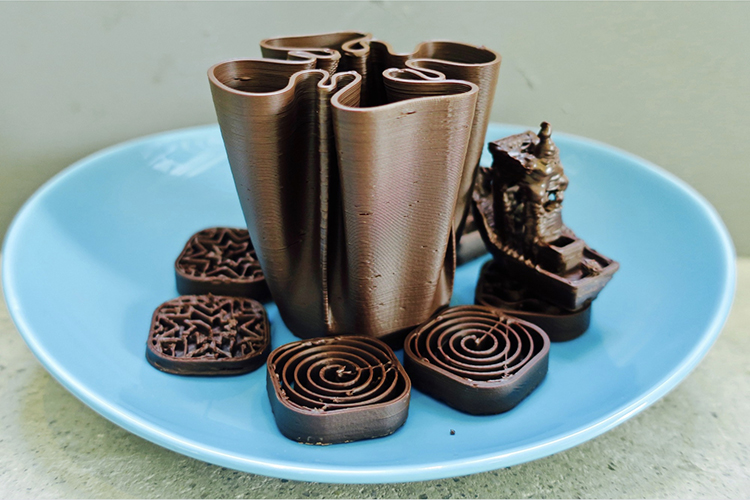
Based in the Pennovation Center, Cocoa Press is the fledgling 3D printing operation of Evan Weinstein, a May 2019 graduate and a graduate student in Penn’s School of Engineering and Applied Science. As a high school student at Springside Chestnut Hill Academy, Mr. Weinstein brainstormed an innovative approach to the chocolate industry. The last two decades have arguably seen a growth in “bean to bar” small-business chocolate ventures, focused on sourcing and curating high-quality small-batch artisanal bars. But Mr. Weinstein’s focus is not so much on the ingredients as it is on the form. He wants to go beyond the bar to allow chocolatiers to create shapes while avoiding expensive molds, which are generally $500 each.
In the summer after his sophomore year, Mr. Weinstein worked in the 3D printing lab in the evenings, where he worked on his 3D chocolate printer. By the end of the summer, he applied for the World Maker Faire in 2017, where he presented it as his prototype hobby project.
When his senior year began, Mr. Weinstein renamed his project Chocolatier for his senior design project, with five other mechanical engineering students. The Engineering Entrepreneurship Lab course solidified Mr. Weinstein’s chocolate venture as a viable business opportunity. He went on to win the Miller Innovation Fellowship at Penn for his project and was accepted into the Pennovation Accelerator program. He is currently finalizing the mechanics of his 3D printers.
The printer itself looks like a popcorn machine. The user creates a file to print through a scan. Each printer comes with syringes to fill with chocolate. He’s also experimented with printing butter icing and white chocolate. Each substance requires different temperature and air pressure settings.
While a regular 3D printer creates a design out of plastic based on a scan, Cocoa Press printers create a design made out of chocolate. With the scanning technology, chocolate designs can have new textures regular bars do not—internal structures like air bubbles, and squiggles, like Ruffles and their ridges.
Mr. Weinstein prints his logos out in chocolate to bring to fairs, like the Midwest RepRap Festival (a festival celebrating self-replicating machines), and a 3D food printing conference in the Netherlands in June 2020.
In July of 2019, Mr. Weinstein filed a non-utility patent. The Cocoa Press printer can be sold to food hobbyists and niche markets but is not certified for food retail. Food-safe commercial kitchen certification is incredibly expensive so Mr. Weinstein plans to reach out to local chefs and chocolate purveyors in the future. For now, he hopes to land 50 preorders by fall of 2020.
In addition to his own business cards, some designs Mr. Weinstein has created include pets, a cloth-like vase called Julia Vase #11, and Benchy Boat, the benchmark design for 3D printers. “A lot of chocolate companies are trying to stand out, especially with sourcing and ingredients. I can make a scan of my head, and in one hour have a chocolate head.”
For the full story and a video of the printer at work, visit https://tinyurl.com/SEASchocolateprinter