
John Keene, City & Regional Planning
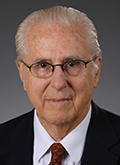 John Keene, MCP’66, a professor emeritus of city and regional planning in Penn’s Weitzman School of Design, passed away on March 4. He was 90.
Mr. Keene received a BA from Yale University in 1953 in international relations, graduating magna cum laude. From 1953 to 1956, he served in the U.S. Navy as a CIC officer and operations officer. He went on to receive a JD from Harvard Law in 1959, then received a master of city planning from Penn in 1966, specializing in the legal aspects of planning. Immediately after graduating from Penn, Mr. Keene joined Penn’s faculty as an assistant professor of city planning. In 1968, he was promoted to associate professor; he went on to serve for over five decades at Penn, teaching “an encyclopedic array of courses on the legal aspects of different planning fields and planning theory, from land development regulation and growth management techniques to protecting farmland and brownfield remediation,” in the words of a tribute from Weitzman School Dean Frederick Steiner. In 1983, Mr. Keene was promoted to professor of city and regional planning, and he chaired the department from 1989 to 1994. He also served as chair of the department’s graduate group from 1989 to 1991 and again from 2002 to 2005.
In 1978, Mr. Keene was appointed as the University Ombudsman, a position he held until 1984. In this capacity, he held several leadership positions in Penn’s governance, including chairing the President’s Commission on Judicial Procedures from 1982 to 1983. He also served on several Faculty Senate and University Council committees. In 1997, he became the chair-elect of the Faculty Senate (Almanac May 6, 1997), serving as chair in the 1998-1999 academic year. He took other initiatives on campus, serving on a Locust Walk Advisory Committee and other consultative committees. He was awarded the Christian R. and Mary F. Lindback Foundation Award for Distinguished Teaching in 2004, and the G. Holmes Perkins Award for Distinguished Teaching in 2005. “A good teacher is remembered long after the class has ended,” a student stated. “These words best describe Professor Keene. Professor Keene has had an immeasurable impact on my personal and professional life.” Another student said, “The impact of his scholarship goes beyond the four walls of the classroom. Many of my colleagues in international development continue to refer to his work for guidance.”
Mr. Keene retired in 2006 and later took emeritus status, but remained active at Penn. That same year, he was again chosen as the University Ombudsman (Almanac July 11, 2006). “John, who was University Ombudsman from 1978 to 1984, brings a breadth and depth of experience, excellent judgment, and a commitment to service to the role of Ombudsman that will enable him to be very effective,” President Emerita Amy Gutmann said at the time. “I am delighted that he has agreed to serve again as Penn’s Ombudsman.” During this era, Mr. Keene was also an officer of the Penn Association of Senior and Emeritus Faculty (PASEF), continuing to serve on Faculty Senate committees as a non-voting member.
As chair of the Faculty Senate, Mr. Keene addressed graduates at Penn’s 1998 commencement (Almanac May 19/26, 1998). “As I stand here looking out at all of you, my thoughts flash back to my own Penn graduation in 1966, when I received my Master’s in City Planning,” he said. “When I sat in Convention Hall, I had no inkling of the upheavals that would take place at Penn and on campuses across the nation in a few short years, as your parents’ generation cried out against the injustices and inequities they saw around them. How will your world be transformed by the grinding pressures of population growth, especially in developing countries? … As you build your career and family, you must also take individual responsibility for protecting the global ecosystem, for controlling environmental pollution, and for reducing social injustice in the world, or human society as we know it will not continue.”
Mr. Keene researched the ways in which law, planning, land-use policy, and environmental policy interact. In 1975, he took a leave of absence from Penn to research the emerging aspects of land use regulation and the effects of recent legislation on the concept of property. In 1999, he received a University Research Foundation (URF) award for a project called Regional Planning in Spain: An Evaluation. He published the books Untaxing Open Space (1976); The Protection of Farmland: A Reference Guidebook for State and Local Governments (1981); and Saving American Farmland: What Works? (1997), and co-authored others. He also wrote several peer-reviewed articles, reports, and book chapters. In 2014, an article he wrote was published in the Encyclopedia of Social and Behavioral Sciences, and in 2018, he co-authored The Law of Agricultural Land Preservation in the United States with Thomas L. Daniels. He consulted in several legal cases involving farmland and legal policy and served in 1973 on the Philadelphia City Charter Revision Commission.
He is survived by his wife, Ana Maria Keene; and eleven children. To read several Weitzman School faculty and alumni’s fond remembrances of Mr. Keene, visit https://www.design.upenn.edu/news/remembering-john-keene-1931%E2%80%932022. In lieu of flowers, the family has asked for contributions in Mr. Keene’s honor be made to the department of city and regional planning’s fellowship fund or the department of urban studies’ scholarship fund.