
Four Faculty Members: 2025 Sloan Research Fellows
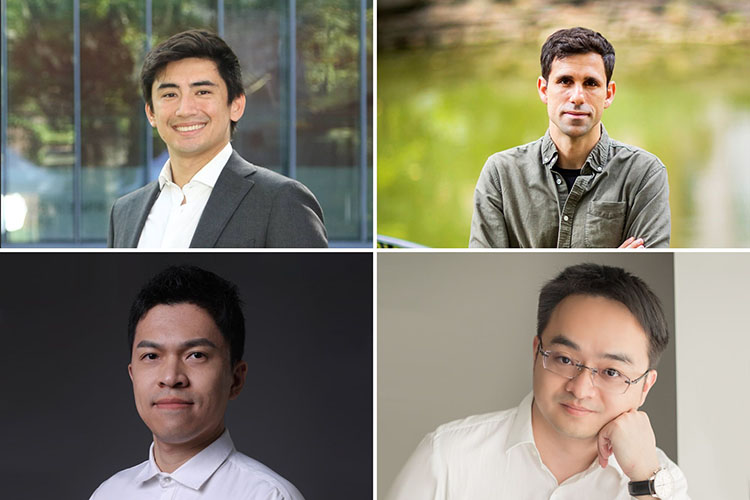 Penn faculty members Jason Altschuler, César de la Fuente, Liang Wu, and Anderson Ye Zhang have each been selected to receive a 2025 Sloan Research Fellowship, which recognizes early-career scientists in North America. They are among 126 fellows, chosen from more than 1,000 nominees this application cycle, who will receive the two-year, $75,000 research fellowship.
Jason Altschuler is an assistant professor in the department of statistics and data science at the Wharton School. He also holds secondary appointments in the department of electrical and systems engineering and the department of computer and information science in the School of Engineering & Applied Science and is a member of the applied mathematics and computational sciences group in the School of Arts & Sciences. His research interests lie at the intersection of mathematical optimization, probability, and machine learning, with a focus on the design and analysis of efficient algorithms. Dr. Altschuler has been named a fellow for his contributions to the field of mathematics.
César de la Fuente is a Presidential Associate Professor in the department of psychiatry in the Perelman School of Medicine, with secondary appointments in Penn Engineering and Penn Arts & Sciences. The de la Fuente Lab pioneered the first AI-designed antibiotic with in vivo efficacy, launching AI-driven antibiotic discovery, and has identified more than a million new antimicrobial compounds. Dr. de la Fuente’s work has accelerated antibiotic discovery, cutting preclinical candidate identification from years to hours and turning decades of research into hours. He has won more than 80 awards, has appeared as an invited speaker at more than 300 talks, is a fellow of the American Institute for Medical and Biological Engineering, and is a National Academy of Medicine Emerging Leader. He has authored more than 170 publications and holds multiple patents. Dr. de la Fuente has been named a Sloan Fellow for his contributions to the field of chemistry.
Liang Wu is an assistant professor in the department of physics and astronomy in the School of Arts & Sciences. He uses advanced laser and light-based techniques to study materials that could power next-generation quantum computers, solar cells, and memory devices. His work focuses on materials like superconductors and quantum magnets, aiming to make future technology faster and more efficient. Dr. Wu has given more than 120 invited talks, and his honors include the Richard L. Greene Dissertation Award in Experimental Condensed Matter from the American Physical Society, the Army Research Office Young Investigator Award, the William L. McMillan Award from the University of Illinois (given for outstanding contributions in condensed matter physics), and the Presidential Early Career Award for Scientists and Engineers (given by the Army Research Office). Dr. Wu has been named a Sloan Fellow for his contributions to the field of physics.
Anderson Ye Zhang is an assistant professor in the department of statistics and data science at the Wharton School. His research interests include network analysis, clustering, spectral analysis, and analysis of preference data. A central theme of his work is the investigation of fundamental limits and the development of efficient computational methods in complex statistical problems. Working at the intersection of statistics and machine learning, he aims to advance both the theoretical and practical frontiers of modern data analysis. He has received prestigious accolades for his work, including the National Science Foundation CAREER award. Dr. Zhang has been named a Sloan Fellow for his contributions to the field of mathematics.
Since the Sloan Research Fellowships were first awarded in 1955, 135 faculty members from Penn have been recipients. The fellowships are among the most competitive available to researchers in North America.
Open to scholars in chemistry, computer science, earth system science, economics, mathematics, neuroscience, and physics, Sloan Research Fellowships are awarded in coordination with the scientific community. Candidates must be nominated by fellow scientists, and recipients are selected by independent panels of senior scholars based on research accomplishments, creativity, and potential of fellows to become leaders in their fields.