
Eugenio Calabi, Mathematics
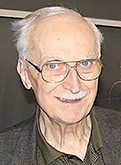 Eugenio (Gene) Calabi, the Thomas A. Scott Professor Emeritus of Mathematics in the School of Arts and Sciences, died on September 25. He was 100.
Born in 1923 in Milan, Italy, Dr. Calabi moved to the United States with his family at an early age. As an undergraduate at the Massachusetts Institute of Technology in 1946, Dr. Calabi earned a Putnam Fellowship. In 1950, he received his PhD in mathematics from Princeton University after completing a doctoral dissertation, “Isometric Complex Analytic Imbedding of Kähler Manifolds,” under the supervision of Salomon Bochner. After serving as a professor at the University of Minnesota, Dr. Calabi joined Penn’s faculty as a professor of mathematics in 1964. Three years later, he was named the Thomas A. Scott Professor of Mathematics, a distinction he held until his retirement in 1994, when he became emeritus.
Dr. Calabi was a seminal researcher who made crucial contributions to differential geometry. His colleague, Tony Pantev, noted that Dr. Calabi, “was one of the giants of current mathematical thinking and will be sorely missed not only by us but by the whole mathematical community.” He specialized in differential geometry, partial differential equations and their applications, presenting the incomplete Calabi conjecture in 1954, which was finally proven, to much fanfare, in the 1970s. In 1982, he introduced a geometric flow, now called the Calabi flow, as a proposal for finding Kähler metrics of constant scalar curvature. He also found the Laplacian comparison theorem in Riemannian geometry and, with Beno Eckmann, discovered the Calabi–Eckmann manifold. While Dr. Calabi authored fewer than 50 peer-reviewed articles, these became key pieces of mathematical literature and were anthologized in book form in 2021.
Dr. Calabi was widely awarded for his work. In 1982, he was elected into the National Academy of Sciences. He won the Leroy P. Steele Prize from the American Mathematical Society (AMS) in 1991 for his work in differential geometry. “His pioneering work in the complex of Monge-Ampere equation and Kahler Einstein metrics, followed by later work of Aubin and Yau, led to the resolution of a number of problems in algebraic geometry beyond the reach of other methods,” read the citation for the Steele Prize.
In 2013, Dr. Calabi became a fellow of the American Mathematical Society, and nine years later, he was named Commander of the Order of Merit of the Italian Republic. In 2008, Penn established a Calabi Assistant Professorship of Mathematics in his honor, which was first given to Joachim Krieger (Almanac October 21, 2008).
On the occasion of Dr. Calabi’s 100th birthday in May 2023, many of his colleagues shared their reminiscences of him, which can be read here.
He is survived by his wife, his son, his daughter, and their families. A memorial service was held on September 27, and Penn’s department of mathematics plans to hold a memorial for Dr. Calabi this fall.