
Edmund B. Spaeth, Jr., Law School
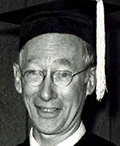 Edmund B. Spaeth, Jr., the retired president judge of the Pennsylvania Superior Court and former senior fellow at Penn Law, died of congestive heart failure at Cathedral Village in Philadelphia on March 31. He was 95 years old.
Judge Spaeth was born in Washington, then moved to Mount Airy. He graduated from Germantown Friends School and Harvard College. He served in US Navy intelligence operations during World War II and later joined the Naval Reserve, retiring with the rank of commander.
In 1948, he graduated from Harvard Law School. He became an associate with the Philadelphia law firm MacCoy, Evans & Lewis.
In 1964, he was appointed a judge of the Philadelphia Court of Common Pleas and was subsequently elected to a full term. In 1973, he was appointed to fill a vacancy on the Pennsylvania Superior Court but was defeated in the primary election. Later that year, he was appointed to fill a second vacancy on the Superior Court and was elected to a full 10-year term.
Judge Spaeth joined the faculty of Penn’s Law School as a lecturer in 1973. His principal subject was evidence, but he also taught professional responsibility. In 1985, he became a senior fellow at the Law School. He cofounded and directed the Law School’s Center for Professionalism (Almanac October 20, 1987). In 1991, he received the Harvey Levin Award for Excellence in teaching at the Law School (Almanac May 14, 1991). He taught at Penn until 1997.
In 1983, he became president judge of the Superior Court and served until his term expired in 1986. From 1986-2002, he acted as counsel to the Philadelphia law firm Pepper Hamilton. In 1988, he became chair of Pennsylvanians for Modern Courts, a nonprofit corporation created to advance reforms of the judicial system.
In 1989, Governor Bob Casey appointed him chairman of the state Judicial Inquiry and Review Board. The following year, he resigned, telling Governor Casey that the judicial system was too dysfunctional for the board to do its job. The governor appointed him to a commission to recommend changes in that system. Among the commission’s recommendations was abolishing the review board and replacing it with a system of judicial discipline more open to the public, in which the prosecutorial and judicial functions would be separated, and the ability of the Pennsylvania Supreme Court to undo the disciplinary order limited. The changes became law.
He is survived by his wife, Nancy Wiltbank; his son, Edmund B. III; two daughters, Eleanor Lee Simons and Suzanne Marinell; four grandchildren; two great-grandchildren; two step-great-grandchildren; two brothers; and several nieces and nephews. A memorial service will be at 2 p.m. on April 24 at Germantown Friends Meeting, 31 West Coulter Street in Philadelphia. Donations may be made to the Squirrel Island Library, Squirrel Island, ME 04570, or to Pennsylvanians for Modern Courts, Three Parkway, Suite 1320, Philadelphia, PA 19102.