
2016 Sloan Fellowships
Three University of Pennsylvania faculty members, two from the Perelman School of Medicine and one from the Wharton School, are among the 126 recipients of this year’s Sloan Research Fellowship. The Alfred P. Sloan Foundation provides grants annually to early-career scientists and scholars whose achievements and potential identify them as the next generation of scientific leaders.
Sloan Research Fellows are nominated by their peers and selected by an independent panel of senior scholars. Each Fellow receives a $55,000 award to further his or her research.
 Matthew Kayser, assistant professor of psychiatry and neuroscience at Penn’s Perelman School of Medicine, is a practicing psychiatrist specializing in issues related to sleep and mental health. His lab studies how neural circuits give rise to complex behaviors and how dysfunction of neural processes can cause mental illness. His particular focus is in understanding how sleep—a highly conserved behavior whose core function remains a mystery—contributes to sculpting brain circuits during development and in other times of life.
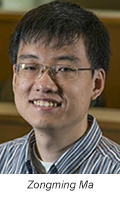 Zongming Ma, assistant professor in the department of statistics at the Wharton School, conducts research on statistical analysis of high-dimensional and massive datasets, such as those arising from neuroscience and social networks. His research focuses on the core statistical problems that are common to these and other related application areas. By building the mathematical foundation for these problems, his goal is to gain sufficient theoretical insights to design practical algorithms for better data analysis.
 Golnaz Vahedi, assistant professor of genetics and a member of the Institute for Immunology at the Perelman School of Medicine, studies the biological circuits that underlie cellular processes in immune cells to uncover the molecular basis of major inherited diseases. Her lab works with vast quantities of rich, high-dimensional data that capture system-wide properties at molecular and cellular resolution in immune cells. A major focus of the Vahedi lab is to deconstruct gene-environment interactions in complex diseases, such as autoimmune disorders, by generating the epigenomic maps of immune cells and developing computational methods to integrate these maps with human genetics.